Analytic Hierarchy Process for Design Selection of
Laminated Bamboo Chair
V. Laemlaksakul, S. Bangsarantrip
Abstract
—
This paper demonstrates the laminated bamboo chair design selection, the applicability of Analytic Hierachy Process (AHP) in solving such a problem. AHP is a multicriteria decision making (MCDM) approach, which is based on the pair wise comparison of elements of a given set with respect to multiple criteria. Even though there are applications of the AHP to furniture design selection, using the Expert Choice software. We report our findings and our insights, together with the results of a sensitivity analysis.KeyWords
—
analytic hierarchy process (AHP), multicriteria decision making (MCDM), laminated bamboo chair, expert choiceI. INTRODUCTION
Product innovation is a key factor of enterprise innovation, and creative design is the core of product innovation. The application of new materials is mainly dependent on the properties of the specific materials. In furniture, engineered wood products, bamboo can easily be production.
Bamboos possess several types of advantages including rapid growth rate, low cost and offering friendly environment. The plants are botanically considered as a special group in grass family which can be planted easily into any kind of land. They are also excellent for rejuvenating degraded areas and typically could grow much faster than other common trees as their daily growth rate is merely 80–300 mm 2 .
The Analytic Hierarchy Process (AHP) developed by Saaty [1], has been studied extensively and used in almost all the applications related with multiple criteria decision making (MCDM) in the last 20 years. It is concerned with a model that reflects the decision problem’s major components (such as decision criteria) and their interconnections (such as comparisons with each other). It functions via breaking the problem into several subcategories and blending the results
Manuscript received December 30, 2007. This research was a part of a research project titled “Design of laminated bamboo furniture by using ergonomics method” supported by King Mongkut’s University of Technology North Bangkok, Thailand (the fiscal year 2007) under code: 5003110525033.
V. Laemlaksakul is an Associate Professor with the Department of Industrial Engineering Technology, King Mongkut’s University of Technology North Bangkok, Bangsue, Bangkok 10800 Thailand (corresponding author phone: +6629132500; fax: +6625874356; email: vcl@ kmitnb.ac.th).
S. Bangsarantrip is a lecturer with the Department of Industrial
throughout the world, the process relies on focusing on the goal of the problem and having adequate knowledge in each of and solutions of those subcategories in a very systematic manner. Used in numerous applications of decision making the categories. It operates as a complete model, signifying the relations of importance, dominance, and preference among the aspects of the problem.
Many AHP applications in realworld decisionmaking have been reported [28]. The AHP was adopted in education, engineering, government, industry, management, manufacturing, personal, political, social, and sports [9]. The wide applicability is due to its simplicity, ease of use, and great flexibility. It can be integrated with other techniques, for instance, mathematical programming in order to consider not only both qualitative and quantitative factors, but also some realworld resource limitations.
In this paper describe a study which provides guidance in selection of the “best” laminated bamboo furniture through the AHP.
II. METHODOLOGY
A. Criteria
AHP can pairwise compare a set of attributes and distinguish in general the more important factors from the less important factors [1011]. The pairwise comparison judgments were made with respect to the attributes of one level of hierarchy given the attribute of the next higher level of hierarchy (from the main criteria to the subcriteria). AHP is also able to solicit consistent subjective expert judgment via the consistency test. The stage AHP set out by Saaty[1].
B. Scale ranging
The relative importance of the criteria and subcriteria were rated by the ninepoint scale proposed by Saaty [1], as shown in Table 1, which indicated that the level of relative importance from equal, moderate, strong, very strong, to extreme level by 1, 3, 5, 7, and 9, respectively. The intermediate values between two adjacent arguments are represented by 2, 4, 6, and 8.
C. SubErgonomics
The subcriteria for subergonomics evaluation are followed by the 6 fundamentals of seating as; lumbar support, backrest angle seat height, width/depth, armrest and seat angle.
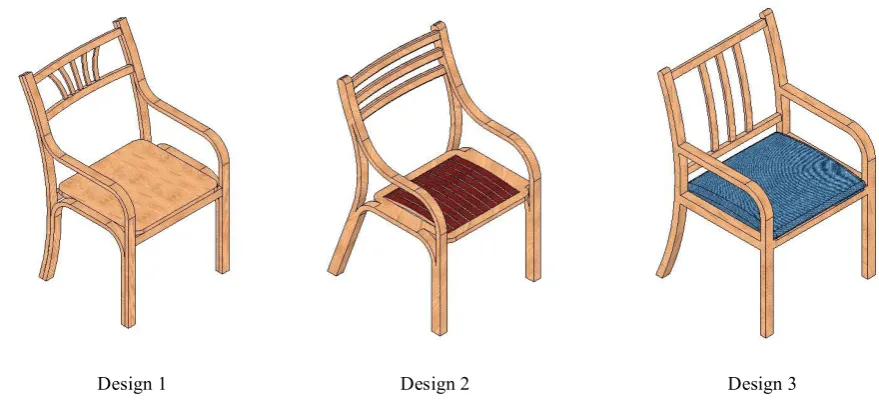
[image:2.595.306.542.109.295.2]The prototypes of laminated bamboo chair were designed based on the design criteria.
Table 1
The AHP pairwise comparison scale [1] Given values
(19)
Explanation
1 Equal Both alternatives have equal importance. 3 Moderate One of the alternatives is slightly more
important than the other.
5 Strong One of the alternatives is judged as strongly more important than the other by experts.
7 Very Strong One of the alternatives is judged as very strongly important compared to the other.
9 Extreme Importance
One alternative is strictly superior to the other one.
2, 4, 6, 8 Intermediate values
[image:2.595.66.537.326.444.2]Used for compromised judgments when necessary.
Fig. 1. The decision hierarchy for selecting laminated bamboo chairs
[image:2.595.74.514.498.699.2]Design 1 Design 2 Design 3
Fig. 2. The selected designs for laminated bamboo chair GOAL
Function Material Construction Process Economy Ergonomic
SubErgonomics
Design 1 Design 2 Design 3
D. Data Collection
A questionnaire was designed for data collection, and the format was synthesized with reference to AHP matrix. Since the assignment of the weight requires logical and analytical thinking, only the relevant experts or professionals providing penetrating insights were highly valuable to an empirical inquiry. In order to select the suitable respondents, a question on the preceding (general) survey asked the respondents if they were experienced in furniture design and development. A total of 7 experienced respondents in the general survey replied and expressed their interest in conducting the AHP questionnaire.
E. Analysis
To analyses the survey findings, the judgment matrices were pairwise compared and computed via the use of commercial software packages (ExpertChoice TM ). The local priority weights of all main criteria and subcriteria were first calculated, and then combined with all successive hierarchical levels in each matrix to obtain a global priority vector.
III. RESULTS
In our study, 7 returned questionnaires were received for the AHP survey. By evaluating the consistency level of the collected questionnaires, questionnaires appeared to have acceptable consistency (Table 2) and would enter into analysis. This AHP survey further confirms the significance of
all crucial selection criteria by the experts who have a high level of experience in furniture industry. Findings relating to relative importance of selection criteria and subcriteria are summarized below: From Table 2, the total weight for furniture design 1 is highest relating to 5 fundamentals of seating. Normally, one of the most concerned factors for chair design is ergonomics and the purpose of chair design is to comfort users when sitting. By this reason, if ergonomics criteria are best concerned, furniture design 1 would be the most appropriate for this analysis.
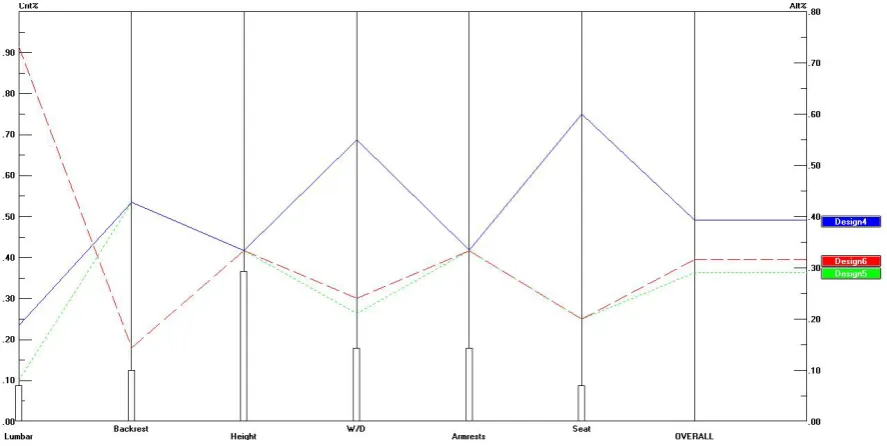
However, if an ergonomics criterion is solely considered, it lacks of reasonable for applications because there are some important criteria omitted such as function, material, construction, aesthetic, process and economy. The Figure 3 shows that furniture design 1 is accorded to all criteria except aesthetic and economy. Furniture design 2 is the best appropriate for aesthetic and furniture design 3 is the best appropriate for economy. From Table 3 and Figure 4, Design 1 was most appropriate followed by all subcriteria. It is concluded that furniture design 1 is the best choice for further analysis.
[image:3.595.46.553.470.529.2] [image:3.595.45.550.580.648.2]After selecting the appropriate furniture design by AHP, the consistency ratio for main criteria and subcriteria were calculated as shown in Table 4 and 5 respectively. It is clearly that all consistency ratios are less than 0.1 (or 10%). It can be said that the furniture design selecting by AHP is significantly reasonable. Table 2 Weight for main criteria analysis. Design No. Function 0.248 Material 0.024 Construction 0.417 Ergonomics 0.129 Process 0.030 Economy 0.055 Aesthetic 0.096 Total 1 0.203 0.014 0.290 0.053 0.020 0.007 0.013 0.600 2 0.023 0.002 0.031 0.037 0.008 0.005 0.074 0.180 3 0.023 0.009 0.096 0.039 0.002 0.042 0.008 0.219
Table 3 Ergonomics weight for subcriteria analysis. Design No. Lumbar Support 0.011 Backrest Angle 0.016 Seat Height 0.047 Width/Depth 0.023 Armrest 0.023 Seat Angle 0.011 Total
1 0.003 0.007 0.016 0.017 0.008 0.004 0.053 2 0.001 0.007 0.016 0.002 0.008 0.004 0.037 3 0.008 0.002 0.016 0.003 0.008 0.004 0.039
Table 4
Inconsistency ratio for main criteria.
Main Criteria
[image:3.595.49.549.696.732.2]Table 5
Inconsistency ratio for subcriteria
Sub Criteria Lumbar
Support
Backrest Angle
Seat Height Width/Depth Armrest Seat Angle Inconsistency Ratio 0.09 0.00 0.00 0.02 0.00 0.00
Fig. 3. Performance sensitivity graph for 7 criteria.
[image:4.595.76.520.482.705.2]IV. CONCLUSIONS
From this research, Analytic Hierarchy Process (AHP) was applied to select the appropriate laminated bamboo chair. Furniture design 1 was most appropriate followed by all criteria, especially ergonomics criterion. However, furniture design 1 needs to be improved in term of economy criterion.
This research was limited only dining chair. The developed AHP guideline can well apply for other styles of furniture design beyond laminated bamboo but concerning on ergonomics criterion.
ACKNOWLEDGMENT
Authors thank the College of Industrial Technology, King Mongkut’s University of Technology North Bangkok, Thailand for supporting the experimental equipments to conduct this research.
REFERENCES
[1] T. L. Saaty, The analytic hierarchy process. New York: McGrawHill, 1980.
[2] F. Zahedi, “The analytic hierarchy process – A survey of the method and its applications,” Interfaces, 16 (4), 1986, pp. 96–108.
[3] B. L. Golden, E. A. Wasil, P. T. Harker, (Eds.), The analytic hierarchy process: applications and studies. New York: SpringerVerlag, 1989. [4] J, P. Shim, “Bibliography research on the analytic hierarchy process
(AHP),” SocioEconomic Planning Sciences 23 (3), 1989, pp. 161–167. [5] L. G. Vargas, “An overview of the analytic hierarchy process and its
applications,” European Journal of Operational Research, 48 (1), 1990, pp. 2–8.
[6] T. L. Saaty, Fundamentals of the analytic hierarchy process. Pittsburgh : RWS Publications, 2000.
[7] E. Forman, S. I. Gass, “The analytic hierarchy process: an exposition,” Operations Research, 49 (4), 2001, pp. 469–486.
[8] B. Golden, E. A. Wasil, “Celebrating 25 years of AHP based decision making,” Computers and Operations Research, 30 (10), 2003, pp. 1419– 1497.
[9] O. S. Vaidya, S. Kumar, “Analytic hierarchy process: an overview of applications,” European Journal of Operational Research, 169 (1), 2006, pp. 1–29.
[10] E. W. L. Cheng, H. Li. “Construction partnering process and associated critical success factors: quantitative investigation,” Journal of Management in Engineering, 2002, pp. 194–202.