warwick.ac.uk/lib-publications
Original citation:
Wonnacott, Elizabeth, Brown, Helen and Nation, Kate. (2017) Skewing the evidence : the
effect of input structure on child and adult learning of lexically based patterns in an artificial
language. Journal of Memory and Language, 95 . pp. 36-48.
Permanent WRAP URL:
http://wrap.warwick.ac.uk/86223
Copyright and reuse:
The Warwick Research Archive Portal (WRAP) makes this work of researchers of the
University of Warwick available open access under the following conditions.
This article is made available under the Creative Commons Attribution 4.0 International
license (CC BY 4.0) and may be reused according to the conditions of the license. For more
details see:
http://creativecommons.org/licenses/by/4.0/
A note on versions:
The version presented in WRAP is the published version, or, version of record, and may be
cited as it appears here.
Skewing the evidence: The effect of input structure on child and adult
learning of lexically based patterns in an artificial language
Elizabeth Wonnacott
a,⇑, Helen Brown
b, Kate Nation
c aDivision of Psychology and Language Sciences, University College London, UK b
Department of Psychology, University of Warwick, UK c
Department of Experimental Psychology, University of Oxford, UK
a r t i c l e i n f o
Article history:
Received 23 September 2016 revision received 18 January 2017
Keywords:
Language acquisition Statistical learning Overgeneralization
a b s t r a c t
Successful language acquisition requires both generalization and lexically based learning. Previous research suggests that this is achieved, at least in part, by tracking distributional statistics at and above the level of lexical items. We explored this learning using a semi-artificial language learning paradigm with 6-year-olds and adults, looking at learning of co-occurrence relationships between (meaningless) particles and English nouns. Both age groups showed stronger lexical learning (and less generalization) given ‘‘skewed” languages where a majority particle co-occurred with most nouns. In addition, adults, but not children, were affected by overall lexicality, showing weaker lexical learning (more generaliza-tion) when some input nouns were seen to alternate (i.e. occur with both particles). The results suggest that restricting generalization is affected by distributional statistics above the level of words/bigrams. Findings are discussed within the framework offered by models capturing generalization as rational inference, namely hierarchical-Bayesian and simplicity-based models.
Ó2017 The Authors. Published by Elsevier Inc. This is an open access article under the CC BY license (http:// creativecommons.org/licenses/by/4.0/).
Introduction
A classic problem for theories of language acquisition is how learners avoid overgeneralization in the face of an ability to gener-alize. An example is our knowledge of restrictions on novel combi-nations of verbs and argument structures, as in the use of ‘‘carry” in the double-object dative e.g.,⁄‘‘Carry me that”.Children go through a stage of producing overgeneralizations, yet eventually learn that certain combinations of verbs and structures are restricted. This ‘‘paradox” (Baker, 1979) has received a good deal of attention in the literature. Broadly, two different classes of solution have been proposed, one emphasizing increasing knowledge of the semantics of words and constructions (e.g.,Pinker, 1989) which eventually provide constraints that block overgeneralizations, and one emphasizing the use of distributional statistics to make inferences about which generalizations are permissible (e.g.,Braine, 1971). There is a growing body of evidence suggesting that generalization is constrained by both types of information and that grammatical learning can be characterized as graded rather than absolute (e.g.,Ambridge, Pine, Rowland, Freudenthal, & Chang, 2014). This is consistent with the notion that children acquire probabilistic
constraints from input distributions (e.g., Hsu & Chater, 2010; Matthews & Bannard, 2010; Perfors & Wonnacott, 2011; Wonnacott, 2011; Wonnacott, Boyd, Thomson, & Goldberg, 2012). To inform theory, it is important for experimental work to iden-tify what types of distributional information influence learning and generalization and under which conditions. Here we assess children and adults’ sensitivity to a particular distributional prop-erty which we term skew. Specifically, we ask whether it is easier to learn arbitrary, lexically based restrictions when structures are not evenly distributed across lexical items (i.e., more words occur with one structure than the other). We also probe the finding from earlier work (Wonnacott, 2011; Wonnacott, Newport, & Tanenhaus, 2008) that it is easier to learn lexical restrictions given broader experience of lexical restrictions within the language.
Artificial language learning provides an ideal tool for exploring learners’ sensitivity to different input statistics in isolation of other cues (e.g., semantic, phonological).Wonnacott et al. (2008)took this approach in a series of experiments with adult learners. The input languages incorporated two competing transitive structures and were constructed so that some verbs alternated between structures, but others occurred in just one structure (an arbitrary restriction, since the constructions were synonymous and there were no semantic or phonological cues to verb distribution). Differ-ent input sets were used in differDiffer-ent learning conditions such that the distributional relationship between verbs and structures was
http://dx.doi.org/10.1016/j.jml.2017.01.005
0749-596X/Ó2017 The Authors. Published by Elsevier Inc.
This is an open access article under the CC BY license (http://creativecommons.org/licenses/by/4.0/). ⇑Corresponding author at: Division of Psychology and Language Sciences UCL,
University College London, 2 Wakefield Street, London WC1N 1PF, UK. E-mail address:[email protected](E. Wonnacott).
Contents lists available atScienceDirect
Journal of Memory and Language
manipulated. Participants were given production and judgment tests after exposure to one of these input sets, and generalization was deemed to have occurred when they produced, or accepted as grammatical, an unattested verb-structure combination. Gener-alization was found to be affected by the distributional statistics of the learner’s input. One factor was verb frequency: verbs fre-quently encountered in one structure were less likely to be gener-alized to the other. Importantly, however, participants’ learning of verb-structure pairings was affected not only by the frequency of those pairings but also by their more general experience of the lan-guage being learned. The likelihood of generalization was influ-enced by the learners’ broader experience of alternation across the input: verbs which had only occurred in one construction were more likely to be generalized to the alternate construction if the learner had experienced more alternating verbs in the input.
Wonnacott (2011)used an adapted learning paradigm to repli-cate aspects of these findings with 6-year-old children. There are relatively few artificial language learning experiments with children beyond infancy (e.g.,Brooks, Braine, Catalano, Brody, & Sudhalter, 1993; Hudson Kam & Newport, 2005, 2009; Wonnacott, 2011; Wonnacott et al., 2012). Those that have been conducted indicate that children’s learning is substantially slower than that of adults. For example,Wonnacott et al. (2012)found that after three days of training on a single novel verb-argument construction, children produced the structure with correct linking of word order to the-matic roles on only 57% of trials, while adults were at ceiling.
The observation that children’s learning is slower than adults has implications for experimental design. Unfortunately however, it is not straightforward to simply add additional exposures to compen-sate for the slower rate of learning. Children can only tolerate short experimental sessions, and schools cannot generally accommodate additional sessions to mitigate this. It is thus necessary to design artificial languages where the ‘‘baseline” structures can be acquired relatively quickly. Given these constraints, in order to be able to directly focus on the balance between generalization and lexically specific constraints given relatively little exposure, Wonnacott (2011)used a learning paradigm where the critical relationships were between nouns and meaningless words referred to as ‘‘parti-cles”, rather than verbs and verb constructions. To facilitate learn-ing, the languages used novel particles but familiar English nouns. This simpler paradigm allowed the same types of statistical manip-ulations as inWonnacott et al. (2008)to be explored, with languages containing both alternating nouns (i.e., nouns which occurred with both particles) and nouns restricted to occur with just one particle. A production test was used to probe generalization.
In line with the previous effects of verb frequency in adults, noun frequency played a role, with more generalization to the non-occurring particle for low frequency nouns. Again, however, generalization was also affected by learners’ more general experi-ence of the language being learned. Most relevant to the current work, Experiment 1 compared the learning of minimal-exposure items in different language contexts. Each of the two minimal-exposure itemsoccurred only with one of the two particles, and both were low frequency (presented four times each). The question was whether learners would restrict their usage of minimal-exposure itemsto the particle with which it had occurred in the four exposures, or generalize and extend it to the other particle. From the perspective of individual lexical frequency, four exposures is a very small sample and learners might therefore be expected to ignore this item-specific input and generalize. Importantly, how-ever, these items were introduced later in the experiment,after the participants had been exposed to language input containing other nouns. How these minimal-exposure items were treated depended critically upon the input to which the children had been previously exposed. Those previously exposed to an input language where each noun occurred with just one of the two particles
(dubbed thelexicalistlanguage) were more likely to avoid general-izing with theminimal-exposure nouns, treating them as restricted to occur with the one particle with which they were attested. In contrast, learners who had been exposed to a language where all verbs alternated (dubbed the generalist language) treated minimal-exposure nounsas alternating. Thus children’s learning of the restrictions on particular nouns appeared to be affected by their more general learning of how nouns tended to behave across the whole language.
An additional factor explored in the same experiment, and using the same input languages, was whether children could pick up on the statistical prevalence of the particles in the language overall. To this end, in both languages there was a 3:1 bias for one particle, achieved in the lexicalistlanguage by having three nouns occur with particle1, and one noun with particle2, and in the generalistlanguage by having the 4 alternating nouns each have a bias to occur three times more often with particle1. Testing with entirely novel nouns revealed that children exposed to both lexicalistandgeneralistlanguages had learned the particle1 bias – i.e., they were more likely to generalize that particle. In addition, children in thegeneralistcondition were more likely to overgener-alize particle1 with theminimal-exposure nouns.
Perfors, Tenenbaum and Wonnacott (2010; Wonnacott & Perfors, 2009)demonstrated that this pattern of learning is in line with the predictions of a hierarchical Bayesian model. This domain general model was originally developed by Kemp, Perfors, and Tenenbaum (2007), who applied it to a set of cognitive learning problems (e.g., acquisition of the ‘‘shape bias” in word learning). It is characterized by an ability to track statistical distributions at multiple levels of abstraction (in our work, the distribution of par-ticles used with particular nouns and the language-wide distribu-tion of particles), and to make inferences about the extent to which these levels provide a good indicator of future behavior. This is achieved via the formation of ‘‘overhypotheses” about a particu-lar dataset. For example, when trained on thelexicalistlanguage, the model formed an ‘‘overhypothesis” to the effect that the usage of particles was highly consistent for particular nouns, whereas when trained on the generalistlanguage it formed the ‘‘overhy-pothesis” that noun identity and particle usage were unrelated. These ‘‘overhypotheses” led to the model showing the same differ-ence in the learning ofminimal-exposure itemsas human learners, i.e., greater learning of the associations between these items and their attested particles in the lexicalist than generalistlanguage. The model also mimicked human performance in showing greater generalization with the more frequent of the two particles/struc-tures, both with novel items and with theminimal-exposure items in thegeneralistlanguage. This is due to the fact that it tracked their distribution across the whole language.
The effect of this latter type of skew on the learning of lexical pat-terns has not been investigated. Intuitively however, it might be easier to learn that particular words are associated with particular structures when there is a majority structure which can act as a ‘‘de-fault”: once the default has been acquired, associations need only be learned for exception items, whereas if there is no default (for exam-ple, if there are two structures which are used equally often) sepa-rate associations must be learned for each lexical item. If so, returning to theWonnacott (2011)languages, it should be harder to learn the association between nouns and particles in a version of thelexicalistlanguage without skew. If exposure toskewedinput aids more general learning about the lexical nature of the language, then we would also expect better learning and less overgeneraliza-tion withminimal-exposure nounsafterskewedthanunskewedinput. Moreover, although thegeneralistandlexicalistconditions used by
Wonnacott (2011) both exhibited equivalent skew of particles across the language, meaning that the greater learning with minimal-exposure verbs could not be due to overall skew per se, the presence of skew in thelexicalistlanguage could potentially be a necessary condition to drive learning of the higher order general-ization about the lexical nature of the language. To explore this, it is necessary to compare the learning of lexical constraints in an entirely lexical butunskewedlanguage, compared to one with alter-nation. Experiment 1 examined the role of skew in an artificial lan-guage learning experiment with 6 year olds and we asked whether adults showed similar patterns of learning in Experiment 2.
Experiment 1
We addressed two central questions. First, does skew aid learn-ing of lexical restrictions? To explore this, two groups of 6-year olds were exposed to languages based on those constructed by
Wonnacott (2011). Specifically: (i)lexicalist-skewedlanguage, com-prising five particle1-only nouns and one particle2-only noun; (ii) lexicalist-unskewed language, comprising three particle1-only nouns and three particle2-only nouns. These languages were both fully lexical (no alternating nouns) but if children benefit from skewed input they should show better learning of noun-particle associations in the lexicalist-skewed language (i.e. better learning where there is a majority default particle, used for most nouns, along with an exception form, than when each particle occurs with an equal number of nouns).
We tested learning using two different test types. First, in the input nounstest we asked children to produce their own sentences with the trained nouns, i.e. with the nouns which had occurred in the exposure set. If skew plays a role, we predict stronger learning of the restrictions on these nouns (i.e. greater usage of the correct particle rather than the incorrect particle) for children learning the lexicalist-skewed language compared with thelexicalist-unskewed language. Second, followingWonnacott (2011), we also asked chil-dren to produce sentences with two ‘‘minimal-exposure” nouns that were introduced in an additional exposure session occurring onlyafterexposure to the main language input. In the additional exposure session, which was identical across conditions, each minimal-exposure noun occurred just four times, with one of the minimal-exposure nouns always occurring with particle1, and the other always occurring with particle2. Children were then asked to use these two nouns in their own sentences, and we looked to see whether they continued to use them with the attested particle. This test allowed us to see whether exposure to skewed input was sufficiently general to aid ongoing learning of lexical restrictions. We predicted stronger learning of the restric-tions on the minimal-exposure nouns (i.e. continuing to use them with the particle with which they occurred in the four exposures, rather than generalizing to the unattested particle) for participants
previously exposed to the lexicalist-skewed input than for those who were exposed to thelexicalist-unskewedinput. Note that min-imal exposure items are more appropriate than entirely novel nouns since they allow us to look at how learners balance general-ization against some minimal lexically based information.
Our second question was whether there is a benefit of overall lexicality, even in the absence of skew. To explore this, two further groups of 6 year olds were trained and tested on languages to be compared with the lexicalist-unskewed language, specifically: (i) mixed language, comprising one particle1-only noun, one particle2-only noun and four (unbiased) alternating nouns and (ii)generalist-unskewedlanguage, comprising six (unbiased) alter-nating nouns. Neither of these languages contained skew, but if overall lexicality aids learning, children should find it easier to learn restrictions on nouns in the lexicalist-unskewed language, than in either of these two languages where nouns can alternate. Again, learning was probed with two types of test items. First, in theinput nounstest, children produced sentences with nouns from the exposure set. Note that here, since only non-alternating nouns are relevant (because we are specifically interested in learning of the restrictions), and since there are no non-alternating nouns in thegeneralist-unskewedcondition, only thelexicalist-unskewed lan-guage andmixed language are compared, with greater learning predicted in thelexicalist-unskewed language. Second, there was theminimal-exposure nounstest, where participants produced sen-tences with the two nouns which had been presented just four times (asparticle1-onlyandparticle2-only) in an additional expo-sure session. If lexicality plays a role, we predict stronger learning of the restrictions on the newminimal-exposurenouns for learners who were previously exposed to thelexicalist-unskewedlanguage than those who were exposed to either thegeneralist-unskewed ormixedlanguages. Full details of the languages and test items are described inTable 2.
We also determined whether children had any explicit aware-ness of their learning of lexicality via a post-experiment interview. The relationship between implicit and explicit learning in artificial language learning experiments within the statistical learning liter-ature is not well understood, although there seems to be an assumption that it is largely implicit, at least in children. Collecting subjective data is a first step towards exploring this issue.
Method
Participants
Data were collected from sixty 6-year-old children. Participants were monolingual native English speakers with no known hearing, language, or speech disorders. Two of the original 60 children were replaced as they failed to contribute any data which met baseline performance (see Results). Each child was randomly assigned to one of four conditions (seeTable 1). Since our contrasts compare thelexicalist-unskewedcondition against each of the other condi-tions, we used t-tests to compare the mean age and listening span of this group against those of each of the other groups - no signif-icant differences were found (allps > .2).1 Informed consent was
1
obtained from both schools and parents prior to the start of the experiment.
Stimuli
Stimuli were sentences that began with the word moop, fol-lowed by one of 16 English nouns with familiar referents (bee, camel, donkey, duck, frog, giraffe, hippo, kangaroo, monkey, owl, par-rot, penguin, pig, rabbit, tiger, zebra) and one of two sentence-final novel particles (dow, tay). Sentences took the form ‘‘moop noun dow/tay”, wheremoopwas intended to mean ‘‘there are two” (fol-lowingWonnacott (2011), and chosen since plurality is a salient property and simple to depict). Stimuli were recorded by a female native British English speaker. Words were edited into separate sound files and peak amplitude was normalized using Audacity (http://audacity.sourceforge.net/). Clipart pictures of the 16 noun referents were selected from free online databases and were edited to generate pictures that showed pairs of items (e.g., two tigers, two penguins,etc.).
[image:5.595.42.565.85.148.2]The structure of the four input languages is summarized in
Table 2. Four of the sixinput nouns(labeled as input nouns 1–4 inTable 2) featured in theinput nounstest,a production test which immediately followed input training (note: twoinput nounswere not tested – this was to provide children with the opportunity to produce multiple sentences with the same nouns yet avoid over-lengthy testing). This test was identical across conditions, although the children’s experience with the nouns, and whether they had been restricted or alternating, differed across conditions. Only data from nouns that had been particle1-only and particle2-only were analyzed, meaning that there were different numbers of test items across conditions, and no data at all in thegeneralist-unskewed con-dition (the test was included for consistency across concon-ditions). However a second test was also included where data from all con-ditions were analyzed. This was theminimal-exposure nounstest. This test featured two new nouns which were presented to the learner in a short exposure session (minimal-exposure training) administered immediately before the test. Importantly, this expo-sure was identical across the conditions and comprised one noun that occurred four times with particle1, and a second that occurred four times with particle2. Thus the minimal-exposure nounstest explored whether learning of the restrictions on new low
fre-quency particle1-only/particle2-only nouns differed for learners previously exposed to different input languages.
The sixinputand twominimal-exposure nounswere randomly selected for each participant from the set of 16 possible nouns to avoid the possibility of item-based effects. Assignment todow ver-sustayas the minority or majority particle was counterbalanced in thelexicalist-skewedcondition.
Procedure
Children were tested individually in a quiet area of their school. Tasks were run on a Toshiba laptop using ExBuilder software, a custom built software package developed at the University of Rochester. Each child completed three experimental sessions, the majority on three consecutive days though 11 children (3lexicalist-skewed, 4lexicalist-unskewed, 3mixed, 1generalist-unskewed) completed the three sessions over four or five days due to absence from school on one or more days.
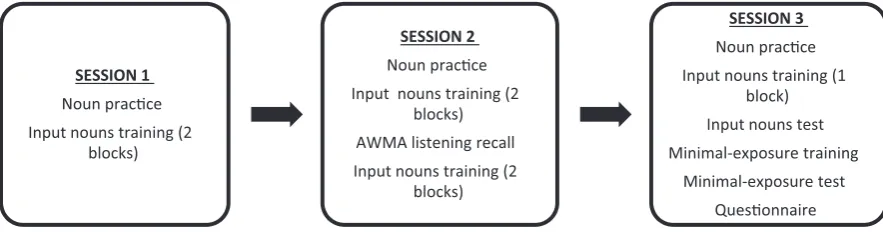
Fig. 1summarizes the tasks and testing schedule. Children were introduced to a toy elephant at the beginning of Session 1, and told were told that they were going to learn how to say some things like ‘‘Ellie Elephant”.
Noun practice. In Session 1 children completed two noun practice tasks. First, they viewed a picture (e.g., one tiger) while hearing its English name (‘‘tiger”) and repeated the name aloud. Second, they viewed the same pictures and were asked to produce the cor-responding names on their own. This second task was repeated at the beginning of Sessions 2 and 3 to ensure that the children labeled the pictures correctly. When incorrect labels were provided the participant was told ‘‘This one is called a tiger. Can you say tiger?”. Trial order was randomized on a child-by-child basis.
Input nouns training. Children heard 12 sentences per block of training, with each of the six nouns being heard twice per block. On each trial the child saw a picture (e.g., two tigers), heard a sen-tence (e.g.,moop tiger dow) and repeated the sentence aloud. If any element of the sentence was mispronounced the experimenter said ‘‘Almost, this one was ‘moop tiger dow’. Can you say that?”.If a sen-tence was mispronounced a second time no feedback was provided and the next trial initiated. Trial order was randomized on a
child-Table 1
Mean (SD) age and listening span standard score of children in Experiment 1 as a function of input condition. Standard score populationM= 100,SD= 15.
Input condition Ntotal Nmale Age Listening spana
Counterbalancing
Lexicalist-skewed 15 12 6; 3 (0; 4) 109 (10) 8 maj. =dow
7 maj. =tay
Lexicalist-unskewed 15 9 6; 2 (0; 5) 107 (20) NA
Mixed 15 8 6; 0 (0; 6) 102 (15) NA
Generalist-unskewed 15 7 6; 2 (0; 4) 107 (21) NA
a
[image:5.595.46.562.201.302.2]Automated Working Memory Assessment (Alloway, 2008).
Table 2
Noun types included in input and tests.
Training/Test Lexicalist-skewed
Lexicalist-unskewed
Mixed Generalist-unskewed version1 (n= 7) version2 (n= 8)
Input noun 1 Input training and input test tay-only dow-only dow-only dow-only Alternating
Input noun 2 Input training and input test dow-only tay-only tay-only tay-only Alternating
Input noun 3 Input training and input test dow-only tay-only dow-only Alternating Alternating
Input noun 4 Input training and input test dow-only tay-only tay-only Alternating Alternating
Input noun 5 Input training dow-only tay-only dow-only Alternating Alternating
Input noun 6 Input training dow-only tay-only tay-only Alternating Alternating
by-child basis such that the same animal was not presented twice in a row.
Input nouns test. Children saw a picture (e.g., two tigers), heard the first word of the sentence (‘‘moop”), and were asked to complete the rest of the sentence on their own. If the noun was produced incorrectly they were given corrective feedback (‘‘Good try, but this one is a tiger, not a lion”) and asked to say the sentence again using the correct noun. These trials were not included in the analyses. No corrective feedback was provided regarding the usage of sentence-final particles. In order to keep the test of reasonable length, only nouns 1–4 from the input training task (seeTable 2) were encoun-tered at test with each presented four times. Trial order was ran-domized on a child-by-child basis such that the same animal was not presented twice in a row.
Minimal-exposure nouns training. Two further nouns that had not featured in the input nouns training were encountered during the minimal-exposure nouns training. One always occurred with dowand one withtay.As in the input nouns training task, children saw a picture of the noun, heard ‘‘moop noun dow/tay”, and repeated the sentence aloud. Each minimal-exposure noun was encountered four times with feedback provided where necessary, as per the input nouns training task. Trial order was randomized for each child with no constraints (since there were only two ani-mals a fully random order was preferable to one in which the two sentences alternated).
Minimal-exposure nouns test. This was identical to theinput nouns test, with pictures of the twominimal-exposure nouns being pre-sented and children required to complete the sentence (given the initial word ‘‘moop”). Each noun was tested during the first or sec-ond trial, then three repetitions of the two nouns occurred in a ran-dom order. There were four trials per noun.
Questionnaire. At the end of the final session the experimenter interviewed each child to ascertain any patterns that they had noticed in the experimental language. We asked them to describe how they knew when to use dow/tay, and if they noticed any pat-terns in the way Ellie Elephant used them. Of interest was whether children showed any awareness of the fact that particle usage could be conditioned on the noun (e.g., ‘‘donkey goes with dow”).
Results
Results from theinput nounsandminimal-exposure nounstests were analyzed separately. We were interested in looking at the learning of the restrictions on non-alternating nouns, therefore for the input nouns test, we only analyzed data for nouns which were restricted in the input, that is, those that were dow-only or tay-only (meaning that for this test, no data were analyzed for
thegeneralist-unskewedcondition). Trials were excluded if children had initially used an incorrect noun and been corrected by the experimenter, if they inserted an alternative word for a particle, or if they failed to include a particle. Children were not penalized for omitting to repeat the initial wordmoop. The proportion of tri-als failing to meet these baseline criteria is reported below. Data were analyzed using both frequentist and Bayesian methods. (Note that further information on excluded data can be viewed online at
http://rpubs.com/ewonnacott/242454; this script includes infor-mation about error trials (the frequency of ‘‘other particle” and ‘‘no particle” trials) and presents the patterns of particle usage for thealternatingnouns along with some basic analyses in terms of regularization – cf. Hudson Kam & Newport, 2005; Samara, Smith, Brown, & Wonnacott, in press).
For frequentist analyses, since the dependent variable was bin-ary (i.e. whether the particle in the response was correct/incorrect) the data were analyzed using logistic mixed effects models (Baayen, Davidson, & Bates, 2008; Jaeger, 2008; Quené & Van den Bergh, 2008) in the package lme4 (Bates, Maechler, Bolker, & Walker, 2013) for the R computing environment (R Core Team, 2012). These models allow binary data to be analyzed with logistic models rather than proportions, as recommended byJaeger (2008). For each of our analyses, the dependent variable was whether the correct (i.e. attested) particle was produced (coded as 1 vs. 0). The independent variable wasconditionwhich had either three levels (input nouns analyses: lexicalist-skewed, lexicalist-unskewed and mixed) or four levels (minimal-exposure nouns analyses: lexicalist-skewed, lexicalist-unskewed mixed and generalist-unskewed). In each case,lexicalist-unskewedwas the reference level so that we could inspect the contrast between this condition and the other conditions. This was achieved within the lme4 package by replacing the three-way (or four-way) factor ‘‘condition” with two (or three) centered dummy variables and using the main fixed effects from the output of this model. We used this technique throughout. We also included whether the correct particle for the trial wasdowortayas a control variable, as well as the interaction of this with condition. There was no effect of these control factors in any of the models, therefore although they were retained in the model they are not reported. All variables were coded as centered, numerical predictors so that effects in the model could be evalu-ated as the average effects over levels of the other predictors. To avoid anti-conservative conclusions (Barr, Levy, Scheepers, & Tily, 2013), we specified a full random effects structure in our models, including intercepts for subjects and by-subject random slopes for all within-subject factors and their interactions. All models con-verged with Bound Optimization by Quadratic Approximation (BOBYQA optimization;Powell, 2009).
For Bayesian Analyses, we computed Bayes factors using the method advocated byDienes (2008, 2015). This requires an esti-mate of the predicted mean difference between conditions accord-ing to H1. Recall that our key aim is to de-confound the benefit that
SESSION 1
Noun pracce
Input nouns training (2
blocks)
SESSION 2
Noun pracce
Input nouns training (2
blocks)
AWMA listening recall
Input nouns training (2
blocks)
SESSION 3
Noun pracce
Input nouns training (1
block)
Input nouns test
Minimal-exposure training
[image:6.595.70.512.67.183.2]Minimal-exposure test
Quesonnaire
Wonnacott (2011)saw for the learning of lexically restricted nouns after exposure to thelexicalistlanguage compared to thegeneralist language: was this due to the lexical nature of the input, and/or did skew play a key role? We address this by contrasting an unskewed version of the lexicalist language (lexicalist-unskewed) with matched languages where lexicality and skew are manipulated separately. Wherever we contrast ourlexicalist-unskewedcondition with each of the other conditions, we inform our H1 by the differ-ence between thelexicalistandgeneralistconditions for minimal-exposure nouns inWonnacott (2011). In that experiment, partici-pants produced the correct particle for minimal-exposure nouns 86% of the time in thelexicalistcondition and 66% of the time in the generalistcondition. However, so as to meet assumptions of normality, we work in log-odds space. To obtain the estimate of predicted difference, we ran a logistic mixed effects model equiva-lent to those reported in the current paper, over the relevant data fromWonnacott (2011). The estimate obtained was 2.758. Follow-ingDienes (2008)we model H1 by using this estimate as theSDof a half normal distribution.
For each of the comparisons between conditions, we used Bayes factors (BF) to test the strength of evidence for this model com-pared with a null hypothesis of no difference between conditions. Our sample estimate is the estimate produced for the coefficient from the relevant lme model used in the frequentist analyses described above. FollowingDienes (2008), a BF of 3 or above is taken to indicate substantial evidence for the alternative rather than the null hypothesis, while a BF of 1/3 or below is taken to indicate substantial evidence for the null rather than alternative hypothesis. Thus, a BF between 3 and 1/3 indicates data insensitiv-ity for distinguishing the alternative and null hypotheses (see
Dienes, 2008, 2014). Full details of analyses can be found in the R analyses script which is available online at http://rpubs.com/ ewonnacott/242454. Data are also available at https://osf.io/ 2zfe6/.
Input nouns
Data from the lexicalist-skewed, lexicalist-unskewed and mixed conditions were analyzed (recall that there were no non-alternating nouns in thegeneralist-unskewedlanguage). There were more contributing data points per child in thelexicalist-skewedand lexicalist-unskewedconditions than in themixedcondition (since in the latter, two of the nouns being tested were alternating nouns); however logistic linear mixed effects models are robust to prob-lems associated with proportional data from uneven samples. Tri-als not meeting the baseline criteria described above were excluded (lexicalist-skewed: 3%, all majority nouns; lexicalist-unskewed: 5%;mixed: 2%).
The proportion of correct responses in each condition is shown inTable 3. Our first hypothesis was that skew would benefit learn-ing, leading to the prediction that more correct particles would be produced overall in the lexicalist-skewed condition than the lexicalist-unskewedcondition. The data were consistent with this prediction (M skewed= 90% and 99% for the minority and majority
particles respectively; M unskewed= 74%; beta = 3.11, SE = 0.74, z = 4.20, p < .001; BF = 1974.81). Our second hypothesis was that the overall lexicality of the language should lead to more produc-tions with the correct particle in thelexicalist-unskewedthan the mixed condition (recalling that we look only at the two non-alternating nouns in the latter language). In fact, there was evi-dence for no difference (M lexicalist-unskewed =74%; M mixed= 70%; beta = 0.05, SE = 0.58, z = 0.09 p = .93, BF = 0.22. This suggests that skew but not overall lexicality of the language is helpful to children’s learning of the lexical restrictions on these nouns.
Within thelexicalist-skewed language, performance on nouns that occurred with the majority particle was higher than perfor-mance on the minority particle (90% vs. 99%). Although this pattern of results was predicted, given the sensitivity to overall particle frequency found inWonnacott (2011), the difference is not signif-icant here, with the BF comparison telling us that the test is insen-sitive (beta = 1.86, SE = 3.67, z = 0.51 p = .61; BF = 1.07; for this BF comparison we take H1 to be scaled by an estimate of the differ-ence in performance for the majority and minority particle in the lexicalistlanguage in Wonnacott (2011), obtained by running an equivalent logistic mixed effects model on that data). However, the children are near ceiling with the majority particle. Note that for the key comparison between the lexicalist-skewed and lexicalist-unskewed languages, particle frequency cannot lead to overall greater performance in theskewedlanguage since although it aids performance with the majority noun it should equally hin-der performance with the minority noun. Thus if particle frequency were the only factor at play, performance on the minority particle noun in theskewedlanguage should belowerthan performance on the unbiased nouns in theunskewedlanguage, which is not what we see. Nevertheless, a potential concern is that more majority nouns than minority nouns were included. We thus repeated the analysis with just one majority and one minority noun included (achieved by removinginput nouns3 and 4 from theskewed lan-guage condition). Performance in the skewedlanguage remained high (95%, SE = 3%) with evidence for a difference between the skewed and unskewed languages (beta = 3.00, SE = 0.84, z = 3.59, p < .001; BF = 209.11).
Minimal-exposure nouns
Data from all four conditions were analyzed. We again excluded trials not meeting the baseline criteria (lexicalist-skewed: 6%; lexicalist-unskewed:5%;mixed: 5%; generalist-unskewed: 5%). There was no difference in amount of data excluded across conditions (logistic linear mixed effects model, allps > .5).
[image:7.595.41.562.671.751.2]We again explored two predictions. First, if skew helps children learn new restrictions, more correct particles should be produced in thelexicalist-skewedthanlexicalist-unskewedcondition. This pre-diction was confirmed (M skewed= 77% and 92% for the minority and majority particles respectively;M unskewed= 64%; beta = 2.66, SE = 0.93, z = 2.88 p = .004; BF = 26.13) demonstrating that, as for the input nouns, skew helps children to learn lexical restrictions.
Table 3
Mean (SE) proportion of trials where the attested particle was produced as a function of language input condition for input nouns and minimal-exposure nouns in Experiments 1 and 2.
Input condition Experiment 1 (Children) Experiment 2 (Adults)
Input nouns Minimal-exposure nouns Input nouns Minimal-exposure nouns
Lexicalist-skewed
Minority particle 0.90 (0.06) 0.77 (0.11) 0.88 (0.07) 0.93 (0.07)
Majority particle 0.99 (0.01) 0.92 (0.06) 0.94 (0.03) 1.0 (0)
Lexicalist-unskewed 0.74 (0.04) 0.64 (0.08) 0.78 (0.06) 0.89 (0.07)
Mixed 0.70 (0.07) 0.58 (0.07) 0.61 (0.04) 0.84 (0.07)
Second, if the overall lexicality of the language during training assists learning, children should produce more attested particles in the lexicalist-unskewed condition, relative to the mixed and generalist-unskewed conditions. While the means in Table 3 are consistent with this general pattern, the differences between the conditions were not significant with no evidence one way or the other for a difference between performance following exposure to thelexicalist-unskewedlanguage (M= 64%) and either themixed (M =58%; beta = 0.49, SE = 0.82, z = 0.60, p = .55; BF = 0.48) or generalist-unskewed (M= 58%; beta = 0.66, SE = 0.82, z = 0.80 p = .43; BF = 0.60) language.
Again note that, as with the input nouns, accuracy was higher for majority compared to minority particle nouns (92% vs. 77%) though again this test was insensitive (beta = 2.19, SE = 4.72, z = 0.46, p = .64, BF = 1.06; here H1 for the BF analyses was scaled by an estimate of the difference in performance for the majority and minority particle with minimal exposure nouns in thelexicalist andgeneralistlanguages inWonnacott (2011), obtained by running an equivalent logistic mixed effects model on that data). Note again though that even if there is a benefit of frequency for the majority particle, overall greater performance in the lexicalist-skewedlanguage cannot be due to particle frequency, since this would have led to an equivalentdecreasein performance on the minority nouns, which was not seen. Note also that in these anal-yses there were an equal number of minority and majority particle test items.
[image:8.595.29.556.87.152.2]Post-experiment questionnaire data assessing explicit awareness Responses were binary coded to indicate whether the children showed any explicit awareness that particle-usage could be condi-tioned on the noun. To be coded as aware a child had to mention one (or more) of the noun-particle relationships in their input (e.g., ‘‘donkey goes with dow”).
Table 4shows the number of children in each condition who showed some awareness, as well as the mean score on theinput nounsandminimal-exposure nounstests broken down for children who did/did not show awareness in each condition. It can be seen that although the majority of children did not give responses that indicated awareness, more did so in thelexicalist-skewedcondition than in the other conditions. However chi square tests comparing the lexicalist-skewed condition against the other conditions did not provide evidence for reliable differences (ps > .1). Looking at performance within thelexicalist-skewedlanguage, there does not appear to be any evidence that participants showing awareness of lexical conditioning outperformed those who did not, with either inputorminimal-exposurenouns, though our numbers are small here.
Discussion
The results from Experiment 1 clearly demonstrate that 6-year-olds benefit from the presence of skew when learning lexically based co-occurrence relations. Children exposed to an artificial lan-guage where five nouns occurred with a majority particle and a single noun occurred with a minority particle were more likely to reproduce the correct noun-particle pairings than children
exposed to a language where an equal number of nouns occurred with each particle. This was despite that fact that the frequency of occurrence of the noun-particle bigrams was matched across the two languages. In addition, previous exposure to skewed input conferred an ongoing advantage to the learning of new nouns introduced later in the experiment under conditions of minimal exposure. Skew was not manipulated for minimal exposure nouns, but nevertheless those children previously exposed to skewed input were more likely to learn and produce the appropriate parti-cle. Once again, this was not a consequence of bigram frequency which was equivalent across conditions. Rather, children learned differently from this matched exposure depending upon their past experience. Note also that for both input nouns and minimal-exposure nouns, greater learning in theskewedcondition cannot be due to simple lexical frequency, i.e., the greater frequency of the majority particle in theskewedlanguage. If this was the case, we would have observed better performance only on the nouns taking the majority particle, with equivalentreducedperformance on the noun taking the minority particle. This is not what we observed.
Contrary to our predictions, we saw no evidence that lexicality of the input had an effect in the absence of skew. That is, children did not show better learning of noun-particle pairings in the lexicalist-unskewedlanguage compared with the mixedlanguage, despite the presence of alternation in the latter language. For input nouns, our Bayesian analyses suggested that we had substantial evidence for the null hypothesis (i.e. evidence of no difference between conditions for these nouns). For minimal exposure nouns, where we expected previous exposure to alternation to reduce learning and thus have a benefit in thelexicalist-unskewed tion, there was also no evidence of a difference between condi-tions. Here, however, the Bayesian analyses suggested that for these items our test was insensitive. Note that this isnotthe same as finding evidence of ‘‘no” difference. We considered whether we had sufficient power to find an effect. If our true mean between conditions was actually zero, based on our current level of vari-ance, N = 22 is required (assuming variance is proportional to the square root of standard error); on the other hand, if we assume that our current estimate was correct, with this level of variance we would need around 17 times as many participants as we do at present to show the effect (261 children per condition). Testing this number is clearly impractical.2
At least for the input nouns, children showed reliable evidence of an effect of skew and reliable evidence ofnobenefit of lexicality. This suggests that the benefit of witnessing lexicalist input in
Wonnacott (2011) may actually have been dependent on the presence of skew in that input language. These findings have
Table 4
Number of children showing some awareness of the fact that particle usage can be conditioned on noun identity.
Input condition Participants demonstrating some awareness Participants not demonstrating some awareness
N Mean (SE) input nouns Mean (SE) min. exposure nouns N Mean (SE) input nouns Mean (SE) min. exposure nouns
Lexicalist-skewed 8 0.94. (0.03) 0.89 (0.07) 7 0.99 (0.01) 0.82 (0.09)
Lexicalist-unskewed 3 0.75 (0.12) 0.67 (0.22) 12 0.73 (0.04) 0.63 (0.09)
Mixed 4 0.63 (0.10) 0.48 (0.02) 11 0.73 (0.08) 0.61 (0.06)
Generalist-unskewed 4 N.A. 0.46 (0.17) 11 N.A. 0.62 (0.07)
2We did have the opportunity to test an additional 11 children in the lexicalist-unskewed and 13 in the mixed conditions. These participants werenottested as part of our original planned sample, which was 15 children per condition. Due to practicalities in terms of sample availability at the time of testing, the ages in the new sample were not well matched to those in our original (the children were significantly younger) and we have therefore chosen not to include their data in the reported analyses. We did, however, repeat all of the Bayesian statistics for this larger sample (noting that, in contrast to the interpretation of p-values in Frequentist analyses, Bayes Factors remain a valid measure of evidence even with optional stopping,
implications with regard to the applicability of the hierarchical Bayesian model – an issue we return to in the General Discussion; we will also consider the implications of the relationship between awareness and condition. First, however, we consider whether the current pattern of results also holds for learning by adults.
Experiment 2
Previous experiments demonstrate that adult learners are sen-sitive to overall lexicality.Wonnacott et al. (2008, Experiments 1 and 2)devised languages with alternating and one-construction verbs in the input. The two transitive structures were equally bal-anced, but the proportion of alternating verbs differed across the experiments (4/12 in Experiment 1 vs. 8/12 in Experiment 2). Learning of the constraints on the one-construction verbs was greater in Experiment 1 than Experiment 2. In addition, Wonnacott et al. demonstrated that the learning of the constraints on one-construction minimal-exposure verbs (i.e., verbs exposed four times after the main exposure set) was stronger after exposure to lexicalist input (where all verbs were one construction) than after exposure to generalist input (where construction frequencies matched the lexicalist input, but all verbs alternated). This was demonstrated both under conditions of skew (lexicalist input = 7 verbs occurring in one structure, 1 verb in the other construction;
Wonnacott et al., 2008, Experiment 3) and for unskewed input (lexicalist input = 4 verbs in each structure; Wonnacott, Perfors, & Tenenbaum, 2008). Finally, a more recent adult artificial lan-guage learning study byPerek and Goldberg (2015)followed up
Wonnacott et al. (2008). This experiment again explored the learn-ing of two novel word order constructions and contrasted learnlearn-ing of a fully lexicalist input language (three verbs used consistently with structure 1, three used consistently with structure 2) with one where the frequency of the two constructions was matched but where some verbs (two out of six) alternated. A key difference from the previous work was that these constructions had subtly different functions from each other, a factor which was predicted to encourage generalization, even after exposure to fully lexical input. This prediction was born out, with participants in the lexi-calist group displaying some tendency for generalization. However, critically for current purposes, there was nevertheless stillless gen-eralization for those participants in the lexicalist group than for those who had witnessed alternation. Note that this occurred despite that fact that the constructions were of equal frequency in both languages (i.e. no skew).
Taken together, the findings reviewed above indicate that over-all lexicality of the language can aid learning of constraints in adults, even in the absence of skew. This is at odds with the find-ings from children in Experiment 1, where we saw that, at least for input nouns, children were unaffected by witnessing some alternating nouns in the input (equivalent performance in the lexicalist-unskewed and mixed languages). This might reflect dif-ferences between child and adult learners. Alternatively however, it might reflect differences in methodology: the experiments with adults used fully artificial languages (all novel words) where the critical relationships were between verbs and two novel transitive constructions, rather than nouns and particles. To address which explanation is correct, Experiment 2 used the lexicalist-skewed, lexicalist-unskewedandmixedconditions from Experiment 1 with adults, using identical stimuli and following the same procedures.
Method
Participants
Forty-five undergraduate students (mean age 22 years) from the University of Warwick participated in Experiment 2. Fifteen
were randomly assigned to each of thelexicalist-skewed, lexicalist-unskewedandmixedconditions. All were monolingual native Eng-lish speakers with no known hearing, language, or speech disor-ders. Informed consent was obtained at the start of the experiment.
Stimuli, design and procedure
The materials and procedure were identical to Experiment 1 except that adults completed a written post-experiment question-naire rather than being interviewed. This included an open-ended question which asked them to describe the structure of the lan-guage they had been learning. Responses were binary coded (aware/unaware) according to whether they showed any aware-ness of the fact that particle usage could be lexically conditioned. This included both mentioning any of the particular animal-particle pairings in their input (or in theminimal-exposure nouns) or writing something which indicated awareness that particular animals and particles co-occurred (for example, some participants suggested that particles indicated ‘‘gender”, presumably on the basis of previous experience with modern foreign languages; this was not seen in the children’s data in Experiment 1).
Results
Data analysis procedures and baseline criteria for inclusion were identical to those in Experiment 1. All participants and trials met the baseline criteria and so all were included in the analyses.
Input nouns
The proportion of correct responses in each condition is shown in Table 3. The data were consistent with both of our original hypotheses: there were more correct productions in the lexicalist-skewedcondition relative to thelexicalist-unskewed condition (M skewed= 88% and 94% for the minority and majority particles respectively; M unskewed= 78%; beta = 1.76, SE = 0.69, z = 2.54, p = .01, BF = 10.16), and more correct productions in the lexicalist-unskewed condition than in the mixed condition (M lexicalist-unskewed= 78%; M mixed= 61%; beta = 1.30, SE = 0.62, z = 2.10, p = .04; B = 3.49). This suggests that adults’ learning of lexical restrictions is affected by both skew and overall lexicality of the language. As with the children in Experiment 1, there were more correct productions with the majority particle noun than the minority particle nouns within the skewed language (88% vs. 94%) although the difference was not reliable with the BF compar-ison telling us that the test is insensitive (beta = 2.43, SE = 3.39, z = 0.72, p = .48; BF = 1.18). To ensure that the difference between the lexicalist-skewed and lexicalist-unskewed conditions was not carried by the greater number of majority test nouns, we repeated the analyses with input nouns 3 and 4 (seeTable 2) removed from theskewedlanguage (so that data from just one majority and one minority noun were included), as in Experiment 1. Performance in theskewedlanguage remained high (94%, SE = 3%) with evidence for a contrast between the skewed and unskewed languages (beta = 2.15, SE = 0.81, z = 2.66 p = .008; BF = 14.55).
Minimal-exposure nouns
Post-experiment questionnaire data assessing explicit awareness
Table 5 shows the number of adults in each condition who showed some awareness that particle usage was conditioned to lexical items, as well as the mean score on theinput nounsand minimal-exposure nouns at test, broken down for participants who did/did not show awareness. In contrast to children, the majority of adults were coded as aware, although there were more unaware participants in themixedcondition. Fisher exact analyses suggested that the difference between conditions was reliable for mixedversuslexicalist-unskewed(p = .017),and marginal formixed versus lexicalist-skewed(p = .081). While there is very little data, looking specifically within themixedcondition, we see little evi-dence for a relationship between their awareness of lexicality as so measured, and their usage of correct particles.
Discussion
Like the children in Experiment 1, adults showed better learn-ing of noun-particle pairlearn-ings when exposed to an artificial lan-guage in which five nouns occurred with a majority particle and just one occurred with a minority particle, compared to a language where an equal number of nouns occurred with each particle. However, adults, unlike the children in Experiment 1, showed evi-dence of benefitting from overall lexicality: they showed stronger learning of noun-particle relationships in theunskewedbut entirely lexically consistent language, relative to a language in which parti-cle usage was consistent for two nouns but alternated for the other four. This is consistent with the pattern of results seen during verb construction learning inunskewedlanguages by adults (Wonnacott et al., 2008), and with the predictions of a hierarchical Bayesian model (Perfors et al., 2010).
Turning to theminimal-exposure nouns, there were no reliable differences across conditions. Moreover, the Bayes factor analyses suggested that our test is actually insensitive for both noun types. In retrospect, we think that our paradigm here is not optimal for use with adults. AlthoughWonnacott et al.’s (2008)experiments using the verb-argument structure paradigm also used ‘‘minimal exposure” items, their items were more incidental as they occurred in a more complex context, alongside some of the input items as well as other novel items. In the current experiment, by contrast, learners heard the twominimal-exposure nounsin a block of eight sentences with four sentences per noun without any otherinput nounsincluded. As the production test immediately followed, the restrictions on these nouns were likely to be very salient for adults (in fact, 75% of adults scored 100% in the minimal-exposure nouns test). Hearing the new nouns in a separate block may also have encouraged adults to feel that these items should be treated as sep-arate from otherinput nouns. This highlights that the same testing procedures may have different pragmatic considerations for adults and children.
General discussion
Two experiments explored the factors affecting generalization in language learning using an artificial language learning
method-ology. The artificial languages were designed such that nouns were followed by one of two meaningless particles, but some nouns were restricted to occur with only one of these particles. Using a noun with a non-attested particle could thus be viewed as an instance of overgeneralization on the part of the participant. We focused on the learning of noun-particle pairings which were matched in frequency across different input languages. Despite being matched for frequency, the extent to which pairings were reproduced versus generalized to the alternative particle depended upon the ambient language experienced.
Children (Experiment 1) and adults (Experiment 2) showed bet-ter learning of noun-particle dependencies under conditions of skew. For both groups, this effect was clearly seen in productions with nouns that had been included in the exposure set. In children, we also found evidence that experience with askewedlanguage conferred an ongoing advantage that transferred to the learning of two new nouns under conditions of minimal exposure: children previously exposed to skewed input learned minimal-exposure pairings better than children who had not. Adults did not show a reliable effect of skew for theminimal-exposure nouns.However, Bayes Factor analyses suggested that this test was insensitive. As discussed above (Experiment 2, Discussion), we feel that there are good reasons why this particular test may have been sub-optimal for adult participants.
As pointed out above, it is important to realize that our result herecannotbe due solely to participants having stronger perfor-mance with the majority-particle nouns as a result of a bias to pro-duce the more frequent particle. Participants are indeed predicted to show stronger learning for those nouns, but note that, to the same extent particle frequency benefits the majority-particle nouns, it shouldweakenthe minority-particle noun. For this rea-son, it is important that both of these noun-types were included in our analyses. It is also important to take this result in conjunc-tion with the findings ofWonnacott (2011), where there was also a benefit of previous exposure to a skewed-lexicalist input lan-guage seen with minimal-exposure items, although in this case the alternativegeneralistlanguage was also equally skewed. Taken together, these results suggest that children’s learning of lexically based patterns is stronger when the input distribution is skewed, and this initial strong lexically based learning can support ongoing learning of lexically based patterns in the input.
The ongoing benefit of skew which we see in these experiments fits with the general idea that higher-level learning about the more general nature of a language can affect the learning of lexically-specific patterns. The hierarchical Bayesian model used to model earlier data (Wonnacott, 2011; Wonnacott et al., 2008) has thus far not been used to make predictions about the consequence of skew. However, it does make use of a prior, which favors more skeweddistributions. This prior – the so called Chinese Restaurant Prior – is commonly used in models where it is necessary to assign objects to classes where the number of classes is unknown (other priors which achieve this have the same bias for skew). If the num-ber of classes is unknown, the model must always assume that there is some probability that a new object will be in a different class, though this probability decreases as data is sampled. This leads to a bias which favors distributions where some classes are more rare. Given the complexity of the hierarchical Bayesian
Table 5
Number of adults showing some awareness of the fact that particle usage can be conditioned on noun identity.
Input condition Participants demonstrating some awareness Participants not demonstrating some awareness
N Mean (SD) input nouns Mean (SD) min. exposure nouns N Mean (SD) input nouns Mean (SD) min. exposure nouns
Lexicalist-skewed 14 0.92 (0.04) 0.96 (0.04) 1 1 (0) 1 (0)
Lexicalist-unskewed 15 0.78 (0.06) 0.89 (0.07) 0 N.A. N.A.
model, predictions with the languages used in the current experi-ments are unclear. Nevertheless, the use of this prior is at least consistent with an effect of skew.
The effect of skew may additionally be captured by the closely relatedsimplicity frameworkwhich has also been used to model the process of constraining generalization (Hsu & Chater, 2010). This approach is able to capture the intuition that a grammar com-prising a default rule and an exception is somehow simpler than one listing individual pairings for each noun. As a consequence, it should be easier to learn. Within the simplicity framework, and using the minimal description length principle (Hsu & Chater, 2010), the probability of acquiring a particular grammar (the rela-tive difficulty in learning it) given set of utterances depends on both the ‘‘cost” of encoding the rules of the grammar (simpler grammars have lower encoding costs) and the ‘‘cost” of encoding the observed utterances under the grammar, with more accurately specified grammars benefiting from lower encoding costs. Thus, there is a trade-off between simpler grammars, which are low cost but incur higher encoding costs per utterance if they are less accu-rate, versus more complex grammars which have a higher cost but may be more accurate, and thus accrue lower encoding costs per utterance. A particular grammar is ‘‘acquired” when the overall cost (i.e., including both the encoding of the rules and utterances) is minimal. This means that as the number of utterances increases, it eventually becomes worthwhile to adopt a more complex yet accurate grammar (note that this can also be expressed in terms of a Bayesian model with a particular class of priors: the cost of the grammar is the prior, the cost of encoding the utterances the likelihood). Given sufficient input, learners can arrive at any gram-mar, but the quantity of input required will differ depending on the complexity of the grammar, with more complex grammars requir-ing more input to be cost-effective. This approach has been shown to predict order of acquisition and grammaticality ratings for nat-ural languages in children (Hsu & Chater, 2010) and adults (Hsu, Chater, & Vitányi, 2011).
Returning to our experiments, the simplicity approach predicts that participants would begin with the most simple and fully gen-eral grammar, where nouns in gengen-eral are followed by particles in general with no lexical specification. However, this overgeneral grammar will incur a cost when encountering both the lexicalist-skewedand thelexicalist-unskewedinput sets, and this cost accu-mulates for each utterance encountered; this can be thought of as the model making erroneous ‘‘predictions” for particle occur-rences that never occur. With time, disregarding the overgeneral grammar in favor of representing lexical patterns will become more cost effective for learning both languages. In addition, how-ever, the simplicity metric predicts faster learning of lexical pat-terns givenskewedthanunskewedinput: theskewedgrammar is simpler since it is more efficient to have a default rule and an exception, rather than to list individual pairings for each noun; because it is simpler, this grammar should be arrived at with less input. The fact that children in the skewed language go on to show better learning for the minimal-exposure nouns suggests that stronger lexical learning for the input nouns continues to impact on their attention to lexically based information: they approach new lexically specific information (the noun-particle co-occurrences) in the context of a grammatical system which has moved further from the over-general grammar, and thus are more focused on learning these co-occurrences than children in the unskewed condition.
In addition to showing a benefit of skew, adults learned noun-particle relations better in the context of an entirely lexical lan-guage (i.e. one without alternating nouns). This fits with the results of previous work with adults (Perek & Goldberg, 2015; Perfors et al., 2010; Wonnacott et al., 2008). A hierarchical Bayesian model can capture this type of learning since the model forms an
‘‘overhy-pothesis” about the extent to which particle usage is lexically determined across the language. This ‘‘overhypothesis” affects the likelihood of learning further noun-particle pairings. The per-spective of the simplicity approach is that following lexicalist-unskewed input, the relative cost per utterance is much steeper for an overgeneral grammar than a lexically specified grammar, and thus savings per utterance encoding quickly accumulate. In contrast, in themixedlanguage, input from the alternating nouns provides support for this overgeneral grammar. Thus the mixed language is learned more slowly as more experience is required to move away from that grammar.
Unlike for adults, there was no evidence that children in Exper-iment 1 benefitted from overall lexicality in the absence of skew. In fact, for the input nouns, there was evidence that learning of the noun-particle relationships was equivalent in the lexicalist-unskewed and mixed language (BF < 1/3, supporting the null hypothesis), suggesting that experience of alternation had no effect on their learning. The results from the minimal-exposure items were inconclusive, with the BF analyses suggesting H1 could not be either accepted or rejected. It is thus necessary to be cautious, although, on the basis that the effect for skew is bigger for the input nouns than the minimal-exposure items, we think it unlikely that experience of lexicality would benefit these items but not the nouns actually occurring in the input. Given this, we tentatively suggest that the stronger learning observed byWonnacott (2011)
in the lexicalistlanguage compared with the generalistlanguage was dependent on the fact that the skewed distribution of particles supported strong learning of lexical patterns in the lexicalist condition.
If overall input lexicality does not confer a benefit for children in the absence of skew, can this be accommodated by approaches such as a hierarchical Bayesian model or the simplicity frame-work? First, it is important to note that the current results, taken in conjunction to those ofWonnacott (2011), do not speak against the general claim that that strong learning of some lexical restric-tions can boost the further learning of others (a key component to the notion of ‘‘over-hypothesis” in the hierarchical Bayesian model). As discussed above, our results sit best with an account in which exposure to skewed, lexically based input can lead to strong learning of lexical constraints which aids the learning of fur-ther input constraints. On the ofur-ther hand, we do not see evidence that children can benefit from lexicality if there is no skew to aid their learning.
One possibility is that children have a stronger ‘‘prior” working against the learning of a lexically-specified grammar, arising from the greater capacity required for storing such a grammar compared with one in which particle usage is fully generalized. Apparently against this proposal is evidence that children’s usage of particular structures is often highly item specific in the early stages of learn-ing, which has been argued to provide evidence of more lexically conservative learning (e.g. Lieven, Pine, & Baldwin, 1997; Tomasello, 2000; Wonnacott et al., 2012). Our view is that the extent to which early learning is lexically specific likely depends on the nature and complexity of the structures under discussion. In the current experiment, we use the simplest possible ‘‘structure” (a single word), making generalization relatively easy, and our learning task exacerbates pressures on memory by asking children to learn and reproduce multiple lexical associations in tandem. These factors may bias children towards generalization.