‘Inquiry as Relational Practice: thinking relationally about the practice of teaching and learning’ chapter in S.Clarke, H.Hahn & P.Hoggett (eds) (2008) Object Relations & Social Relations. London: Karnac.
Margaret L. Page
Introduction
What conditions are needed and what conceptual tools in order for the consultant / educator to enable clients and students to creatively explore tensions which present themselves as polarities? What might relational thinking offer to educators and consultants who wish to develop this capacity? This chapter takes up these questions and explores them through examples drawn from experiences of teaching and learning within management education. Taking up the themes explored by Karen Izod, it draws from the work of Jessica Benjamin and from current research on experiential teaching and learning to explore difficulties and opportunities of inquiry based teaching and learning within contexts where instrumental approaches predominate. Finally it returns to the question - so what is special or radical about relational thinking? What is its potential or actual contribution to teaching and learning in university based management education programmes?
In the first section the author offers an introduction to relational theory and practice, as an application of inquiry based learning and teaching. This is developed in the three illustrations that follow. The first of these is a co-mentoring relationship that enabled teaching staff to sustain an inquiring stance in relation to Masters level students, and to resist institutional pressures to adopt a more instrumental approach. The second and third sections also relate to Masters level students, this time in the context if a programme that is experiential and based on peer learning. Two vignettes are offered that explore how relational thinking offered a way of making sense, in reflection after the event, of the challenges of sustaining inquiry in the context described. The final section draws together reflections on these experiences to consider what relational thinking might offer to inquiry practice. More specifically it explores its potential contribution to working with the difficulties and opportunities of management learning in the current UK context where pressure is intense to stick to instrumental approaches.
Relational theory, inquiry practice
whom carries expectations from their respective organisations, communities of practice and cultural backgrounds. Thus how we take up our roles as teachers and learners, clients and consultants becomes the subject of negotiation, but also the relationship between each of us and our respective organisations and communities. These negotiations raise powerful emotions and strongly held opinions, and can lead to clashes in the teaching and learning encounter (Case and Selvester 2000, 2002). A strong conceptual framework can offer a container for negotiating the conflicts that are likely to be experienced. The relational perspective offers in my view a conceptual framework that can offer an effective container for inquiry in this context.
On a deeper level, my interest in relational theory and practice stems from a need to work across boundaries, to hold together seemingly irreconcilable tensions in my own ontological stance as a feminist, and as a university based management educator. I was first attracted to relational theory through the writings of Jessica Benjamin who introduces her approach to relational theory as a project of bringing into dialogue clashing discourses, feminism and psychoanalysis. The experience of living with apparently irreconcilable discourses and values, without allying oneself exclusively with either one, has been described by Meyerson and Scully as the experience of being a ‘tempered radical’ (Meyerson and Scully, 1995). The tempered radical is an identity instantly recognised by public sector managers with whom I work in leadership and management development and with which they strongly identify. Moreover, this experience and the associated skills of working across boundaries, of holding together identities that belong to communities that have historically been in conflict, and defined themselves against negative images of each other, has been widely conceptualised in feminist and post colonialist management literature (Anzaldua, 1987; Lugones, 1997; Stanley, 1997). Benjamin’s work offers concepts that speak directly to the practice of working across these boundaries of conflicting identities, of community, of cultures for the purposes of bringing opposing voices into dialogue. As a feminist management educator, working in university based Business Schools that are predominantly positivist and managerialist in culture and pedagogy, I have found this conceptual frame useful as a sense making framework to support the introduction of inquiry into my teaching practice.
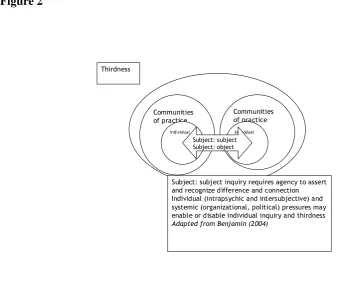
and change. Finally, the concept of ‘thirdness’ offers a means of conceptualising the psychodynamics of thinking together, and the difference between a dialogue in which each advocates a single perspective, and a dialogue in which new thinking arises within the interaction between two independent subjects.
Figure 2
Communities of practice
Communities of practice Individual Individual
Subject: subject Subject: object
Thirdness
Subject: subject inquiry requires agency to assert and recognize difference and connection Individual (intrapsychic and intersubjective) and systemic (organizational, political) pressures may enable or disable individual inquiry and thirdness
Adapted from Benjamin (2004)
These relational concepts speak directly to the challenges and opportunities of facilitating learning between individuals who carry different sectoral and
organisational and indeed gender and national cultures - and to travellers between cultures. They offer potential for making sense of the psychosocial challenges of working across boundaries and for keeping at the edge of inquiry, resisting pressures to assimilate to a single hegemonic view when the going gets tough. Acceptance that subject: subject relating will be achieved in moments and inevitably break down moves the focus of inquiry to skills of repair and seems a liberating alternative to setting dialogue as a standard for learning.
The illustrations that follow explore how these concepts were useful to illumine the challenges and opportunities within the practice of inquiry in two contrasting educational contexts. In each illustration the students were mid career managers, on Masters level university based management education programmes. While the context of the first is a modular programme in a Business School, with no specific ideological or practice affiliation, the second and third are set in a programme with a strong alternative culture, where pedagogic practices are based on experiential learning and peer learning community.
Illustration 1:
‘The creation of a space in which new learning can emerge, and in which affect can be moderated…. The creation of the analytic 3rd…, a space in which either subject can recognise the difference of the other’ (Benjamin, 1998) and provides a mode of containment for the interacting pair (Ogden, 1989) Izod 2006, p.6.
The illustration that follows describes the co inquiry developed in the context of mentoring and co teaching (Page and Kirk, 2006). In it mentor and mentee explore how inquiry enabled mentor and mentee to access and sustain their capacity for learning and curiosity. The concepts of intersubjectivity, recognition and thirdness enabled them to make sense of and develop their teaching and learning practice
Mentee
A major issue for me in taking up a role as a ‘teacher’ was grappling with theory as the perceived knowledge base that legitimises and lends authority to university based teaching. While experienced as an agent of change, I could not find any of the qualities of my experience of doing change in the
organisational literature about change leadership or management. I felt lost within a territory within which I expected to be a guide. If I owned up to disorientation and difficulty I seemed to give away my legitimacy as an academic. Yet when I tried to engage with the theory, I seemed to lose touch with my own knowledge and sense of competency, grounded in experience of the territory of actually doing workplace change and change leadership.
Mentor
As I read the chapters in the main text for my preparation for these sessions I felt that I was stuck inside the book. I couldn’t find my way out. It was as if I was made invisible by the theory and yet I had to come out of the book so that I could communicate what was in it to the students, and do it in a way that was effective and demonstrate my effectiveness as a teacher to my new colleague and mentee. I shared my feeling of being stuck in the book with Margaret. The conversation helped me to work my way out of the book, and into my role as a teacher.
Confronted by the reality of undertaking tasks that present risk and
uncertainty, I had escaped the anxiety by stepping out of the role and into the book (Hirschhorn, 1988: 47). I had buried myself in the text as if the theory would be a substitute for creating a worthwhile educational experience for the students. The uncertainty was because I was unfamiliar with some of the theory, and the risk was that I would expose my inadequacies and this would threaten my identity as a teacher in the eyes of the students and my new colleague, who was also my mentee.
What is revealing about this incident is that it spoke to the teaching dilemma that we were facing in our teaching.
Adapted from Page and Kirk, 2006
for helping students to critically engage with the theory alongside reflection on their experiences in the workplace.
In conceptualising their inquiry processes, they drew from the concepts of inter
subjectivity and of recognition, developed by feminist relational psychoanalyst Jessica Benjamin. In her practice and research, Benjamin explores the centrality of
recognition between individuals, and the difficulties that each individual subject has in recognising the other as an equivalent centre of experience (Benjamin, 1990). In her concept of inter-subjectivity, she speaks of an oscillation between mutual recognition, in which individuals relate to each other as subject to subject, and moments where this sense of separateness is lost, and ‘subject to object’ replaces ‘subject to subject’ relating. In such moments, mutual recognition as two equal subjects may turn to a form of misrecognition, a failure to appreciate the individuality of the other and loss of contact with their subjectivity (Benjamin, 1990: 12). From her perspective, this oscillation between subject to subject and subject to object relating is part of the human condition, and skills of repair replace an idealised concept of dialogue in which subject to object relating does not occur.
These concepts of recognition and intersubjectivity proved useful in thinking about the struggle to sustain inquiry in the classroom, and for confronting expectations carried by students that tutors ‘perform’ as holders of knowledge. These expectations were embedded in the culture of the business school as well as in their own
internalised ideas of what it meant to be a ‘good teacher’. In their roles as mentor and mentee, they discovered that they shared the value of inquiry as a way of being and this mutual recognition became the ground that enabled each of them from our different histories and positions, to find a place and purpose in taking up their roles as teachers in the current reality of the business school.
Co-inquiry became a means of surfacing and bridging different sets of expectations about how to take up teaching and student roles. At the core of the inquiry process was the constant effort to find agency, and in enacting agency to enable students to find their own vitality. This effort to find ‘vitality’ was cyclical, needing times
together for joint thinking and times apart to develop our own thoughts. The liberating effect of inquiry conversations, their qualities of subject to subject interaction, was related to maintaining the distinctive qualities of their individual voices each speaking from their own purpose and passion. Figure 1 represents this process.
NOTE TO READER- NOT SURE WHETHER THE HIGHLIGHTED PARAS ARE USEFUL IN THECONTEXT OF THIS PAPER- REMOVE?
Theory is the knowledge base of academic learning. Yet theory can be both a ritualistic defence against thinking- and a provocation to thinking- an enabler to thinking one’s own thoughts. In order for the teacher to enable learners to access their own thinking in relation to theory, she must first find her own thoughts in relation to the theory - take it inside herself, make her own meaning from it, and develop her capacity to use it or to reject it as a way of making sense of the world. But then, there’s a danger that she will reproduce the same relatedness to theory that she has struggled against- asserting or advocating her version rather than the other.
So teaching is not concerned only with transfer of knowledge from teacher or text to student, but with a quality of relationship to knowledge. This quality of relationship or ‘relatedness’ has emotional as well as intellectual qualities (Armstrong, 2005:15). From this perspective, the idea of ‘knowledge transfer’ or knowledge exchange evokes a fantasy, a belief that learning can take place without the work of engagement with ideas, the agency of the individual as s/he accesses and makes meaning of ideas in her own context.
Yet this fantasy is a seductive one that is embedded in the teaching and learning environments of business schools and organisations today. Both staff and students are likely to ‘carry’ these expectations into the teaching and learning encounter. Powerful emotions, desires and frustrations are likely to be triggered in this encounter and choices have to be made about how to work with them. The choices made will follow from the sense of purpose held by staff about their role as academics, and their assessment of what might be possible in the context of each programme (Simpson et al,. 2000). This will be shaped in part by their inner world and individual
predilections, and in part by the culture and purpose of the organisation of which they are a part (Page, 2006).
Organisational cultures
privileging expert knowledge and performance, judgement and standards
Mentor
Students
Mentee
Inquiry
Agency and vitality embodied in teaching
and learning interactions
Academic culture privileging
knowledge of theory,
The authors of this co-inquiry found that the qualities of relatedness that developed within the co-mentoring relationship enabled both to create a space with students within which new learning could emerge. The co-mentoring was itself a space within which affect was moderated and learning took place. But it was more than this. It seemed to embody qualities of thirdness that then became available to be offered in the teaching context. This process was not smooth or consistent. It involved
challenge, confrontation and conflict, and a capacity to engage in the political environment in which these struggles took place. Crucially, it involved mutual recognition as individuals struggling to take up a role as educators in a context where the meaning of teaching and of learning was and will continue to be contested.
The following two illustrations explore challenges that arose in a very different context. While the previous context was a single time limited module in which students met each other for the first time, this programme was nurtured by dedicated academic staff who protected it from modularisation or the introduction of teaching practices inconsistent with the programme philosophy. While students were not subjected to the pressures of a modular teaching environment, similar dynamics came into play as staff and students had to negotiate clashes between students’ desire for answers and inquiry based learning and teaching introduced by staff.
Illustration 2:
Holding open a space for inquiry between conflicting realities
The learning was one of being able to acknowledge that different realities could pertain, and could be held as complementary, allowing for renegotiation of relations between them. Izod, 2006 p.8
Allowing different realities to be held as complementary requires both will and capacity to moderate considerable pressure, arising from history of conflict, loyalties to ideologies mediated through relationships embedded in systems and cultures. In the following vignette I illustrate how I stumbled into capacity to hold in tension two complementary realities, and in doing so discovered a way of taking up my role as an educator with authority that had previously been unable to take up.
The group of students sat in a circle, checking in. My attempts to discuss the purpose of this were interpreted by some of them as evidence of my lack of knowledge of programme practice and culture, by others as simple
Working with this group a year later, a breakthrough occurred. Students repeatedly asked what had been the basis of my interpretations of their group process. Instead of holding myself apart, maintaining an interpretive stance, I found myself able to articulate to them how I felt and the sense that I made of this. I felt tearful, and able to both speak from this place, and to suspend from it sufficiently to speak to it. I felt a surge of relief as far from dissolving and losing authority, as I had feared, I felt more ‘myself’, as if I had entered my own body at last, and come truly alive in my relatedness to the students, to have entered my role in a different way in the context of the programme . This sense of relief at no longer holding myself apart, and of release of tension, seemed to mirror something of the student’s experience. Students expressed this later by congratulating me on ’joining’ the programme – and we entered into a more dialogic and less defended way interaction from this point on. It felt as if a visceral shift had taken place, as a result of which I had found a way of taking up my role with a different kind of authority. I was able to experience ‘authority’ and ‘peer relating’ in a way consistent with the qualities of relatedness on the programme.
Adapted from Page and Sanger, 2006
Working at the time with a systems psychodynamics approach to experiential learning and group work (Gould, Stapley and Stein, 2004) I wondered whether I should have held out, and sustained a consultant role that was separate from the student group. Was it right to hold to the disciplines of the group relations tradition, in order students the opportunity for this specific form of experiential learning, or was it time to adapt method to context, and take up my role as tutor in a way more adapted to the course culture (Gertler, B and Izod, K.2004). From the group relations perspective, I
paradigms within which we were operating. In time, I discovered ways of doing this that honoured the programme culture while inviting students to discover its norms and to make them available for inquiry.
Significantly, and perhaps the key to holding these different realities was finding the capacity to let go of affiliation to one, or the other, and to hold both in equal esteem. This was a process, and needed a length of time. Once I was able to acknowledge that different realities could pertain, and could be held as complementary, I could make inquiry within this territory available for students. However as previous illustrations show, this carries risks for the consultant or educator, and responses to such
invitations will be shaped by the context in which it they are made. Subject to subject relating may be achieved in moments, but will inevitably break down, in contexts where anxieties are likely to be high and pressures will be experienced and enacted by students and staff to abandon inquiry in favour or more instrumental approaches intense. It is to the skills of repair that I will turn in the next illustration.
Illustration 3:
The dynamics involved in recognising the ‘other’
A capacity to appreciate the other (individual and organisation) as outside the self, and in relatedness to one’s self… a subject with his own desires and coping patterns’ (Izod 2006, p.9)
… finding a level of recognition inevitably means encountering difference – working with ones’ own and the groups’ patterns of response to difference
(Izod 2006, p.9)
On management education programmes the idea of learning community has become fashionable. Research literature explores the tendency for the ‘community’ to be experienced and constructed as ‘alternative’, better than workplaces, and the challenges this raises for learning from reflection on experience (Reynolds, 2000; Reynolds and Trehan, 2003). Introducing inquiry within such a context can be a risky affair, as defences are likely to be tightly held and anxieties intense where they are called into question (Page, 2006; Reynolds, 2000; Reynolds and Trehan, 2003). In this situation, the teacher will need to make a judgement about how much anxiety can be held by students within the context, and at what point it may become undermining to the learning task (Simpson, French, and Vince, 2000). The concepts of inter
subjectivity and of oscillation between subject to subject and subject to object relating offer a useful holding frame to support inquiry in this context.
The context of the vignette that follows is a teaching session on gender in organisations. In it, I explore a situation in which inquiry offered a frame within which students were able to move into subject to subject relating momentarily, through exploration of gender difference. At a later stage however subject to subject relating broke down, as students experienced levels of anxiety that made it difficult to sustain inquiry.
exploring. In the previous session, an external speaker had presented her work on gender in organisations, and while students had engaged with it, once she had gone seemed to disown their interest in it, some making reference to corporate clients who were unlikely to be interested either in inquiry as an approach or to gender. As a way of enabling students to explore the relevance of the issues they were invited to take part in a co-operative inquiry into their own experiences of being men or women on the programme (Reason, 1988). Parallels and contrasts could then be explored between their experiences of interactions on the programme and in their practice as managers in their organisations.
The students took up this invitation with enthusiasm. They formed single sex groups which then came together to report their findings. The experience of the opportunity to work in single sex groups was very different. While the experience of the male students was of energetic release and excitement, the female students experienced ambivalence and loss, and a wish to claim their identity as ‘human beings’. In discussion, the male students expressed a sense of being constrained by female students and the course culture, and of reclaiming attributes that they had to suppress on the programme, the female students felt that being asked to identify as women was equivalent to being asked to collude with being somehow lacking, being somehow less than ’human being’s.’
This contrast was reflected in the painful and conflictual nature of the discussion when they came together. During this discussion, both male and female students stated that only certain ways of being men or women were acceptable on the
programme. For some of the female students, being with the male students offered a heightened sense of femininity that was fun, powerful and subversive. Both male and female students spoke of their desire to be recognised by each other as sexed and gendered, and of feeling that the androgynous and asexual culture of the programme was preventing this from happening. Yet the qualities and politics of gender were not explored, and this resulted in an unproblematised assertion of heterosexual norms and conventional ideas of sexuality and sexual attraction. Thus while some of the more vocal male students shared this sense of fun, a gay student voiced a sense of being negatively judged by the women for not living up to their ideal of how men should be. One of the female students, the only lesbian, stated that her femininity had not been ‘seen’ by the other women, while others remained silent - stating that they could and would not compete and did not wish to relate to ‘the boys’ in this way.
As the session was drawing to a close, male and female students seemed to achieve a synthesis by reworking an interaction that had taken place during the group
in a convent’. The exchange between the male storyteller and female audience seemed to go back and forth several times and become a joint performance. As hilarity rose, the story was told again and again with zest and gusto; both male and female narrators seemed to take up exaggerated roles with enthusiasm and irony.
It seemed that through their inquiry some of the capacity to own and to play with the meanings attributed to sex difference had been restored to the room. Surfacing and naming these qualities that had previously been repressed seemed to restore energy and playfulness within their interactions, and some of their lost capacity for creative interaction was recovered. A sense of agency, and a capacity to take up authority was one of these lost qualities, identified by both male and female students. However there was also a sense of danger, of ambivalence, that was difficult to contain. It was
difficult to develop a discussion of the event and in subsequent sessions, students again seemed to disown the discussion that had developed during the inquiry, and expressed hostility towards the tutor. While a substantial proportion of the students took up gender relations as a theme in their written assignments, it was as if in the group defences against anxieties raised acted as s powerful block to learning. The ‘subject to subject’ interaction that was achieved was achieved momentarily, but could not be sustained. Repair took place subsequently in individual interactions and discussions with the tutor, but could not be managed within the group.
In subsequent discussion with interested students, the first author explored what sense they now made of events. One key point they made was their sense of insufficient containment for the anxiety they experienced in ‘not knowing’. What they wished for was not inquiry, but an expert-led approach that would tell them how to apply their learning within their organisational roles. Related to this was a sense of academic staff having underestimated the difficulty they experienced of doing inquiry. Yet in their reflections they also showed that they had a wish to break free of dependency on expertise and in assignments that they were able to be inquiring.
In the words of one student:
I am left with the sense that the group has missed something ‘gritty’, probably in the cause of ‘community’ or however you describe it, but certainly because we haven’t lived our differences. Our still emerging inquiry skills also put undue onus on the facilitator to ‘make things right for us’, which is a fine fractal of the very tension you highlight, of an organisation wanting an
‘expert’ facilitator with the answers, which the facilitator resists. Of course as a consultant you can simply agree that you are not the right person for the job, but as a tutor, what do you do????
Relational thinking as inquiry practice
Learning in management education has the potential to be co-inquiry, a contract between the educator and students. Yet pressures are intense to adopt a more instrumental, knowledge transfer based approach to teaching and learning. These pressures come from the increasingly business led priorities of academic institutions and from the aspirations of students and their organisational sponsors from local and international markets. Teaching and learning thus does not take place in a vacuum, but in organisational and social contexts that shape and give meaning to interactions within the class room. Readiness to relate in subject: subject mode is determined as much by externally given meanings and values that have to be negotiated as by organisations in the mind.
‘Thirdness’ is not a new concept in psychoanalytic thinking, yet I have argued and demonstrated in the illustrations above how the concepts of inter subjectivity and of thirdness developed by Benjamin can offer a means to develop and enrich the disciplines and practices of inquiry that are needed to sustain it. Keys to this are the concepts of holding difference and connection; of holding the intrapsychic
‘organisation in the mind’ brought by each individual and the specific qualities of relationship experienced between subjects as a separate domain to the intrapsychic. These relational and psychodynamic concepts offer a language that facilitates
understanding of how the political and social domains permeate the psychodynamics enacted in teaching and learning contexts. Moreover they offer a conceptual
framework that support inquiry practices through the inevitability of breakdown of subject-subject dialogue, and offer a means for subject-object relating not to be
pathologised, or seen as a failure of inquiry but accepted and incorporated into inquiry practice. I have illustrated how this oscillation between modes of intersubjectivity was a central feature of staff student interactions in each of the three examples above. From a psychodynamic relational perspective, skills of repair replace an idealised concept of dialogue in which subject-to-object relating does not occur. The focus of inquiry practice can then move to moments of reparation. In all three illustrations, skills of repair, and the dynamics of recognition and misrecognition, were played out over a period of time, during which allowed an understanding of inquiry processes to develop. The concept of ‘thirdness’, I have suggested, captures the qualities of relatedness needed for the long haul and the ups and downs of sustaining inquiry with others.
Final reflections
Reason and Marshall speak of working with students to discover purpose in their inquiry in three interrelated arenas: inquiry for me, for us and for them (1987: 112-3; 2001::413). Each domain contains potential for finding or losing agency and vital connection. In each domain, competing narratives jostle and collide. These may be carried from previous contexts or be embedded or enacted in current contexts. They must be negotiated by
members of organisations as they enter or leave and as their context changes. The process is anxiety provoking and destabilising. Both educators and students may become stuck in defensive or ritualistic behaviours that lead to a loss of agency, or be overwhelmed by pressures to conform to powerful sets of expectations and projections. In these circumstances educators and members of organisations need a protected space to recover their thinking capacity and retain a sense of agency.
Co-inquiry, supported by an understanding of the psychodynamics of
relational thinking can offer disciplines and practices for sustaining agency in role taking. However inquiry cannot replace instrumental pressures and cultures, but can and must take root in forms and in spaces that already exist, and be held alongside existing cultures and practices. Relational thinking offers a conceptual frame that can sustain individuals who seek to introduce inquiring relationships and to sustain vitality within organisational as well as educational contexts.
References
Anzaldúa, G. (1987) Borderlands/La Frontera: The New Mestiza, San Francisco: Aunt Lute Books
Armstrong, D. (2005) ‘Names, Thoughts and Lies’, French, R. Organization in the Mind, Karnac, London, ed. pp.15 – 28. First published 1992 in Free Associations, Vol.3 No. 26, pp. 261-282
Benjamin, J., (2004) ‘Beyond Doer and Done To: An Intersubjective View of Thirdness’
Psychoanalytic Quarterly, 1.XX111
Benjamin, J., (1990) The Bonds of Love: Psychoanalysis, Feminism and the Problem of
Domination, London: Virago
Bion, W.R. (1961) Experiences in Groups, London: Tavistock
Case, P. and Selvester, K. (2002) ‘Watch Your Back; Reflections on Trust and Mistrust in Management Education’. Management Learning Vol. 33(2):231-247 Case, P. and Selvester, K. (2000) ‘Close Encounters: Ideological Invasion and Complicity on an ‘International Management’ Master’s Programme’. Management Learning Vol. 31(1):11-23
Gertler, B and Izod, K. (2004) ‘Modernism and Postmodernism in Group Relations: A Confusion of Tongues’ in Cytrynbaum and D.A.Noumair (Eds) pp. 89-108 in Group Dynamics Organizational Irrationality, and Social Complexity: Group Relations Reader 3. Jupiter, Florida: A. K. Rice Institute
Hirschhorn, L. (1988) The Workplace Within: The Psychodynamics of Organizational Life, MIT Press, Cambridge, M.A.
Izod, K. (2006) How Does a Turn Towards Relational Thinking Influence Consulting Practice in Organisations and Groups? Conference paper presented to ‘Relational Thinking, Linking Psychoanalysis, Organisations and Society, Centre for Psycho Social Studies, June 2006
Lugones, M. (1997) ‘Playfulness, ‘World’-Travelling, and Loving Perception’ first published in Hypatia 2, 2 (Summer 1987); reprinted as ch. 17, pp. 275-290 in Diana T. Meyers (ed.)
(1997) Feminist Social Thought: A Reader, London: Routledge.
Meyerson, D. and Scully, M. (1995) ‘Tempered Radicalism and the Politics of Ambivalence and Change’ Organization Science 6(5): 585-600
Page, M. and Sanger, C. (2006) Subverting Utopias | Dangerous Dialogue: can humanistic and systems psychodynamics be bridged in experiential teaching and learning? OPUS conference paper, London, November 2006
Page, M and Kirk, P. (2006) Worker as Researcher, Researcher as Worker:
Teaching and Learning as Inquiry. International Work Based Learning Conference, Northampton, March 2006.
Page, M. (2006) ‘A traveller’s tale: on joining a peer learning community; moments of
passionate dis / connection in a quest for inquiry’, Gherardi, S., Nicolini, D. (Eds.) The
Passion for Learning and Knowing. Proceedings of the 6th International Conference on Organizational Learning and Knowledge, University of Trento e-books, Trento, pp. 628-48 Reason, P. and Marshall, J. (2001) ‘On Working with Graduate Research Students’, Reason,
P. and Bradbury, H. (Eds.) Handbook of Action Research, Participative Inquiry and Practice,
Sage Publications, London, pp. 413-419
Reason, P. and Marshall, J. (1987) ‘Research as Personal Process’, Boud, D. and Griffin, V.
(Eds.), Appreciating Adult Learning, Kogan Page, London, pp. 112-26
Reason, P. (1988) Human Inquiry in Action. London: Sage Publications
Reynolds, M. and Trehan, K. (2003) ‘Learning from Difference?’ Management Learning Vol. 34(2): 163-180
Reynolds, M. (2000) ‘Bright Lights and the Pastoral Idyll’ Management Learning Vol. 3(1): 57-73
Simpson, P., French, R. and Vince, R. (2000) ‘The Upside of the Downside; how utilizing defensive dynamics can support learning in groups’ Management Learning Vol. 31(4): 457:470