The Embodied Mathematics Project: Report
BOYLAN, Mark <http://orcid.org/0000-0002-8581-1886> and REANEY, Sarah
Available from Sheffield Hallam University Research Archive (SHURA) at:
http://shura.shu.ac.uk/22326/
This document is the author deposited version. You are advised to consult the publisher's version if you wish to cite from it.
Published version
BOYLAN, Mark and REANEY, Sarah (2018). The Embodied Mathematics Project: Report. Project Report. Sheffield, Sheffield Institute of Education, Sheffield Hallam University. (Unpublished)
Copyright and re-use policy
See http://shura.shu.ac.uk/information.html
Sheffield Hallam University Research Archive
The Embodying Mathematics Project
1
:
Report
Mark Boylan and Sarah Reaney
August 2018
2 | P a g e
Acknowledgements
The Embodying Mathematics Project, 2015-2017, was a collaboration between Complicite theatre company and Sheffield Hallam University. The project was undertaken with financial support of the John Lyon’s Charity, the Paul Hamlyn Foundation and Sheffield Hallam
University through an Impact Fellowship Grant. Following the completion of the project, Complicite has continued to develop this work as Ensemble Maths
The time and commitment of teachers and support of the school leaders from the following schools was essential to the project's success:
London
Torriano Primary School 2015/16 & 2016/ 17
St Mary's and St John's CE School, 2015/16 & 2016/17 Christopher Hatton Primary School 2016/17
Edith Neville Primary School 2016/17 Fitzjohn's Primary School 2016/17 Rhyl Primary School 2016/17
St Mary’s Bryanston Square 2015/16 Camrose Primary School 2015/16
Sheffield
Lydgate Lane Junior School 2016/17 Hunter’s Bar Junior School 2016/17
Project team
Dina Mousawi , Hilary Povey, Mark Boylan, Nick McIvor, Poppy Keeling, Shane Shambhu, Victoria Gould (first name alphabetical order, details of members of the project team and roles are provided in section 3.2.1.)
Additional support
In addition the project was supported by a project steering group (Professor Leon Feinstein, Professor Marcus du Sautoy, Judith Dimant and Bavaani Nanthabalan) and an external research advisory group, Professor Anne Watson, Professor John Leach and Dr Alf Coles and Sally Pearse. Claire Christie of Ashley Down Primary School advised on links between
activities and the National Curriculum in the London 2015/16 phase.
3 | P a g e
T
ABLE OF
C
ONTENTS
1 Introduction ... 15
2 Background and rationale ... 16
3 The Embodying Mathematics Project ... 18
3.1 Aims ... 18
3.2 Overview ... 18
3.3 Common features ... 18
3.3.1 Team and roles ... 18
3.3.2 Programme components ... 19
3.4 Summary of evolution of the project ... 20
3.5 Participation and activity ... 22
4 Research and Evaluation ... 23
4.1 Methodology ... 23
4.2 Ethics ... 23
4.3 Outcome measures ... 24
4.3.1 Pupil Attitude Survey ... 24
4.3.2 Multiples and multiplication facts test ... 24
5 Implementation and attitudes to the project and activities ... 25
5.1 Implementation and teachers' attitudes ... 25
5.1.1 Balance of activities and implementation ... 25
5.1.2 Workshops ... 25
5.1.3 Being a Mathematician ... 25
5.1.4 Group Mastery Activities ... 26
5.1.5 Lesson activities ... 28
5.1.6 Professional development activities ... 28
5.1.7 Performance ... 28
5.2 Pupils' attitudes ... 29
5.2.1 Teacher perceptions ... 29
5.2.2 Survey ... 29
5.2.3 Focus groups ... 30
6 Constraints, adaptations, and supporting factors ... 33
4 | P a g e
7.1 Overview of professional development ... 35
7.2 Collaborative learning ... 35
7.3 View of mathematical 'ability' and mathematical activity ... 35
7.4 Extending the teaching repertoire ... 36
7.5 Teacher agency... 36
7.6 Subject knowledge and pedagogical subject knowledge ... 36
8 Pupil outcomes ... 37
8.1 Attitudes and social learning ... 37
8.1.1 Teacher perceptions ... 37
8.1.2 Pupil survey data ... 38
8.2 Mathematical learning ... 39
8.2.1 Teacher perceptions of learning ... 39
8.2.2 Mathematics tests ... 40
9 Outcomes and implications ... 42
9.1 Outcomes and implications for design and further development of curriculum materials, activities, pedagogy and professional development activities ... 42
9.1.1 Workshops ... 42
9.1.2 Being a Mathematician ... 42
9.1.3 Group Mastery Activities ... 42
9.1.4 Lesson activities ... 43
9.1.5 Performance ... 43
9.1.6 Professional development ... 44
9.2 Teacher mediation of activity to support learning and positive relationships to mathematics ... 44
9.3 Development of evaluation tools ... 44
9.4 Implications of outcomes for teachers and pupils and evaluation of project design 45 9.4.1 Teacher outcomes ... 45
9.4.2 Pupil outcomes ... 46
9.4.3 Project design... 46
10 Conclusion ... 48
11 References ... 49
6 | P a g e
Glossary
Circle time PSHE activity supporting classroom relationships and to develop social and oracy skills
EMP Embodying Mathematics Project
Ensemble Drama practice that emphasises actors working together rather than individual performance, also the name for the group working together GMA Group Mastery Activity - ensemble activity done in a classroom
KS2 Key Stage 2, English primary years 3-6 7-11 years old
Lesson An EMP lesson. A 'lesson' consisted of a set of linked activities that might take more than a single school lesson to complete
7 | P a g e
Report Summary
BackgroundThe Embodying Mathematics Project (EMP) (2015-2017) was a collaboration between Complicite theatre company and Sheffield Hallam University (SHU) funded by The John Lyon’s Charity, the Paul Hamlyn Foundation, and an SHU Impact Fellowship Grant. The project focused on developing drama informed mathematical movement activities drawing on previous work by Complicite and activities developed in mathematical education
contexts.
Prior to the EMP, Complicite had developed ensemble movement mathematics activities during the process of devising A Disappearing Number, its 2007 production which centres on the history of Srinivasa Ramanujan, a 20th century mathematician, and on the idea that
mathematics is a creative and ‘beautiful’ discipline. These activities, initially used in the rehearsal room, were developed into a series of workshops for schools. In 2015, Complicite invited proposals to develop this work and members of the Mathematics Education
Research Group at Sheffield Hallam University proposed a combined curriculum and professional development project, focused on primary mathematics in the 7-10 years old age range, called the Embodying Mathematics Project.
EMP drew on: evidence that engaging in drama, in general, can impact positively on pupils' attitudes to school and their mathematical attainment; conceptualisation of ensemble or rehearsal room pedagogy; developments in mathematics education that promote
collaborative learning; and recent interest in embodiment in mathematics education. In addition, the EMP sought to develop and add to previous movement based mathematical activities.
The project was developed in the primary mathematics context, in which the curriculum is often decontextualised and lacks meaning, and with pupils increasingly grouped according to perceived mathematical ability. This means that learners can become alienated from mathematics, from other people and from themselves. In addition, many primary teachers have themselves had alienated experiences of school mathematics and report anxiety about teaching the subject linked to their own negative experiences of mathematics in school and beyond.
Aims
The project sought to:
• design, develop and evaluate curriculum materials, activities and pedagogy informed by movement based and ensemble practices
• develop appropriate professional development activities
• examine how teachers can mediate embodied and ensemble learning to impact on pupil learning and attitudes
8 | P a g e
9 | P a g e
Project outline
The overall project consisted of three sub-projects that were mutually supportive but implemented as distinct activities:
a. Year 1 2015/16 London 4 schools, 8 teachers - Complicite and SHU co-design and implementation
b. Year 2 2016/17 Sheffield 2 schools, 6 teachers - Complicite and SHU design, Complicite implementation
c. Year 2 2016/17 London 6 schools, 10 teachers - Complicite design and implementation.
SHU led the evaluation in all cases.
A total of 24 teachers, and 600-700 children, drawn from 9 schools in London and 2 schools in Sheffield, participated in the project.
The EMP core team comprised Complicite practitioners, an experienced mathematics curriculum developer and mathematics education academics and evaluators from SHU, and, in the first year, support from an experienced school based professional developer.
Components
Components of the programme were:
• Complicite workshops lasting 1-2 hours, led by Complicite practitioners and offering both learning experiences for pupils and professional development opportunities for teachers.
• Lesson activities designed to be used either inside or outside the classroom. • Group Mastery Activities (GMAs) developed for the second year of the project in
response to Year 1 teachers’ difficulties securing enough time in spaces large enough to perform EMP activities regularly (GMAs reproduce aspects of Complicite
workshop activities within a classroom setting).
• ‘Being a Mathematician’ used in London in Year 1. Being a Mathematician aimed to promote a set of dispositions that embodied and ensemble activities could
potentially cultivate and ones for which there was evidence from meta-cognitive interventions of association with improved mathematical attainment and
relationships to mathematics.
• Professional development through day-long workshops and twilight sessions; these were called 'development days' to indicate that although professional development was an important focus, teachers were also supporting the development of materials and activities.
10 | P a g e
During the first design year of the project in London, materials were developed for 20 lessons2, organised into four modules, suitable for use with Y3 to Y5 pupils. To enhance the teachers’ and students capacity to view mathematics and mathematical activities in new ways a framework focused on ways of 'Being a Mathematician’ were developed. Teachers experienced 2.5 days of CPD and 4 twilight sessions.
During the second year in London, the project focused on developing GMAs leading to performance. Teachers experienced 1 day of CPD and 1 twilight session with the project activity taking place over one school term.
In Sheffield schools, the project focused specifically on Y3 pupils, and materials developed in the design year were refined and used by teachers alongside GMAs, with materials for up to 20 lessons being devised. As in London, the year culminated in performance, and on this occasion all participating classes came together to perform and parents were invited. Teachers experienced 4 days of CPD and 3 twilight sessions.
Evaluation
A design evaluation was undertaken to inform development of activities during the project as well as potential future development. Although outcomes were assessed, the main purpose was informative rather than evaluative given the atypical nature of schools' participating and that activities were being piloted.
The project was evaluated using a mixed method design. Evaluation focused on design of embodied activities, teacher professional development outcomes, pupil responses and attitudes. In Sheffield, effect on knowledge of multiples and factors, an area relevant to project activities, was assessed through a short pre and post test.
Data was collected through activities in development days (including audio recording discussions), 7 teacher interviews, surveys of teachers, 4 pupil focus groups, pupil attitude surveys and a mathematics test (in Sheffield). Although the evaluation of impact on attitudes and the test was observational, a comparison with a previous Y3 cohort was undertaken in Sheffield. Recognised statistical analytical processes were used. Due to the nature of the design, findings from the impact evaluation should be treated with caution and causality cannot be inferred.
Implementation and teachers' attitudes to the projects
From surveys, interviews and feedback at development days, the teachers involved in nearly all cases were positive about the project and EMP activities. The value of activities for supporting pupils' collaboration was a particular feature appreciated. As noted above, Complicite workshops became more focused on teacher professional development than pupil experience during the project and this was valued by teachers, particularly where this involved Complicite practitioners and teachers co-leading. One teacher suggested time for
2 A 'lesson' here is a set of linked activities that might take more than a single school lesson to complete, see
11 | P a g e
debriefing and discussion with practitioners would have augmented learning. Teachers in London 2015/16 valued the conceptual framework for 'Being a Mathematician'
GMAs, an emergent component of the project, were particularly appreciated and noted as an aspect likely to be continued in the future. They could and were used flexibly, including in subjects other than mathematics. Different GMAs were used for either energising or
calming the class depending on what was needed. Whilst teachers reported that GMAs were socially challenging for pupils, this led to valuable social learning and created opportunities for reflection with pupils on working together. Teachers reported using them the expected 2-3 times per week, though tended to reduce over time.
Sheffield teachers, who were provided with lesson activities, as well as GMAs, were positive about lesson materials, particularly number focused activities which were found to more easily fit into the curriculum due to current emphases. The way lesson activities were
presented was appreciated with materials being easy to use. As anticipated, sets of activities took longer than a lesson to use.
The amount of professional development experienced was viewed as appropriate in all three sub-projects with the full PD days viewed most favourably, and practically engaging in activities as the most useful part of the PD experience. Teachers were also positive about the performance in those sub-projects where it was a component.
Pupil attitudes to the project and project activities
Teachers' perceptions, pupil survey data and pupil focus group data supported the
conclusion that the majority of pupils were positive or very positive about activities. There is some association of this with pupils' general enjoyment of mathematics. A minority were less favourably inclined, for some of these this was because they did not find activities mathematically challenging and/or they preferred to work individually.
Constraints, adaptations and supporting factors
Constraints or barriers to implementation included: curriculum and time pressures; the availability of spaces outside the classroom; pupil concentration; and accountability pressures. Supporting factors included: flexible classroom spaces (where found); school orientation and developments compatible with the project, including school leadership support; and teachers' existing capacities and experience.
Professional development outcomes
Professional development outcomes for teachers included:
• increased knowledge about linking mathematics to movement and skills to do this • extended teaching repertoires more generally
• knowledge about performative possibilities of mathematical activity • the capacity to develop a learning community in the classroom • changes in beliefs about mathematical ability
12 | P a g e
• increased understanding of teaching specific mathematical content, skills and knowledge.
There were several individual reports of transformative learning in terms of approach to teaching and view of mathematical ability.
Pupil outcomes
Teachers reported positive influences on pupil attitude to learning saying that GMAs, and project activities more generally, had supported the development of a sense of
togetherness in the class. At best engaging in Embodying Maths Project activities broke down patterns of children labelling themselves or each other. Although some pupils resisted ways collaborative ways of working due to their individualised orientation, and other
'vulnerable' pupils - for example EAL or SEN pupils - found the ensemble environment challenging, teachers reported the experience of collaborating as bringing important social learning. This was enhanced by classroom discussions of the value of working in an
ensemble way. Teachers explicitly linked project activities to Personal, Social and Health Education (PSHE).
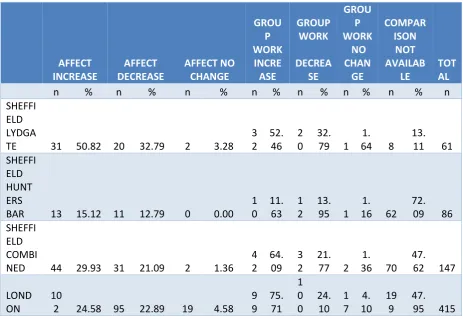
A pupil attitude survey showed no change for pupils participating in London 2017. In Sheffield the number of students who indicated an improved attitude to mathematics was greater than those who indicated a less favourable attitude (13 more pupils with an increase than decrease for pre-affect score and 11 with a higher working with others score). Similar outcomes were found regarding attitudes to working with others in mathematics. However, this outcome must be treated with caution as end of year attitudes compared with the previous cohort showed no significant difference. Given Y3 children in both schools in Sheffield joined the junior schools in Y3, it may be that attitudes in mathematics improve in the two schools anyway, and so this outcome is not conclusive. Further, there was
significant flux in attitudes and teachers' reported that Y3 pupils were struggled with the Likert-format assessment.
Teachers considered the activities effective in supporting pupil learning. Evidence from the impact study in Sheffield suggests that in one school there was a small but not statistically significant higher mathematics score than in comparison with a previous year. In the other school, test scores were found to be lower than the previous year and this difference was significant. These outcomes should be treated with caution due to the test used and lack of comparative pre as well as post test data, as well as possible differences due to cohort effects. Note that due to changes in national assessment data it is not possible to compare the cohorts on a separate measure.
In the two schools the average scores were relatively high in the post test (mean of 5.25 and 20% of pupils have a score of 7-10 out of 10). The test was related to the content of lesson activities and GMAs, This indicates that the level of mathematical content in the multiple and factor activities was not challenging for all pupils, as a proportion already understood the content.
13 | P a g e
1. Design and further development of project components
Professional development: Both formalised professional development activities and
engagement in the project had a range of professional development outcomes. The overall balance of encouraging engagment in the substantive mathematical activities and
considering their use in classrooms was successful.
The format for PD days that evolved was effective and valued by teachers. Twilights focused only on reflection were less useful. The suggestion to include debriefs or opportunity for discussion with practitioners during workshop visits is worth considering.
Being a Mathematician: This component has potential for development as a distinct initiative.
GMAs. The development of this new component represents a significant success of the project and gave opportunities for developing the ensemble in the classroom. Teachers offered useful advice and suggestions, as well as adaptations that could be incorporated into descriptions of GMAs. If they are to be used beyond Y3 and engage all pupils, attention is needed to considering the mathematical challenge of activities. However, there may be a tension between ensemble experience and the aesthetics of using movement and rhythms work to explore multiples of numbers in the full range required in the KS2 curriculum. This could be explored in future developments.
Lesson activities: These were, in general, positively received though the developed symmetry activities were less successful and should be revisited in future iterations. Performance: Like GMAs, this was an emergent aspect of the project and both forms - to peers/school community and to parents - were successful.
2. Teacher mediation of activity to support learning and positive relationships to mathematics
Teachers had a key role in mediating activities so they could be used successfully. Important for this were their prior experience, their enthusiasm, and modelling by Complicite
practitioners.
3. Development of evaluation tools
A range of evaluation methods and tools were used in the project. Whilst overall these were successful in generating data to inform design, attention in future evaluation should be given to appropriateness of mathematics test(s) and the way pupil attitudes are assessed.
4. Implications and outcomes for teachers, pupils and project design
14 | P a g e
Teachers reported important outcomes in terms of a sense of class togetherness and the capacity of some individuals to collaborate. As an extension to the EMP, the value of ensemble pedagogy for Y7 pupils transitioning to secondary school is worth further exploration.
Two distinct approaches to developing the project in the future have emerged. The first of these is Embodied Mathematics, conceived as broadly similar to the 2016/17 Sheffield version of the project, in which lesson activities were carried out alongside GMAS. The second approach is Ensemble Mathematics, structured in a similar way to the 2016/17 London project, and focusing on GMAs with lesson activities provided as an optional extra.
Conclusion
The EMP has led to the development of a variety of innovative curriculum activities focused on mathematics and movement. Particularly interesting areas are the extension of
15 | P a g e
1 INTRODUCTION
Complicite theatre company and Sheffield Hallam University (SHU) collaborated to create, implement and evaluate The Embodying Mathematics Project (EMP) between 2015 and 2017). It was funded by The John Lyon’s Charity, the Paul Hamlyn Foundation, and a SHU Impact Fellowship Grant.
The project focused on developing drama informed mathematical movement activities for KS2 teachers and children, drawing on previous work by Complicite and other activities developed in mathematical education contexts by teachers, curriculum designers and others.
16 | P a g e
2
B
ACKGROUND AND RATIONALE
Complicite's theatre is rooted in ensemble and physical theatre practices. The company developed a number of ensemble movement mathematics activities which were used by actors as part of the creative process of devising a play - A Disappearing Number - centred on celebrated Indian mathematician Ramanujan (see Abbott, 2014). These activities informed workshops for schools offered by the company's Creative Learning arm. In 2015, Complicite invited proposals to develop this work further and members of the Mathematics Education Research Group at Sheffield Hallam University proposed a curriculum and
professional development project - the Embodying Mathematics Project (EMP) - focused on primary mathematics for 7-10 year olds.
The EMP was informed by a variety of prior research and mathematics education activity. There is some evidence that engaging in drama can impact positively on pupils' attitudes to school and their mathematical attainment (Fleming, Merrell & Tymms, 2004; Şengün &
İskenderoğlua, 2010). Materials to support learning mathematics have been developed that utilise the story telling aspects of drama (Pound & Lee 2015). The interest in the application of drama to mathematical learning can considered part of a growing current in education focused on STEAM (Science, Technology, Engineering, Arts, Mathematics) education, and on arts-based creative pedagogies more generally.
Different emphases are found within the developing STEAM literature and practices with, for example, the arts being viewed as a way of enlivening science and mathematics or with a more holistic view in which the distinctive contribution of the arts reshapes the meaning of mathematics and science activity (Colucci-Gray et al. 2017). The EMP was informed by the latter approach. Further, narrow accountability measures increasingly mean that the arts and arts-based pedagogies are marginalised in the curriculum, so diminishing the quality of education and limiting learners' experiences. Thus, part of the rationale for the project was to demonstrate the value of drama based pedagogies and to create a space for them in an often overloaded curriculum in which 'high stakes' subjects that more directly inform school status are emphasised.
Recently, steps have been taken to conceptualise an ensemble or rehearsal room pedagogy (Kitchen, 2015; Neelands, 2009) in the context of drama education, and specifically in
relation to teaching Shakespeare in English schools. There are resonances in the construct of ensemble pedagogy with developments in mathematics education that promote
collaborative learning and co-responsibility for each other's learning (see for example, Angier and Povey, 1999, Boaler, 2008; Esmonde, 2009).
17 | P a g e
pedagogy, and subsequently developed a set of mathematics curriculum materials focused on dance as part of the Bowland Mathematics project3.
Attention to embodiment in mathematics sits within a more general current interest in the relationship between learning and kinetic movement theoretically (Bautista, Roth, & Thom, 2011; Malinverni & Pares, 2014)) and in practice, for example, through the relationship of dance to the curriculum generally and not just mathematics (Skoning, 2012).
The EMP was informed by these various approaches and explored ways that drama, and specifically ensemble practices and principles, can support mathematical learning through embodied experience to foster engagement and support a sense of learning together. In contrast to Complicite’s earlier mathematics and drama workshops (prior to the EMP) in which any professional learning teachers gained by observing Complicite workshops was vicarious. In the EMP teachers rather than (only) theatre practitioners were positioned as leaders of embodied activities, with professional development activities devised to support this.
The project was developed with an awareness that primary mathematics is often
decontextualised and lacks meaning. Pupils are increasingly grouped according to perceived mathematical ability and this has implications for social justice as socially and economically disadvantaged children are often negatively impacted by these arrangements (Boylan & Povey, 2009; Povey, 2009, Marks, 2013, 2014). These trends mean that learners can become alienated from mathematics, from other people and ultimately from themselves. In
addition, many primary teachers have themselves had alienated experiences of school mathematics and report anxiety about teaching the subject linked to their own negative experiences of mathematics in school and beyond (Bibby, 2002). Thus the EMP was
conceived as a means of offering and supporting a different experience of mathematics for pupils (and teachers) than the one that is usually found in schools currently.
18 | P a g e
3
T
HE
E
MBODYING
M
ATHEMATICS
P
ROJECT
3.1
A
IMSThe project sought to:
• design, develop and evaluate curriculum materials, activities and pedagogy informed by movement based and ensemble practices
• develop appropriate professional development activities
• examine how teachers can mediate embodied and ensemble learning to impact on pupil learning and attitudes
• identify appropriate evaluation methodologies and tools for assessing outcomes of embodied activities
• assess outcomes for teachers of engagement in professional development • and assess learning and social outcomes for pupils.
3.2
O
VERVIEWThe project overall consisted of three projects that were mutually supportive but implemented as distinct activities:
• Year 1 2015/16 - London 4 schools, 8 teachers - Complicite and SHU co-design and implementation, SHU evaluation
• Year 2 2016/17 - Sheffield 2 schools, 6 teachers - Complicite and SHU design, Complicite implementation, SHU evaluation
• Year 2 2016/17 - London 6 schools, 10 teachers - Complicite design and implementation, SHU evaluation
Details of the different activities used in the three sub-projects are provided in summary form in Section 3.4. Some 24 different teachers and 21 classes took part (taking into account teachers who participated for more than one year). Approximately 600-700 pupils in total directly experienced the project including participating in at least one workshop with a Complicite practitioner.
3.3
C
OMMON FEATURESIn this section, common aspects of all three projects are described.
3.3.1 Team and roles
As noted in Section 3.1, during the project the two main partners, Complicite and SHU, had shifting roles with Complicite taking more responsibility for design and implementation during the project.
Complicite
Project Manager: Poppy Keeling
19 | P a g e
Complicite Associates and workshop leaders: Victoria Gould and Shane Shambhu
Project Coordinator: Dina Mousawi Sheffield Hallam University
Project Lead and Principal Investigator: Professor Mark Boylan
Curriculum development lead: Professor Hilary Povey
Members of the evaluation team: Sarah Reaney-Woods, Gill Adams, Ben Willis, Judith Higginson
St Marylebone School, London/West London Maths Hub
Professional development lead: Nick McIvor
3.3.2 Programme components 3.3.2.1 Complicite Workshops
Led by Complicite practitioners, in London in 2015/16 (Year 1) workshops spanned two hours (the length Complicite used prior to the project), with the main focus of the workshop being on pupils' experience with teachers observing. In Sheffield and London in 2016/17 workshops were designed to last an hour. In Sheffield, the aim of the workshops was more fully on being a professional development opportunity for teachers to witness and learn from practitioners using embodied activities with pupils. Further, in some cases in Sheffield activities were co-led by teachers and practitioners. Similarly, in London in 2016/17 the main aim of the workshops was for teachers to learn from observation.
3.3.2.2 Lesson activities
Lessons were designed to be used either inside or outside the classroom. Appendices 1 and 3 provide a summary of lesson activities and content. Lessons consisted of a number of activities, with teachers free to select from these, given a recognition that all of the activities included in a 'lesson' might take longer than a single hour. In London 2015/16 (Year 1), lesson activities complemented Complicite workshop activities rather than reproducing them. They were also designed to be used flexibly across KS2. In Sheffield 2016/17, workshop activities were integrated into lesson plans, thus workshops consisted of demonstrations of lesson activities. The focus was on Y3. In Sheffield, Being a
Mathematician (see below), teaching prompts and notes on mathematical concepts were integrated into lesson and activity descriptions. This change to presentation of materials response to teacher feedback in Year 1. Appendix 2 and 4 give examples of lessons from Year 1 and Year 2 respectively.
3.3.2.3 Group Mastery Activities
non-20 | P a g e
classroom) space within a classroom setting. Further, the aim of a GMA is that everyone has a sense of mastering both a physical activity and mathematical learning together. GMAs also offered the opportunity to develop a 'felt sense' of number. They were designed to be done in the classroom regularly, ideally three times a week. GMAs consisted of a physical 'root' to which mathematics layers were added. GMAs have resonances with unison response that is part of a number of learning traditions internationally (see Watson, 2002).
3.3.2.4 Being a Mathematician
This was a strand of the project used in London in Year 1 that was informed by evidence on the power of metacognition in mathematics learning. 'Being a Mathematician' aimed to promote a set of dispositions that embodied and ensemble activities could potentially cultivate and ones for which there was evidence from meta-cognitive interventions of association with improved mathematical attainment and relationships to mathematics (see Appendix 6). A number of drama based activities were provided. A revised version of the 'Being a Mathematician' dispositions, informed by teacher and team reflections, was shared with teachers in in Sheffield in 2016/17, but was not emphasised or addressed in PD after the introductory day.
3.3.2.5 Professional development activities
As well as practitioner workshops in schools, a variety of patterns of CPD days and twilight sessions were used to support professional development. CPD day activities emphasised teachers experiencing embodied and ensemble activities as participants. Consequently, typically CPD would consist of project team members leading EMP lesson activities or GMAs, followed by reflection on the experience and discussion of use with pupils. Twilight sessions tended to focus on reflection on use of materials. The CPD days were called 'development days' to indicate that although professional development was an important focus, teachers were also supporting the development of materials and activities.
3.3.2.6 Performance
In both Sheffield 2016/17 and London 2016/17, the use of GMAs led to a mathematical 'performance' to other pupils and/or to parents. Performances were not designed primarily to entertain, but rather to make the mathematics children had engaged in public and shared with others.
3.4
S
UMMARY OF EVOLUTION OF THE PROJECTThe EMP was conceived as an opportunity to explore the possibilities for, and constraints on, drama informed mathematics pedagogy and professional development. Thus, as anticipated, project activities evolved over the two years.
21 | P a g e
22 | P a g e
3.5
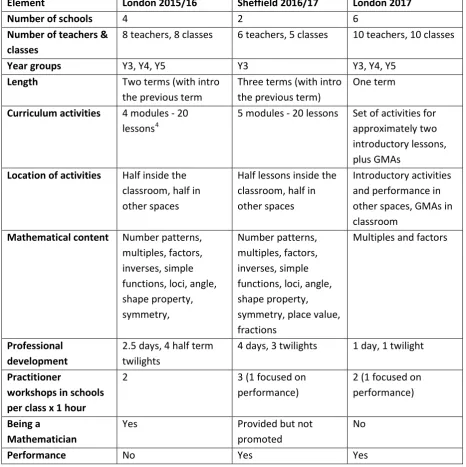
P
ARTICIPATION AND ACTIVITY [image:23.595.65.532.182.650.2]The table below provides a summary of participation and activity across the three projects.
Table 3.5 Summary of participation and activity
Element London 2015/16 Sheffield 2016/17 London 2017
Number of schools 4 2 6
Number of teachers & classes
8 teachers, 8 classes 6 teachers, 5 classes 10 teachers, 10 classes
Year groups Y3, Y4, Y5 Y3 Y3, Y4, Y5
Length Two terms (with intro the previous term
Three terms (with intro the previous term)
One term
Curriculum activities 4 modules - 20 lessons4
5 modules - 20 lessons Set of activities for approximately two introductory lessons, plus GMAs
Location of activities Half inside the classroom, half in other spaces
Half lessons inside the classroom, half in other spaces
Introductory activities and performance in other spaces, GMAs in classroom
Mathematical content Number patterns, multiples, factors, inverses, simple functions, loci, angle, shape property, symmetry,
Number patterns, multiples, factors, inverses, simple functions, loci, angle, shape property, symmetry, place value, fractions
Multiples and factors
Professional development
2.5 days, 4 half term twilights
4 days, 3 twilights 1 day, 1 twilight
Practitioner
workshops in schools per class x 1 hour
2 3 (1 focused on
performance)
2 (1 focused on performance)
Being a
Mathematician
Yes Provided but not
promoted
No
Performance No Yes Yes
4 A lesson might take more than a timetabled lesson depending on teacher choice of activities. If all materials
23 | P a g e
4
R
ESEARCH AND
E
VALUATION
4.1
M
ETHODOLOGYA design evaluation was undertaken to inform development of activities during the project as well as potential future development. Although outcomes were assessed the main purpose here was informative rather than evaluative given the atypical nature of schools' participating and that activities were being piloted.
The evaluation used a mixed-methods approach with data gathered from: • notes and audio recordingsfrom design and project meetings • notes and audio recordings from professional development events • reflections by project team members
• observations of workshops
• teacher records of use of materials and reflections on materials • interviews with Complicite practitioners
• interviews with teachers (2 in London 2015/16 by telephone, 5 in Sheffield 2016/17 by SHU researchers face to face)
• Short video segments recorded by Complicite with London 2016/17 teachers • survey of London 2016/17 teachers
• review half day with London teachers
• review half day with Sheffield teachers to discuss preliminary evaluation outcomes • four focus group interviews with a total of approximately twenty Sheffield pupils • pupil attitude surveys
• a pre and post-test of mathematics related to GMAs.
Qualitative data was analysed using thematic analysis and quantitative data analysed using standard and recognised statistical methods, with details given when data is reported or in appendices as appropriate. Data entry for the London 2016/17 project was undertaken by an administrator employed directly by Complicite and for Sheffield 2016/17 by an SHU administrator. Quantitative analysis was undertaken by an SHU Research Fellow who was independent of the design team. Thus, data entry and analysis have a degree of
independence from the immediate project team.
4.2
E
THICS24 | P a g e
opt in consent obtained for participation in focus group interviews, with pupils' personal consent audio recorded.
4.3
O
UTCOME MEASURES 4.3.1 Pupil Attitude SurveyA pupil attitude survey (PAS) was an important instrument for evaluation in both London and Sheffield. The PAS was adapted from one used in another study (see Boylan et al., 2016) which in turn was informed by previously developed scales. The PAS was trialled in the EMP during 2015 in London, further developed and then used as a pre- and post-test in both London and Sheffield during 2016/17. See Appendix 8 for the final survey. Because of the age of the children participating, it was administered by teachers reading out the questions, and pupils' individually completing the survey. The Likert questions in the PAS related to two factors: mathematics affect (attitudes to mathematics) and working with others in
mathematics. To allow for comparison with a previous cohort, the previous Year 3 cohort (Year 2 2015/16) also took the PAS. In addition, as part of the post-test survey, questions were asked about attitude to project activities with the London and Sheffield surveys varying slightly due to the different project activities.
4.3.2 Multiples and multiplication facts test
25 | P a g e
5
I
MPLEMENTATION AND ATTITUDES TO THE PROJECT AND ACTIVITIES
5.1
I
MPLEMENTATION AND TEACHERS'
ATTITUDESIn both interviews and surveys, teachers, in general, indicated positive attitudes to the project, particularly in the second year in both Sheffield and London.
Two of four schools in London involved in the first year chose to continue with the project, further evidencing that the project was seen as worthwhile by those teachers. In this section teacher attitudes to specific aspects of the project are reported.
5.1.1 Balance of activities and implementation
In London 2015/16, a number of teachers noted difficulties in accessing spaces outside the classroom. Consequently, in 2016/17 the number of activities designed for use outside the classroom was limited, and GMAs were developed to provide ensemble experiences in the classroom. However, teachers in Sheffield 2016/17 also reported adapting activities designed to be used in large spaces within their classroom by moving furniture and having some pupils do the activity and some watch, for example 'walking the space' in the
classroom.
Teachers in all three sub-projects reported using materials flexibly and, in the case of lesson activities, selecting some activities from a 'lesson' and developing their own lesson from these.
Due to current focus in primary mathematics on number, number activities were found to be easier to fit into the curriculum and other activities on shape and space felt to be more useful as additional or supplementary activities.
5.1.2 Workshops
Teachers valued workshops as professional development activities, with London (2016/17) teachers ranking this as one of the top three aspects of the project in relation to PD. Teachers valued observing and learning from practitioners working with pupils and this helped to remind or reinforce learning from development days.
In Sheffield, two teachers specifically mentioned the value in being able to ask for advice, and one spoke about later workshops as being like "team teaching" (Sheffield teacher 5). One teacher (Sheffield teacher 3), reflected that visits to schools could have been used for greater professional learning if practitioners could stay after workshops to reflect with project teachers.
5.1.3 Being a Mathematician
26 | P a g e
because of this strand. The Being a Mathematician framework was refined based on application by teachers in London during 2015/16.
5.1.4 Group Mastery Activities
GMAs were viewed positively by both London (2016/17) and Sheffield (2016/17) teachers. A number noted that these were the project activities they were most likely to use in the future. GMAs were not necessarily seen as a better way of exploring mathematical content, but rather:
supplemented the work we did in class and gave children a really effective way to understand mathematical concepts and ideas they often struggle with when we're just using concrete materials and more abstract concepts in class. (Sheffield Teacher 3) At the same time, teachers in Sheffield reported they tended to use GMAs less as time went on, stating that it was difficult to sustain momentum and that pupil enthusiasm lessened over time. The activities were seen as particularly valuable at the start of the year. Teachers of Y3 pupils, in both Sheffield and London, commented on the appropriateness of the mathematical activities or, alternatively, that children grasped the mathematics easily. A teacher of Y5 pupils in London stated that the GMAs’ mathematical content was not challenging enough for their pupils but more suitable for younger children.
Teachers reported that pupils found embodied aspects of GMAs challenging initially, with 6 out of 8 London 2016/17 teachers agreeing or strongly agreeing that pupils found them hard. 'Embodied aspects' of GMAs refers to the combination of physical activity and social-psychological aspects as well as embodying mathematical thinking. This contrasts with the challenge of the mathematical content abstracted from the GMAs.
As one Y3 teacher put it, acting as 'the perfect ensemble ' was something for pupils to aspire to and there was value in trying to perfect a GMA even if this was not achieved. The same teacher commented:
I don't think we ever had a session where there wasn't somebody that forgot to do something…..but they picked up that [the what the ensemble aim was] fairly quickly (London 2016/17 teacher 1)
Engaging with GMAs (and other ensemble embodied activities) required the development of some children's' embodied and social capacities. One teacher reported:
A huge amount of time and effort went into just getting the children ready to be able to engage with these sorts of activities (Sheffield Teacher 3)
Sheffield teachers shared strategies they used to develop pupils' capacity to engage with GMAs. One teacher's approach was to create opportunities for pupils to observe each other doing GMAs and to reflect on the experience. In the following quote they share an example of this related to using GMAs (see page 61-63 for a description of the activity :
[We've discussed] it's really important that everyone understands and we give
27 | P a g e
when] we've done ‘everybody stand up together when I say a multiple of 3’.when I say a list of numbers in turn. For example We've discussed, "what we should do if I say ‘12’, and you know straight away that 12 is a multiple of 3". I have said, "that's great but I want you to wait until you think everybody knows that and has time to know that, so you can all stand together".
Teachers reported the perseverance needed to master GMAs as a whole class as leading to valuable learning (discussed in Section 7).
The last example was related to developing a sense of ensemble by giving others time to be able to include themselves in the activity. A related example was addressing informal patterns of social inclusion and exclusion within the class. A London teacher discussed using the GMA 'loop activity' (see pages 61-64). In the loop activity a virtual loop or set of
connections is set up in the class by 'passing' being the lead person from one pupil to another. Passing is done by eye contact. One someone has been the least person they then pass this on. Eventually, the loop closes as the last person passes the leadership back to the first person.
The teacher noted she had to offer some guidelines to the class about not passing the loop to your friends and had to personally be part of the loop to ensure one child who was often isolated in the class was included (London, 2016/17 teacher 1). Both of the last two
examples of teacher practice point to the way in which GMAs helped to promote a sense of togetherness in classes or at least opportunities for discussion of relationships and social learning. Discussion about this was an important aspect of implementation. The value of GMAs in this regard is discussed more fully in Section 8.
The short length of GMAs was viewed positively, and allowed them to be used when there was a period of time between other activities:
I could just use them as and when: in the middle of the day; at the start of the lesson; end of the lesson; as an activity to get children re-focused on something. Different GMAs lend themselves to different classroom strategies. So re-focusing the children could just be the ‘arms up’. Whereas a starter could be counting in multiples or things (Sheffield 2016/17, teacher 4)
Similarly, the flexibility of being able to adapt or develop GMAs was valued.
The majority of London teachers (2016/17) had used, or would use, GMAs in other subject areas. A Sheffield teacher described using a GMA to count in Spanish and another using them at the start of Circle Time.
28 | P a g e
5.1.5 Lesson activities
Teachers interviewed in Sheffield (2016/17) were positive about lesson activities both in relation to mathematical learning and to pupil engagement. As noted above, number activities were easier to integrate into schools' curricula. Place value and fraction activities were most frequently named when asked which lesson activities might be used in future years.
Teachers in both Sheffield schools stated that the symmetry and shape activities did not fit with the schools' interpretations of the KS2 mathematics curriculum for Y3. Two Sheffield teachers also noted that, with the some of the symmetry activities, Y3 children found it difficult to be accurate with their physical positioning or to stay till enough to represent the mathematical content. This then required a lot of intervention from the teacher and so reduced children's autonomy.
Sheffield teachers appreciated the overall presentation of activities, particularly if
understood as a set of related activities rather than a lesson, with instructions being "very clear and you can read it before the lesson and know what you want to do without having to keep picking it up and rereading it" (Sheffield teacher 1). Another teacher summarised this as materials being "very easy to follow" (Sheffield teacher 5).
5.1.6 Professional development activities
In general, teachers in all three sub-projects considered the amount of professional development appropriate (see Appendix 8 for details on London teachers' views). When London teachers were asked about the value of different types of experiences, the full development days were seen as most beneficial. Teachers in the second year of the project in Sheffield saw less value in twilights, particularly later in the year when opportunities for reflection were offered rather than additional content. The professional development focused on performance was reported as leading to confusion.
Activities that were most valued during development days were opportunities to engage in the activities as participants, though one teacher stated that talking to other teachers about how they used the materials was most useful. Teachers also valued observing practitioners working with children.
One teacher suggested that observing colleagues as well as practitioners could have created further professional development opportunities.
5.1.7 Performance
29 | P a g e
5.2
P
UPILS'
ATTITUDES 5.2.1 Teacher perceptionsOverall, interviewed teachers reported pupils being positive about the project. Even though GMAs were found to be challenging, completing a GMA successfully together was satisfying. For example, above it was noted that one teacher had adapted a GMA to count in Spanish; managing to complete a ‘loop’ on this occasion was noted as source of pride by the pupils. A number of teachers pointed to different relationships that children had to the activities. One reported that their whole class "bought into it really easily" (Sheffield teacher 5), whilst others had minorities of pupils who were resistant to or disengaged from GMAs. In some classes, this appeared connected to pupils' prior attainment with high attaining pupils less like to engage fully. However, this was not true of all high attaining pupils. Teachers in Sheffield also reported that, as time went on, when using the GMAs, there was a sense of boredom for some pupils and some finding it challenging to maintain engagement and enthusiasm over time. However, this was not reported in London in 2016/17 and the
difference may be due to the Sheffield project spanning three terms rather than one term in London.
One teacher noted a relationship between engagement and gender, with boys tending to be the pupils who found it more difficult to "channel their liveliness into the work that we've been doing together" (Sheffield teacher 3).
5.2.2 Survey
5.2.2.1 Attitudes to the project
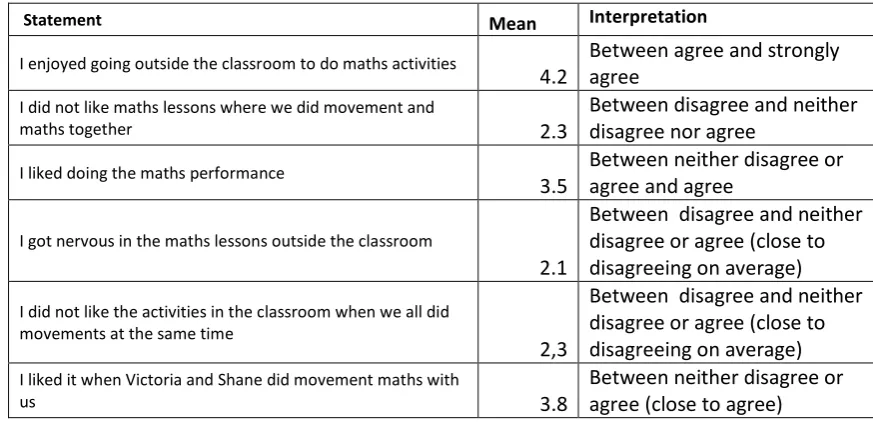
In both London and Sheffield, pupils were positive about the project overall, as shown in the tables below and with more detail provided in Appendix 11. The tables below summarise pupil responses through scoring Likert responses 1-5: for statements positive about project components or activities, 'strongly agree' scored 5, but for items that are negative about project activities, 'strongly disagree' scored 1. A mean score is used as a proxy 5. This means that the high score in each case represents higher positive attitude to the project.
5 Note that scoring Likert scales in this way makes assumptions about the responses as ordered data and with
30 | P a g e
Table 5.2.2.1a London 2016/17 Pupils' attitudes to the project
Statement Mean Interpretation
I enjoyed going outside the classroom to do maths activities
4.2 Between agree and strongly agree
I did not like maths lessons where we did movement and
maths together 2.3 Between disagree and neither disagree nor agree I liked doing the maths performance
3.5 Between neither disagree or agree and agree
I got nervous in the maths lessons outside the classroom
2.1
Between disagree and neither disagree or agree (close to disagreeing on average)
I did not like the activities in the classroom when we all did movements at the same time
2,3
Between disagree and neither disagree or agree (close to disagreeing on average)
I liked it when Victoria and Shane did movement maths with
us 3.8 Between neither disagree or agree (close to agree)
Table 8.2.2.1b Sheffield 2016/17 Attitudes to the project
Statement Mean
score
Interpretation
I enjoyed going outside the classroom to do maths activities
4.2 Between agree and strongly agree
I did not like maths lessons where we did movement and
maths together 2.1 Between disagree and neither disagree nor agree I liked doing the maths performance 4.0 Agree I got nervous in the maths lessons outside the classroom 2.0 Disagree I liked it when different teachers did movement maths with
us 4.1 Between agree and strongly agree
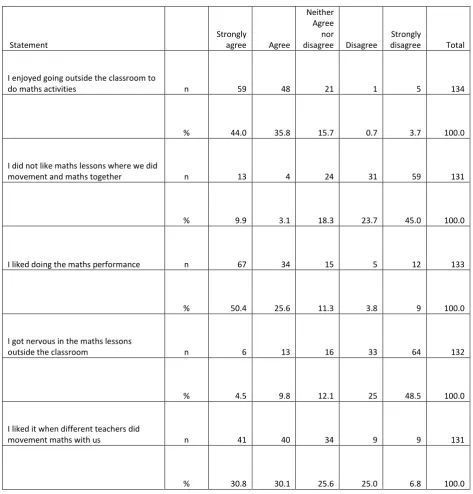
The tables indicate an overall positive attitude to the project. However, it is important to note that this was not shared by all pupils, with between 5-33% on each item indicating a negative attitude, and a further 11-25% neither agreeing nor disagreeing.
Analysis of London attitudes showed that 5 of the 6 questions formed a factor, that is there were patterns in the pupils’ responses, thus indicating that pupils had similar attitudes about different aspects of the project. One statement ‘I was nervous in maths lessons outside the classroom’ did not fit into this pattern (see Appendix 12).
5.2.3 Focus groups
[image:31.595.67.504.128.339.2]31 | P a g e
of different attitudes to the project was in similar proportions to the report in the survey, with most pupils in two of four focus groups being broadly positive about the project, pupils in the third expressing mixed views, and the fourth having overall negative attitudes. Pupils who were positive about the project stated that they enjoyed working in a circle, and liked that everyone had a chance to do something. They enjoyed exploratory aspects of workshops:
Pupil 1: they asked what we could do to make it better. If we get it wrong, they’ll spot it but they’ll let us try and figure it out first, so we have chance to say ‘oh we got something wrong’ and we’ll figure it out and change it.
Pupil 2: They didn’t just tell us how we could improve, they let us participate and try and find out what the answer was.
Pupil 3: they didn’t just go ‘ooh, you’ve got to hurry up’. They let us take our time.
However, for others, workshops were experienced differently, with children reporting that sometimes they felt they were 'proved wrong' and this made them feel uncomfortable.
For some working outside the classroom in the circle caused some anxiety:
Pupil 5: Worried because you didn't know what you were going to do
Another echoed this comment, stating they were discomforted by "not knowing what was happening”. For others there was physical discomfort from "standing around two long"6.
There was evidence that many pupils had internalised messages about working together in relation to GMAs. Many pupils described the activities as fun, helpful for maths, promoting awareness and working as part of a team, and that everyone had a chance to participate. A recurrent theme for some was that it was ok to make mistakes.
One pupil reported:
Pupil 5: When we were doing it people said it felt magical. That was the first time we did it but now it just feels normal.
Pupils enjoyed the performance ,though for some there was anxiety. Meeting with children from the other was a highlight and working as a team in the performance was spoken of with pride. Conversely, another said it was boring because:
Pupil 6: At points other people were doing stuff and you didn’t know what they were doing. We enjoyed when they got into different groups ‘one group of four, two groups of four’.
6 One adaptation made was for pupils to sit between activities outside the classroom or do some activities,
32 | P a g e
33 | P a g e
6
C
ONSTRAINTS
,
ADAPTATIONS
,
AND SUPPORTING FACTORS
In this section, constraints and adaptations to overcome the constraints, and supporting factors relevant to implementation are considered.
6.1.1.1 Constraints and adaptations Curriculum and time pressures
Teachers reported that it was challenging to make time for activities given "the full-on-ness of your school agenda"(London teacher, Y3, 2016/17)
An important issue for teachers was the fit between project activities and the school curriculum. Currently, the emphasis on number in the primary curriculum means that number activities are more likely to be used by teachers. Where curricula diverged, the project activities became something that needed to be 'fitted in' rather than the more 'seamless' relationship described as happening in the autumn term.
Spaces outside the classroom
The availability of spaces outside the classroom limited what teachers could do. As a design feature, the project team had limited the number of outside lessons. However, this was still an issue. One creative solution to issues of space was to revisit activities at the start of PE lessons (Sheffield teacher 2016/17).
Pupil concentration
Teachers highlighted issues of concentration span, both in terms of standing still in a circle or length of activities as a whole. For Y3 pupils a full lesson outside the classroom using EMP activities was felt to be a long time for some classes and children. Working outside the classroom for 20-30 minutes was found to be a more beneficial time by one Y3 teacher pointing to a 40 minute limit on concentration span, with the teacher suggesting that embodied activities could be interspersed with activities using different learning modes - such as individual whiteboards or other written activity.
Accountability pressures
Teachers in one of the London schools in Year 1 found it challenging to implement the project due to the circumstances of their school which was under accountability pressures. This school did not continue with the project into the second year.
6.1.1.2 Supporting factors Flexible classroom spaces
One Sheffield school had folding desks with wheels designed to be quickly rearranged and to clear spaces in the classroom. This facilitated adapting the ‘walking the space' activity in the classroom and using an inner circle of children engaged in an activity in the classroom and an outer circle of observers.
34 | P a g e
One of the Sheffield schools was engaging with mastery principles, including an emphasis on pupils working together, as well as ‘concrete, pictorial, abstract’ as a teaching sequence and so engaging in the project was supported by current developments in the school. In the other Sheffield school there was, similarly, an emphasis on the use of concrete materials and experiences in mathematics.
A teacher in one of the Sheffield schools noted that they were fortunate to have a leadership team that supported teacher creativity, experimentation and engagement in research. They were not sure that other schools would be as supportive to working in new ways. The teachers themselves worked in a culture of teacher enquiry through lesson study embedded into the schools' practice. Further, the project fitted with the schools' approach of "getting the children doing rather than sitting” (Sheffield Teacher 4). Concurrently with the EMP, the same school was engaged in developing mathematics lessons linked to PE activities to promote pupil physical activity.
As well as pedagogical orientation, in both Sheffield schools mathematics was usually taught in all attainment groups.
Teacher capacity
In one Sheffield school, one teacher had a background in music and the other had
completed a teacher enquiry project. Similarly, in London teachers attracted to the project had an interest in creative learning approaches. One had a background in drama and reported that their school emphasised oral ways of working and used the language of 'teams'. Thus, it is important to recognise that the teachers and schools involved in the project were not typical and this may be an important issue to consider in replication of the project.
35 | P a g e
7
P
ROFESSIONAL DEVELOPMENT OUTCOMES
7.1
O
VERVIEW OF PROFESSIONAL DEVELOPMENTLondon teachers (2016/17) were surveyed about professional development outcomes. Teachers strongly agreed or agreed that the project had led to the following outcomes (number of teachers out of 8 who completed the survey in brackets):
• My understanding of ways to teach one or more areas of mathematics has increased (8)
• I know more about how to link mathematics and movement activities (8) • My ability to teach mathematics outside the classroom has increased (8) • I am more confident to lead mathematics outside the classroom (7) • I am more able to turn mathematics into something to be shared through
performance (7)
• I am have more strategies to develop a sense of a learning community in the classroom (6)
• My idea of what mathematics is has changed through taking part in the project (4) Interviews with Sheffield teachers indicated similar professional learning outcomes and provided further insight into their learning.
7.2
C
OLLABORATIVE LEARNINGOne teacher commented:
It’s been interesting to think about how they work together when they work in a group and whether they are thinking about making sure everyone in the group understands or whether they are just kind of saying 'oh I get it so I'll do it, if they don't understand, then that's fine’. ( Y3 Teacher Sheffield 2016/17)
The extent to which teachers' views on collaborative learning in mathematics had changed depended, not surprisingly, on their starting points. For some teachers collaborative learning was already established in their practice, and these teachers reported this being deepened, particularly in terms of the whole class working together building on pair and group work.
7.3
V
IEW OF MATHEMATICAL'
ABILITY'
AND MATHEMATICAL ACTIVITYOne teacher (London 2016/17 teacher 4) who had participated across the project over two years saw links between developing a sense in the class of responsibility for others' learning and moving away from more fixed views of mathematical 'ability'. These were key messages of EMP professional development activities.
36 | P a g e
I think the great thing is that we’ve had a lot of space to think about what being a good mathematician [is] …., it’s actually made me think in a broader sense about what I want my maths lessons to look like, or if I was a leader what I would want maths to be like in my school, and how I would want children to think about maths…. The practical activities are great as well, and that’s great to have that in your bank of knowledge, that the great thing is your changing, my changing mindset – and what that can do for what you perceive as a good maths lesson or what you perceive as good maths teaching (London teacher 2016/17, teacher 5). This teacher reported changing seating arrangements in their classroom from 'ability' groups to mixed ability tables. The same teacher reported a significant change in her capacity to notice what was happening in the classroom.
7.4
E
XTENDING THE TEACHING REPERTOIRETeachers told us that engaging in the project had led them to extend their repertoire of teaching approaches. There were two particular aspects to this.
One related to embodied and movement approaches to learning mathematics, with two of the eight Sheffield teachers who were, from their self-reports, the most sceptical at the start of their involvement, expressing surprise that this combination worked well. The second related to the pedagogical approach in the learning activities, summarised by teachers as 'open', or"showing a concept to children rather than just telling them" (Sheffield 2016/17 Teacher 1). The extent to whether this teaching approach was novel varied across the teachers and their current practice, and consequently the degree of learning varied.
7.5
T
EACHER AGENCYIn both London (2016/17) and Sheffield (2016/17) teachers reported and welcomed an agentic relationship to materials. A London teacher who had been part of the project for two years referred to taking ownership (London teacher 2016/27 teacher 4). In Sheffield a teacher described (Sheffield teacher 4) adapting a fractions lesson activity to use crash mats as sites for forming fractions. Other adaptations have been discussed above.
7.6
S
UBJECT KNOWLEDGE AND PEDAGOGICAL SUBJECT KNOWLEDGE37 | P a g e
8
P
UPIL OUTCOMES
8.1
A
TTITUDES AND SOCIAL LEARNING 8.1.1 Teacher perceptions8.1.1.1 Togetherness
London 2016/17 teachers, via the survey, reported (number in brackets is how many responded out of eight):
• The group mastery activities helped develop a sense of togetherness (7) One teacher who had participated in both years of the London project:
I think one of the most poignant and important things is the sense of togetherness that we’ve got in doing this and the sense that there is no longer, I think, a good place and a bad place in the maths classroom. I think now it’s more a case of… when we do these group mastery activities, particularly, we’re all in this together and we’re all going to help each other out (London 2016/17,Teacher 4)
The same teacher linked this to breaking down a pattern of children labelling themselves or each other as good or bad at mathematics. The benefits of this were summarised by one teacher in the following way:
You have so many different learners with different needs [in a class] that this project really allowed everyone to shine. It allowed the children to learn from each other, to grow, to feel confident and to feel a part of something (London 2016/17, Teacher 3). Similarly, another teacher emphasised the value of ensemble activities for children with SEN or EAL needs and feeling part of a community in the classroom (Sheffield teacher 4). One teacher described the value in being able to give attention to the whole class at once and this being rare in primary classrooms. She linked this to improved relationships with the children and value for the children to feel:
She's [the teacher] giving her attention to all of us because we together are creating something special (London, 2016/17 teacher 4).
Thus, the GMAs were considered to have a purpose beyond mathematics as the same teacher went onto say:
I think that process has really paid dividends in terms of bringing them together as a unit, as an ensemble and getting them understanding how to work together with each other and also to understand the benefits of working together and supporting each other (London, 2016/17 teacher 1).
8.1.1.2 Social learning and regulation
38 | P a g e
sense of unity when there was disharmony in the class. Others described using activities at different points in the day (London 2016/17, teacher 2). Although the social and
mathematical learning aspects of GMAs were usually discussed separately, one teacher encouraged pupils to 'help each other out' where needed.
8.1.1.3 Individual relationships to collaborating
As discussed earlier, teachers reported that not all pupils were positive,with particular mention of initial uncertainty or reluctance’. One reported that pupils engaged move over timeand that there had been "dramatic" changes in attitude: "they have gone from just completely wanting to spoil it and not being interested to wanting to be part of it". As noted above, this teacher reported spending time discussing the reasons for working in this way. Pupils became more willing to work with others. Although learning to work in ensemble ways was challenging, it was felt that for those pupils who found it hard the project had "led to the development of some really positive learning behaviours" (Sheffield teacher 3).
Although pupils' found GMAs challenging, teachers reported that their use had beneficial outcomes. This was particularly the case in relation to working together.
It’s been a good thing to be pushing the kids to work together and it is important because for it to work, we all need to do it properly and together. They struggled with that a bit at the beginning. We've got a lot of very outspoken characters in my class who want to get a laugh out of everybody. They want to be the centre of attention. They found it quite hard to start with, to tone that down and actually think, right we all need to be doing this together at the same time (Y3 Sheffield teacher 1).
Anecdotes of individual change in attitudes were described by teachers, for example: There are children - very vulnerable children - in the class who struggle enormously with these [group/collaboration] sorts of skills and aptitudes. It has been challenging for them at times, but also [we are] seeing them coming on a journey (Sheffield teacher 3).
8.1.2 Pupil survey data
Pupils' pre- and post-test affect and relationships to groups were analysed. In London, no significant change were found. However in Sheffield an overall improvement was found. Appendix 13 gives full statistics of the analysis. However, a more accessible way of
39 | P a g e
As noted earlier, an important limitation of the evaluation is that both Sheffield schools are Junior schools. These pupils experience a change of schools and so it may be that attitudes to mathematics change anyway. Comparison of Sheffield 2016/17 Y3 pupils' summer attitudes with that of 2015/16 pupils shows no significant differences.
However we do not know what the comparison (2015/16) cohorts' attitude was at the start of the year and so firm conclusions cannot be drawn. It may be that in these two schools there is a strong emphasis on working together as a whole outside of the project and both already use all-attainment teaching approaches in the project.
In London schools there was a weak correlation between pupils’ mathematics affect (post-test) and t