ISSN Online: 2152-7393 ISSN Print: 2152-7385
DOI: 10.4236/am.2019.104016 Apr. 24, 2019 212 Applied Mathematics
Computing the Enclosures Eigenvalues Using
the Quadratic Method
Shurouq Mohammad Abusamra
Department of Mathematics, Faculty of Science, King Abdul-Aziz University, Jeddah, KSA
Abstract
In this article, We compute the enclosures eigenvalues (upper and lower bounds) using the quadratic method. The Schrodinger operator (A) (har-monic and anhar(har-monic oscillator model) has used as an example. We study a new technique to get more accurate bounds. We compare our results with Boulton and Strauss method.
Keywords
Quadratic Method, Enclosures Eigenvalues, Boulton and Strauss Method
1. Introduction
Galerkin method is one of the best methods for determining upper bounds for the eigenvalues of semi-definite operators, unfortunately this method cannot find enclosures eigenvalue. This paper shows how to compute enclosures of the eigenvalues of self-adjoint operators by the Quadratic method. At first, we study the second-order relative spectrum (The Quadratic method) in [1] [2], and Boulton & Strauss method in [3] [4]. These methods have used for computing eigenvalue enclosures (upper and lower bounds) of the eigenvalues of self-adjoin operators. The quadratic method, which relies on calculation of the second-order which is providing, certified a priori intervals of spectral enclosure. Then we study our new technique which gives more accurate results, we also follow the results that have been published by Boulton & Hobiny in [5]. The method will be examined by harmonic and anharmonic oscillator models.
Second-order relative spectra were first considered by Davies (1998) in the context of resonances for general self-adjoint operators in [6] [7]. It was then suggested by Shargrodsky and subsequently by Levitin and Shargorodsky (2000) in [8] that the second order relative spectra can also be employed for the pollu-How to cite this paper: Abusamra, S.M.
(2019) Computing the Enclosures Eigen-values Using the Quadratic Method. Ap-plied Mathematics, 10, 212-225.
https://doi.org/10.4236/am.2019.104016
Received: February 7, 2019 Accepted: April 21, 2019 Published: April 24, 2019
Copyright © 2019 by author(s) and Scientific Research Publishing Inc. This work is licensed under the Creative Commons Attribution International License (CC BY 4.0).
DOI: 10.4236/am.2019.104016 213 Applied Mathematics
tion-free computation of eigenvalues in gaps of the essential spectrum. Various implementations, including on models from elasticity, solid state, physics, relati-vistic quantum mechanics and magneto hydrodynamics confirm that the Qua-dratic method is a reliable tool for eigenvalue approximation in the spectral pol-lution regime. Properties of second order relative spectra have been studied re-cently by Bolton & Leviton in [9] and then by Bolton & Strauss (2007, 2011) in [3] [4]. Boulton and Strauss extended this method to normal operators and op-timal convergence rates for eigenvalues and estimated that by an order of mag-nitude for the harmonic & anharmonic oscillator models, by cut the interval into sub-interval around the eigenvalues in the Spectrum, and the approximation en-closure eigenvalues results of these models are more accurate than the Quadratic method around λ.
Our improvement depends on domain expansion around the first five eigen-values in the spectrum, we will take a value for a less than λ1 and a value for b
greater than λ5 and calculate the conjugate pairs of eigenvalues (λ λ λ λ λ1, , , ,2 3 4 5)
(i.e.; around λ1 we will choose a1<λ1<λ2<λ3<λ4 <λ5 <b1). In this paper we
studied two models (harmonic and anharmonic oscillator) which are: 1): har
( )
x = −u x x u x′′( )
+ 2( )
.2): anh
( )
x = −u x x u x′′( )
+ 4( )
.Notation
• Below denotes a generic separable Hilbert space with inner product .
and norm . .
Let the operator (:D
( )
→) be self-adjoint. We will write Spec( )
to denote the spectrum of ().• is real inner product space means that is real vector space on which there is an inner product x y, associating a real number to each pair of elements x, y. The norm is real function such that
x
=
x x
,
1 2, and thedis-tance is:
d x y
( )
,
= − = −
x y
x y x y
,
−
1 2. And:( )
,(
,)
(
, ; ,)
d x z ≤d x y +d y z x y∈, which is called triangular inequality.
• For any pair of elements x, y of satisfies the following properties:
, 0
x x ≥
, ,
y x = x y
1 2 1 2
,
y x bx+ = x y bx y+
1 2 1 2
, , ,
x ay by+ =a x y +b x y
• Given a subspaces ⊂D
( )
of dimension n such that:{ }
n1j j
Span b =
=
we will write
(
,)
n, 1l n n
l = a b bj k k j= ×
DOI: 10.4236/am.2019.104016 214 Applied Mathematics
• The essential spectrum of : is the remaining part of spec
( )
.•
( )
( )
( )
ess
disc
spec Spec
Spec
=
.
• Theorem: Let be a self-adjoint operator:
- λ∈spec
( )
, there exists a sequence uj∈Dom( )
such that:-
λ
u
j,
u
j→
0
as j →∞ [This sequence is called Welys sequence].- λ∈Specess
( ) (
↔ λ−)
is not Fredholm.• The min-max theorem tells us if is bounded above and below by the mini-mum and maximum eigenvalues respectively
(
λmin,λmax)
, and we have:(
)
( )
(
)
min if any x max if any
λ ≤ ≤λ , where
( )
x denoted by Rayleigh-Ritz quotient on a self-adjoint operator as:( ) ,, ;
( )
.A x
x x
x Dom x x
= ∈
2. The Quadratic Method
We begin by describing the basic framework of the Quadratic method associated to a self-adjoint operator. First considered by Davis (1998) in the context of re-sonances for general self-adjoint operator in [6] [7], it was then suggested by Shargrodsky and subsequently by Levitin and Shargorodsky (2000) in [8], Prop-erties of second order relative spectra have been studied recently by Boulton & Levitin in [9] and then by Boluton & Strauss (2007, 2011) in [3] [4]. For the ben-efit of the reader, we include here some definitions.
Let be self-adjoint operator on Hilbert space . Let ⊂Dom
( )
, a number z∈ belongs to second order spectrum Spec2(
,)
if there exists,
u v∈ such that;
(
−
zI u
) (
,
−
zI v
)
=
0
. (2.1) For all u is nonzero. Means that the Second Order Spectrum usually contain complex numbers, but it turns out that if z Spec∈ 2(
,)
then:( )
(
( )
( )
)
,(
( )
( )
)
Spec Re z − Im z Re z + Im z ≠
ϕ
.
Consider: =
{
e e e1, ,2 n}
.Be a basis of [ is finite dimensional subspace of Dom
( )
], then the Quadratic matrix polynomial is:( )
22 2 1 0
Q z = − z +z . (2.2)
where the mass, stiffness and bending matrices are;
[ ]
0 jk=(
e ej, k)
,[ ]
1 jk =(
e ej, k)
,[ ]
2 jk =(
ej, ek)
We define the spectrum of Q(z) as the set of z∈ such that
( )
0DOI: 10.4236/am.2019.104016 215 Applied Mathematics u=λu
for some u∈/ 0
{ }
. (2.4) In this method we need to construct companion matrices which depend on the quadratic matrix polynomial to find the enclosure eigenvalues.We have two possible companion matrices form which are given by
2 1
0 2
I
S= −
, 0
0 0
I
T=
And 2 0 0 I
S= −
, 1 0
0 2
I
T =
The eigenvalues of the matrix polynomial can be determined from one of this companion matrices form
LEMMA 2. 1: Let Q(z) is defined and be singular then:
( )
(
)
(
)
det
Q z
= ⇔
0
det
S zT
−
=
0
. (2.5)For
2 1
0 2
I
S= −
, 0
0 0
I
T =
(
)
(
)
( )
(
)
2 1 1
1 1 2
0 0 det 0 2 2 det zI I S zT z
zI z I
Q z − − − = − − − = − − + =
Indeed, the assertion that Q(z) is singular is equivalent to the existence of
0
u≠ such that
2 2u−2z u z1 + 0u=0
. (2.6) Denoting v = zu, this can be rewritten as
2u−2 1v z v+ 0 =0
. (2.7) In turn, the latter is equivalent to:
0 2 1 0 0 0 2 I
I u u
z v v = −
(2.8) As needed for the verification of (2.3).
LEMMA 2.2: Let =Span b
{ }
j jn=1⊂Dom( )
and is the orthogonal projection onto , then:(
)
{
{ } (
(
) (
)
)
}
2 , ?
Spec = z∈ ∃ ∈u −zI u −zI v = ∀ ∈v (2.9)
If
⊂
Dom
( )
2 , then:(
)
{
{ }
(
)
}
(
)
(
)
{
}
2 2 2; : 0 ; , 0,
: 0 | .
Spec z u z u v v
z Spec z
= ∈ ∃ ∈ − − = ∀ ∈
= ∈ ∈ −
(2.10)
Typically Spec2
(
,)
contains non-real points. From the lemma it is easyDOI: 10.4236/am.2019.104016 216 Applied Mathematics
We now discuss a strategy suggested by Davis and Plum for computing the spectrum of self-adjoint operator.
Let = * and ⊂Dom
( )
for z∈ to Spec( )
, consider thefunc-tion :→
[
0,∞)
be given:( )
minv L(
)
z z v ∈ − =
(2.11)
Then
( )
z is an upper bound for the distance from z to the spectrum of , that means:( )
{
(
)
( )
}
,
min
:
.
Dist z Spec
=
z
−
λ λ
∈
spec
So
( )
z
≥
dist z Spec
,
( )
. (2.12) Assume that z not in Spec( )
, since ⊂Dom( )
then:( )
(
)
(
)
(
)
( )
0 1 1 0 1 1 min sup , so v v z v z v z u uz dist z Spec z
≠ ∈ − − ≠ ∈ − − − = − ≥ = − = ∈
(2.13)
Therefore
( )
x can be small only when x∈ is close to Spec( )
, so we can make a connection between Spec( )
and ( )
x .Suppose [a, b] be an interval of the spectrum of which lies in it, and
( )
2{
( )
:
( )
}
Dom
u Dom
Lu Dom
⊂
= ∈
∈
.let
[
a z z z= 0, , , ,1 2 zn =b]
,∀ ∈z ,( )
(
)
(
)
( )
( )
2 0 2 2 0 , ² min min min, is nonzero
n
v
v
v
z v v
z v z v v Q v v G z v
≠ ∈ ≠ ∈ ∈ − = − = = =
Clearly,
Spec
2(
,
)
= ∈
{
z
:
G z
( )
=
0
}
. For z∈, let Q(z) be as in (2.1),0 v≠ :
( )
minv( )
Q v G z
v ∈
= (2.14)
Thus the zeros of G(z) appear in conjugate pair. THEOREM 2.1: (Shargorodsky):
For λ∈Spec2
(
,)
, and G( )
λ =0, let( )
( )
upp
Re
Im
DOI: 10.4236/am.2019.104016 217 Applied Mathematics
Then:
( )
,
low upp
Spec
λ λ
ϕ
≠
. (2.15)Let λ = +a ıb forα β ∈, , then:
(
)
(
)
(
λ
− u,λ
− v)
=(
(
α
−) (
u,α
−)
v)
+2ıβ α
(
(
−)
u v,)
−β
2( )
u v,Then either β = 0, u∈, u = v we get:
(
α
−)
u 2−β
2 u 2+2ıβ α
(
(
−)
u u,)
=0So:
(
)
2 2
2
a u
u
β = − and
(
(
α −
)
u u
,
)
=
0
(2.16)So:
(
a)
u( )
dist ,Spec( )
uβ
= − ≥α
≥ α
(2.17)3. The Boulton and Strauss Method
The method of second order relative spectra has been shown to reliably ap-proximate the discrete spectrum for a self-adjoint operator in [2]. Boulton and Strauss extended this method to normal operators and find optimal convergence rates for eigenvalues and estimated that by an order of magnitude in [3] [4]. The spectrum of , Spec
( )
, may be expressed as the union of the discrete spec-trum consisting of all isolated eigenvalues of finite multiplicity, Specdisc( )
,and the essential spectrum, where.
( )
( )
( )
ess
disc
spec Spec
Spec
=
(3.1)
In most standard situations the essential spectrum can be found analytically, but points in Specdisc
( )
are usually estimated by numerical procedures. Thestandard numerical techniques, such as the Quadratic method, aim at solving Galerkin approximate problems posed in weak form: find u∈ −
{ }
0 andλ ∈ such that u v, =λ u v, ∀ ∈v ( is finite dimensional). Boulton and Strauss method depends on sub-interval around the eigenvalues in
( )
Spec to find more accurate approximation enclosure eigenvalues than the Quadratic method around λ. Let:
( )
( )
( )( )
min inf Spec and max sup Spec .
λ
= λ
= (3.2)( )
; 2(
,)
min( ), max( ) .Dom Spec D
λ
λ
∀ ⊂ ⊂
(
)
( ) ( )2 min max
limn→∞Spec ,n ⊆ ?D
λ
,λ
for any sequence (n).By corresponding limit sets which has been stimulated by the following prop-erty: if
( )
a b, Spec( )
=ϕ, then:(
)
( )
( )
2 , , , .
Spec D a b =ϕ ∀ ⊂ Dom (3.3)
whenever z Spec∈ 2
(
,)
.DOI: 10.4236/am.2019.104016 218 Applied Mathematics
a two-sided explicit residual given by |Im(z)|. Indeed, if
( )
a b, Spec( )
=λand z Spec∈ 2
(
,)
with z D a b∈( )
, , then:( )
( )
( )
( )
( )
( )
( ) { }
2 2
,
Im z Im z
Re z Re z Spec
b Re z Re z a
λ
− + =
− −
(3.4)
4. New Technique to Get More Accurate Results
we described a new technique to get more accurate bounds for the eigenvalues in
( )
Spec . Hobiny was discussed the Quadratic method to estimate enclosure ei-genvalues for self-adjoint operator and illustrated the results on the harmonic and anharmonic oscillator models to know the accuracy and efficiency for this method in [5]. We discussed also the bounds of the size of the enclosure eigen-values and studied them in the context of one dimensional Schrodinger opera-tors, and illustrated that the conjugate pairs of the eigenvalues in Spec2
(
,)
are closed to the real line, so the conjugate pairs will give small intervals (a, b)s
enclosing points in Spec2
( )
.After that Boulton in [9] [10] [11], was modified this studying and gave a value for each a, b within a specific domain for the first five eigenvalues in Spec
( )
, (i.e.: a1<λ1<b1, a2<λ2<b2, a3<λ3<b3, a4<λ4<b4, a5<λ5<b5).Our improvement depends on domain expansion around the first five eigen-values in Spec
( )
, we will take a value for a less than λ1 and a value for bgreater than λ5 and calculate the conjugate pairs of eigenvalues (λ1, λ2, λ3, λ4, λ5)
(i.e.; around λ1 we will choose a1<λ1<λ2 <λ3<λ4 <λ5<b1 where:
( )
( )
( )
( )
2
1
1
low
Im z Re z
b Re z
λ
= −− (4.1)
( )
( )
( )
( )
2
1
1
upp
Im z Re z
Re z a
λ = +
− (4.2)
And the same technique for other eigenvalues. Then we will apply a, b in our programs to find the first five enclosure eigenvalues and produce our compari-son by numerical experiments on the harmonic and anharmonic oscillator mod-els.
5. Schrodinger Operator
Consider the trial subspace constructed via the finite element method on fi-nite segment.
Let >0 and set = then, the general Schrodinger equation is:
( )
( )
( ) ( )
;(
,)
u x = −u x V x u x′′ + x∈ −
(5.1)
where V(x) is called the potential function, and it must be bounded below
( )
( )
0u =u − = ; which is called the Dirichlet Boundary Conditions. If we take u(x) as a common factor then:
( ) ( )
( )
2
2
d
dx V x u x λu x
− + =
DOI: 10.4236/am.2019.104016 219 Applied Mathematics
Take:
( )
2
2
d dx V x
−
= +
then u x
( )
=λu x( )
(5.3)so the operator is a differential equation.
If
V x
( )
=
x
2 (5.4), then the equation is related to harmonic oscillator model.If
V x
( )
=
x
4 (5.5), then the equation is related to anharmonic oscillator model.We compare between the Quadratic method, Boulton & Strauss and our de-velopment on these models to calculate the enclosure eigenvalues to know which one is the best in this field.
6. Harmonic Oscillator Model
The Harmonic Oscillator is one of the most important models of quantum theory.
Lethar =, for V x
( )
=x2 , then the exact eigenvalue is1 2 1
j j
λ
+ = + ; j∈.By Schrodinger equation we have:
( )
( )
2( )
har x = −u x′′ +x u x
(6.1)
And har
( )
x =λ
u x( )
(6.2) This equation can be solved explicitly and we can find the approximation ei-genvalues using Matlab program by matrices M, N, R where,(
,)
M = Ψ Ψ ′ ′
2 ,
N=x Ψ Ψ
(
,
)
R
= Ψ Ψ
And λapp M NR
+
= .
Now we compute
Spec
2(
6har,
L
6har)
as described before and calculate theei-genvalues enclosure. All the coefficients of the matrices were found analytically. NOTE: In our improvement method we choose (n = 200, L = 6) to compare our results with Boulton and Strauss method, which approximate the first five eigenvalues of harmonic and anharmonic models with n = 200, L = 6.
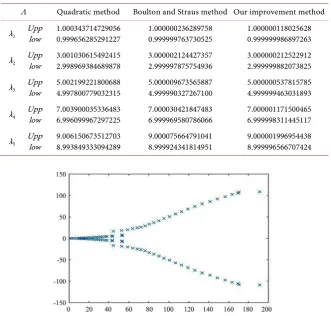
Figure 1 and Figure 2 show the conjugate pair for each eigenvalue with upper and lower bounds of eigenvalues in
Spec
2( )
6har .Trial 1: In this trial we use the Quadratic method, Boulton & Strauss method, and our improvement with: n = 200, L = 6, to find the first five approximation enclosure eigenvalues (upper and lower eigenvalues) of 6har, where
2L h
n
=
DOI: 10.4236/am.2019.104016 220 Applied Mathematics
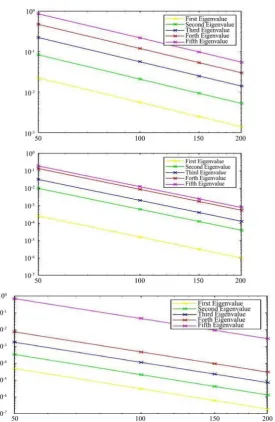
We calculate the Error between the exact and the lower bound for the first five approximation enclosure eigenvalues of 6har. error=exactj−λj. The slope of
[image:9.595.209.541.160.476.2]the graphs is close to the value (6) in all cases as n increases (Figure 3).
Table 1. Approximating enclosures for the first five eigenvalues of 6har with n =
200, λlow is the lower bound of the enclosing λ and λupp is the upper bound.
Λ Quadratic method Boulton and Straus method Our improvement method λ1 Upp low 1.000343714729056 0.999656285291227 1.000000236289758 0.999999763730525 1.000000118025628 0.999999986897263
λ2 Upp low 3.001030615492415 2.998969384689878 3.000002124427357 2.999997875754936 3.000000212522912 2.999999882073825
λ3 Upp low 5.002199221800688 4.997800779032315 5.000009673565887 4.999990327267100 5.000000537815785 4.999999463031893
λ4 Upp low 7.003900035336483 6.996099967297225 7.000030421847483 6.999969580786066 7.000001171500465 6.999998311445117
[image:9.595.263.480.522.687.2]λ5 Upp low 9.006150673512703 8.993849333094289 9.000075664791041 8.999924341814951 9.000001996954438 8.999996566707424
Figure 1. Second order spectra relative to Lhar. The horizontal axis is the real part of
the points in Spec2
(
6har,Lhar6)
and the vertical axis is imaginary part.Figure 2. Spec2
(
6har)
and illustration on the end pints of the segment given inDOI: 10.4236/am.2019.104016 221 Applied Mathematics
(a)
(b)
[image:10.595.258.488.63.595.2](c)
Figure 3. Approximating enclosures for the first five eigenvalues of 6har by the:
Quadratic, Boulton & Strauss, and Our improvement methods with n = 200, λlow is the lower bound of the enclosing λ and λupp is the upper bound. (a) This sub-figure shows the error between the exact and lower bound for the first five approximation ei-genvalues of 6har using the quadratic method; (b) This sub-figure shows the error
be-tween the exact and lower bound for the first five approximation eigenvalues of 6har
us-ing the Boulton & Strauss method; (c) This sub-figure shows the error between the exact and lower bound for the first five approximation eigenvalues of 6har using our
DOI: 10.4236/am.2019.104016 222 Applied Mathematics
7. Anharmonic Oscillator Model
The anharmonic oscillator is another model of Schrodinger equation in one di-mension. This model is one of the most important problems of quantum me-chanics.
We choose this model to show that the technique for both methods can be ap-plied to operator where the exact spectrum is not known.
Let 6anh =A, for
V x
( )
=
x
4 then; by Schrodinger equation we have( )
( )
4( )
anh
x
= −
u x x u x
′′
+
(7.1)And
anh( )
x
=
λ
u x
( )
(7.2) The exact eigenvalue is unknown.This equation can be solved explicitly and we can find the approximation ei-genvalues using Matlab program by matrices M, N, R where:
(
,
)
M
= Ψ Ψ
′ ′
4
,
N
=
x
Ψ Ψ
(
,
)
R
= Ψ Ψ
We compute
Spec
2(
6anh,
L
anh6)
, as in Figure 4.Trial 2: In this trial we use the Quadratic method, Boulton & Strauss method, and Our improvement technique with: n = 200, L = 6, to find the first five ap-proximation enclosure eigenvalues (upper and lower eigenvalues) of 6anh,
where
2L h
n
=
[image:11.595.206.539.539.746.2](see Table 2, Figure 5).
Table 2. Approximating enclosures for the first five eigenvalues of 6anh with n =
200, λlow is the lower bound of the enclosing λ and λupp is the upper bound.
Λ Quadratic method Boulton and Straus method
Our improvement
method λ1 Upp low 1.060362557981696 1.060361563013190 1.060362252449401 1.060362061273195 1.061066062252193 1.059658118801031
λ2 Upp low 3.799676880351021 3.799638443628093 3.799673918715551 3.799672602711578 3.797040801641494 3.797040801641494
λ3 Upp low 7.455732063205368 7.455606688132128 7.455701633603200 7.455694527185979 7.462745619537849 7.448650264962926
λ4 Upp low 11.644110613912629 11.644649763222517 11.644757012619969 11.644727274867936 11.659764086317372 11.629726975328792
DOI: 10.4236/am.2019.104016 223 Applied Mathematics
Figure 4. Second order spectra relative to L6anh. The horizontal axis is the real part of the
points in Spec2
(
6anh,L6anh)
and the vertical axis is imaginary part.Figure 5. Approximating enclosures for the first five eigenvalues of 6anh by the
DOI: 10.4236/am.2019.104016 224 Applied Mathematics
8. Conclusions
We compute
Spec
2(
6har,
L
har6)
andSpec
2(
6anh,
L
anh6)
, as we described beforeand calculate the eigenvalues enclosure. All the coefficient of the matrices 0, 1
and 2 were found analytically.
Figure 1 and Figure 4 show
Spec
2(
6har,
L
har6)
andSpec
2(
6anh,
L
6anh)
forvalue n = 200, clearly in both the second-order relative spectra is not the same. In Table 1 and Table 2 we show the approximation of the first five eigenva-lues enclosures of 6har, 6anh respectively, with n = 200 by three different
methods (Quadratic method, Boulton & Strauss method, and Our improvement) to compare between these methods and identify which one is more accurate for computing eigenvalues.
For the Harmonic oscillator model, the error between the approximation re-sults and the first five exact eigenvalues (1, 3, 5, 7, 9) in our technique is less than the error between the exact and the approximation eigenvalues by the Boulton and Strauss method, and the same thing between of the Quadratic method re-sults and the exact eigenvalues, so the approximation enclosure eigenvalues by our technique is more accurate and effective than the Boulton & Strauss method and the Quadratic method, also Figure 3 shows that clearly.
For the anharmonic oscillator model, the exact eigenvalues are unknown but by results and Figure 5, we can confirm the previous result.
Conflicts of Interest
The author declares no conflicts of interest regarding the publication of this pa-per.
References
[1] Kato, T. (1949) On the Upper and Lower Bounds of Eigenvalues. Journal of the Physical Society of Japan, 4, 334-339. https://doi.org/10.1143/JPSJ.4.334
[2] Strauss, M. (2013) The Second Order Spectrum and Optimal Convergence. Mathe-matics of Computation, 82, 2305-2325.
https://doi.org/10.1090/S0025-5718-2013-02693-2
[3] Boulton, L. and Strauss, M. (2011) On the Convergence of second order spectra and Multiplicity. Proceedings of the Royal Society A Mathematical Physical and Engi-neering Sciences, 467, 264-284. https://doi.org/10.1098/rspa.2010.0233
[4] Boulton, L. and Strauss, M. (2007) Stability of Quadratic Projectione Methods. Op-erators and Matrices, 17, 217-233. https://doi.org/10.7153/oam-01-15
[5] Boulton, L. and Hobiny, A. (2013) On the Quality of Complementary Bounds for Eigenvalues. Calcolo, 52, 577-601. https://doi.org/10.1007/s10092-014-0131-y
[6] Davies, E.B. and Plum, M. (2004) Spectral Pollution. IMA Journal of Numerical Analysis, 24, 417-438. https://doi.org/10.1093/imanum/24.3.417
[7] Davies, E.B. (1996) Spectral Theory and Differential Operators. Cambridge Univer-sity Press, Cambridge.
DOI: 10.4236/am.2019.104016 225 Applied Mathematics
393-416. https://doi.org/10.1093/imanum/24.3.393
[9] Boulton, L. and Levitin, M. (2007) On Approximation of the Eigenvalue of Per-turbed Periodic Schrodinger Operators. Journal of Physics A Mathematical and Theoretical, 40, 9319. https://doi.org/10.1088/1751-8113/40/31/010
[10] Boulton, L. and Hobiny, A. (2016) On the Convergence of the Quadratic Method. IMA Journal of Numerical Analysis, 36, 1310-1333.
https://doi.org/10.1093/imanum/drv036
[11] Boulton, L., Garcia del Moral, M.P. and Restuccia, A. (2012) Spectral Properties in Super Symmetric Matrix Models. Nuclear Physics B, 856, 716-747.