RESEARCH ARTICLE
THE PRACTICES OF INTEGRATIVE LANGUAGE TEACHING APPROACH AT AREKA PREPARATORY
SCHOOL: WITH PARTICULAR FOCUS ON THE IMPLEMENTATION OF THE APPROACH
TO TEACH ENGLISH LANGUAGE SKILLS
*Amarech Alaye and Wondimu Tegegne
Wolaita Sodo University, Ethiopia
ARTICLE INFO ABSTRACT
The main objective of the current study was to examine the practices teaching English language skills via integrative language teaching approach in the actual classroom situation. For this purpose, Areka Preparatory School was selected as a research setting. Descriptive research design was employed for the current study. Besides, systematic random sampling was used to select sample of students. To collect the necessary data for the study, semi-structured interview for six teachers, questionnaire for one hundred seventy students, classroom observation and document analysis were employed. To analyze the collected data, qualitative and quantitative methods of data analysis were employed. That is, data collected through questionnaires were analyzed employing statistical tools such as frequency and percentage using SPSS version 20, while responses obtained from interview was described and discussed. In addition, data obtained via document analysis and classroom observation were tallied and converted to numbers and analyzed to validate and substantiate the data obtained from interview and questionnaire. From the analysis of data, different findings were obtained. The study revealed that English language teachers use integrative language teaching approach when necessary and based on the topic being taught. Besides, it was found out that English language teachers use various techniques to teach language skills integratively. The findings of the study divulged that the majority teachers responded that they use cooperative teaching in integrative language classes. Based on the findings, conclusions are drawn and recommendations are forwarded to improve the implementation of integrative language skills teaching approach.
Copyright©2019, Amarech Alaye and Wondimu Tegegne. This is an open access article distributed under the Creative Commons Attribution License, which
permits unrestricted use, distribution, and reproduction in any medium, provided the original work is properly cited.
1.
Introduction and Rationale of the Study
An integrated language skills teaching approach is an approach whereby language skills are taught integratively. Oxford (2001) stated that the four English skills should not be taught in isolation but integratively in the classroom through an integrated approach. For example, by practicing conversational skills the learner can focus not only on speaking but also listening, in order to react and ask appropriate follow-up question (Matthew, 2012). Skill integration also happens when students are involved in project work, which may well involve examining through reading, listening, speaking (e.g. in discussions or when giving a presentation to the audiences and writing to submitting a report (Harmer, 2007 as cited in Elena and Lorena, 2011). This research describes how English language teachers teach the language skills integratively. In an age of globalization, the objectives of language skill learning and teaching is for meaningful communication and the development of learners‘ communicative competence (Hinkle, 2006). Meaningful communication requires the integration of the various language skills.
In the integrated language skills instruction, learners are exposed to authentic language and are involved in activities that are meaningful and interesting (Shen, 2003). The four macro English language skills are all an integral part of typical language proficiency and use. These language skills can also work together in language acquisition. Hence, language skills should be taught integratively. The phrase "integrated skills" is commonly used to describe curricula that develop the language skills in parallel fashion (Xue-Ping, 1997). Such perception leads to the development of the communicative or integrative language teaching approach. Jing (2006) stated that there are many situations in which more than one language skills are used to communicate in our daily life. He added that the integration of language skills leads the focus on realistic language use and can be helpful towards students’ all-round
development of communicative competence in language. The
other advantages of integrating language skills teaching encourage the learner to focus on the natural language and can, therefore, lead to the learners' broader development of
communicative competence in English (Jing, 2006). Besides,
Nunan (1989) argues that skills integration is an important feature of language learning, which appeals to interaction, task
ISSN: 0975-833X
International Journal of Current Research Vol. 11, Issue, 08, pp.6498-6504, August, 2019
DOI: https://doi.org/10.24941/ijcr.36515.08.2019
INTERNATIONAL JOURNAL OF CURRENT RESEARCH
Article History:
Received 24th May, 2019
Received in revised form 13th June, 2019
Accepted 20th July, 2019
Published online 31st August, 2019
Citation: Amarech Alaye and Wondimu Tegegne. 2019. “The practices of integrative language teaching approach at Areka Preparatory School: With particular focus
on the implementation of the approach to Teach English Language Skills”, International Journal of Current Research, 11, (08), 6498-6504.
Key Words:
Approach, Practices, English, Teaching, Implementation, Integrative, Language, Skills.
continuity, real world focus, language and learning focus, and task outcomes. In Ethiopia, for long years English language skills were taught discreetly, independently of each other (Yohannes and Mahlalela, 2015). Besides, all language skills were not taught equally, teachers emphasize on grammar oriented teaching methods in their language teaching. In otherwords, a great attention was given to the teaching of grammar and vocabulary and the other language skills were ignored and given less attention. Such a language teaching approach had produced language learners who mastered the knowledge of grammar and vocabulary, but who cannot use the language for different communicative functions (Shimels, 2012). In line with the global shift in the approach of language teaching and to overcome the problems of discrete(segregated) language teaching approach, Ethiopian Ministry of Education (MOE) introduced the integrative language teaching approach over two decades. The new English for Ethiopia' books now seem to be in contrast to the traditional, structural, grammar based materials which had been used in the country. The textbook and teachers' guide are also prepared in a way that language skills can be taught integratively. The new approach is intended to help students develop and use the language skills effectively for various real world purposes (MOE 1997 as cited in Lackachew, 2003). However, the envisioned objectives may not be achieved if the approach is not effectively used to teach the language skills. With this regard, this study was planned explore how English language teachers use integrative approach to teach language skills. As shown in the foregoing discussion, the integrative language skills was introduced in Ethiopia as a major language teaching approach before two
decades ago (Lackachew,2003). However, as far as the
knowledge of the researcher is concerned, research is not conducted on practices teaching language skills via integrative teaching approach at Wolaita Zone, specifically in Areka City Administration. This study, therefore, explores the teaching of English language skills via integrative approach. By doing so, the study will fill the felt research gap.
2. Objectives of the Study
The main objectives of this study were:
To explore how English language teachers implement the
integrative approach to teach English language skills.
To examine how often English language teachers practice
(implement) the integrative language skill teaching in the English language classroom.
To investigate the techniques used by English languageteachers to teach language skills integratively in the actual classroom situation.
3. Research Design and Methodology
3.1. Research Design: According to Best and Kahn (2003)
descriptive research design enables the researcher to examine the present situation and identify some of the major problems in the area of the study. In line with this, descriptive design was used to describe the current practices of integrative
language teaching approach. Besides, it was used to describe
how English language teachers implement integrative language teaching approach.
3.2 Research Setting: The study was carried out in Areka
Preparatory School. The school is located in South, Nations, Nationalities, and Peoples Regional State, Wolaita Zone,
Areka City Administration. This school is located at 29 kms away from Soddo Town. It is found 299 km away from Addis Ababa in the southern direction. Currently, it has 460 male and 249 female grade 11 students, totally 709; 519 male and 502 female grade 12 students, totally 1021; there were eight male teachers who teach these students. Besides, the school has one (1) director and three (3) vice directors; two guidance and counseling principals and eleven (13) administrative workers. The main reason for selecting this school was that there hasn’t been any research work conducted in the school on this research title. Furthermore, the school was selected because the researcher has been working there for four consecutive years. In this regard, the researcher believes that, it is easy to collect data. Therefore, the researcher selected the above mentioned school for its accessibility and convince to collect the necessary data for this study.
3.3. Participants of the Study: This study was intended to
assess the practices of integrative language teaching approach. Thus, English language teachers and students were selected as the major participants of this study. This is because it was believed that they can provide necessary data for the study. In this school, there are eight English language teachers who teach grade 11 and grade 12 students. All of them were selected as participants of the study. Furthermore In Areka Preparatory School, there are 10 grade 11 and sixteen grade 12 sections with a total of 709 and 1021 students respectively. Thus, all grade 11 and grade 12 students were taken as the participants of the study because it is believed that they can provide the data needed for the study. Furthermore, 66 students from grade 11 students and 110 from grade 12 students were selected as samples of this study using
systematic random sampling technique. Hence, 176 students
were selected as samples of the study.
3.4. Instruments for Data Collection: The data for this study were gathered through, questionnaire, classroom observation, interview and document analysis.
3.4.1 Interview: Interview semi-structured interview was designed to obtain necessary data from Areka Preparatory
English language teachers. The interview was used to
triangulate the data obtained from the questionnaire, classroom observation and document analysi. Thus, six English language teachers were interviewed. The interviews took place face-to-face and one interview meeting was used with one teacher only. The interactions were tape-recorded and played back during data analysis. Then, the recorded data were transcribed for analysis.
3.4.2 Questionnaire: Questionnaire was developed to collect data from students regarding the practices of integarative language teaching approach. The questionnaire was meant to explore how and how often English language teachers practice (implement) the integrative language skill teaching in the English language classroom. In order to make fit the questionnaire with the students’ level of understanding, it was prepared in English language and translated to Amharic language by the researcher (supposing that many students
speak and understand the language to minimize
misunderstanding), but the researcher gathered data using two versions of questionnaires (both Amharic and English questionnaires) depending on the interest of the students.
language teachers' lesson plans that were prepared in 2008 E.C were referred to for the purpose of this study. The lesson plans of English language teachers prepared at different times were assessed in order to check whether or not they plan to teach language skills in an integrative way. The researcher collected and assessed 72 lesson plans. To assess the lesson plans, checklist was prepared. The checklist focused on classroom instructional activities or techniques employed by teachers to teach language skills integratively, the role of teachers and learners played and instructional materials used in the teaching-learning process. The checklist was prepared in the form of yes or no items. Finally, the lesson plans were analyzed according to the checklist.
3.4.4 Classroom Observation: Classroom observation is an attempt to observe classroom interactions and events as they occur naturally and researcher try to combine it with questionnaires and interviews to collect relatively firsthand information (Burns, 1999 et.al). In this situation, Merriam (1998) also believed that classroom observation is a kind of data triangulation in order to validate the findings. As the result, in this research, classroom observation used to crosscheck whether teachers and students practice integrative language skill teaching in the actual classroom situations. Data collection from classroom observation took over two months period beginning with classroom observation of six teachers and their lesson for three times (a total of 126 minutes). However two teachers did not volunteered to be observed. Hence, the researcher has made 18 observations. The classroom observation was made in order to check whether or not English language teachers implement integrative language skills teaching in the actual classroom situation. The observation was made based on prepared checklist. The checklist assesses issues comprising on classroom instructional activities, techniques employed by teachers to integrate language skills and instructional materials used in the integrative language teaching approach. During the classroom observation, the researcher sat in the class and took short notes to record important activities that were performed in related to integrated language teaching. Moreover, those teachers teaching in their actual classroom situation were observed to get data on how English language teachers teach language skills integratively. Besides, data were gathered in the form of note taking to see how English language teachers implement integrative language skills teaching.
3.5. Methods of Data Analysis: To analyze the collected data, qualitative and quantitative methods of data analysis were employed. That is, the complete and consistent questionnaires were coded and filled in to SPSS. Then, different statistical analysis such as frequency and percentage was applied to SPSS data. The result of statistical analysis was presented in the table form. Finally, it was used to validate and substantiate the interview data. Besides, responses obtained from interview was described and discussed. In addition, data obtained via document analysis and classroom observation were tallied and converted to numbers and analyzed. During analysis, results
obtained from questionnaires, interview, classroom
observation and document analysis were presented
integratively in the way they can support and validate each other.
4.
Data Analysis and Discussion
4.1. The responses of English Language Teachers regarding Practices (Implementation) of Integrative
Language Teaching Approach: In the current situation,
language skills teaching recognize that, in meaningful and effective communication, educators use language skills in integrative way rather than segregated way. Because, all language skills are tied to each other and essential in successful classroom situation and in meaningful communication (Hinkel,
2001 et al.). With this regard, language teachers use different
techniques/ methods to teach language skills integratively. Thus, the objective of this study was to describe how English language teachers teach language skills integratively in the actual classroom situation. To achieve this purpose, English language teachers were asked which approach they use to teach English language skills. Accordingly, two different responses were forwarded. For example, T1, T2, T4, T5 and T6 replied that they teach language skills using both (integrative and segregated) approaches. Concerning this
question, T1 stated that;” I teach language skills using both
approach but mostly I use segregated approach". T2 also said
that, "I teach language skills using both approach but it is
difficult to say I implement integrative language teaching approach appropriately in the actual class room situation.
Similarly, T4 and T5 replied that, they use both approaches, however, mostly they use segregated approach. T4 expressed
that: “Mostly, I teach language skills in segregated way. But
some topics force me, to use language skills integratively. For example in listening lessons the instruction itself reveals integrative language teaching approach if one teacher can implement according to the instruction".
Teacher 5 added that, "I teach language skills discretely and sometimes I implement ILTA, when I follow the teachers’
guide and students’ textbook instruction". He added that,
students' textbook instruction and teachers guide show direction on how to teach language skills integratively. But, mostly I do not follow students textbook and teachers guide instruction. These instructions ordered students should be actively participate and a part of a teacher. On the contrary to the above responses, one of the teachers (T3) replied that ''I use integrative language teaching approach, especially after I start attending my second degree''. The above data revealed that most of the teachers use both (segregated and integrative language teaching approach). It is also noticed that the ELTs use ILTA when necessary and based on the topic being taught. On the contrary, one teacher reported that he uses mainly ILTA. This may imply that ILTA is being used by Areka Preparatory School teachers to teach English language skills not too frequently and as expected. This was confirmed through classroom observation. This means that almost all (14) observed lessons teachers teach language skills in segregated way. Besides, most (58) assessed Areka preparatory English language teachers lesson plans objective set were not prepared revealed to the integration of language skills. Hence, this finding agrees to Haimanot (2015). With regard Haimanot (2015) stated that teachers have positive attitudes towards integrative language teaching approach, however, they did not practices effectively in the actual classroom situation. Besides, English language teachers were asked how they teach language skills integratively. In response, English language teachers reported that they use various techniques to teach language skills integratively. They mentioned the following techniques:
Making students read a passage turn by turn and making
Making students discuss with their classmates about certain issues and prepare report on what they have discussed.
Giving comprehension questions, making to students to
discuss over the questions and report.
Providing a dialogue, one student asked a question, the
second student asking what the first student has said and others will report on what she/ he listened.
Providing unfamiliar topics like myths about HIV/AIDS
etc as mentioned in grade 11 students textbook in unit four. Because the topic is interesting they may be listen attentively, what teacher forward new things and give their attention towards the lesson. Hence, English language teachers use different techniques to teach language skills integratively.
Furthermore, English language teachers were asked what materials they use in the classroom in order to teach language skills integratively. In this regard English language teachers forwarded similar responses. In response, they responded that they use students textbook and teachers' guide. For example, T1 reported that:"Now a day's students' textbook and teachers' guide are designed in a way that promotes skill integration (especially grade 11 and 12). Therefore, these materials are useful. It also includes techniques of teaching two or more than two language skills together". In addition, he remarked that if one teacher follows all instructions that are found in the textbook and teachers' guide, he/ she can teach two or more than two language skills integratively in English language class, because, the instructions indicate how to teach grammar/vocabulary to other (listening, writing, speaking skills and etc. But "I myself I do not follow it because of various problems".
In addition, T2, T3, T4, T5 and T6 replied that they use familiar materials like chalk, black board only because the school has these materials. From the above discussion one can infer that Areka Preparatory School has not sufficient materials (audio visual, TV, charts) that is used to language skills integratively. Similarly, as the researcher observed classroom situations, none of them were using various materials to teach language skills. Besides, the researcher did not observed in all (18) classroom observations teacher use any material except students' textbook and teachers' guide. In this regard teachers' lesson plans also became an empirical evidence, in 67 lesson plans, there is no different materials that listed in addition to students’ text book and teachers’ guide that supports integrative language teaching approach that supported to teach language skills integratively. So, based on these empirical evidences Areka ELT did not use various materials except students textbook and other common materials (chalk, black board and duster only). Next the researcher asked ELT about what activities they use to teach language skills integratively. In this regard, Areka Preparatory School English language teachers replied that they use different activities to teach language skills integratively.
Listening activities, speaking activities, reading
activities and writing activities.
Reading activities; to make notes and report to the
class.
Listening activities; to summarize the large text and
ordered to take note and new words (vocabulary).
Group discussion
Individual explanation and idea sharing
From this discussion, it can be concluded that Areka preparatory School teachers use different techniques and activities to teach language skills integratively. With this
regard, Aneeela, (2012) remarks that an effective
communicative class is supposed to be involving the integration of the language skills, in which the teacher needs to establish a positive atmosphere, plan appropriate activities, encourage learners and deal with problems sensitively. On the contrary, the activities used by ELT mentioned above like role play and summarize the text, ordered to take note and new words(vocabulary) from reading activities, none of teachers carry out these activities during the observing the actual classroom situation. In addition to this, none of the teachers stated these activities (role play and summarizing the text) in their lesson plan to teach language skills.
4.3.2 The Responses of Students about the Practices of Integrative Language Teaching Approach in Their School (ILTA)
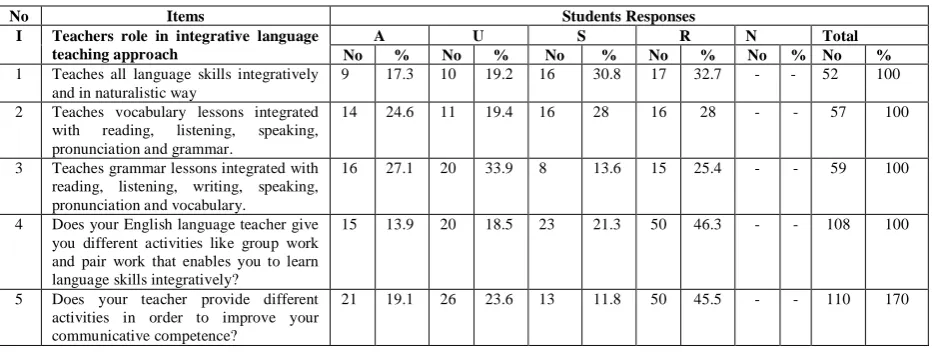
Table 1, presents students responses about how do English language teachers implement integrative language teaching approach. As depicted in item 1 (see Table 1), 116(68.2%) students responded English language teachers do not teach language skills conjugated one another. But 52 (30.6%) students said English language teachers teach the language skills in an integrated way. The remaining, 2(1%) students replied they are not sure whether or not their English language teachers teach all language skills integratively. In item 2 (see Table 1), 112( 65.9%) students reported English language teachers do not teach vocabulary lessons integrated with reading, listening, pronunciation and grammar. However 57(33.5%) students replied their teachers teach vocabulary by integrating with other language skills. The remaining, 1(0.6%) students stated that he/she is not sure if his/ her ELT teach vocabulary lesson with grammar, pronunciation and other language skill. From the responses to item 1 and 2, it can be deduced that English language teachers do not teach language skills integratively. In response to item 3(see Table 1), which deals with whether or not English language teachers teach grammar lessons by integrating with reading, listening, writing, speaking, pronunciation and vocabulary, 111(65.3%) students revealed that their ELT do not teach grammar with the above listed language skills. The remaining, 59 (34.7%) students replied that their teachers teach grammar lesson with these language skills. In item 4 (see Table 1) students were asked whether or not their ELT give different activities like group work and pair work that enables them to learn language skills integratively. Accordingly, 108 (63.5%) students said ELT give different activities like group work and pair work to teach language skills integratively. However, the remaining,
62(36.5%) students reported that ELT do not give these
This implies that teachers understanding about the teaching learning process of ILTA and their practice is incompatible. With this regard Alemayehu (2008) concluded English teachers know the theory of how to teach language skills integratively but they do not practically implement their theoretical knowledge. In response to item 5 (see Table 1), 110 (64.7%) students replied that activities provide by their English
language teachers were essential to develop their
communicative competence. But 59 (34.7%) students
responded that their ELT do not provide different activities to improve their communicative competence. The remaining, 1 (0.6%) student replied that he/she is not sure whether activities that were given by their English language teachers help to develop his/her communicative competence. Generally, as has been said above, the results obtained from teachers interview and students questionnaire, teachers use group and pair work to teach language skills integratively, however the researcher observed four(4) lesson only teachers use these activities to teach language skills and their lesson plan almost all teachers do not include pair work and group work. This result clearly shows that (response for the classroom activities and lesson plan), there was a certain controversy. But, as scholars (confirmed that classroom observation and document analysis use as to gather actual data used as empirical evidence. Thus, this result implies that most Areka preparatory School ELT did not use frequently use pair work and group work to teach language skills integratively. Table 2 summarizes the responses of student on their English language teachers' role during integrative language teaching approach and how often their English language teachers teach language skills by integrating each other.
As can be seen from Table 2 item 1, 9 (17.3%) students responded that their ELT always teach language skills integratively and in naturalistic way, 10(19.2%) students said that ELT usually teach language skills integratively. But, 16 (30.8%) students replied that their teachers sometimes teach language skills in integrative way and 17 (32.7%) the students stated that their teachers rarely teach language skills
integratively and in naturalistic way.These responses revealed
[image:5.595.64.534.69.237.2]that to some extent English language teachers teach language skills integrtaively, but they do not use ILTA frequently, because great number of students confirmed that they rarely teach language skills in integrative way. Similarly, during the researcher interviewed most of the teachers stated that they teach language skills using both (ILTA and SLTA). But they mostly use SLTA. For example, one of the teachers said that "I teach language skills through both approaches". Because most macro language skills are related to each and difficult to divorcé each other". This implies that purposefully, he does not plan to teach language skills integratively. During classroom observation, majority of the teacher write note and give explanation to the students. As a result, the researcher observed four observations English language teachers tried to teach language skills associated to each other. On the contrary, 14 observations were focused on grammar parts and its objective were to state the form of grammar. In this regard teachers write note on the board and students also write what their teacher writes. This result revealed that Areka Preparatory School English language teachers used segregated approach to teach language skills. In Table 2 (see item 2), 14 (24.6%) students replied that their English language teachers always teach vocabulary by integrating it to the other language
Table 1. Students Responses on their English Language Teachers Practice ILTA
No Items Students Responses
Yes No Not sure Total
No % No % No % No %
1 Does your teacher teach all language skills (speaking, reading writing, listening, vocabulary, grammar and pronunciation) in an integrative way?
5 2 30.6 116 68.2 2 1.2 170 100
2 Does your English language teacher teach vocabulary lessons integrated with reading, speaking, writing listening, pronunciation and grammar ?
57 33.5 112 65.9 1 0.6 170 100
3 Does your English language teacher teach grammar lessons integrated with reading, listening, writing, speaking pronunciation and vocabulary?
59 34.7 111 65.3 - - 170 100
4 Does your English language teacher give you different activities like group work and pair work that enables you to learn language skills integratively?
108 63.5 62 36.5 - - 170 100
5 Does your teacher provide different activities in order to improve your communicative competence?
[image:5.595.65.533.263.439.2]110 64.7 59 34.7 1 0.6 170 100
Table 2. The Responses of Students on how often their English Language Teachers Teach Language Skills Integratively
No Items Students Responses
I Teachers role in integrative language teaching approach
A U S R N Total
No % No % No % No % No % No %
1 Teaches all language skills integratively and in naturalistic way
9 17.3 10 19.2 16 30.8 17 32.7 - - 52 100
2 Teaches vocabulary lessons integrated with reading, listening, speaking, pronunciation and grammar.
14 24.6 11 19.4 16 28 16 28 - - 57 100
3 Teaches grammar lessons integrated with reading, listening, writing, speaking, pronunciation and vocabulary.
16 27.1 20 33.9 8 13.6 15 25.4 - - 59 100
4 Does your English language teacher give you different activities like group work and pair work that enables you to learn language skills integratively?
15 13.9 20 18.5 23 21.3 50 46.3 - - 108 100
5 Does your teacher provide different activities in order to improve your communicative competence?
skills (reading, speaking writing, listening, grammar and pronunciation) and 11(19.4%) students stated that they usually teach vocabulary with integration to the above mentioned language skills. On the other hand, 16 (28%) and 16 (28%) students reported that ELT rarely and never teach vocabulary by integrating it to the other language skills. Additionally, during classroom observation almost all vocabulary lesson was not integrated with other language skills especially grammar and pronunciation skills. The researcher did not observed teachers articulate his students’ speech and teach grammar during vocabulary lessons. Besides, in 18 lesson plans teachers do not prepared to teach vocabulary with macro language skills and other language skills such as such pronunciation, spelling and grammar), 5 lesson plans were prepared vocabulary lesson associated to other language skills. This result implies that vocabulary is not frequently integrated with other language skills. In item 3 (see Table 2) the students were asked whether or not their ELT integrate grammar lessons with other language skills. In response, 16 (27.1%) students replied that their English language teachers always teach grammar lessons by integrating with reading, listening, speaking, writing, vocabulary and pronunciation, while 20 (33.9%) students said that their English language teachers usually teach grammar with the above listed language skills. The rest, 8 (13.6%) students reported that their English language teachers sometimes teach and 15(25.4%) students said that they rarely teach grammar with the above language skills. Similarly, during my interview with preparatory English language teachers, they reported that they teach each skill in different lessons.
For example, T2 said that mostly "I teach grammar lesson with
giving appropriate notes, but it is difficult to rehearsed
different activities related to the topic". Moreover, ELT
prepared their lesson plan focus in one lesson, one language skill. For example, in grammar lesson almost all teachers state their role to write note and give explanation for their students as well as students’ role to take note and listen attentively. This implies that grammar lessons is not integrated with the above
stated language skill. As revealed in item 4, among the
students who reported that they were given different classroom activities by their ELT, 15(13.9%) students responded that their English language teachers always give them different
classroom activities which helps to improve their
communicative competence and 20(18.5%) students replied that their teachers usually give different activities. Besides, 23(21.3%) and 50(46.3%) students said that their English language teachers give classroom activities sometimes and rarely respectively. Similarly, the result of the classroom observation revealed that most teachers do not give much emphasis for different activities, the students follow what their teacher do. Furthermore, in document analysis almost all teachers plan to teach grammar and vocabulary lessons. This result indicates that there exists a discrepancy between what teachers understand about ILTA and what they really practice it. On the contrary Areka preparatory teachers replied that they use different activities to teach language skills integratively and to improve students’ communicative competence. However, the result of class room observation obtained from instructional activities implies that the majority of teachers do not giving due attention for integrative language skill teaching activities rather they focused on grammar based classroom practices. Therefore, the results obtained from the students response and classroom observation for the classroom activities imply that most teachers tend to favor employing
traditional ways teaching language skills contrary to what they perceive and believe about the integrative language teaching approach. This result clearly point out that most teachers tend to employ with traditional ways of language teaching and they did not use different activities. In item 5 (see Table 2), 21(19.1%) students said that their English language teachers always give group and pair work to teach language skills integratively and 26(23.6%) students responded that their teachers usually provide activities to perform with group members. Besides, 13(11.8%) students said that their ELT sometimes give different group/pair work in the actual classroom situation. On the other hand, 50(45.5%) students reported that their ELT rarely give group work to teach language skills integrative way.
This shows that Areka Preparatory School English language teachers do not frequently use group work in the language skill teaching process. However, scholars like Oxford, 2001 recommend in interactive lessons group work/ pair are often used to increase students’ interaction and collaboration. Similarly, the data obtained from the teachers’ interview, most teachers believed that pair work and group work are very essential to teach language skills. However they do not give frequently pair/group work to teach language skills. Besides, during classroom observation the researcher observed almost all teachers follow the same style i.e. teacher centered method rather than giving various activities to the students and create interactive language classes. Furthermore, the analysis of group work revealed that in most ELT teachers’ lesson plan, they did not frequently planed group and pair work used to teach language skills. Regarding to this, 21 teachers lesson plan includes pair work, in fifty one (51) lesson plans the teachers did not use pair work to teach language skills. Besides, in 13 lesson plans English language teachers prepared their lesson plan to teach language skills via pair work and forty nine (49) lesson plans were prepared to teach language skills via group work. This shows that Areka Preparatory teachers did not much emphasis to organized the students in order to teach language skills integratively. Generally, the data gathered from teachers’ interview, students’ questionnaire and document analysis, most teachers do not emphasized group/ pair work. They focus on grammar parts rather than other language skills. Besides, this result clearly shows that there is a certain controversy between teachers believe towards their role and their actual classroom practices.
5. Conclusion
Regarding teachers’ practice of integrative language teaching approach the following findings were obtained:
The study revealed that most of the teachers use both
teachers to teach English language skills, but is not frequently and as expected.
This study revealed that English language teachers use
various techniques to teach language skills integratively. They give chance for their students to engage different activities like reading passage, involving in dialogue and providing unfamiliar topics to discuss with their classmates to teach language skills integratively. Whereas, most students answered that their teachers did not frequently give different activities to teach language skills integratively in order to improve their communicative competence. This result confirmed by classroom observation. This means during classroom observation the above mentioned activities were not employed by teachers in the actual classroom context. This imply that most teachers tend to favor employing traditional ways of teaching language skills contrary to what they perceive and believe about the integrative language teaching approach. Hence, the result clearly point out that most teachers tend to employ with traditional ways of language teaching style.
The findings of the study divulged that the majority
teachers responded that they use cooperative teaching in integrative language classes. Most student also said that teachers use cooperative teaching in integrative classroom context. On the contrary, data obtained from classroom observation revealed that most teachers did not frequently use cooperative learning to teach language skills integratively. This result also confirmed by teachers’ lesson plans. In teachers lesson plan almost all teachers do not planed organizing their students to teach language skills cooperatively. This implies that teacher understanding about the teaching learning process of ILTA and their practice is not compatible.
As the result of the study showed, almost all teachers
teach language skills in lecturing methods. Here small number of teachers and students said that they give pair and group work to teach language skills in the actual classroom situation and during classroom observation the researcher did not frequently observed teachers use these activities to teach language skills. Teacher lesson plan also shows that small number of teachers planned to organize their students in pairs or groups to teach language skills integratively. Thus, this result implies that most Areka preparatory English language teachers did not use frequently pair work and group work to teach language skills integratively.
6. Recommendations
On the basis of the findings and the conclusions, the following recommendations were made.
From teachers interview it was observed that almost all
of them did not get training on integrative language teaching approach (current language teaching methods). This hinders their implementation of integrative language teaching method. Therefore, Areka town administration education office in collaboration with Wolaita Zone education desk and universities in the catchment areas should provide training regarding ILTA to the School English teachers.
It would be helpful if teacher training institutions
(colleges and universities) be aware of the gap between the teachers’ theoretical knowledge of integrative language teaching approach and their classroom practices. So, they should train teachers on both the theoretical and practical aspects of integration of language skills in the actual classroom situation.
As presented in the findings, some teachers said that
they are not motivated to teach language skills in integrated way and most students are not interested to be involved in different activities. This really affects the practice of integrative language teaching approach. Thus, teachers should be interested and motivated to teach the language skills integratively. Besides, it is advisable for teachers to motivate their students to in engage in integrative language teaching activities in class room discussion.
7. REFERENCES
Best, W.J. and V.J. Kahn (7thed) 2003. Research in Education
(10th ed). New Delhi: Prentice-Hall of India pvt. Ltd.
Burns, A. 1999. Collaborative action research for English language teachers. Cambridge: CUP.
Haimanot, M. 2015. An Assessment of the integrated English teaching practice with reference to Delachin Secondary
School, Addis Ketema. MA thesis. Addis Ababa.
University.
Hinkel, E. 2001. Building awareness and practical skills for cross-cultural communication in ESL/EFL. In M.
Celce-Murcia (Ed.), Teaching English as a second or foreign
language (3rd ed., pp. 443–458). Boston: Heinle &
Heinle.
Hinkel, E. 2006. Current perspectives on teaching the four
skills. TESOL Quarterly, 40, 109-131.
Jing, W. 2006. Integrating Skills for Teaching EFL -Activity Design for the Communicative Classroom. Journal of
Sino-US English Teaching. 3(12) (Serial No.36).
Lakachew, M. 2003. Teachers‟ Attitude towards
Communicative Language Teaching and Practical
Problems in its Implementation. M.A. Thesis. Addis Ababa University.
Matthew, R. 2012. Ranking the four skills how Asia university freshmen view their English ability.
Nunan, N. 1989. Designing tasks for communicative classroom. Cambridge: CUP.
Oxford, R. 2001. Integrated skills in the ESL/EFL classroom.
ERIC digest ERIC Clearinghouse on Languages and
Linguistics.
Shen, Y. 2003. Teaching postgraduate English as international
communication. International Association of Teachers of
English as a Foreign Language News Letters, Issue 170.
Shimels, A. 2012. Assessing the implementation of
communicative language teaching for English language
teachers in Ethiopian universities.16 (1), 51 -69
Xue-Ping, G. 1997. A scheme for the obtaining of language
skills. The Internet TESL Journal, 3(6).
Yohannes Tefera and Mahlalela, B. V. 2015. The Extent to which Integrated Skills Language Teaching/Learning Approach is depicted in Grade 9 English Textbook.
Ethiop. J.Soci.Lan.Stu. 2(1)81-93.