A STUDY ON COMPLICATIONS OF DIABETES MELLITUS AND ITS MANAGEMENT MEASURES
*1
Tabasum Unnisa
1
Student of M.Sc nutrition and dietetics, Anwar Ul Uloom PG College,
2
Assistant Professor, Department of nutrition and dietetics, Anwar Ul Uloom, PG College,
Affiliated to Osman
ARTICLE INFO ABSTRACT
Diabetes mellitus is a major metabolic disorder. The acute and chronic complications of diabetes mellitus are major cause of blindness, renal failure, limb amputations, stroke, coronary heart diseases, diabetic foot, hypertension and other complications.
evidence for the crucial role of prolonged hyperglycaemia induce damage of the kidneys, eyes, nerves and arteries still remains to be observations. Studies shows that the occurrence and progression of these
dyslipidaemia. Lifestyle changes such as weight control, increase physical exercise and smoking cessation are also potentially beneficial in preventing diabetes mellitu
mortality caused by diabetes mellitus can be reduced by secondary prevention such as regular screening, early detection and appropriate treatment of chronic complications are improved. Diabetes education is needed among diabet
the primary and secondary prevention of diabetic complications. Compiled data was subjected through graphical representation and statistical analysis. The study was conducted with sample s 150 among males and female. Questionnaires were used for survey and chi
57% of the male subjects knew diabetic nephropathy, and the remaining 43% were unaware of the same. Coming to female subjects, 69% of them were of them
the remaining 31% weren’t aware of it. 72% of the male subjects reported they knew diabetic retinopathy and the remaining 28% of the male subjects were unaware of the same. Coming to female subjects, 57% of them repor
know about it. 63% of the male subjects were aware that diabetes is the cause for heart diseases while the remaining 37% weren’t. In the same manner 57% of the female subjects were aware
is the cause for heart diseases and the left 43% were unaware of it. Awareness was created among diabetic people through poster regarding proper dietary habits, regular exercise, regular blood sugar levels and knowledge regarding acute and c
Copyright © 2018, Tabasum Unnisa and Tanveer Fatima
permits unrestricted use, distribution, and reproduction
INTRODUCTION
Diabetes mellitus is a major source of morbidity, mortality and economic cost to society. Patients with diabetes are at risk of the development of acute and chronic complications such as diabetic ketoacidosis, hypoglycaemic etc. and chronic complication such as nephropathy, retinopathy, neuropathy, heart diseases, infections etc.
Acute complications of diabetes
1. Hypoglycaemia: Hypoglycaemia is insulin shock. This may take place in patient who are receiving insulin wherever
*Corresponding author:Tabasum Unnisa,
Student of M.Sc nutrition and dietetics, Anwar Ul Uloom PG College, Affiliated to Osmania University, Hyderabad, India
ISSN: 0975-833X
Article History:
Received 21st January, 2018 Received in revised form 27th February, 2018 Accepted 29th March, 2018 Published online 30th April, 2018
Citation: Tabasum Unnisa and Tanveer Fatima, Journal of Current Research, 10, (04), 68421-68426.
Key words:
Diabetes Mellitus, Nephropathy, Retinopathy, Heart disease, Hypertensions.
RESEARCH ARTICLE
A STUDY ON COMPLICATIONS OF DIABETES MELLITUS AND ITS MANAGEMENT MEASURES
Tabasum Unnisa and
2Tanveer Fatima
Student of M.Sc nutrition and dietetics, Anwar Ul Uloom PG College, Affiliated to Osman
Hyderabad, India
Assistant Professor, Department of nutrition and dietetics, Anwar Ul Uloom, PG College,
Affiliated to Osmania University, Hyderabad, India
ABSTRACT
Diabetes mellitus is a major metabolic disorder. The acute and chronic complications of diabetes mellitus are major cause of blindness, renal failure, limb amputations, stroke, coronary heart diseases, diabetic foot, hypertension and other complications. Recent studies has provided with an unequivocal evidence for the crucial role of prolonged hyperglycaemia induce damage of the kidneys, eyes, nerves and arteries still remains to be observations. Studies shows that the occurrence and progression of these complications were prevented by the optimal control of blood glucose, hypertension and dyslipidaemia. Lifestyle changes such as weight control, increase physical exercise and smoking cessation are also potentially beneficial in preventing diabetes mellitu
mortality caused by diabetes mellitus can be reduced by secondary prevention such as regular screening, early detection and appropriate treatment of chronic complications are improved. Diabetes education is needed among diabetes populations. An adequate healthcare resources were allocated for the primary and secondary prevention of diabetic complications. Compiled data was subjected through graphical representation and statistical analysis. The study was conducted with sample s 150 among males and female. Questionnaires were used for survey and chi
57% of the male subjects knew diabetic nephropathy, and the remaining 43% were unaware of the same. Coming to female subjects, 69% of them were of them were aware of diabetic nephropathy and the remaining 31% weren’t aware of it. 72% of the male subjects reported they knew diabetic retinopathy and the remaining 28% of the male subjects were unaware of the same. Coming to female subjects, 57% of them reported they knew about diabetic Retinopathy and the remaining 43% didn’t know about it. 63% of the male subjects were aware that diabetes is the cause for heart diseases while the remaining 37% weren’t. In the same manner 57% of the female subjects were aware
is the cause for heart diseases and the left 43% were unaware of it. Awareness was created among diabetic people through poster regarding proper dietary habits, regular exercise, regular blood sugar levels and knowledge regarding acute and chronic complications.
Tabasum Unnisa and Tanveer Fatima. This is an open access article distributed under the Creative in any medium, provided the original work is properly cited.
Diabetes mellitus is a major source of morbidity, mortality and economic cost to society. Patients with diabetes are at risk of the development of acute and chronic complications such as sis, hypoglycaemic etc. and chronic complication such as nephropathy, retinopathy, neuropathy,
Hypoglycaemia is insulin shock. This ng insulin wherever
Student of M.Sc nutrition and dietetics, Anwar Ul Uloom PG College, Affiliated to Osmania University, Hyderabad, India.
there is imbalance between diet and insulin dosage, or it may because due to delay in eating, omission of food or loss of food by vomiting and diarrhoea. In some patients excessive exercise may also cause symptoms of insulin shock.
2. Diabetic Acidosis and coma: ketoacidosis as it is known, is also
level of ketones in the blood, feeling of weakness, headache, anorexia, pain in the abdominal region.
Chronic complications of diabetes
1.Infections: In diabetics, cuts and wound healing is delayed in diabetics because of neuropat
Ischemia. They are prone to tuberculosis and infections of the skin, urinary tract and foot.
International Journal of Current Research
Vol. 10, Issue, 04, pp.68421-68426, April, 2018
, 2018. “A study on complications of diabetes mellitus and its management measures
A STUDY ON COMPLICATIONS OF DIABETES MELLITUS AND ITS MANAGEMENT MEASURES
Affiliated to Osmania University,
Assistant Professor, Department of nutrition and dietetics, Anwar Ul Uloom, PG College,
Diabetes mellitus is a major metabolic disorder. The acute and chronic complications of diabetes mellitus are major cause of blindness, renal failure, limb amputations, stroke, coronary heart diseases, Recent studies has provided with an unequivocal evidence for the crucial role of prolonged hyperglycaemia induce damage of the kidneys, eyes, nerves and arteries still remains to be observations. Studies shows that the occurrence and progression complications were prevented by the optimal control of blood glucose, hypertension and dyslipidaemia. Lifestyle changes such as weight control, increase physical exercise and smoking cessation are also potentially beneficial in preventing diabetes mellitus. Furthermore, morbidity and mortality caused by diabetes mellitus can be reduced by secondary prevention such as regular screening, early detection and appropriate treatment of chronic complications are improved. Diabetes es populations. An adequate healthcare resources were allocated for the primary and secondary prevention of diabetic complications. Compiled data was subjected through graphical representation and statistical analysis. The study was conducted with sample size of 150 among males and female. Questionnaires were used for survey and chi-square test was applied. 57% of the male subjects knew diabetic nephropathy, and the remaining 43% were unaware of the were aware of diabetic nephropathy and the remaining 31% weren’t aware of it. 72% of the male subjects reported they knew diabetic retinopathy and the remaining 28% of the male subjects were unaware of the same. Coming to female ted they knew about diabetic Retinopathy and the remaining 43% didn’t know about it. 63% of the male subjects were aware that diabetes is the cause for heart diseases while the remaining 37% weren’t. In the same manner 57% of the female subjects were aware that diabetes is the cause for heart diseases and the left 43% were unaware of it. Awareness was created among diabetic people through poster regarding proper dietary habits, regular exercise, regular blood sugar
Creative Commons Attribution License, which
there is imbalance between diet and insulin dosage, or it may to delay in eating, omission of food or loss of food by vomiting and diarrhoea. In some patients excessive exercise may also cause symptoms of insulin shock.
Diabetic Acidosis and coma: Diabetic acidosis or ketoacidosis as it is known, is also characterized by elevated level of ketones in the blood, feeling of weakness, headache, anorexia, pain in the abdominal region.
Chronic complications of diabetes
In diabetics, cuts and wound healing is delayed in diabetics because of neuropathy, hyperglycaemic and Ischemia. They are prone to tuberculosis and infections of the
INTERNATIONAL JOURNAL OF CURRENT RESEARCH
2.Cataract and retinopathy:Prevalence of diabetic retinopathy, especially in middle-aged and elderlypeople, causing visual disability. Risk of blindness in older persons which is indicated by deposition of white exudate and haemorrhage or by oedematous swelling of retinal tissues. Cataracts and other eye diseases occur earlier and more often in diabetic than non-diabetic.
3.Nephropathy: Diabetic nephropathy is one of the chronic vascular complications of diabetes, which tends to develop after severely years of diabetes and result in progressive loss of kidney functions and face an increased risk of death. During the early stages of diabetic nephropathy, there are usually no symptoms. As the condition progresses, individuals with diabetic nephropathy may show oedema of the feet and legs. Later oedema may occur throughout the body increase in blood pressure, larger amounts of protein leaking into the urine and elevated levels of cholesterol and triglycerides occur in the blood. Once the kidneys are severely damaged, blood sugar levels may drop because the kidneys retain insulin in the body. In late stages, patients become severely anaemic, breathe less and serum potassium levels may rise, necessitating urgent dialysis.
4.Neuropathy: The term diabetic neuropathy includes either a clinical or subclinical neuropathy other disorder without any additional causes of peripheral neuropathy other than diabetes. Damage to nerve fibres conducting sensation and blood vessels as well as viscera is the most common complication of diabetes Diabetic neuropathy is encountered in about half of the people with diabetes either as a polyneuropathy or mononeuropathy especially in patients over 60 years age with T2DM.
5.Heart disease: Diabetes affects the blood vessels, the blood and the heart. Diabetes increase the risk of heart disease by 3 to 4 fold. The susceptibility of the diabetic to atherosclerosis is due to several factors. Atherosclerotic disease of the small arteries in diabetic is responsible for the high incidence of claudication and gangrene in the lower limbs, and for cerebral infarction, stroke and diffused cerebral disease. All diabetics who have had the disease for at least 10 years, irrespective of the age of onset are likely to have clinically significant atherosclerosis.
6.Gastroparesis: Gastroparesis is also called delayed gastric emptying. It result in food remaining in the stomach for a longer period of time than normal Gastroparesis may occur when the vague nerve is damage and the muscles of the stomach and intestines do not work normally.
7.Female infertility: is more common in women with diabetes type 1, despite modern treatment, also delayed puberty and menarche, menstrual irregularities (especially, oligo menorrhoea), mild hyperandrogenism, polycystic ovarian syndrome, fewer live born children and possibly earlier menopause.
8.Abnormal immune responses: The immune response is impaired in individuals with diabetes mellitus. Cellular studies have shown that hyperglycaemia both reduces the function of immune cells and increases inflammation.
II. Objectives
A. The study will be undertaken with the aim to assess awareness regarding diabetic complications.
B. To assess the association between diabetic complications. To reduce the mortality, morbidity, disability from diabetic complications.
C. To prevent awareness programme on progression. To assess the level of knowledge regarding complications of diabetes mellitus.
D. To improve the quality of life among diabetic patients through questionnaires.
E. To subject the collected data in a graphical representation and chi square statistical analysis.
MATERIALS AND METHODS
Methodology of the present study were discussed under the following heads:
Research design
Selection of the area
Selection of the sample
Size of the sample
Data collection
Research design
Premier hospital and Dr. Modi diabetic clinic were selected as the area of the study.
Random sampling was conducted.
Size of the sample was 150 in numbers.
Data collection was done through questionnaire as a tool.
After data collection, the data were analysed.
Selection of the area: Samples were selected from premiere hospital at Nanal Nagar, Dr. Modi diabetic clinic at Mehdipatnam.
Selection of the sample: Diabetic people were selected randomly.
Size of the sample: Through the random sampling 150 subjects were selected for the survey.
Data collection tools of the survey
A well designed questionnaires were used as a tool for collection of the data.
The questionnaires included questions related to:
General information
Height, weight and blood sugar levels
Eating habits
Physical activity
Awareness questions
Information Collection: The information required for the study was collected by using questionnaires, used to collect the information were developed in English. The objectives of the study were kept in mind while constructing the questionnaires. It consists of both close and open questions with multiple choices.
General information: The General information was collected to get the following details like personal information of the responded viz, name, age, gender, occupation.
Awareness information: It included questio
open type. The questions were regarding dietary choice, physical activity required per day risk factors associated to complications of diabetes.
Data analysis: Data was collected, consolidated and subjected to statistical analysis using statistical measures such as chi square test, mean, graphical representation.
Chi square was applied, whose formula is given below:
Where,
O = observed value E = expected value Eij = R × C ÷ N
RESULTS AND DISCUSSIONS
Table 1. Diagnosis of types of diabetes
Diagnosis Male
frequency
Male % Female
frequency
Yes 62 91 64
No 6 9 18
Total 68 100 82
Figure 1. diagnosis of types of diabetes
DISCUSSION
From the above figure, it is shown that 91% males have knowledge of what type of diabetes they were diagnosed with, unlike the remaining 9% who don’t know the same. In the same way 78% females know what type of diabetes they were diagnosed with and the remaining 22% were unaware of it. Thus it can be concluded that more amount of people know what type of diabetes they were diagnosed with.
NOTE: - The chi-square statistic is 6.4516. The .011085. The result is significant at p<.05.
Table 2. knowledge of diabetic nephropathy
Knowledge of diabetic nephropathy
Male frequency
Male % Female
frequency
Yes 39 57 26
No 29 43 56
Total 68 100 82
It included questions of close and open type. The questions were regarding dietary choice, physical activity required per day risk factors associated to
Data was collected, consolidated and subjected to statistical analysis using statistical measures such as chi-
Chi square was applied, whose formula is given below:
Table 1. Diagnosis of types of diabetes
Female frequency
Female %
78 22 100
Figure 1. diagnosis of types of diabetes
From the above figure, it is shown that 91% males have knowledge of what type of diabetes they were diagnosed with, unlike the remaining 9% who don’t know the same. In the same way 78% females know what type of diabetes they were and the remaining 22% were unaware of it. Thus it can be concluded that more amount of people know what type of diabetes they were diagnosed with.
square statistic is 6.4516. The p-value is
Table 2. knowledge of diabetic nephropathy
Female frequency
Female %
26 31
56 69
82 100
Figure 2. Knowledge of diabetic nephropathy
DISCUSSION
From the above figure it is shown 57% of the male subjects knew diabetic nephropathy, and the remaining 43% were unaware of the same. Coming to female subjects, 69% of them were of them were aware of diabetic nephropathy and the remaining 31% weren’t aware of it.
Category Yes
Male 57 (44.00) [3.84] 43 (56.00) [3.02]
Female 31 (44.00) [3.84] 69 (56.00) [3.02] Column
totals
88
NOTE: - The chi-square statistic is 13.7175. The result is significant at p< .05.
Table 3. Knowledge of diabetic retinopathy
Knowledge diabetic retinopathy
Male frequency
Male %
Yes 49 72
No 19 28
Total 68 100
Figure 3. Knowledge
DISCUSSION: From the above figure it is shown that 72% of the male subjects reported they knew diabetic retinopathy and the remaining 28% of the male subjects were unaware of the same. Coming to female subjects, 57% of them reported they knew about diabetic Retinopath
know about it.
Knowledge of diabetic nephropathy
above figure it is shown 57% of the male subjects knew diabetic nephropathy, and the remaining 43% were unaware of the same. Coming to female subjects, 69% of them were of them were aware of diabetic nephropathy and the remaining 31% weren’t aware of it.
No ROW TOTALS
43 (56.00) [3.02] 100
69 (56.00) [3.02] 100
112 200 (GRAND
TOTAL) square statistic is 13.7175. The p-value is .000212. The
Table 3. Knowledge of diabetic retinopathy
Male % Female
frequency
Female %
72 47 57
28 35 43
100 82 100
Knowledge of diabetic retinopathy
DISCUSSION: From the above figure it is shown that 63% of the male subjects were aware that diabetes is the cause for heart diseases while the remaining 37% weren’t. In the same manner 57% of the female subjects were aware that diabetes is the cause for heart diseases and the left 43% were unaware of it.
Category Yes No Row totals
Male 37 (47.00) [2.13] 63 (53.00) [1.89] 100
Female 57 (47.00) [2.13] 43 (53.00) [1.89] 100
[image:4.595.125.479.127.360.2]Column totals 94 106 200 (grand total) NOTE: - The chi-square statistic is 8.0289. The p-value is .004604. The result is significant at p< .05.
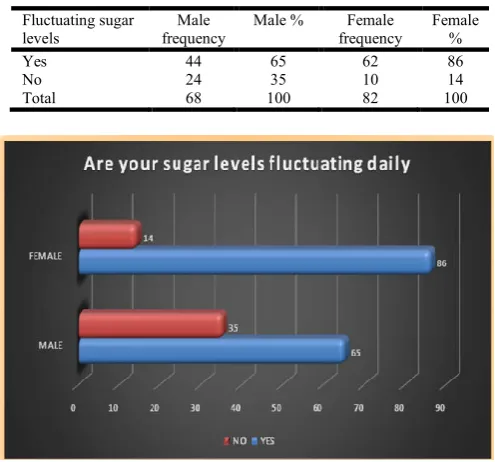
Table 5. Fluctuating sugar levels
Fluctuating sugar levels
Male frequency
Male % Female
frequency
Female %
Yes 44 65 62 86
No 24 35 10 14
Total 68 100 82 100
Figure 5. Fluctuating sugar levels
DISCUSSION: From the above table it is shown that 65% of male subjects were experiencing regular fluctuating of sugar levels and the rest 35% weren’t experiencing the same. Also 86% of females had the same problems and the rest 14% didn’t.
Category Yes No Row totals
[image:4.595.317.547.454.526.2] [image:4.595.37.285.541.772.2]Male 65 (75.50)
[1.46]
35 (24.50) [4.50]
100
Female 86 (75.50)
[1.46]
14 (24.50) [4.50]
100
Column totals
151 49 200 (grand
total)
SUMMARY
The present study was aimed to assess awareness regarding diabetic complications through well designed questionnaires which included blood sugar levels, eating habits, physical activities and awareness questions. This study was designed to determine retinopathy, neuropathy, nephropathy, hypertension, hypoglycaemia, heart diseases, etc. The study was conducted on diabetic population including 150 subjects, of which 68 were males and 82 females, designed on 16 questions and responses were evaluated. The study revealed that 91% male subjects knew what type of diabetes they were diagnosed with and the rest 9% didn’t know it. 78% of female subjects also knew what type of diabetes they were diagnosed with unlike the remaining 22%. When asked how long they were suffering from diabetes 15% reported they were suffering from 0-1 year, 19% from 1-3 years, 15% were suffering from 3-6 years and the left 50% were suffering from more than 6 years. Coming to females 13% were suffering from 0-1 years, 18% from 1-3 years, 24% from 3-6 years and 45% from more than 6 years. It was also found that 63% of males were checking their sugar levels regularly and the rest 37% weren’t. Coming to female reports 65% of them were checking their sugar levels regularly
Category Yes No Row totals
Male 72 (64.50) [0.87] 28 (35.50) [1.58] 100
Female 57 (64.50) [0.87) 43 (35.50) [1.58] 100
Column totals 129 71 200 (grand total)
NOTE: - The chi-square statistic is 4.9132. The p-value is .026652. The result is significant atp< .05.
Table 4. Diabetic cause of heart diseases
Diabetic cause of heart diseases Male frequency Male % Female frequency Female %
Yes 25 37 47 57
No 43 63 35 43
Total 68 100 82 100
Figure 4. Diabetic cause of heart diseases
and the left 35% weren’t practicing the same. 63% of male were exercising regularly and 37% weren’t doing the same. 58% of female subjects were doing regular exercises and the rest 42% were not exercising regularly. Next findings revealed 69% of male subjects were taking food on time, unlike the remaining 31%. Similarly, 79% of females were taking food on time and 21% weren’t following this. Also, 79% of males knew the complications caused due to diabetes and the left 21% didn’t know the same. 74% of females knew the diabetic complications, the left 26% didn’t. 35% of males reported problems with infections and 65% had no such problems. 34% of females were having problems regarding infections and the left 66% were not having problems with infections.57% of males knew diabetic nephropathy and 43% were unaware of it. 31% females knew diabetic nephropathy and the rest 69% didn’t know about it. Diabetic retinopathy was known to 72% of male subjects and the remaining 28% were unaware of it. Also, 57% of female subjects were aware of diabetic retinopathy and the rest 43% had no knowledge of it. 69% Male subjects reported positive replies regarding knowledge of diabetic neuropathy while the left 31% were unaware of it. Coming to female subjects 60% of the female subjects knew diabetic neuropathy and the rest 40% didn’t know about diabetic neuropathy. 37% of male subjects knew that diabetes is the cause of heart diseases and the rest 63% didn’t know the same. 57% of females also knew that diabetes is the cause for heart diseases and the rest 43% were unaware of it. Slow digestion problems were also reported. 56% males were experiencing daily, 29% sometimes and 15% had no problems and females reported 51% were experiencing the problem daily, 32% sometimes and 17% were not experiencing any problems. It was also found that 62% of males were taking measures to keep their sugar levels under control and the rest 38% were not taking any measures. 56% of females were taking measures to keep their sugar levels under control and the rest 44% were not taking any measures. Fluctuating sugar levels on daily basis were also reported. 65% of males reported the problem of daily fluctuating sugar levels and the rest 35% had no such problems. 86% females also reported that their sugar levels were fluctuating daily and the rest 14% weren’t experiencing the same. 85% of male subjects were on medication while the rest 15% weren’t on any medication. 91% of female subjects were also on medication and the rest 9% weren’t. Insulin dosage was being taken by 31% of male subjects and 69% weren’t taking any insulin dosage. Also 22% of females were taking insulin dosage while the rest 78% weren’t taking any insulin dosage.
Conclusion
The present study was conducted with the objective to study the prevalence and to create awareness in the diabetic population about diabetic complications. This study was carried out by well-defined survey through questionnaires. Most diabetic people were unaware about diabetic complications. The aim of this study was to assess the existing knowledge and practice of complications of diabetes. The incidence and prevalence of diabetes mellitus are increasing worldwide. Primary reasons has been found to be lack of physical activities and improper dietary management. Others reasons include lack of knowledge regarding diabetic complications, improper health maintenance and irregular body check-ups. Some people don’t even know what type of diabetes they were diagnosed with.
Diabetes mellitus can affect all the major organ systems, leading to complications that are a source of significant morbidity and premature mortality, making a costly disease. According to the WHO (World Health Organization), it will affect an estimated 366 million people in 2030. The most unfortunate fact is there is no permanent cure for diabetes yet. But it can be controlled through the means of controlled blood sugar levels, healthy diet, proper exercise and medications which can minimise the long term complications of diabetes. Structured teaching programme is an effective way to reduce complications caused due to diabetes. The result of this study played a key role in devising additional interventions to minimise diabetic complications, both in health care centres as well as in community. The only way to escape diabetes is through prevention and prevention heavily depends on regular lifestyle activities. Awareness and basic knowledge is significant in minimising complications of diabetes, thus govt. must play a vital role in providing communities with this basic knowledge
Acknowledgement
My efforts would not have been materialized without the grace of the Almighty and the encouragement, support and guidance of the following people. It’s with pleasure and a sense of in debtness that I acknowledge here the invaluable help of all those who contributed so much to the completion of my thesis. I take the opportunity to express my deep-set gratitude and heart-felt thanks to Ms Tanveer Fatima Lecturer, Dept. Of Nutrition and Dietetics, Anwar ul uloom College, for her incessant guidance, constant encouragement, wisdom, patience, support and precious suggestions all through the thesis. I am immensely grateful to Zoya Mam, Head of Nutrition and Dietetics, Anwar ul uloom College Mallepally, Hyderabad without whom it was not possible to complete my thesis. I am very grateful to Principal, Mr Mohammed Mazher uddin Sir and head of the department with Ms. Zoya Nureen, Anwar-ul-uloom College, Mallepally Hyderabad for providing me an opportunity of doing thesis. I express my heartfelt thanks to the teaching and non-teaching staff of the Department of Nutrition and Dietetics for providing me their valuable Advices and constant encouragement. I would like to thank other faculty members, family, friends, lab assistance, typing help and others who are supportive and understand all the way to them I can only offer my deep appreciation for their willingness and patience.
REFERENCES
Srilakshmi, B. Dietetics, seventh editional, (pg no 343-344). Brajendra kumar Tripathi, Arvind kumar Srivastava, (2006),
Diabetes mellitus: Complications and therapeutics.
Dr.Efren Rene Nieves Ruiz, Dr Miguel Orlando Cueto Aguilar & Lourdes Zapata Garcia (2017), Prevalance of Chronic Complications Due to Diabetes Mellitus Type 2 in a Family Medicine Unit in Leon Guanajuato, Dec 2017, Vol.3
Iraj Heydari, Afsaneh Amiri. 2009.Chronic complications of diabetes mellitus is newly diagnosed patients, International Journal of diabetes mellitus.
John-Michael Gamble, Sonia Butalia, 2014. Medical practice variations in Diabetes mellitus, 7573-7-851.
Mohammed Lotfy, Jennifer Adeghate, HubaKalasz, Jaipaul Singh, Ernest Adequate, 2017. Chronic complications of diabetes mellitus, Vol 13.
Pranav kumar prabhakar, 2016. Pathophysiology of secondary complications of diabetes mellitus, vol9, Issue.
Ronald Reagan. 2012. N.Jordanetal; Pediatric type2 diabetes mellitus complications
Shubhangini AJoshi, Nutrition and Dietetics, Third edition, (pg no 256,257,258).