doi:10.4236/wsn.2010.29081 Published Online September 2010 (http://www.SciRP.org/journal/wsn)
Approximate Continuous Aggregation via Time Window
Based Compression and Sampling in WSNs
Lei Yu, Jianzhong Li, Siyao Cheng
Department of Computer Science and Technology, Harbin Institute of Technology, Harbin, China E-mail:{yulei2008,lijzh}@hit.edu.cn, csyhit@126.com
Received July 4, 2010; revised August 7, 2010; accepted September 10, 2010
Abstract
In many applications continuous aggregation of sensed data is usually required. The existing aggregation schemes usually compute every aggregation result in a continuous aggregation either by a complete aggregation procedure or by partial data update at each epoch. To further reduce the energy cost, we propose a sam-pling-based approach with time window based linear regression for approximate continuous aggregation. We analyze the approximation error of the aggregation results and discuss the determinations of parameters in our approach. Simulation results verify the effectiveness of our approach.
Keywords: Approximate Aggregation, Continuous Aggregation, Sampling, Sensor Network
1. Introduction
Wireless sensor networks (WSNs) offer a powerful and efficient approach for monitoring and collecting infor-mation in a physical environment. To extract the sum-mary information about the monitored environment, the aggregations of sensed data, such as sum and average, are common interesting queries for users. Therefore, a lot of algorithms and protocols for aggregate query processing in WSNs are proposed [1-8].
The existing works addressed two types of aggregate queries which include exact and approximate aggregate queries. The exact aggregate query requires all the sensed data to be involved in aggregation computation to obtain the exact aggregation results [1,2]. However, the exact aggregate query processing often incurs great energy consumption and is also very sensitive to the packet loss and node failure during the data aggregation. Considering the approximate aggregation results would be enough to reflect the information of the environment, approximate aggregate query processing is addressed to save energy and achieve robustness against the failure of the links and nodes [3-8]. In the research of the approximate aggregate query processing in WSNs, sampling is widely used as a powerful and energy-efficient technique to ob-tain the statistical information of the environment. A number of sampling based schemes have been proposed for approximate query processing in WSNs [8-10].
In the applications of WSNs such as monitoring air
pollution and water quality, the users are often interested in understanding how the environment changes over time and observing data trend in a time window. In such cases, continuous aggregation of sensed data is usually required. In a continuous aggregation, the query aggregation pe-riod is divided into epochs and one aggregate answer is provided at each epoch. The existing aggregation schemes usually compute every aggregation result in a continuous aggregation either by a complete aggregation procedure [1,2-4,7] or by partial data update [8] at each epoch. However, the users, who are interested in the time-evolving characteristic of aggregation results, are more concerned about the data trend rather than each individual accurate aggregation result. On the other hand, the communication cost of the existing schemes could be substantial, especially for continuous query with a short epoch and a long period. Motivated by such circum-stances, we propose a sampling-based approach with time window based compression for approximate con-tinuous aggregation.
(BS) a compact description of their sensor readings dur-ing a time window. The BS computes approximation aggregation results of every epoch in this time window. In this paper, linear regression modeling is adopted by sensor nodes to compress their sensor data in a time window. We analyze the approximation error of the aggregation results and discuss the determinations of parameters in our approach.
The rest of the paper is organized as follows. We pre-sent our approach and approximation error analysis in Section 2. We discuss the determination of parameters in our approach in Section 3. Simulation results are pre-sented in Section 4. Finally, we conclude this paper in Section 5.
2 Approximate Continuous Aggregations
2.1 System Model and Time Window Based Framework
We assume a multi-hop sensor network with N number of sensor nodes. The BS knows N. All the sensor nodes and the base station are loosely time synchronized. Each node has the same communication radius Rc. We assume
a continuous querying environment for sensor networks. For a continuous aggregation query, the base station initially disseminates a query into the network, consisting of the epoch duration, the lifetime of the query evalua-tion and a sampling ratio.
During the period of a continuous aggregation query, aggregation computation is conducted at time intervals. Each time interval consists of l number of successive epochs. The BS computes the aggregation result of every epoch in a time interval at one time. Such a time interval is referred to as time window and represented by
[t 1t l]. l is the time window size. LetAgt1 …Agt l
denote the aggregation results from l successive epochs
1,...
t t l.
In the network, the aggregation computation involves sampling sensor nodes that participate in answering the aggregation query, and collecting a compressed repre-sentation of sensor readings within a time window from each sampled node.
After receiving the query from the BS, each sensor node u generates a random number rnu in the range of [0,
1). If rnu , u is sampled for the aggregation query,
otherwise u is not sampled. Let S{si 1 i m} (m is the sample size) be the set of sampled nodes. At the end of a time window[t 1t l], each node siS
generates a compressed representation Mi of its
sens-ing readsens-ings {ri t 1ri t 2ri t l } that contributes to the
aggregation in the time window [t 1t l]. The genera-tion of Mi depends on the specific data compression
method we adopted. After that, si transmits Mi to the
BS. The BS reconstructs the sensor readings of every sampled node si by Mi , denoted by
1 2
{ri t ri t ,ri t l }, and computes an approximation answer ( 1 )
k t k t l
Ag for a specific aggregation
query.
Definition 1. (( )-approximation aggregation ): Let
k
A be a true aggregation result of epoch k, Agk is called as ( ) -approximation of Ak , if
Pr( k )
k A
Ag
.
2.2. Modeling Sensor Data with Error Constraint
In our framework, a sample is not a single sensor reading but a compressed representation of the sensor readings, which enables a sensor node to transmit its sensing read-ings in a time window with less communication cost. It can be built by either lossy or lossless compression methods.
Considering the inherent redundancy of sensor data and the fundamental limit of lossless compression in information theory, we use a data modeling approach, linear regression, to achieve a lossy compression of sensor readings. Linear regression has been widely used to characterize data in sensor networks and answer aggrega-tion queries [11-13]. On this basis, lossless compression methods always can be used for any possible further size reduction. Nevertheless, we note that our framework does not depend on any particular compression method. However, data compression with linear regression model-ing would introduce errors in the reconstructed data. Therefore, we put error constraints on the modeling process in our approach. If sampled nodes find that the variance of error incurred by modeling exceeds some thresholdT2, referred to as error constraint, they choose
to transmit their original data. Otherwise, model pa-rameters including error variance are transmitted. 2.2.1. Linear Regression Model
Regarding the sensor readings rt1rt l of a node in
each time window [t 1t l] as a function of the se-quence number from 1 to l, a linear regression model [14] for these sensor readings is built in the following form
R X (1) where ( 1 ... )
T
t t l
r r
R , ( 0 1... )
T p
,
0 1
0 1
0 1
(1) (1) ... (1) 1 1 ... 1
(2) (2) ... (2) 1 2 ... 2
( ) ( ) ... ( ) 1 ...
p
p p
p p
h h h
h h h
h l h l h l l l
X
1
( t ... t l)T
677
In the model, { ( )h xi h xi( ) xi 0 i p} are the set of basis functions, 0 1…p are regression coefficients,
and is a random error vector. Besides, the time win-dow size l is larger than p1 . According to Gauss-Markov conditions [14], we also haveE( )i 0,
2 ( )i
Var and Cov( i j)0 where i j ,
{ 1 ... }
i j t t l .
By the least square estimate, the estimation of regres-sion coefficients, denoted by ( 0 1...p), can be computed by solving the following matrix equation, us-ing, for example, Gaussian elimination:
A b (2) whereAX XT , bX RT .
Once determining l andp, we can see that the ma-trices X and A do not change with R, so they just need to be computed only once for an aggregation query. 2.2.2. Error Variance and Data Reconstruction Besides computing regression coefficients, each sam-pled node also needs to estimate the variance of the er-rors, denoted by 2, to decide whether to transmit original data or regression coefficients.
Under Gauss-Markov conditions [14], an unbiased es-timator of error variance 2 can be computed by
2 ( ) ( )
1 T
l p
R X R X
(3) Given an error constraint T2, if
2 2
T
, the node transmits p1 number of regression coefficients
0 1
( ...p)
and 2 to the base station.
Other-wise, it transmits l number of original sensor readings. By the regression coefficients of received from a sampled node, the BS can reconstruct its sensor readings
1 (rt ...rt l)
R in the time window by
R X (4) where X can be pre-computed by the BS with l and
p.
In the rest of this paper, we regard both the original readings and the regression coefficients as model pa-rameters and do not distinguish them. A sample trans-mitted by a sampled node si is denoted
by Mi ( i2i). WhenMi(i0) , Mi represents
the original sensor readings. 2.3. Approximate Aggregation
2.3.1. Aggregation Estimation
At the end of each time window, the BS waits for the arrivals of all samples for some time tw. The waiting
time tw should be larger than the maximum time
needed for the message delivery from the samples node
to the BS.
After reconstructing sensor readings {ri k 1 i m} of sampled nodes {si 1 i m} at epoch k in a time window [t 1t l] by Formula (4), the approximation aggregation result Agk of epoch k (t 1 k t l) can be obtained by
1 2
( k k... m k)
k F
Ag r r r (5)
where F is the estimator function of aggregation results. Now we specifically discuss how to estimate the results of aggregation queries including Average and Sum re-spectively.
Average Average aggregation is estimated by
1
1 m
a
k i k
i
A r
m
(6)Sum Sum aggregation is estimated by
1 m
a a
k k i k
i
N
A N A r
m
(7)2.3.2. Approximation Error Analysis
Let i k ri k ri k . If the estimator function F is a
linear function, Formula (5) can be rewrote as
1 1 2 2
1 2 1 2
( ... )
( ... ) ( ... )
k k k k m k m k
k
k k m k k k m k
F r r r
Ag
F r r r F
(8)
where ri k is the original data of epoch k and i k is
the residual in the linear regression model (1) of node
i
s .
Then, the approximation error of
k
Ag to the exact
aggregation result Ak of epoch k is
1 2 1 2
1 2 1 2
( ... ) ( ... )
( ... ) ( ... )
sampling estimation error modeling estimation error k
k
k k m k k k k m k
k k m k k k k m k
A Ag
F r r r A F
F r r r A F
(9)
where F r(1k ...rm k )Ak is the estimation error with
original data samples, referred to as sampling estimation error, and F(1k ...m k ) is referred to as modeling estimation error. The above result indicates the ap-proximation error consists of two types of errors includ-ing samplinclud-ing estimation error and modelinclud-ing estimation error. Because these two errors separately rely on different factors such as the sample size or the number of regres-sion coefficients, we regard them as two independent random variables.
Nowwe specifically analyze the approximate error of Average and Sum. Let Aka and
s k
A be the exact aver-age and sum result of epoch k (t 1 k t l) respec- tively, i.e., 1
1
N a
k N i i k
A
r and 1N s
k i i k
A
r . By
1 1
1 m 1 m
a
k i k i k
i i
A r
m m
As we can see, Aak is a linear combination of two
random variables Rk and Zk ,
1 1
m
k m i i k
R
r and 1
1 m
k m i i k
Z
.According to the linear regression theory, under Gauss-Markov conditions, the residual i k follows a normal distribution (0 2(1 ))
i k k
N p where 2 i
is the error variance in the linear model at node si ,
k k t and pk k is the
k
-th element on theprin-cipal diagonal of matrix ( T )1 T X
P X X X X . Consider-ing that 2i in Mi is an unbiased estimator of i2, we
have 2 2 1 1 (0 ) m k k i k i p Z N m
(10) Since Rk is the mean of original data samples,
ac-cording to the general results in the sampling theory [15], we have the following results
( k) ka
E R A
2
( ) k (1 )
k S m Var R m N 2 2 1 1 ( ) 1 N a
k i k k
i
S r A
N
Confidence Interval:
2 2
1 1
Pr k k ka k k 1
f f
R s A R s
m m
(11) where f m N,
2
is the upper 2 point on the standard normal distribution, 2 1 2
1 1( )
m
k m i i k k
s
r Ris the (unbiased) sample variance and is an unbiased estimator of the population MSE(Mean Square Error)
2 k
S .
By the above discussions, we have the following results Lemma 1. Under Gauss-Markov conditions,
E(r , , 2
0,
( )
(1 )
j k i k
i k k
i j E r
p i j
Proof. If i j, since the samples ri k and rj k are
assumed to be independent random variables in the sam-pling theory, ri k and j k are independent and we
have
(i k j k) (i k) ( j k) 0
E r E r E .
If i j, according to the linear regression theory, we know i k and i x (0 x p) are independent, thus
( i x i k) ( i x) ( i k) 0
E E E . Then, we have
2
0 1 2
2 2
( ) [( ... ) ]
( ) (1 )
p
i k i k i i i i p i k i k
i k k
i k
E r E k k k
E p
Theorem 1. Let 2 1 2
1 1( )
a m
k i k
k m i A
s
r and
k k t. Then
2 2 2
1 1 ( ) N k k k i k i p
E s S
N
(12) Proof. It can be easily shown that
2 2 1 1 2 1 1 1 ( ) ( 1)
1 ( )
2 ( 1)
m m
i k j k
k
i j
i j
m m
i k j k
i j
i j
s r r
m m r r m m
2 2 1 1 2 1 1 1 ( ) ( 1)1 ( )
2 ( 1)
N N
k i k j k
i j
i j
N N
i k j k
i j
i j
S r r
N N r r N N
For each pair (ri k rj k ) (i j ,1 i j N ), the probability that they are both being reconstructed due to the corresponding nodes (i , j ) being sampled, is m(m-1)/(N(N-1)). Then, with Lemma 1, we have
2 2 1 1 2 1 1 2 1 1 2 2 2 1 1 2 1 1 ( ) ( ( ) )
2 ( 1)
1 ( 1)
(( ) )
2 ( 1) ( 1)
1
(( ) ) 2 ( 1)
1
(( ) ( ) ( )) 2 ( 1)
1
m m
i k j k
k
i j
i j
N N
i k j k
i j
i j
N N
i k j k
i j
i j
N N
i k j k i k j k
i j
i j
k i
E s E r r
m m
m m
E r r
m m N N
E r r
N N
r r E E
N N S N
2 2 2 1 1 ( ) N N k k k i i k i p E S N
By replacing Sk2 by 2 k
s , E s( )2k by s2k, and i2 by 2
i
in Formula (13), we can estimate sk2 b y
1 2 2 1 k k p k N N i is
. However, 2 1
N i i
can not be obtained since sampling all nodes is prohibitive in our approach. Thus, we use an upper bound of sk2, denotedby 2
( )sk
, and estimate it by 2 2 (1 k k) T
k p
s due to
2 2
T i . Theorem 2. 2 2 2 1 1 1
Pr (1 )
(1 )(1 )
r z
m
a a
k k k k
k i
i
r z
f
A s p
A m m
(13)where m
N
f , sk s2k (1 pk k)T2
,
2r
and
2z
are respectively the upper r 2, z 2 point on the
standard normal distribution.
679
2 2
2
2
2
1
2
1
1 1
1
1
(1 )
r z
r
z
m
a a
k k k i
i
a
k k k
m
k k k i
i
f
A A A s
m m
f
B R A s
m
C Z p
m
Because sk2 sk2
, by Formula (12) we have
2
1
Pr( )B Pr( Rk Aka rsk mf) 1 r
Since 2
2 1
1
(0 k k )
m p
i
k m
i
Z N
,
2
2
1 1
Pr z (1 ) 1
m
i
k k k z
i
Z p
m
By Formula (9), we have AakAkaRkAka Zk.
When inequalities B and C are satisfied, A must hold. Because sampling and modeling errors are inde-pendent random variables, so B and C are inde-pendent events. Then, we have
Pr( )A Pr(BC)Pr( ) Pr( )B C (1 r)(1z)
Let
2 2
2
1
1 1
(1 )
r z
m
k k k k i
i
f
s p
m m
.SinceAksNAkaNRkNZk, we can easily derive the
following results from the above analysis of average:
Pr Ask Aks Nk (1 r)(1 z)
(14)
Here Formulas (13) and (14) give the approximation error k (Nk) of Average (Sum) aggregation with the
probability guarantee (1r)(1z).
3. Parameter Determination
From Formulas (13) and (14) we can see that with given the probability guarantee, i.e., r andz, the
approxi-mation error depends on the error constraint 2 T
and the sample size m. In this section we discuss the selection of their values with the desired error bound for k by
users, denoted byT.
3.1. Error Constraint 2 T
As shown in Formula (3), i indicates the average er-ror for the data reconstructed in a time window. Thus,
T
specifies the maximum degree of the average error that the user can tolerate for the reconstructed data. A larger T would allow larger errors in the reconstructed
data and may enlarge the approximation error. On the other hand, a larger T gives the sampled nodes more
chances to transmit their model parameters instead of their original data and further reduce the communication cost. Thus, the trade-off exists between communication cost and approximation error.
Here we provide one possible solution to determineT2.
During the first time window of aggregation, all sampled nodes transmit their original data to the BS. The BS fits the specified model to these data and computes the mod-eling errors {ˆi2| 1 i m} for all sampled nodes. A histogram is computed to count the number of error val-ues falling into each bin, which reflects the quality of data modeling for the sensor network. According to this frequency distribution, the user can select a value of T2
as large as possible while ensuring an acceptable ap-proximation error. Finally, the BS broadcasts 2
T
to the sensor network and each sensor node works on the new error variance constraint. This procedure could be con-ducted reactively when substantial sampled nodes start to continuously transmit their original data, which indicates the changes of the nature of data in the sensor network.
In our experiments on real data set, we show linear re-gression well characterizes the sensor data and incur few original data transmissions even with a small error vari-ance constrain.
3.2. Sampling Ratio
From Formulas (13) and (14), a larger sample size m enables a smaller approximation error.
It is easily shown that we can relax k to
2 2
1 1
r z
f
k sk m m T
without changing the inequality relationship with the probability guarantee(1r)(1z) in Formulas (13) and (14). We consider the least sample size to satisfy
k T
for any k in[t 1t l]. With an approxima-tion of f m N/ 0 (for relative small sample size and large population), we have
2 2
1 1
r k z T T
m s m
which should hold for any k in [t 1t l]. Then, we can obtain the least sample size mk required by epoch k
in the time window [t 1t l] to ensure k is less
than a threshold T
2 2 2
( ) , 1
r k z T
k
T
s
m t k t l
(15)
For each epoch k in [t 1t l], if the BS finds
k
mm , it can issue another sampling request to obtain
k
m m samples. However, sk
upper bound rmax and lower bond rminof sensor readings
are known
* max min 2
1 1
( )
1 2
m
k
i
r r
s
m
(16)We can obtain an estimation of the required sample size, denoted by mr, for all epochs in the time window [t 1t l] by inserting Formula (15) into Formula (16). The sampling ratio is set to be not less than mr/N.
3.3. Time Window Size l
When all sampled nodes transmit their original data, the approximation error includes only the sampling estima-tion error and no modeling estimaestima-tion error. Thus, the aggregation computation with original data needs a less sample size than with the compressed data by modeling to achieve the same approximation error. Let mo be the
sample size needed to obtain ( T )-approximation aggregation by collecting the original data, then
2
1 o o
f
k m T
s
where mo
o N
f . With the approxima-tion of fo mo/N0,
2
2 2
( )
o k T
m s
On the other hand, we have
2 2
1 (1 r)(1 z) r r
As above, we also have
2 2z
.
According to the above discussion on sampling ratio, we have
2 2 2 2
2 2
2 2
2
2 2 2
2 2 2
2
2
2 2
2
2 2
( ) ( )
( ) ( )
( ) ( )
( )
( )
(1 )
r k z T T r k z T
t
o k T k
k T
k T
k k
k T T
k k
s s
m
m s s
s s
s s
s
s s
(17)
Without data modeling compression, the aggregation requires m lo( 1) original data transmissions for a time window to achieve the approximation error T . With
the data modeling compression, our scheme requires
( 2)
m p data transmissions to achieve the approxima-tion error T. To achieve energy savings, we should
havem lo( 1) /m pt( 2)1, then
2
1 ( 2) t ( 2)(1 T)
o k
m
l p p
m s
In the case of T Sk , 1 2
T
k
s
, we could set
1 4( 2)
l p .
4. Simulation Evaluation
To measure the performance of our secure aggregation scheme, we simulate a sensor network based on the data from a real world deployment with 54 sensor nodes (ID from 1 -54) in the Intel Research lab, which includes a trace of sensor readings collected between February and April,2004 , node location and network connectivity in-formation. The sensors collected time-stamped humidity, temperature and voltage values in 31 second intervals. We use the first 2000 epochs of the data set in the day 03/08 with the largest size among all days and assume a continuous aggregation query on the temperature attribute during this period. The periodic aggregation is conducted on it with a time window size l40, i.e., 50 time win-dows. In the linear regression model, we letp3.
[image:6.595.314.533.540.665.2]To show the performance of linear regression model for describing sensor data, we investigate the distribution of error variance and its impact on data transmission for all sensor nodes.
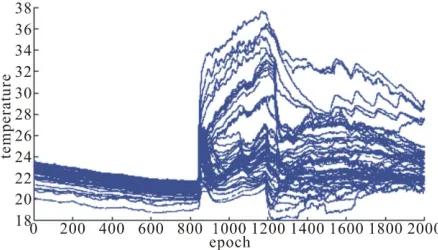
Figure 1 shows temperature readings (in degrees Cel-sius) of 52 sensor nodes in 2000 successive epochs, which are used for our simulation. Figure 2 shows the error variance of linear regression model in every time window for all sensor nodes. For all time windows, all the sensor nodes have error variances less than 0.2. Fig-ure 3 shows under different choice of error constraint
2 T
, the number of sensor nodes which has a larger mod-eling error variance than 2
T
in each time window. We can conclude most of sensor nodes at most of time win-dows are consistent with variance constraint. When 2 0 07
T
, less than 10% of sensor nodes ex-ceedT2 ; when
2 0 1 T
, the number decreases to
2%.Our experiment indicates only a small portion of sampled node will transmit their original data.
681
[image:7.595.61.280.234.349.2]Figure 2. The error variances of linear regression model in all sensor nodes for each time window.
Figure 3. the number of sensor nodes with error variance 2
T
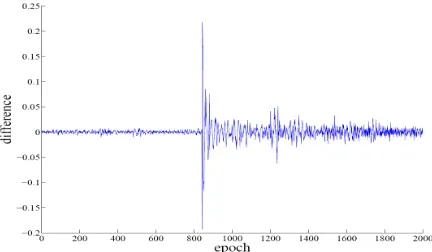
in each time window.Assuming = 0.4 and T2 0 2, Figure 4 shows the difference between the average aggregation result esti-mated by sampling with time window based compression and the aggregation result estimated by sampling with original data transmission in every epoch. As we can see, the difference is in [-0.2, 0.25]. It indicates that our approach with data compression can obtain the estima-tion of average aggregaestima-tions close to those obtained by the approach without data compression, even when the sample size is the same. It also indicates our approach achieves the energy efficiency while obtaining the ap-proximate estimations, since in each time window only five numbers are sent from each sampled node.
Figure 4. The difference between two average aggregation results respectively estimated by the approaches with and without data compression in every epoch.
5. Conclusions
In this paper we propose a sampling-based approach with time window based linear regression for approximate continuous aggregation. The approximation error of the aggregation results is analyzed. The determination of parameters in our approach is also discussed. By simula-tion results on real data set we verify the effectiveness of our approach.
5. References
[1] S. Madden, M. J. Franklin, J. M. Hellerstein and W. Hong, “The Design of an Acquisitional Query Processor for Sensor Networks,” Proceedings of International Conference on Management on Data, California, 2003, pp. 491-502.
[2] S. Madden, M. J. Franklin, J. M. Hellerstein and W. Hong, “TAG: A Tiny Aggregation Service for Ad Hoc Sensor Networks,” Proceedings of the 5th Symposium on Operating Systems Design and Implementation, New York, 2002, pp. 131-146.
[3] J. Considine, F. Li, G. Kollios and J. Byers, “Approxi-mate Aggregation Techniques for Sensor Databases,” In-ternational Conference on Data Engineering, Boston, 2004, pp. 449-460.
[4] S. Nath, P. B. Gibbons, S. Seshan and Z. R. Anderson, “Synopsis Diffusion for Robust Aggregation in Sensor Networks,” Sensys, 2004, pp. 250-262.
[5] G. Cormode, M. N. Garofalakis, S. Muthukrishnan and R. Rastogi, “Holistic Aggregates in a Networked World: Distributed Tracking of Approximate Quantiles,” Pro-ceedings of International Conference on Management on Data, 2005, pp. 25-36.
[6] A. Deligiannakis, Y. Kotidis and N. Rossopoulos, “Proc-essing Approximate Aggregation Queries in Wireless Senor Networks,” Information Systems, Vol. 31, No. 8, 2006, pp. 770-792.
[7] A. Manjhi, S. Nath and P. B. Gibbons, “Tributaries and Deltas: Efficient and Robust Aggregation in Sensor Net-work Streams,” ACM SIGMOD, ACM Press, 2005, pp. 287-298.
[8] S. Y. Cheng, J. Z. LI, Q. Q. Ren and L. Yu, “Bernoulli Sampling Based (epsilon, delta)-Approximate Aggrega-tion in Larger-Scale Sensor Networks,” IEEE Interna-tional Conference on Computer Communications, Cali-fornia, 2010, pp. 1181-1189.
[9] S. Lin, B. Arai, D. Gunopulos and G. Das, “Region Sam-pling: Continuous Adaptive Sampling on Sensor Net-works,” IEEE International Conference on Data Engi-neering, Cancun, 2008, pp. 794-803.
[image:7.595.62.278.556.682.2]Uni-form Random Sampling in Sensor Networks,” Proceed-ings of 1st Workshop on Data Management in Sensor Networks, August, 2004.
[11] C. Guestrin, P. Bodik, R. Thibaux, M. Paskin and S. Madden, “Distributed Regression: An Efficient Frame-work for Modeling Sensor NetFrame-work Data,” ACM/IEEE IPSN, 2004, pp. 1-10.
[12] W. Xue, Q. Luo, L. Chen and Y. Liu, “Contour Map Matching for Event Detection in Sensor Networks,”
SIGMOD, New York, 2006, pp. 145-156.
[13] H. Gupta, V. Navda, S. R. Das and V. Chowdhary, “Effi-cient Gathering of Correlated Data in Sensor Networks,” MobiHoc, New York, 2005, pp. 402-413.
[14] A. Sen and M. Srivastava, “Regression Analysis: Theory, Methods, and Applications,” Springer-Verlag, New York, 1990.