2
Department of Computer Science and Electrical Engineering, Kumamoto University, Kumamoto, Japan
3
Mcgill University, Montreal, Canada Email: *[email protected]
Received February 20, 2013; revised March 20, 2013; accepted March 28, 2013
Copyright © 2013 Riichi Murayama et al. This is an open access article distributed under the Creative Commons Attribution License, which permits unrestricted use, distribution, and reproduction in any medium, provided the original work is properly cited.
ABSTRACT
Transmitting a longitudinal wave and a traverse wave into a composite material in a molten state has been studied in the online control of the composite material which cannot be evaluated by a conventional ultrasonic sensor as a final analy- sis, using the difference in the propagation characteristics of both modes. It is especially expected that measurement of the physical quantity which was not able to be conventionally measured can be performed by carrying out coincidence measurement of the ultrasonic wave in both modes. Therefore, in this research study, an ultrasonic probe, which can simultaneously transmit and receive a longitudinal wave and a traverse wave has been developed using an electromag- netic acoustic transducer (EMAT) because it has the advantage of measuring high temperature samples. In this study, two methods have been compared. The 1st method uses a traverse wave EMAT that travels in a vertical direction and a bar wave by which the low order mode is equivalent to longitudinal wave vibration. The other method is to carry out the mode conversion of the traverse wave by a traverse wave-EMAT. The longitudinal converted from the transverse wave are spread in the axis direction. As the experimental results of both optimizations of the drive conditions, it has been confirmed that the 2nd mode conversion method was promising. This paper reports about the trial process and the ex- perimental results.
Keywords: Longitudinal Wave; Transverse Wave; Material Property Evaluation; High Temperature Measurement
1. Introduction
2S = V
(2) For the NDT and SHM in the composite material indus-
try, it is crucial to know the elastic properties such as Young’s modulus, shear modulus, Poisson’s ratio aniso- tropy, texture or stress. Ultrasonic techniques are often used to evaluate or nondestructively characterize such properties. Since many parts or structures are subject to high temperature, it is of interest and sometimes even mandatory to characterize their properties at high tempe- rature [1-3]. Thus ultrasonic testing at high temperature has become important. The Young’s modulus E, shear modulus μ and Poisson’s ratio v of an isotropic material can be obtained knowing the longitudinal wave velocity VL and transverse wave velocity VS. Their relations are given in Equations (1)-(3), respectively.
2 S L
2 S L 1 2 V /V =
2 1 V /V
(3)
2 2 2
s L S
2 2
L S
V 3V 4V
E =
V V
(1)
Where E, Young’s modulus, is the ratio of the applied longitudinal stress to the longitudinal strain when a rod is subjected to a uniform stress over its end planes and its lateral surface is free to expand. Where μ, the shear modulus, is the ratio of the transverse stress to transverse strain. Where v, Poisson’s ratio, is the ratio of the lateral contraction (expansion) to the longitudinal extension (contraction) of the rod.
2. Concept of Trial Ultrasonic Probes Using
a Bar Wave and a Transverse Wave
Figure 1 shows the generating principle of a bar-wave. If a biased magnetic field by a magnet and high frequency induced magnetic field by an electromagnetic-induced
(a) (b)
[image:2.595.308.540.88.196.2]Figure 2. Principle of the transverse EMAT. Figure 1. Robe using bar wave.(a): Drive principle; (b): Out-
line the Probe.
coil is produced in the long direction of the shaft part of a trial probe, an induce vibration by a Magnetostrictive ef- fect on the surface is introduced. It will be converted into a bar wave, which is a kind of ultrasonic wave, if the di- ameter is enough small. The vibration of this bar wave serves as a compressional wave and converts into a lon- gitudinal wave at the step part of the trial ultrasonic probe, and it crosses the probe [4]. An EMAT for the traverse wave was installed on the top surface of the trial ultra- sonic probe and injects a transverse wave into the probe.
It crosses the probe. (a) (b) Finally, the simultaneous transmission and reception
[image:2.595.310.535.235.367.2]of the longitudinal wave and transverse wave is performed by combining the two kinds of generating procedures.
Figure 3. Trial ultrasonic probe using mode transformation method.(a): Drive principle; (b): Outline the Probe.
Figure 2 shows the generating principle of a trans- verse wave which crosses a specimen in the thickness di- rection by an electromagnetic acoustic wave transducer (EMAT). An EMAT consists of a magnet and an elec- tromagnetic induction coil. It generates a magnetic field and high frequency electric current on the surface of the specimen. It then generates a Lorentz force in the hori- zontal direction on the surface which changes the direc- tion according to the high frequency electric current in the induction coil. It converts to a transverse wave which crosses the specimen in the thickness direction [5,6].
probe and arrives at the bottom surface. Finally these two types of transmission and reception method are perform- ed simultaneously. If we then assume the trial probe as shown in Figure 3(b), θ1 as 28.71˚, as 61.29˚ by using equation (1) if θ1 + θ2 was supposed to be 90˚. Finally, these two types of transmission and reception methods are simultaneously performed.
2 sin 1 1 sin
V V 2 (4) θ1: Injection and feflection angle at the same mode. θ2: Reflection angle in the different modes. V1: Longitudinal wave velocity (m/s). V2: Transverse wave velocity (m/s).
3. Concept of Trial Ultrasonic Probes Using
Ultrasonic Mode Conversion
4. Experimental Results of a Transverse
Wave-EMAT
Figure 3(a) shows the principle of the ultrasonic mode conversion according to Snell’s law. During the mode conversion process, a traverse wave converts into a lon- gitudinal wave according to Snell’s law using Equation (4). Figure 3(b) shows an outline of an ultrasonic wave using this mode conversion method [7-9]. When the sen- sor coil for traverse waves is installed on the side of the probe, the traverse is reflected on the opposite inclined wall and converted into a longitudinal wave on the slope. This longitudinal wave crosses in the vertical direction. When a transverse wave-EMAT was installed on the top surface of the probe, the EMAT injected a longitudinal wave into the probe. This longitudinal wave crosses the
(a) (b)
Figure 4. Relationship between the signal amplitude and the number of turns.(a):Transmitter; (b): Receiver.
of the transmitter coil and the received signal intensity. As a result, the transmitter coil with 11 turns and the re- ceiver coil 25 turns were selected. In addition, a 2 MHz drive frequency and 10-mm diameter of the coil was se- lected. Figure 5 shows the received signal waveform us- ing the best condition with a test block of 70-mm thick- ness. The reflected signal at the bottom surface was de- tected with a good S/N.
5. Ultrasonic Probe Using Bar Wave
The transverse wave-EMAT was used as a transverse wave source and the bar wave EMAT, which consists of a cylindrical-shaped magnet with 1000 number of turns, and a cylindrical-shaped electromagnetic induction coil with 10 number of turns wound around the step part were used as a longitudinal wave source. The trial probes with 10 mm, 12 mm, 14 mm, 18 mm, 22 mm, 26 mm diame- ters at the step part were fabricated. The height and the maximum diameter of the trial probe were 140 mm and 30 mm. Figure 6 shows the experimental results. As the shaft part diameter increased, the detected transverse wave signal was improved, but the longitudinal wave signal became poor. As a conclusion, this trial method was not fit for simultaneously transmitting and receiving a trans- verse wave and a longitudinal wave.
6. Ultrasonic Probes Using Ultrasonic Mode
Conversion
The probe for the mode conversion with a 58-mm height and 40 mm length is shown in Photo 1. The electromag- netic induction coils with the same specification were in- stalled on the top surface of the probe and on the other side surface at an slope of 28.7˚. The schematic diagram is shown in the Figure 7. The pulsar was used to drive the electromagnetic induction coil. The amplifier was us- ed to amplify the signal by 40 dB. An Nd permanent magnet was used to apply the static magnetic field on the surface of the probe. Figure 8 shows the received signal
[image:3.595.309.533.87.223.2]Photo 1. Overlook of the trial probe.
[image:3.595.59.286.87.229.2]Figure 5. Received signal waveform.
Figure 6. Shaft part-diameter and signal amplitude.
[image:3.595.309.539.489.715.2](a) (b)
Figure 8. Detected signal waveform.(a): Longitudinal wave; (b): Transverse wave.
waveform. Both the transverse wave and the longitudinal wave signal with a good S/N, which were reflected by the bottom surface of the probe, were detected as shown in Figure 8.
7. High Temperature Experiment
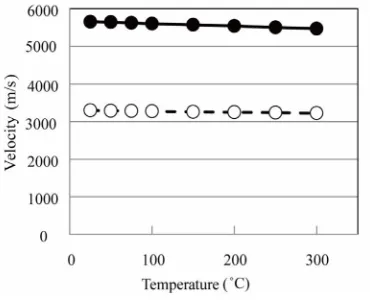
The trial probe simultaneously driving longitudinal wave and traverse wave was heated from 20˚C to 180˚C in 20˚C steps. Figure 9 shows the relationship between the temperature of the probe and both velocities. Figure 10
shows the relation between the temperature of the probe and the signal intensity. While the probe was heating, the longitudinal wave velocity changed from 5865 [m/s] to 5783 [m/s], and the traverse wave velocity changed from 3115 [m/s] to 3017 [m/s]. This means that the change ra- tio was 1.3% in the longitudinal wave and 3.1% in the transverse wave. As for the signal intensity, the longitu- dinal wave intensity dramatically decreased as the tem- perature increased, but the transverse wave intensity did not significantly change.
8. Conclusions
An ultrasonic probe, which can simultaneously trans- mit and receive the traverse wave and the longitudinal wave by the EMAT, was developed. The ultrasonic probe using the bar wave could not detect the received signal with a good S/N. Although a small diameter at the step part of the ultrasonic probe was needed to generate the bar wave with good intensity, it meant that the transvers wave coming through from the upper side of the shaft part was blocked at the shaft part. That is why the devel- opment of this type of ultrasonic probe was stopped.
The ultrasonic probe using the mode conversion me- thod could detect the transverse wave and the longitudi- nal wave. However, the longitudinal wave intensity was smaller than the transverse wave.
[image:4.595.328.514.87.400.2]It is necessary to improve this method such that im- provement in the conversion rate at the time of changing into a longitudinal wave from a traverse wave from now
Figure 9. Temperature and the velocity.
Figure 10. Temperature and the signal intensity.
on and the high temperature of 200˚C or more can also be borne.
REFERENCES
[1] L. Beloqui, J. Krautkrämer and H. H. Krautkrämer, “Ultra- sonic Testing of Materials,” 4th Edition, Springer, Berlin, 1990, pp. 528-550.
[2] B. A. Auld, “Acoustic Fields and Waves in Solids,”New York, Vol. 2, 1973, pp. 30-38.
[3] R. Kazys, A. Voleisis, R. Sliteris, L. Mazeika, R. V. Nieu- wenhove, P. Kupschus and H. A. Abderrahim, “High Tem- perature Ultrasonic Transducers for Imaging and Meas- urements in a Liquid Pb/Bi Eutectic Alloy,” IEEE Trans-
actions on Ultrasonics, Ferroelectrics and Frequency
Control, Vol. 52, No. 4, 2005, pp. 525-537.
doi:10.1109/TUFFC.2005.1428033
[4] T. Arakawa, K. Yoshikawa, S. Chiba, K. Muto and Y. At- suta, “Applications of Brazed-Type Ultrasonic Probes for High and Low Temperature Uses 2,” Nondestructive Test-
ing and Evaluation, Vol. 7, No. 1-6, 1992, pp. 263-272.
doi:10.1080/10589759208953005
[5] R. B. Thompson, “A Model for the Eletromagnetic Gene- ration and Detection of Rayleigh and Lamb Wave,” IEEE Transaction on Sonics and Ultrasonics, Vol. 20, No. 4, 1973, pp. 340-346. doi:10.1109/T-SU.1973.29770
[image:4.595.331.516.88.239.2]