166
Robust Semantic Parsing with Adversarial Learning for Domain
Generalization
Gabriel Marzinotto1,2, G´eraldine Damnati1, Fr´ed´eric B´echet2, Benoˆıt Favre2
(1) Orange Labs / Lannion France
(2) Aix Marseille Univ, CNRS, LIS / Marseille France
[email protected], [email protected] [email protected], [email protected]
Abstract
This paper addresses the issue of generaliza-tion for Semantic Parsing in an adversarial framework. Building models that are more robust to inter-document variability is crucial for the integration of Semantic Parsing tech-nologies in real applications. The underlying question throughout this study is whether ad-versarial learning can be used to train mod-els on a higher level of abstraction in order to increase their robustness to lexical and stylis-tic variations. We propose to perform Seman-tic Parsing with a domain classification adver-sarial task without explicit knowledge of the domain. The strategy is first evaluated on a French corpus of encyclopedic documents, an-notated with FrameNet, in an information re-trieval perspective, then on PropBank Seman-tic Role Labeling task on the CoNLL-2005 benchmark. We show that adversarial learn-ing increases all models generalization capa-bilities both on in and out-of-domain data.
1 Introduction
For many NLP applications, models that per-form well on multiple domains and data sources are essential. As data labeling is expensive and time consuming, especially when it requires spe-cific expertise (FrameNet, Universal Dependen-cies, etc.), annotations for every domain and data source are not feasible. On the other hand, do-main biases are a major problem in almost ev-ery supervised NLP task. Models learn these bi-ases as useful information and experience a sig-nificant performance drop whenever they are ap-plied on data from a different source or domain. A recent approach attempting to tackle domain bi-ases and build robust systems consists in using neural networks and adversarial learning to build domain independent representations. In the NLP community, this method has been mostly used in crosslingual models to transfer information from
English to low resource languages in problems and recently in various monolingual tasks in order to alleviate domain bias of trained models.
In the context of Semantic Frame Parsing, we address in this paper the generalization issue of models trained on one or several domains and ap-plied to a new domain. We show that adversarial learning can be used to improve the generalization capacities of semantic parsing models to out of do-main data. We propose an adversarial framework based on a domain classification task that we use as a regularization technique on state-of-the-art se-mantic parsing systems. We use unsupervised do-main inference to obtain labels for the classifica-tion task.
Firstly we perform experiments on a large multi-domain frame corpus (Marzinotto et al.,
2018a) where only a relatively small number of frames where annotated, corresponding to possi-ble targets in an Information Extraction applica-tive framework. We evaluate our adversarial framework with a semantic frame parser we devel-oped on this corpus and presented in (Marzinotto et al., 2018b). Secondly we checked the gener-icity of our approach on the standard PropBank Semantic Role Labeling task on the CoNLL-2005 benchmark, with a tagging model proposed by (He et al., 2017). We show that in both cases adver-sarial learning increases all models generalization capabilities both on in and out-of-domain data.
2 Related Work
2.1 Domain-Adversarial Training
adver-sarial because it is connected to the task-specific classifier using a gradient reversal layer. During training a saddle point is searched where the task-specific classifier is good and the domain classifier is bad. It has been shown in (Ganin and Lempit-sky,2015) that this implicitly optimizes the hidden representation towards domain independence.
In NLP problems this approach has success-fully been used to train cross-lingual word repre-sentations (Conneau et al., 2017) and to transfer learning from English to low resource languages for POS tagging (Kim et al.,2017) and sentiment analysis (Chen et al., 2016). These approaches introduce language classifiers with an adversarial objective to train task-specific but language ag-nostic representations. Besides the cross-lingual transfer problem, there are few studies of the im-pact of domain-adversarial training in a monolin-gual setup. For instance, (Liu et al.,2017) success-fully uses this technique to improve generaliza-tion in a document classificageneraliza-tion task. It has also been used recently for varied tasks such as transfer learning on Q&A systems (Yu et al.,2018) or du-plicate question detection (Shah et al.,2018) and removal of protected attributes from social media textual data (Elazar and Goldberg,2018).
2.2 Robustness in Semantic Frame Parsing
In Frame Semantic Parsing, data is scarce and classic evaluation settings seldom propose out-of-domain test data. Despite the existence of out-of-domain corpora such MASC (Passonneau et al., 2012) and YAGS (Hartmann et al., 2017) the domain adaptation problem has been widely reported (Johansson and Nugues, 2008; Søgaard et al.,2015) but not extensively studied. Recently, (Hartmann et al.,2017) presented the first in depth study of the domain adaptation problem using the YAGS frame corpus. They show that the main problem in domain adaptation for frame seman-tic parsing is the frame identification step and pro-pose a more robust classifier using predicate and context embeddings to perform frame identifica-tion. This approach is suitable for cascade systems such as SEMAFOR (Das et al., 2014), (Hermann et al., 2014) and (Yang and Mitchell, 2017). In this paper we propose to study the generalization issue within the framework of a sequence tagging semantic frame parser that performs frame selec-tion and argument classificaselec-tion in one step.
3 Semantic parsing model with an adversarial training scheme
3.1 Semantic parsing model:biGRU
We use in this study a sequence tagging semantic frame parser that performs frame selection and ar-gument classification in one step based on a deep bi-directional GRU tagger (biGRU). The advan-tage of this architecture is its flexibility as it can be applied to several semantic parsing schemes such as PropBank (He et al.,2017) and FrameNet (Yang and Mitchell,2017).
More precisely, the model consists of a 4 layer bi-directional Gated Recurrent Unit (GRU) with highway connections (Srivastava et al., 2015). This model does not rely solely on word embed-dings as input. Instead, it has a richer set of fea-tures including syntactic, morphological and sur-face features. (see (Marzinotto et al.,2018b) for more details).
Except for words where we use pre-trained em-beddings, we use randomly initialized embedding layers for categorical features.
3.2 Sequence encoding/decoding
For all experiments we use a BIO label encoding. To ensure that output sequences respect the BIO constrains we implement an A∗decoding strategy similar to the one proposed by (He et al., 2017). We further apply a coherence filter to the output of the tagging process. This filter ensures that the predicted semantic structure is acceptable. Given a sentence and a wordwthat is a Lexical Unit (LU) trigger, we select the frameF as being the most probable frame among the ones that can have w
as a trigger. OnceF is determined, we then mask all FEs that do not belong toF and perform con-strained A∗ decoding. Finally, we improve this strategy by introducing a parameterδ ∈ (−1; 1) that is added to the output probability of thenull label P(yt = O) at each time-step. By default,
with δ = 0 the most probable non-null hypoth-esis is selected if its probability is higher than
P(yt = O). Varying δ > 0 (resp. δ < 0) is
3.3 Adversarial Domain Classifier
In order to design an efficient adversarial task, sev-eral criteria have to be met. The task has to be related to the biases it is supposed to alleviate. And furthermore, the adversarial task should not be correlated to the main task (i.e semantic pars-ing here), otherwise it may harm the model’s per-formances. Determining where these biases lay is not easy, although this is critical for the success of our method. We propose to use a domain classifi-cation adversarial task.
Given two data-sets (X1, Y1) and (X2, Y2)from different domains. The expected gains from introducing an adversarial domain classifier are proportional to how different X1and X2are (the more dissimilar the better) and proportional to how similar the label distributionsY1and Y2 are (higher similarity is better). Otherwise, ifX1 andX2are very similar, there is no need to transfer learning from one domain to another. Under this condition, The adversarial domain classifier will not be able to recognize domains and give proper information on how to build better representations. IfY1andY2are extremely dissimilar, to the point whereYcannot be predicted without explicit do-main information, using adversarial learning may be harmful. In our case, prior probabilities for both frame distribution and word senses are cor-related to the thematic domains. However, adver-sarial learning can still be useful because most of the LUs are polysemous even within a domain. Therefore, the model needs to learn word sense disambiguation through a more complex process than simply using the domain information.
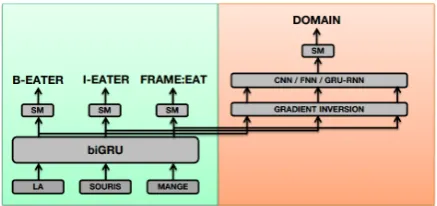
Our adversarial domain classifier is an exten-sion of (Ganin and Lempitsky,2014) to recurrent neural networks. We start from our biGRU se-mantic parser and on the last hidden layer, we stack another neural network that implements a domain classifier (called adversarial task). The domain classifier is connected to the biGRU us-ing a gradient reversal layer. Trainus-ing consists in finding a saddle point where the semantic parser is good and the domain classifier is bad. This way, the model is optimized to be domain independent. The architecture is shown in Figure 1. The ad-versarial task can be implemented using a CNN, a RNN or a FNN. In this paper we use CNN as they yield the best results on preliminary experiments.
[image:3.595.307.526.62.165.2]This architecture is trained following the guide-lines of (Ganin and Lempitsky, 2014). During
Figure 1: Adversarial Domain Classifier model
training, the adversarial classifier is trained to pre-dict the target class (i.e. to minimize the loss
Ladv) while the main task model is trained to make
the adversarial task fail (i.e. to minimize the loss
Lf rame−Ladv). In practice, in order to ensure
sta-bility when the parameters of the shared network are updated, the adversarial task gradient magni-tude is attenuated by a factor λas shown in (1). Here∇Lrepresents the gradients w.r.t the weights
θfor either the frame classifier loss or the adver-sarial loss,θare the model’s parameters being up-dated, and µ is the learning rate. This λ factor increases on every epoch following (2), wherepis the progress, starting at 0 and increasing linearly up to 1 at the last epoch.
θ←θ−µ∗(∇Lf rame−λ∇Ladv) (1)
λ= 2
1 + exp(−10·p) −1 (2)
3.4 Unsupervised domain inference
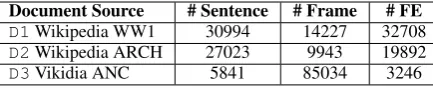
Document Source # Sentence # Frame # FE D1Wikipedia WW1 30994 14227 32708
D2Wikipedia ARCH 27023 9943 19892
[image:4.595.74.291.62.107.2]D3Vikidia ANC 5841 85034 3246
Table 1: Description of the CALOR-Frame corpus
minimal intra-cluster inertia is kept. Eventually, the resulting clusters are used as classes that the CNN will be trained to recognize for each cor-responding training sentence. The underlying as-sumption is that the clustering process will capture domain-related regularities and biases that will be harnessed by the adversarial task in order to in-crease the model’s generalization capacities.
4 Evaluation setting
To create an experimental setting that shows the effect of domain on the semantic parsing task, we run experiments on the CALOR-Frame corpus (Marzinotto et al.,2018a), which is a compilation of French encyclopedic documents, with manual FrameNet annotations (Baker et al., 1998). The CALOR-Frame corpus has been designed in the perspective of Information Extraction tasks (auto-matic filling of Knowledge Bases, document ques-tion answering, semantically driven reading com-prehension, etc.). Due to thepartial parsing pol-icy, the CALOR corpus presents a much higher amount of occurrences per Frame (504) than the FrameNet 1.5 corpus (33).
We selected three subsets from the corpus, each one from a different source and/or thematic domain: Wikipedia World War 1 portal (D1), Wikipedia Archeology portal (D2) and Vikidia1
Ancient history portal (D3). These sources allow to study the impact of both style changes (associ-ated to differences on syntactic structures) and the-matic changes (associated to lexical differences).
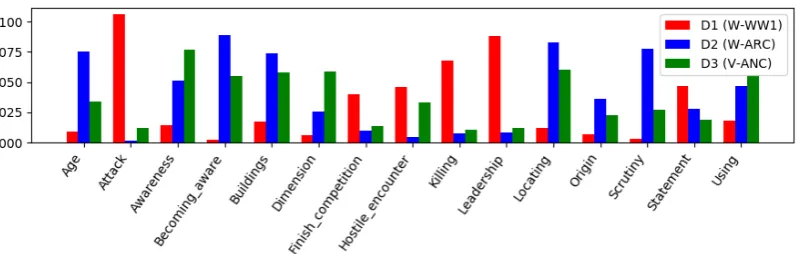
For the study, we focus on a set of 53 Frames that occur in all the three sub-corpora. Each par-tition has a different prior on the Frames and lex-ical units (LUs) distributions. Figure2shows the normalized Frame distributions for the three sub-sets, illustrating the thematic domain dependence. Frames such asAttackandLeadershipare frequent in D1 while Age and Scrutiny are characteristic Frames for D2. The same analysis can be done using LUs, yielding similar conclusions. We also observe thatD2and D3are more similar but the difference between these sub-corpora lie more in
1Vikidia is an encyclopedia for childrenvikidia.org
the syntactic structure of sentences and in the pol-ysemic use of some LU, as will be discussed in the experiments.
5 Results
In these experiments we evaluate the impact of our adversarial training scheme on the semantic frame parser presented in section3.1. The parser is trained on 80% of theD1andD2corpora and evaluated on the remaining 20%, considered here asin-domain data, as well as the wholeD3 cor-pus for the out-of-domain data. For the domain inference, we use the method presented in sec-tion3.4. Several experiments were made, varying the number of clusters K (K = 2, K = 5 and
K = 10). The performance obtained were very similar, the influence ofK being negligible in our experiments, therefore we report here only those done withK = 5.
We report results using precision/recall/f-measure metrics at the Target, Frame and Argu-ment identification levels. The errors are cumu-lative: to obtain a correct argument identification, we need to have both its frame and target correct. Moreover we use a hard-span metric for argument identification, meaning that both the label and the span have to be correct for an hypothesis to be con-sidered as correct.
Results are given in figure 3 where the pre-cision/recall curve on argument identification is given with and without adversarial training for the in-domain corpusD1and the out-of domain cor-pusD3. Table2 presents F-measure (F-max) for the 3 identification tasks (target, frame, argument) forD1,D2andD3.
Figure 3 clearly illustrates the drop in perfor-mance between in-domain and out-of-domain cor-pora. The difference is significant, it accumulates at each step resulting on a 9 points drop in F-max for the argument identification task as shown in ta-ble2. When applying our adversarial method dur-ing model traindur-ing, we clearly increase the gen-eralization capabilities of our model on out-of-domain data (D3), as the biGRU + AC curve outperforms thebiGRU curve at every operating point in figure3. This is confirmed on the F-max values for each level in table2.
Figure 2: Most frequent frames and their normalized distribution for each partition (from left to right: W-WW1 (D1),W-ARC(D2) andV-ANC(D3))
Figure 3: Precision/Recall trade-off with (biGRU+AC) and without (biGRU) adversarial training onD1(in-domain) andD3(out-of-domain)
due to a gain in recall, and is confirmed on the F-max measures forD1andD2in table2.
We believe that, since domains are correlated with the lexicon, the adversarial objective pushes the model to rely less on lexical features and to give more importance to features such as syntax and part-of-speech. This is inline with the obser-vation that most of the improvement comes from a higher recall. This can also explain the perfor-mance gains on in-domain data. The high dimen-sionality of word embeddings may have lead to some over-fitting on our initialbiGRUmodel. On the other hand, adversarial learning can act as a regularization technique that makes the model rely as much as possible on domain independent fea-tures.
In order to have a better understanding of the be-havior of our method we performed two additional contrastive experiments where we used firstlygold domain labels instead of inferred ones, and sec-ondly a single domain corpus for training rather than a multi-domain one.
Gold domain labels. We consider here thetrue domain labels forD1andD2as the classes for our
adversarial classifier. Therefore only two domains are considered in the adversarial training process. Results are presented in the second part of table
2, in line biGRU+AC-gold. As we can see re-sults are very similar to those obtained with au-tomatic clustering (biGRU+AC). With an aver-age difference of only 0.3pts (Fmax) for the ar-gument identification task across the different do-mains. This confirms that our unsupervised clus-tering approach is as efficient as a supervised do-main classification for adversarial learning. More-over, our approach has the advantage that it can be applied in situations where no domain information is available.
Target Identification Frame Identification Argument Identification in-domain out-of-domain in-domain out-of-domain in-domain out-of-domain
D1 D2 D3 D1 D2 D3 D1 D2 D3
biGRU 97.1 97.5 94.2 93.4 95.4 91.0 59.2 56.3 50.2
biGRU+AC 97.3 98.7 94.7 94.2 95.9 91.9 60.0 57.0 51.7
[image:6.595.72.529.60.126.2]biGRU+AC-gold 97.7 98.2 94.9 94.9 95.9 92.0 60.1 56.7 51.3
Table 2: F-measure (Fmax) on target, frame and argument identification with (biGRU+AC) and without (biGRU) adversarial training. Clustering with exact domain labels is given in linebiGRU+AC-gold
gains in terms of model generalization.
5.1 Error Analysis
5.1.1 Target and Frame Identification
When looking carefully at the generalization capa-bilities of the initial model, we observed that the frames with the highest performance drops onD3 are those associated to LUs that are polysemous in a general context, but are unambiguous given a thematic domain. For example, installer (to in-stall)triggers the frameInstallingin bothD1and D2, but triggersColonizationin D3. Sometimes the confusion comes from changes in the writing style. For example arriver (to arrive)means Ar-rivingin both D1andD2, but inD3it is used as a modal verb (arriver `a meaning to be able to) triggering no frame.Under these circumstances, a model trained on a single domain underestimates the complexity of the frame identification task, mapping the LU to the frame without further anal-ysis of its sense.
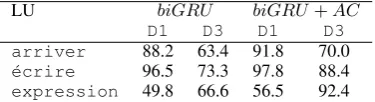
When we apply biGRU +AC, the gains ob-served on Frame Identification are not constant across LUs. To analyze the impact of the adversar-ial approach, we compare for each LU the distri-bution across clusters of the sentences containing the given LU. This is done separately forD1and D3(forD3, sentences are projected into the clus-ters by choosing the less distant cluster centroid). In table4, we present the LUs for which the cluster distribution onD1andD3are the most dissimilar. These are also the LUs that are the most positively affected by the adversarial strategy.
This means that whenever a LU has similar dis-tribution of context words across the different do-mains this context information is already exploited by the system to perform frame disambiguation. On the other hand, when the context words of a LU depend on the domain, the model can take ad-vantage of adversarial learning to build a higher level representation that abstracts as much as pos-sible from the lexical variations of the words sur-rounding the LU.
5.1.2 Argument identification
In this section, we focus on the Frame Argu-ment (or FE for Frame EleArgu-ment) Identification level, and propose contrastive experiments follow-ing the complexity factors analysis proposed by (Marzinotto et al., 2018b). In this study, the au-thors have shown that FE identification is perform-ing better for verbal LU triggers than for nomi-nal ones, and for triggers that are at the root of the syntactic dependency tree. We want to see here how these complexity factors are affected by the adversarial learning strategy. Additionally, we want to see if the system behaves equivalently over core and non-core Frame Elements. Actually, in the usual evaluation Framework of the Framenet 1.5 shared task, non-core FEs are assigned a 0.5 weight for the F-measure computation, reducing the impact of errors on non-core FEs. In this pa-per, all FEs are rated equally, but here we sepa-rate them to observe their behaviour. As we can see in table5, adversarial training consistently im-proves the FE identification results, in all condi-tions. Moreover, bigger gains are observed for the difficultconditions.
6 Generalization to PropBank Parsing
atten-Target Identification Frame Identification Argument Identification in-domain out-of-domain in-domain out-of-domain in-domain out-of-domain
D1 D2 D3 D1 D2 D3 D1 D2 D3
biGRU 97.6 95.5 93.3 93.8 93.4 90.9 58.2 46.1 43.6
biGRU+AC 97.6 95.6 94.3 95.3 94.5 91.2 60.0 47.1 45.2
Table 3: Frame semantic parsing performances (Fmax). Models trained onD1. Adversarial learning with inferred domainsbiGRU+AC.
LU biGRU biGRU+AC
D1 D3 D1 D3 arriver 88.2 63.4 91.8 70.0
´
ecrire 96.5 73.3 97.8 88.4
expression 49.8 66.6 56.5 92.4
Table 4: Frame Identification score for LUs with the highest variation in cluster distribution
D3 biGRU biGRU+AC
overall 50.2 51.7 (+3%)
core FE 56.5 57.0 (+0.9%)
non-core FE 48.9 50.4 (+3.1%) verbal trigger 53.4 54.9 (+2.8%) nominal trigger 34.6 39.0 (+12.7%) root trigger 59.5 61.3 (+3.0%) non-root trigger 45.4 47.2 (+4.0%)
Table 5: Frame Element Identification results accord-ing to complexity factors onD3(Fmax)
tion (Tan et al.,2017;Strubell et al.,2018). How-ever, these parsers still suffer performances drops of up to 12 points in F-measure on OOD with re-spect to ID. For this experiment we have applied the same adversarial approach over a state-of-the-art Propbank parser (He et al.,2017) using a single straight classifier model. As there is no explicit domain partitions in the training corpus, we ap-ply our inferred domain adversarial task approach, running the clustering algorithm with 5 clusters. We were not able to reproduce the same results as the one published in the paper, we hence provide the results obtained running the downloaded sys-tem in our lab. Similarly to the previous FrameNet parsing model, we vary a threshold on the output probabilities of Semantic Roles in order to opti-mize the F-measure and we provide F-max values, computed using the official evaluation script. We observe in table 6 that the adversarial approach outperforms the original system on both the ID and OOD tests sets.
7 Conclusion
We have presented a study on improving the ro-bustness of a frame semantic parser using ad-versarial learning. Results obtained on a
[image:7.595.88.276.167.218.2]multi-ID WSJ OOD BROWN (He et al.,2017) 82.4 71.7 (He et al.,2017)+AC 83.0 72.3
Table 6: SRL performance (Fmax) on CoNLL-2005, based on (He et al.,2017) model
domain publicly available benchmark, called CALOR-Frame, showed that domain adversarial training can effectively be used to improve the generalization capacities of the tagging models, even without prior information about domains in the training corpus. We showed that our technique can be applied to other semantic models, by imple-menting it into a state-of-the-art PropBank parser and showing some consistent gains. This positive result suggests that our approach could apply suc-cessfully to more NLP tasks.
References
Collin F Baker, Charles J Fillmore, and John B Lowe. 1998. The berkeley framenet project. In Proceed-ings of the 36th Annual Meeting of the Associa-tion for ComputaAssocia-tional Linguistics and 17th Inter-national Conference on Computational Linguistics-Volume 1, pages 86–90. Association for Computa-tional Linguistics.
Xilun Chen, Yu Sun, Ben Athiwaratkun, Claire Cardie, and Kilian Weinberger. 2016. Adversarial deep av-eraging networks for cross-lingual sentiment classi-fication.ArXiv e-prints.
Alexis Conneau, Guillaume Lample, Marc’Aurelio Ranzato, Ludovic Denoyer, and Herv´e J´egou. 2017. Word translation without parallel data. arXiv preprint arXiv:1710.04087.
Dipanjan Das, Desai Chen, Andr´e FT Martins, Nathan Schneider, and Noah A Smith. 2014. Frame-semantic parsing. Computational linguistics, 40(1):9–56.
Yanai Elazar and Yoav Goldberg. 2018. Adversarial removal of demographic attributes from text data. In
EMNLP.
labeling with neural network factors. In Proceed-ings of the 2015 Conference on Empirical Methods in Natural Language Processing, pages 960–970.
Yaroslav Ganin and Victor Lempitsky. 2014. Unsuper-vised domain adaptation by backpropagation. arXiv preprint arXiv:1409.7495.
Yaroslav Ganin and Victor Lempitsky. 2015. Unsuper-vised domain adaptation by backpropagation. In In-ternational Conference on Machine Learning, pages 1180–1189.
Yaroslav Ganin, Evgeniya Ustinova, Hana Ajakan, Pascal Germain, Hugo Larochelle, Franc¸ois Lavi-olette, Mario Marchand, and Victor Lempitsky. 2016. Domain-adversarial training of neural
net-works. Journal of Machine Learning Research,
17(59):1–35.
Silvana Hartmann, Ilia Kuznetsov, Teresa Martin, and Iryna Gurevych. 2017. Out-of-domain framenet se-mantic role labeling. In Proceedings of the 15th Conference of the European Chapter of the Associa-tion for ComputaAssocia-tional Linguistics: Volume 1, Long Papers, volume 1, pages 471–482.
Luheng He, Kenton Lee, Mike Lewis, and Luke Zettle-moyer. 2017. Deep semantic role labeling: What works and what’s next. InProceedings of the An-nual Meeting of the Association for Computational Linguistics.
Karl Moritz Hermann, Dipanjan Das, Jason Weston, and Kuzman Ganchev. 2014. Semantic frame iden-tification with distributed word representations. In
ACL (1), pages 1448–1458.
Richard Johansson and Pierre Nugues. 2008. The ef-fect of syntactic representation on semantic role la-beling. In Proceedings of the 22nd International Conference on Computational Linguistics (Coling 2008), pages 393–400. Association for Computa-tional Linguistics.
Joo-Kyung Kim, Young-Bum Kim, Ruhi Sarikaya, and Eric Fosler-Lussier. 2017. Cross-lingual transfer learning for pos tagging without cross-lingual
re-sources. In Proceedings of the 2017 Conference
on Empirical Methods in Natural Language Pro-cessing, pages 2832–2838. Association for Compu-tational Linguistics.
Pengfei Liu, Xipeng Qiu, and Xuanjing Huang. 2017.
Adversarial multi-task learning for text classifica-tion.CoRR, abs/1704.05742.
Gabriel Marzinotto, Jeremy Auguste, Fr´ed´eric B´echet, G´eraldine Damnati, and Alexis Nasr. 2018a. Se-mantic Frame Parsing for Information Extraction :
the CALOR corpus. In LREC 2018, Miyazaki,
Japan.
Gabriel Marzinotto, Fr´ed´eric B´echet, G´eraldine Damnati, and Alexis Nasr. 2018b. Sources of Com-plexity in Semantic Frame Parsing for Information
Extraction. In International FrameNet Workshop
2018, Miyazaki, Japan.
Rebecca J Passonneau, Collin Baker, Christiane Fell-baum, and Nancy Ide. 2012. The masc word sense sentence corpus. InProceedings of LREC.
Darsh J. Shah, Tao Lei, Alessandro Moschitti, Salva-tore Romeo, and Preslav Nakov. 2018. Adversarial domain adaptation for duplicate question detection. InEMNLP.
Anders Søgaard, Barbara Plank, and Hector Martinez Alonso. 2015. Using frame semantics for knowl-edge extraction from twitter. InAAAI, pages 2447– 2452.
Rupesh Kumar Srivastava, Klaus Greff, and J¨urgen Schmidhuber. 2015. Training very deep networks. In NIPS 2015, pages 2377–2385, Montral, Qubec, Canada.
Emma Strubell, Patrick Verga, Daniel Andor, David Weiss, and Andrew McCallum. 2018. Linguistically-informed self-attention for semantic role labeling. arXiv preprint arXiv:1804.08199.
Zhixing Tan, Mingxuan Wang, Jun Xie, Yidong Chen, and Xiaodong Shi. 2017. Deep semantic role label-ing with self-attention.CoRR, abs/1712.01586.
Bishan Yang and Tom Mitchell. 2017. A joint sequen-tial and relational model for frame-semantic parsing. In Proceedings of the 2017 Conference on Empiri-cal Methods in Natural Language Processing, pages 1247–1256. Association for Computational Linguis-tics.
Haitong Yang, Tao Zhuang, and Chengqing Zong. 2015. Domain adaptation for syntactic and seman-tic dependency parsing using deep belief networks.
Transactions of the Association for Computational Linguistics, 3:271–282.