Munich Personal RePEc Archive
India as a destination of multinational’s
RD: Growingimportance and
management strategy of local RD centers
Motohashi, Kazuyuki
February 2014
Online at
https://mpra.ub.uni-muenchen.de/57281/
1
India as a destination of multinational’s R&D: Growing importance and management strategy of local R&D centers
By Kazuyuki Motohashi, The University of Tokyo and RIETI, Japan
Abstract
While R&D activities of multinational firms in India focus on offshore development, some companies are developing cutting-edge technologies. In addition, product development for the local market has increased with the expansion of the Indian market. India’s importance as an R&D center is predicted to increase, and multinationals in advanced countries must
improve the competency creation mission of R&D entities in India. To do so, attracting exceptional talent and running highly autonomous organizations with reduced control from headquarters are critical. However, within a corporate-wide innovation strategy, fostering unity through social controls such as international personnel rotations and training, close communication, and permeation of the corporate culture are essential to having an effective local entity.
2
1. Introduction
As Japan and other advanced economies mature, economic growth in
emerging countries shows high potential. This trend has become clearer with the financial crisis of 2008 and the recent Euro crisis. Accordingly, to capture emerging markets experiencing considerable growth, companies in advanced countries commonly engage in greater R&D activities. Among these markets, India is attracting attention, particularly among firms in Europe and the United States. According to a UNCTAD survey, India ranks just behind China and the United States as a top R&D center for multinationals (UNCTAD, 2005). When comparing China and India, many companies are attracted to China’s market and cheap labor, while India’s strength lies in its high-quality R&D resources. In particular, India boasts the world’s largest offshore centers for software, and many multinational firms have established IT-related development offices there. In this paper, we focus on India as an international R&D center and discuss management strategies for overseas R&D centers.
3
However, large differences in business environments are proportional to the difficulties in managing local R&D centers. In particular, India has strict labor laws with very active labor unions, the caste system still exists, and customs and practices differ widely by state. Moreover, weak intellectual property laws and high worker turnover lead to a high risk of technology leaks. This is a sensitive factor in R&D, which is usually highly confidential. By conducting R&D in India, companies can significantly improve efficiency, although there is a high risk of failure due to the unsuccessful management of the research facilities. R&D management is critical because it is a
high-risk/high-return investment.
In this paper, we provide an overview of technology management of overseas R&D centers, focusing on India as a host country. In the next section, we discuss the taxonomy of R&D globalization. While HBA and HBE are
concepts created for R&D globalization in advanced countries, we summarize various activities that reflect R&D characteristics in emerging countries including India. In section 3, we discuss the current state of R&D of foreign firms in India. In addition to providing an overall view using patent data, we discuss the market orientation of Suzuki Motors in developing new vehicles as well as examine the development of a portable electrocardiogram (ECG) device by GE Healthcare (a case of reverse innovation). In section 4, we present a framework by which to dynamically understand the mission and positioning of foreign research centers as well as discuss the state of
management and organizational strategies for foreign R&D centers in India. Finally, we present our conclusions and discuss remaining issues.
2. Taxonomy of R&D Globalization 2-1. HBA and HBE
Various types of activities come to mind when discussing foreign R&D centers, and these can be categorized into two types: 1) a “technology
acquisition” model, wherein overseas cutting-edge technologies are brought into domestic business, and 2) a “local development” model, wherein
4
Kuemmerle (1997) termed the former home-base-augmenting (HBA) and the latter home-base-exploiting (HBE). HBA holds true when a technology that is desirable to a company exists in the target market. For example,
companies commonly establish research laboratories near Silicon Valley or Boston to capture cutting-edge technologies in IT or biotech. On the other hand, in HBE, the size and characteristics of the market are more important than the level of technology in the target market. Products must be localized when local consumer needs differ from those of the home market. For
example, in the Chinese market, companies establish local development centers to localize home appliances such as washers and dryers.
Cantwell and Mudambi (2005) focused not only on the knowledge flow but also on the missions of local entities and classified them into
“competency-creating mandates” and “competency-exploiting mandates.” Along with Kuemmerle (1997), this taxonomy follows the theories of
Dunning (1996)—who discussed whether the activities of local entities are aimed at acquiring strategic resources or whether they provide local market services—and others (Ghoshal and Bartlett, 1990; Birkinshaw and Hood, 1998; Frost et al., 2002) who debated whether they should be viewed as the overall corporate group’s core research facilities or as local facilities
responding to local needs. In other words, the taxonomy delves into
governance issues within a global research organization by questioning the local entity’s position in the overall corporate group. Thus, local entities with competency creation missions are granted strategic autonomy. The
5
2-2. Taxonomy based on the State of R&D
Due to heterogeneous nature of R&D activities, the framework presented above does not capture whole missions and characteristics of overseas R&D centers in real world Here we separately consider the concepts of research and development. “Research” has no inherent products or services and
denotes activities at a more abstract level. “Development,” on the other hand, represents activities that aim for a specific output such as the creation of new products. Typically, these two areas are undertaken by different organizations within a company. For example, in the case of a general
electronics manufacturer with multiple lines of business such as computers, consumer electronics, and telecommunications devices, research is conducted by an organization such as an R&D headquarters or central research
laboratory that is not affiliated with a specific business unit. On the other hand, development often takes place within business units such as a consumer electronics or telecommunications division. In the case of
pharmaceutical companies, research generally refers to the stages leading up to the clinical trial phase, after which development takes over. The former is typically managed by an organization such as a research laboratory, while the latter is managed within, for example, development headquarters. The decision to create separate research and development functions in an overseas entity is often analyzed in different sections within Japanese companies.
Next, we consider the growing importance of emerging countries as global R&D centers. The vast differences between the business environments of advanced and emerging countries can be used to a company’s advantage, as in the case of offshore development. When a company based in an advanced country conducts R&D in an emerging country, HBE-style activities become possible. In this case, a company leverages technology resources from the home country and localizes them in local markets. However, this reduces the differences between products made according to home country specifications and local circumstances (i.e., adaptation), an activity different from a
6
other words, development aimed at local markets (adaptation) is conducted offshore (arbitrage).
By separating research and development as well as by more clearly identifying the position of target countries with differing business environments, we can deepen our understanding of the global R&D
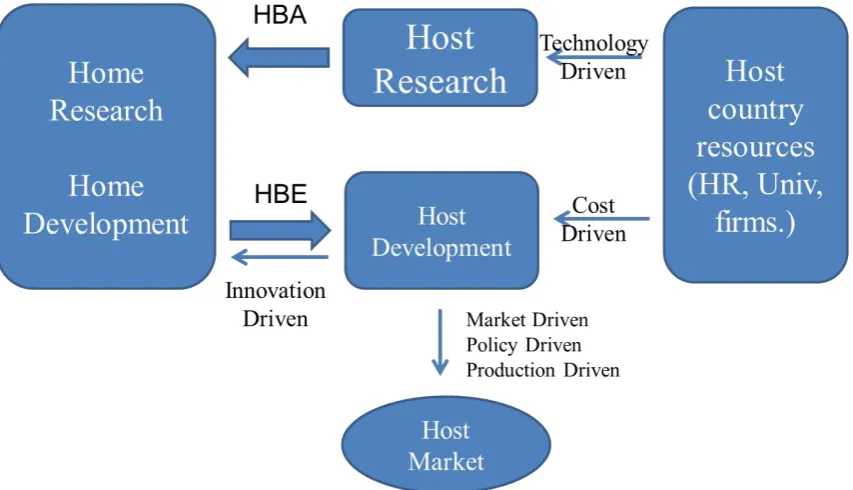
taxonomy (Figure 1). In addition to the traditional concepts of HBA and HBE, we present the following six classifications summarized by Gammeltoft
(2006), who surveyed the latest case studies on global R&D expansion into emerging countries.
(1)Technology driven: acquiring local cutting-edge technology and monitoring technology trends;
(2)Market driven: incorporating local consumer needs and product localization;
(3)Policy driven: responding to various local regulations, R&D incentives, and planning for local standardization of activities;
(4)Production driven: providing technology support for local production facilities;
(5)Cost driven: leveraging local, inexpensive labor;
(6)Innovation driven: acquiring local ideas for new products and strengthening global product development infrastructure through optimal division of roles.
(Figure 1)
The traditional HBA model primarily refers to research functions by which research capabilities in the home country are strengthened through foreign laboratories. Conversely, the HBE model primarily refers to development teams’ localization of products in target countries based on the home country’s technology.
7
range of concepts. Of the six classifications, “market driven” is the closest. However, “policy driven” and “production driven” can also be generalized as local development models. With regard to the policy-driven model, responding to both market needs and various standards is critical in localizing products. Many standards require localization with regard to, for example, environmental and safety regulations governing car exhausts, safety standards for cosmetics and pharmaceuticals, and electrical standards for electronics products. A company shipping products that do not meet these standards could cause accidents, and in the case of non-compliance, the company is often linked with large damages that smear its brand image. In terms of responding to such risks, following regulations and ensuring development and inspections to comply with standards are critical functions of local entities.
In terms of optimizing local production processes, a production-driven model is a development function for localization; this function is particularly important for car manufacturers. Manufacturing cars locally requires the creation of supply chains with local parts manufacturers. Of course, knockdown assembly of cars can be implemented by importing essential parts from Japan. However, when local content regulations make this difficult, increasing the procurement volume from local manufacturers is essential for reducing manufacturing costs. When using parts from local manufacturers, companies must conduct inspections to ensure that parts meet the standards demanded by car manufacturers. In emerging countries such as China and India, it can be difficult to find parts complying with the standards of Japanese car manufacturers. Thus, companies must alter production processes to attain the same level of quality in finished goods by using lower-quality products. Thus, local R&D is a necessity to achieve production processes that meet the conditions of the production facilities.
8
annually produce high volumes of quality engineering personnel. Therefore, these countries have attracted foreign direct investments by multinationals as their off-shore software development sites. This phenomenon has expanded to the design and development of electronics products such as medical devices and telecommunications equipment. In addition, it should be noted that a cost-driven approach extends to research and is not confined to development. Microsoft’s research division established Microsoft Research Asia in Beijing, which employs more than 300 researchers engaging in cutting-edge research. In addition, IBM’s research division has research centers in Beijing, Delhi, and Bangalore. From a global perspective, these centers play an important role in R&D organization.
Finally, innovation-driven R&D activities focus on incorporating ideas from target countries into new product development processes. Headquarters’ business divisions are often central to the development of global products, with overseas development centers positioned in support roles. However, products for local markets necessitate creativity at the local level. Innovation-driven activities define foreign development centers created with the expectation of reaping local innovation as well as new concepts and ideas. Leveraging product development ideas from emerging countries for global products will likely become more common in the future.
3. R&D in Multinational Firms in India 3-1. FDI Development in India
9
has conducted business in India since its time as a British colony, although the company’s activities gained momentum in the late 1990s. In 1997, GE established an offshore development center, and since the 2000s, it has further energized its business there with an eye to the Indian market. The Indian government began incentivizing foreign firms in earnest in the 2000s. As India was a British colony, it had a deep-rooted wariness with regard to foreign capital, allowing only gradual deregulation. At the outset of the 1990s, China began bringing in foreign capital, and by 2000, it was experiencing an average annual economic growth of greater than 10%. On the other hand, India’s economic growth was stagnant at about half that, 5.5%. Thus, galvanized by the steadily growing economy of its neighboring country through external liberalization, India undertook large-scale reforms of direct investment in 2002, apart from in certain industries. Further deregulation occurred in 2005 in service industries such as
telecommunications, financial services, and real estate. Special economic zones were established in 2005, in which foreign firms in many industries were allowed to create wholly owned subsidiaries and receive tax incentives. Since 2006, the average economic growth have been accelerated, and the country is expected to become an economic power in 21st century. As a result, the activities of foreign firms have not been limited to offshore centers
focused on global markets; they also focus on the Indian market itself.
Figure 2 shows the results of a survey—conducted in 2004 by the
Economist—of 500 global executives on the most attractive countries in terms of globalization objectives (Economist Intelligence Unit, 2004). India was deemed the most attractive location for “new opportunities in
outsourcing,” followed by for “access to a highly skilled labor force,”
indicating that software resources in India are highly rated not only for their low cost but also for their quality. Overall, 24% of the executives listed R&D activities in India as being alongside those in Europe, the United States, and other advanced countries. From the perspective of foreign firms, India is highly attractive as an R&D destination. On the other hand, China is
10
(Figure 2)
3-2. R&D Activities of Foreign Firms
R&D activities of foreign firms in India gathered steam in 2000. IBM is a typical example, creating the India Research Laboratory in 1998 as part of its global research facilities. In 2001, the company established the India Software Laboratory to conduct software-related R&D. In 2000, GE established the John F. Welch Technology Center (JFWTC) in Bangalore, with close to 4,000 researchers working on a variety of R&D activities. There are no formal statistics on R&D centers for foreign firms in India, although in 2010, the country had 471 companies with 649 research centers (Krishna et al., 2012).
Figure 3 shows the total patents by company, according to the USPTO, registered between 2006 and 2010 by inventors living in India (Basant and Mani, 2012). IBM leads the way, followed by Texas Instruments, GE, and others. Of the 15 companies, four are IT or telecommunications companies, five are semiconductor companies, three are software-related companies, and two are electronics-related companies—GE and Honeywell. The remaining company is Sabic Plastics (a chemicals company based in Saudi Arabia). Many of the patents are software related. In addition, the companies are mostly from the United States, although European firms such as ST Microelectronics and SAP are also ranked. Japanese firms were slower to enter India than their European and US counterparts, with companies only recently creating research laboratories. For example, in 2010, the
pharmaceutical manufacturer Eizai created a production process research center (Eizai Knowledge Center India) in the state of Andhra Pradesh. In 2011, Hitachi opened its Hitachi India R&D Center in Bangalore. However, as seen in greater detail below, some companies have in-house R&D
capability, such as Suzuki Motors, which conducts full-scale development of new cars in production facilities and not through independent R&D centers.
(Figure 3)
11
companies in India are likely to be primarily cost driven. With Indian software engineers, companies can churn out software for product development at a global level. A high percentage of such activities are
conducted in India. However, akin to IBM Research India, certain companies with research groups in India position the country as a center for knowledge creation at a global level rather than for mere offshore development
activities. GE’s JFWTC employs about 4,000 staff, about 500 of which engage in research (Jin, 2008). The research capabilities of universities and public research institutions are not particularly high; therefore, companies do not absorb cutting-edge technology in India. However, the activities of utilizing outstanding personnel to pursue India-originated research output are technology driven. Intel created the Intel India Development Center in Bangalore as an important CPU development center. The X86 Zeon
microprocessor was developed in this center and was the first six-core chip produced by the company.
Economic growth in India has raised citizens’ income levels and pushed market-driven R&D for the local market. Though difficult to ascertain from patent data, some car manufacturers are developing passenger cars for the local market. Along with Indian income levels, the number of passenger cars sold in India is rapidly rising. In 2012, 2.77 million cars were sold, fourth highest in the world behind China, the United States, and Japan. However, 80% of these are small cars costing between $5,000 and $10,000 and
requiring lower costs in line with market needs. In India, Suzuki Motors is particularly strong in the small-car market, in which it has a 40% share, and it has long developed passenger cars for the local market through its local entity.
12
wherein local ideas are turned into products that expand the knowledge base of headquarters in the home country. We discuss the cases of Suzuki Motors and GE Healthcare in greater detail below, as we explain the state of R&D activities in India.
3-3. Market-driven R&D in Maruti Suzuki
Suzuki Motors entered the Indian market in 1982 through a joint venture with the nationalized car manufacturer Maruti Udyog Ltd. At the time, the Indian government did not allow domestic activities of foreign firms, and the joint venture was only realized at the behest of the Indian government. Suzuki Motors later increased its share in the joint venture (Maruti Suzuki), and in 2003, turned it into a wholly owned subsidiary concurrently with its listing on the Indian Stock Exchange. According to the statistics by the Society of Indian Automobile Manufacturers (SIAM), Multi Suzuki produced 1.18 million cars in 2012, of which 120,000 were exported; the remaining 1.06 million were sold domestically. That year, 2.77 million cars were sold in India, giving Suzuki the highest market share in the country at 38%.
Cars comprise thousands, even tens of thousands of parts, and there are as many parts manufacturers. Car manufacturers (assembly manufacturers) work directly with the largest of these, Tier 1 suppliers, which in turn are supplied by many Tier 2 or Tier 3 suppliers; this represents a hierarchical structure characteristic of the industry. Producing cars in India requires the construction of a supply chain with these parts manufacturers.
For example, Denso is a Tier 1 supplier of electronic control units, fuel pumps, and injectors. It imports critical parts from Japan and primarily engages in assembly in India. Although it has some local procurement of resin and die cast parts, Tier 2 suppliers in India are not mature, and Japanese Tier 2 suppliers are mostly small- and medium-sized companies that have yet to enter the Indian market. “Cutting costs requires us to increase our local procurement, which is an important initiative for us, and the automakers are cooperative. We cannot decrease our quality, but we need to change our way of thinking by, for example, getting rid of some
13
The development of low-cost cars meeting Indian specifications is achieved jointly by car manufacturers such as Suzuki Motors and parts
manufacturers such as Denso. For Denso to increase its procurement from local Tier 2 suppliers, they must collaborate with Suzuki Motors on the functionality standards that must be met by end products. This type of collaboration furthers localization of production processes for Suzuki Motors and enables greater cost competitiveness for its products.
In addition, Maruti Suzuki continued developing an infrastructure to develop small cars in India. Until then, when the company introduced new models to the Indian market, it created local models based on those already developed and mass produced in Japan. However, the introduction of the Swift in 2005 transformed that modus operandi, with cars of the same
quality and specification simultaneously produced in Japan, Hungary, India, and China. This policy further advanced in 2009, with the release of the A-Star. This car is a global model, produced in India, and it is not only sold in India but also exported to Europe. By periodically conducting exchanges among the engineers, Maruti Suzuki and Suzuki Motors in Japan continue to develop the infrastructure in India. There are three stages in local design. The first is designing the front and rear body, specifically the shape of the lights and front grill. Maruti Suzuki has already reached this level. The second stage is designing the entire body, and the final stage is developing the entire car, including the platform. According to Maruti Suzuki staff, it “would like to be at stage two in a few years” (from a 2009 interview with Maruti Suzuki executives).
3-4. Reverse Innovation at GE Healthcare
The John F. Welch Technical Center, or JFWTC, is GE’s research laboratory in India. It employs 4,000 researchers and engineers and is one of the
14
GE Healthcare held a high share of the global ECG market, although at prices between $3,000 and $10,000, the products were too expensive to be accepted in the Indian market. In addition, as patients in India were dispersed in areas not easily accessible by faster means of transportation, portability was critical. Furthermore, as certain locations did not have electric power, battery capabilities were necessary. GE Healthcare
understood that existing products did not meet these market needs, and in response to these needs and to significantly reduce costs, it formed a new product development team at the JFWTC. In 2007, this team introduced the MAC400, an $800 portable ECG, into the market. Existing products had a digital signal processor (DSP), keyboard, and printer, which were all
high-quality components that needed to be specially ordered. In contrast, the MAC400 used standard, low-cost components to drastically reduce costs. Moreover, the product was lightweight and battery operated, thus making it popular in India. GE continued to further improve the product, and it is now sold in 60 countries, including the United States, as an entirely new product category. This example from GE Healthcare is one of reverse innovation, wherein a product created through the initiative of a foreign R&D center spurs innovation both globally and in the home country.
GE is a rare example of reverse innovation achieved by companies from advanced countries. However, we will likely see more instances of products from emerging countries spreading to other emerging countries, such as a product developed in India being sold in China. A 2009 survey by the
Ministry of Economy, Trade and Industry (METI) noted that the percentage of companies responding affirmatively to whether locally developed products will be supplied solely to the relevant country decreased from 55.6% five years ago to the current 28.2%. In addition, this number is predicted to further decrease to 9.3% in the next five years. Conversely, companies responding that they would supply locally developed products to the entire world remained at 14.6%; however, this number is predicted to increase to 35.2% in the next five years (METI, 2010). Thus, the tendency is
clear—products designed in emerging countries are developed not only for local markets but also for global markets.
15
and Timble (2012) noted that to be successful in an emerging country, companies from advanced countries must adopt a completely new approach to management. In addition, management must modify its views such that emerging countries can be positioned as core growth engines for the company. This is because business environments in emerging countries can completely differ from those in advanced countries. In GE Healthcare’s ECG project, the company aimed to provide a product with 50% of the performance of existing products but at 15% of the price. This goal could not be achieved by merely improving existing products; therefore, the company initiated a project to develop a new unique product in its Indian research laboratory.
Originally, GE Healthcare’s case was a local development project for a local market. Similar projects, although on a small scale, are likely to be found among global companies. However, for a product to be sold at a global level, and for a project to attract investment of major resources, a management’s views must undergo transformation. Senior management must decide whether it will concentrate serious efforts in emerging markets for the company’s future growth. In the case of GE Healthcare, Immelt, the
company’s chairman, appointed a project leader who reported directly to him, which helped overcome various internal and external obstacles and
generated significant results.
However, great risks are involved in making huge investments in a new region, where the business environment differs greatly from that in
16
4. Organizational Management of Local R&D Centers
Among standard theories of international business management, there are four types of global R&D organizations (Ghoshal and Bartlett, 1990).
(1) Center for global: the home country takes the lead in conducting R&D for global markets.
(2) Local for local: foreign research laboratories act independently in responding to local market needs.
(3) Local for global: R&D for global markets is conducted in foreign research laboratories.
(4) Globally linked: multiple research laboratories in various countries collaborate in a network structure to work on a single project.
Determining the ideal type depends on the specifics of a project and company policy. In companies that primarily use pattern (1), the role of foreign
research facilities is minimal. This pattern may be effective for discovering and capturing cutting-edge technology, but it does not require a large-scale center. This is a centralized R&D management method wherein foreign research facilities work under the direction of the home country. Patterns (2) and (3) can be classified as decentralized management styles and require R&D centers of a scale that allows for some autonomy. For (2), R&D centers typically work as part of a larger organization in a particular region, and among foreign R&D centers, these are the most independent from the
mother country. On the other hand, in (3), foreign centers often act under the control of the mother country in targeting global markets. Finally, in (4), companies have global R&D centers, each with a particular role in pursuing corporate-wide projects. This pattern leads to classifications that go beyond “centralized” or “decentralized.”
17
for global” local entity, both of which leave much to the discretion of the local entity. It is more realistic for the R&D division at headquarters to take the lead in creating the local entity and then gradually increase its autonomy (Motohashi, 2012).
Figure 4 graphically shows this evolutionary process for foreign research laboratories. The vertical axis shows the level of the competency creation mission for the local entity, and the horizontal axis shows whether the target market is local or global. The competency creation mission shows the
importance of a local entity for a multinational firm in its knowledge creation activities at a global level (Cantwell and Mudambi, 2005). The progression from (1) to (4) can be shown as a shift from local R&D subsidiaries to local R&D centers and finally to centers of excellence (COE). In this process, a company first increases its competency creation mission in accordance with specific local circumstances, and when the capabilities of the local entity have grown sufficiently, the company positions the local entity as part of the global R&D organization.
(Figure 4)
As seen in section 3, a characteristic of R&D organizations in India is the emphasis on their position as offshore development centers for the global market. Ghoshal and Bartlett’s (1990) classifications noted above were created when the internationalization of R&D activities was being implemented among advanced countries and cost-driven offshore
18
Naturally, not all foreign R&D centers follow the path to becoming COEs, and it is not realistic for even multinational firms to have COEs throughout the world. The level of a competency creation mission is determined by the global strategy of the multinational firm and the economic environment of the country in question (Cantwell and Mudambi, 2005). India is blessed with an R&D environment characterized by many outstanding software
engineers; this facilitates the progression of its research facilities from being offshore sites to COEs. In addition, economic growth accelerated in the country from 2000 onward, making its market attractive.
As a result, progression from local R&D sites to local R&D centers can be observed, as in the case of Suzuki Motors, and GE’s JFWTC can be regarded as having evolved from a local R&D center to a COE. Increasing the
competency creation mission of foreign R&D centers in India is essential to winning both the local and global competitions for innovation, due to its growing importance of both supply and demand sides of R&D. Both Suzuki Motors and GE Healthcare have invested in India for long time, but the levels of local R&D centers, classified in Figure 4, are different. While GE’s R&D center can be illustrated as an example of reverse innovation, Multi Suzuki’s activity is still in the process of local R&D subsidiary to local R&D centers. Since new product development in automotive industry requires much more coordination of activities within and between firms, it takes more time to reach the stage of “center of excellence” than the case of health care products. However, more autonomy to facilitate local innovation is
imperative, even for automotive industry, in order to capture the opportunity associated with growing presence of emerging economies in global business.
19
control: researcher incentive is damaged and local knowledge cannot be fully leveraged. However, delegating authority to local entities can divert their activities from the company-wide mission. As seen on a global corporate-wide level, there is a danger that resources will not be used effectively (Acemoglu et al., 2007). Thus, training local managers and rotating researchers between the local entities and headquarters are important countermeasures (Brickley et al., 2001). In addition, rather than formal mechanisms such as regulations and compensation schemes, companies will find it effective to work on social controls via close communication between headquarters and local entities as well as by sharing the corporate culture (Ecker et al., 2013).
5. Conclusion
In this paper, we reviewed Indian R&D activities of multinational firms from advanced countries and examined the state of organizational management in local R&D centers. India has an abundance of quality research personnel, and there is significant offshore development by US firms, particularly in the field of software. Moreover, companies such as IBM, Intel, and GE conduct cutting-edge R&D in India. The economic growth and increasing income levels in India have made the Indian market attractive, and local R&D activities have been on the rise, particularly in the automotive market. Thus, India has world-class potential both as a global R&D center targeting global markets and as a regional R&D hub for its local market and markets in emerging countries.
For multinational firms, realizing the high potential for innovation in India requires increasing the competency creation mission of local R&D centers. In doing so, companies must attract outstanding personnel to their local
entities and provide a high level of autonomy by loosening the control from headquarters. However, in a corporate-wide innovation strategy, making the activities of local entities effective will require the engendering of unity through social controls such as international personnel rotation and training, close communication, and permeation of the corporate culture.
20
headquartered in advanced countries may attempt to instill their corporate culture in India, this is easier said than done. Accordingly, companies must create a management system in local entities with a high degree of
transparency, using clear and formal rules and incentive systems. In
addition, for the results of local R&D activities to be used as company-wide knowledge at a global level, companies must create a knowledge
management system. Moreover, local R&D centers must assume the role of partners that link Indian universities and public research institutions. Here, too, harvesting local knowledge and technology into corporate-wide
competency is critical. To share local intelligence throughout the company without stifling it, companies must adopt a flexible company-wide approach that accepts diversity. Although not discussed in this paper, the topic of how multinational firms should manage organizations should be explored in future studies.
References
Acemoglu, D., Aghion, P., Lelarge, C., van Reenen, J. and F. Zilibotti (2007),
Technology, information and decentralization of the firm, Quarterly Journal of
Economics, 122: 1759-1799
Andersson, U and M. Forsgren (2000), In Search of Centre of Excellence: Network
Embeddedness and Subsidiary Roles in Multinational Corporations, Management
International Review, 40(4), 329-350
Basant, R. and S. Mani (2012), Foreign R&D Centres in India: An Analysis of their Size,
Structure and Implications, Indian Institute of Management Ahmedabad
Working Paper No. 2012-01-06, January 2012
Birkinshaw, J. M. and N. Hood (1998). Multinational subsidiary revolution: capability
and charter change in foreign owned subsidiary companies, Academy of
Management Review, 23(4): 773-795
Brickey, J. A., Smith, C. A. and H. L. Zimmerman (2001), Managerial economics and
organizational architecture (2ed ed.), Boston: McGraw-Hill
Cantwell, J. and R. Mudambi (2005), NME competence creating subsidiary mandates,
Strategic Management Journal, 26, 1109-1128
Ecker, B. van Triest, S. and C. Williams (2013), Management Control and the
21
Economist Intelligence Unit (2004), Economic Intelligence Survey: The Economist
World Investment, Prospect 2004
Frost, T. S., Birkinshaw, J. M. and P. C. Ensign (2002), Centers of excellence in
multinational corporations, Strategic Management Journal, 23(11): 997-1018
Gammeltoft, P. (2006), Internationalization of R&D: trends, drivers and managerial challenges, Int. J. Technology and Globalization, 2(2006), 177-199
Ghemawat, P. (2007), Redefining Global Strategy: Crossing Borders in A World Where
Differences Still Matter, Harvard Business School Press, Cambridge MA
Ghoshal,S. and C. Bartlett (1990), The multinational enterprise as an interorganizational network, Academy of Management Review 15(4), 603-625
Govindarajan V. and C. Trimble (2012), Reverse Innovation: Creating Far From Home, Win Everywhere, Harvard Business Review Press, Cambridge MA
Immelt, J. R., Govindarajan, V. and C. Trimble (2009), "How GE is disrupting itself," Harvard Business Review, September 2009
Kim, K., Park, J-H, and J. E. Prescott (2003), The global integration of business functions: A study multinational businesses in integrated global industries, Journal of International Business Studies, 34: 327-344
Krishna, V.V., Patra, S. K. and S. Bhattacharya (1997), Internationalisation of R&D and Global Nature of Innovation: Emerging Trends in India, Science Technology and Society, 17(2), pp. 165-199
Kuemmerle, W. (1997), Building Effective R&D Capabilities Abroad, Harvard Business Review, March-April 1997
Jin, Z. (2008), R&D Strategy in India, Fujitsu Research Institute Research Report No. 325, October 2008 (in Japanese)
Ministry of Economy, Trade and Industry (METI) (2010), Monozukuri White Paper 2010, jointly compiled with Ministry Education, Science and Technology and Ministry of Health and Labor, The Japanese Government (in Japanese)
Motohashi, K. (2012), Managing Competency Creating R&D Subsidiaries: Evidence from Japanese Multinationals", TCER WORKING PAPER SERIES, Working Paper E-48, 2012/06
22
23
[image:24.595.87.535.421.727.2]Figure 1: Taxonomy of R&D Globalization
Figure 2: Attractiveness of FDI Destination Countries
24
Table 3: Indian Inventions and Patents (USPTO Patents)
Note (*): Sun Microsystems was bought out by Oracle in 2010
Source: Basant and Mani (2012)
Figure 4: An Evolutionary Model for Foreign Research Labs
1 IBM IT 250
[image:25.595.109.488.426.725.2]