CREATED USING THE RSC ARTICLE TEMPLATE (VER. 3.1) - SEE WWW.RSC.ORG/ELECTRONICFILES FOR DETAILS
ARTICLE TYPE www.rsc.org/xxxxxx | XXXXXXXX
Structure of a uranyl peroxo complex in aqueous solution from
first-principles molecular dynamics simulations.
†
Michael Bühl,*
aNicolas Sieffert,
band Georges Wipff
cReceived (in XXX, XXX) Xth XXXXXXXXX 200X, Accepted Xth XXXXXXXXX 200X Revised version 21 October 2013 First published on the web Xth XXXXXXXXX 200X
5
DOI: 10.1039/b000000x
Static ab initio and density-functional computations, as well as Car-Parrinello molecular dynamics simulations in aqueous solution are reported for [UO2(OH)(2-O2)(H2O)2]- and [UO2(OH)2(1
-O2H)(H2O)]-. Whereas the 1-hydroperoxo isomer is found more stable than the 2-peroxo form in
the gas phase, the order of stability is reversed in explicit bulk solution . Based on free energies 10
from thermodynamic integration (BLYP functional), the peroxo form is favoured by ca. 32 kJ/mol in water. This stabilisation is discussed in terms of the hydration shells about the individual ligands and dipole moments of the complexes in water, and highlights the importance of explicit solute-solvent interactions and bulk solvation for the speciation of uranyl(VI) compounds.
15
1 Introduction
The high affinity between the uranyl(VI) ion and peroxide can affect nuclear waste management, because hydrogen peroxide is generated from water through -radiolysis.1 Not only can uranyl peroxides take part in the complex speciation equilibria 20
whenever -emitters and water are present, such peroxides have also been implicated in the enhanced corrosion of spent nuclear fuel by seawater.2 Uranyl-peroxo complexes are well known in the solid, e.g. in form of the studtite minerals such as [UO2(O2)](H2O)4,3,4 or giant cluster compounds up to
25
[UO2(OH)(O2)]60
60-.5 The latter have attracted much interest of late, contributing to the unabated renaissance of uranyl chemistry.6
Uranyl peroxides are insoluble in acidic media, but soluble in 30
aqueous alkaline solutions.7 The speciation of ternary UO22+/OH-/H2O28 and UO22+/H2O2/CO32- systems9 in aqueous
solution has recently been studied using potentiometric and spectrophotometric techniques, the former system more recently also through quenching of laser-induced 35
fluorescence,10 the latter through Raman spectroscopy.11 In keeping with the tendency of hydroxo and peroxo complexes to aggregate and condensate, not only mononuclear, but also di- and trinuclear species have been characterised spectrophotometrically as a function of pH.8 While the overall 40
composition of the complexes (including the protonation state) can be deduced this way, their precise structure cannot. As Grenthe and coworkers note, "it is not possible to distinguish between the stochiometry of [(UO2)p(OH)q(HO2)r]
2p-q-r
and [(UO2)p(OH)q-r(O2)r]
2p-q-r ",8 45
[i.e. whether the complexes contain peroxo (O22-) or
hydroperoxo ligands (HO2-), see Chart 1], and they further
state that "additional chemical information, for instance from the coordination geometry in solid state structures, has to be used to do this". We now propose to use information from 50
quantum-chemical computations for this purpose.12
Such computations have a long history and are now well established for actinide compounds in general, and uranyl complexes in particular.13 Because of their relatively 55
favourable computational expense, methods rooted in density functional theory (DFT) are becoming increasingly popular. For uranyl-peroxo complexes, recent computational studies have focused mainly on hydrated binary complexes of the type [UO2(O2)r(H2O)x]
2-2r
, calling special attention to their 60
structural and vibrational14 or their bonding properties.15 Studtite has also been investigated through periodic DFT calculations.16 All of these studies have employed static geometry optimisations and, for the molecular species, vibrational frequency calculations, with solvation effects 65
included implicitly through polarisable continuum models (PCMs). Potential shortcomings of such PCMs for polar protic solvents such as water are well recognised, and specific interactions with the solvent (hydrogen bonds) can be included by considering microsolvated clusters containing few 70
explicit water molecules.17
To go beyond the static picture, we have established the use of Car-Parrinello molecular dynamics (CPMD) simulations with explicit inclusion of the solvent to model a number of uranyl 75
complexes in aqueous and non-aqueous solutions.18,19,20 Using
this method, together with a special numerical technique (pointwise thermodynamic integration, PTI), several thermodynamic and kinetic parameters of uranyl hydrate,
[UO2(H2O)5] 2+
, have been reproduced with an accuracy of ca.
±10 kJ/mol. We now apply this approach to a prototypical uranyl peroxo complex, calling special attention to the tautomeric equilibrium of Chart 1. As it turns out, gas-phase and PCM single-point calculations predict a tautomer 5
corresponding to II to be the most stable, wheras optimisations in a continuum and CPMD simulations in an explicit water box favor the expected peroxo form I.
2 Computational details
The same methods and basis sets as in our previous studies of 10
uranyl hydroxides and oxalates18f-h were employed (see Supporting Information, SI, for details and references). CPMD21 / BLYP22 simulations were performed in the NVT ensemble using a single Nosé-Hoover thermostat set to 320 K, a norm-conserving pseudopotential on U,23 and a plane-wave 15
cutoff of 80 Ry (100 Ry in selected cases). The slighly elevated temperature was chosen to keep the systems liquid -like and enhance sampling. Cubic supercells were used with a lattice contant of 13 Å, which contained uranyl, one peroxo moiety (O2), one OH- and a total of 59 water molecules. The
20
mirror images are well separated and cannot react with each other, e.g. via condensation. The BLYP functional was chosen because it performs better than most other standard GGAs for describing the properties of liquid water.24 Using the same setup selected conformers were also optimised in the gas 25
phase, and the most stable were reoptimised with a larger lattice constant of 15 Å (denoted CP-opt). These computations were performed with the CPMD program.25
Because the simulations were performed at constant volume, 30
Helmholtz rather than Gibbs free energies are obtained, but in condensed phase the difference between both is very small. No further dissection of the free energies into enthalpic and entropic contributions (which would require, in principle, simulations at different temperatures) was attempted, but for 35
the tautomeric equilibria that are investigated, entropy effects are expected to be small.
Nonperiodic geometry optimisations were performed at BLYP, and B3LYP26 levels, employing the small-core 40
Stuttgart-Dresden relativistic ECP together with its valence basis set on U27 (from which the most diffuse s-,p-,d-, and f-functions were omitted, affording a [7s6p5d3f] contraction),28
standard 6-311G+(d,p) basis29 for all other elements, and an ultrafine integration grid (99 radial shells with 590 angular 45
points per shell), denoted SDD. The minimum character of each stationary point was verified by computation of the harmonic vibrational frequencies, which were all real. Refined single-point energies were evaluated using the B3LYP-optimized geometries,30 the same SDD ECP and valence basis 50
on U (augmented with a g-function with exponent 0.5), aug-cc-pVTZ basis31 elsewhere (denoted SDDD+), and a variety of DFT and ab initio methods, namely, B3LYP, M06,32 MP2, and CCSD(T). Selected single-point calculations employed the polarisable continuum model (PCM) in its integral equation 55
formalism according to Tomasi and coworkers33 (employing the UFF radii for all atoms and the parameters of water).
These computations were performed with the Gaussian suite of programs,34 except for the MP2 and CCSD(T) single points, which were obtained with NWChem.35 Finally, empirical
60
dispersion corrections were evaluated for B3LYP structures using the recent scheme by Grimme and coworkers (denoted B3LYP-D3).36
65
Chart 2: Mono-anionic uranyl-peroxo complexes considered this study, including labeling of selected O atoms.
3 Results and discussion
3.1 Static calculations
70
Rather than the neutral peroxo complex [UO2(O2)(H2O)3] that
had been previously studied using computational methods,14,15 we chose anionic [UO2(OH)(O2)(H2O)2]
as a target, because this corresponds to the protonation state deduced experimentally by Grenthe and coworkers.8 Some initial 75
exploratory optimisations were performed in the gas phase at the CP-opt/BLYP level. With subsequent MD studies in mind, where aquo and hydroxo ligands can usually rotate rather freely, no exhaustive searches of the conformational space of these ligands were undertaken. For the peroxo tautomers I, the 80
isomer with O2 and OH ligand cis to each other (1a, Chart 2)
is more stable than the corresponding trans form (1b) by 14.6 kJ/mol. Similarly, for the hydroperoxo tautomer II, the form with the two OH ligands trans (2a) is more stable than the corresponding cis isomer (2b, where the OOH moiety has also 85
undergone a rotation out of the equatorial uranyl plane) by 5.8 kJ/mol. Because they can be interconverted via a simple proton transfer from Oa to Ob (see labeling in Chart 2), 1a and
2a were taken as starting and end point in constrained CPMD simulations in water (see section 3.2 below) and considered as 90
representative for the tautomers I and II, respectively.
At the crude CP-opt/BLYP level, 2a is 16.9 kJ/mol lower in energy than 1a, a somewhat unexpected result, as side-on 2
-O2 complexes are rather common and have also been observed
95
in uranyl peroxo complexes in the solid (as bridging units, though).3 When refined with a higher plane-wave cutoff (corresponding to a bigger basis set), this energy difference is roughly halved (see Table 1). Structures and energies of these two tautomers were subsequently refined at a variety of DFT 100
the CCSD(T) level, the "gold standard" in quantum chemistry,372a is more stable than 1a by 32.9 kJ/mol.
Table 1. Relative energies of 2a relative to 1a (in kJ/mol) at selected levels of theory.[a]
5
Level ΔErel Level ΔErel
BLYP/CP-opt[b] -16.9 BLYP/SDD+ 1.0 BLYP/CP-opt100[b,c] -8.1 B3LYP/SDD+ -17.9
BLYP/SDD[b] 2.3 M06/SDD+ -21.1
B3LYP/SDD[b] -18.3 HF/SDD+ -82.8
B3LYP/SDD-D3[d] -16.9 MP2/SDD+ -14.0 B3LYP/SDD G[e] -19.2 CCSD/SDD+ -49.4
B3LYP/SDD/PCM[b,f] 4.2 CCSD(T)/SDD+ -32.9
[a]
B3LYP/SDD+ geometries employed unless stated otherwise. [b]Fully optimised at the given level. [c]Optimised with a plane-wave cutoff of 100 Ry. [d]B3LYP/SDD geometries employed. [e]Free energies at standard pressure and 298.15 K. [f]Fully optimised; -33.1 kJ/mol if evaluated as 10
single-point energy for gas-phase structures.
While dispersion and thermodynamic corrections are indicated to be small (compare B3LYP/SDD, B3LYP/SDD-D3 and B3LYP/SDD G values in Table 1), a simple continuum 15
solvation model predicts a notable stabilisation of 1a in solution to the point that it becomes slightly favored over 2a
(compare B3LYP/SDD and B3LYP/SDD/PCM values). The stabilisation of 1a is only apparent after optimisation in the continuum, not from PCM single points on gas phase 20
geometries, where 2a actually appears to be even more favoured than in the gas phase (see footnote [f] in Table 1).
The BLYP/SDD and BLYP/SDD+ energies stand out, because at these levels, both isomers are essentially isoenergetic in the 25
gas phase. At the BLYP/CP-opt level, the hydroperoxo species 2a is again noticeably lower in energy. The discrepancy between these levels, which must be due to the different pseudopotenatials, basis sets and isolated vs. periodic set-ups employed, is somewhat larger than unsually 30
found (ca. 9 kJ/mol in this case with the largest basis sets, i.e. CP-opt100 vs. SDD+). We note that, somewhat fortuitously, the results with the lower BLYP/CP-opt level agree well with those of the more sophisticated functionals B3LYP and M06, the latter of which has been recommended for actinide 35
complexes.38
Another noteworthy result in Table 1 is the apparent discrepancy between MP2, CCSD and CCSD(T) results. While MP2 and CCSD(T) data tend to be rather similar for 40
"well-behaved" systems such as uranyl hydrate,38,39 similarly
pronounced oscillations have been observed for the relative stability of cis- and trans-uranyl complexes.37,40 For an appraisal of the BLYP results in relation to the other DFT and the CCSD(T) data see below.
45
In order to estimate the effect of explicit solvation on these relative energies, we have optimised microsolvated clusters containing one additional water molecule in the second hydration shell. A few initial placements of this additional 50
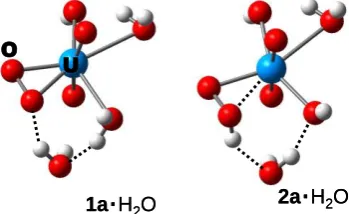
water were trialled for optimisation (though again no exhaustive search was undertaken). The resulting, most stable minima of each 1a.H2O and 2a.H2O are depicted in Figure 1.
In both cases, a similar binding mode of the extra water molecule is realised, where it donates a H-bond either to Oa or 55
Ob, the other OH bond aligning with a terminal U=O moiety. At the B3LYP/SDD level, the hydroperoxo isomer 2a.H2O is
still preferred, but the energetic discrimination is essentially halved, from -18.3 kJ/mol (Table 1) to -8.9 kJ/mol. Again, optimisation in the continuum stabilises 1a.H2O, making it
60
[image:3.595.48.292.119.294.2]more stable than 2a.H2O by 9.1 kJ/mol at that level (see
Figure S1 in the ESI for a plot of the optimised structures).
U
O
1a
.
H
2O
2a
.
H
2O
U
O
1a
.
H
2O
2a
.
H
2O
Figure 1: Microsolvated clusters of 1a and 2a (B3LYP/SDD 65
optimised).
A similar result is obtained at the BLYP/SDD level, where pristine 1a.H2O (instead of being nearly isoenergetic with
2a.H2O) is now favoured by 6.6 kJ/mol. Evidently, including
70
explicit water molecules can have a noticeble effect on the relative stabilies. Ultimately, more and more water molecules would have to be added, with a subsequent search for the global minima in each case, to converge these results. Because the statistical significance of each minimum is expected to 75
decrease with increasing water coverage, we have adopted a fully dynamical description of the bulk solution, the results of which will be discussed in the following section.
3.2 CPMD simulations
80
When an unconstrained BLYP/CPMD simulation of 1a was launched in the gas phase starting from the CP-opt minimum, both water molecules detached immediately, affording [UO2(OH)(2-O2)]-.2H2O with reduced coordination number
about uranyl and two water molecules in the second hydration 85
sphere. As frequently observed in these gas-phase simulations, the uranyl-water interaction appears to be too weak to keep the water coordinated to the metal, and microsolvated complexes with intermolecular H-bonds are preferred. This finding is presumably related to the inherent underestimation 90
of metal-ligand binding energies in transition-metal hydrates with such simple gradient-corrected density functionals.41
A system containing 1a in a periodic water box was then prepared starting from an equilibrated snapshot of a previous 95
anionic system, namely [UO2(OH)5]3-.37 After replacing the
[image:3.595.343.518.215.322.2]dissociated quickly into the solution, to be replaced by another one from the bulk within the first 2 ps, restoring five-coordination about uranyl. No further spontaneous ligand dissociations were observed in this or in any of the subsequent free or constrained MD simulations in water. The structure of 5
aqueous 1a will be discussed in more detail at the end of this section.
From the last point of this simulation of 1a, a starting point for aqueous 2a was generated by manually opening up the U-10
O-O angle of the 2
-UO2 ring and moving a H atom from the
adjacent water ligand to the "dangling" O atom of the resulting U-O-O moiety. Apart from a ca. 180 rotation of the hydroperoxo ligand about the U-Ob' axis within the first 1.5 ps (passing through transient structures with syn-periplanar 15
O=U-O-O units as in 2b), 2a was stable in an unconstrained MD simulation over 4 ps in total.
To probe whether a 1-U-O-O arrangement (with a formal negative charge on the dangling O atom) could be stable in 20
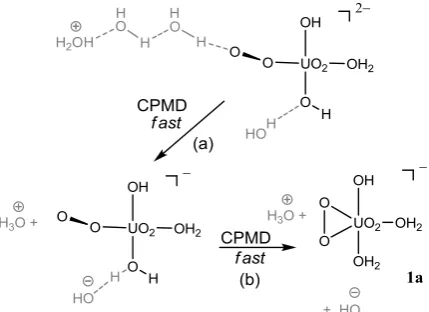
water, an instantaneous snapshot from the latter trajectory with syn-periplanar O=U-O-O unit was chosen and the H atom manually moved from the hydroperoxo ligand onto a water molecule from the bulk via a relay of two water molecules that was adjusted accordingly (see Scheme 1). Such a water 25
relay was used instead of moving the proton just to a nearby solvent molecule in order to avoid immediate collapse of such a contact ion pair, yet to allow easy reprotonation through this relay (via the well-known Grotthus mechanism) in good time. With a hydronium ion nearby, the resulting [UO2(OH)2(1
-30
O2)(H2O)]2- complex should be rather unstable and rapid
re-protonation was expected, either at the 1-peroxo site (restoring 2a), or at one of the hydroxo ligands. It was the latter process that was observed: very quickly, within 0.2 ps, one of the OH ligands abstracted a proton from a nearby water 35
molecule, affording [UO2(OH)(1-O2)(H2O)2]-, in which the
1
-U-O-O moiety rapidly (within another 0.3 ps) collapsed to the 2-UO2 ring affording 1a. The simulation was stopped
before the H3O+ and OH- ions that were still present in the
bulk could meet and neutralise each other. 40
Scheme 1: CPMD simulations probing the fate of a 1-UO2
complex in water (top): rapid proton transfer (a) and ring closure (b) restore peroxo complex 1a (see text).
45
The spontaneous formation of 1a rather than 2a in this simulation may be taken as evidence for the stability of the former over the latter isomer. Hower, no firm conclusions can be drawn from such a singular event. We therefore decided to 50
compute the relative free energy between these isomers, which are both stable in unconstrained CPMD runs, via constrained CPMD/PTI simulations.
We chose the difference coordinate r = r(Ob-Hc) - r(Oa-Hc) 55
for this purpose. In the last 2 ps of the unconstrained simulation of aqueous 1a, r fluctuated around a value of ca. 1.91(29) Å. This value was taken as starting point for the constrained MD runs, and was successively decreased in steps of 0.32 Å, until a structure corresponding to 2a was first 60
obtained at a value of r = -0.97 Å. Between r = +0.31 Å and -0.33 Å, the mean constrained force changed from a large positive to a large negative value. To have a finer mesh in that region and to probe for possible hysteresis (a common plague of constrained MD simulations),42 two additional points at r 65
= -0.17 Å and +0.15 Å were sampled, retracing the path from the last point at r = -0.33 Å. The free-energy profile resulting from this procedure, along with representative snapshots along the path, is displayed in Figure 2.
70
A
[kJ/mol]
r[Å]
2a' 1a
O U
2a
A
[kJ/mol]
r[Å]
2a' 1a
O U
2a
Figure 2: Free-energy profile for tautomerisation of aqueous uranyl-peroxo complexes from constrained CPMD/BLYP simulations, including representative snapshots from the trajectory (see Figure S2 in the ESI for an enlarged plot). 75
As the proton transfer from a water to the peroxo ligand proceeds starting from 1a, the free energy increases, passing a barrier of A‡ = 60.7(±3.8) kJ/mol at r = +0.15 Å until an apparent minimum is reached at r = -0.97 Å, with A = 80
[image:4.595.58.273.535.691.2]multiplied with the integration width). Note that these uncertainties are just an indication of the numerical precision of the PTI technique, not of the intrinsic errors of our quantum-chemical model.
5
Tautomer 2a' is characterised by an intramolecular H-bond donated from the dangling OOH moiety to the adjacent hydroxo ligand, a feature that is not retained in the gas-phase minima. When the path was continued in order to break this intramolecular H-bond, the OH moiety of the hydroperoxo 10
ligand started to rotate out of the equatorial uranyl plane, and a water molecule from the bulk approached, accepting a H-bond from the OOH unit and donating one to the OH ligand (cf. 2a in Figure 2; the additional water molecule is indicated as washed-out ball-and-stick representation, see also the blue 15
arrow in the enlarged version in Figure S2).
With the chosen coordinate, little energetic discrimination between 2a' and 2a is apparent. At one point on this part of the path connecting the two, at r = -1.61 Å, this water 20
molecule from the bulk suddenly acted as a relay for a proton transfer from the OOH moiety to the OH ligand (through bonds that are not involved in the constraint, see Figure S3 in the ESI for details). This process happened quickly (within 0.4 ps) under concomitant UO2 ring closure, affording the
25
reactant 1a. In order to maintain the path, the simulation for this point (r = -1.61 Å) was thus repeated imposing an additional constraint on the OH bond of the water relay, which was fixed at its initial value of 0.98 Å. For the later points on the path beyond this r value, this additional constraint could 30
be lifted without further occurrence of a similar, spontaneous proton transfer.
Again, the statistical significance of this singular event is limited, but it is another indication that 1a is more stable than 35
2a in aqueous solution. As such, it reinforces the conclusion from the PTI calculation that it is indeed 1a that is preferred in water. A quantitative prediction for this preference is hampered by the fact that the BLYP functional used in the CPMD simulations affords slightly disparate results with the 40
setups involved in our periodic and nonperiodic calculations (most likely due to the different pseudopotentials and, in particular basis sets), and that it also affords results that differ appreciably from the CCSD(T) benchmark (Table 1). A rough estimate can be given, however, as follows:
45
First, we probe the effect of using the larger basis by refining the point of highest constraint force (at r = +0.31 Å) with a higher cutoff. On going from 80 Ry to 100 Ry, this force increases slightly, from 0.01615(29) au to 0.01660(13) au 50
(standard deviations over the last picosecond in paren-theses). Even though both are essentially identical within 1 , it is interesting to note that when the integral over the whole path is scaled by the resulting factor from this single point, the separation between 1a and 2a' increases from A = 31.3 55
kJ/mol to 32.2 kJ/mol. In view of this small basis-set effect we did not recalculate the full path with this higher cutoff; instead we will use this "single-point" estimate.
Next, neglecting all enthalpic and entropic effects on the 60
tautomeric equilibrium between 1a and 2a (which is a reasonable assumption, given that the B3LYP E and G values in Table 1 differ by less than 1 kJ/mol), solvation changes the relative stability of 2a from -8.1 kJ/mol in the gas phase (CP-opt100 value in Table 1) to +32.2 kJ/mol in water 65
(A of 2a' in Figure 2, scaled according to the preceding discussion), i.e. by ca. +40 kJ/mol at the BLYP level. Using this solvation free energy difference as an increment to correct the gas-phase energies in Table 1 (simply adding it to the ΔErel values in the rightmost column), affords estimates for 70
the relative free energy of 2a in water ranging from ca. +19kJ/mol or +22 kJ/mol (based on M06 or B3LYP energies, respectively) to +7 kJ/mol (based on the CCSD(T) energy). All these estimates agree with CPMD/BLYP that 1a should be preferred in water. Only the less reliable HF and CCSD levels 75
would predict 2a to be more stable also in aqueous solution,
These estimates may not be the final answer, however, because 2a may not be the actual species in solution. Uranyl complexes have a pronounced preference for the coordination 80
number of five in the equatorial plane. If 2a would attach an additional water molecule from the solution with a sufficiently large free binding energy, the resulting [UO2(OH)2(
1
-O2H)(H2O)2]
could still be present, if not prevalent, in solution. Apart from the nature of the spectator ligands, the 85
affinity of four-coordinate uranyl complexes toward a fifth water ligand depends on the overall charge of the complex, and decreases with this charge. While dicationic complexes tend to bind water strongly, dianionic complexes may not bind a fifth ligand at all, examples being [UO2Cl4]2- 43 or, more
90
relevant for the title compound, [UO2(OH)4]2-.44 For uranyl
chloride complexes, high-energy X-ray scattering experiments suggest that the transition from five-to four-coordination occurs already at the neutral dichloride UO2Cl2(H2O)n (2+n = 4.3 on average), and that the monoanionic trichloride is four-95
coordinate, i.e. [UO2Cl3(H2O)]
-,45 in full agreement with predictions from DFT and CPMD/PTI simulations.46
An attempted optimisation of pristine [UO2(OH)2( 1
-O2H)(H2O)2]-, starting from 2a.H2O (Figure 1) with the
100
"outer-sphere" water molecule pulled in toward U to create a roughly pentagonal bipyramidal environment of O atoms about the metal, resulted in spontaneous expulsion, apparently without barrier, of one of the water ligands (incidentally the one trans to the OOH ligand, affording another "4+1" isomer 105
11.8 kJ/mol higher than 2a.H2O at B3LYP/SDD). Even if
cooperative polarisation in bulk water47 would increase the affinity between 2a and a fifth water ligand to a point that the latter would be bound in terms of E or H, it is unlikely that it would counterbalance the entropic penalty for such an 110
associative process. In fact, when a CPMD simulation was started from the same five-coordinate structure for aqueous [UO2(OH)2(1-O2H)(H2O)2]- (after 1ps equilibration with all
equatorial U-O bonds fixed), a water ligand (now the one cis to OOH) was expelled immediately into the bulk solution 115
To summarise this part, there is no evidence from experiment or computation that 2a could be stabilised by binding a fifth water ligand to such an extent that it would be more stable than 1a. We can thus predict the preference for the latter structure in aqueous solution with confidence.
5
It should be noted that the direct proton transfer followed in Figure 1 is not necessarily the true minimum energy path; it was chosen because it can be described by a simple reaction coordinate. Because there may be other channels for the same 10
reaction with a lower barrier (in particular using water molecules from the bulk as relay, as discussed above for the spontaneous reverse event), the barrier in Figure 1 is just to be taken as an upper limit. As A is a state function and thus, in principle, independent of the chosen path, the relative free 15
energy between 1a and 2a should be reliable.
r[Å]
gOO(r) n
O(r)
nO(r)
a)
b)
1a
2a'
r[Å]
gOO(r) n
O(r)
nO(r)
a)
b)
1a
2a'
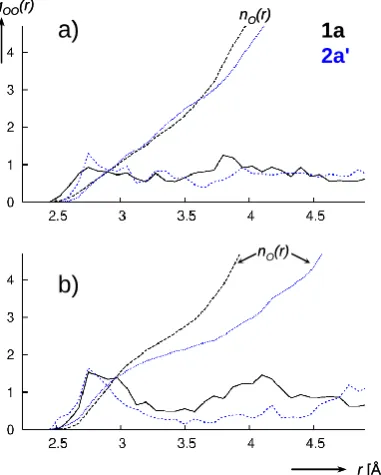
Figure 3: O(complex)-O(water) radial distribution functions gOO(r) for 1a (black) and 2a' (blue) on the constrained paths 20
shown in Figure 1, evaluated between O atoms from the solution and a) the two peroxo O atoms (Ob,b'), or b) the single water or OH ligand (Oa).(nO: integral ∫gOO(r)4r2dr showing the mean number of O atoms in a sphere with radius r).
25
What is the reason for the large solvation effect that reverses the relative stability of 1a and 2a between gas phase and solution? It is difficult to pinpoint an obvious, clear-cut reason for this reversal from our simulations, but it appears that on going from 1a to 2a' on our path in Figure 1, peroxo and 30
hydroperoxo moieties stay similarly well solvated (Figure 3a), whereas the water ligand in 1a interacts more closely with the surrounding water than the OH ligand in 2a' (Figure 3b - note the broader extent of the first maximum of gOO between 2.5 Å
and 3.5 Å and the concominant increase of the mean number 35
of water molecules, nO). As the water ligand in 1a is
converted into OH during formation of 2a', it thus forfeits part of its stabilisation from the solvent. The reinforcement of
hydrogen bonds donated by metal-coordinated water ligands has been discussed recently.48
40
To study the solute-solvent interactions in more detail, hybrid QM/MM (quantum-mechanics/molecular-mechanics) simulat-ions were performed for 1a and 2a', starting from the last snapshots of the constrained CMPD trajectories (see SI for 45
details) . Because all solvent molecules were included in the MM region, specific H-bond interactions may not be described with quantitative accuracy in these QM/MM simulations (also, proton transfer reactions involving the solvent are prevented). However, the solvent-solute inter-50
action energies, EQM-MM, are easily obtained and may inform
qualitatively on the strength of solvation. When averaged over 15 ps of QM/MM-MD, the mean EQM-MM values (electrostatic
part only, without van-der-Waals terms) were indeed more negative for 1a (ca. -289 kJ/mol) than for 2a' (-234 kJ/mol), 55
confirming the better solvation of the former over the latter.
Table 2. Average relative energies and free energies (in kJ/mol), as well as dipole moments (in D) of the complexes in gaseous vs aqueous phase (in parentheses: standard deviations 60
or estimated uncertanty).
Property 1a 2a'
Gas phase[a]
Relative energy[b] 0.0 -30.5(228) Dipole moment 11.8(6) 10.3(7)
In solution (PCM)[a,c]
Relative energy[b] 0.0 37.4(152) Relative free energy[d] 0.0 39.3(150) Dipole moment 15.9(10) 13.7(10)
In solution (explicit solvent from CPMD) Relative free energy[e] 0.0 31.3(±6.3) Dipole moment[f] 18.1(13) 16.3(12)
[a]
Mean values over 50 snapshots taken from the constrained CPMD simulations in explicit water (over the last pico-second), in which only the complexes 1a or 2a' were retained (the solvent has been removed at each step). Single points at 65
the BLYP/SDD/6-311+G** level. [b]SCF energies.
[c]
Employing the PCM model from Gaussian 03 with parameters of water and the same 50 snapshots have been used to compute the single points, at the same level. [d]SCF energies plus the sum of all non-electrostatic terms (see Table 70
S1). [e]As obtained from the PTI calculation (see Figure 2).
[f]
Computed from Wannier Functions Centers (WFCs) on the same 50 snapshots, using the U atom as origin for the dipole moment.
75
Further analysis of the QM region in these QM/MM simulation revealed that 1a had a much larger mean dipole moment (ca. 16 D) than 2a' (ca. 8 D).49 When the dipole moments of the solutes were evaluated for the purely 80
[image:6.595.69.260.263.501.2]Table 3. Optimised or mean simulated bond distances in 1a (in Å, for labeling scheme see Chart 2). Level[a] U=O[b] U-Ob U-Ob' U-OaH2 U-OH2 U-OH O
b -Ob'
CP-opt(g) 1.873 2.248 2.178 2.773 2.832 2.333 1.478
BLYP(g) 1.873 2.253 2.214 2.805 2.845 2.311 1.457
B3LYP(g) 1.827 2.222 2.182 2.721 2.782 2.307 1.440 B3LYP(PCM) 1.836 2.241 2.227 2.572 2.618 2.223 1.459 CPMD(aq) 1.90(4) 2.27(8) 2.24(7) 2.69(16) 2.53(9) 2.26(8) 1.49(2)
[a]
CPMD(aq): mean values during the last 2 ps of unconstrained MD (BLYP level, standard deviation in parentheses) in water; BLYP, B3LYP: optimised parameters using the respective functional (SDD basis).
[b]
Mean value for the bonds to the terminal uranyl O atoms.
5
for details), the resulting values were more similar, but still slightly higher for 1a (ca. 18 D) than for 2a' (ca. 16 D). Thus,in addition to specific solute-solvent interactions, bulk solvation is also indicated to contribute to the stabilisation of
1a in water. When PCM calculation are performed for the 10
bare solutes taken from these snapshots, similar results are obtained in terms of polarised solute-solvent energies and dipole moments (see Tables 2 and S1).
Because of the large fluctuations of energies and dipole 15
moments over these snapshots (see standard deviations in parentheses), the quantitative results in Table 2 should not be overinterpreted, but qualitatively they confirm the conclusions from CPMD, namely that 1a is disfavored in the gas phase, but more stable in water, where it is better solvated and has a 20
higher dipole moment than 2a. When averaged over the CPMD snapshots, the simple PCM energies favor 1a as well, in line with the static optimisations in a continuum (Table 1). Explicit and bulk solvation thus appear to be closely linked, and the structures arising from the former are important for 25
the latter.
To conclude this section, optimised and MD-simulated structural parameters of 1a are collected in Table 3 for further reference. Whereas the U-Ob,b' bonds involving the 2-peroxo 30
unit expand slighly upon solvation (compare CP-opt and CPMD(aq) data in Table 3), U-OH2 and U-OH bonds contract
noticeably, in particular that involving the water ligand trans to the peroxo unit (by ca. -0.3 Å), but also the one adjacent to it (by -0.08 Å, cf. U-OaH2 values). Similar trends are seen
35
upon optimisation in the continuum (compare B3LYP(g) and B3LYP(PCM) data in Table 3). In contrast, the corresponding U-OaH bond in 2a does not experience such a contraction upon solvation: in fact, upon going from CP-opt toCPMD(aq) this distance increases slightly, by ca. +0.02 Å (data not 40
shown), in qualitative accord with the arguments on the differential solvation of OH and water ligands discussed above.
4 Conclusions
45In summary, we have used static DFT and ab initio calculations, as well as DFT-based MD simulations, to complement recent experimental speciation studies of uranyl peroxo complexes. Focusing on a possible tautomeric equlibrium between complexes with a 2-UO
2 metallacycle
50
(1a) and a 1-UOOH moiety (2a), it turns out that the latter is
indicated to be significantly more stable than the former in the gas phase. According to optimisations with a simple polarisable continuum model and to constrained CPMD/PTI simulations, however, this relative order of stability is 55
reversed in aqueous solution, where 1a is preferred, most likely due to differential solvation of the ionic (peroxo, hydroxo) vs. neutral ligands (water). After correction for intrinsic deficiencies of the BLYP functional used in th ese MD simulations (by calibrating against gas-phase energies 60
obtained at hybrid DFT and CCSD(T) level), the hydroperoxo tautomer 2a is estimated to be between ca. +7 kJ/mol to +22 kJ/mol higher in (free) energy than 1a. This result can be taken as strong evidence that it is indeed the latter species that is present in the speciation equilibria.
65
When only the general constitution of uranyl complexes can be determined experimentally, but not their precise structure, this missing information can be obtained from quantum-chemical calculations. As the present study demonstrates once 70
more, proper description of solvation effects is of the essence if ionic (and/or polar) substrates are immersed in a polar, protic solvent.
Acknowledgement: This work was supported by the 75
EaStCHEM School of Chemistry via the EaStCHEM Research Computing facility and a local Opteron PC cluster maintained by Dr. H. Früchtl. N.S. thanks the UJF and the CNRS for financial support and the CECIC (project: liqsim) for computer resources. NWChem calculations made use of the 80
facilities of HECToR, the U.K. national high-performance computing service, which is provided by UoE HPCx Ltd. at the University of Edinburgh, Cray Inc., and NAG Ltd. and funded by the Office of Science and Technology through EPSRC's High End Computing Programme.
85
Notes and references
a EaStCHEM School of Chemistry, North Haugh, University of St.
Andrews, St. Andrews, Fife KY16 9ST, UK, E-mail: [email protected]
bDépartement de Chimie Moléculaire, UMR-5250, ICMG FR-2607,
90
CNRS, Université Joseph Fourier Grenoble I, 301 rue de la Chimie, BP 53, 38041 Grenoble Cedex 9, France.
cUMR 7177 CNRS, Laboratoire MSM, Institut de Chimie, 1 rue Blaise
Pascal, 67000 Strasbourg, France.
95
reference 34), additional graphical material and optimised coordinates of complexes 1a and 2a. See DOI: 10.1039/xxxx/ 1 (a) H. Christensen, T. Sunder, Nucl.Technol., 2000, 131, 102–123;
(b) C. Corbel, G. Sattonnay, S. Guilbert, F. Garrido, M. F. Barthe, C. Jegou, J. Nucl. Mater., 2006, 348, 1-17.
2 E.g. after the Fukushima accident: C. R. Armstrong, M. Nyman, T. Shvareva, G. E. Sigmon, P. C. Burns, A. Navrotsky, Proc. Nat. Acad. Sci., 2012, 109, 1874–1877.
3 P. C. Burns, K. A. Hughes, Am. Mineral., 2003, 88, 1165 – 1168. 4 See also the bibliography in: C. Mallon, A. Walshe, R. J. Forster, T.
E. Keyes, R. J. Baker, Inorg. Chem., 2012, 51, 8509−8515. 5 Review: J. Qiu, P. C. Burns, Chem. Rev. 2013, 13, 1097-1120. 6 For a recent review see e.g.: R. J. Baker, Chem. Eur. J., 2012, 18,
16258-16271.
7 For a recent study of uranium peroxide precipitation see: K. W. Kim, J. T. Hyun, K. Y. Lee, E. H. Lee, K. W. Lee, K. C. Song, J. K. Moon,
J. Hazard. Mater., 2011, 193, 52-58.
8 P. L. Zanonato, P. Di Bernardo, I. Grenthe, Dalton. Trans. 2012, 41, 3380-3386.
9 P. L. Zanonato, P. Di Bernardo, Z. Szabo, I. Grenthe, Dalton. Trans. 2012, 41, 11635-11641.
10 A. Martinez-Torrents, S. Meca, N. Baumann, V. Marti, J. Gimenez, J. de Pablo, I. Casas, Polyhedron 2013, 55, 92-101.
11 K. W. Kim, E. C. Jung, K. Y. Lee, H. R. Cho, E. H. Lee, D. Y. Chung, J. Phys. Chem. A, 2012, 116, 12024-12031.
12 We note that although well-characterised metal hydroperoxo complexes are rare, there are several examples of such species (a search for M-O-O-H fragments in the Cambridge Structure Database returns 12 hits); selected examples comprise V(V) or Pd(II) complexes: (a) M. Šimuneková, J. Šimunek, J. Chrappová, P. Schwendt, Z. Žák, F. Pavelčík, Inorg. Chem. Commun., 2012, 24, 125-128; (b) X. Cai,, S. Majumdar, G. C. Fortman, C. S. J. Cazin, A. M. Z. Slawin, C. Lhermitte, R. Prabhakar, M. E. Germain,, T. Palluccio,, S. P. Nolan,, E. V. Rybak-Akimova, M. Temprado, B. Captain, Carl D. Hoff, J. Am. Chem. Soc., 2011, 133, 1290-1293. 13 Fore some selected reviews see: (a) D. Wang, W. F. van Gunsteren,
Z. Chai, Coord. Chem. Rev., 2012, 41, 5836-5865; (b) G. A. Shamov,
Acc. Chem. Res., 2010, 43, 19-29; (c) R. G. Denning, J. Phys. Chem. A, 2007, 111, 4125-4143; (d) Z. Szabó, T. Toraishi, V. Vallet, I. Grenthe, Coord. Chem. Rev., 2006, 250, 784-815; (e) N. Kaltsoyannis, P. J. Hay, J. Li, J. P. Blaudeau, B. E. Bursten, in: The Chemistry of the Actinide and Transactinide Elements, 3rd ed.; Morss, L. R., Edelstein, N. M., Fuger, J., Katz, J. J., Eds.; Springer: Dordrecht, The Netherlands, 2006; Vol. 3, pp 1893-2012.
14 S. O. Odoh, G. Schreckenbach, Inorg. Chem., 2013, 52, 5590-5602. 15 V. Vallet, U. Wahlgren, I. Grenthe, J. Phys. Chem. A, 2012, 116,
12373-12380.
16 P. F. Weck, E. Kim, C. F. Jove-Colon, D. C. Sassani, Dalton Trans., 2012, 41, 9748-9752.
17 E.g.: (a) P. Wåhlin, B. Schimmelpfennig, U. Wahlgren, I. Grenthe, V. Vallet, Theor. Chem. Acct., 2009, 124, 377-384; (b) K. E. Gutowski, D. A. Dixon, J. Chem. Phys. A, 2006, 110, 8840-8856; (c) V. Vallet, H. Moll, U. Wahlgren, Z. Szabo, I. Grenthe, Inorg. Chem., 2003, 42, 1982-1993.
18 Review: M. Bühl, G. Wipff, ChemPhysChem, 2011, 12, 3095-3105. 19 For more recent applications of this technique see: (a) M. Bühl, I.
Grenthe, Dalton Trans., 2011, 40, 11192-11199; (b) M. Bühl, N.
Sieffert, A. Chaumont, G. Wipff, Inorg. Chem., 2012, 51, 1943-1952. 20 For other first-principles MD simulations of uranyl hydrate see: (a)
R. Spezia, B. Siboulet, S. Abadie, R. Vuilleumier, P. Vitorge, J. Phys. Chem. B, 2011, 115, 3560–3570; (b) R. J. Frick, T. S. HoferA. B. Pribil, B. R. Randolf, B. M. Rode, J. Phys. Chem. A, 2009, 113, 12496–12503 (c) P. Nichols, E. J. Bylaska, G. K. Schenter, W. de Jong, J. Chem. Phys., 2008, 128, 124507. (d) D. Hagberg, G. Karlström, B. O. Roos, L. Gagliardi, J. Am. Chem. Soc., 2005, 127, 14250-14256.
21. R. Car, M. Parrinello, Phys. Rev. Lett., 1985, 55, 2471-2474. 22 (a) A. D. Becke, Phys. Rev. A, 1988, 38, 3098-3100; (b) C. Lee, W.
Yang, R. G. Parr, Phys. Rev. B, 1988, 37, 785-789.
23 M. Bühl, R. Diss, G. Wipff, J. Am. Chem. Soc., 2005, 127,
13506-13507.
24 The initial CPMD/BLYP simulations in the Parrinello group have afforded good descriptions of liquid water, see for instance: (a) M. Sprik, J. Hutter, M. Parrinello, J. Chem. Phys., 1996, 105, 1142-1152, although potential shortcomings of this functional are now better appreciated, see: (b) J. VandeVondele, F. Mohamed, M. Krack, J. Hutter, M. Sprik, M. Parrinello, J. Chem. Phys., 2005, 122, 014515 and references cited therein.
25 CPMD Versions 3.7.0 and 3.13.1, Copyright IBM Corp. 1990-2008, Copyright MPI für Festkörperforschung Stuttgart 1997 - 2001. 26 A. D. Becke J. Chem. Phys. 1993, 98, 5648; C. Lee, W. Yang, R. G.
Parr, Phys. Rev. B 1988, 37, 785.
27 (a) W. Küchle, M. Dolg, H. Stoll, H. Preuss,J. Chem. Phys., 1994,
100, 7535-7542.
28 This small-core ECP has been shown to reproduce all-electron scalar relativistic results very well, see: S. O. Odoh, G. Schreckenbach, J. Phys. Chem. A, 2010, 114, 1957-1963.
29 R. Krishnan, J. S. Binkley, R. Seeger, J. A. Pople, J. Chem. Phys., 1980, 72, 650-654.
30 B3LYP geometries were employed because for uranyl hydrate, they have performed very well in single-point energy calculations using migh-level multireference methods: F. P. Rotzinger, Chem. Eur. J.,
2007, 13, 800 – 811
31 (a) T. H. Dunning, Jr., J. Chem. Phys. 1989, 90, 1007-1023; (b) R. A. Kendall, T. H. Dunning, Jr., R. A. Harrison, J. Chem. Phys. 1992, 96, 6769-6806.
32 Y. Zhao, D. G, Truhlar, Theor. Chem. Acct. 2008, 120, 215-241. 33 as implemented in Gaussian 09: (a) V. Barone, M. Cossi, J. Tomasi,
J. Comput. Chem., 1998, 19, 404-417; (b) M. Cossi, G. Scalmani, N. Rega, V. Barone, J. Chem. Phys., 2002, 117, 43-54. (c) M. Cossi, O. Crescenzi, J. Chem. Phys., 2003, 19, 8863-8872; review: (d) J. Tomasi, B. Mennucci, R. Cammi, Chem. Rev., 2005, 105, 2999-3093. 34 (a) M. J. Frisch, et al., Gaussian 03, Revision E.01, Gaussian, Inc., Wallingford CT, 2004; (b) M. J. Frisch, et al., Gaussian 09, Revision A.02, Gaussian, Inc., Wallingford CT, 2009 (see SI for full references).
35 M. Valiev, E. J. Bylaska, N. Govind, K. Kowalski, T. P. Straatsma, H. J. J. van Dam, D. Wang, J. Nieplocha, E. Apra, T. L. Windus, W. A. de Jong, Comput. Phys. Commun. 2010, 181, 1477-1489 (Version 6.1.1).
36 S. Grimme, J. Antony, S. Ehrlich, H. Krieg, J. Chem. Phys, 2010,
132, 154104.
37 This level has also been successfully used to rationalise the barrier involved in the uranyl "yl-exchange": M. Bühl, G. Schreckenbach,
Inorg. Chem. 2010, 49, 3821-3827.
38 Based on results for the water-exchange barriers in uranyl hydrate, see: J. P. Austin, N. A. Burton, I. H. Hillier, M. Sundararajan, M. A. Vincent, Phys. Chem. Chem. Phys., 2009, 11, 1143-1145.
39 P. Wåhlin, C. Danilo, V. Vallet, F. Réal, J.-P. Flament, U. Wahlgren,
J. Chem. Theor. Comput., 2008, 4, 569–577.
40 Due to program limitations, the so-called T1-diagnostic (J. T. Lee, P.
R. Taylor. Int. J. Quantum Chem. Symp. 1989, 23, 199-207) could not be printed after the CCSD calculations with NWChem. This property is an indication of possible shortcomings of the Hartree-Fock single-reference wave function. With a smaller basis set (no g-functions on U, aug-cc-pVDZ on O, cc-pVDZ on H), this diagnostic could be computed with Gaussian 03, where it amounted to 0.026 and 0.022 for 1a and 2a, respectively (with a similar relative energy of the latter, -55 kJ/mol, as the CCSD/SDD+ energy in Table 1). These numbers are somewhat above the commonly used threshold for the need for a multi-determinantal ansatz (0.02), but similar to those computed for uranyl hydrate (reference 39) or for cis- and trans -uranyl complexes involved in the yl-exchange (reference 37). Note that transition-metal complexes with T1-values up to 0.05 have been
classified as single-reference cases (W. Jiang, N. J. DeYonker, A. K. Wilson, J. Chem. Theor. Comput., 2012, 8, 460–468).
42 See e.g.: A. E. Mark, C. P. van Helden, P. E. Smith, L. H. M. Janssen, W. F. van Gunsteren, J. Am. Chem. Soc., 1994, 116, 6293-6302.
43 L. di Spio, E. Tondello, G. Pellizzi, G. Ingletto, A. Montenero, Cryst. Struct. Commun. 1974, 3, 297-300.
44 (a) D. L. Clark, S. D. Conradson, R. J. Donohoe, D. W. Keogh, D. E. Morris, P. D. Palmer, R. D. Rogers, C. D. Tait, Inorg. Chem. 1999,
38, 1456-1466; (b) U. Wahlgren, H. Moll, I. Grenthe, B. Schimmel-pfennig, L. Maron, V. Vallet, O. Gropen, J. Phys. Chem. A 1999,
103, 8257-8264.
45 L. Soderholm, S. Skanthakumar, R. E. Wilson, J. Phys. Chem. A
2011, 115, 4959-4967.
46 M. Bühl, N. Sieffert, V. Golubnychiy, G. Wipff, J. Phys. Chem. A
2008, 112, 2428-2436.
47 M. Bühl, N. Sieffert, A. Chaumont, G. Wipff, Inorg. Chem., 2011,
50, 299–308.
48 J. M. Andric, G. V. Janjic, D. B. Ninkovic, S. D. Zaric, Phys. Chem. Chem. Phys. 2012, 14, 10896–10898.