The effect of extreme ionization rates during the initial collapse of a
molecular cloud core
James Wurster,
1‹Matthew R. Bate
1and Daniel J. Price
21School of Physics and Astronomy, University of Exeter, Stocker Rd, Exeter EX4 4QL, UK
2Monash Centre for Astrophysics and School of Physics and Astronomy, Monash University, VIC 3800, Australia
Accepted 2018 February 12. Received 2018 February 12; in original form 2017 November 27
A B S T R A C T
What cosmic ray ionization rate is required such that a non-ideal magnetohydrodynamics (MHD) simulation of a collapsing molecular cloud will follow the same evolutionary path as an ideal MHD simulation or as a purely hydrodynamics simulation? To investigate this question, we perform three-dimensional smoothed particle non-ideal MHD simulations of the gravitational collapse of rotating, one solar mass, magnetized molecular cloud cores, which include Ohmic resistivity, ambipolar diffusion, and the Hall effect. We assume a uniform grain size ofag=0.1μm, and our free parameter is the cosmic ray ionization rate,ζcr. We evolve
our models, where possible, until they have produced a first hydrostatic core. Models withζcr
10−13s−1 are indistinguishable from ideal MHD models, and the evolution of the model withζcr=10−14s−1matches the evolution of the ideal MHD model within 1 per cent when
considering maximum density, magnetic energy, and maximum magnetic field strength as a function of time; these results are independent ofag. Models with very low ionization rates
(ζcr10−24s−1) are required to approach hydrodynamical collapse, and even lower ionization
rates may be required for largerag. Thus, it is possible to reproduce ideal MHD and purely
hydrodynamical collapses using non-ideal MHD given an appropriate cosmic ray ionization rate. However, realistic cosmic ray ionization rates approach neither limit; thus, non-ideal MHD cannot be neglected in star formation simulations.
Key words: magnetic fields – MHD – methods: numerical – stars: formation.
1 I N T R O D U C T I O N
Molecular clouds contain magnetic fields (e.g. Crutcher 1999; Bourke et al.2001; Heiles & Crutcher2005; Troland & Crutcher
2008) with low ionization fractions (Mestel & Spitzer1956) as low
asne/nH2=10−
14in dense cores (Nakano & Umebayashi1986a; Umebayashi & Nakano1990). Prior to star formation, ionization is mostly driven by cosmic rays interacting with the gas and dust, with contributions from radionuclide decay. After a protostar forms, the protostar itself is thermally ionized and ionizes its immediate envi-ronment through X-rays. The ionization rate depends on the source, with typical rates for cosmic rays, radionuclide decay, and X-rays given byζcr≈10−17s−1exp (−/cr) (Spitzer & Tomasko1968; Umebayashi & Nakano1981),ζr≈7.6×10⁻¹⁹s−1(Umebayashi & Nakano2009), andζXr ≈9.6×10⁻¹⁷s−1exp (−/Xr) (e.g. Igea & Glassgold1999; Turner & Sano2008), respectively, where is the surface density of the gas, andcrandXrare the charac-teristic attenuation depths of cosmic rays and X-rays, respectively.
E-mail:[email protected]
A completely ionized medium is well represented by ideal mag-netohydrodynamics (MHD), while a completely unionized fluid embedded in a magnetic field should be well represented by pure hydrodynamics. In a partially ionized medium, non-ideal MHD is required, where the three non-ideal effects are electron–ion/neutral drift (Ohmic resistivity), ion–electron drift (Hall effect), and ion– neutral drift (ambipolar diffusion). Their relative importance de-pends, amongst other things, on the gas density, number density of charged species (including grains), gas temperature, and mag-netic field strength (e.g. Wardle & Ng 1999; Nakano, Nishi & Umebayashi 2002; Tassis & Mouschovias 2007; Wardle 2007; Pandey & Wardle2008; Keith & Wardle2014). The Hall effect also depends on the direction of the magnetic field with respect to the rotation axis (e.g. Braiding & Wardle2012a,b; Tsukamoto et al.
2015a,2017; Wurster, Price & Bate2016).
Many studies have modelled the collapse of a molecular cloud to the first or second Larson core (Larson1969) using non-ideal MHD (e.g. Nakano & Umebayashi1986b; Fiedler & Mouschovias
1993; Ciolek & Mouschovias1994; Li & Shu1996; Mouschovias
1996; Mouschovias & Ciolek1999; Shu et al.2006; Duffin & Pu-dritz2009; Mellon & Li2009; Dapp & Basu2010; Li, Krasnopol-sky & Shang2011; Machida, Inutsuka & Matsumoto2011; Dapp,
2018 The Author(s)
Basu & Kunz2012; Krasnopolsky et al.2012; Tomida et al.2013; Tomida, Okuzumi & Machida 2015; Tsukamoto et al. 2015a,b,
2017; Wurster et al.2016). For efficiency, these studies typically assumed that the dominant ionization source at early times was cosmic ray ionization and that there was no attenuation. Thus, the canonically used cosmic ray ionization rate isζcr=10−17s−1.
The first three-dimensional models of collapsing magnetized molecular clouds were performed using ideal MHD (e.g. Price & Bate2007; Hennebelle & Fromang2008; Duffin & Pudritz2009; Hennebelle & Ciardi2009; Commerc¸on et al.2010; Seifried et al.
2011), despite ideal MHD being a poor approximation to observed molecular cloud environment. However, these studies provided use-ful insight into the behaviour of magnetic fields and provided impor-tant benchmarks for future studies. These models were effectively fully ionized; thus, what cosmic ray ionization rate would be re-quired to reproduce these results, assuming non-ideal effects MHD were included?
As a rotating molecular cloud collapses, a dense disc forms (e.g. Larson 1972; Tscharnuter 1987). Given a realistic cosmic ray attenuation rate, the centre of the dense disc should be very weakly ionized or completely neutral, forming a magnetic dead zone (Gammie 1996). A very weakly ionized medium can be self-consistently modelled with non-ideal MHD; however, this can be very expensive to run. Thus, at what ionization rate can a medium be treated as purely hydrodynamical?
The goal of this study is to model the early collapse of a ro-tating, magnetized molecular cloud core using non-ideal MHD to determine at what cosmic ray ionization rates (if any) a purely hy-drodynamical or an ideal MHD collapse can be recovered. The free parameter is the cosmic ray ionization rate,ζcr, which we held con-stant throughout each simulation. Due to the computational expense when low ionization rates are used, we only model the collapse up to the formation the first hydrostatic core, except in our two lowest ionization rate models, which never evolved out of the isothermal collapse phase. In Wurster, Bate & Price (2018), we examined how the collapse to stellar core formation changes if one assumes cosmic ray ionization ratesζcr10−16s−1.
This paper is organized as follows. In Section 2, we present our numerical methods, and in Section 3 we present our initial conditions and discuss how the initial environment is affected by different cosmic ray ionization rates. In Section 4, we present and discuss our results, and we conclude in Section 5.
2 N U M E R I C A L M E T H O D
2.1 Non-ideal MHD
We solve the equations of self-gravitating, non-ideal MHD given by
dρ
dt = −ρ(∇ ·v), (1)
dv dt = −
1
ρ∇(PI)−
1
ρ∇
B2
2 I−B B
− ∇, (2)
dB
dt =(B· ∇)v−B(∇ ·v)+ dB
dt
non−ideal + dB
dt
artificial
, (3)
∇2=
4πGρ, (4)
where d/dt≡∂/∂t+v· ∇is the Lagrangian derivative,ρ is the density,vis the velocity,Pis the hydrodynamic pressure,Bis the magnetic field (which has been normalized such that the Alfv´en
velocity is defined as vA≡B/√ρ in code units; see Price & Monaghan2004),is the gravitational potential,Gis the grav-itational constant, andIis the identity matrix. The equation set is closed by a barotropic equation of state,
P =
⎧ ⎨ ⎩
c2
s,0ρ; ρ < ρc,
c2
s,0ρc(ρ/ρc)7/5; ρc≤ρ < ρd,
c2
s,0ρc(ρd/ρc)7/5(ρ/ρd)11/10;ρ≥ρd,
(5)
wherecs, 0 is the initial isothermal sound speed, and the density thresholds areρc=10−14g cm−3andρd=10−10g cm−3.
The non-ideal MHD term in equation (3) is
dB
dt
non−ideal
= − ∇ ×[ηOR(∇ ×B)] (6)
− ∇ ×ηHE(∇ ×B)×Bˆ (7)
+ ∇ ×ηAD(∇ ×B)×Bˆ ×Bˆ, (8)
where the non-ideal coefficients for Ohmic resistivity, the Hall ef-fect, and ambipolar diffusion terms are given in (e.g.) Wardle & Ng (1999) and Wardle (2007).
To calculate the number densities of the charged species and thus the non-ideal MHD coefficients, we use Version 1.2.1 of theNICIL library (Wurster2016). The maximum temperature reached in this study will beT<500 K; thus, cosmic rays will be the only ionization source, since we intentionally ignore ionization from radionuclide decay in order to test the effect of low ionization rates. Cosmic rays can create two species of negatively charged ions: a light ion species based upon hydrogen and helium components and a heavy ion species with the mass of magnesium (e.g. Asplund et al.2009). We include three species of grains that can absorb free electrons to become negatively chargedn−g, or lose electrons through collisions to become positively chargedn+g, or remain neutraln0
g. The total number density of grains is dependent on the local gas density, namely
ng=ffgmn
mgngas, (9)
wherefdg is the gas-to-dust ratio,mn and mg are the masses of a neutral particle and dust grain, respectively, andngas is the gas number density. To conserve gain number density,ng=n−g +n0g+
n+
g.
2.2 Smoothed particle non-ideal MHD
Our calculations are carried out using the 3D smoothed particle magnetohydrodynamics (SPMHD) codePHANTOM(Price et al.2017) with the inclusion of self-gravity and non-ideal MHD (Wurster
2016). The density of each smoothed particle hydrodynamics (SPH) particleais calculated by iteratively solving
ρa=
b
mbWab(ha); ha=hfac
ma
ρa
1/3
(10)
using the Newton–Raphson method, where we sum over all neigh-boursb,maandhaare the particle’s mass and smoothing length,
respectively,Wabis the smoothing kernel, andhfac=1.2 is a coef-ficient required to obtain∼58 neighbours when using the adopted cubic spline kernel.
The remainder of the discretized SPMHD equations are read-ily available in the literature (e.g. see review by Price 2012), and we use the same form as given in Wurster et al. (2016). We
enforce the divergence-free condition on the magnetic field us-ing the constrained hyperbolic/parabolic divergence cleanus-ing al-gorithm described in Tricco & Price (2012) and Tricco, Price & Bate (2016).
In ideal MHD, artificial resistivity is required for magnetic sta-bility (i.e. the final term in equation 3); as per convention, artificial resistivity is included in all of our simulations both for consis-tency and for the possibility that physical and artificial resistiv-ity are important in different regions. We use the form given by Price & Monaghan (2004, 2005); however, the signal velocity is instead given byvsig,ab= |vab׈rab|(Price et al.2017). A compar-ison of artificial resistivity algorithms presented in Wurster et al. (2017a) showed that the method used here is the least dissipative of all SPMHD algorithms used to date, especially during the collapse to form the first core. Hence, our results are dominated by physical and not artificial resistivity.
2.3 Time-stepping
In ideal MHD, the limiting time-step for particleais typically the Courant–Friedrichs–Lewy (CFL) condition,
dtCFL,a= CCFLha
c2
s,a+v 2 A,a
, (11)
whereCCFL=0.3<1.0 is the dimensionless Courant number and cs,ais the sound speed. However, non-ideal effects each add a new
time constraint, namely
dtOR,a= CNIh 2 a
ηOR,a, dtHE,a=
CNIh2
a
ηHE,a, dtAD,a=
CNIh2
a
ηAD,a, (12)
whereCNI=1/2πis a dimensionless coefficient analogous to the Courant number. Test cases with ambipolar diffusion show that the non-ideal MHD time-step can be∼40–50 shorter than the CFL time-step (e.g. Mac Low et al.1995; Wurster, Price & Ayliffe2014); however, in realistic problems, the minimum non-ideal MHD time-step can be several hundred times shorter in quickly evolving, dense regions.
Super-time-stepping (Alexiades, Amiez & Gremaud 1996) is used to relax the conditions given by equation (12) for the diffusive terms that are parabolic in nature (i.e. Ohmic resistivity and ambipo-lar diffusion). This involves takingNsts<Nreal≈dtCFL/min (dtOR, dtAD) steps of dτj, wherej= 1, . . . ,Nsts and dτj> dτj+1 and requiring stability only at the end ofNstssteps rather than at the end of every step. The best possible speed-up yields (e.g. Choi, Kim & Wiita2009)
Nsts=int
dtCFL k·min (dtOR,dtAD)
+1, (13)
where we setk=0.9. For added stability, we first subdivide dtCFL by positive integer n such that 20dτ1 dtCFL/n and then take nNsts<Nrealsteps per dtCFL; this subdivision bynis only required in extreme environments where multiple physical processes are simultaneously contributing to a complex evolution, or for very low ionization rates (i.e.ζcr10−24s−1).
Given the hyperbolic nature of the Hall effect, we are required to solve this time-step explicitly. Methods (e.g. O’Sullivan & Downes
2007; Meyer, Balsara & Aslam2012) have been proposed to sub-step with the Hall term, but these have yet to be implemented into PHANTOM.
3 I N I T I A L C O N D I T I O N S
Our models are similar to those used in our previous studies (Price & Bate 2007; Bate, Tricco & Price2014; Wurster et al.
2016) and consist of a spherical cloud of radiusR=4×1016cm= 0.013 pc and densityρ0=7.43×10⁻¹⁸g cm−3that is placed inside a low-density box of edge lengthl=4Rand a density contrast of 30:1; the cloud and surrounding medium are in pressure equilib-rium. This allows the cloud to be modelled self-consistently, and we use quasi-periodic boundary conditions at the edge of the box, in which SPH particles interact magnetohydrodynamically ‘across the box’, but not gravitationally. Our simulations use 106 parti-cles in the sphere, which are initialized on a regular close-packed lattice.
The initial cloud has mass M = 1 M, rotational velocity =1.77×10⁻¹³rad s−1, and sound speedc
s,0=2.19×104cm s−1 (i.e.T0=13.5 K). We thread the cloud with a uniform magnetic field that is anti-aligned with the axis of rotation, i.e.B= −B0zˆ, which will promote disc formation in the presence of the Hall effect (e.g. Braiding & Wardle2012a,b; Tsukamoto et al.2015a; Wurster et al.
2016); this configuration yields (∇ ×B0)0=0. The magnetic field has an initial strength ofB0=1.63×10⁻⁴G, which corresponds to a normalized mass-to-flux ratio ofμ0≡(M/B)0/(M/B)crit=5, where (M/B)0≡M/πR2Bis the initial mass-to-flux ratio and (M/B)crit=c1/(3π)
√
5/Gis the critical value where magnetic fields prevent gravitational collapse altogether;Mis the total mass contained within the cloud,Bis the magnetic flux threading the surface of the (spherical) cloud at radiusR assuming a uniform magnetic field of strengthB,Gis the gravitational constant, andc1 0.53 is a parameter numerically determined by Mouschovias & Spitzer (1976). The free-fall time istff=2.4×10⁴yr, which is the characteristic time-scale for this study.
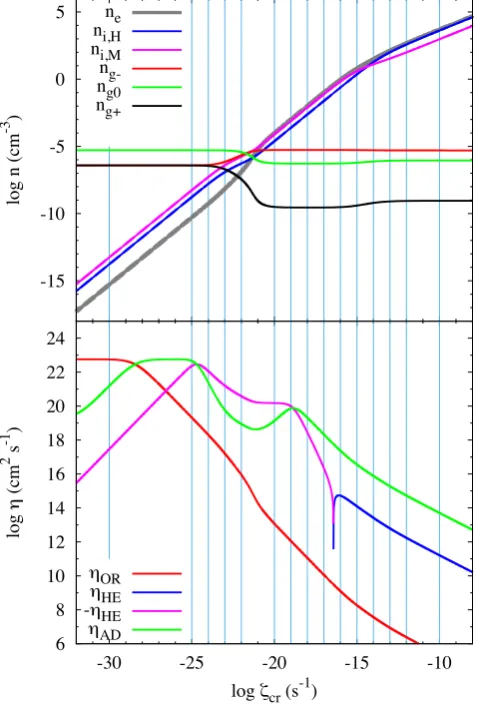
The non-ideal MHD models use the default values included in the NICILlibrary (Wurster2016). The dust grains have a radius and bulk density ofag=0.1μm andρb=3 g cm−3(Pollack et al.1994), respectively, and the dust-to-gas ratio isfdg=0.01. The mass of the neutral particle is based upon the hydrogen and helium abundance; thus,mn= 2.31 mp, where mp is the mass of a proton. We test 15 cosmic ray ionization rates in the rangeζcr ∈[10−30, 10−10] s−1, which are indicated by the vertical lines in Fig.1. Our models will be named after their ionization rate such that modelζXhas a
cosmic ray ionization rate ofζcr=10−Xs−1. The ideal MHD and purely hydrodynamical models will be referred to as iMHD and HD, respectively.
Since the time constraint imposed by non-ideal MHD quickly becomes prohibitively expensive for low ionization rates, our focus is on comparing the very early phases of the collapses, typically just prior to or just after entering the first hydrostatic core phase, which begins atρmax ≈10−13g cm−3. The maximum density analysed in this study isρmax≈10−11g cm−3; however, several of the low ionization rate models end atρmax10−14g cm−3.
3.1 Initial behaviour of the charged species and non-ideal MHD coefficients
Fig.1shows the species number densities and the non-ideal MHD coefficients, calculated using our initial conditions. At constant den-sity, temperature, and magnetic field strength, the number densities and non-ideal MHD coefficients are strongly dependent on the cos-mic ionization rate,ζcr.
At ionization rates ofζcr10−24s−1, cosmic rays are unable to ionize ions rapidly enough for the ions and electrons to significantly
-15 -10 -5 0 5
log n (cm
-3 )
ne ni,H ni,M n g-ng0 ng+
6 8 10 12 14 16 18 20 22 24
-30 -25 -20 -15 -10
log
η
(cm
2 s -1 )
log ζcr (s-1) ηOR
ηHE
[image:4.595.45.284.59.414.2]-ηHE ηAD
Figure 1. The species number densities (top) and non-ideal MHD coeffi-cientsη(bottom) calculated using our initial conditions ofρ0=7.43×10⁻¹⁸
g cm−3,B
0=1.63×10⁻⁴G (i.e.μ0=5), andcs, 0=2.19×104cm s−1
(i.e.T0=13.5 K). The vertical lines represent the values of the cosmic ray
ionization rate,ζcr, that are included in our suite. The grain populations are
the dominant species at low ionization rates, and the positively charged ions and electrons are dominant at high ionization rates. This turnover is reflected inη, whereηAD<|ηHE|. Increasingζcrdoes not lead to a monotonic change
inη; thus, models with different initial values ofζcrwill start with different
non-ideal effects controlling the evolution.
contribute to the charged species populations; at these rates, the charged species are from grain collisions that transfer electrons to make a positively and negatively charged grain population, with
n−
g ≈n+g. At ionization rates ofζcr10−20s−1, the ion and electron populations are several orders of magnitude more populous than the charged grain number densities. However, the grains have a much larger mass than the ions (i.e. mg = 7.5×10⁹mp compared to mlightion =2.31 mpand mheavyion = 24.3 mp), thus still contribute non-trivially to the value of the non-ideal MHD coefficients even at very high ionization rates.
Forζcr10−20s−1(recall that the canonical cosmic ionization rate isζcr=10−17s−1), the number densities of ions and electrons are similar, and the ionization fraction reaches ne, i/(nn + ni) ≈ 0.003 atζcr≈10−10s−1; thus, even at high cosmic ray ionization rates, thermal ionization or another source is required to fully ionize the medium.
Using our given initial conditions, the initial non-ideal MHD coefficients have six regimes:
(i)ζcr/s−14×10−29:ηOH> ηAD>−ηHE;
(ii) 4×10⁻²⁹ζcr/s−13×10−27:ηAD> ηOR>−ηHE; (iii) 3×10⁻²⁷ζcr/s−12×10−25:ηAD>−ηHE> ηOR; (iv) 2×10⁻²⁵ζcr/s−11×10−19:−ηHE> ηAD> ηOR; (v) 1×10⁻¹⁹ζcr/s−14×10−17:ηAD>−ηHE> ηOR; (vi) 4×10⁻¹⁷ζcr/s−1:ηAD> ηHE> ηOR.
Although ambipolar diffusion is typically the dominant effect, the Hall effect is the dominant term in region (iv), which is the same region where grains transition from higher number densi-ties compared to the ions to lower number densidensi-ties. At very low ionization rates, the Ohmic coefficient is approximately constant, since it is dependent on the Ohmic conductivityσO, which is ap-proximately constant due to the grain number densities. The Hall coefficient rapidly decreases at low ionization rates due to its depen-dence on the Hall conductivityσH, which will rapidly decrease for
n−
g ≈n+g ni. The ambipolar coefficient is also dependent on the Hall conductivity, but via the perpendicular conductivity, hence its delayed decrease. At high ionization rates, all three terms decrease rapidly as the cloud becomes more ionized. Thus, all three terms have less of an effect on the evolution of the cloud in an absolute sense.
These results are qualitatively similar to those that are obtained from using differentρ0,B0, andT0. Therefore, the numerical results will necessarily differ if we change our initial conditions; however, our qualitative results will be independent of them.
3.2 Grain properties
Although a uniform grain size is not realistic, they are common in numerical models. We use the uniform grain size ofa0=0.1μm to match our previous studies (Wurster, Price & Bate2016,2017b; Wurster et al.2018) and to agree with the fiducial value suggested by Pollack et al. (1994). Uniform grain sizes of smaller radius were used in Tsukamoto et al. (2015a,b,2017).
An alternative to the uniform grain size is the Mathis, Rumpl & Nordsieck (1977, MRN) grain distribution,
dng(a)
da =AnHa
−3.5, (14)
wherenH is the number density of the hydrogen nucleus, ng(a) is the number density of grains with a radius smaller thana, and A=1.5×10⁻²⁵cm2.5 (Draine & Lee1984). In this distribution, there are more grains with smaller radii; thus, the smaller grains will more strongly influence the evolution than the larger grains. Fig.2shows the non-ideal MHD coefficients as a function ofζcr using a uniform grain size ofa0=0.01 and 1μm (top two panels), and using the MRN grain distribution using the ranges suggested in Kunz & Mouschovias (2009) and Wardle & Ng (1999; bottom two panels, respectively).
At high ionization rates (ζcr 10−13s−1), the coefficients dif-fer by less than 10 per cent, except for a0=0.1μm where the 10 per cent agreement is only forζcr10−10s−1. Thus, for high ionization rates, we expect the grain properties to play a minimal role in the evolution of the system. Asζcrdecreases to realistic rates (ζcr≈10−17s−1), the coefficients become more dependent on the grain properties, although the coefficients for our fiducial grain size and the MRN distribution using the Kunz & Mouschovias (2009) range differ by less than a factor of 1.3.
10 15 20 25
Fixed grain radius a0 = 0.01μm
log
η
(cm
2 s -1 )
ηOR ηHE -ηHE ηAD
10 15 20 25
Fixed grain radius a0 = 1μm
log
η
(cm
2 s -1 )
10 15 20 25
MRN grain distribution 0.018μm < a0 < 0.90μm
log
η
(cm
2 s -1 )
10 15 20 25
-30 -25 -20 -15 -10
MRN grain distribution 0.005μm < a0 < 0.25μm
log
η
(cm
2 s -1 )
[image:5.595.70.264.50.603.2]log ζcr (s-1)
Figure 2. The non-ideal MHD coefficients using our initial conditions as in the bottom panel of Fig.1. The dotted lines in each panel are calculated using our fiducial uniform grain size ofa0=0.1µm, and the solid lines
are calculated using the grain size/distribution listed in the panel. The MRN distribution is calculated assuming 40 bins of equal width in log-space. The coefficients have a greater dependence on grain properties at lower cosmic ray ionization rates, where the coefficients can differ by up to 9 dex; at high ionization rates (ζcr10−13s−1), the coefficients typically differ by less
than 10 per cent.
2 4 6 8 10 12 14 16
Ekin
[10
9 erg g -1 ]
HD iMHD
10-17 10-16 10-15 10-14 10-13 10-12 10-11
0 0.2 0.4 0.6 0.8 1 1.2 ρmax
[g cm
-3 ]
[image:5.595.327.526.54.296.2]Time [tff]
Figure 3. The evolution of the total kinetic energy (top) and the maximum density (bottom) for the HD and iMHD models. The kinetic energy differs by more than 10 per cent fort0.51tff, and the maximum density differs
by more than 10 per cent att0.99tff.
At low ionization rates (ζcr 10−25s−1), the coefficients can differ by up to nine orders of magnitude. Fora0=1μm, the co-efficients are larger than using our fiducial grain size, suggest-ing that these systems will approach the hydrodynamical limit at higher ionization rates due to greater non-ideal MHD effects. For a0=0.01μm and the MRN distributions, the coefficients are typ-ically lower than for our fiducial grain size suggesting that these models will be slightly more ideal than our fiducial models. Given that the MRN distributions are the more realistic models, the results we present in Section 4.4 will be upper limits such that using the MRN distribution would require even lower ionization rates to ap-proximate the hydrodynamical case than models using our fiducial uniform grain size ofa0=0.1μm.
4 R E S U LT S
4.1 Limiting models: hydrodynamic and ideal MHD
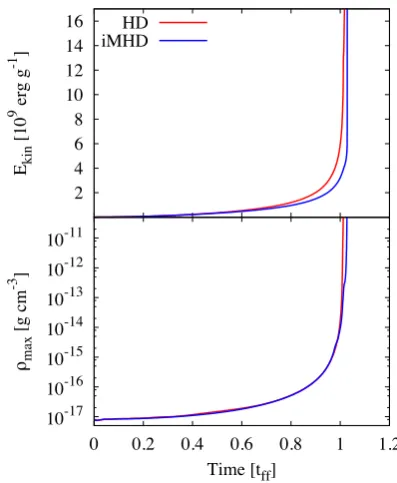
The iMHD and HD models represent the limiting models such that the models are totally ionized and totally neutral, respectively. Fig.3
shows their evolution of the total kinetic energy and the maximum density.
Qualitatively, both models follow similar trends, with a slow evolution untilt≈tff, at which time the collapse occurs very rapidly. The presence of strong magnetic fields delays the collapse of the molecular cloud, such that, byt≈0.99tff, the maximum densities differ by 10 per cent, and it then takes iMHD∼370 yr longer to reachρmax≈10−11g cm−3than HD.
The kinetic energy begins to diverge almost immediately with it differing by 10 per cent aftert≈0.51tff, with more kinetic energy in HD than in iMHD at any given time. This is expected since the magnetic field supports the cloud against gravitational collapse; thus, the gas collapses slightly slower.
10-16
10-15
10-14
10-13
10-12
10-11
0.94 0.96 0.98 1.00 1.02 1.04
ρmax
[g cm
-3 ]
Time [tff]
iMHD HD ζ10
ζ15
ζ16
ζ17
ζ18
ζ19
ζ20
ζ22
ζ23
ζ24
ζ25
[image:6.595.51.278.58.251.2]ζ30
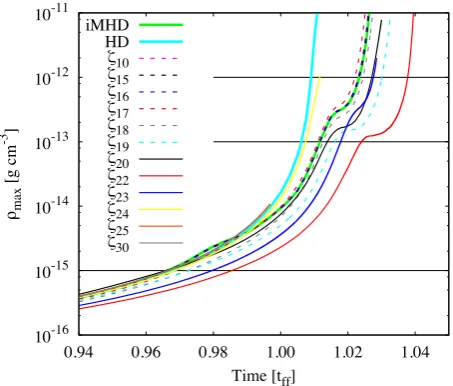
Figure 4. The evolution of the maximum density for selected models for t>0.94tff. The thick green and cyan lines represent models iMHD and HD,
respectively, whose full evolution is shown in the bottom panel of Fig.3. Models withζcr10−16s−1all lie on top of the iMHD curve; thus, only
two have been shown for clarity. Modelζ17evolves slightly faster than
iMHD, whileζ18–ζ23evolve slower. The low ionization rate models with
ζcr10−24s−1evolve similarly to HD. The maximum densities for HD
andζ22–ζ30do not coincide with the centre of the core. Not all models
have reachedρmax=10−11g cm−3due to computational limitations. The
horizontal lines match the maximum densities shown in Figs5–8. 4.2 Transition models: non-ideal MHD
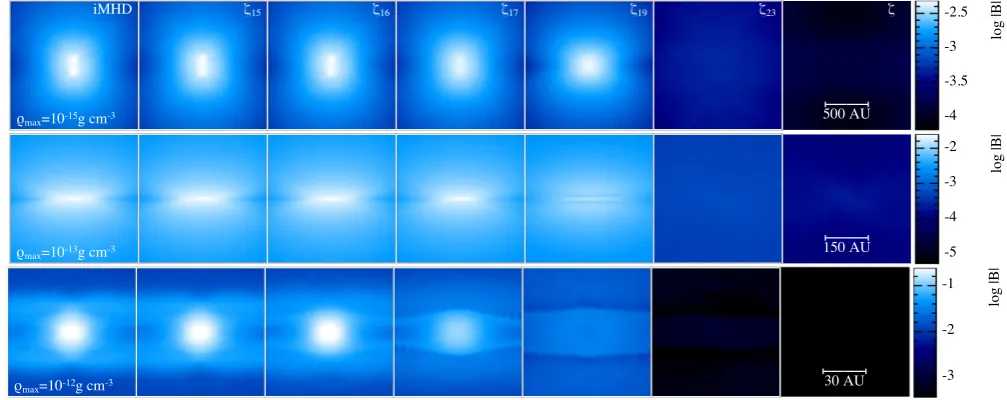
We define any model that includes non-ideal MHD as a transition model since the ionization fraction is neither one (iMHD) nor zero (HD). Fig.4shows the late evolution (t>0.94tff) of the maximum density for selected models, and Figs5–8show cross-sections of the density, magnetic field strength, radial and azimuthal velocities of selected models atρmax≈10−15, 10−13, and 10−12g cm−3.
The models withζcr10−16s−1evolve similarly to iMHD and will be discussed in more detail in Section 4.3 below. These clouds
are magnetically supported, thus form a dense collimated struc-ture with strong magnetic fields, since initially, the gas is free to collapse along the rotation axis. The models withζcr10−24s−1 follow a similar evolutionary path as HD and will be discussed in Section 4.4. These models follow an initially spherical collapse; however, byρmax>10−13g cm−3, a thick, rotationally supported disc has formed. Throughout their evolution, they retain an approx-imately uniform magnetic field.
Modelsζ16toζ24do not represent a smooth transition between the evolutionary paths of iMHD and HD as the initial ionization rate is decreased, with the exception of the magnetic field strength and geometry. Agreeing with intuition,ζ17evolves similarly to but slightly faster than iMHD, thus is in the region bracketed by iMHD and HD in Fig.4. As expected, at our selectedρmaxsnapshots, its central gas distribution is more diffuse and has a weaker magnetic field strength than the models withζcr10−16s−1.
The models with 10−23 ζcr/s−1 10−18 evolve slower than iMHD, withζ22having the longest evolutionary time. This is a re-sult of the Hall effect. At these early times, the rotation is beginning to convert the poloidal magnetic field,|Bp| =B2
r +Bz2, into a toroidal magnetic field,|Bφ|. Since the field lines remain closed, there are both±Bφφˆ components, and the Hall effect enhances one component and decreases the other. At this stage, the initial direction of the magnetic field is relatively unimportant for the characteris-tics that we investigate, and we find that models initialized with
B= +B0zˆcollapse only slightly faster than their counterparts with −B0ˆz, but still do not collapse faster than iMHD. Byρmax≈10−12g cm−3, a weak counter-rotating envelope has formed inζ
18andζ19, and we have verified that this does not form for the B= +B0ˆz
models.
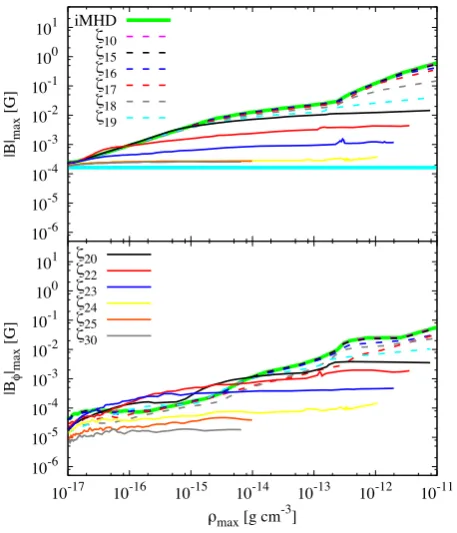
[image:6.595.39.546.489.667.2]Fig.9shows the maximum magnetic field strength and the mag-nitude of the maximum toroidal field as a function of maximum densityρmax, which we use as a proxy for time; recall thatBφ, 0=0. Although the absolute value of the Hall effect is not the strongest inζ22(i.e. there are larger values of|ηHE|at lower ionization rates; see Fig.1), the net magnetic field in this model is stronger than inζ25(i.e. the model with the largest|ηHE|) since that model has large ambipolar diffusion. Thus, more of the net magnetic field is
Figure 5. Density slice through the core of the clouds of selected models atρmax≈10−15, 10−13, and 10−12g cm−3. Frame sizes and colour bar range change
with each row to better show the structure at eachρmax. Atρmax≈10−15g cm−3, a dense column of gas has formed along the rotation axis in the higher
ionization rate models (ζcr10−17s−1), an oblate spheroid has formed for mid-range ionization rates, and the collapse is approximately spherical for low
ionization rates (ζcr10−23s−1); the maximum density is not in the core for the models withζcr10−22s−1. Atρmax≈10−13g cm−3, the scale height of
the discs decreases from iMHD toζ22and then increases again.
Figure 6. Magnetic field strength through the core of the clouds of selected models as in Fig.5. Atρmax≈10−15g cm−3, the dense column of gas has an
enhanced magnetic field strength in the higher ionization rate models (ζcr10−17s−1), while the magnetic field strength is approximately uniform at low
ionization rates (ζcr10−23s−1). Byρmax≈10−12g cm−3, the models withζcr10−19s−1have an unstructured magnetic field that is stronger in the
mid-plane.
Figure 7. Radial velocity slices through the core of the clouds of selected models as in Fig.5. The initial radial infall (i.e. wherevr<0) is approximately
spherical for the low ionization rate models (ζcr10−24s−1) and faster at larger radii from the core than for models with higher rates (ζcr>10−24s−1). At
largerρmax, the infall becomes less spherical in all models, and the infall rate is faster in the mid-plane for the magnetized models while the vertical infall is
faster in HD.
converted into the toroidal magnetic field inζ22 thanζ25 (or any other model in our suite). In several models, the maximum toroidal field becomes stronger than the maximum poloidal field at a given location, with|Bφ|max>|Bp|maxoccurring forζ23,ζ22,ζ20,ζ24,ζ19, andζ18at increasing maximum densities.
The maximum magnetic field strength continually increases as the cloud collapses for the models withζcr10−23s−1, although the growth rate is much slower forζ22andζ23. Byρmax≈10−13g cm−3,|B|
max ≈5.7B0, 19B0, and 130B0forζ23,ζ22, and iMHD, respectively; the low ionization rate models (i.e.ζ24,ζ25, andζ30) have magnetic field strengths that asymptote at|B|max≈1.7B0.
Fig.10shows the evolution of the total kinetic and magnetic en-ergies for selected models. These values include the gas in both the cloud and background medium. Magnetic fields support the molec-ular cloud against collapse; thus, at any givenρmax, there is more
kinetic energy in HD than in iMHD, with the kinetic energy decreas-ing from the HD value to the iMHD value asζcris increased; this can also be seen in Figs7and8, which show decreasing radial and azimuthal velocities for increasingζcr. The total magnetic energy increases for models withζcr10−22s−1, with the magnetic energy growing more slowly for models with lowerζcr. The total magnetic energy decreases for the models withζcr10−23s−1; at the end of the simulation, the models withζcr10−24s−1have decreased by ∼2 per cent, whileζ23has decreased by only∼0.4 per cent.
4.3 Approaching ideal MHD
As ionization rates increase, the medium becomes more ionized; thus, the ionization fractions begin to approach the ideal MHD limit. However, at temperatures and densities presented here, ionization
[image:7.595.47.550.324.502.2]Figure 8. Azimuthal velocity slices through the core of the clouds of selected models as in Fig.5. The rotation speed of the cloud increases as the cosmic ray ionization rate decreases and as time increases. Atρmax≈10−12g cm−3, the rotational speed is faster above and below the disc forζcr10−16s−1; a
counter-rotating envelope is beginning to form inζ18andζ19.
10-6
10-5
10-4
10-3
10-2
10-1
100
101
|B|
max
[G]
iMHD ζ10 ζ15 ζ16 ζ17 ζ18 ζ19
10-6
10-5
10-4
10-3
10-2
10-1
100
101
10-17 10-16 10-15 10-14 10-13 10-12 10-11
|Bφ |max
[G]
ρmax [g cm
-3 ] ζ20
ζ22 ζ23 ζ24 ζ25 ζ30
Figure 9. The evolution of the maximum magnetic field strength (top) and the magnitude of the maximum toroidal field|Bφ|max(bottom) for selected
models. The thick cyan line represents the initial magnetic field strength. The legend is split across the panels for clarity. Initially, the entire magnetic field is poloidal|Bp| =
B2
r +Bz2, and the evolution of the poloidal and
total magnetic field strengths are similar. The maximum magnetic field strength increases for all models, although only increases by a factor of ∼1.7 for the low ionization rate models. For the majority of the models, |Bp|max>|Bφ|max; however,ζ23,ζ22,ζ20,ζ24,ζ19, andζ18all switch to
having a dominant toroidal field at increasing maximum densities.
fraction remains1. The question we ask in this section is how high of an ionization rate is required to safely approximate the ideal MHD limit?
From the induction equation (equation 3), a one-fluid non-ideal MHD system can be approximated as ideal when dB/dt|non−ideal
1 2 3 4 5 6 7 8 9
Ekin
[10
9 erg g -1 ]
iMHD HD ζ10 ζ15 ζ16 ζ17 ζ18 ζ19
2.2 2.4 2.6 2.8 3.0
10-17 10-16 10-15 10-14 10-13 10-12 10-11
Emag
[10
9 erg g -1 ]
ρmax [g cm-3]
[image:8.595.310.536.285.551.2]ζ20 ζ22 ζ23 ζ24 ζ25 ζ30
Figure 10. Evolution of the total kinetic (top) and magnetic (bottom) en-ergies for selected models. The thick green and cyan lines represent iMHD and HD, respectively; the thick cyan line in the bottom panel represents the initial magnetic energy,Emag, 0. The legend is split across the panels for
clarity. When comparing kinetic energy at similar maximum densities, there is typically a progression from the iMHD to HD models as the ionization rate decreases. Forζcr10−22s−1, the total magnetic energy increases
as the molecular cloud collapses, whereas it slightly decreases forζcr
10−23s−1.
(B· ∇)v−B(∇ ·v). However, we want to know the largest possible dB/dt|non−ideal that will still result in a system equiva-lent to iMHD. Since different quantities may show equivalence at differentζcr, we will compare several different quantities below, in-cluding 2D cross-sections, total and maximum values. A non-ideal MHD model must be equivalent in all of our quantities to be deemed equivalent to iMHD.
[image:8.595.49.278.287.554.2]10-8
10-6
10-4
10-2
100
0 0.2 0.4 0.6 0.8 1 1.2
RD(
ρmax
)
Time [tff]
ζ10 ζ12 ζ13 ζ14
[image:9.595.53.280.54.230.2]ζ15 ζ16 ζ17
Figure 11. The relative difference, as defined in equation (15), of the max-imum density with respect to time for the high ionization rate models com-pared to iMHD. The relative differences are less than 10 per cent fort<tff;
however, even slight differences in evolution times at high densities (i.e. at t∼tff) cause large relative differences. The evolution times of the models
withζcr10−14s−1agree within 10−4for the majority of the collapse.
Upon visual inspection of the cross-section plots in Figs5–8, we find that the models withζcr 10−15s−1look similar to iMHD for all properties. This also appears true for the evolution of the maximum density with time (Fig.4) and for total kinetic and mag-netic energy (Fig.10). To quantify this, Fig.11shows the relative difference,
RD≡ |X(ζn)−X(iMHD)|
|X(iMHD)| , (15)
whereX(ζn) andX(iMHD) are the values for the non-ideal modelζn
and iMHD, respectively, of the maximum density,ρmax, and Fig.12
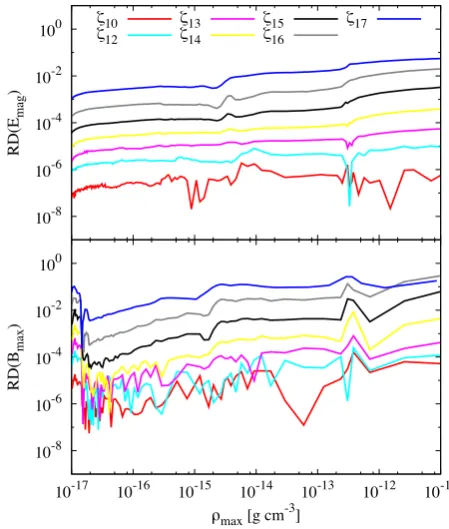
shows the relative difference of magnetic energy and total magnetic field strength of a high ionization rate model compared to the iMHD model; for comparison, we intentionally include models that clearly do not approach the ideal limit.
The maximum density in the models withζcr10−15s−1differs from iMHD by less than 10 per cent for the entire calculation, with onlyζ15yielding a difference larger than 1 per cent near the end.
The relative difference of the magnetic energy and maximum magnetic field strength compared toρmax decreases for increas-ing ionization rates; models with higher ionization rates are more similar to iMHD. The magnetic energy of all models withζcr 10−17s−1differs from iMHD by less than 10 per cent, while the energy in models withζcr 10−15s−1differs by less than 1 per cent.
Total magnetic energy is a global property of the simula-tion, including both the quickly collapsing inner region and the slowly evolving background medium. The maximum magnetic field strength, however, is localized in or near the core, and is sensitive to the evolution of the collapse and is obtained from a single particle; thus, we do not expect as low of relative difference as in the ener-gies. Models withζcr10−12s−1have maximum magnetic field strengths that differ from iMHD by less than 10−4, while models withζcr10−14s−1differ by less than 1 per cent. The relative dif-ference betweenζ15and iMHD increases to almost 10 per cent in the first hydrostatic core; this large difference and the increasingly large difference in RD(ρmax) suggest thatζ15does not approach the ideal MHD limit.
10-8
10-6
10-4
10-2
100
RD(E
mag
)
ζ10 ζ12
ζ13 ζ14
ζ15 ζ16
ζ17
10-8
10-6
10-4
10-2
100
10-17 10-16 10-15 10-14 10-13 10-12 10-11
RD(B
max
)
ρmax [g cm
[image:9.595.313.538.56.321.2]-3]
Figure 12. The relative differences of the magnetic energy (top) and the maximum magnetic field strength (bottom) of the high ionization rate models compared to iMHD. Forρmax10−11g cm−3, the magnetic energy of the
high ionization rate models differs by less than 10 per cent from iMHD, and the maximum magnetic field strength differs by less than 40 per cent.
Forζcr 10−14s−1, the grain properties have minimal effect on the non-ideal MHD coefficients (see Section 3.2), except when decreasing to smaller grains of uniform size. Although our con-clusions will be qualitatively unaffected by switching to larger grains or to an MRN grain distribution, the agreement between (e.g.)ζ14and iMHD may not be as robust for the smaller grain size ofa0=0.01μm.
For the collapse up toρmax=10−11g cm−3, we conclude that non-ideal MHD models withζcr10−14s−1agree with ideal MHD within 1 per cent, and models with ζcr 10−13s−1 agree with ideal MHD within 0.1 per cent, suggesting that they are essentially indistinguishable from ideal MHD models.
4.4 Approaching pure hydrodynamics
As ionization rates decrease, the medium becomes more neutral, thus begins to approach the purely hydrodynamic limit. Unlike approaching the ideal limit where all simulations include magnetic fields and non-ideal effects begin to negligibly contribute to their evolution, the hydrodynamic models by definition exclude magnetic fields; thus, for a low ionization rate model to approach the HD model, their evolution must essentially ignore the magnetic field.
In order that the one-fluid non-ideal MHD equations reduce to the ideal MHD limit, all that has to happen is for the third term in equation (3) to become negligible. Thus, it is unsurprising that with a high enough ionization rate, the ideal MHD limit is recovered to a high level of accuracy (see Section 4.3). To recover the hydro-dynamical limit, however, all four terms in the induction equation (equation 3), which are calculated using the magnetic field and den-sity of a particle, and its neighbours must sum to exactly zero, and the second term in the momentum equation (equation 2) must also
10-16
10-15
10-14
0.94 0.95 0.96 0.97 0.98 0.99 1
ρmax
[g cm
-3 ]
Time [tff]
HD ζ30 ζ25 ζ24 ζ23
10-8
10-6
10-4
10-2
100
0 0.2 0.4 0.6 0.8 1
RD(
ρmax
)
[image:10.595.51.278.56.415.2]Time [tff]
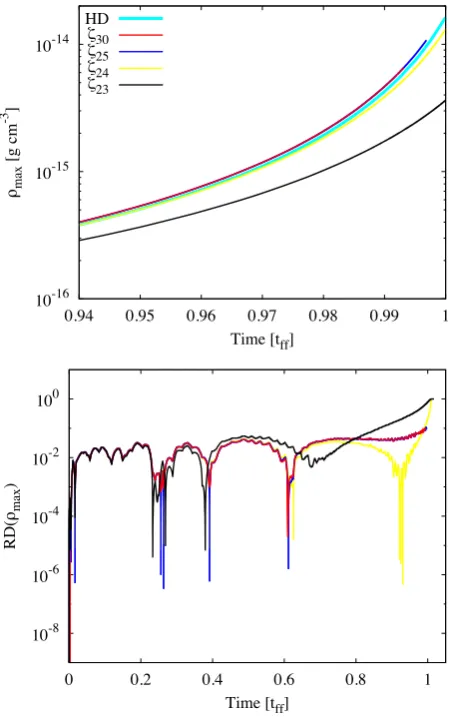
Figure 13. Top: evolution of the maximum density over a short range of time for our low ionization rate models, as in Fig.4. Bottom: the relative difference of the maximum density with respect to time over the entire evolution, as in Fig.11. The collapse rates are slightly faster forζ25andζ30
compared to HD, with the relative difference never surpassing 10 per cent. Modelζ24collapses slightly slower than HD, and the relative difference
surpasses 10 per cent att≈0.99tff.
be zero. Thus, we do not expect to be able to approximate the hydro-dynamic limit using non-ideal MHD to the same level of accuracy that was achieved for the ideal limit.
As can be seen in the cross-section plots (Figs5–8),ζ24shares more characteristics with HD than iMHD or evenζ23; however, there are still noticeable structure differences. Model HD has a slightly larger scale height, and slightly faster rotational and radial velocities. Based upon visual inspection alone, we conclude that by decreasing the ionization rate, the models approach HD; however, ζ24is not equivalent to HD. Atρmax≈10−15g cm−3,ζ24,ζ25, and ζ30are indistinguishable from one another, although neither of the latter two models progressed toρmax ≈10−13g cm−3 for a later comparison.
For our quantitative analysis, Fig.13showsρmaxand the relative difference inρmaxof the low ionization rate models compared to HD. The evolution ofζ23 has been included for reference, but it clearly cannot approximate HD. The collapse rate for these low ionization rate models varies in time with respect to HD, collapsing slightly faster or slower depending on the time; the transitions are marked by the relative difference approaching zero in these plots. Over the entire evolution,ζ24 collapses slower than HD, with the
relative difference surpassing 10 per cent byt≈0.99tff. Given the slower collapse and the visual differences,ζ24is not equivalent to HD. Modelsζ25andζ30collapse faster than HD but evolve at the same rate as one another, and at any given time, their maximum density differs from HD by less than 10 per cent.
Inζ24,ζ25, andζ30, the maximum magnetic field strength grows by a factor of∼1.7 (bottom panel of Fig.9); for reference, by this density ofρmax ≈5×10⁻¹⁵g cm−3, the magnetic field strength in iMHD has increased by a factor of∼60. Despite the maximum magnetic field strength slightly increasing, the total magnetic energy in these three models decreases toEmag≈0.98Emag, 0(bottom panel of Fig.10).
If the grain size was decreased to a0=0.01μm or an MRN distribution was used, then the non-ideal MHD coefficients would be lower; thus, these models would be slightly more ideal (Fig.2). Therefore, modelling smaller grains would yield low ionization rate models that are even less similar to the hydrodynamical case than those presented here. If an a0=1μm grain size was modelled, then the non-ideal MHD coefficients would be larger, suggesting that these models would be more similar to HD. However, the larger coefficients result in a smaller time-step (recall equation 12), which makes it prohibitively expensive to model; see further discussion in Section 4.5.
Thus, even with low cosmic ray ionization rates of ζcr 10−24s−1, the relative differences of the energies, magnetic field strengths, and the maximum densities remain between 1 and 10 per cent. However, given the slow growth of the magnetic en-ergy and maximum magnetic field strength, we can conclude that models withζcr 10−24s−1 approach the hydrodynamic model. At these low ionization rates, unless precision results are required, pure hydrodynamics can be used in place of non-ideal MHD.
4.5 Time-stepping
Given unlimited resources and time, one should simply use non-ideal MHD with the desired cosmic ray ionization rate rather than ideal or hydrodynamic approximations. However, including non-ideal MHD adds to the computational expense both by additional calculations and by decreasing the minimum time-step.
Fig.14shows the minimum and CFL time-steps at each density. All models with ζcr 10−15s−1 have dt
non-ideal > dtCFL, while ζ17 has dtnon-ideal∼dtCFL. Models with 10−25 ζcr/s−110−19 are always limited by the Hall time-step, whileζ17 and ζ18 are Hall-limited for ρmax 2 ×10⁻¹⁵g cm−3 and ρmax 10−16g cm−3, respectively. Modelζ30is limited by the super-time-stepping algorithm using the Ohmic time-step. Note that the ambipolar or Ohmic time-steps would be the limiting case in most models if super-time-stepping were not used.
Atρmax≈10−15g cm−3, the non-ideal time-step inζ
25is limited by the Hall time-step and is∼3900 times shorter than the CFL time-step. Atρmax≈10−11g cm−3, the non-ideal time-step inζ17(which uses the fiducial cosmic ionization ray rate) is∼15 times shorter than the CFL time-step. Given that studies of collapsing molecular clouds need to reach maximum densities at least a few orders of magnitude larger than presented here, the slow-down of a factor of a few for the canonical ionization rate ofζcr≈10−17s−1can be tedious, while it can be completely prohibitive for lower ionization rates.
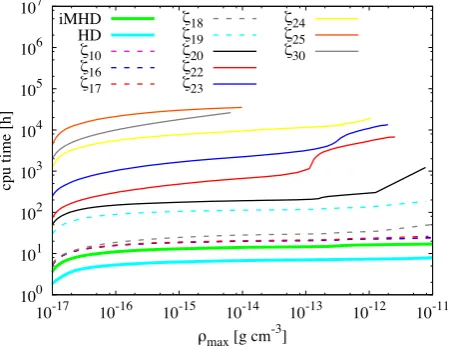
The effect of non-ideal MHD on performance is very evident in the number of CPU hours used, as shown in Fig.15. The HD model runs∼53 per cent faster than the iMHD model in part due to the reduced number of calculations required and the slightly longer
10-10
10-9
10-8
10-7
10-6
10-5
10-4
10-3
10-2
10-1
10-17 10-16 10-15 10-14 10-13 10-12 10-11
dt [t
ff
]
ρmax [g cm
-3 ] CFL
ζ16 ζ17 ζ18 ζ19 ζ20
[image:11.595.54.280.56.234.2]ζ22 ζ23 ζ24 ζ25 ζ30
Figure 14. The evolution of the minimum time-step as calculated from the non-ideal terms (see equation 12); the thick green line is the time-step calculated from the CFL condition (see equation 11), and is included for reference. For the models whose time-steps are controlled by Ohmic resistivity or ambipolar diffusion, we plot dt=dtOR, AD/Nsts, whereNstsis
given in equation (13). Initially,ζ25requires the smallest time-steps, while
ζ30uses a time-step≈20–50 times larger due to super-time-stepping with the
Ohmic time constraint. Models withζcr10−15s−1have dtnon-ideal>dtCFL,
thus are excluded.
100
101
102
103
104
105
106
107
10-17 10-16 10-15 10-14 10-13 10-12 10-11
cpu time [h]
ρmax [g cm
-3 ] iMHD
HD ζ10 ζ16 ζ17
ζ18 ζ19 ζ20 ζ22 ζ23
ζ24 ζ25 ζ30
Figure 15. The cumulative CPU time used for each model. HD, iMHD, and models withζcr10−18s−1run very quickly toρmax=10−11g cm−3. As
the ionization rate decreases, the required resources become prohibitively expensive, especially forζcr10−24s−1. To reachρmax≈10−15g cm−3,
it takesζ25∼2200 times longer than iMHD. All the non-ideal models with
ζcr10−17s−1take the same length of time, which is∼1.4 times longer
than iMHD to reachρmax≈10−11g cm−3.
CFL time-step sincevA ≡ 0. The models withζcr 10−17s−1 take∼1.4 times longer to reachρmax≈10−11g cm−3than iMHD; since their non-ideal time-steps are similar to the CFL time-step, the additional time used is mostly taken up by theNICILlibrary. Given that the models withζcr 10−14s−1well approximate the ideal MHD model (see Section 4.3), an ideal MHD model can instead be run at a speed-up of∼1.4.
As the ionization rate decreases, the cumulative CPU time in-creases, withζ25being the most expensive simulation followed by ζ30and then the remainder of the models in order of increasing ion-ization rate. To reachρmax≈10−15g cm−3, it takesζ
25∼2200 times
longer than iMHD; thus, these models are prohibitively expensive to run to any useful maximum density. However, since the models withζcr10−24s−1have small relative differences for their total magnetic energies and maximum magnetic field strengths, respec-tively, it would be reasonable to run purely hydrodynamical models in their place.
5 S U M M A RY A N D C O N C L U S I O N
We have presented a suite of non-ideal MHD simulations with vari-ous cosmic ray ionization ratesζcrto determine what rate is required to recover a hydrodynamical collapse and an ideal MHD collapse. Our models were initialized as a 1 M, spherically symmetric, rotating molecular cloud core; the cloud was magnetized with a magnetic field initially aligned anti-parallel to the rotation axis, and had an initial strength of B0= 1.63×10⁻⁴G, orμ0 =5. Our models used a uniform grain size ofa0=0.1μm, but we discussed how different grain models are expected to change the results. In particular, we found that at high cosmic ray ionization rates, the results will be approximately independent of grain properties, but at very low ionization rates the non-ideal MHD coefficients that we use tend to be larger than those produced by MRN grain size distri-butions, suggesting that the ionization rates required to approximate hydrodynamical evolution may be even lower than the values we find usinga0=0.1μm. All three non-ideal MHD terms (Ohmic resistivity, Hall effect, and ambipolar diffusion) were included. We tested 15 different cosmic ray ionization rates, which were held con-stant for the entire simulation. The initial density of the molecular cloud core wasρ0=7.43×10⁻¹⁸g cm−3, and it was evolved until
10−15ρmax/(g cm−3)10−11, depending on the value ofζcr.
Our two key results are as follows.
(i)Approaching the ideal MHD limit: We evolved models with high ionization rates until they entered the first hydrostatic core and reachedρmax≈10−11g cm−3. Models withζ
cr10−13s−1were indistinguishable from the ideal MHD model when considering the evolution of their maximum density, magnetic energy, and magnetic field strengths, i.e. all properties matched the evolution of the ideal MHD model within 0.1 per cent. The evolution of the model with ζcr =10−14s−1 matched the evolution of the ideal MHD model within 1 per cent.
(ii)Approaching the hydrodynamic limit: The models withζcr
10−24s−1look similar to the hydrodynamical model, but with noticeable differences; in these models, the total magnetic energy grew by a factor of 1.7 and the maximum magnetic field strength decreased by 2 per cent. Our lowest ionization rate models were not followed beyond the isothermal collapse phase due to the non-ideal MHD constraints on the time-step. Those withζcr10−25s−1had maximum densities at a given time that agreed with the hydrody-namical model within 10 per cent. Given the reasonable agreement with the hydrodynamical model and the orders of magnitude in-crease in runtime, we conclude that hydrodynamical models can be used to approximate non-ideal MHD models withζcr10−24s−1 unless precision results are required.
We conclude that it is possible to reproduce ideal MHD and purely hydrodynamical collapses using non-ideal MHD given an appropriate cosmic ray ionization rate. However, reaching either limit by cosmic ray ionization alone is unlikely, since molecu-lar clouds in the local neighbourhood have cosmic ray ionization rates ofζcr≈ 10−17s−1(e.g. Padovani, Galli & Glassgold2009; Neufeld & Wolfire2017). Even if the comic ray ionization rate were to temporarily increase (e.g. due to a nearby supernova), the
[image:11.595.54.282.349.522.2]increase will not be sustained enough to shift the evolution into the ideal MHD regime for the lifetime of the initial collapse.
For cosmic ray ionization rates ofζcr 10−24s−1, we can ap-proximate a hydrodynamic collapse; however, it is improbable to reach these low ionization rates in local diffuse molecular clouds given that this rate is well below the rate expected from radionuclide decay. Studies of the early Universe by Susa, Doi & Omukai (2015) found that, even in the absence of cosmic rays and heavy metals, the primordial gas is partially ionized (i.e. contains e−, H+, Li+). Their electron fractions for this case are similar to ours forζcr 10−24s−1; however, their H+, Li+ fractions are higher due to the
absence of dust grains. Although our low ionization rate models are unlikely to be relevant in the local Universe, they may have implications for the early Universe.
While our quantitative conclusions depend on our initial condi-tions and our chosen maximum densities, we find that the canonical cosmic ray ionization rate ofζcr=10−17s−1approaches neither the ideal MHD limit nor the hydrodynamical limit. For star formation simulations to properly evolve the magnetic field, non-ideal MHD is essential.
AC K N OW L E D G E M E N T S
JW and MRB acknowledge support from the European Re-search Council under the European Community’s Seventh Frame-work Programme (FP7/2007- 2013 grant agreement no. 339248). DJP received funding via Australian Research Council grants FT130100034, DP130102078, and DP180104235. This work was supported by resources on the swinSTAR national facility at Swinburne University of Technology. swinSTAR is funded by Swin-burne and the Australian Government’s Education Investment Fund.
R E F E R E N C E S
Alexiades V., Amiez G., Gremaud P.-A., 1996, Commun. Numer. Methods Eng., 12, 31
Asplund M., Grevesse N., Sauval A. J., Scott P., 2009, ARA&A, 47, 481 Bate M. R., Tricco T. S., Price D. J., 2014, MNRAS, 437, 77
Bourke T. L., Myers P. C., Robinson G., Hyland A. R., 2001, ApJ, 554, 916 Braiding C. R., Wardle M., 2012a, MNRAS, 422, 261
Braiding C. R., Wardle M., 2012b, MNRAS, 427, 3188 Choi E., Kim J., Wiita P. J., 2009, ApJS, 181, 413 Ciolek G. E., Mouschovias T. C., 1994, ApJ, 425, 142
Commerc¸on B., Hennebelle P., Audit E., Chabrier G., Teyssier R., 2010, A&A, 510, L3
Crutcher R. M., 1999, ApJ, 520, 706 Dapp W. B., Basu S., 2010, A&A, 521, L56
Dapp W. B., Basu S., Kunz M. W., 2012, A&A, 541, A35 Draine B. T., Lee H. M., 1984, ApJ, 285, 89
Duffin D. F., Pudritz R. E., 2009, ApJ, 706, L46 Fiedler R. A., Mouschovias T. C., 1993, ApJ, 415, 680 Gammie C. F., 1996, ApJ, 457, 355
Heiles C., Crutcher R., 2005, in Wielebinski R., Beck R., eds, Lecture Notes in Physics, Vol. 664, Cosmic Magnetic Fields. Springer-Verlag, Berlin, p. 137
Hennebelle P., Ciardi A., 2009, A&A, 506, L29 Hennebelle P., Fromang S., 2008, A&A, 477, 9 Igea J., Glassgold A. E., 1999, ApJ, 518, 848 Keith S. L., Wardle M., 2014, MNRAS, 440, 89
Krasnopolsky R., Li Z.-Y., Shang H., Zhao B., 2012, ApJ, 757, 77 Kunz M. W., Mouschovias T. C., 2009, ApJ, 693, 1895
Larson R. B., 1969, MNRAS, 145, 271 Larson R. B., 1972, MNRAS, 156, 437
Li Z.-Y., Shu F. H., 1996, ApJ, 472, 211
Li Z.-Y., Krasnopolsky R., Shang H., 2011, ApJ, 738, 180
Mac Low M.-M., Norman M. L., Konigl A., Wardle M., 1995, ApJ, 442, 726
Machida M. N., Inutsuka S.-I., Matsumoto T., 2011, PASJ, 63, 555 Mathis J. S., Rumpl W., Nordsieck K. H., 1977, ApJ, 217, 425 Mellon R. R., Li Z.-Y., 2009, ApJ, 698, 922
Mestel L., Spitzer L., Jr, 1956, MNRAS, 116, 503
Meyer C. D., Balsara D. S., Aslam T. D., 2012, MNRAS, 422, 2102 Mouschovias T. C., 1996, in Tsinganos K. C., Ferrari A., eds, NATO
Ad-vanced Science Institutes (ASI) Series C Vol. 481. Springer-Verlag, Netherlands, p. 505
Mouschovias T. C., Ciolek G. E., 1999, in Lada C. J., Kylafis N. D., eds, NATO Advanced Science Institutes (ASI) Series C Vol. 540. Springer-Verlag, Netherlands, p. 305
Mouschovias T. C., Spitzer L., Jr, 1976, ApJ, 210, 326 Nakano T., Umebayashi T., 1986a, MNRAS, 218, 663 Nakano T., Umebayashi T., 1986b, MNRAS, 221, 319 Nakano T., Nishi R., Umebayashi T., 2002, ApJ, 573, 199 Neufeld D. A., Wolfire M. G., 2017, ApJ, 845, 163 O’Sullivan S., Downes T. P., 2007, MNRAS, 376, 1648 Padovani M., Galli D., Glassgold A. E., 2009, A&A, 501, 619 Pandey B. P., Wardle M., 2008, MNRAS, 385, 2269
Pollack J. B., Hollenbach D., Beckwith S., Simonelli D. P., Roush T., Fong W., 1994, ApJ, 421, 615
Price D. J., 2012, J. Comput. Phys., 231, 759 Price D. J., Bate M. R., 2007, MNRAS, 377, 77 Price D. J., Monaghan J. J., 2004, MNRAS, 348, 123 Price D. J., Monaghan J. J., 2005, MNRAS, 364, 384 Price D. J. et al., 2017, PASA, preprint (arXiv:1702.03930)
Seifried D., Banerjee R., Klessen R. S., Duffin D., Pudritz R. E., 2011, MNRAS, 417, 1054
Shu F. H., Galli D., Lizano S., Cai M., 2006, ApJ, 647, 382 Spitzer L., Tomasko M. G., Jr, 1968, ApJ, 152, 971 Susa H., Doi K., Omukai K., 2015, ApJ, 801, 13 Tassis K., Mouschovias T. C., 2007, ApJ, 660, 370
Tomida K., Tomisaka K., Matsumoto T., Hori Y., Okuzumi S., Machida M. N., Saigo K., 2013, ApJ, 763, 6
Tomida K., Okuzumi S., Machida M. N., 2015, ApJ, 801, 117 Tricco T. S., Price D. J., 2012, J. Comput. Phys., 231, 7214
Tricco T. S., Price D. J., Bate M. R., 2016, J. Comput. Phys., 322, 326 Troland T. H., Crutcher R. M., 2008, ApJ, 680, 457
Tscharnuter W. M., 1987, A&A, 188, 55
Tsukamoto Y., Iwasaki K., Okuzumi S., Machida M. N., Inutsuka S., 2015a, ApJ, 810, L26
Tsukamoto Y., Iwasaki K., Okuzumi S., Machida M. N., Inutsuka S., 2015b, MNRAS, 452, 278
Tsukamoto Y., Okuzumi S., Iwasaki K., Machida M. N., Inutsuka S.-i., 2017, PASJ, 69, 95
Turner N. J., Sano T., 2008, ApJ, 679, L131 Umebayashi T., Nakano T., 1981, PASJ, 33, 617 Umebayashi T., Nakano T., 1990, MNRAS, 243, 103 Umebayashi T., Nakano T., 2009, ApJ, 690, 69 Wardle M., 2007, Ap&SS, 311, 35
Wardle M., Ng C., 1999, MNRAS, 303, 239 Wurster J., 2016, PASA, 33, e041
Wurster J., Price D., Ayliffe B., 2014, MNRAS, 444, 1104 Wurster J., Price D. J., Bate M. R., 2016, MNRAS, 457, 1037
Wurster J., Bate M. R., Price D. J., Tricco T. S., 2017a, Crespo A. J. C., Gesteira M. G., Altomare C., eds, Proc. SPHERIC 2017: 12th Interna-tional SPHERIC Workshop. Universidade de Vigo, Spain
Wurster J., Price D. J., Bate M. R., 2017b, MNRAS, 466, 1788 Wurster J., Bate M. R., Price D. J., 2018, MNRAS, 475, 1859
This paper has been typeset from a TEX/LATEX file prepared by the author.