2-[(
E
)-2-(4-Chlorophenyl)ethenyl]-1-methylpyridinium iodide monohydrate
1Kullapa Chanawanno,aSuchada Chantraprommab* and Hoong-Kun Func§
aDepartment of Chemistry and Center of Excellence for Innovation in Chemistry, Faculty of Science, Prince of Songkla University, Hat-Yai, Songkhla 90112, Thailand, bCrystal Materials Research Unit, Department of Chemistry, Faculty of Science, Prince of Songkla University, Hat-Yai, Songkhla 90112, Thailand, andcX-ray Crystallography Unit, School of Physics, Universiti Sains Malaysia, 11800 USM, Penang, Malaysia
Correspondence e-mail: [email protected]
Received 22 August 2008; accepted 29 August 2008
Key indicators: single-crystal X-ray study;T= 100 K; mean(C–C) = 0.005 A˚; Rfactor = 0.038;wRfactor = 0.104; data-to-parameter ratio = 25.9.
In the title compound, C14H13ClN +
IH2O, the cation is
nearly planar and exists in an E configuration; the dihedral angle between the pyridinium and benzene rings is 0.98 (17). The cations stack in an anti-parallel manner along the aaxis through two – interactions between the pyridinium and benzene rings [centroid–centroid distances 3.569 (2) and 3.6818 (13) A˚ , respectively]. The cation, anion and water molecule are linked into a chain along theaaxis by weak C— H O and C—H I interactions together with O—H I hydrogen bonds and the chains are further connected into a three-dimensional network.
Related literature
For bond-length data, see: Allen et al. (1987). For related structures, see, for example: Chantraprommaet al.(2007a,b,c). For background on non-linear optical properties, see, for example: Lakshmanaperumal et al. (2004); Marder et al.
(1994); Qiuet al. (2007); Williams (1984); Zhaiet al.(1999); Zhanet al.(2006).
Experimental
Crystal data
C14H13ClN+I
H2O
Mr= 375.62 Monoclinic,P21=c
a= 7.0876 (1) A˚
b= 9.8096 (2) A˚
c= 21.0940 (4) A˚
= 95.147 (1)
V= 1460.68 (5) A˚3
Z= 4
MoKradiation
= 2.36 mm1
T= 100.0 (1) K 0.280.170.07 mm
Data collection
Bruker SMART APEXII CCD area-detector diffractometer Absorption correction: multi-scan
(SADABS; Bruker, 2005)
Tmin= 0.560,Tmax= 0.845
18928 measured reflections 4241 independent reflections 3486 reflections withI> 2(I)
Rint= 0.038
Refinement
R[F2> 2(F2)] = 0.037
wR(F2) = 0.104
S= 1.13 4241 reflections
164 parameters
H-atom parameters constrained
max= 2.13 e A˚
3
min=0.79 e A˚
3
Table 1
Hydrogen-bond geometry (A˚ ,).
D—H A D—H H A D A D—H A
O1W—H1W1 I1 0.86 2.87 3.592 (4) 143 O1W—H2W1 I1i
0.85 2.87 3.567 (4) 141 C14—H14A O1W 0.96 2.50 3.202 (5) 130 C14—H14D O1Wii
0.96 2.56 3.460 (5) 157 C1—H1A I1iii 0.93 3.20 3.830 (4) 127 C2—H2A I1iv
0.93 3.17 3.825 (4) 129 C3—H3A I1iv
0.93 3.21 3.840 (4) 127
Symmetry codes: (i) x1;y;z; (ii) xþ1;yþ1;zþ1; (iii)
xþ2;yþ1;zþ1; (iv)x;yþ1 2;zþ
1 2.
Data collection:APEX2(Bruker, 2005); cell refinement:APEX2; data reduction: SAINT (Bruker, 2005); program(s) used to solve structure: SHELXTL (Sheldrick, 2008); program(s) used to refine structure:SHELXTL; molecular graphics:SHELXTL; software used to prepare material for publication:SHELXTLandPLATON(Spek, 2003).
KC thanks the Development and Promotion of Science and Technology Talents Project (DPST) for a study grant. Finan-cial support from the Center of Excellence for Innovation in Chemistry (PERCH-CIC), Commission on Higher Education, Ministry of Education, is gratefully acknowledged. The authors also thank Prince of Songkla University, the
Malay-organic compounds
o1882
Chanawannoet al. doi:10.1107/S1600536808027724 Acta Cryst.(2008). E64, o1882–o1883 Acta Crystallographica Section EStructure Reports Online
ISSN 1600-5368
1
This paper is dedicated to Her Royal Highness the late Princess Galyani Vadhana Krom Luang Naradhiwas Rajanagarindra for her patronage of science in Thailand.
Research University Golden Goose grant No. 1001/PFIZIK/ 811012.
Supplementary data and figures for this paper are available from the IUCr electronic archives (Reference: IS2329).
References
Allen, F. H., Kennard, O., Watson, D. G., Brammer, L., Orpen, A. G. & Taylor, R. (1987).J. Chem. Soc. Perkin Trans.2, pp. S1–S19.
Bruker (2005).APEX2,SAINTandSADABS. Bruker AXS Inc., Madison, Wisconsin, USA.
Chantrapromma, S., Jindawong, B., Fun, H.-K. & Patil, P. S. (2007a).Acta Cryst.E63, o2124–o2126.
Cryst.E63, o2321–o2323.
Chantrapromma, S., Jindawong, B., Fun, H.-K. & Patil, P. S. (2007c).Anal. Sci.
23, x81–x82.
Lakshmanaperumal, C. K., Arulchakkaravarthi, A., Balamurugan, N., Santhanaraghavan, P. & Ramasamy, P. (2004).J. Cryst. Growth,265, 260– 265.
Marder, S. R., Perry, J. W. & Yakymyshyn, C. P. (1994).Chem. Mater.6, 1137– 1147.
Qiu, F., Xu, H., Cao, Y., Jiang, Y., Zhou, Y., Liu, J. & Zhang, X. (2007).Mater. Charact.58, 275–283.
Sheldrick, G. M. (2008).Acta Cryst.A64, 112–122. Spek, A. L. (2003).J. Appl. Cryst.36, 7–13.
Williams, D. J. (1984).Angew. Chem. Int. Ed. Engl.23, 690–703.
Zhai, J., Huang, C.-H., Wei, T.-X., Yu, A.-C. & Zhao, X.-S. (1999).Solid State Commun.109, 733–738.
supporting information
sup-1
Acta Cryst. (2008). E64, o1882–o1883
supporting information
Acta Cryst. (2008). E64, o1882–o1883 [doi:10.1107/S1600536808027724]
2-[(
E
)-2-(4-Chlorophenyl)ethenyl]-1-methylpyridinium iodide monohydrate
Kullapa Chanawanno, Suchada Chantrapromma and Hoong-Kun Fun
S1. Comment
In the last two decades, many efforts were focused on the discovery of new organic materials which exhibit large
nonlinear optical (NLO) properties and would have applications in the fields of optoelectronics and photonics
(Lakshmanaperumal et al., 2004; Marder et al., 1994; Qiu et al., 2007; Zhai et al., 1999; Zhan et al., 2006). In order to
obtain second-order NLO single crystals, the main requirements should be the choice of molecules with large
hyperpolarizability (β) and the alignment of these molecules with optimal orientation into a noncentrosymmetric space
group in the crystal (Williams, 1984). Among the known organic NLO materials, ionic chromophores are of great interest
because they exhibit large first hyperpolarizabilities (β) and have high melting points and hardness of their crystals. At the
molecular level, a generally popular approach towards NLO materials is to design and synthesize compounds with
extended conjugated π-systems with donor and acceptor groups because such compounds are likely to exhibit large
values of molecular hyperpolarizability (β) and to possess polarization. Styryl pyridinium derivatives are considered to be
good conjugated π-systems. In continuation of our on-going research on nonlinear optical materials (Chantrapromma et
al., 2007a,b,c), the title compound, (I), was synthesized and the X-ray structure analysis was carried out in order to obtain
detailed information about the molecular packing. However, compound (I) crystallizes in monoclinic space group P21/c
and doesn't exhibit second-order nonlinear optic properties.
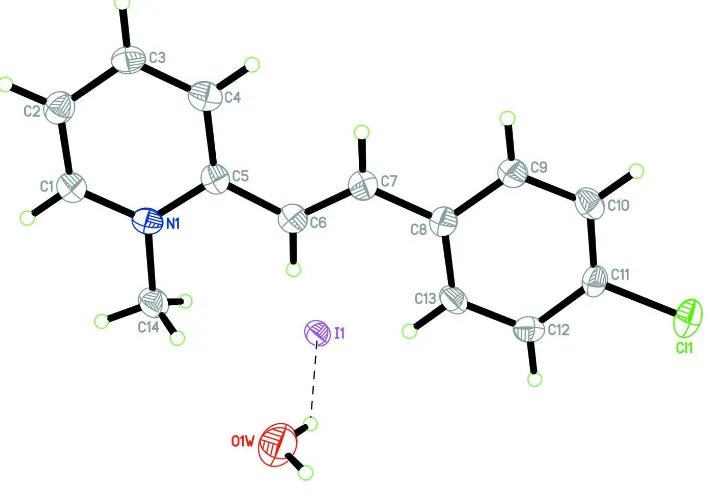
The asymmetric unit of the title compound consists of C14H13ClN+ cation, I- anion and one water molecule (Fig. 1). The
conformation of the cation is essentially planar as indicated by the dihedral angle between the pyridinium (N1/C1—C5)
and the benzene (C8—C13) rings, being 0.98 (17)°. The mean plane through C5/C6/C7/C8 plane makes dihedral angles
of 6.1 (4)° and 6.4 (4)° with pyridinium and benzene rings, respectively. The cation exists in the E configuration and the
torsion angle C5—C6—C7—C8 = -179.2 (3)°. The bond distances and angles in (I) have normal values (Allen et al.,
1987) and comparable with closely related structures (Chantrapromma et al., 2007a,b,c).
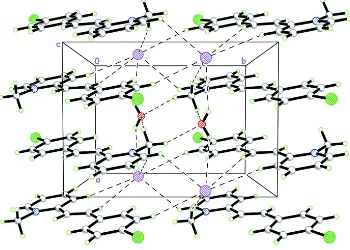
The packing of the molecule down the c axis (Fig. 2), showing that the cation is linked with water molecule by weak C
—H···O interactions (Table 1) and linked with I- anions by weak C—H···I interactions (Table 1) whereas the I- anion is
linked with water molecule by O—H···I hydrogen bonds, forming one-dimensional chains along the a axis. These chains
are further connected into a three-dimensional network (Fig. 2). π···π interactions involving pyridinium and benzene rings
were also observed with Cg1···Cg2 distances of 3.662 (2) Å (symmetry code; 1 - x, -y, 1 - z) and 3.569 (2) Å (symmetry
code; 2 - x, -y, 1 - z); Cg1 and Cg2 are the centroids of the N1/C1–C5 pyridinium and C8–C13 benzene rings, respectively.
The crystal is stabilized by O—H···I hydrogen bond, weak C—H···O and C—H···I interactions.
S2. Experimental
The title compound was prepared by mixing solutions of 1,2-dimethylpyridinium iodide, 4-chlorobenzaldehyde and
piperidine (1:1:1 molar ratio) in methanol. The resulting solution was refluxed for 12 hr under a nitrogen atmosphere. The
temperature after several days, Mp. 492–493 K.
S3. Refinement
All H atoms were placed in calculated positions (O—H = 0.85–0.86 and C—H = 0.93–0.96 Å) and refined as riding, with
Uiso(H) = 1.2Ueq(C) or 1.5Ueq(O, methyl C), A rotating group model was used for the methyl groups. The highest residual
[image:4.610.130.493.177.425.2]electron density peak is located at 0.76 Å from I1 and the deepest hole is located at 0.59 Å from I1.
Figure 1
The title compound showing 50% probability displacement ellipsoids and the atom-numbering scheme. The O—H···I
supporting information
sup-3
[image:5.610.130.480.74.324.2]Acta Cryst. (2008). E64, o1882–o1883 Figure 2
The packing diagram of the title structure viewed approximately along the c axis. Hydrogen bonds were drawn as dashed
lines.
2-[(E)-2-(4-Chlorophenyl)ethenyl]-1-methylpyridinium iodide monohydrate
Crystal data
C14H13ClN+·I−·H2O
Mr = 375.62
Monoclinic, P21/c
Hall symbol: -P 2ybc
a = 7.0876 (1) Å
b = 9.8096 (2) Å
c = 21.0940 (4) Å
β = 95.147 (1)°
V = 1460.68 (5) Å3
Z = 4
F(000) = 736
Dx = 1.708 Mg m−3
Melting point: 492-493 K K
Mo Kα radiation, λ = 0.71073 Å
Cell parameters from 4241 reflections
θ = 1.9–30.0°
µ = 2.36 mm−1
T = 100 K
Plate, orange
0.28 × 0.17 × 0.07 mm
Data collection
Bruker SMART APEXII CCD area-detector diffractometer
Radiation source: fine-focus sealed tube Graphite monochromator
Detector resolution: 8.33 pixels mm-1
ω scans
Absorption correction: multi-scan (SADABS; Bruker, 2005)
Tmin = 0.561, Tmax = 0.845
18928 measured reflections 4241 independent reflections 3486 reflections with I > 2σ(I)
Rint = 0.038
θmax = 30.0°, θmin = 1.9°
h = −9→9
k = −13→12
Refinement on F2
Least-squares matrix: full
R[F2 > 2σ(F2)] = 0.037
wR(F2) = 0.104
S = 1.13
4241 reflections 164 parameters 0 restraints
Primary atom site location: structure-invariant direct methods
Secondary atom site location: difference Fourier map
Hydrogen site location: inferred from neighbouring sites
H-atom parameters constrained
w = 1/[σ2(F
o2) + (0.0483P)2 + 1.1431P]
where P = (Fo2 + 2Fc2)/3
(Δ/σ)max = 0.001
Δρmax = 2.13 e Å−3
Δρmin = −0.79 e Å−3
Special details
Experimental. The data was collected with the Oxford Cyrosystem Cobra low-temperature attachment.
Geometry. All e.s.d.'s (except the e.s.d. in the dihedral angle between two l.s. planes) are estimated using the full covariance matrix. The cell e.s.d.'s are taken into account individually in the estimation of e.s.d.'s in distances, angles and torsion angles; correlations between e.s.d.'s in cell parameters are only used when they are defined by crystal symmetry. An approximate (isotropic) treatment of cell e.s.d.'s is used for estimating e.s.d.'s involving l.s. planes.
Refinement. Refinement of F2 against ALL reflections. The weighted R-factor wR and goodness of fit S are based on F2,
conventional R-factors R are based on F, with F set to zero for negative F2. The threshold expression of F2 > σ(F2) is used
only for calculating R-factors(gt) etc. and is not relevant to the choice of reflections for refinement. R-factors based on F2
are statistically about twice as large as those based on F, and R- factors based on ALL data will be even larger.
Fractional atomic coordinates and isotropic or equivalent isotropic displacement parameters (Å2)
x y z Uiso*/Ueq
I1 0.96440 (3) 0.30947 (2) 0.374487 (10) 0.02517 (9)
Cl1 0.65015 (14) −0.33018 (11) 0.25791 (5) 0.0349 (2)
N1 0.7517 (4) 0.2927 (3) 0.58820 (14) 0.0228 (6)
O1W 0.4685 (5) 0.3289 (4) 0.39663 (18) 0.0589 (10)
H1W1 0.5617 0.2949 0.3782 0.088*
H2W1 0.3691 0.2881 0.3808 0.088*
C1 0.7754 (5) 0.3535 (4) 0.64637 (17) 0.0254 (7)
H1A 0.7521 0.4464 0.6498 0.030*
C2 0.8329 (5) 0.2805 (4) 0.69966 (18) 0.0277 (8)
H2A 0.8473 0.3228 0.7393 0.033*
C3 0.8698 (5) 0.1412 (4) 0.69383 (17) 0.0262 (7)
H3A 0.9115 0.0900 0.7294 0.031*
C4 0.8440 (5) 0.0817 (4) 0.63559 (17) 0.0264 (7)
H4A 0.8674 −0.0111 0.6318 0.032*
C5 0.7828 (5) 0.1569 (4) 0.58078 (17) 0.0221 (7)
C6 0.7492 (5) 0.0969 (4) 0.51828 (17) 0.0256 (7)
H6A 0.7187 0.1548 0.4839 0.031*
C7 0.7592 (5) −0.0353 (4) 0.50694 (17) 0.0268 (7)
H7A 0.7883 −0.0912 0.5421 0.032*
C8 0.7293 (5) −0.1035 (4) 0.44465 (16) 0.0235 (7)
C9 0.7663 (5) −0.2435 (4) 0.44164 (18) 0.0266 (7)
H9A 0.8075 −0.2903 0.4786 0.032*
C10 0.7425 (5) −0.3135 (4) 0.38414 (19) 0.0271 (8)
supporting information
sup-5
Acta Cryst. (2008). E64, o1882–o1883
C11 0.6808 (5) −0.2432 (4) 0.33021 (17) 0.0238 (7)
C12 0.6421 (5) −0.1050 (4) 0.33059 (17) 0.0258 (7)
H12A 0.6005 −0.0596 0.2932 0.031*
C13 0.6668 (5) −0.0354 (4) 0.38847 (17) 0.0250 (7)
H13A 0.6414 0.0575 0.3896 0.030*
C14 0.6940 (5) 0.3805 (4) 0.53292 (18) 0.0298 (8)
H14D 0.6802 0.4727 0.5470 0.045*
H14A 0.5754 0.3489 0.5126 0.045*
H14B 0.7889 0.3769 0.5032 0.045*
Atomic displacement parameters (Å2)
U11 U22 U33 U12 U13 U23
I1 0.02744 (14) 0.02228 (14) 0.02596 (14) 0.00264 (9) 0.00324 (9) 0.00111 (9)
Cl1 0.0368 (5) 0.0385 (6) 0.0293 (5) −0.0051 (4) 0.0027 (4) −0.0126 (4)
N1 0.0206 (13) 0.0229 (16) 0.0249 (15) 0.0010 (11) 0.0027 (11) 0.0046 (12)
O1W 0.0347 (17) 0.083 (3) 0.058 (2) 0.0104 (16) −0.0028 (15) −0.028 (2)
C1 0.0246 (17) 0.0238 (18) 0.0278 (18) 0.0003 (14) 0.0028 (14) 0.0000 (15)
C2 0.0255 (17) 0.032 (2) 0.0261 (18) −0.0004 (14) 0.0028 (14) −0.0020 (15)
C3 0.0209 (16) 0.031 (2) 0.0263 (17) 0.0017 (14) −0.0021 (13) 0.0030 (15)
C4 0.0218 (16) 0.0267 (19) 0.0307 (18) −0.0010 (14) 0.0017 (14) 0.0034 (15)
C5 0.0175 (15) 0.0230 (18) 0.0265 (17) −0.0009 (12) 0.0050 (12) −0.0007 (14)
C6 0.0265 (17) 0.0245 (19) 0.0258 (17) 0.0002 (14) 0.0018 (14) 0.0001 (14)
C7 0.0272 (17) 0.0261 (19) 0.0268 (18) 0.0021 (14) 0.0002 (14) −0.0019 (15)
C8 0.0227 (16) 0.0244 (19) 0.0236 (16) −0.0012 (13) 0.0027 (13) −0.0021 (14)
C9 0.0288 (18) 0.0231 (19) 0.0272 (18) 0.0000 (14) −0.0009 (14) 0.0014 (15)
C10 0.0266 (17) 0.0195 (18) 0.035 (2) −0.0016 (14) 0.0038 (15) 0.0009 (15)
C11 0.0203 (16) 0.0253 (19) 0.0257 (17) −0.0029 (13) 0.0025 (13) −0.0064 (14)
C12 0.0233 (16) 0.027 (2) 0.0267 (17) 0.0026 (14) −0.0011 (13) 0.0029 (14)
C13 0.0246 (16) 0.0172 (17) 0.0329 (19) 0.0022 (13) 0.0013 (14) 0.0009 (14)
C14 0.037 (2) 0.025 (2) 0.0281 (18) 0.0052 (15) 0.0056 (15) 0.0032 (15)
Geometric parameters (Å, º)
Cl1—C11 1.744 (4) C6—H6A 0.9300
N1—C1 1.361 (5) C7—C8 1.473 (5)
N1—C5 1.361 (5) C7—H7A 0.9300
N1—C14 1.478 (5) C8—C13 1.397 (5)
O1W—H1W1 0.8628 C8—C9 1.400 (5)
O1W—H2W1 0.8523 C9—C10 1.391 (5)
C1—C2 1.364 (5) C9—H9A 0.9300
C1—H1A 0.9300 C10—C11 1.368 (5)
C2—C3 1.399 (6) C10—H10A 0.9300
C2—H2A 0.9300 C11—C12 1.383 (5)
C3—C4 1.358 (5) C12—C13 1.396 (5)
C3—H3A 0.9300 C12—H12A 0.9300
C4—C5 1.407 (5) C13—H13A 0.9300
C6—C7 1.322 (5) C14—H14B 0.9600
C1—N1—C5 121.6 (3) C13—C8—C9 118.5 (3)
C1—N1—C14 117.3 (3) C13—C8—C7 123.3 (3)
C5—N1—C14 121.0 (3) C9—C8—C7 118.2 (3)
H1W1—O1W—H2W1 106.3 C10—C9—C8 121.0 (3)
N1—C1—C2 121.1 (4) C10—C9—H9A 119.5
N1—C1—H1A 119.4 C8—C9—H9A 119.5
C2—C1—H1A 119.4 C11—C10—C9 118.8 (3)
C1—C2—C3 119.0 (4) C11—C10—H10A 120.6
C1—C2—H2A 120.5 C9—C10—H10A 120.6
C3—C2—H2A 120.5 C10—C11—C12 122.5 (3)
C4—C3—C2 119.2 (3) C10—C11—Cl1 119.1 (3)
C4—C3—H3A 120.4 C12—C11—Cl1 118.4 (3)
C2—C3—H3A 120.4 C11—C12—C13 118.4 (3)
C3—C4—C5 121.7 (4) C11—C12—H12A 120.8
C3—C4—H4A 119.2 C13—C12—H12A 120.8
C5—C4—H4A 119.2 C12—C13—C8 120.9 (3)
N1—C5—C4 117.4 (3) C12—C13—H13A 119.6
N1—C5—C6 119.3 (3) C8—C13—H13A 119.6
C4—C5—C6 123.4 (3) N1—C14—H14D 109.5
C7—C6—C5 123.9 (3) N1—C14—H14A 109.5
C7—C6—H6A 118.0 H14D—C14—H14A 109.5
C5—C6—H6A 118.0 N1—C14—H14B 109.5
C6—C7—C8 127.0 (4) H14D—C14—H14B 109.5
C6—C7—H7A 116.5 H14A—C14—H14B 109.5
C8—C7—H7A 116.5
C5—N1—C1—C2 0.5 (5) C5—C6—C7—C8 −179.2 (3)
C14—N1—C1—C2 −178.4 (3) C6—C7—C8—C13 −6.4 (6)
N1—C1—C2—C3 0.7 (5) C6—C7—C8—C9 173.2 (4)
C1—C2—C3—C4 −1.3 (5) C13—C8—C9—C10 0.3 (5)
C2—C3—C4—C5 0.6 (5) C7—C8—C9—C10 −179.4 (3)
C1—N1—C5—C4 −1.1 (5) C8—C9—C10—C11 −0.4 (5)
C14—N1—C5—C4 177.7 (3) C9—C10—C11—C12 0.3 (5)
C1—N1—C5—C6 177.9 (3) C9—C10—C11—Cl1 −179.9 (3)
C14—N1—C5—C6 −3.2 (5) C10—C11—C12—C13 −0.2 (5)
C3—C4—C5—N1 0.6 (5) Cl1—C11—C12—C13 −179.9 (3)
C3—C4—C5—C6 −178.4 (3) C11—C12—C13—C8 0.0 (5)
N1—C5—C6—C7 −173.9 (3) C9—C8—C13—C12 −0.1 (5)
C4—C5—C6—C7 5.1 (6) C7—C8—C13—C12 179.6 (3)
Hydrogen-bond geometry (Å, º)
D—H···A D—H H···A D···A D—H···A
O1W—H1W1···I1 0.86 2.87 3.592 (4) 143
supporting information
sup-7
Acta Cryst. (2008). E64, o1882–o1883
C14—H14A···O1W 0.96 2.50 3.202 (5) 130
C14—H14D···O1Wii 0.96 2.56 3.460 (5) 157
C1—H1A···I1iii 0.93 3.20 3.830 (4) 127
C2—H2A···I1iv 0.93 3.18 3.825 (4) 129
C3—H3A···I1iv 0.93 3.21 3.840 (4) 127