Constraint Optimal Selection Techniques (COSTs) for
Linear Programming
*
Goh Saito#, H. W. Corley, Jay M. Rosenberger
IMSE Department, The University of Texas at Arlington, Arlington, USA Email: #[email protected]
Received June 28, 2012; revised July 30, 2012; accepted August 15,2012
ABSTRACT
We describe a new active-set, cutting-plane Constraint Optimal Selection Technique (COST) for solving general linear programming problems. We describe strategies to bound the initial problem and simultaneously add multiple constraints. We give an interpretation of the new COST’s selection rule, which considers both the depth of constraints as well as their angles from the objective function. We provide computational comparisons of the COST with existing linear pro-gramming algorithms, including other COSTs in the literature, for some large-scale problems. Finally, we discuss con-clusions and future research.
Keywords: Linear Programming; Large-Scale Linear Programming; Cutting Planes; Active-Set Methods; Constraint Selection; COSTs
1. Introduction
1.1. The General Linear Programming Problem
Linear programming is a tool for optimizing numerous real-world problems such as the allocation problem. Consider a general linear program (LP) as the following problem P
maximizezc xT
ect toAxb
,
x 0
z n
1
2
n
n
(1)
subj (2) (3) where represents the objective function for varia- bles
T
1 2
x
x
c c c
x
m n
1 1 1
2 2 2
, ,
,
mn n m
c x ,
and the expression (2) describes rows of constraints for variables
T
1 11 12
1 T
2 21 22
2
T
1 2
n
n
n m m
m
x a a a
a x b
x a a a
a x b
x a a a
a
x b
P
a 0
, i 1, , ;m ;
.
Furthermore, the vector 0 in (3) is a column vector of
zeros of appropriate dimension according to context. The dual of is considered the standard minimization LP problem. We focus here on the maximization case.
A COST RAD [1] utilizing multi-bound and multi-cut techniques was developed by Saito et al. [2] for nonne-
gative linear programs (NNLPs). In NNLPs, i and
i
a 0 b 0 0
, ,
A b c
P
P
and c . However in LPs, the components of and are not restricted to be nonnegative numbers.
Though simplex pivoting algorithms and polynomial interior-point barrier-function methods represent the two principal solution approaches to solve problem [3], there is no single best algorithm. For either method, we can always formulate an instance of for which the method performs poorly [4]. However, simplex me- thods remain the dominant approach because they have advantages over interior-point methods, such as efficient post-optimality analysis of pivoting algorithms, appli- cation of cutting-plane methods, and delayed column ge- neration. Current simplex algorithms are often inadequate, though, for solving a large-scale LPs because of their insufficient computational speeds. In particular, emerg- ing technologies require computer solutions in nearly real time for problems involving millions of constraints or variables. Hence faster techniques are needed. The COST of this paper represents a viable such approach.
1.2. Background and Literature Review
*All the authors contributed equally to this research.
#Corresponding author. An active-set framework for solving LPs will be analo-
gous to that of Saito et al. [2] for NNLPs. We begin with
a relaxation of , with a single artificial bounding constraint such as
P
M
1x or c xT M for suffi-
ciently large M so as not to reduce the feasible region
of P.
A series of relaxations r of is
formed by adding one or more violating constraints from set (2). The constraints that have been added are called
operative constraints, while constraints that still remain
in (2) are called inoperative constraints. Eventually a
solution r of is obtained when none of the ino- perative constraints are violated; i.e., for no inoperative
constraint is . In the LP COSTs of this paper we explore 1) the ordering of a set of inoperable constraints for possibly adding them to the current ope- rable constraints and 2) the actual selection of a group of such constraints to be added at an iteration.
, 0,1, 2, ,
P r P
x
P
P
a c
P
T * 0
i r bi a x
i
Active-set approaches have been studied in the past, including those by Stone [5], Thompson et al. [6], Adler et al. [7], Zeleny [8], Myers and Shih [9], and Curet [10],
with the term “constraint selection technique” used in Myers and Shih [9]. Adler et al. [7] added constraints
randomly, without any selection criteria. Zeleny [8] added a constraint that was most violated by the problem
r to form r1. These methods are called SUB and
VIOL here, respectively, as in Saito et al. [2]. Also, VIOL,
which is a standard pricing method for delayed column generation in terms of the dual [11], is identical to the Priority Constraint Method of Thompson et al. [6]. In all
of these approaches, constraints were added one at a time.
P
More recent work on constraint selection has focused on choosing the violated inoperative constraints consi- dered most likely to be binding at optimality for the ori- ginal problem according to a particular constraint se- lection criterion. In the cosine criterion, the angle be- tween normal vector i of (2) and normal vector of
(1) as measured by the cosine,
T
, i
i a c a c
a c
P
cos i ,
is considered. Naylor and Sell ([12], pp. 273-274), for example, suggest that a constraint with a larger cosine value may be more likely to be binding at optimality. Pan [13,14] applied the cosine criterion to pivot rules of the simplex algorithm as the “most-obtuse-angle” rule. The cosine criterion has also been utilized to obtain an initial basis for the simplex algorithm by Trigos et al. [15] and
Junior et al. [16]. Corley et al. [1,17] chose for r1 a
single inoperative constraint of violating and having the largest
T
i bi
a x Pr
r
x cos
a c,
i
a c
i P
i
In Saito et al. [2] the COST RAD was developed for
NNLPs. It was based on the following two geometric factors. Factor I is the angle that the a constraint’s normal vector formed with the normal vector of the ob-
jective function. Factor II is the depth of the cut that con- straint removes as a violated inoperative constraint of
r. From these two factors the constraint selection me-
tric
.
T
RAD , , i ,
i i
i b
b
a c
a c
P
(4)
was developed. This constraint selection metric was uti- lized in conjunction with a multi-bound and multi-cut technique [2] in which multiple constraints were effec- tively selected from a RAD-ordered set of inoperative violating constraints for forming each r. In this paper
we rename the COST RAD of [2] for NNLPs as NRAD.
1.3. Contribution
Although NRAD performs extremely well for NNLPs, we show here that its superiority over traditional algo- rithms is less dramatic for the general LP (1)-(3). Hence, the contribution of this paper includes using the prin- ciples of NRAD to develop a new COST for the general LP, which we refer to as GRAD. Even though GRAD and NRAD share similar principles, GRAD is a signifi- cant modification of NRAD. Indeed, GRAD solves general LPs seven times faster on the average than NRAD in our computational experiments.
The remainder of this paper is organized as follows. GRAD with multi-cuts is developed in Section 2, and an interpretation is given. In Section 3, we present computa- tional results where GRAD is compared to the CPLEX simplex methods, CPLEX barrier method, and the active- set approaches SUB, VIOL, and NRAD. In Section 4 we offer conclusions and discuss future research.
2. The COST GRAD
2.1. NNLP vs LP
An active-set framework for solving general LPs will be analogous to that for NNLPs. However, GRAD is not an immediate extension of NRAD since LPs do not have some of the useful properties of NNLP problems. For example, the origin x0 is no longer guaranteed to be feasible for LP problems. Moreover, the optimal solution
x may not lie in the same orthant as the normal ai to a constraint. We must thus modify NRAD for NNLP to GRAD for LP in order to emulate the underlying reasoning of NRAD based on Factors I and II efficiently.
2.2. Constraint Selection Criterion
Boundedness of NNLP could be assured by adding multiple constraints from (2) until no column of A is a zero vector. However, this is not the case for LP. There- fore an initial bounded problem is formed by adding a bounding constraint such as 0
P T
M
opyright © 2013 SciRes. AJOR
P
C
some constraints from (2), as described in Section 2.3.
0 is then solved to obtain an initial solution 0
x . Pr1
is generated by adding one or more inoperative con- straints of r that maximize the constraint selection
metric for LP among all inoperative constraints of violating . Define this constraint selection metric as
P r P r x
1, 0GRAD , , ij ij,
i i
j c i j i
a c a
b
a c 1, 0 j j n n j cb b
(5)
where
1, ,
min , if
,otherwise, i k k m i i b b b b
kmin1, ,m bk 0 (6)
and is a small positive constant. Thus GRAD seeks such that
i
i, ,ii a b c a xr bi
. i b
T i OPERATIVE GRAD arg max i The first term in (5) is a quantity that invokes Factor I and Factor II analogous to NRAD, while the second term is a quantity that invokes Factor II. In (6), values of are shifted by
=1, , min i k m b b
0 c0
0 P
P
if the minimum value is non-
as well. Although equality constraints are not considered here, it should be noted that equality constraints could be included in .
2.3. Multi-Bound and Multi-Cut for LP
The boundedness of the initial problem 0 for NNLP is
obtained by adding multiple constraints from (2) ordered by decreasing value of NRAD until no column of A is a zero vector. Although this approach does not guarantee boundedness for LP, a generalization was found to be effective here.
For the COST GRAD, an initial bounded problem 0
is formed by adding an artificial bounding constraint such as
P
T M
c x , as well as multiple constraints from (2) ordered by decreasing value of GRAD, until each column of A has at least one positive and at least one negative coefficient (Step 1). After an optimal solution to the initial bounded problem is obtained by the primal simplex method (Step 2), subsequent iterations are so- lved by the dual simplex method (Step 3). Moreover, after the solution of 0 and each subsequent r, con-
straints are again added in groups. r1 is formed by
selecting inoperative constraints in decreasing order of GRAD until both a positive coefficient and a negative coefficient are included for each variable
P P
P
j
positive. Hence i is always positive, and each term in (5) contributes additively to the criterion. GRAD (5) becomes the same as NRAD (4) when and . Therefore it could be utilized to effectively solve NNLPs
x (Step 3,
lines 7-27). The following pseudocode describes the COST GRAD with the new multi-cut technique.
b
Step 1—Identify constraints to form the initial problem P0. 1
i m
1: for do 2: if j aij 0
POSITIVE POSITI
then
3: a VEa
i4: end if 5: if j aij 0
NEGATIVE GA i
OPERATIVE EXPL ED OPERATIVE positive 0
then
6: NE TI
OR VE
a a
7: end if
8: end for
9: , , a
negative 0
a
positive > 0
a a e
,
10: while and negativ > 0 and EXPLORED 1, ,
m
EXPLOREDGRAD ,
argmax i i
i EXPLORED EXPLOR do
11: Let
c
i ,i a b
ED
12:
13: if positive 0 j
j a
a 0
OPERATIVEOPE I i
POSITIV EX E
1
a aij 0
and then
i j
RAT PLOR
14: VE
D 15: if Ea then
18:
1
1,if 0
, , where
0, otherwise
i j
i i n i j
a
a a a
a ,j= 1, , n
19: end if 20: end if 21: if ne
j
j a 0
i j a
TIVE i
gative 0
and then
22: OPERATIVE OPERA 23: if NEGATIVEaEXPLORED
1
a aij 0
then
24: // case if there are no more constraints with 25: else
26:
1
1,if 0
, , where
0,otherwis
i j
i i n i j
a
a a a
a , 1, ,
e j n
negative
a a a
0
27: end if 28: end if
29: positive positive ,
a a a negative
30: end while
for the initial bounded problem
Step 2—Using the primal simplex method, obtain an optimal solution x P0
T
mize zc x
T
to
maxi (7)
M
subject c x
PERATIVE
.
x0
P 0, STOP
STOP
OPERATIVE
true xr P
(8)
T , O
i bi i
a x (9) (10) Step 3—Perform the following iterations until an optimal solution to problem is found.
1: r false
2: while false do
3: if T * then
i r b ii a x
4: STOP // is an optimal solution to . 5: else
6: EXPLOREDOPERATIVE, positive 0
a , anegative 0
a a
7: while positive > 0 and negative > 0 and
T
i r i
i ma xb
EXPLORED 1, , do
8: Let
T
i r bi
c
a a x
ORED i
EXPLORED
GRAD , , argmax i i i
i b
9: EXPLORED EXPL
10: if positive 0 j
j a 0
i j
a
and then
TIVE i
OPERATIVEOPERA EXPLORED
1 0
ij
a
, 1, ,
e j n
11:
12: if POSITIVEa then
13: a //case if there are no more constraints with
14: else
15:
1
1,if 0
, , where
0,otherwis
i j
i i n i j
a
a a a a
16: end if
17: end if 18: if ne
j
j a 0
i j
a
ATIVE i gative 0
and then
Copyrigh es. AJOR 20: if NEGATIVEaEXPLORED
1
a aij 0
then
21: case if there are no more constraints with 22: else
23:
1
1,if 0
, , where
0,otherwis
i j
i i n i j
a
a a a
a , 1, ,
e j n
negative
a a a
1
r r
r
P r
24: end if 25: end if
26: positive positive ,
a a a negative
27: end while 28:
.
x
29: Solve defined by (7)-(10) using the dual simplex method to obtain 30: end if
31: end while
2.4. Interpretation of GRAD GRAD can also be derived from NRAD. Note that the term
The interpretation of NRAD in Saito et al. [2] utilized the
fact that an NNLP always results in a positive value for
i . However for LP of (1)-(3), the intersection of , drawn from the origin, and i i may not neces- sarily lie in the feasible region. Moreover, the
t © 2013 SciR
T
a c c
T b
a x
j
c of
NNLP are all positive. The GRAD constraint selection metric of (5) thus must be modified from RAD
ai, ,bi c
2 n n,
x c x
z
in (4) to account for these facts.
For LP, the basic idea for determining whether a constraint from (2) is likely to be binding at optimality is described as follows. Given an objective function
1 1 2
maxzc x c
observe that is maximized when cj and xj are
large. Hence, a larger value of cj is more likely to yield
a larger value of xj. This relationship implies that the
left-hand side of the constraint is likely to be larger for larger values of
1, 0 . j n ij j j c a c
For aj with cj0, it is hard to predict the value of
j
x in a solution. Consequently, we assume that the xj
in which cj are all equally likely and have the
nominal value 1. The left-hand side is now 0 1, 0 . j j n n j ij j c a
bb ith
1, 0 ij j c
a c
As for the right-hand side of the constraint, a small i
makes a constraint more likely to be binding. We thus divide the left-hand side by i to measure the
constraint’s likelihood of being binding at optimality, resulting in
1, 0
ij
j c
a c
j 1, j 0
n n
j ij
j c
i i
a
b b
,which is essentially GRAD.
1, j 0
n ij j
j c i
a c
b
j
in (5) is simply RAD for an NNLP. For LP we add a term involving the for which the cj are negative.
Consider (11) below.
1, 0 1, 0
.
j j
n n
ij j ij j
j c i j c i
a c a c
b b
a
(11)
The second term in (11) makes sense from the point of view that the expression (11) results in a higher value when ij and cj are both negative, and bi is large.
However, it is found in Section 3.3.1 that the constraint selection metric performed better when the second term was
1, j 0
n ij
j c i
a b
1 r P ,as shown in (5).
3. Computational Experiments
The COST GRAD (5) was compared with the CPLEX primal simplex method, the CPLEX dual simplex method, the polynomial interior-point CPLEX barrier method, as well as the previously defined constraint selection tech- niques SUB, VIOL, and NRAD (4). GRAD, NRAD, SUB, and VIOL utilized the CPLEX dual simplex solver to solve each new relaxed problem .
3.1. Problem Instances
A set of 105 randomly generated LP was constructed. The LP problems were generated with 1000 variables
n and 200,000 constraints
m having various den-numbers between 1 and 5, or between −1 and −5 were assigned to elements of A. To assure that the randomly generated LP had a feasible solution, a feasible solution (not all elements of were nonzero) was rando- mly generated to derive random , where
x x
b Ax b
y
x
y A
. Then a feasible solution (having the same number of nonzero elements as ) was randomly generated to derive random , where . The ratio of the
number of positive and negative elements of
c c
A was one. The number of nonzero in each constraint was binomially distributed ij
a
, density
B n p
a
. Additionally, we required each constraint to have at least two nonzero
ij so that a constraint would not become a simple upper
[image:6.595.58.539.205.756.2]or lower bound on a variable. At each of the 21 densities, 5 random LP were generated. Table 1 summarizes the generated LP.
Table 1. Randomly generated general LP problem set [18].
Number of variables 1000
Number of constraints 200,000
Range of aij 1 ≤ random real ≤ 5, or −5 ≤ random real ≤−1
Fraction of positive aij 0.5
Average of 5 instances of LP at each density
Problem
instance Density
Number of nonzero in a constraint
ij
a bi cj
Number of binding constraints at optimality
Mean Min Mean Max Min Mean Max Min Mean Max Mean
1-5 0.00505 2.0 5.1 17.6 −2.5 1.0 4.4 −19.2 −1.0 16.0 836.0
6-10 0.00602 2.0 6.0 19.6 −2.4 1.0 4.3 −18.2 −0.9 15.1 834.2
11-15 0.00701 2.0 7.0 23.0 −2.2 1.0 4.2 −19.0 −0.9 13.7 827.6
16-20 0.00801 2.0 8.0 23.2 −2.0 1.0 4.1 −19.8 −1.0 14.6 812.4
21-25 0.00900 2.0 9.0 25.4 −1.8 1.0 3.9 −17.7 −1.1 14.8 803.6
26-30 0.01000 2.0 10.0 27.6 −1.8 1.0 3.8 −17.1 −0.9 13.1 807.0
31-35 0.02000 4.0 20.0 43.2 −1.6 1.0 3.6 −15.2 −1.0 12.9 754.0
36-40 0.03001 8.8 30.0 60.2 −1.3 1.0 3.3 −13.3 −1.0 11.6 723.0
41-45 0.04000 15.8 40.0 70.6 −1.3 1.0 3.2 −11.6 −1.1 9.5 694.4
46-50 0.04999 22.0 50.0 82.8 −1.2 1.0 3.2 −13.1 −0.9 10.0 696.0
51-55 0.06000 29.8 60.0 97.8 −1.0 1.0 3.0 −11.1 −1.0 9.7 659.8
56-60 0.07000 38.0 70.0 110.4 −1.1 1.0 3.1 −9.9 −1.0 9.4 664.8
61-65 0.08001 43.8 80.0 123.6 −1.0 1.0 2.9 −12.0 −1.0 9.3 647.4
66-70 0.08999 53.2 90.0 133.6 −0.9 1.0 2.9 −9.7 −1.0 8.2 630.0
71-75 0.10000 61.0 100.0 145.0 −0.9 1.0 2.9 −11.5 −1.0 9.2 633.6
76-80 0.20001 146.2 200.0 261.4 −0.8 1.0 2.8 −9.2 −1.0 8.1 578.6
81-85 0.30001 236.8 300.0 369.6 −0.6 1.0 2.6 −7.9 −1.0 5.6 546.6
86-90 0.40000 332.6 400.0 471.4 −0.6 1.0 2.6 −9.1 −1.0 6.8 530.0
91-95 0.50001 429.6 500.0 574.0 −0.7 1.0 2.6 −8.6 −1.0 6.6 514.0
96-100 0.75000 688.8 750.0 811.4 −0.6 1.0 2.5 −8.4 −1.0 5.8 472.2
3.2. CPLEX Preprocessing
As in Saito et al. [2], the CPLEX preprocessing para-
meters PREIND (preprocessing presolve indicator) and PREDUAL (preprocessing dual) had to be chosen appro- priately. The default parameter settings of PREIND 1 (ON) and (AUTO) were used for CPU times of the CPLEX primal simplex method, the CPLEX dual simplex method, and the CPLEX barrier method. No CPLEX preprocessing was implemented [used PREIND = 0 (OFF) and PREDUAL = −1 (OFF)] by the CPLEX primal simplex and dual simplex solvers as part of GRAD, NRAD, SUB, and VIOL.
PREDUAL 0
3.3. Computational Results
Comparisons of computational methods were performed with the IBM CPLEX 12.1 callable library on an Intel Core 2 Duo E8600 3.33 GHz workstation with a Linux 64-bit operating system and 8 GB of RAM. Compu- tational test results of Tables 2 through 5 were obtained
by calling CPLEX commands from an application writ- ten in the programming language C. In these tables, each CPU time presented is an average computation time of solving five instances of randomly generated LP.
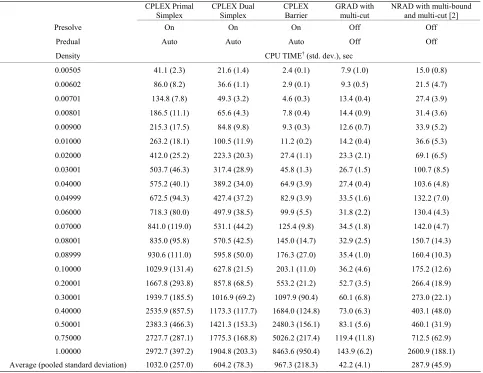
Computational results for the CPLEX primal simplex, dual simplex, and barrier solvers for the general LP set are presented in Table 2. CPU times for the COST GRAD with multi-cut, as well as the COST NRAD with multi-bound and multi-cut are shown for comparison. The CPU times for GRAD were faster than the CPLEX primal simplex, the CPLEX dual simplex, and the CPLEX barrier linear programming solvers at densities between 0.02 and 1. Between densities 0.005 and 0.01, CPLEX barrier was up to 4.0 times faster than GRAD. On average, GRAD was 7.0 times faster than NRAD applied to these non-NNLP problems and 14.6 times faster than the fastest CPLEX solver, which was the dual simplex.
[image:7.595.58.541.353.726.2]3.3.1. Influences of the COST GRAD and Multi-Cut In constructing a constraint selection metric for LP, a
Table 2.Comparison of computation times of CPLEX and COST RAD methods on LP problem set.
CPLEX Primal Simplex
CPLEX Dual Simplex
CPLEX Barrier
GRAD with multi-cut
NRAD with multi-bound and multi-cut [2]
Presolve On On On Off Off
Predual Auto Auto Auto Off Off
Density CPU TIME† (std. dev.), sec
0.00505 41.1 (2.3) 21.6 (1.4) 2.4 (0.1) 7.9 (1.0) 15.0 (0.8) 0.00602 86.0 (8.2) 36.6 (1.1) 2.9 (0.1) 9.3 (0.5) 21.5 (4.7) 0.00701 134.8 (7.8) 49.3 (3.2) 4.6 (0.3) 13.4 (0.4) 27.4 (3.9) 0.00801 186.5 (11.1) 65.6 (4.3) 7.8 (0.4) 14.4 (0.9) 31.4 (3.6) 0.00900 215.3 (17.5) 84.8 (9.8) 9.3 (0.3) 12.6 (0.7) 33.9 (5.2) 0.01000 263.2 (18.1) 100.5 (11.9) 11.2 (0.2) 14.2 (0.4) 36.6 (5.3) 0.02000 412.0 (25.2) 223.3 (20.3) 27.4 (1.1) 23.3 (2.1) 69.1 (6.5) 0.03001 503.7 (46.3) 317.4 (28.9) 45.8 (1.3) 26.7 (1.5) 100.7 (8.5) 0.04000 575.2 (40.1) 389.2 (34.0) 64.9 (3.9) 27.4 (0.4) 103.6 (4.8) 0.04999 672.5 (94.3) 427.4 (37.2) 82.9 (3.9) 33.5 (1.6) 132.2 (7.0) 0.06000 718.3 (80.0) 497.9 (38.5) 99.9 (5.5) 31.8 (2.2) 130.4 (4.3) 0.07000 841.0 (119.0) 531.1 (44.2) 125.4 (9.8) 34.5 (1.8) 142.0 (4.7) 0.08001 835.0 (95.8) 570.5 (42.5) 145.0 (14.7) 32.9 (2.5) 150.7 (14.3) 0.08999 930.6 (111.0) 595.8 (50.0) 176.3 (27.0) 35.4 (1.0) 160.4 (10.3) 0.10000 1029.9 (131.4) 627.8 (21.5) 203.1 (11.0) 36.2 (4.6) 175.2 (12.6) 0.20001 1667.8 (293.8) 857.8 (68.5) 553.2 (21.2) 52.7 (3.5) 266.4 (18.9) 0.30001 1939.7 (185.5) 1016.9 (69.2) 1097.9 (90.4) 60.1 (6.8) 273.0 (22.1) 0.40000 2535.9 (857.5) 1173.3 (117.7) 1684.0 (124.8) 73.0 (6.3) 403.1 (48.0) 0.50001 2383.3 (466.3) 1421.3 (153.3) 2480.3 (156.1) 83.1 (5.6) 460.1 (31.9) 0.75000 2727.7 (287.1) 1775.3 (168.8) 5026.2 (217.4) 119.4 (11.8) 712.5 (62.9) 1.00000 2972.7 (397.2) 1904.8 (203.3) 8463.6 (950.4) 143.9 (6.2) 2600.9 (188.1) Average (pooled standard deviation) 1032.0 (257.0) 604.2 (78.3) 967.3 (218.3) 42.2 (4.1) 287.9 (45.9)
†Average of 5 instances of LP at each density.
natural strategy might be to have the metric give priority to those constraints with either “as large positive ij
and large positive
a
j
c with small i as possible,” or “as
small negative ij and small negative b
a cj with large
i as possible.” However, when running LP problems
utilizing NRAD (4), the constraint selection metric is
b
1, 0
NRAD , , ij j
i i
j c
a c b
a c
1, 0
,
j j
n n
ij j
j c
i i
a c
b
b0
c
b
a
(12)
if the terms for and j are explicitly wri-
tten out. The first term follows the above general strategy,
0 j
c
except when i becomes negative. The second term
should be subtracted, instead of added, from the first term in order for the constraint selection metric to take a higher value when giving priority to “as small negative
ij and small negative cj b
with large bi as possible.”
The i in the second term should also be positive for
the metric to work additively.
[image:8.595.59.539.253.725.2]To examine the effect of changing the form of NRAD (12) to GRAD, several intermediate variations are tested and presented in Table 3. The results utilizing SUB are also shown in the table for comparison. The first va- riation,
Table 3. Comparison of computation times to illustrate the effects of muti-cut, NRAD and GRAD on LP problem set.
Constraint selection metric†
SUB SUB NRAD NRAD variation 1 (13)NRAD variation 2 (14) NRAD variation 3 (11)NRAD GRAD
Multiple cuts for NNLP
Multiple cuts for LP
Multiple cuts for NNLP
Multiple cuts
for LP Multiple cuts for LP
Density CPU TIME‡, sec
0.00505 16.2 14.5 15.0 13.9 14.0 10.1 11.2 9.4
0.00602 16.8 15.1 21.5 15.7 15.5 10.8 13.0 11.4
0.00701 22.9 17.9 27.4 18.6 22.1 12.4 18.5 15.3
0.00801 30.9 19.3 31.4 21.0 24.2 13.7 20.7 14.8
0.00900 31.2 22.4 33.9 22.4 21.7 14.2 17.9 13.4
0.01000 31.8 28.6 36.6 28.8 25.8 15.4 19.7 16.4
0.02000 73.5 57.0 69.1 53.4 53.3 23.9 34.7 25.8
0.03001 98.2 79.6 100.7 73.5 66.7 27.9 38.3 26.9
0.04000 111.4 83.4 103.6 75.8 76.4 29.6 40.7 27.6
0.04999 144.6 100.1 132.2 87.3 90.1 38.7 49.9 34.5
0.06000 148.5 106.3 130.4 91.7 93.3 35.9 47.1 32.5
0.07000 160.0 109.4 142.0 93.8 108.5 39.6 52.2 34.5
0.08001 179.0 116.6 150.7 98.4 98.5 37.5 49.4 32.5
0.08999 191.0 122.8 160.4 102.8 111.5 38.8 53.2 34.9
0.10000 201.1 133.5 175.2 111.4 112.5 41.6 57.7 36.2
0.20001 312.7 196.1 266.4 166.6 176.6 57.5 83.3 50.4
0.30001 389.0 246.0 273.0 168.5 195.4 59.2 98.2 55.8
0.40000 566.8 344.5 403.1 238.0 254.7 74.6 119.8 70.0
0.50001 734.8 431.0 460.1 284.9 299.5 90.9 136.1 79.4
0.75000 1158.4 614.8 712.5 379.7 430.7 113.0 186.2 107.2
1.00000 3662.7 774.6 2600.9 455.4 522.1 134.8 236.9 138.5
Average 394.4 173.0 287.9 123.9 134.0 43.8 65.9 41.3
variation1
NRAD ai, ,bi c
1, 0
, j
n ij j
j c i
a c
b
0
c
0,
b
(13)
is a version only considering the j term of (12).
The test problems of Table 1 did not have any con- straints with i therefore the case was not specially
handled. The second version,
variation2
1, 0
NRAD ai, ,bi c
, j
n ij j
j c i
a c
b
i
b
(14)
is (13) with , which was defined in (6). Variation 3,
variation3
1, 0 1, 0
NRAD , ,
j ij j i i
j c a c b
a c ,
n n
ij j
j c
i j i
a c
b b
10
, 10
i
a
subtracts a term from (14) to give (11) above. For cal- culation of b was used for all results pre-
sented.
Results for SUB and NRAD from Table 3 show that the multi-cut method for LP reduced CPU times by 56% to 57% over the multi-cut method for NNLP to support the importance of having both positive and negative ij
for every variable xj in forming a set of cuts for each
iteration of an active-set method for LP. The rest of the comparisons are made with those methods utilizing the multi-cut method for LP.
For densities between 0.005 and 0.09, SUB, NRAD, and variation 1 (13) of NRAD performed about the same. Introducing the use of bi in (14), (5), and (11) sig- nificantly improved the CPU times over (13). Between (11) and (14), (14) which only considered the j
term was faster. Going from (14) to GRAD, utilizing the
0
c
term
1, j 0
n ij
j c i
a
b
a
ij a
improved the CPU time slightly more,
5.7% on average.
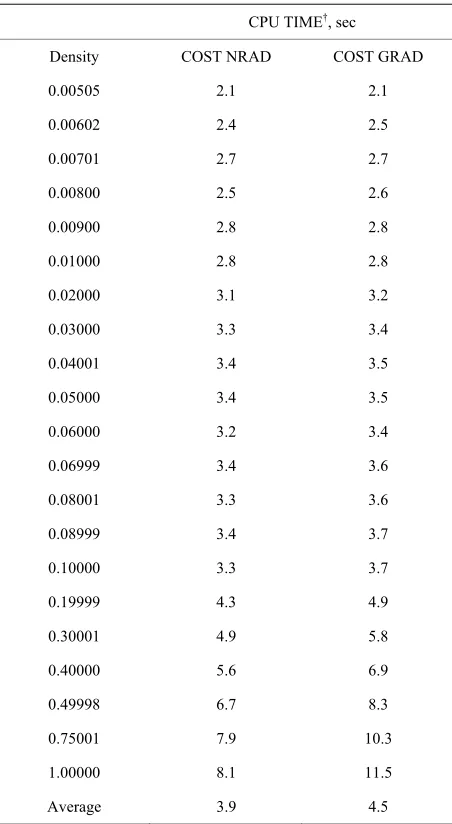
The COST GRAD with multiple cuts for LP was also tested on NNLP problem Set 1 from Saito et al. [2], as
shown in Table 4. The results confirm that the methods perform equally for NNLP. Although the constraint se- lection metric becomes exactly the same between the two methods when running NNLP, a slight increase in CPU times for the COST GRAD occurs because of the time it takes for the algorithm to determine whether the problem is an NNLP (pseudocode in Section 2.3, Step 1, lines 1 through 8). In the case of solving NNLP with the GRAD, this check allows the multi-cut procedure to stop search- ing for negative ij if there are no constraints with ne-
gative in the inoperative set.
3.3.2. Number of Constraints Added
[image:9.595.310.536.111.523.2]In Table 5, CPU times and the number of constraints added during computation of the test problems by GRAD (both single-cut and multi-cut versions) are compared with the constraint selection methods SUB and VIOL of
Table 4. Comparison of computation times of NRAD and GRAD on NNLP Set 1 from Saito et al. [2].
CPU TIME†, sec
Density COST NRAD COST GRAD
0.00505 2.1 2.1
0.00602 2.4 2.5
0.00701 2.7 2.7
0.00800 2.5 2.6
0.00900 2.8 2.8
0.01000 2.8 2.8
0.02000 3.1 3.2
0.03000 3.3 3.4
0.04001 3.4 3.5
0.05000 3.4 3.5
0.06000 3.2 3.4
0.06999 3.4 3.6
0.08001 3.3 3.6
0.08999 3.4 3.7
0.10000 3.3 3.7
0.19999 4.3 4.9
0.30001 4.9 5.8
0.40000 5.6 6.9
0.49998 6.7 8.3
0.75001 7.9 10.3
1.00000 8.1 11.5
Average 3.9 4.5
†Average of 5 instances of LP at each density. Used CPLEX preprocessing
parameters of Presolve = off and Predual = off.
Adler et al. [7] and Zeleny [8], respectively. “Number of
Constraints Added” reflects the number of constraints added in the set, but not the artificial bounding constraint
OPERATIVE
T M
c x
T M 1010
c x
. To implement SUB and VIOL as in previous work, a single bounding constraint
was used.
Although the single-cut SUB performed comparably with the CPLEX dual simplex with the default prepro- cessing parameter settings in solving NNLP, SUB is much slower when solving LP. However, as shown above in Table 3, the CPU times for SUB greatly im- proves to 173.0 seconds from 4515.6 seconds on average, faster than 604.2 seconds for the CPLEX dual simplex, once the multi-cut procedure is incorporated.
For the NNLP Set 1 in Saito et al. [2], the 25.1
Table 5. Comparison of computation times of COST GRAD and non-COST methods, SUB and VIOL on LP problem set.
Density CPU TIME†, sec Number of added constraints Constraints binding at
(and number of iterations
for multi-cut methods) †r Optimality as a % of constraints added†
SUB VIOL GRAD SUB VIOL GRAD SUB VIOL GRAD
SC‡ MCǁ SC§ MCǁ SC¶ MCǁ SC‡ MCǁ SC§ MCǁ SC¶ MCǁ SC‡ MCǁ SC§ MCǁ SC¶ MCǁ
0.00505 246.0 14.5 120.1 15.1 149.1 9.4 8041 (12.8)7363 2911 (11.8)7002 6133 (10.8)6129 10.4 11.4 28.7 11.9 13.6 13.6
0.00602 324.8 15.1 145.8 17.6 188.0 11.4 8154 (12.8)7264 2904 (12.4)6751 6094 (11.0)5801 10.2 11.5 28.7 12.4 13.7 14.4
0.00701 408.7 17.9 166.7 18.5 223.4 15.3 8,205 (13.6)7193 2834 (12.8)6393 6014 (11.6)5638 10.1 11.5 29.2 12.9 13.8 14.7
0.00801 458.6 19.3 179.7 20.9 256.1 14.8 8165 (14.2)7068 2767 (12.4)6144 5985 (11.4)5514 10.0 11.5 29.4 13.2 13.6 14.7
0.00900 545.4 22.4 193.4 23.0 296.0 13.4 8129 (15.0)7001 2685 (13.6)6031 5845 (12.0)5387 9.9 11.5 29.9 13.3 13.7 14.9
0.01000 628.5 28.6 217.4 24.3 299.6 16.4 8228 (16.0)7009 2,705 (13.4)5725 5726 (12.0)5143 9.8 11.5 29.8 14.1 14.1 15.7
0.02000 1463 57.0 302.2 31.5 491.9 25.8 7974 (21.8)6597 2341 (15.0)4423 5208 (15.4)4465 9.5 11.4 32.2 17.0 14.5 16.9
0.03001 2521 79.6 356.8 37.2 536.2 26.9 7570 (26.4)6237 2163 (17.4)3875 4557 (16.6)3826 9.6 11.6 33.4 18.7 15.9 18.9
0.04000 2552 83.4 346.9 36.7 600.2 27.6 7347 (30.8)6024 2055 (18.6)3496 4386 (20.4)3685 9.5 11.5 33.8 19.9 15.8 18.8
0.04999 3344 100.1 400.1 41.4 724.3 34.5 7354 (36.8)6112 2009 (20.8)3318 4317 (22.4)3634 9.5 11.4 34.6 21.0 16.1 19.2
0.06000 3346 106.3 378.5 38.8 644.2 32.5 7067 (40.2)5864 1860 (21.6)3028 3949 (24.0)3326 9.3 11.3 35.5 21.8 16.7 19.8
0.07000 4480 109.4 414.9 41.0 654.1 34.5 6923 (44.4)5780 1843 (23.2)2905 3927 (26.0)3323 9.6 11.5 36.1 22.9 16.9 20.0
0.08001 4357 116.6 426.4 40.1 708.3 32.5 6851 (48.6)5737 1803 (24.0)2724 3600 (26.4)3035 9.5 11.3 35.9 23.8 18.0 21.3
0.08999 4448 122.8 428.1 42.3 595.8 34.9 6727 (52.8)5658 1743 (25.6)2636 3555 (28.8)3029 9.4 11.1 36.1 23.9 17.7 20.8
0.10000 4379 133.5 449.2 45.1 643.3 36.2 6730 (58.2)5681 1734 (26.8)2563 3500 (30.8)2992 9.4 11.2 36.5 24.7 18.1 21.2
0.20001 7666 196.1 650.5 69.4 758.9 50.4 6226 (97.2)5415 1561 (37.8)2089 3145 (50.0)2742 9.3 10.7 37.1 27.7 18.4 21.1
0.30001 7499 246.0 758.1 93.8 806.6 55.8 5814 (131.8)5137 1393 (45.8)1775 2787 (63.6)2467 9.4 10.6 39.2 30.8 19.6 22.2
0.40000 10,947 344.5 947.9 134.7 1020 70.0 5814 (176.6)5248 1359 (55.6)1684 2641 (79.6)2381 9.1 10.1 39.0 31.5 20.1 22.3
0.50001 11,929 431.0 1104 178.6 1050 79.4 5764 (217.2)5225 1318 (64.0)1573 2482 (93.6)2264 8.9 9.8 39.0 32.7 20.7 22.7
0.75000 12,697 614.8 1420 313.4 1100 107.2 5386 (315.2)4988 1192 (83.6)1387 2201 (127.4)2030 8.8 9.5 39.6 34.0 21.4 23.3
1.00000 10,585 774.6 1,621 478.0 1183 138.5 5055 (415.6)4725 1070 (102.0)1245 2040 (168.4)1913 8.6 9.2 40.4 34.8 21.2 22.6
Average 4516 173.0 525.1 82.9 615.7 41.3 7025 (85.6)6063 2012 (31.3)3656 4195 (41.1)3749 9.6 11.1 33.4 18.4 16.0 17.9
†Average of 5 instances of LP at each density; ‡One constraint was added per iteration [7]. was used as the bounding constraint; ǁMulti-cut
technique for LP was applied with as the bounding constraint; §One constraint was added per iteration [8]. was used as
e bounding constraint; ¶One constraint was added per iteration
r. was used as the bounding constraint.
r
10
10
T 1010
M
c x
T 1010
M
c x T 1010
M
c x
T
M
r
th
seconds of the single-cut version of NRAD was faster than 118.5 second for VIOL on average, whereas for the general LP set, the 615.7 seconds of the single-cut ver- sion of GRAD was slower than 525.1 seconds for VIOL on average. However the COST GRAD, which incor- porates multi-cut, outperformed VIOL with multi-cut. The respective times were compared at 41.3 seconds vs 82.9 seconds on average.
In general, a method that makes use of posterior infor-
mation such as VIOL adds fewer constraints and thus adds a higher percentage of binding constraints at opti- mality. But this comes at a cost of extra computation time required to rank the set of inoperative constraints at every iteration The data in Table 5 confirmed that single- cut VIOL added the fewest number of constraints (2012 on average). The advantage of not re-sorting the con- straints at every for a prior method, i.e. GRAD,
became apparent when multi-cut is applied. In multi-cut VIOL, violating inoperative constraints had to be re- sorted in descending order of violation at every iteration
.
r
r
.
r
mn
Comparing the CPU times with and without the mul- tiple cuts, the reduction in CPU times was greater for GRAD than in NRAD. For NRAD, the reduction was about six-fold (from 25.1 to 3.9 seconds) on average. The CPU times for GRAD reduced about 14-fold (from 615.7 seconds to 41.3 seconds).
4. Conclusions
A COST GRAD with multi-cut for general LP was developed here. An interpretation of GRAD was given, and the new technique was tested on a set of large-scale randomly generated LP with . For densities be- tween 0.02 and 1, GRAD outperformed the CPLEX primal simplex, dual simplex, and barrier solvers for LP (maximization) with long-and-narrow
Another area of exploration is the utilization of local posterior information [1] obtained from each r
x in addition to the global GRAD information for constraints obtained prior to the active-set iterations. It is concei- vable that the rationale behind NRAD and GRAD could also lead to better integer programming cutting planes. Finally, it should be noted that any COST such as GRAD is a polynomial algorithm if the CPLEX barrier solver is used to solve each new subproblem with added con- straints instead of the primal simplex or the dual simplex. Such a COST, however, performs extremely poorly in practice.
5. Acknowledgements
We gratefully acknowledge the Texas Advanced Re- search Program for supporting this material under Grant No. 003656-0197-2003.
REFERENCES
[1] H. W. Corley and J. M. Rosenberger, “System, Method and Apparatus for Allocating Resources by Constraint Selection,” US Patent No. 8082549, 2011.
http://patft1.uspto.gov/netacgi/nph-Parser?patentnumber= 8082549
[2] G. Saito, H. W. Corley, J. M. Rosenberger and T.-K. Sung, “Constraint Optimal Selection Techniques (COSTs) for Nonnegative Linear Programming Problems,” Tech-nical Report, The University of Texas, Arlington, 2012. http://www.uta.edu/cosmos/TechReports/COSMOS-04-0 2.pdf
[3] M. J. Todd, “The Many Facets of Linear Programming,” Mathematical Programming, Vol. 91, No. 3, 2002, pp. 417-436.
[4] J. M. Rosenberger, E. L. Johnson and G. L. Nemhauser, “Rerouting Aircraft for Aircraft Recovery,” Transporta-tion Science, Vol. 37, No. 4, 2003, pp. 408-421.
A matrices. More- over, GRAD for LP still maintains the attractive features of the dual simplex method such as a basis, shadow prices, reduced costs, and sensitivity analysis [5]. As with the case for NRAD, GRAD also retains the post- optimality advantages of pivoting algorithms useful for integer programming. As a practical matter, the CPLEX presolve routines, which as noted in Saito et al. [2]
account for most of the speed of the CPLEX solvers, are proprietary. However, this paper places GRAD in the public domain. Further research may improve GRAD to- wards the efficiency that NRAD demonstrated with NNLP. Incorporating new techniques may also be of interest. In particular, incorporating a method to better approximate the feasible region for general LP, as well as simul- taneously addressing both the primal and dual problems, could conceivably improve COST GRAD by adding both constraints and variables.
[5] J. J. Stone, “The Cross-Section Method: An Algorithm for Linear Programming,” Rand Corporation Memoran-dum P-1490, 1958.
[6] G. L. Thompson, F. M. Tonge and S. Zionts, “Techniques for Removing Nonbinding Constraints and Extraneous Variables from Linear Programming Problems,” Manage- ment Science, Vol. 12, No. 7, 1966, pp. 588-608.
[7] I. Adler, R. Karp and R. Shamir, “A Family of Simplex Variants Solving an m × d Linear Program in Expected Number of Pivots Steps Depending on d Only,” Mathe-matics of Operations Research, Vol. 11, No. 4, 1986, pp. 570-590.
[8] M. Zeleny, “An External Reconstruction Approach (ERA) to Linear Programming,” Computers & Operations Re-search, Vol. 13, No. 1, 1986, pp. 95-100.
[9] D. C. Myers and W. Shih, “A Constraint Selection Tech-nique for a Class of Linear Programs,” Operations Re-search Letters, Vol. 7, No. 4, 1988, pp. 191-195.
[10] N. D. Curet, “A Primal-Dual Simplex Method for Linear
Programs,” Operations Research Letters, Vol. 13, No. 4, 1993, pp. 223-237.
[11] M. S. Bazaraa, J. J. Jarvis and H. D. Sherali, “Linear Pro-gramming and Network Flows,” 3rd Edition, John Wiley, New York, 2005.
[12] A. W. Naylor and G. R. Sell, “Linear Operator Theory in Engineering and Science,” Springer-Verlag, New York, 1982. doi:10.1007/978-1-4612-5773-8
[13] P.-Q. Pan, “Practical Finite Pivoting Rules for the Sim-plex Method,” Operations-Research-Spektrum, Vol. 12, No. 4, 1990, pp. 219-225.
[14] P.-Q. Pan, “A Simplex-Like Method with Bisection for Linear Programming,” Optimization, Vol. 22, No. 5, 1991, pp. 717-743.
[15] F. Trigos, J. Frausto-Solis and R. R. Rivera-Lopez, “A Simplex-Cosine Method for Solving Hard Linear Prob-lems,” Advances in Simulation, System Theory and Sys-tems Engineering, Vol. 70X, 2002, pp. 27-32.
[16] H. Vieira Jr. and M. P. E. Lins, “An Improved Initial Basis for the Simplex Algorithm,” Computers & Opera-tions Research, Vol. 32, No. 8, 2005, pp. 1983-1993. [17] H. W. Corley, J. M. Rosenberger, W.-C. Yeh and T.-K.
Sung, “The Cosine Simplex Algorithm,” The Internation- al Journal of Advanced Manufacturing Technology, Vol. 27, No. 9, 2006, pp. 1047-1050.
![Table 1. Randomly generated general LP problem set [18].](https://thumb-us.123doks.com/thumbv2/123dok_us/1574767.703636/6.595.58.539.205.756/table-randomly-generated-general-lp-problem-set.webp)