Using Variance as a Stopping Criterion
for Active Learning of Frame Assignment
Masood Ghayoomi German Grammar Group
Freie Universit¨at Berlin Berlin, 14195
Abstract
Active learning is a promising method to re-duce human’s effort for data annotation in dif-ferent NLP applications. Since it is an itera-tive task, it should be stopped at some point which is optimum or near-optimum. In this paper we propose a novel stopping criterion for active learning of frame assignment based on the variability of the classifier’s confidence score on the unlabeled data. The important ad-vantage of this criterion is that we rely only on the unlabeled data to stop the data annotation process; as a result there are no requirements for the gold standard data and testing the clas-sifier’s performance in each iteration. Our experiments show that the proposed method achieves 93.67% of the classifier maximum performance.
1 Introduction
Using supervised machine learning methods is very popular in Natural Language Processing (NLP). However, these methods are not applicable for most of the NLP tasks due to the lack of labeled data. Al-though a huge amount of unlabeled data is freely available, labeling them for supervised learning techniques is very tedious, expensive, time consum-ing, and error prone.
Active learningis a supervised machine learning method in which informative instances are chosen by the classifier for labeling. Unlike the normal su-pervised set-up where data annotation and learning are completely independent, active learning is a se-quential process (Settles, 2009; Busser and Morante, 2005). This learning method is used in a variety of
NLP tasks such as information extraction (Thomp-son et al., 1999), semantic role labeling (Busser and Morante, 2005), machine translation (Haffari and Sarkar, 2009), and name entity recognition (Laws and Sch¨utze, 2008). In our study, we apply this method for the frame assignment task as a kind of semantic analysis.
The process of active learning is as follows: the learner takes a set of labeled instances, calledseed
data, as an input for initial training of the classifier; and then a larger set of unlabeled instances will be selected by the classifier to be labeled with the hu-man interaction. Even a small set of well selected samples for labeling can achieve the same level of performance of a large labeled data set; and the ora-cle’s effort will be reduced as a result.
The motivation behind active learning is select-ing the most useful examples for the classifier and thereby minimizing the annotation effort while still keeping up the performance level (Thompson et al., 1999). There are two major learning scenarios in active learning which are very popular among re-searchers and frequently used in various NLP tasks:
stream-based sampling(Cohn et al., 1994) and pool-based sampling(Lewis and Gale, 1994).
con-Algorithm 1Uncertainty Sampling in Active Learning
Input:Seed dataS, Pool of unlabeled samplesU
UseSto train the classifierC
while the stopping criterion is metdo
UseCto annotateU
Select the topKsamples from Upredicted by
Cwhich have the lowest confidence
LabelK, augmentSwith theKsamples, and re-moveKfromU
UseSto retrainC
end while
fident on their labels are selected and handed out to the oracle. To this aim, a confidence score is re-quired which is in fact the prediction of the classi-fier with the highest probability for the label of the sample (Busser and Morante, 2005).
The approach taken in active learning for our task is based on the uncertainty of the classifier with ac-cess to the pool of data. The learning proac-cess is presented in Algorithm 1. Since active learning is an iterative process (Busser and Morante, 2005), it should be stopped at some point which is optimum or at least near-optimum. A learning curve is used as a means to illustrate the learning progress of the learner, so that we can monitor the performance of the classifier. In fact, the curve signals when the learning process should stop as almost no increase or even a drop in the performance of the classifier is observed. At this point, additional training data will not increase the performance any more. In this paper, we propose a new stopping criterion based on the variability of the classifier’s confidence score on the selected unlabeled data so that we avoid using the labeled gold standard.
The structure of the paper is as follows. In Sec-tion 2, we briefly describeframe semanticsas it is the domain of application for our model. Section 3 introduces our stopping criterion and describes the idea behind it. In Section 4, we describe our data set and present the experimental results. In Section 5, related work on stopping criteria is outlined; and finally Section 6 summarizes the paper.
2 Frame Semantics
Syntactic analysis such as part-of-speech (POS) tag-ging and parsing has been widely studied and has achieved a great progress. However, semantic
anal-ysis did not have such a rapid progress. This prob-lem has recently motivated researches to pay special attention to natural language understanding since it is one of the essential parts in information extraction and question-answering.
Frame semantic structure analysis which is based on the case grammar of Fillmore (1968) is one of the understanding techniques to provide the knowl-edge about the actions, the participants of the ac-tion, and the relations between them. In Fillmore’s view, a frame is considered as an abstract scene hav-ing some participants as the arguments of the pred-icate, and some sentences to describe the scene. In fact the frames are the conceptual structures for the background knowledge of the abstract scenes repre-sented by the lexical units and provide context to the elements of the action. FrameNet (Baker and Lowe, 1998) is a data set developed at ICSI Berkley Uni-versity based on the frame semantics.
In frame semantic structure analysis, the semantic roles of the elements participating in the action are identified. Determining and assigning the semantic roles automatically require two steps:frame assign-ment, and role assignment (Erk and Pado, 2006). The first step consists in identifying the frame which is evoked by the predicate to determine the unique frame that is appropriate for the sample. The next step is identifying the arguments of the predicate and assigning the semantic roles to the syntactic argu-ments of the given frame. In our research, we study the first step, and leave the second step for future work.
3 The Proposed Stopping Criterion
The main idea behind the stopping criteria is to stop the classifier when it has reached its maximum per-formance and labeling of further examples from the unlabeled data set will not increase the classifier’s performance any more. Determining this point is very difficult experimentally without access to the gold standard labels to evaluate the performance; however, we should find a criterion to stop active learning in a near-optimum point. To this aim, we propose a novel stopping criterion which uses the
performance saturation of the classifier and the vari-ability on the confidence of the selected instances.
Generally, as we will see in Section 5, a stopping criterion could be based either on the performance of the classifier on the test data, or on the confidence score of the classifier on the unlabeled data. In our method, we used the second approach. The biggest advantage of this model is that no gold standard data is required to evaluate the performance of the system in each iteration.
3.1 Mean and Variance
Mean and variance are two of the well-known sta-tistical metrics. Mean is a stasta-tistical measurement for determining the central tendency among a set of scores. In our study, we have computed the mean (M) of the classifier’s confidence score for the pre-dicted labels of 5 samples selected in each iteration. Variance is the amount of variability of the scores around their mean. To compute the variability of the classifier’s confidence score for the selected samples in each iteration, the following equation is used in our task:
V ariance=
PK
i=1(Ci−M)2
K (1)
where Ci is the confidence score of each selected
sample in each iteration,Mis the mean of the confi-dence scores for the predicted labels, and Kis the number of samples selected in the same iteration (K=5 in our study).
3.2 The General Idea
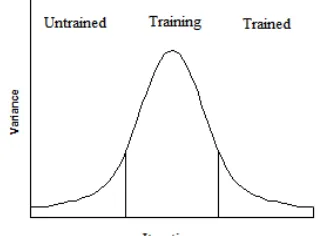
According to the pool-based scenario, in each iter-ation Ksamples of the extra unlabeled data which have the lowest confidence score are selected, and after labeling by the oracle they are added to the training data. In the early iterations, the mean of the classifier’s confidence score for the selected samples is low. Since the classifier is not trained enough in these iterations, most of the scores are low and they do not have a high degree of variability. As a result the variance of the confidence score for these sam-ples is low. We call this step theuntrainedstage of the classifier.
As the classifier is training with more data, the confidence score of the samples will gradually in-crease; as a result, there will be a high degree of variability in the confidence scores which spread out
around their mean. In these iterations, the classifier is relatively in the borderline of the training stage, passing from untrained to trained; so that there will be a high variability of confidence scores which leads to have a high variance. This is the training
stage of the classifier.
When the classifier is trained, the confidence score of the classifier on the selected samples will increase. However, from a certain point that the clas-sifier is trained enough, all of the confidence scores are located tightly around their mean with a low de-gree of variability; as a result, the variance of the samples decreases. This is the stage that the classi-fier istrained.
The curve in Figure 1 represents the behavior of the variance in different iterations such that the x
[image:3.612.342.501.319.437.2]axis is the number of iterations, and theyaxis is the variance of the confidence scores in each iteration.
Figure 1: Normal distribution of variance for the classi-fier’s confidence score
Based on our assumption, the best stopping point is when variance reaches its global peak and starts to decrease. In this case, the classifier passes the train-ing stage and enters into the trained stage.
3.3 The Variance Model
To avoid this problem, we propose a model, called
variance model(VM), to stop active learning when variance (V) decreases innsequential iterations; i.e.
Vi<Vi−1 <...<Vi−n.
There is a possibility that this condition is not satis-fied at all in different iterations. In such cases, ac-tive learning will not stop and all data will be la-beled. This condition is usually met when there are instances in the data which are inherently ambigu-ous. Having such data is generally unavoidable and it is often problematic for the learner.
Although the above model can deal with the lo-cal maxima problem, there is a possibility that the decreased variance innsequential iterations is very small and it is still possible to stick in the local max-ima. To avoid this problem and have a better stop-ping point, we extend the proposed model by setting a thresholdm, called theExtended Variance Model
(EVM), in which the minimum variance decrement innsequential iterations must bem; i.e.
Vi<Vi−1 −m<...<Vi−n−m.
4 Experimental Results 4.1 Setup of Experiment
What we aim to do in our study is assigning frames with active learning. We have chosen the pool-based scenario by using the uncertainty sampling method. In our task, since we have a small data set, 5 in-stances (K=5) with the lowest confidence score of the predited labels will be selected in each iteration from the pool of data and handed out to the oracle to be labeled.
We have used a toolkit for the supervised word sense disambiguation task calledMajo (Rehbein et al., 2009) which has a graphical user interface (GUI) for semantic annotation based on active learning. The toolkit supports German and English; and it uses the openNLP MAXENT package1to build the model. In this toolkit, the confidence score of the classifier is the posterior probability of the most probable label assigned to each sample.
In addition, there are some built-in plugins in the tool for syntactic and semantic pre-processing to provide the relevant features for the classifier. We utilized the following plugins that support English:
1http://maxent.sourceforge.net/
• Stanford Word Range Pluginprovides features based on the local context of the surface string for the target. The window size of the local context can be set manually in the GUI. Based on initial experiments for the target verbs, we found out that a window±3 performs the best.
• Stanford POS Tag Word Range Pluginprovides the POS tags of the words within a sentence by using Stanford POS Tagger. In this plugin, the window size could also be set manually to extract the POS local context of the target word. Based on initial experiments, a window of±3 achieved the best performance.
• Berkley Sentence Phrase Plugin utilizes the Berkley Parser and provides the syntactic anal-ysis of the sentence. This plugin is used to ex-tract all word forms of the children nodes from a particular syntactic mother node (VP in our study) and add them to the feature set.
• Berkley Sentence Phrase POS Tag Pluginuses the Berkley POS tagger such that we define the mother node of the target word in the parse tree (VP in our study) and it identifies and extracts all children of this mother node and uses their POS as features.
4.2 Corpus
The annotated data that we used for our ex-periments is the current version of the Berke-ley FrameNet (Baker and Lowe, 1998) for En-glish which consists of 139,437 annotated exam-ples from the British National Corpus for 10,196 predicates. Among the predicates that FrameNet in-volvs, namely verbs, nouns, adjectives, and prepo-sitions, we only considered verbs; as a result the data reduced to 61,792 annotated examples for 2,770 unique verb-frames.
Table 1: Data distribution of the targets
Verb Frames Freq. S E T
Bend 4 115 11 82 22
Feel 5 134 13 95 26
Follow 3 113 10 81 22
Forget 3 101 9 72 20
Hit 4 142 12 102 28
Look 3 183 15 134 34
Phone 2 166 14 121 31
Rise 4 110 11 77 22
Rush 2 168 14 123 31
Scream 2 148 12 108 28
Shake 4 104 10 73 21
Smell 3 146 13 106 27
Strike 3 105 10 75 20
Throw 2 155 13 113 29
two frames, 5 targets (follow, forget, look, smell,
strike) with three frames, 4 targets (bend,hit, rise,
shake) with four frames, and 1 target (feel) with five frames.
4.3 Data Distribution
The total amount of data prepared for the 14 verbs are divided into three non-overlapping sets in a bal-anced form in terms of both the number of the target predicate frames, and the relevant instances of each frame. In other words, the distribution should be such that different frames of the target verb is found in each of the three data sets. 10% is considered as initial seed data (S); 20% as test data (T), and the rest of 70% as extra unlabeled data (E). Table 1 presents the data distribution in which 5-fold cross-validation is performed to minimize the overfitting problem.
As mentioned, our proposed stopping criterion has two parameters,nandm, that should be tuned. For this purpose, we divided the 14 targets into the held-out set and the test set. To this aim, 7 tar-gets, namely feel, look, phone, rise, shake, smell, andthroware selected as the held-out set; and 7 tar-gets, namelybend,follow,forget,hit,rush,scream, andstrikeare used as the test set.
4.4 Results
Figures 2 and 3 illustrate the learning curves of the active learning process and random sampling as the baseline for the targets look and rise. The curves are the average of the 5 folds. As can be seen, in these targets our classifier has beaten the majority
[image:5.612.96.284.83.283.2]Figure 2: Learning curve of the verblookfor 5 folds
Figure 3: Learning curve of the verbrisefor 5 folds
class baseline; and also active learning with uncer-tainty sampling has a relatively better performance than random sampling.
Figures 4 and 5 present the average variance curves of 5 folds for the two targets. These curves verify our assumption about the behavior of the vari-ance curve as described in Section 3.2. As the graphs show, following our assumption the variabil-ity around the mean is tight in the early stages of training; then as the classifier is trained with more data, the variability around the mean spreads out; and finally, the variability will be tight again around the mean.
Applying our proposed stopping criterion, in each iteration we compute the variance of the classifier’s confidence score for the selected samples in each fold. To evaluate how well our stopping criterion is, we have compared our results with the maximum average performance of the classifier for the 5 folds in which the whole data is labeled.
Applying our model on the held-out set, we found that n=2 is the best value based on our data set, so that we stop active learning when variance decreases in two sequential iterations; i.e.
Vi<Vi−1 andVi−1 <Vi−2.
[image:5.612.319.529.198.318.2]Figure 4: Variance curve of the verblookfor 5 folds
Figure 5: Variance curve of the verbrisefor 5 folds
variance in iterations 3, 5, and 7 is the local maxima so that active learning does not stop in these itera-tions and they are ignored.
The summary of the result for the uncertainty sampling method of the test set is shown in Table 2 in which the F-score serves as the evaluation met-ric. Comparing the applied variance model as the stopping criterion on the test set with the maximum performance (M) of the uncertainty sampling as an upper bound in our experiment, we see that for two targets (bend, rush) the maximum performance of the classifier is achieved at the stopping point; for two targets (follow,hit) there is a minor reduction in the performance; while for the other targets (forget,
scream,strike) there is a big loss in the performance. Averagely, the variance model achieved 92.66% of the maximum performance.
To determine the advantage of our stopping cri-terion, we present the total numbers of annotated instances (A) for each target, their relevant num-bers of annotated instances for the maximum per-formance, and the variance model in Table 3.
[image:6.612.366.481.99.221.2]Av-Figure 6: Variance curve of the verbrise
Table 2: The comparison of the average performance of the classifier (F-score) on the stopping point with the maximum performance in uncertainty sampling
Verb M VM
Bend 53.00 53.00 Follow 71.81 70.00 Forget 51.00 41.00 Hit 65.71 63.56 Rush 89.03 89.03 Scream 72.14 62.85 Strike 64.00 53.00
[image:6.612.352.496.269.390.2]Average 66.67 61.78
Table 3: The comparison of the number of the annotated data for all data, at the maximum performance, and at the stopping point
Verb A M VM
Bend 93 46 55
Follow 91 75 54 Forget 81 79 51
Hit 114 67 71
Rush 137 24 51
Scream 120 62 64 Strike 85 85 41
Average 103 62.57 55.29
eragely, if we have 103 samples for annotation, we need to annotate almost 63 instances to reach the maximum performance of 66.67%; while by apply-ing our stoppapply-ing criterion, the learnapply-ing process stops by annotating at least 55 instances with 61.78% per-formance. I.e., annotating a smaller number of in-stances, our active learner achieves a near-optimum performance. It is worth to mention that since it is very difficult to achieve the upper bound of the clas-sifier’s performance automatically, all data is labeled to find the maximum performance of the classifier.
Looking carefully on the variance curves of the 5 folds of the held-out set, we have seen that in some iterations the decreased variance in two sequential iterations is very small and it may still stick in the local maxima as can be seen in iteration 8 of fold 3 of the targetlookin Figure 7.
To avoid sticking in such local maxima, we used the extended version of our original model and set a threshold (m) in the held-out set. Experimentally we found out that the decreasing variance in two se-quential iterations must be bigger than 0.5; i.e.
[image:6.612.81.298.597.695.2]Figure 7: Variance curve of the verblook
so that in Figure 7 we stop in iteration 18. We ap-plied the extended variance model on the test set and compared the results to our original variance model. We found out for two targets (forget, scream) the extended model has achieved a very good perfor-mance; for four targets (follow, hit, rush, strike) it was ineffective; and for one target (bend) it caused to have a small reduction in the performance.
The summary of the classifier performance after applying the extended model for uncertainty sam-pling is shown in Table 4. To ease the comparison, the performance of our original model is repeated in this table. As presented in the table, the average performance in the extended model has a 13.70% relative improvement compared to the average per-formance in the original variance model.
Table 4: The comparison of the average performance of the classifier (F-score) on the variance model and the ex-tended variance model
Verb VM EM
Bend 53.00 52.00 Follow 70.00 70.00 Forget 41.00 46.00 Hit 63.56 63.56 Rush 89.03 89.03 Scream 62.85 63.56 Strike 53.00 53.00
Average 61.78 62.45
5 Related Work on Stopping Criteria
The simplest stopping criterion for active learning is when the training set has reached a desirable size or a predefined threshold. In this criterion, the ac-tive learning process repeatedly provides informa-tive examples to the oracle for labeling, and updates the training set, until the desired size is obtained or the predefined stopping criterion is met. Practi-cally, it is not clear how much annotation is
suffi-cient for inducing a classifier with maximum effec-tiveness (Lewis and Gale, 1994).
Schohn and Cohn (2000) have used support vector machines (SVM) for document classification using the selective sampling method and they have pro-posed a criterion to stop the learning process in their task. Based on their idea, when there is no informa-tive instance in the pool which is closer to the sep-arating hyperplane than any of the support vectors, the margin exhausts and the learning process stops.
Zhu and Hovey (2007) have used a confidence-based approach for the stopping criteria by utlizing themaximum confidenceand theminimum errorof the classifier. The maximum confidence is based on the uncertainty measurement when the entropy of the selected unlabeled sample is less than a prede-fined threshold close to zero. The minimum error is the feedback from the oracle when active learning asks for the true label of the selected unlabeled sam-ple and the accuracy prediction of the classifier for the selected unlabeled sample is larger than a prede-fined accuracy threshold. These criteria are consid-ered as upper-bound and lower-bound of the stop-ping condition.
Zhu et al. (2008) proposed another stopping criterion based on a statistical learning approach calledminimum expected error strategy. In this ap-proach, the maximum effectiveness of the classifier is reached when the classifier’s expected errors on future unlabeled data is minimum.
Vlachos (2008) has used the classifier confidence score as a stopping criterion for the uncertainty sam-pling. He has applied his model to two NLP tasks: text classification and named entity recognition. He has built his models with the SVM and the maxi-mum entropy. The idea is when the confidence of the classifier remains at the same level or drops for a number of consecutive iterations, the learning pro-cess should terminate.
labeled test set, the evaluation performance is not possible. The maximum possible performance is a confidence-based stopping criterion in which active learning is stopped where the optimal performance of the classifier is achieved. Again, in this approach there is no labeled test data to evaluate the perfor-mance. The convergence criterion is met when more examples from the pool of unlabeled data do not contribute more information to the classifier’s per-formance, so that the classifier has reached its maxi-mum performance. Laws and Sch¨utze computed the convergence as the gradient of the classifier’s esti-mated performance or uncertainty.
Tomanek and Hahn (2008) proposed a stopping criterion based on the performance of the classi-fier without requiring a labeled gold standard for a committee-based active learning on the name en-tity recognition application. In their criterion, they approximated the progression of the learning curve based on the disagreement among the committee members. They have used thevalidation set agree-ment curve as an adequate approximation for the progression of the learning curve. This curve was based on the data in each active learning iteration that makes the agreement values comparable be-tween different active learning iterations.
Bloodgood and Vijay-Shanker (2009) explained three areas of stopping active learning that should be improved: applicability (restricting the usage in certain situation), lack of aggressive stopping (find-ing the stopp(find-ing points which are too far, so more examples than necessary are annotated), instability (well working of a method on some data set but not the other data set). Further, they presented a stop-ping criterion based on stabilizing predictions that addresses each of the above three areas and provides a user-adjustable stopping behavior. In this method, the prediction of active learning was tested on exam-ples which do not have to be labeled and it is stopped when the predictions are stabilized. This criterion was applied to text classification and named entity recognition tasks using the SVM and the maximum entropy models.
6 Summary and Future Work
In this paper, after a brief overview of frame seman-tics and active learning scenarios and query meth-ods, we performed the frame assignment in the
pool-based active learning with the uncertainty sampling method. To this end, we chose 14 frequent targets from FrameNet data set for our task.
One of the properties of active learning is its itera-tivness which should be stopped when the classifier has reached its maximum performance. Reaching this point is very difficult; therefore, we proposed a stopping criterion which stops active learning in a near-optimum point. This stopping criterion is based on the confidence score of the classifier on the extra unlabeled data such that it uses the variance of the classifier’s confidence score for the predicted labels of a certain number of samples selected in each it-eration. The advantage of this criterion is that there is no need to the labeled gold standard data and test-ing the performance of the classifier in each itera-tion. Based on this idea, we proposed a model which is satisfied by n sequential decrease on a variance curve. The original model is expanded by setting a thresholdmon the amount of the decrement of vari-ance innsequential iterations. We believe that our proposed criterion can be applied to any active learn-ing settlearn-ing based on uncertainty sampllearn-ing and it is not limited to the frame assignment.
To find out how effective our model is, we com-pared the achieved results of our variance model with the maximum performance of the classifier and we found that 92.66% of the performance is kept in the test data. In the extended variance model, we achieved a higher performance of the classifier in which 93.67% of the performance is kept.
For the future word, while in our current re-search the learner selects 5 instances in each itera-tion, this number could be different and investiga-tion is needed to find out how much our proposed criterion depends on theK. The other possibility to expand our proposed model is using the variance of the classifier’s confidence score for the predicted la-bels of the whole unlabeled data in each iteration and not the selected samples.
7 Acknowledgments
References
C. F. Baker and C. J. Fillmore J. B. Lowe. 1998. The berkeley framenet project. In Proceedings of ACL, pages 86–90, Montreal, QC.
J. Baldridge and M. Osborne. 2004. Active learning and the total cost of annotation. In Proceedings of EMNLP, pages 9–16, Barcelona, Spain.
M. Bloodgood and K. Vijay-Sarkar. 2009. A method for stopping active learning based on stabilizing pre-dictions and the need for user-adjustable stopping. In 13th Conf. on Computational Natural Language Learning, pages 39–47, Boulder, Colorado.
B. Busser and R. Morante. 2005. Designing an active learning based system for corpus annotation. In Re-vista de Procesamiento del Lenguaje Natural, num-ber 35, pages 375–381.
D. Cohn, A. L. Atlas, and R. E. Ladner. 1994. Improving generalization with active learning. Machine Learn-ing, 15(2):201–221.
K. Erk and S. Pado. 2006. Shalmaneser - a toolchain for shallow semantic parsing. InProceedings of LREC, Genoa, Italy.
C. J. Fillmore. 1968. The case for case. In Emmon W. Bach and Robert T. Harms, editors,Universals in Lin-guistic Theory, pages 1–88, New York. Rinehart and Winston.
G. Haffari and A. Sarkar. 2009. Active learning for mul-tilingual statistical machine translation. In Proceed-ings of the 47th ACL-IJCNLP, Singapore.
F. Laws and H. Sch¨utze. 2008. Stopping criteria for ac-tive learning of named entity recognition. In Proceed-ings of the 22nd CoLing, pages 465–472, Manchester. D.D. Lewis and W. Gale. 1994. A sequential algo-rithm for training text classifiers. InProceedings of the ACM SIGIR Conf. on Research and Development in IR, pages 3–12.
I. Rehbein, J. Ruppenhofer, and J. Sunde. 2009. Majo - a toolkit for supervised word sense disambiguation and active learning. In Proceedings of the 8th Int. Workshop on Treebanks and Linguistic Theories, Mi-lan, Italy.
G. Schohn and D. Cohn. 2000. Less is more: Active learning with support vector machines. In Proceed-ings of 17th Int. Conf. on Machine Learning, Stanford University.
B. Settles. 2009. Active learning literature survey. Com-puter Sciences Technical Report 1648, University of Wisconsin–Madison.
C. A. Thompson, M.E. Califf, and R.J. Mooney. 1999. Active learning for natural language parsing and in-formation extraction. InProceedings of the 16th Int. Conf. on Machine Learning, pages 406–414.
K. Tomanek and U. Hahn. 2008. Approximating learn-ing curves for active-learnlearn-ing-driven annotation. In 6th Int. Language Resources and Evaluation Confer-ence, pages 1319–1324.
A. Vlachos. 2008. A stopping criterion for active learn-ing. Journal of Computer, Speech and Language, 22(3):295–312.
J. Zhu and E. Hovy. 2007. Active learning for word sense disambiguation with methods for addressing the class imbalance problem. In Proceedings of the EMNLP-CoNLL, pages 783–790, Prague.