Towards a Computational Semantic Analyzer for Urdu
Annette Hautli Miriam Butt
Department of Linguistics University of Konstanz
{annette.hautli|miriam.butt}@uni-konstanz.de
Abstract
This paper describes a first approach to a computational semantic analyzer for Urdu on the basis of the deep syntactic analy-sis done by the Urdu grammar ParGram. Apart from the semantic construction, ex-ternal lexical resources such as an Urdu WordNet and a preliminary VerbNet style resource for Urdu are developed and con-nected to the semantic analyzer. These re-sources allow for a deeper level of repre-sentation by providing real-word knowl-edge such as hypernyms of lexical enti-ties and information on thematic roles. We therefore contribute to the overall goal of providing more insights into the computa-tionally efficient analysis of Urdu, in par-ticular to computational semantic analysis.
1 Introduction
The state of the art in wide-coverage deep syn-tactic parsing has allowed semantic processing to come within reach of applications in computa-tional linguistics (Bos et al., 2004). This new pos-sibility for wide-coverage computational semantic analysis however also raises questions about ap-propriate meaning representations as well as engi-neering issues. We address some of these here.
In achieving the goal of producing a deep, broad-coverage semantic analysis for text, much effort has been put into the development of robust and broad-coverage syntactic and semantic parsers as well as lexical resources. However, the focus has mostly been on European languages.
For Urdu, neither a wide-coverage computa-tional semantic analyzer nor a wealth of lexi-cal resources exist to date; however, efforts have been put into the development of a syntactic parser within the framework of Lexical-Functional
Grammar (LFG) (Bresnan and Kaplan, 1982; Dal-rymple, 2001), namely the Urdu ParGram Gram-mar (Butt and King, 2002; B ¨ogel et al., 2007; B ¨ogel et al., 2009). As to the development of lexi-cal resources, Ahmed and Hautli (2010) have gen-erated a preliminary Urdu WordNet on the basis of Hindi WordNet (Bhattacharyya, 2010). A lexi-cal resource for Urdu verbs following the method-ology of the English VerbNet (Kipper-Schuler, 2005) is currently under construction, some of its content has already been hooked into the our Urdu semantic analyzer Urdu (section 2.2.2).
The computationally efficient semantic analy-sis of Urdu is a completely new area of research and it is not immediately clear what a cross-linguistically motivated representation and analy-sis should look like. Therefore, the aim of this paper is to present a first approach to a computa-tional semantic representation of Urdu and to dis-cuss some of the challenges that have to be dealt with. In addition we show how external lexical resources can be linked to the system and dis-cuss what information these lexical resources con-tribute to the overall semantic analysis.
The paper is structured as follows: Section 2 elaborates on some of the resources available for Urdu, followed by a detailed description of the se-mantic analyzer in Section 3. Section 4 elaborates on some of the issues involved in building the sys-tem, followed by the conclusion in Section 5.
2 Concepts
2.1 The Urdu ParGram Grammar
The Urdu LFG grammar (Butt and King, 2002; B ¨ogel et al., 2007; B ¨ogel et al., 2009) is part of an international research program called ParGram (Parallel Grammars) (Butt et al., 2002), aiming at developing parallel syntactic analyses for differ-ent languages within theLFG framework (Butt et al., 1999). The underlying platform that is used to
develop parallelLFG grammars isXLE(Crouch et al., 2011), developed at Palo Alto Research Center (PARC) and consisting of cutting-edge algorithms for parsing and generating LFG grammars along with a user interface for writing and debugging.
LFGpostulates two basic levels of syntactic de-scription for natural language utterances. Phrase structure configurations (linear order, constituency and hierarchical relations) are represented in a
constituent structure (c-structure), whereas
gram-matical functions are explicitly represented at the other level of description, the functional structure (f-structure), an attribute value matrix (AVM).
Building XLE grammars involves the manual writing of syntactic rules that are annotated with f-structure information. It is possible to incorporate a stochastic disambiguation module into the gram-mar (Riezler et al., 2002), but this still needs to be done for the Urdu grammar. The amount of man-ual work makes grammar development a higher-level task, whose positive side is the integration of theoretically well informed analyses that hold generally across languages.
However, grammar rules are not the only com-ponent of an XLEgrammar. Figure 1 provides an overview of the complete processing pipeline.
tokenizer & morphology (FST)
↓
transliteration (FST)
↓
syntax (XLE LFG)
↓
semantics (XFR ORDERED REWRITING)
Figure 1: UrduXLEpipeline
At first, sentences are tokenized into words, these words are transliterated into a Roman ver-sion of the Arabic script (Malik et al., 2010) and then morphologically analyzed by a finite-state morphological analyzer (B ¨ogel et al., 2007). The transliteration allows us to abstract away from some of the vagaries of the Urdu script as well as open up our grammar for the processing and gen-eration of Hindi (cf. section 2.2.1).
The information gained from the morphologi-cal analyzer is passed on to the XLEsyntax com-ponent, where the grammar rules generate c- and f-structure. The semanticXFRsystem will be pre-sented in full detail in Section 3. Note that it is possible to reverse the pipeline and generate back
out from an f-structure analysis (but not as yet from a semantic representation).
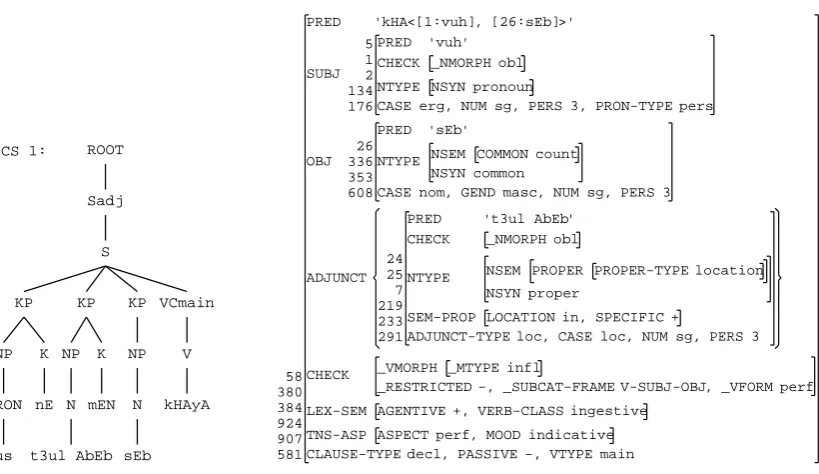
This syntactically deep approach is particularly well suited for languages with fairly free word or-der, such as Urdu, as it looks beyond the surface arrangement of words in a sentence and provides a deep functional and semantic analysis. As an ex-ample, see Figure 2 for a c- and f-structure of (1).
(1)
AKAê» I. áÓ I.K.
@ ÉK ÿ @
us nE t3ul AbEb mEN sEb kHAyA he Erg Tel Aviv in apple eat.Perf.F.Sg ‘He ate an apple in Tel Aviv.’The level we are most concerned with is the f-structure, as it is a first step towards a seman-tic analysis (f-structures have been shown to be equivalent to quasi logical forms; (van Genabith and Crouch, 1996)). In cases where parts of con-stituents are scattered across the sentence, e.g., as in discontinuous parts of anNP(Raza and Ahmed, 2011), the f-structure collects these pieces in the one grammatical function representation they be-long to. This greatly facilitates the automatic se-mantic analysis because we can build on a deep and very detailed syntactic analysis that already abstracts from the surface sentential order.
Looking at Figure 2, the c-structure is shown on the left and models the linear order and hier-archical relationshiop of the constituents. In the AVM on the right, the f-structure, the main pred-icate of the sentence is kHA ‘to eat’, the subject (SUBJ) of the sentence is the pronoun us ‘he/she’, with the object (OBJ) sEb ‘apple’. The location is analysed as an adjunct, an optional element in the sentence. Information on tense and aspect is cap-tured in the TNS-ASP f-structure at the bottom. There is also some lexical semantic information contained in the analysis underLEX-SEM, namely that it is an agentive, ingestive verb.1
In addition to the f-structure, a computational semantic analysis abstracts even further away from the syntax and is able to provide information on the lexical semantics of the words involved by supplementing the analysis with information from external lexical resources, see section 3.
2.2 Lexical Resources for Urdu 2.2.1 Urdu WordNet
CS 1: ROOT Sadj S KP NP PRON us K nE KP NP N t3ul AbEb K mEN KP NP N sEb VCmain V kHAyA
"us nE t3ul AbEb mEN sEb kHAyA"
'kHA<[1:vuh], [26:sEb]>' PRED 'vuh' PRED obl _NMORPH CHECK pronoun NSYN NTYPE
CASE erg, NUM sg, PERS 3, PRON-TYPE pers 176 134 2 1 5 SUBJ 'sEb' PRED count COMMON NSEM common NSYN NTYPE
CASE nom, GEND masc, NUM sg, PERS 3 608 353 336 26 OBJ 't3ul AbEb' PRED obl _NMORPH CHECK location PROPER-TYPE PROPER NSEM proper NSYN NTYPE
LOCATION in, SPECIFIC + SEM-PROP
ADJUNCT-TYPE loc, CASE loc, NUM sg, PERS 3 291 233 219 7 25 24 ADJUNCT infl _MTYPE _VMORPH
_RESTRICTED -, _SUBCAT-FRAME V-SUBJ-OBJ, _VFORM perf CHECK
AGENTIVE +, VERB-CLASS ingestive LEX-SEM
ASPECT perf, MOOD indicative TNS-ASP
[image:3.595.92.502.76.313.2]CLAUSE-TYPE decl, PASSIVE -, VTYPE main 581 907 924 384 380 58
Figure 2: C- and f-structure for us nE t3ul AbEb mEN sEb kHAyA ‘He ate an apple in Tel Aviv.’
already available, one of them Hindi Wordnet (Bhattacharyya et al., 2008; Bhattacharyya, 2010) which is inspired in methodology and architecture by the English WordNet (Fellbaum, 1998). For-tunately, Urdu and Hindi are structurally almost identical, although the two writing systems (a ver-sion of Arabic and Devanagari, respectively) dif-fer markedly. This difdif-ference can be overcome by employing a transliterator from Arabic to Ro-man script and vice versa (Malik et al., 2010), combining it with a transliterator that maps Ro-man to Devanagari script (also vice versa), using XFSTby (Beesley and Karttunen, 2003). Figure 3 sketches the pipeline of how we arrive at a prelim-inary Urdu WordNet (Ahmed and Hautli, 2010).
Urdu input
↓
transliteration to Hindi
↓
lookup in Hindi WordNet
↓
extraction of Hindi WordNet information
↓
removing synset description and example
↓
basic lexical resource for Urdu
Figure 3: Hindi/Urdu WordNet pipeline
By using this methodology it is possible to
gen-erate a preliminary Urdu WordNet (Ahmed and Hautli, 2010) that can be employed in variousNLP applications, among them the semantic represen-tation presented in this paper. A sample output for the noun sEb ‘apple’ is shown in Figure 4.
[image:3.595.371.463.434.580.2]TOP ↓ Noun ւ ց Animate Inanimate ↓ ↓ Flora Object ↓ ↓ Tree Edible ց ւ sEb
Figure 4: Sample Urdu WordNet output
(2)
Ñ ¢«@ QK Xð
vazir-e azAm
minister.M.Sg-Ezafe great
‘the prime minister’ (lit. the great minister)
2.2.2 Towards a resource for Urdu verbs
One lexical resource used by the English LFG grammar is the English VerbNet (Kipper-Schuler, 2005), which categorizes English verbs according to Levin’s verb classes (Levin, 1993). On the one hand, verbs are grouped according to their seman-tic relatedness, e.g. ingestive verbs or verbs of mo-tion. Moreover, these related verbs are grouped into further subclasses according to their syntactic behavior. In addition to this semantic and syntac-tic classification, VerbNet also encodes informa-tion on the event structure and the thematic roles (Fillmore, 1985) of a verb. A similar resource is being developed for Hindi (Begum et al., 2008), however instead of Western style thematic roles, Panini’s karaka relations are used.
For Urdu, we are currently working on creat-ing a VerbNet style resource, carefully takcreat-ing into account the characteristics of Urdu verbs regard-ing their syntactic behavior and includregard-ing suffi-cient lexical semantic information so that the re-source can be used in NLPtools. At the moment, most of the classification work is done by hand, because we also want to capture the very subtle variations which are likely to be lost in an auto-matic approach. For the case at hand, we are par-ticularly interested in getting information on the thematic roles of a verb.
As an example, we consider the rakH ‘put’ class. A subgroup of these verbs allow for a loca-tive alternation illustrated in (3)–(4). For the auto-matic semantic analysis it is solely important that the correct thematic roles are assigned to the argu-ments of the verb. Therefore we have to include this information in the verb resource for Urdu. By combining the information coming from the f-structure, where, for example, a locative adjunct is marked as such, with the information coming from the lexical resource, we can arrive at a semantic analysis that represents concepts rather than the actual sentence.
(3)
@QêK. ú GAK áÓ CÇ ÿ áÓ
mEN=nE gilAs mEN pAnI bHarA I=Erg glas.M.Sg in water.M.Sg fill.Perf.M.Sg ‘I filled water in the glass.’
hAgent, Theme, Locationi
(4)
@QêK. CÇ ÿ ú GAK ÿ áÓ
mEN=nE pAnI=sE gilAs bHarA I=Erg water.M.Sg=Instr glass.Nom fill.Perf.M.Sg I filled the glass with water.
hAgent, Location, Themei
The group of verbs in this class are:
I KAëX
DHANp ‘to cover’,QêK.
bHar ‘to fill’,l .
saj ‘to get decorated’ and¹ëX
DHak ‘to cover’.3 Urdu computational semantic analysis
3.1 General methodology
The primary aim of the semantic analyzer is to provide a more abstract level of linguistic rep-resentation, building on the information that is coming from the syntax, particularly from the f-structure. The Prolog-based XFR rewrite rules offer a suitable method for XLE grammars to arrive at a semantic representation (Crouch and King, 2006). Although they operate mainly on f-structures, c-structure information can also be used, e.g. to investigate scope issues further.
The XFR system is a language-independent component of XLE that can be used for various tasks, e.g. machine translation or the mapping of f-structures to semantic representations. TheXFR semantic representation is driven neither by a spe-cific semantic theory about meaning representa-tion, nor by a theoretically motivated apparatus of meaning construction. It is a computational solu-tion, which is why it is seen as a “semantic con-version” rathern than a “semantic construction”.
XFR comprises a set of rewrite rules, the facts on the left hand side of a rule are rewritten to the facts on the right hand side. In addition, the rewrite rules are ordered, i.e. the first rule applies to the original input, the second rule takes as input the output of the first rule and so on.
For a concrete example of anXFRrewrite rule, we consider the f-structure in Figure 2. Given the case that we would want to systematically replace the subject and the object of the sentence with the right corresponding thematic roles, we could em-ploy the rule in Figure 5.
PRED(%1,kHA), SUBJ(%1,%2), OBJ(%1,%3) ==>
context head(%1,kHA), role(Agent,kHA,%2), role(Patient,kHA,%3).
The matrix f-structure is represented by the variable %1, its SUBJf-structure is stored under variable %2, the OBJ under variable %3. If the facts do not match correctly, the rule does not ap-ply. If the rule applies, the facts on the left hand side are consumed and rewritten to the facts on the right hand side of the rule. The representa-tion that is generated is a flat representarepresenta-tion of the predicate argument structure of the clause, i.e. it is not distributed across f-structures, . Despite the oversimplifying nature of the rule in Figure 5, the methodology remains the same for more complex rule constructions. In the following we present a more complexXFRrule.
3.2 The UrduXFRsystem
Figure 6 presents a schematic view of the Urdu semantics pipeline.
syntax (XLE LFG)
↓
semantics (XFR ORDERED REWRITING)
↑
inclusion of lexical resources (XFR ORDERED REWRITING)
Figure 6: Urdu Semantics pipeline
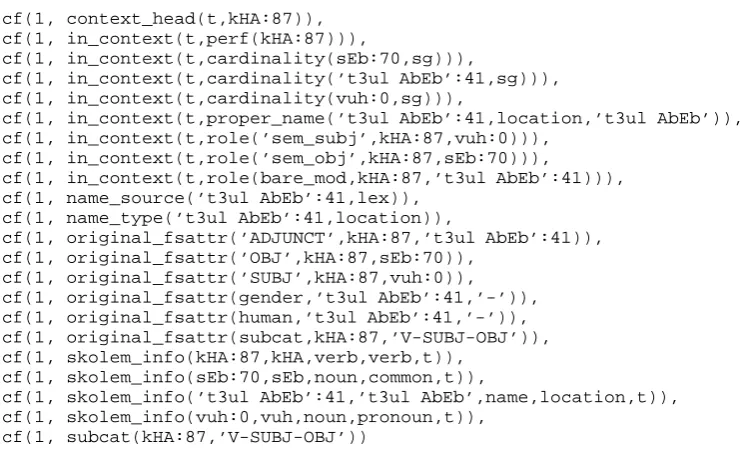
Input to the semantic representation is the syn-tacticXLEanalysis as shown in Figure 2, which is stored in a Prolog format and can then be further processed by the XFR system. The output of the XFRsemantic rules is shown in Figure 7. This rep-resentation does not yet contain information com-ing from lexical resources yet; its inclusion will be discussed in greater detail in Section 3.3.
In the semantic representation at hand, the sen-tential predicatekHA ‘eat’ is thecontext head of the semantic representation, a term which is equivalent to the notion of the main predication in the formal semantics literature. The subcate-gorized arguments in the sentence are rewritten to role facts, the default roles of sem subj and sem obj will later be replaced by the thematic roles coming from the verb lexical resource.
Another main factor of the semantic analy-sis in that one should be able to see the do-main of predication, i.e. the contexts in which the predications of the sentence hold. In the case at hand, there is only one context where predications can be true, namely context t (in context(t, ...)) with its head kHA
‘eat’ (context head(t,kHA:87)).2
Main clauses as well as relative clauses and other subordinate clauses open up new contexts in which predications are true or false. These clauses can be identified due to the syntactic anal-ysis at f-structure level, where they are analyzed asCOMPs orXCOMPs (complementizers). Lexical items such as negation markers also open up new contexts, e.g. the negationnahIN ‘not’. By
check-ing which predications hold in which contexts, so-phisticated analyses of facts vs. beliefs and modal contexts can be achieved.
Another very important component of the syn-tactic as well as the semantic analysis is the inclu-sion of named entities in the lexicon. Hautli and Sulger (2011) have used automatic methods on a raw Urdu corpus to detect these so-called multi-words and also to classify them. They are very important for the system, because the components have a non-compositional meaning and should be treated as one unit.
This becomes apparent when looking at the predicate of theADJUNCT,t3ul AbEb ‘Tel Aviv’.
It is analyzed as one unit and is the bare modifier of the verb phrase (bare mod(kHA:87,‘t3ul AbEb’:41)). Due to the f-structure informa-tion [PROPER-TYPE location], it is clear that the modifier is locative, which is captured by the fact (proper name‘t3ul AbEb’, location).
The skolem info facts store the part-of-speech information for each lexical item in the sentence and are the prerequisite for look-ing up words in lexical resources. The original fsattr facts provide information according to which ambiguous information from the lexical resources can be disambiguated. The information about the subcategorization frame (subcat) is kept for the same reason, in case where a verb has multiple frames in the lexical re-source, the system can choose the appropriate one according the subcategorization information com-ing from the syntax.
In cases where multiple valid semantic rep-resentations are generated, all analyses are dis-played. Disambiguation on that level would re-quire a more discourse-oriented analysis, which we do not provide at the moment.
cf(1, context_head(t,kHA:87)), cf(1, in_context(t,perf(kHA:87))),
cf(1, in_context(t,cardinality(sEb:70,sg))),
cf(1, in_context(t,cardinality(’t3ul AbEb’:41,sg))), cf(1, in_context(t,cardinality(vuh:0,sg))),
cf(1, in_context(t,proper_name(’t3ul AbEb’:41,location,’t3ul AbEb’)), cf(1, in_context(t,role(’sem_subj’,kHA:87,vuh:0))),
cf(1, in_context(t,role(’sem_obj’,kHA:87,sEb:70))),
cf(1, in_context(t,role(bare_mod,kHA:87,’t3ul AbEb’:41))), cf(1, name_source(’t3ul AbEb’:41,lex)),
cf(1, name_type(’t3ul AbEb’:41,location)),
cf(1, original_fsattr(’ADJUNCT’,kHA:87,’t3ul AbEb’:41)), cf(1, original_fsattr(’OBJ’,kHA:87,sEb:70)),
cf(1, original_fsattr(’SUBJ’,kHA:87,vuh:0)), cf(1, original_fsattr(gender,’t3ul AbEb’:41,’-’)), cf(1, original_fsattr(human,’t3ul AbEb’:41,’-’)), cf(1, original_fsattr(subcat,kHA:87,’V-SUBJ-OBJ’)), cf(1, skolem_info(kHA:87,kHA,verb,verb,t)),
cf(1, skolem_info(sEb:70,sEb,noun,common,t)),
cf(1, skolem_info(’t3ul AbEb’:41,’t3ul AbEb’,name,location,t)), cf(1, skolem_info(vuh:0,vuh,noun,pronoun,t)),
[image:6.595.82.455.65.290.2]cf(1, subcat(kHA:87,’V-SUBJ-OBJ’))
Figure 7: Semantic representation for us nE t3ul AbEb meN sEb kHAyA ‘He ate an apple in Tel Aviv.’
3.3 The inclusion of lexical resources
This section deals more closely with the inclusion of external lexical semantic information, making the generalXFRmethodology quite a powerful one because knowledge from various sources can be combined in one system.
By including knowledge contained in an Urdu WordNet and the Urdu verb resource, we can in-clude hypernym relations such as that an apple is a fruit or the thematic roles of the arguments in a clause. This abstraction is not on the syntac-tic level any more, but is now at the level of lex-ical semantics. The benefit of such a represen-tation is that we arrive at a meta-level of analy-sis where concepts are represented rather than lin-guistic structure.
For Urdu WordNet, we consider all senses that are produced for one item by the resource (i.e. see the two different senses forsEb ‘apple’ in Figure
4) and we take the direct hypernym of the lexical item. For the verb resource, we are mainly con-cerned with the thematic roles that are assigned to the arguments of the sentence.
In order to include external resources, they are reformatted as non-resourced Prolog facts (tem-plate nameuwnfor information from Urdu Word-Net and verbs for thematic role information in Figure 8) that can be picked up by theXFRrewrite rules. For that, the templates are called on the right side of an XFRrule and compared with the
infor-mation from the semantic representation. If the information matches, the rule applies and the lex-ical items are rewritten to include the conceptual information from the lexical resources.
See Figure 8 for an example of non-resourced facts that are being called by XFR rules and that rewrite information coming from the semantic rep-resentation in Figure 7. If the context head of the sentence is kHA ‘eat’ in a context with a
variable %Ctx3, and if within the same context %Ctx there is a semantic subject with variable %S and a semantic object with variable %O that are also captured in theoriginal fsattrand theskolem infofacts and given that the verb is found in the non-resourced facts, then rewrite the arguments to their thematic roles.
The second rewrite rule includes information from Urdu WordNet and inserts the hypernym of the verbkHA ‘eat’, namely that it is a verb of
con-sumption.
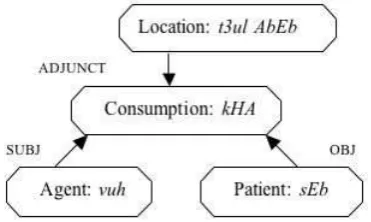
The resulting semantic representation is pre-sented in a less formal way in Figure 9. The Agent of the sentence,vuh ‘he/she’ performs a
consump-tive action,kHA ‘eat’ towards the Patient, sEb
‘ap-ple’ and this act is performed at the location t3ul AbEb ‘Tel Aviv’.
|-uwn(kHA,Consumption);
|-verbs(kHA,Agent,Patient);
+context head(%Ctx,kHA),
in context(%Ctx,role(sem subj,kHA,%S), in context(%Ctx,role(sem obj,kHA,%O), original fsattr(SUBJ,%Pred,%S), original fsattr(OBJ,%Pred,%O), skolem info(kHA,kHA,verb,verb,%Ctx), skolem info(%O,%O,noun,common,%Ctx)), skolem info(%S,%S,noun,pronoun,%Ctx)), verbs(kHA,%TRole1,%TRole2)
==>
in context(%Ctx,role(%TRole1,kHA,%S), in context(%Ctx,role(%TRole2,kHA,%O).
context head(%Ctx,%Pred), uwn(%Pred,%Hyper)
==>
[image:7.595.75.261.322.433.2]context head(%Ctx,%Hyper).
Figure 8: Including lexical semantic information viaXFRrules
Figure 9: Final representation for us nE t3ul AbEb
meN sEb kHAyA ‘He ate an apple in Tel Aviv.’
4 Discussion
As for every computational grammar or semantic or analyzer, one wishes to have a thorough quan-titative and qualitative evaluation justifying its ro-bustness, coverage and accuracy, however we can-not provide such a justification in this paper. Al-though efforts are underway to create an indent gold standard for Urdu in the form of depen-dency triples as has been done for English (King et al., 2003), no such standard exists for Urdu to date. On the computational semantics side, this is also due to the fact that there has not been very much research in that direction.
The computational semantic analysis presented in this paper draws heavily on the syntactic anal-ysis performed by the Urdu ParGram grammar. The more expressive the generated f-structures, the more detailed the semantic representations are. However, one could also use f-structures coming
from other parsers whose output is reformatted ac-cording to the XLE standard and one could run theXFRsystem on these, potentially stochastic, f-structures as well.
As to adequate meaning representation, the overall move towards developing parallel seman-tics on top of parallel grammars within the Par-Gram community has only just started investigat-ing appropriate representations of semantic con-cepts. The expressive power of a system also de-pends heavily on the external lexical resources that are available, in comparison to English, Urdu is far behind. However, with efforts like this computa-tional semantic analyzer and the implementation of basic lexical resources we can contribute to the variety of tools available for Urdu.
5 Summary
In this paper we have presented a first approach to an automatic semantic analysis for Urdu, build-ing on a deep and very detailed syntactic analysis by the Urdu ParGram Grammar. We have given a brief overview of the methodology ofXFRrewrite rules, how they operate on top ofLFGf-structures and what kind of semantic analysis they can pro-vide. The inclusion of available lexical resources facilitates the generation of an abstract level of the representation of concepts rather than surface syn-tactic structure. We have also discussed some of the issues involved in building a semantic analyzer for a language where few other resources exist and where a lot of work has to go into the theoretical as well as the computationally efficient analysis of the language itself.
References
Tafseer Ahmed and Annette Hautli. 2010. An Experi-ment for a basic lexical resource for Urdu on the ba-sis of Hindi WordNet. In Proceedings of CLT 2010, Islamabad, Pakistan.
Kenneth Beesley and Lauri Karttunen. 2003. Finite State Morphology. CSLI Publications, Stanford.
Rafiya Begum, Samar Husain, Lakshmi Bai, and Dipti Misra Sharma. 2008. Developing Verb Frames for Hindi. In Proceedings of the Sixth International Language Resources and Evaluation (LREC’08), Marrakech, Morocco.
Pushpak Bhattacharyya. 2010. IndoWordNet. In Pro-ceedings of the Seventh conference on International Language Resources and Evaluation (LREC’10), Malta.
Tina B¨ogel, Miriram Butt, Annette Hautli, and Sebas-tian Sulger. 2007. Developing a Finite-State Mor-phological Analyzer for Urdu and Hindi: Some Is-sues. In Proceedings of FSMNLP07. Postdam, Ger-many.
Tina B¨ogel, Miriram Butt, Annette Hautli, and Sebas-tian Sulger. 2009. Urdu and the Modular Architec-ture of ParGram. In Proceedings of the Conference on Language and Technology (CLT09). CRULP, La-hore, Pakistan.
Johan Bos, Stephen Clark, Mark Steedman, James R. Curran, and Julia Hockenmaier. 2004. Wide-coverage semantic representations from a CCG parser. In COLING ’04: Proceedings of the 20th In-ternational Conference on Computational Linguis-tics, page 1240.
Joan Bresnan and Ronald M. Kaplan, 1982. The Men-tal Representation of Grammatical Relations. The MIT Press, Cambridge.
Miriam Butt and Tracy Holloway King. 2002. Urdu and The Parallel Grammar Project. In Proceedings of COLING2002, 3rd workshop on Asian language resources and international standardization, pages 39–45, Taipei, Taiwan.
Miriam Butt, Tracy Holloway King, Mar´ıa-Eugenia Ni˜no, and Fr´ed´erique Segond. 1999. A Grammar Writer’s Cookbook. CSLI Publications, Stanford.
Miriam Butt, Helge Dyvik, Tracy Holloway King, Hi-roshi Masuichi, and Christian Rohrer. 2002. The Parallel Grammar Project. In Proceedings of COL-ING2002, Workshop on Grammar Engineering and Evaluation, pages 1–7, Taipei, Taiwan.
Miriam Butt, Tina B¨ogel, and Sebastian Sulger. 2008. Urdu Ezafe and the Morphology-Syntax Interface. In Miriam Butt and Tracy Holloway King, editors, Proceedings of LFG08. CSLI Publications, Stan-ford.
Dick Crouch and Tracy Holloway King. 2006. Seman-tics via F-structure Rewriting. In LFG06 Proceed-ings. CSLI Publications, Stanford.
Dick Crouch, Mary Dalrymple, Ron Ka-plan, Tracy King, John Maxwell, and Paula Newman. 2011. XLE Documentation. http://www2.parc.com/isl/groups/nltt/xle/doc/.
Mary Dalrymple, 2001. Lexical Functional Grammar, volume 34. Academic Press.
Christiane Fellbaum, editor. 1998. WordNet: An Elec-tronic Lexical Database. Cambridge: The MIT Press.
Charles J. Fillmore. 1985. Frames and the Seman-tics of Understanding. Quaderni di Semantica, VI(2):222–254.
Annette Hautli and Sebastian Sulger. 2011. Extracting and Classifying Urdu Multiword Expressions. In Proceedings of the 49th Annual Meeting of the Asso-ciation for Computational Linguistics: Human Lan-gauge Technologies (ACL-HLT ’11): Student Ses-sion, Portland, Oregon.
Tracy Holloway King, Richard Crouch, Stefan Rie-zler, Mary Dalrymple, and Ron Kaplan. 2003. The PARC700 Dependency Bank. In Proceedings of the EACL03: 4th International Workshop on Linguisti-cally Interpreted Corpora (LINC-03).
Karin Kipper-Schuler. 2005. VerbNet: A Broad-Coverage, Comprehensive Verb Lexicon. Ph.D. the-sis, University of Pennsylvania.
Beth Levin. 1993. English Verb Classes and Alterna-tions. Chicago: The University of Chicago Press.
Muhammad Kamran Malik, Tafseer Ahmed, Sebastian Sulger, Tina B¨ogel, Atif Gulzar, Ghulam Raza, Sar-mad Hussain, and Miriam Butt. 2010. Transliter-ating Urdu for a Broad-Coverage Urdu/Hindi LFG Grammar. In Proceedings of the Seventh conference on International Language Resources and Evalua-tion (LREC’10), Malta.
Ghulam Raza and Tafseer Ahmed. 2011. Argument Scrambling within Urdu NPs. In Proceedings of LFG11, Hong Kong.
Stefan Riezler, Tracy Holloway King, Ronald M. Ka-plan, Richard Crouch, John T. Maxwell, and Mark Johnson. 2002. Parsing the Wall Street Journal us-ing a Lexical-Functional Grammar and Discrimina-tive Estimation Techniques. In Proceedings of the 40th Annual Meeting of the Association for Compu-tational Linguistics (ACL’02), Philadephia, PA.