Topic Models with Logical Constraints on Words
Hayato Kobayashi Hiromi Wakaki Tomohiro Yamasaki Masaru Suzuki Research and Development Center,
Toshiba Corporation, Japan
{hayato.kobayashi, hiromi.wakaki,
tomohiro2.yamasaki, masaru1.suzuki}@toshiba.co.jp
Abstract
This paper describes a simple method to achieve logical constraints on words for topic models based on a recently de-veloped topic modeling framework with Dirichlet forest priors (LDA-DF). Log-ical constraints mean logLog-ical expressions of pairwise constraints, Must-links and
Cannot-Links, used in the literature of
constrained clustering. Our method can not only cover the original constraints of the existing work, but also allow us eas-ily to add new customized constraints. We discuss the validity of our method by defining its asymptotic behaviors. We ver-ify the effectiveness of our method with comparative studies on a synthetic corpus and interactive topic analysis on a real cor-pus.
1 Introduction
Topic models such as Latent Dirichlet Allocation or LDA (Blei et al., 2003) are widely used to cap-ture hidden topics in a corpus. When we have do-main knowledge of a target corpus, incorporating the knowledge into topic models would be useful in a practical sense. Thus there have been many studies of semi-supervised extensions of topic models (Andrzejewski et al., 2007; Toutanova and Johnson, 2008; Andrzejewski et al., 2009; An-drzejewski and Zhu, 2009), although topic mod-els are often regarded as unsupervised learning. Recently, (Andrzejewski et al., 2009) developed a novel topic modeling framework, LDA with Dirichlet Forest priors (LDA-DF), which achieves two links Must-Link (ML) and Cannot-Link (CL) in the constrained clustering literature (Basu et al., 2008). For given wordsAandB, ML(A, B)and
CL(A, B) are soft constraints thatA andB must appear in the same topic, and thatAandBcannot appear in the same topic, respectively.
Let us consider topic analysis of a cor-pus with movie reviews for illustrative pur-poses. We know that two words ‘jackie’ (means Jackie Chan) and ‘kung-fu’ should ap-pear in the same topic, while ‘dicaprio’ (means Leonardo DiCaprio) and ‘kung-fu’ should not appear in the same topic. In this case, we can add constraints ML(‘jackie’,‘kung-fu’) and
CL(‘dicaprio’,‘kung-fu’) to smoothly conduct analysis. However, what if there is a word ‘bruce’ (means Bruce Lee) in the corpus, and we want to distinguish between ‘jackie’ and ‘bruce’? Our full knowledge among ‘kung-fu’, ‘jackie’, and ‘bruce’ should be(ML(‘kung-fu’,‘jackie’)∨ ML(‘kung-fu’,‘bruce’)) ∧ CL(‘bruce’,‘jackie’), although the original framework does not allow a disjunction (∨) of links. In this paper, we ad-dress such logical expressions of links on LDA-DF framework.
Combination between a probabilistic model and logical knowledge expressions such as Markov Logic Network (MLN) is recently getting a lot of attention (Riedel and Meza-Ruiz, 2008; Yu et al., 2008; Meza-Ruiz and Riedel, 2009; Yoshikawa et al., 2009; Poon and Domingos, 2009), and our work can be regarded as on this research line. At least, to our knowledge, our method is the first one that can directly incorporate logical knowl-edge into a prior for topic models without MLN. This means the complexity of the inference in our method is essentially the same as in the original LDA-DF, despite that our method can broaden knowledge expressions.
2 LDA with Dirichlet Forest Priors We briefly review LDA-DF. Letw := w1. . . wn
be a corpus consisting of Ddocuments, wheren is the total number of words in the documents. Let di andzi be the document that includes the i-th
word wi and the hidden topic that is assigned to
wi, respectively. LetTbe the number of topics.
As in LDA, we assume a probabilistic language model that generates a corpus as a mixture of hid-den topics and infer two parameters: a document-topic probabilityθthat represents a mixture rate of topics in each document, and a topic-word proba-bilityϕthat represents an occurrence rate of words in each topic. The model is defined as
θdi ∼ Dirichlet(α),
zi|θdi ∼ Multinomial(θdi),
q ∼ DirichletForest(β, η), ϕzi ∼ DirichletTree(q),
wi|zi, ϕzi ∼ Multinomial(ϕzi),
where α and (β, η) are hyper parameters for θ andϕ, respectively. The only difference between LDA and LDA-DF is thatϕis chosen not from the Dirichlet distribution, but from the Dirichlet tree distribution (Dennis III, 1991), which is a gener-alization of the Dirichlet distribution. The Dirich-let forest distribution assigns one tree to each topic from a set of Dirichlet trees, into which we encode domain knowledge. The trees assigned to topicsz are denoted asq.
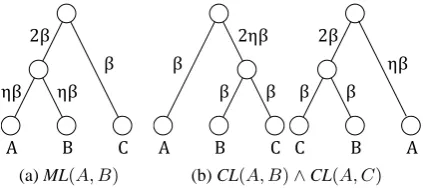
In the framework, ML(A, B)is achieved by the Dirichlet tree in Fig. 1(a), which equalizes the oc-currence probabilities ofAandB in a topic when η is large. This tree generates probabilities with
Dirichlet(2β, β) and redistributes the probability for “2β” with Dirichlet(ηβ, ηβ).
In the case of CLs, we use the following algo-rithm.
1. Consider a undirected graph regarding words as vertices and links CL(A, B) as edges be-tweenAandB.
2. Divide the graph into connected components.
3. Extract the maximal independent sets of each component.
4. Create Dirichlet trees to raise the occurrence probabilities of words corresponding to each maximal independent set.
For examples, the algorithm creates the two trees in Fig. 1(b) for the constraint CL(A, B) ∧ CL(A, C). The constraint is achieved when η is large, since words in each topic are chosen from the distribution of either the left tree that zeros the occurrence probability ofA, or the right tree that zeros those ofBandC.
2β β
ηβ ηβ
B C
A
(a) ML(A, B)
β β
2ηβ β
B C
A
β β
ηβ 2β
B
C A
[image:2.595.311.523.61.155.2](b) CL(A, B)∧CL(A, C)
Figure 1: Dirichlet trees for two constraints of (a)
ML(A, B)and (b) CL(A, B)∧CL(A, C).
Inference of ϕandθ is achieved by alternately sampling topiczi for each wordwi and Dirichlet
treeqz for each topic z. Since the Dirichlet tree
distribution is conjugate to the multinomial distri-bution, the sampling equation of zi is easily
de-rived like LDA as follows:
p(zi=z|z−i,q,w) ∝
(n(−di,zi) +α) Iz∏(↑i)
s
γz(Cz(s↓i))+n−(Ciz(s↓i))
∑Cz(s)
k
(
γz(k)+n(−ki,z)
),
wheren(−di,z) represents the number of words
(ex-cludingwi) assigning topiczin documentd.n(−ki,z)
represents the number of words (excludingwi)
as-signing topicz in the subtree rooted at nodekin treeqz. Iz(↑i)andCz(s↓i)represents the set of
internal nodes and the immediate child of nodes, respectively, on the path from the root to leaf wi
in treeqz. Cz(s) represents the set of children of
nodesin treeqz. γz(k) represents a weight of the
edge to nodekin treeqz. Additionally, we define
∑S s :=
∑
s∈S.
Sampling of tree qz is achieved by
sequen-tially sampling subtree qz(r) corresponding to the
r-th connected component by using the following equation:
p(qz(r)=q′ |z,q−z, qz(−r),w) ∝ |Mr,q′|×
I∏z,r(q′)
s
Γ
(∑Cz(s)
k γ
(k)
z ) ∏Ckz(s)Γ
(
γz(k)+n(zk)
)
Γ(∑Cz(s)
k (γ
(k)
z +n(zk))) ∏Ckz(s)Γ
( γz(k)
) ,
whereIz,r(q′)represents the set of internal nodes in
the subtreeq′corresponding to ther-th connected component for treeqz. |Mr,q′|represents the size
of the maximal independent set corresponding to the subtreeq′ forr-th connected component.
After sufficiently samplingziandqz, we can
sampledzandq, in a similar manner to the stan-dard LDA as follows.
ˆ
θ(zd) = n
(d)
z +α
∑T z′=1
(
n(zd′)+α )
ˆ
ϕ(zw) =
Iz∏(↑w)
s
γ(Cz(s↓w))
z +n(zCz(s↓w))
∑Cz(s)
k
(
γz(k)+n(zk)
)
3 Logical Constraints on Words
In this section, we address logical expressions of two links using disjunctions (∨) and negations (¬), as well as conjunctions (∧), e.g., ¬ML(A, B) ∨ ML(A, C). We denote it as (∧,∨,¬)-expressions. Since each negation can be removed in a prepro-cessing stage, we focus only on (∧,∨)-expressions. Interpretation of negations is discussed in Sec. 3.4.
3.1 (∧,∨)-expressions of Links
We propose a simple method that simultaneously achieves conjunctions and disjunctions of links, where the existing method can only treat conjunc-tions of links. The key observation is that any Dirichlet trees constructed by MLs and CLs are essentially based only on two primitives. One is Ep(A, B) that equalizes the occurrence prob-abilities of A and B in a topic as in Fig. 1(a), and the other is Np(A) that zeros the occurrence probability of A in a topic as in the left tree of Fig. 1(b). The right tree of Fig. 1(b) is created by
Np(B)∧Np(C). Thus, we can substitute ML and
CL with Ep and Np as follows:
ML(A, B) = Ep(A, B)
CL(A, B) = Np(A)∨Np(B)
Using this substitution, we can compile a (∧,∨ )-expression of links to the corresponding Dirichlet trees with the following algorithm.
1. Substitute all links (ML and CL) with the cor-responding primitives (Ep and Np).
2. Calculate the minimum DNF of the primi-tives.
3. Construct Dirichlet trees corresponding to the (monotone) monomials of the DNF.
Let us consider three wordsA =‘kung-fu’,B =
‘jackie’, and C = ‘bruce’ in Sec. 1. We want to constrain them with (ML(A, B) ∨ML(A, C))∧
CL(B, C). In this case, the algorithm calculates the minimum DNF of primitives as
(ML(A, B)∨ML(A, C)) ∧ CL(B, C)
= (Ep(A, B)∨Ep(A, C)) ∧ (Np(B)∨N p(C))
= (Ep(A, B)∧Np(B)) ∨ (Ep(A, B)∧Np(C)) ∨ (Ep(A, C)∧Np(B)) ∨ (Ep(A, C)∧Np(C))
and constructs four Dirichlet trees correspond-ing to the four monomials Ep(A, B) ∧ Np(B),
Ep(A, B) ∧ Np(C), Ep(A, C) ∧ Np(B), and
Ep(A, C)∧Np(C)in the last equation.
Considering only (∧)-expressions of links, our method is equivalent to the existing method in the original framework in terms of an asymptotic be-havior of Dirichlet trees. We define asymptotic behavior as Asymptotic Topic Family (ATF) as fol-lows.
Definition 1 (Asymptotic Topic Family). For any (∧,∨)-expressionfof primitives and any setWof words, we define the asymptotic topic family off with respect toWas a familyf∗calculated by the following rules: Given (∧,∨)-expressionsf1 and f2of primitives and wordsA, B∈ W,
(i) (f1∨f2)∗ := f1∗∪f2∗,
(ii) (f1∧f2)∗ := f1∗∩f2∗,
(iii) Ep∗(A, B) := {∅,{A, B}} ⊗2W−{A,B},
(iv) Np∗(A) := 2W−{A}.
Here, notation⊗is defined asX⊗Y :={x∪ y | x ∈ X, y ∈ Y} for given two sets X and Y. ATF expresses all combinations of words that can occur in a topic whenηis large. In the above example, the ATF of its expression with respect to
W ={A, B, C}is calculated as
((ML(A, B)∨ML(A, C)) ∧ CL(B, C))∗
= (Ep(A, B)∨Ep(A, C)) ∧ (Np(B)∨Np(C))∗
=
(
{∅,{A, B}} ⊗2W−{A,B} ∪{∅,{A, C}} ⊗2W−{A,C}
)
∩ (2W−{B} ∪ 2W−{C}
)
={∅,{B},{C},{A, B},{A, C}}.
[image:3.595.94.270.100.181.2]part of {B} satisfies ML(A, C) ∧CL(B, C). If you want to remove {B} and {C}, you can use exclusive disjunctions. For the sake of simplicity, we omit descriptions aboutWwhen its instance is arbitrary or obvious from now on.
The next theorem gives the guarantee of asymp-totic equivalency between our method and the ex-isting method. Let MIS(G) be the set of max-imal independent sets of graph G. We define
L := {{w, w′} |w, w′ ∈ W, w ̸= w′}. We con-sider CLs only, since the asymptotic equivalency including MLs is obvious by identifying all ver-tices connected by MLs.
Theorem 2. For any (∧)-expression of CLs rep-resented by∧{x,y}∈ℓ:ℓ⊆LCL(x, y), the ATF of the corresponding minimum DNF of primitives repre-sented by ∨X∈X:X ⊆2W(∧x∈XNp(x)) is
equiva-lent to the union of the power sets of every max-imal independent set S ∈ MIS(G) of a graph
G := (W, ℓ), that is, ∪X∈X(∩x∈XNp∗(x)) =
∪
S∈MIS(G)2S.
Proof. For any (∧)-expressions of links character-ized byℓ⊆ L, we denotefℓandGℓ as the
corre-sponding minimum DNF and graph, respectively. We define Uℓ :=
∪
S∈MIS(Gℓ)2S. When |ℓ| = 1, fℓ∗ = Uℓ is trivial. Assuming fℓ∗ = Uℓ when |ℓ| > 1, for any set ℓ′ := ℓ∪ {{A, B}} with an additional link characterized by{A, B} ∈ L, we obtain
fℓ∗′ = ((Np(A)∨Np(B))∧fℓ)∗
= (2W−{A}∪2W−{B})∩ Uℓ
= ∪S∈MIS(Gℓ)
(
(2W−{A}∩2S) ∪(2W−{B}∩2S)
)
= ∪S∈MIS(Gℓ)(2S−{A}∪2S−{B})
= ∪S∈MIS(G
ℓ′)2
S = U
ℓ′
This proves the theorem by induction. In the last line of the above deformation, we used ∪
S∈MIS(G)2S = ∪
S∈IS(G)2S and MIS(Gℓ′) ⊆
∪
S∈MIS(Gℓ)((S− {A})∪(S− {B}))⊆IS(Gℓ′),
where IS(G)represents the set of all independent sets on graphG.
In the above theorem, ∪X∈X(∩x∈XNp∗(x))
represents asymptotic behaviors of our method, while ∪S∈MIS(G)2S represents those of the exist-ing method. By usexist-ing a similar argument to the proof, we can prove the elements of the two sets are completely the same, i.e., ∩x∈XNp∗(x) =
{2S | S ∈ MIS(G)}. This interestingly means that for any logical expression characterized by
CLs, calculating its minimum DNF is the same
as calculating the maximal independent sets of the corresponding graph, or the maximal cliques of its complement graph.
3.2 Shrinking Dirichlet Forests
Focusing on asymptotic behaviors, we can reduce the number of Dirichlet trees, which means the performance improvement of Gibbs sampling for Dirichlet trees. This is achieved just by minimiz-ing DNF on asymptotic equivalence relation de-fined as follows.
Definition 3 (Asymptotic Equivalence Relation). Given two (∧,∨)-expressions f1, f2, we say that f1 is asymptotically equivalent tof2, if and only iff1∗ =f2∗. We denote the relation as notation≍, that is,f1≍f2⇔f1∗ =f2∗.
The next proposition gives an intuitive under-standing of why asymptotic equivalence relation can shrink Dirichlet forests.
Proposition 4. For any two wordsA, B ∈ W,
(a) Ep(A, B)∨(Np(A)∧Np(B))≍Ep(A, B),
(b) Ep(A, B)∧Np(A) ≍ Np(A)∧Np(B).
Proof. We prove (a) only.
Ep∗(A, B)∪(Np∗(A)∩Np∗(B))
= {∅,{A, B}} ⊗2W−{A,B} ∪(2W−{A}∩2W−{B})
= ({∅,{A, B}} ∪({∅,{B}} ∩ {∅,{A}})) ⊗2W−{A,B}
= {∅,{A, B}} ⊗2W−{A,B} = Ep∗(A, B)
In the above proposition, Eq. (a) directly re-duces the number of Dirichlet trees since a dis-junction (∨) disappears, while Eq. (b) indirectly reduces since (Np(A) ∧ Np(B)) ∨ Np(B) = Np(B).
Table 1: The average numbers of Dirichlet trees compiled by minimum DNF (M-DNF) and asymptotic minimum DNF (AM-DNF) in terms of the number of random links. Each value is the av-erage of 100 trials.
# of links 1 2 4 8 16
M-DNF 1 2.08 3.43 6.18 10.35 AM-DNF 1 2.08 3.23 4.24 4.07
indicates that asymptotic equivalency effectively reduces the number of Dirichlet trees especially when the number of links is large.
3.3 Customizing New Links
Two primitives Ep and Np allow us to easily cus-tomize new links without changing the algorithm. Let us consider Imply-Link(A, B) or IL(A, B), which is a constraint thatB must appear ifA ap-pears in a topic (informally,A→B). In this case, the setting
IL(A, B) = Ep(A, B)∨Np(A)
is acceptable, since the ATF of IL(A, B) with respect to W = {A, B} is {∅,{A, B},{B}}.
IL(A, B)is effective whenB has multiple mean-ings as mentioned later in Sec. 4.
Informally regarding IL(A, B) asA → B and
ML(A, B)asA ⇔ B, ML(A, B)seems to be the same meaning of IL(A, B)∧IL(B, A). However, this anticipation is wrong on the normal equiv-alency, i.e., ML(A, B) ̸= IL(A, B)∧IL(B, A). The asymptotic equivalency can fulfill the antici-pation with the next proposition. This simultane-ously suggests that our definition is semantically valid.
Proposition 5. For any two wordsA, B∈ W,
IL(A, B)∧IL(B, A) ≍ ML(A, B)
Proof. From Proposition 4,
IL(A, B)∧IL(B, A)
= (Ep(A, B)∨Np(A))∧(Ep(B, A)∨Np(B)) = Ep(A, B)∨(Ep(A, B)∧Np(A))
∨(Ep(A, B)∧Np(B))∨(Np(A)∧Np(B)) ≍ Ep(A, B)∨(Np(A)∧Np(B))
≍ Ep(A, B) = ML(A, B)
Further, we can construct XIL(X1,· · ·, Xn, Y)
as an extended version of IL(A, B), which allows us to use multiple conditions like Horn clauses. This informally means ∧ni=1Xi → Y as an
ex-tension ofA→B. In this case, we set
XIL(X1,· · ·, Xn, Y) = n
∧
i=1
Ep(Xi, Y)∨ n
∨
i=1
Np(Xi).
When we want to isolate unnecessary words (i.e., stop words), we can use Isolate-Link (ISL) defined as
ISL(X1,· · ·, Xn) = n
∧
i=1
Np(Xi).
This is easier than considering CLs between high-frequency words and unnecessary words as de-scribed in (Andrzejewski et al., 2009).
3.4 Negation of Links
There are two types of interpretation for negation of links. One is strong negation, which regards
¬ML(A, B) as “A andB must not appear in the same topic”, and the other is weak negation, which regards it as “AandBneed not appear in the same topic”. We set¬ML(A, B)≍CL(A, B)for strong negation, while we just remove ¬ML(A, B) for weak negation. We consider the strong negation in this study.
According to Def. 1, the ATF of the negation¬f of primitive f seems to be defined as (¬f)∗ := 2W −f∗. However, this definition is not fit in strong negation, since ¬ML(A, B) ̸≍ CL(A, B)
on the definition. Thus we define it to be fit in strong negation as follows.
Definition 6 (ATF of strong negation of links). Given a link L with arguments X1,· · ·, Xn, let-ting fLbe the primitives ofL, we define the ATF of the negation of L as(¬L(X1,· · · , Xn))∗ := (2W−fL∗(X1,· · ·, Xn))∪2W−{X1,···,Xn}.
Note that the definition is used not for primi-tives but for links. Actually, the similar definition for primitives is not fit in strong negation, and so we must remove all negations in a preprocessing stage.
The next proposition gives the way to remove the negation of each link treated in this study. We define no constraint condition asϵfor the result of
ISL.
Proposition 7. For any wordsA, B, X1,· · · , Xn,
(a) ¬ML(A, B) ≍ CL(A, B),
(b) ¬CL(A, B) ≍ ML(A, B),
(c) ¬IL(A, B) ≍ Np(B),
(d) ¬XIL(X1,· · ·, Xn, Y) ≍∧n−1
i=1 Ep(Xi, Xn)∧Np(Y),
(e) ¬ISL(X1,· · ·, Xn) ≍ ϵ.
Proof. We prove (a) only.
(¬ML(A, B))∗
= (2W−Ep∗(A, B))∪2W−{A,B}
= (2{A,B}− {∅,{A, B}})⊗2W−{A,B} ∪2W−{A,B}
= {∅,{A},{B}} ⊗2W−{A,B}
= 2W−{A}∪2W−{B}
= Np∗(A)∪Np∗(B) = (CL(A, B))∗
4 Comparison on a Synthetic Corpus We experiment using a synthetic corpus
{ABAB, ACAC} × 2 with vocabulary
W = {A, B, C} to clarify the property of our method in the same way as in the existing work (Andrzejewski et al., 2009). We set topic size as T = 2. The goal of this experiment is to obtain two topics: a topic where A and B frequently occur and a topic where A and C frequently occur. We abbreviate the grouping type as AB|AC. In preliminary experiments, LDA yielded almost four grouping types: AB|AC, AB|C, AC|B, and A|BC. Thus, we naively classify a grouping type of each result into the four types. Concretely speaking, for any two topic-word probabilities ϕˆ and ϕˆ′, we calculate the average of Euclidian distances between each vector component ofϕˆand the corresponding one ofϕˆ′, ignoring the difference of topic labels, and regard them as the same type if the average is less than0.1.
[image:6.595.312.523.66.150.2]Fig. 2 shows the occurrence rates of grouping types on 1,000 results after 1,000 iterations by LDA-DF with six constraints (1) no constraint, (2) ML(A, B), (3) CL(B, C), (4) ML(A, B) ∧ CL(B, C), (5) IL(B, A), and (6) ML(A, B) ∨ ML(A, C). In the experiment, we set α = 1, β = 0.01, andη = 100. In the figure, the higher rate of the objective type AB|AC (open bar) is
Figure 2: Rates of Grouping types in the 1,000 results on synthetic corpus {ABAB, ACAC} ×
2 with six constraints: (1) no constraint, (2)
ML(A, B), (3) CL(B, C), (4) ML(A, B) ∧ CL(B, C), (5) IL(B, A), and (6) ML(A, B) ∨ ML(A, C).
better. The results of (1-4) can be achieved even by the existing method, and those of (5-6) can be achieved only by our method. Roughly speaking, the figure shows that our method is clearly better than the existing method, since our method can ob-tain almost 100% as the rate ofAB|AC, which is the best of all results, while the existing methods can only obtain about 60%, which is the best of the results of (1-4).
The result of (1) is the same result as LDA, because of no constraints. In the result, the rate of AB|AC is only about 50%, since each of AB|C, AC|B, and A|BC remains at a high 15%. As we expected, the result of (2) shows that
ML(A, B) cannot remove AB|C although it can removeAC|B andA|BC, while the result of (3) shows that CL(B, C) cannot remove AB|C and AC|B although it can remove A|BC. The re-sult of (4) indicates that ML(A, B) ∧CL(B, C)
is the best of knowledge expressions in the exist-ing method. Note that ML(A, B)∧ML(A, C) im-plies ML(B, C) by transitive law and is inconsis-tent with all of the four types. The result (80%) of (5) IL(B, A) is interestingly better than that (60%) of (4), despite that (5) has less primitives than (4). The reason is that (5) allows A to ap-pear withC, while (4) does not. In the result of (6) ML(A, B)∨ML(A, C), the constraint achieves almost 100%, which is the best of knowledge ex-pressions in our method. Of course, the constraint of(ML(A, B)∨ML(A, C))∧CL(B, C)can also achieve almost 100%.
5 Interactive Topic Analysis
consists of stemmed, down-cased 1,000 (positive) movie reviews used in (Pang and Lee, 2004). In this experiment, the parameters are set asα = 1, β = 0.01,η = 1000, andT = 20.
We first ran LDA-DF with 1,000 itera-tions without any constraints and noticed that most topics have stop words (e.g., ‘have’ and ‘not’) and corpus-specific, unnecessary words (e.g., ‘film’, ‘movie’), as in the first block in Tab. 2. To remove them, we added
ISL(‘film’,‘movie’,‘have’,‘not’,‘n’t’)to the con-straint of LDA-DF, which is compiled to one Dirichlet tree. After the second run of LDA-DF with the isolate-link, we specified most topics such as Comedy, Disney, and Family, since cumber-some words are isolated, and so we noticed that two topics about Star Wars and Star Trek are merged, as in the second block. Each topic la-bel is determined by looking carefully at high-frequency words in the topic. To split the merged two topics, we added CL(‘jedi’,‘trek’)to the con-straint, which is compiled to two Dirichlet trees. However, after the third run of LDA-DF, we no-ticed that there is no topic only about Star Trek, since ‘star’ appears only in the Star Wars topic, as in the third block. Note that the topic includ-ing ‘trek’ had other topics such as a topic about comedy film Big Lebowski. We finally added
ML(‘star’,‘jedi’)∨ML(‘star’,‘trek’) to the con-straint, which is compiled to four Dirichlet trees, to split the two topics considering polysemy of ‘star’. After the fourth run of LDA-DF, we appro-priately obtained two topics about Star Wars and Star Trek as in the fourth block. Note that our so-lution is not ad-hoc, and we can easily apply it to similar problems.
6 Conclusions
We proposed a simple method to achieve topic models with logical constraints on words. Our method compiles a given constraint to the prior of LDA-DF, which is a recently developed semi-supervised extension of LDA with Dirichlet forest priors. As well as covering the constraints in the original LDA-DF, our method allows us to con-struct new customized constraints without chang-ing the algorithm. We proved that our method is asymptotically the same as the existing method for any constraints with conjunctive expressions, and showed that asymptotic equivalency can shrink a constructed Dirichlet forest. In the comparative
Table 2: Characteristic topics obtained in the ex-periment on the real corpus. Four blocks in the table corresponds to the results of the four con-straintsϵ, ISL(· · ·), CL(‘jedi’,‘trek’)∧ISL(· · ·), and (ML(‘jedi’,‘trek’) ∨ ML(‘star’,‘trek’)) ∧ CL(‘jedi’,‘trek’)∧ISL(· · ·), respectively.
Topic High frequency words in each topic ? havegive nightfilmturn performance ? notlifehaveown first only family tell
? movie have n’tget goodnotsee
? haveblack scene tom death die joe
? film have n’t notmake out well see
Isolated have film movie notgood maken’t
? starwar trekplanet effect special Comedy comedy funny laugh school hilarious Disney disney voice mulan animated song Family life love family mother woman father Isolated have film movie notmake goodn’t
StarWars starwarlucas effectjedispecial ? science worldtrekfiction lebowski Comedy funny comedy laugh get hilarious Disney disney truman voice toy show Family family father mother boy child son Isolated have film movie notmake goodn’t
StarWars starwartoyjedimenace phantom StarTrek alien effectstarscience specialtrek Comedy comedy funny laugh hilarious joke Disney disney voice animated mulan Family life love family man story child
study on a synthetic corpus, we clarified the prop-erty of our method, and in the interactive topic analysis on a movie review corpus, we demon-strated its effectiveness. In the future, we intend to address detail comparative studies on real corpora and consider a simple method integrating nega-tions into a whole, although we removed them in a preprocessing stage in this study.
References
David Andrzejewski and Xiaojin Zhu. 2009. Latent Dirichlet Allocation with Topic-in-Set Knowledge. In Proceedings of the NAACL HLT 2009 Workshop on Semi-Supervised Learning for Natural Language Processing, pages 43–48.
David Andrzejewski, Xiaojin Zhu, and Mark Craven. 2009. Incorporating domain knowledge into topic modeling via Dirichlet Forest priors. In Proceedings of the 26th Annual International Conference on Ma-chine Learning (ICML 2009), pages 25–32. ACM.
Sugato Basu, Ian Davidson, and Kiri Wagstaff. 2008. Constrained Clustering: Advances in Algorithms, Theory, and Applications. Chapman & Hall/CRC, 1 edition.
David M. Blei, Andrew Y. Ng, and Michael I. Jordan. 2003. Latent Dirichlet Allocation. Journal of Ma-chine Learning Research, 3:993–1022.
Samuel Y. Dennis III. 1991. On the hyper-Dirichlet type 1 and hyper-Liouville distributions. Com-munications in Statistics — Theory and Methods, 20(12):4069–4081.
Ivan Meza-Ruiz and Sebastian Riedel. 2009. Jointly Identifying Predicates, Arguments and Senses us-ing Markov Logic. In Proceedus-ings of Human Lan-guage Technologies: The 2009 Annual Conference of the North American Chapter of the Association for Computational Linguistics (NAACL HLT 2009), pages 155–163. Association for Computational Lin-guistics.
Bo Pang and Lillian Lee. 2004. A Sentimental Educa-tion: Sentiment Analysis Using Subjectivity Sum-marization Based on Minimum Cuts. In Proceed-ings of the 42nd Annual Meeting on Association for Computational Linguistics (ACL 2004), pages 271– 278.
Hoifung Poon and Pedro Domingos. 2009. Unsuper-vised Semantic Parsing. In Proceedings of the 2009 Conference on Empirical Methods in Natural Lan-guage Processing (EMNLP 2009), pages 1–10. As-sociation for Computational Linguistics.
Sebastian Riedel and Ivan Meza-Ruiz. 2008. Collec-tive Semantic Role Labelling with Markov Logic. In Proceedings of the 12th Conference on Compu-tational Natural Language Learning (CoNLL 2008), pages 193–197. Association for Computational Lin-guistics.
Kristina Toutanova and Mark Johnson. 2008. A Bayesian LDA-based model for semi-supervised part-of-speech tagging. In Advances in Neural In-formation Processing Systems 20, pages 1521–1528. MIT Press.
Katsumasa Yoshikawa, Sebastian Riedel, Masayuki Asahara, and Yuji Matsumoto. 2009. Jointly Identi-fying Temporal Relations with Markov Logic. In Proceedings of the Joint Conference of the 47th Annual Meeting of the Association for Computa-tional Linguistics and the 4th InternaComputa-tional Joint Conference on Natural Language Processing of the Asian Federation of Natural Language Processing (ACL-IJCNLP 2009), pages 405–413. Association for Computational Linguistics.