Online Multilingual Topic Models with Multi-Level Hyperpriors
Kriste Krstovski†,§, David A. Smith‡and Michael J. Kurtz†
†Harvard-Smithsonian Center for Astrophysics, Cambridge, MA
§College of Information and Computer Sciences, University of Massachusetts Amherst, Amherst, MA
‡College of Computer and Information Science, Northeastern University, Boston, MA
[email protected], [email protected], [email protected]
Abstract
For topic models, such as LDA, that use a bag-of-words assumption, it becomes es-pecially important to break the corpus into appropriately-sized “documents”. Since the models are estimated solely from the term cooccurrences, extensive documents such as books or long journal articles lead to diffuse statistics, and short documents such as forum posts or product reviews can lead to sparsity. This paper describes practical inference pro-cedures for hierarchical models that smooth topic estimates for smaller sections with hy-perpriors over larger documents. Importantly for large collections, these online variational Bayes inference methods perform a single pass over a corpus and achieve better perplex-ity than “flat” topic models on monolingual and multilingual data. Furthermore, on the task of detecting document translation pairs in large multilingual collections, polylingual topic models (PLTM) with multi-level hyper-priors (mlhPLTM) achieve significantly better performance than existing online PLTM mod-els while retaining computational efficiency.
1 Introduction
Bag of words models simplify the representation of documents by discarding grammatical information and simply relying on document-level word cooc-currence statistics. Topic models, such as latent Dirichlet allocation (LDA) (Blei et al., 2003), use this representation. A major drawback of the bag of words representation, especially in collections of large documents, is that the word co-occurrence statistics are computed on a document level and
as such they do not capture the effect of words occurring close to each other versus words co-occurring further apart.
One alternative approach to longer documents that has received attention in the past has been to directly model local—i.e., Markov—dependencies among tokens. For example, the topical n-gram model (TNG) introduced by Wang et al. (2007) models unigram and n-gram phrases as mixture of topics based on the nearby word context. More recently, Jameel & Lam (2013) proposed an LDA extension that uses word sequence information to generate topic distribution over n-grams and per-forms topic segmentation using segment and para-graph information. While these and many other ap-proaches offer a better and more realistic modeling of word sequences, they don’t model topical varia-tions across document secvaria-tions either in mono- or multilingual collections.
In this paper, we focus on hierarchical models for improving topic models of long documents. In the past, document-topic based hierarchical prior struc-tures have been explored for LDA. For example, Wallach et al. (2009) showed that Gibbs sampling implementation of asymmetric Dirichlet priors pro-vide better modeling of documents, across the whole collection, compared to the original LDA approach. More recently, Kim et al. (2013) introduced tiLDA, a topic model of monolingual document collections with nested hierarchies. In order to achieve reason-able performance over large document collections with deep hierarchies, tiLDA utilizes parallel vari-ational Bayes (VB) inference. While VB is known to converge faster than Gibbs sampling, and
lel implementations are even faster, they, as with Gibbs sampling, still require multiple iterations over the whole collection besides the overhead of paral-lelizing the model parameters. Furthermore these approaches focus on monolingual collections.
We propose an online VB inference approach for topic models that captures the document specific ef-fect of local and long range word co-occurrence by modeling individual document sections using multi-level Dirichlet prior structure. The proposed models assign Dirichlet priors to individual document sec-tions that are coupled by a document level hierarchi-cal Dirichlet prior which facilitates explicit model-ing of the variation in topics across documents in mono- and multilingual collections. This in turn streamlines the use of topic models in collections of large documents where there is a predetermined section structure. Our contribution is twofold: (1) we present an online VB inference approach for topic models with multi-level Dirchlet prior struc-ture and more importantly (2) introduce a polylin-gual topic model (PLTM) with multi-level hyperpri-ors (mlhPLTM) which is capable of efficiently mod-eling topical variations across document sections in large multilingual collections.
2 Efficient Multi-level Hyperpriors
The original LDA model and its multilingual vari-ant, PLTM, use symmetric Dirichlet priors over the document-topic distributionsθdand topic-word
dis-tributionsϕkwhich means that the concentration
pa-rameter α of the Dirichlet distribution is fixed and that the base measure u across all topics is uni-form. Symmetric Dirichlet priors assume that all documents in the collection are drawn from the same family of distributions. This assumption is not suit-able for collections of documents that cover a di-verse set of topics. In the past this issue has been addressed with asymmetric priors where the base measures are non-uniform. One way to assign asym-metric priors to individual documents is to treat the base measures vector u as a hidden variable and assign a symmetric Dirichlet prior to it which cre-ates a hierarchical Dirichlet prior structure over all document-topic distributions in the collection. This approach was used by Wallach et al. (2009). Unlike Wallach et al. (2009), who use a single
document-w
d
N1
S D
1
w
z
NL
1
L
L
T
. .
. . . .
s
D
d
N1
s
S NL
1
1
T
L
L
T
. . . .
d
u
s
z
D
T N
N D
T
s
d
w
z
s
d
d
s
d
s
d
z z
z
s
S
u
[image:2.612.314.541.62.141.2]S
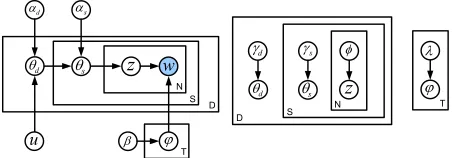
Figure 1: mlhLDA: Graphical representation (left); Free variational parameters for the online VB approximation (right).
topic distributionθd, we introduce section-topic
dis-tributionsθs. The existing symmetric Dirichlet prior
overθdcreates a hierarchical Dirichlet prior overθs
(θ=θd, θs1, θs2, ..., θsS):
p(θ|αdu, αs)∝p(θd|αdu)
Y
s
p(θs|αsθd) (1)
In this setting the most widely used approach for es-timatingθd is Minka’s (2000) fixed-point iteration
approach which is also used in (Kim et al., 2013). Instead we use a more efficient approach for estimat-ing the Dirichlet-multinomial hyperparameters by approximating the digamma differences in Minka’s approach which was showcased in (Wallach, 2008) to be more efficient. Figure 1 shows the graphical model representation (left) of our model, which we refer to as multi-level hyperpriors LDA (mlhLDA), along with the free variational parameters for ap-proximating the posteriors (right).
2.1 Inference using Online VB
VB locally optimal values of the free variational pa-rameters γ and φ, which are used to approximate the posterior θ and z, are computed in the E step of the algorithm but on a batch bof documents di
(rather than the whole collectionDas in the case of batch VB) while holding the topic-word variational parameterλfixed. In the M step,λis updated using stochastic gradient algorithm by first computing the optimal values ofλ˜using the batch optimal values of φb:λ˜
kw =η+|Db|P|i=1b| ndiwφdwki . This value is then
combined with value ofλcomputed on the previous batch through weighted average:
λkwb ←(1−ρb)λkwb−1+ρbλ˜kw (2)
When computing the section-topic variational pa-rameters we follow the proof of the lower bound which was derived by Kim et al. (2013). This lower bound, which is looser than the original VB Evi-dence Lower Bound (ELBO), allows for the batch VB approach to be used with asymmetric priors. More specifically, given the document-topic varia-tional parameterγdk in the E step of our online VB
approach the update for the section-topic variational parameterγsk becomes:
γsk =αs(Pγdk
kγdk) +
X
w
ns
wφswk (3)
3 Online PLTM with multi-level Dirichlet Priors
Given an aligned multilingual document tuple, PLTM assumes that: (1) there exists a single tuple-specific distribution across topics and (2) sets of lan-guage specific topic-word distributions. Each word is generated from a language- and topic-specific multinomial distributionϕl
kas selected by the topic
assignment variablezl n:
wln∼pwln|znl, ϕlk (4) We extend this model by introducing sections spe-cific topic distributions θs across the different
lan-guages in the tuple which are coupled by the tuple specific document-topic distributionθd.
Given a collection of document tuples d where each tuple containsldocuments that are translations of each other in different languages, mlhPLTM as-sumes the following generative process. For each language l in the collection the model first gener-ates a set ofk ∈ {1,2, ..., K}topic-word
distribu-w d N1 S D 1 w z NL 1 L
L
T . . . . . . s D d N1 s
S NL
1 1 T L L T . . . . d u s z D T N N D T s d w z s d d
s
d
s
[image:3.612.334.519.61.130.2]d z z z s S u S
Figure 2: mlhPLTM: Graphical model representation.
w d N1 S D 1 w z NL 1 L
L
T . . . . . . s D d N1 s
S NL
1 1 T L L T . . . . d u s z D T N N D T s d w z s d d s
d
s
[image:3.612.336.518.160.222.2]d z z z s S u S
Figure 3: mlhPLTM: Graphical representation of the free variational parameters for the online VB approximation.
tions, ϕl
k which are drawn from a Dirichlet prior
with language specific hyperparameter βl: ϕl
k ∼
Dirichlet(βl). For each documentdl withs
d
sec-tions in tupled, mlhPLTM then assumes the follow-ing generative process:
•Chooseθd∼Dir.(αd)
•For each sectionsdin document tupled:
•Chooseθs ∼Dir.(αsθd)
–For each languagelin sections:
∗For each wordwin sectionsl d:
·Choose a topicz∼Multi.(θl s)
·Choose a wordw∼Multi.(ϕl z)
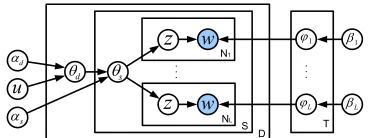
Figure 2 shows the graphical representation of mlh-PLTM. The free variational parameters for the on-line VB approximation of the posteriors are shown in Figure 3.
4 Modeling Sections in Scientific Articles
We explore the ability of mlhLDA to model vari-ations across document sections found in scientific articles using a collection of journal articles from the Astrophysics Data System (ADS) (Kurtz et al., 2000). Our collection consists of 130k training ar-ticles (888,346 sections) and a held-out set of 8,078 articles (54,502 sections). Figure 4 shows an exam-ple mlhLDA representation of an ApJ article with 100 topics. Shown on the top is the inferred topic representation of the whole document (θd) which, in
ex-1. INTRODUCTION Blazars are an intriguing class of active galactic nuclei (AGNs), dominated by non-thermal radiation over the entire electromagnetic spectrum. Their emission extends from radio to TeV energies with a broadband spectral energy distribution (SED) typically described by two main components, the first peaking from IR to X-ray energy range in which blazars are the most commonly detected extragalactic sources ...
7. SUMMARY AND DISCUSSION We have presented the infrared characterization of a sample of blazars detected in the γ-ray. In order to perform our selection, we considered all the blazars in the ROMA-BZCAT catalog (Massaro et al. 2010) that are associated
with a γ-ray source in the 2FGL (The Fermi-LAT
Collaboration 2011). Then, we searched for infrared counterparts in the WISE archive adopting the same criteria described in Massaro et al. ...
Rank Topic=33 Topic=19 Topic=49
1 spectral aperture measured
2 amplification measured uncertainties
3 isotropic total catalog
4 dropout exposure matching
5 competition position estimated
6 caustic ratio respectively
7 detected selected final
8 antenna color cathode
9 function spread total
10 color objects limit
Rank Topic=21 Topic=49 Topic=91
1 entanglement measured ferroelectric
2 color uncertainties population
3 distance catalog rational
4 magnitude matching fraction
5 accretion estimated starburst
6 similar respectively shielding
7 modulus final similar
8 objects cathode emitting
9 right total reputation
10 parameters limit respectively
[image:4.612.73.300.59.241.2]...
Figure 4: mlhLDA representation of the ApJ article “In-frared Colors of the Gamma-Ray Detected Blazers”.
amples of 2 article sections (out of 7), their inferred topic distributions along with the top 10 words for each of the top 3 section topics.
50200 400 600 8001000 1500 2000
50 100 150 200 250 300 350 400
# of Topics [K]
Perplexity
oLDA mlhLDA
5 6 7 8 9 10 11
300 350 400 450 500 550 600 650 700
Time [log(sec)]
Perplexity
batch VB oLDA mlhLDA T=5
T=10
T=20
T=30
T=50 T=70
T=90 T=100 T=5
T=10
T=20
T=30
T=50 T=70 T=90 T=100 T=5
T=10
T=20 T=30
T=70 T=50
T=90 T=100
Figure 5: oLDA vs. mlhLDA: perplexity comparison (left); speed vs. perplexity comparisons with batch VB (right).
The left side of Figure 5 shows the held-out per-plexity comparison between oLDA and mlhLDA across 13 different topic configurations. For this set of experiments we used the above training set of 130k articles and the set of 8,078 held-out arti-cles. From these comparisons we clearly see the ad-vantage of using the multi-level Dirchlet prior struc-ture. Another way of evaluating topic models is through an extrinsic evaluation task which was not available for this collection. In the case of oLDA, ar-ticle sections were treated as individual documents. In the original oLDA1implementation the per
doc-ument concentration parameter αd was set to K1
which we also use in our case for both the sym-metricθdand asymmetricθs(same goes for PLTM
1http://www.cs.princeton.edu/˜mdhoffma
and mlhPLTM). Since in our case we perform rel-ative comparison between oLDA and mlhLDA we weren’t concerned with experimenting with differ-ent concdiffer-entration parameters but we rather used the default one implemented in oLDA.
With a random subset of 10k training and 1k held-out articles we compared the performance of oLDA and mlhLDA with the original batch VB2
tation of Blei et al. (2003). Unlike the implemen-tations of oLDA and mlhLDA which are written in Python the original VB algorithm is written in C and requires multiple iterations over the whole collec-tion. The right side of Figure 5 shows the speed (in natural log scale) vs. perplexity comparison across the three models.
5 Modeling and Retrieving Speeches in Europarl Sessions
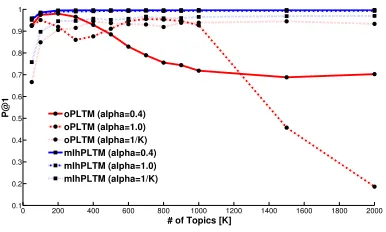
We compared the modeling performance of oPLTM and mlhPLTM on a subset of the English-Spanish Europarl collection (Koehn, 2005). The subset consists of ∼64k training pairs of English-Spanish speeches that are translations of each other which originate from 374 sessions of the European Par-liament (Europarl) and a test set of ∼14k speech translation pairs from 112 sessions. With oPLTM we modeled individual speech pairs while with mlh-PLTM we utilized the session hierarchy and mod-eled pairs of speeches as document sections. Com-parisons were performed intrinsically (using per-plexity) and extrinsically on a cross-language infor-mation retrieval (CLIR) task. This task, along with the Europarl subset, have been previously defined by Mimno et al. (2009) and used across other publica-tions (Platt et al., 2010; Krstovski and Smith, 2013). Given a query English speech, the CLIR task is to re-trieve its Spanish translation equivalent. It involves performing comparison across topic representations of all Spanish speeches using Jensen-Shannon diver-gence and sorting the results. Models are evaluated using precision at rank one (P@1). Figure 6 shows the CLIR task performance comparisons results us-ing 13 different topic configurations. We performed comparisons across three different settings of the concentration parametersαdandαs(αd=αs=K1, 0.4
and 1.0).
[image:4.612.77.292.346.420.2]0 200 400 600 800 1000 1200 1400 1600 1800 2000 0.1
0.2 0.3 0.4 0.5 0.6 0.7 0.8 0.9 1
# of Topics [K]
[image:5.612.318.536.58.133.2]P@1 oPLTM (alpha=0.4) oPLTM (alpha=1.0) oPLTM (alpha=1/K) mlhPLTM (alpha=0.4) mlhPLTM (alpha=1.0) mlhPLTM (alpha=1/K)
Figure 6: oPLTM vs. mlhPLTM: Performance com-parison on the CLIR task using chronological order-ing of sessions across different hyperparameter settorder-ings,
αd=αs=K1, 0.4 and 1.0 .
Across the different concentration parameter val-ues and across the 13 different topic configurations we observe that the performance of oPLTM fluc-tuates as we increase the numbers of topics. On the other hand, across the three different concen-tration parameter settings, mlhPLTM performance is very steady and tends to increase with the num-ber of topics. Across the different topic configura-tions both models provide the best performance with αd =αs = 0.4. Setting the concentration
parame-ters to 1
K gives the overall worst performance.
In our initial experiments we unintentionally re-ordered our set of training Europarl sessions based on two digit years which was different from the experimental setup in (Mimno et al., 2009) and (Krstovski and Smith, 2013) where the order of the presentation data (Europarl speeches) was chrono-logical. This emphasized the fact that in online VB, order of presentation of documents plays an impor-tant role especially in the training step where the model learns the per topic-word distributions. Fig-ure 7 shows the performance comparison results be-tween oPLTM and mlhPLTM when documents in the training and test steps are ordered numerically. In our initial experimental setup concentration pa-rameters where set toαd =αs = K1. To the left is
the perplexity comparison between the two models. The CLIR task performance comparisons results are shown on the right. Unordered mlhPLTM achieves high P@1 after 2,000 topics. While it takes much longer in terms of the number of topics unordered mlhPLTM ultimately achieves similar performance results as ordered mlhPLTM.
50200 400 600 8001000 1500 2000
400 600 800 1000 1200 1400 1600 1800
# of Topics [K]
Perplexity
oPLTM (English) mlhPLTM (English) oPLTM (Spanish) mlhPLTM (Spanish)
50200 400 600 8001,000 2,000
0.4 0.5 0.6 0.7 0.8 0.9 1
# of Topics [K]
P@1
oPLTM mlhPLTM
Figure 7: oPLTM vs. mlhPLTM: perplexity comparison (left); performance comparison on the CLIR task (right). Documents were presented out of chronological order and thus performance is lower, especially for oPLTM.
6 Conclusion
We presented online topic models with multi-level Dirichlet prior structure that provide better model-ing of topical variations across document sections in mono- and multilingual collections. We showed that documents with rich sub-document level structure could be modeled with higher likelihood compared to regular online LDA and PLTM models while of-fering the same efficiency. Furthermore on the task of retrieving document translations we showed that mlhPLTM achieves significantly better retrieval re-sults compared to online PLTM.
Acknowledgments
This work was supported in part by the Harvard-Smithsonian CfA predoctoral fellowship, in part by the Center for Intelligent Information Retrieval and in part by NSF grant #IIS-0910884. Any opinions, findings and conclusions or recommendations ex-pressed in this material are those of the authors and do not necessarily reflect those of the sponsor.
References
David M. Blei, Andrew Y. Ng, and Michael I. Jordan.
2003. Latent Dirichlet allocation.JMLR, 3:993–1022.
T. L. Griffiths and M. Steyvers. 2004. Finding
scien-tific topics. Proceedings of the National Academy of
Sciences, 101(Suppl. 1):5228–5235.
Matthew Hoffman, David Blei, and Francis Bach. 2010. Online learning for latent Dirichlet allocation. In
NIPS, pages 856–864.
[image:5.612.90.283.65.181.2]Do-Kyum Kim, Geoffrey Voelker, and Lawrence K. Saul. 2013. A variational approximation for topic modeling
of hierarchical corpora. InICML, pages 55–63.
Philipp Koehn. 2005. Europarl: A parallel corpus for
statistical machine translation. In MT Summit, pages
79–86.
Kriste Krstovski and David A. Smith. 2013. Online polylingual topic models for fast document translation
detection. InWMT, pages 252–261.
Michael J. Kurtz, Guenther Eichhorn, Alberto Acco-mazzi, Carolyn S. Grant, Stephen S. Murray, and Joyce M. Watson. 2000. The nasa astrophysics data
system: Overview. Astronomy and Astrophysics
Sup-plement Series, 143:41–59.
David Mimno, Hanna Wallach, Jason Naradowsky,
David A. Smith, and Andrew McCallum. 2009.
Polylingual topic models. InEMNLP, pages 880–889.
Thomas P. Minka. 2000. Estimating a dirichlet distribu-tion. Technical report, MIT.
John Platt, Kristina Toutanova, and Wen tau Yih. 2010. Translingual document representations from
discrimi-native projections. InEMNLP, pages 251–261.
Hanna M. Wallach, David Mimno, and Andrew McCal-lum. 2009. Rethinking LDA: Why priors matter. In
NIPS, pages 1973–1981.
Hanna M. Wallach. 2008. Structured Topic Models for
Language. Ph.D. thesis, University of Cambridge. Xuerui Wang, Andrew McCallum, and Xing Wei. 2007.
Topical n-grams: Phrase and topic discovery, with an
application to information retrieval. InICDM, pages