Munich Personal RePEc Archive
Properties of time averages in a risk
management simulation
Bell, Peter Newton
7 May 2014
Online at
https://mpra.ub.uni-muenchen.de/55803/
© Peter Bell, 2014 Page 1 of 10
Properties of time averages in a risk management simulation
Peter N. Bell
Department of Economics, University of Victoria
This research was supported by the Joseph-Armand Bombardier Canada Graduate Scholarship –
Doctoral through the Social Sciences and Humanities Research Council from the Government of
© Peter Bell, 2014 Page 2 of 10 Abstract
This paper investigates a simple risk management problem where an investor is forced to hold a
risky asset and then allowed to trade put options on the asset. I simulate the distribution of
returns for different quantities of options and investigate statistics from the distribution. In the
first section of the paper, I compare two types of averages: the ensemble and the time average.
These two statistics are motivated by research that uses ideas from ergodic theory and tools from
statistical mechanics to provide new insight into decision making under uncertainty. In a large
sample setting, I find that the ensemble average leads an investor to buy zero put options and the
time average leads them to buy a positive quantity of options; these results are in agreement with
stylized facts from the literature. In the second section, I investigate the stability of the optimal
quantity under small sample sizes. This is a standard resampling exercise that shows large
variability in the optimal quantity associated with the time average of returns. In the third
section, I conclude with a brief discussion of higher moments from the distribution of returns. I
show that higher moments change substantially with different quantities of options and suggest
that these higher moments deserve further attention in relation to the time average.
© Peter Bell, 2014 Page 3 of 10 Properties of time averages in a risk management simulation
This paper investigates properties of the distribution for returns in a simple risk
management problem. The model was first introduced in Bell (2014), where an agent holds an
endowment of stock and is allowed to trade some quantity of (at-the-money) put options. I
extend the model to consider the ensemble and time averages as described by Dr. Ole Peters. Peters’ work represents an important development in the literature on decision making under uncertainty and it is a pleasure for me to make some small contribution to the discourse.
Introduction
Research by Peters addresses fundamental ideas in economics about decision making
under uncertainty (2011a, 2011b). Recent work (Peters and Gell-Mann, 2014) provides a
comprehensive review of the historical foundations for decision theory and puts forward an
agenda for “Decision Theory 2.0”. It is an exciting time for the literature where we are finding
new solutions to old problems.
The St Petersburg paradox refers to a well-known gamble where a player flips a fair coin
until it turns up “heads” for the first time, then they receive 2N-1 where N is the number of flips.
The gamble has infinite expected value, which puzzled some influential scholars. Peters
provides rich description of different solutions to game throughout history (2011b). One
important solution was proposed by Daniel Bernoulli in the 1700s. Bernoulli suggested that
people value the gamble based on expected utility, rather than expected wealth, and showed that
the expected utility associated with the game was finite. Thus, Bernoulli laid part of the
foundation for subsequent use of utility functions in decision theory, asset pricing, and
mainstream mathematical economics.
Peters (2011a) uses ergodic theory to identify problems with standard solutions to the St
Petersburg paradox and provides a new solution using techniques from statistical mechanics.
This is desirable because it allows us to avoid using an arbitrary utility function. In a report for
Towers Watson (2012), Peters provides an explanation that is accessible to a general audience
and conveys the potential significance of the results. A particularly striking result is Figure 3
© Peter Bell, 2014 Page 4 of 10
linearly increasing with leverage, but Peters’ method uses a time average, which suggests that
returns have a convex shape in relation to leverage. An investor who maximizes the ensemble
average of returns will take ever more leverage and have large risk of ruin. In contrast, an
investor who maximizes the time average of returns will make more prudent choices. Further
discussion of the implications of a time average for optimal leverage is provided in Peters (2010).
In terms of St Petersburg paradox, an ensemble average of returns suggests an infinite price, but
a time average suggests a finite price; for initial wealth of 102, the St Petersburg game is fair if it
costs approximately 5.0 units of currency (Peters, 2011, p. 2924).
Large Sample Results
Suppose an investor has an endowment of stock and is allowed to trade (at the money)
put options on the stock. What quantity of puts should they buy? I analyze this problem with
several simplifying assumptions, such as zero interest rates. To begin, I specify the data
generating process.
The initial stock price is S, where I assume S=100. The stock price after one time step
(year) follows a geometric Brownian motion, where the returns have zero-mean and 10%
volatility (µ=0 and σ=0.10). I denote the price after one year as S’, where 𝑆′= 100𝑒µ+𝜎𝑍. The
Z denotes a draw of a standard normal random variable (Z~i.i.d. N(0,1)).
The investor trades some quantity of put options that expire after one year. I denote the
quantity of puts as q. The strike of the option is equal to the initial stock price, K=100. I
calculate the option price using Black Scholes formula and denote it as O. I denote the option
payoff at expiry as [𝐾 − 𝑆′]+. The value of the investor’s portfolio after one year is a random
variable, driven by the stock price. The investor can change the distribution of the profit by
changing the quantity of put options they buy. The portfolio value after one year is described by
Equation (1). I assume the investors’ wealth is entirely composed of the asset and, thus,
calculate the returns as in Equation (2).
1. 𝛱(𝑞) = 𝑆′+ 𝑞( [𝐾 − 𝑆′]+− 𝑂)
© Peter Bell, 2014 Page 5 of 10 I restrict the quantity of put options to take values in a set that is economically interesting:
𝑞 ∈ {0.00, 0.02, … , 2.00}. For each value of q, I estimate the distribution of returns using 105
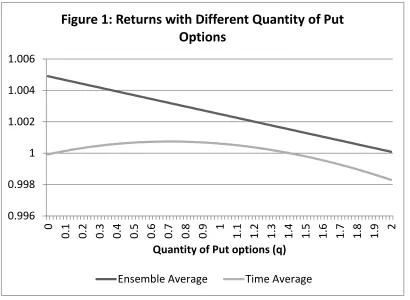
observations. I report the ensemble and time averages for each value of q in Figure 1.
Figure 1 shows the ensemble and time averages for different quantities of put options. I
find that the ensemble average of returns is always decreasing in quantity of put option, which
suggests an investor should not buy any put options. In contrast, the time average of returns has
a convex shape over quantity, which suggests an investor should buy a positive quantity of
options. In particular, the optimal quantity for the time average in Figure 1 is approximately
0.70. Interestingly, this is similar to the optimal quantity identified under the log utility in Bell
(2014).
Although the particular risk management model that I analyze here is unique, the results
confirm some of the stylized facts from Peters’ research. For example: the linear shape of the
ensemble average, the non-linear shape of the time average, and the fact that the time average
leads to more prudent behaviour than the ensemble average. These results are encouraging for
my model and the topic area.
0.996 0.998 1 1.002 1.004 1.006
0
[image:6.612.103.513.142.442.2]0.1 0.2 0.3 0.4 0.5 0.6 0.7 0.8 0.9 1 1.1 1.2 1.3 1.4 1.5 1.6 1.7 1.8 1.9 2 Quantity of Put options (q)
Figure 1: Returns with Different Quantity of Put
Options
© Peter Bell, 2014 Page 6 of 10 Small Sample Results
It is important to explore how results change with different sample sizes because it can
provide insight into the stability or robustness of the distribution of returns and statistics of the
distribution. In what follows, I refer to the optimal quantity as that which maximizes the time
average of returns. I do not consider the ensemble average because the optimal quantity is
generally a corner solution and the time average is the controversial new concept that deserves
attention.
I explore properties of the optimal quantity using a standard resampling procedure. I
specify the sample size and then conduct the optimization exercise 100,000 different times. Each
time I identify an estimate of the optimal quantity. By repeating this exercise with different
sample sizes, I establish properties of the time average in small samples. I use sample sizes
equal to 100, 1,000, 10,000, and 100,000. For each sample size, I report the distribution of the
location of the optimal quantity for a truncated set of q in Table 1.
Table 1: Frequency of Optimal Quantity for Different Sample Sizes
0.00 0.20 0.40 0.60 0.80 1.00 1.20
100 0.41 0.04 0.04 0.04 0.03 0.04 0.41
1,000 0.14 0.09 0.12 0.14 0.13 0.14 0.24
10,000 0.00 0.01 0.11 0.34 0.38 0.14 0.02
100,000 0.00 0.00 0.00 0.38 0.62 0.00 0.00
The columns in Table 1 represent intervals for the quantity of put options. The values in
the columns represent midpoints for the intervals. The rows represent the sample sizes. The
bottom row in Table 1 represents the results for a large sample, which are concentrated around
the optimal quantity (between the 0.60 and 0.80 columns). The results for large sample have
limited variability. The results in the top row of Table 1 represent a small sample and show large
variability. A corner solution (q*=0 or q*1.2) is very common with small samples, and the
large-sample optimum occurs infrequently. This raises some concerns about the behaviour of the
© Peter Bell, 2014 Page 7 of 10 Higher moments
The analysis so far has focused on two different measures for the first moment of returns,
but what about higher moments? Higher moments reflect important information about the
distribution of returns and I am keen to raise the topic in relation to Peters’ work. To help bring
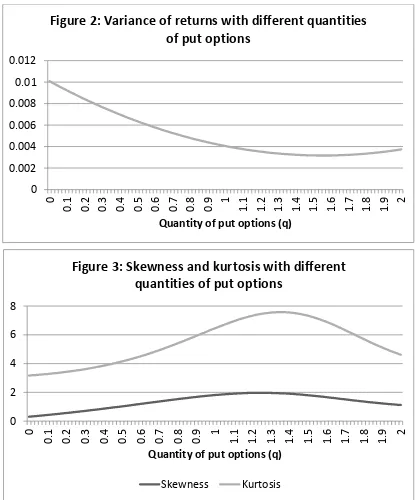
attention to these moments, I show the variance, skewness, and excess kurtosis for different
quantities of options.
0 0.002 0.004 0.006 0.008 0.01 0.012
0
[image:8.612.97.512.212.712.2]0.1 0.2 0.3 0.4 0.5 0.6 0.7 0.8 0.9 1 1.1 1.2 1.3 1.4 1.5 1.6 1.7 1.8 1.9 2 Quantity of put options (q)
Figure 2: Variance of returns with different quantities
of put options
0 2 4 6 8
0
0.1 0.2 0.3 0.4 0.5 0.6 0.7 0.8 0.9 1 1.1 1.2 1.3 1.4 1.5 1.6 1.7 1.8 1.9 2 Quantity of put options (q)
Figure 3: Skewness and kurtosis with different
quantities of put options
© Peter Bell, 2014 Page 8 of 10 Figures 2 and 3 show that the higher moments of the returns change a great deal across
different quantities of put options. It seems that there is a sweet spot with low variance, positive
skewness, and positive kurtosis in a region around q=1.4. This combination of higher moments
is desirable because it is associated with large, positive returns. It is also quite close to the
optimal quantity (q=1.57) identified under the mean-variance utility function in Bell (2014).
However, this region is quite far from the optimal quantity associated with the time average in
large samples.
Conclusion
This short paper demonstrates the use of the time average for risk management in a
simulation setting. In a large sample setting, I show that the ensemble average decreases linearly
with the quantity of put options, whereas the time average has a convex shape. These different
shapes lead to very different risk management behaviour, which concur with stylized facts
reported in work by Ole Peters (see Towers Watson, 2012).
In the second section of the paper I use resampling techniques to show how the
distribution of the optimal quantity associated with the time average of returns changes with
different sample sizes. For small sample sizes (100 or 1,000), I find large variability in the
optimal quantity. For larger sample sizes (10,000 or 100,000), I find the optimal quantity is
densely concentrated around the optimal quantity. These results raises concerns about behaviour
of the time average in small samples, but suggest the statistic is well behaved in large samples.
In the third section of the paper I show higher moments of the distribution for returns in a
large sample setting. I find that a region around q=1.4 is associated with low variance, positive
skewness, and kurtosis for returns, which are desirable qualities for the distribution of returns. It
is not clear to me how these higher moments are related to the discussion of the time average and
I hope to draw attention to this matter by presenting these results here.
I use geometric Brownian motion to represent the stock price in this paper because this
model is directly analogous to the stochastic differential equations used in Peters’ work.
However, Brownian motion is sometimes referred to as mild randomness and I am keen to
extend the simulations conducted here to so-called wild types of randomness in the future, such
© Peter Bell, 2014 Page 9 of 10 References
Bell, P. (2014). Optimal use of put options in a stock portfolio. Unpublished manuscript.
Available from http://mpra.ub.uni-muenchen.de/54871/
Calvet, L. & Fisher, A. (2002). Multifractality in asset returns: theory and evidence. The
Review of Economics and Statistics, 84, 381-406.
Peters, O. (2010). Optimal leverage from non-ergodicity. Quantitative Finance, 11(11),
1593-1602.
Peters, O. (2011a). The time resolution of the St. Petersburg paradox. Philosophical
Transactions of the Royal Society A: Mathematical, Physical and Engineering Sciences,
369(1956), 4913-4931.
Peters, O. (2011b). Menger 1934 Revisited. Manuscript submitted for publication. Available
from http://arxiv.org/abs/1110.1578.
Peters, O. & Gell-Mann, M. (2014). Evaluating gambles using dynamics. Manuscript submitted
for publication. Available from http://arxiv.org/abs/1405.0585.
Towers Watson. (2012). The irreversibility of time: Or why you should not listen to financial
economists. London, UK: Ole Peters.
Wengert, C. (2010). Multifractal Model of Asset Returns (MMAR) [Software]. Available from
© Peter Bell, 2014 Page 10 of 10 Code Appendix
%% Code Appendix -- Properties of Returns Distributions % Written by Peter Bell, May 5 2014
% %
%% Section 1: Specify global parameters for stock and put option. %
clear all;
S=100; K=100; mu=0; sig=0.10;
d1=(1/sig)*(log(S/K)+0.5*sig^2); d2 = d1 - sig; P = K*normcdf(-d2,0,1)-S*normcdf(-d1,0,1);
%% Section 2: Simulate results in large sample %
LargeN=10^5;
s = RandStream.create('mt19937ar','seed',5489);
RandStream.setDefaultStream(s); z=mu+sig*randn(LargeN,1);
S1=S.*exp(z); Pr=zeros(1,1);
for i=1:101
Q=(i-1)/50; P1=Q*(max(K-S1,0)-P); Pr(i,1:LargeN)=(S1+P1)/100; Stats(i,1)=mean(Pr(i,1:LargeN)); Stats(i,2)=geomean(Pr(i,1:LargeN)); Stats(i,3)=var(Pr(i,1:LargeN)); Stats(i,4)=skewness(Pr(i,1:LargeN)); Stats(i,5)=kurtosis(Pr(i,1:LargeN)); end
%% Section 3: Simulate results with resampling
% Please repeat this section and hard-code changes to the following % variable... VarN=10^2, 10^3, 10^4, and 10^5.
%
VarN=10^2; ResampN=10^5; MaxQ=zeros(1,1);
for j=1:ResampN
z=mu+sig*randn(VarN,1); S1=S.*exp(z);
Pr=zeros(1,1);
for i=1:101
Q=(i-1)/50;
P1=Q*(max(K-S1,0)-P); Pr(i,1:VarN)=(S1+P1)/100;
GeomAvg(i,j)=geomean(Pr(i,1:VarN)); end
[rMax iMax] = max(GeomAvg(:,j)); MaxQ(j,1)=(iMax-1)/50;
end
histIndexTwo = 0:0.2:1.2;
[qStarHistLog xOut] = hist(MaxQ(:,1), histIndexTwo);