NAACL-HLT 2012 Workshop on Predicting and Improving Text Readability for target reader populations (PITR 2012)., pages 8–16,
Towards Automatic Lexical Simplification in Spanish: An Empirical Study
Biljana Drndarevi´c and Horacio Saggion
Universitat Pompeu Fabra
Department of Information and Communication Technologies C/ Tanger, 122-140
08018 Barcelona, Spain
{biljana.drndarevic,horacio.saggion}@upf.edu
Abstract
In this paper we present the results of the anal-ysis of a parallel corpus of original and simpli-fied texts in Spanish, gathered for the purpose of developing an automatic simplification sys-tem for this language. The syssys-tem is intended for individuals with cognitive disabilities who experience difficulties reading and interpret-ing informative texts. We here concentrate on lexical simplification operations applied by human editors on the basis of which we derive a set of rules to be implemented automatically. We have so far addressed the issue of lexical units substitution, with special attention to re-porting verbs and adjectives of nationality; in-sertion of definitions; simplification of numer-ical expressions; and simplification of named entities.
1 Introduction
In the highly digitalized21st century sharing infor-mation via Internet has become not only common-place but also essential. Yet, there are still a large number of people who are denied this fundamental human right – access to information. In 2006 the UN conducted an audit with the aim of testing the state of accessibility of the leading websites around the world. The results were rather disappointing, with only three out of 100 tested web pages achieving basic accessibility status. It is therefore clear that one of the priorities for the future is working on en-abling inclusion of all the groups that are currently marginalised and denied equal access to information as the rest of the population.
Written information available online is far too of-ten presented in a way that is perceived as incom-prehensible to individuals with cognitive disabili-ties. It is therefore necessary to simplify the com-plex textual content in order to make it more acces-sible. However, manual simplification is too time-consuming and little cost-effective so as to yield suf-ficient amount of simplified reading material in a satisfactory time frame. Hence, the need and in-terest arise to develop automatic or semi-automatic simplification tools that would (partially) substitute humans in carrying out this laborious task.
Our project is one such aspiration. Our goal is to offer an automated text simplification tool for Span-ish, targeted at readers with cognitive disabilities. We delimit our research to simplification of infor-mative texts and news articles. So far we have fo-cused primarily on syntactic simplification, with an already implemented module currently in the test stage (Bott and Saggion, 2012b). The present work, however, deals with lexical simplification and is cen-tred around a corpus analysis, a preparatory stage for the development of a separate lexical module in the future.
Earlier work already establishes the importance of lexical changes for text simplification (Carroll et al., 1998; Caseli et al., 2009; De Belder et al., 2010). Upon examining a parallel corpus consisting of orig-inal and manually simplified newspaper articles in Spanish, we have found that by far the most com-mon type of changes applied by human editors are precisely lexical changes, accounting for 17.48% of all annotated operations (Bott and Saggion, 2012a). Words perceived as more complicated are replaced
by their simpler synonyms. A recurring example is that of reporting verbs. Corpus analysis shows a clear tendency towards replacing all reporting verbs such asadvertir(warn),afirmar (declare),explicar
(explain), etc. with the ubiquitousdecir(say). Sen-tences 1 (original) and 2 (simplified) illustrate the said phenomenon (translated into English):
1. It is important that we continue working on the means that promote the access of the disabled to cultural content, sheexplained.
2. The Minister of Culturesaidthat she is work-ing towards grantwork-ing the disabled access to cul-tural content.
We therefore document all cases of lexical change observed in the corpus and try to extract rules for their automatic implementation. The remainder of this paper is organized as follows: Section 2 ad-dresses the related work in the field; in Section 3 we describe the experimental setting and the process of obtaining the parallel corpus used in the study, while Section 4 provides a more detailed insight into the kind of lexical simplifications observed. We con-clude in Section 5 and outline our future work.
2 Related Work
Text simplification has so far been approached with two different aims. One is to offer simplified ver-sions of original text to human readers, such as foreign language learners (Petersen and Ostendorf, 2007; Medero and Ostendorf, 2011); aphasic peo-ple (Devlin and Unthank, 2006); low literacy in-dividuals (Specia, 2010) and others. On the other hand, simplified text is seen as input for further nat-ural language processing to enhance its proficiency, e.g. in machine translation or information retrieval tools (Klebanov et al., 2004). The earliest simplifi-cation systems employed a rule-based approach and focused on syntactic structure of the text (Chan-drasekar et al., 1996). The PSET project (Carroll et al., 1998) dealt with simplification of news articles in English for aphasic readers. Together with syn-tactic analysis and transformations similar to those of Chandrasekar et al. (1996), they employed lexi-cal simplification based on looking up synonyms in WordNet and extracting Kucera-Francis frequency
from the Oxford Psycholinguistic Database (Quin-lan, 1992). Therefore, the most frequent of a set of synonyms for every content word of the input text was chosen to appear in its simplified version.
The above approach to lexical simplification has been repeated in a number of works (Lal and Ruger, 2002; Burstein et al., 2007). Bautista et al. (2009) also rely on a dictionary of synonyms, but their crite-rion for choosing the most appropriate one is word-length rather than frequency. Caseli et al. (2009) analyse lexical operations on a parallel corpus of original and manually simplified texts in Portuguese, using lists of simple words and discourse markers as resources. Bautista et al. (2011) focused on numeri-cal expressions as one particular problem of lexinumeri-cal simplification and suggested the use of hedges as a means of dealing with complex numerical content.
Given the fact that many words tend to be poly-semic, attempts have been made to address this is-sue so as to provide more accurate, context-aware lexical substitution. De Belder et al. (2010) were the first to employ word sense disambiguation tech-niques in order to capture contextual information, while Biran et al. (2011) apply an unsupervised method for learning pairs of complex and simple synonyms based on an unaligned corpus of texts from the original Wikipedia and Simple English Wikipedia.
3 Experimental Setting
We have gathered a corpus consisting of 200 in-formative texts in Spanish, obtained from the news agency Servimedia. The articles have been clas-sified into four categories: national news, interna-tional news, society and culture. We then obtained simplified versions of the said texts, courtesy of the DILES (Discurso y Lengua Espa˜nola) group of the Autonomous University of Madrid. Simplifications have been applied manually, by trained human ed-itors, following easy-to-read guidelines suggested by Anula (2009), (2008). We are interested to see how these guidelines are applied in practice, as well as how human editors naturally deal with cases not treated by the guidelines in sufficient detail.
aligning algorithm based on Hidden Markov Mod-els (Bott and Saggion, 2011) has been applied to ob-tain sentence-level alignments. The automatic align-ments have then been manually corrected through a graphical editing tool within the GATE framework (Cunningham et al., 2002). A total of 570 sentences have been aligned (246 in original and 324 in sim-ple texts), with the following correlations between them: one to one, one to many ormany to one, as well as cases where there is no correlation (cases of content reduction through summarisation or infor-mation expansion through the introduction of defini-tions). The alignments facilitate the observation of the corpus, particularly cases where entire sentences have been eliminated or inserted.
A parallel corpus thus aligned enables us to en-gage in data analysis as well as possibly carry out machine learning experiments to treat specific prob-lems we have so far detected. We have documented all simplification operations used by human editors and placed them in eight major categories applied at various linguistic levels (individual words, phrases or sentences). The operations arechange, delete, in-sert, split, proximization, re-order, select and join, listed in the decreasing order of their relative fre-quency in the corpus. Among these are the changes that are either rather idiosyncratic or involve com-plex inferential processes proper to humans but not machines. Sentence 1 (original) and paragraph 2 (simplified) are an example (translated into English):
1. Around 390,000 people have returned to their homes after being forced to evacuate due to floods caused by monsoon rains last summer in Pakistan.
2. Last summer it rained a lot in Pakistan. The rain flooded the fields and the houses. That is to say, the water covered the houses and the fields. For this reason a lot of people left their homes in Pakistan. Now these people return to their homes.
Sentences in bold are examples of information ex-pansion which is difficult to implement automati-cally. The concept of flood is obviously perceived as complicated. However, instead of offering a defi-nition taken out of a dictionary and applicable to any context (as in the example further below), the writer
explains what happened in this particular instance, relying on their common knowledge and inferential thinking. It is obvious that such conclusions cannot be drawn by computers. Whatcanbe done is insert a definition of a difficult term, as in the following example:
1. The Red Cross asks for almost one million eu-ros for the 500,000 Vietnamese affected by the floods.
2. The Red Cross asks for one million euros for Vietnam. The Red Cross is an organization that helps people and countries around the world.
After documenting all the operations and analysing their nature and frequency, we have finally decided to focus on the automatic treatment of the following: lexical simplification, deletions, split operations, in-version of direct speech and the insertion of defini-tions. In the next section, we concentrate on oper-ations applied at the lexical level, with the aim of drawing conclusions about the nature of lexical sim-plification carried out by trained editors and the pos-sibility of their automatic implementation in the fu-ture.
4 Data Analysis
We have so far obtained forty simplifications and our goal is to shortly acquire simplified versions of all 200 texts. A variety of lexical operations have been observed in the corpus, which go far beyond sim-ple substitution of one lexical unit with its simsim-pler equivalent. In order to describe the nature of these changes, we have categorized them as follows:
• substitutions of one lexical unit with its simpler synonym;
• insertion of definitions of difficult terms and concepts;
• simplification of numerical expressions;
• simplification of named entities;
• elimination of nominalisation;
• rewording of idioms and collocations; and
4.1 Lexical substitution
We have documented 84 cases where one lexical unit has been substituted with its simpler synonym. These words make up our lexical substitution ta-ble (LST), gathered for the purpose of data analy-sis. The table contains the lemma of the original
(O) word, itssimple(S) equivalent and additional in-formation about either the original word, the simple word or the nature of the simplification, such as pol-ysemy, hyponym ⇒ hypernym, metaphor, etc. Ta-ble 1 is an excerpt.
Original Simple Commentary
impartir pronunciar polysemy informar decir reporting verb
inmigrante extranjero hyponym⇒hypernym letras literatura polysemy
Table 1: An excerpt from the Lexical Substitution Table
To analyse the relationship between the sets of O-S words, we have concentrated on their frequency of use and length (both in characters and syllables).
4.1.1 Word frequency
For every word in the LST, we consulted its fre-quency in a dictionary developed for the purposes of our project by the DILES group and based on the Referential Corpus of Contemporary Spanish (Cor-pus de Referencia del Espa˜nol Actual, CREA)1. We have found that for 54.76% of the words, the quency of the simple word is higher than the fre-quency of its original equivalent; in 30.95% of the cases, the frequency is the same; only 3.57% of the simple words have lower frequency than the corre-sponding original ones; and in 10.71% of the cases it was impossible to analyse the frequency since the original word was a multi-word expression not in-cluded in the dictionary, as is the case with complex conjunctions like sin embargo(however) orpese a
(despite).
As can be appreciated, in a high number of cases O and S words have the same frequency of use ac-cording to CREA. In an intent to rationalise this phenomenon, we have counted the number of times each of these words appears in the totality of orig-inal and simple texts. In more than half of the
O-1http://corpus.rae.es/creanet.html
S pairs the simple word is more common than its original equivalent, not only in the simplified texts, where it is expected to abound, but also in the orig-inal ones. This difference in the frequency of use in actual texts and the CREA database could be ex-plained by the specificity of the genre of the texts in our corpus, where certain words are expected to be recurrent, and the genre-neutral language of CREA on the other hand. Out of the remaining 44.5% of the cases, where O words are more abundant than S words, five out of fourteen may have been used for stylistic purposes. One good example is the use of varied reporting verbs, such asafirmar(confirm) or
anunciar(announce), instead of uniformly using de-cir(say). Six in fourteen of the same group are pol-ysemic words possibly used in contexts other than the one where the simplification was recorded. Such is the example of the wordart´ıculo, substituted with
cosawhere it meantthing. However, it also occurs with its second meaning (article: a piece of writing) where it cannot be substituted withcosa.
What can be concluded so far is that frequency is a relatively good indicator of the word difficulty, al-beit not the only one, as seen by a large number of cases when the pairs of O-S words have the same frequency. For that reason we analyse word length in Section 4.1.2. Polysemy and style are also seen as important factors at the time of deciding on the choice of the synonym to replace a difficult word. Whereas style is a factor we currently do not intend to treat computationally, we cannot but recognize the impact that polysemy has on the quality and ac-curacy of the output text. Consider the example of another pair of words in our lexical substitution ta-ble: impresi´on ⇒ influencia, in the following pair of original (1) and simplified (2) sentences:
1. Su propia sede ya da testimonio de la “im-presi´on profunda” que la ciudad andaluza dej´o en el pintor.
Its very setting testifies to the profound influ-ence of the Andalusian town on the painter.
2. En esa casa tambi´en se ve la influencia de Granada.
The influence of Granada is also visible in that house.
syn-onyms. However, in expressions such as tengo la impresi´on que(I am under the impression that), the word impresi´oncannot be substituted with influen-cia. We have found that around 35% of all the orig-inal words in the LST are polysemic. We therefore believe it is necessary to include a word sense dis-ambiguation approach as part of the lexical simplifi-cation component of our system in the future.
4.1.2 Word Length
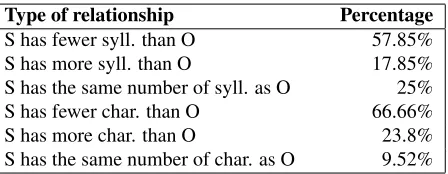
Table 2 summarizes the findings relative to the word length of the original and simple words in the LST, where syll. stands for syllableand char. for
character.
Type of relationship Percentage
S has fewer syll. than O 57.85%
S has more syll. than O 17.85%
S has the same number of syll. as O 25%
S has fewer char. than O 66.66%
S has more char. than O 23.8%
[image:5.612.76.300.263.350.2]S has the same number of char. as O 9.52%
Table 2: Word length of original and simple words
The average word length in the totality of origi-nal texts is 4.81 characters, while the simplified texts contain words of average length of 4.76 characters. We have also found that the original and simplified texts have roughly the same number of short words (up to 5 characters) and medium length words (6-10 characters), while the original texts are more satu-rated in long words (more than 11 characters) than the simplified ones (5.91% in original and 3.64% in simplified texts). Going back to the words from the LST which had the same frequency according to CREA, we found that around 80% of these were pairs where the simple word had fewer syllables than the original one. This leads us to the conclusion that there is a strong preference for shorter words and that word length is to be combined with frequency when deciding among a set of possible synonyms to replace a difficult word.
4.2 Transformation rules
Upon close observation of our data, we have derived a set of preliminary simplification rules that apply to lexical units substitution. These rules concern re-porting verbs and adjectives of nationality, and will
be addressed in that order.
In the twenty pairs of aligned texts nine differ-ent reporting verbs are used. All nine of them have been substituted withdecir(say) at least once, amounting to eleven instances of such substitutions. Three verbs from the same set appear in simplified texts without change. On the whole, we perceive a strong tendency towards using a simple verb like
saywhen reporting direct speech. Our intention is to build a lexicon of reporting verbs in Spanish and complement it with grammatical rules so as to en-able accurate lexical substitution of these items of vocabulary. Simple substitution of one lexical unit with another is not always possible due to syntactic constraints, as illustrated in the following example:
1. El juez advirti´o al duque que podr´ıa provocar la citaci´on de la Infanta.
The judge warned the Duke that he might cause the Princess to be subpoenaed.
2. Muri´o cient´ıfico que advirti´o sobre deterioro de la capa de ozono.
The scientist who warned about the deteriora-tion of the ozone layer died.
In the first case the verbadvertiris used as part of the structure [advertir a X que], in English [warn some-body that]. The verb decireasily fits this structure without disturbing the grammaticality of the sen-tence. In the second instance, however, the reporting verb is used with the preposition and an indirect ob-ject, a structure where the insertion ofdecirwould be fatal for the grammaticality of the output. We be-lieve that the implementation of this rule would be a worthwhile effort, given that informative texts of-ten abound in direct speech that could be relatively easily simplified so as to enhance readability.
As for adjectives of nationality, we have no-ticed a strong preference for the use of periphrastic structure instead of denominal adjective denoting nationality. Thus, a simple adjective is replaced with the construction [de < COUNTRY >], e.g.
el gobierno pakistan´ı (the Pakistani government) is replaced by el gobierno de Pakist´an (the gov-ernment of Pakistan). The same rule is applied to instances of nominalised nationality adjectives. In these cases the structure [ArtDef + Adj]2
comes [ArtDef + persona + de +<COUNTRY>], e.g: los pakistan´ıes ⇒ las personas de Pakist´an
(the Pakistani⇒the people from Pakistan). In only five instances the adjective was preferred. Twice it wasespa˜nol(Spanish), which were the only two in-stances of the expression of this nationality. This leads us to the conclusion thatespa˜nolis sufficiently widespread and therefore simple enough and would not need to be substituted with its periphrastic equiv-alent. Norteamericano (North American) was used twice, therefore being slightly more acceptable than
estadounidense (of/from the United States), which is always replaced by de Estados Unidos. The re-maining is the one instance of egipcio (Egyptian), otherwise replaced byde Egipto.
Based on the observations, our hypothesis is that more common nationality adjectives, such as Span-ish, and possibly alsoEnglishorFrenchneed not be modified. Norteamericanoorestadounidense how-ever common are possibly perceived as complicated due to their length. In order to derive a definite rule, we would need to carry out a more detailed analy-sis on a richer corpus to determine how frequency of use and length of these adjectives correlate.
4.3 Insertion of definitions
Definitions of difficult terms are found in 57.5% of all texts we have analysed. Around 70% of these are definitions of named entities, such asEl Greco,
Amnesty International,Guantanamoand others. In addition to these, difficult lexical units, and even ex-pressions, are explained by means of a definition. Thus,a (prison) cellis defined asa room in a prison, and the prisoner of conscience as a person put in prison for his ideas. In order to deal with named entity definitions, we intend to investigate the meth-ods for the look-up of such definitions in the future. To solve the problem of defining difficult individual lexical units, one solution is to target those words with the lowest frequency rate and in the absence of an adequate simpler synonym insert a definition from a monolingual dictionary, given the availabil-ity of such resources (the definition itself might need to be simplified).
4.4 Numerical expressions
Our analysis shows that the treatment of numerical expressions should have a significant place in our
simplification system, given their abundance in the kind of texts our system is mainly intended for, and a wide variety of simplification solutions observed by examining the parallel corpus. Even though by far the most common operation is elimination (in the process of summarization), there are a number of other recurrent operations. The most common of these are explained below for the purpose of illus-tration, given that the totality of the rules is beyond the scope of this paper. We separately address nu-merical expressions forming part of a date and other instances of using numbers and numerals.
The following are the rules concerning numerical expressions in dates:
1. en<YEAR>⇒en el a˜no<YEAR>
en 2010⇒en el a˜no 2010
2. Years in parenthesis are eliminated (this opera-tion has been applied in 100% of the cases dur-ing manual simplification):
El Greco (1541–1614)⇒El Greco
3. In expressions containing the name and/or the day of the month, irrespective of whether it is followed by a year, the information relative to the month (i.e. name or name and day) is elim-inated (applied in around 85% of the cases):
en septiembre 2010 ⇒ en el a˜no 2010 el 3 de mayo⇒ ∅
As for other numerical expressions, the most common rules and most uniformly applied are the following:
1. Replacing a word with a figure:
cinco d´ıas⇒5 d´ıas
2. Rounding of big numbers:
m´as de 540.000 personas⇒ medio mill´on de personas
3. Rounding by elimination of decimal points:
Cerca de 1,9 millones de casas⇒ 2 millones de casas
4. Simplification of noun phrases containing two numerals in plural and the preposition of by eliminating the first numeral:
5. Substitution of words denoting a certain num-ber of years (such asdecadeorcentenary) by the corresponding number:
IV centenario de su nacimiento⇒400 a˜nos de su nacimiento
6. The thousands and millions in big numbers are expressed by means of a word, rather than a figure:
17.000casas⇒17mil casas
We are currently working on implementing a nu-merical expression simplification module based on rounding and rewording rules derived from our cor-pus and previous study in the field (Bautista et al., 2011).
4.5 Named Entities
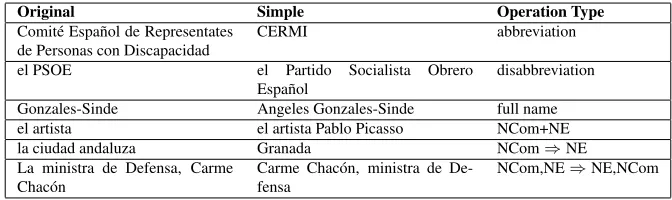
As with numerical expressions, the majority of named entities are eliminated as a result of sum-marization. Only those names that are relative to the theme of the text in question and which tend to appear throughout the article are kept. In the case of these examples, we have observed the follow-ing operations: abbreviation; disabbreviation; usfollow-ing full name instead of the surname alone, customary in newspaper articles; expanding the noun phrase [ArtDef + NCom]3with the name of the referent; re-placing the noun phrase [ArtDef + NCom] with the name of the referent; inversion of the constituents in the structures where a professional title is fol-lowed by the name of its holder in apposition; and a handful of other, less frequent changes. Table 3 summarizes the most common operations and illus-trates them with examples from the corpus. As can be observed, some NE are written as acronyms while others are disabbreviated. It would be interesting to analyse in the future whether the length and the rel-ative frequency of the words that make up these ex-pressions are a factor, or these are simply examples of arbitrary choices made by human editors lacking more specific guidelines.
While to decide how to deal with names of organ-isations that may possibly be abbreviated we would need a larger corpus more saturated in these exam-ples, there are a number of rules ready to be imple-mented. Such is the case of personal names, where
3NCom: common noun
almost 90% of the names appearing in simplified texts contain both name and surname as opposed to first name alone. The same is true of the order of name and title, where in 100% of such examples the name is preferred in the initial position. As for ex-panding the named entity with a common noun (the painter Pablo Picasso), we have recorded this op-eration in only 15% of the personal names used in S texts. We do, however, notice a pattern — this kind of operation is applied at the first mention of the name, where the common noun acts as an additional defining element. It is an interesting phenomenon to be further researched.
4.6 Other simplification tendencies
Human editors have opted for a number of other splification solutions which are either difficult or im-possible to implement computationally. The elimi-nation of nominalisations is an example of the for-mer. Whereas common in the journalistic genre, hu-man simplifications show a very strong tendency to-wards substituting the combination of the support verb and a deverbal noun with the corresponding verb alone, as in the example:
1. La financiaci´on ha sido realizada por la Gener-alitat Valenciana.
The funding has been provided by the Valencian Government.
2. La Generalitat Valenciana ha financiado la in-vestigaci´on.
The Valencian Government has financed the re-search.
The expression realizar una financiaci´on (provide funding) from the original sentence (1) has been sub-stituted by the verbfinanciar(to fund) in the simpli-fied version (2). Twenty other instances of this kind of operation have been recorded, thus making it an issue to be readdressed in the future.
Original Simple Operation Type
Comit´e Espa˜nol de Representates de Personas con Discapacidad
CERMI abbreviation
el PSOE el Partido Socialista Obrero
Espa˜nol
disabbreviation
Gonzales-Sinde Angeles Gonzales-Sinde full name
el artista el artista Pablo Picasso NCom+NE
la ciudad andaluza Granada NCom⇒NE
La ministra de Defensa, Carme Chac´on
Carme Chac´on, ministra de De-fensa
[image:8.612.137.473.65.165.2]NCom,NE⇒NE,NCom
Table 3: Named Entities Substitution Examples
the availability of the necessary resources for Span-ish.
On the other hand, an example of common hu-man simplification tactics which is out of reach for a computational system is rewording of metaphori-cally used expressions. Thus, un gigante de la es-cena(a giant on stage) is changed intoun actor ex-traordinario(an extraordinary actor). Such exam-ples point out to the limitations automatic simplifi-cation systems are bound to possess.
5 Conclusions and future work
In the present paper we have concentrated on the analysis of lexical changes observed in a parallel corpus of original and simplified texts in Spanish. We have categorized all the operations into substitu-tion of lexical units; insersubstitu-tion of definisubstitu-tions of diffi-cult terms and concepts; simplification of numerical expressions; simplification of named entities; and different cases of rewording. Analysis suggests that frequency in combination with word length is the necessary combination of factors to consider when deciding on the choice among a set of synonyms to replace a difficult input word. On the other hand, a high number of polysemic input words underline the importance of including word sense disambiguation as part of the lexical substitution module.
Based on the available data, we have so far de-rived a set of rules concerning reporting verbs, ad-jectives of nationality, numerical expressions and named entities, all of which are to be further de-veloped and implemented in the future. Numeri-cal expressions in particular are given an important place in our system and more in-depth analysis is being carried out. We are working on rounding of big numbers and the use of modifiers in the simplifi-cation of these expressions. A number of issues are
still to be tackled, such as elimination of nominali-sation and simplification of multi-word expressions. The ultimate goal is to implement the lexical mod-ule as part of a larger architecture of the system for automatic text simplification for Spanish.
Acknowledgements
The present study is part of a Spanish research project entitled Simplext: An automatic system for text simplification (http://www.simplext. es). Simplext is led by Technosite and partially funded by the Ministry of Industry, Tourism and Trade of the Government of Spain, through the Na-tional Plan for Scientific Research, Development and Technological Innovation (I+D+i), within the strategic Action of Telecommunications and Infor-mation Society (Avanza Competitiveness, with the file number TSI-020302-2010-84). We are grate-ful to the fellowship RYC-2009-04291 from Pro-grama Ram´on y Cajal 2009, Ministerio de Econom´ıa y Competitividad, Secretar´ıa de Estado de Investi-gaci´on, Desarrollo e Innovaci´on, Spain.
References
A. Anula. 2008. Lecturas adaptadas a la ense˜nanza del espa˜nol como l2: variables ling¨u´ısticas para la deter-minaci´on del nivel de legibilidad. InLa evaluaci´on en el aprendizaje y la ense˜nanza del espa˜nol como LE/L2.
A. Anula. 2009. Tipos de textos, complejidad ling¨u´ıstica y facilicitaci´on lectora. In Actas del Sexto Congreso de Hispanistas de Asia, pages 45–61.
S. Bautista, R. Herv´as, P. Gerv´as, R. Power, and S. Williams. 2011. How to make numerical in-formation accessible: Experimental identification of simplification strategies. In Conference on Human-Computer Interaction, Lisbon, Portugal.
O. Biran, S. Brody, and N. Elhadad. 2011. Putting it simply: a context-aware approach to lexical simpli-fication. In Proceedings of the 49th Annual Meet-ing of the Association for Computational LMeet-inguistics: Human Language Technologies, pages 496–501, Port-land, Oregon, USA. Association for Computational Linguistics.
S. Bott and H. Saggion. 2011. An unsupervised align-ment algorithm for text simplification corpus construc-tion. InACL Workshop on Monolingual Text-to-Text Generation, Portland, USA, June 2011. ACL, ACL. Stefan Bott and H. Saggion. 2012a. Text
simplifica-tion tools for spanish. In Proceedings of Language Resources and Evaluation Conference, 2012.
Stefan Bott and Horacio Saggion. 2012b. A hybrid sys-tem for spanish text simplification. In Third Work-shop on Speech and Language Processing for Assistive Technologies (SLPAT), Montreal, Canada.
J. Burstein, J. Shore, J. Sabatini, Yong-Won Lee, and M. Ventura. 2007. The automated text adaptation tool. InHLT-NAACL (Demonstrations), pages 3–4.
J. Carroll, G. Minnen, Y. Canning, S. Devlin, and J. Tait. 1998. Practical simplification of english newspaper text to assist aphasic readers. In Proc. of AAAI-98 Workshop on Integrating Artificial Intelligence and As-sistive Technology, pages 7–10.
H. M. Caseli, T. F. Pereira, L. Specia, Thiago A. S. Pardo, C. Gasperin, and S. M. Alu´ısio. 2009. Building a brazilian portuguese parallel corpus of original and simplified texts. In10th Conference on Intelligent Text PRocessing and Computational Linguistics (CICLing 2009).
R. Chandrasekar, D. Doran, and B. Srinivas. 1996. Mo-tivations and methods for text simplification. In COL-ING, pages 1041–1044.
H. Cunningham, D. Maynard, K. Bontcheva, and V. Tablan. 2002. GATE: A framework and graphi-cal development environment for robust NLP tools and applications. InProceedings of the 40th Anniversary Meeting of the Association for Computational Linguis-tics.
J. De Belder, K. Deschacht, and Marie-Francine Moens. 2010. Lexical simplification. In Proceedings of Itec2010 : 1st International Conference on Interdisci-plinary Research on Technology, Education and Com-munication.
S. Devlin and G. Unthank. 2006. Helping aphasic people process online information. InProceedings of the 8th
international ACM SIGACCESS conference on Com-puters and accessibility, Assets ’06, pages 225–226, New York, NY, USA.
B. B. Klebanov, K. Knight, and D. Marcu. 2004. Text simplification for information-seeking applications. In On the Move to Meaningful Internet Systems, Lecture Notes in Computer Science, pages 735–747.
P. Lal and S. Ruger. 2002. Extract-based summarization with simplification. InProceedings of the ACL 2002 Automatic Summarization / DUC 2002 Workshop. J. Medero and M. Ostendorf. 2011. Identifying targets
for syntactic simplification.
Ll. Padr´o, M. Collado, S. Reese, M. Lloberes, and I. Castell´on. 2010. Freeling 2.1: Five years of open-source language processing tools. InProceedings of the Seventh International Conference on Language Resources and Evaluation (LREC’10), Valletta, Malta. S. E. Petersen and M. Ostendorf. 2007. Text simplifica-tion for language learners: a corpus analysis. InProc. of Workshop on Speech and Language Technology for Education.
P. Quinlan. 1992. The Oxford Psycholinguistic Database. Oxford University Press.