Proceedings of the 4th Workshop on Computational Approaches to Subjectivity, Sentiment and Social Media Analysis, pages 115–119,
Sentiment Classification using Rough Set based Hybrid Feature
Selection
Basant Agarwal
Namita Mittal
Department of Computer Engineering Department of Computer Engineering Malaviya National Institute Technology Malaviya National Institute Technology
Jaipur, India Jaipur, India
[email protected] [email protected]
Abstract
Sentiment analysis means to extract opinion of users from review documents. Sentiment classification using Machine Learning (ML) methods faces the problem of high dimen-sionality of feature vector. Therefore, a fea-ture selection method is required to eliminate the irrelevant and noisy features from the feature vector for efficient working of ML algorithms. Rough Set Theory based feature selection method finds the optimal feature subset by eliminating the redundant features. In this paper, Rough Set Theory (RST) based feature selection method is applied for sen-timent classification. A Hybrid feature selec-tion method based on RST and Informaselec-tion Gain (IG) is proposed for sentiment classifi-cation. Proposed methods are evaluated on four standard datasets viz. Movie review, product (book, DVD and electronics) review dataset. Experimental results show that Hy-brid feature selection method outperforms than other feature selection methods for sen-timent classification.
1
Introduction
Sentiment analysis is to extract the users’ opinion by analysing the text documents (Pang et al. 2008). Nowadays people are using web for writ-ing their opinion on blogs, social networkwrit-ing websites, discussion forums etc. Hence, it is very much needed to analyse these web contents. Thus, it increases the demand of sentiment analy-sis research. Sentiment analyanaly-sis has been very important for the users as well as for business with the drastic increase of online content. For users, it is important to know past experiences
about some product or services for taking deci-sion in purchasing products. Companies can use sentiment analysis in improving their products based on the users’ feedback written about their products on blogs. E-commerce based companies know the online trends about the products. Ex-ample of sentiment analysis is - knowing which model of a camera is liked by most of the users. Sentiment classification can be considered as a text classification problem. Bag-of-Words (BOW) representation is commonly used for sen-timent classification using machine learning ap-proaches. The words present in all the documents create the feature vector. Generally, this feature vector is huge in dimension that is used by ma-chine learning methods for classification. This high dimensional feature vector deteriorates the performance of machine learning algorithm. Rough set theory has been used for reducing the feature vector size for text classification (Jensen et al. 2001; Jensen et al. 2009; Wakaki et al. 2004). However, it has not been investigated for sentiment analysis yet.
Contribution of this paper:-
1. Rough Set theory based feature selection method is applied for sentiment classification. 2. Hybrid Feature selection method is proposed based on Rough Set and Information Gain which performs better than other feature selection meth-ods.
3. Proposed methods are experimented with four different standard datasets.
The paper is organized as follows: A brief discus-sion of the earlier research work is given in Sec-tion 2. SecSec-tion 3 describes the feature selecSec-tions method used for sentiment classification. Dataset, Experimental setup and results are discussed in Section 4. Finally, Section 5 describes conclu-sions.
2
Related Work
Machine Learning methods have been widely applied for sentiment analysis (Pang et al. 2008; Pang et al. 2002; Tan et al. 2008). Pang and Lee (2004) experimented with various features like unigrams, bi-grams and adjectives for sentiment classification of movie reviews using different machine learning algorithms namely Naïve Bayes (NB), Support Vector Machines (SVM), and Maximum-Entropy (ME). Feature selection methods improve the performance of sentiment classification by eliminating the noisy and irrele-vant features from feature vector. Tan et al. (2008) investigated with various feature selection methods with different machine learning algo-rithm for sentiment classification. Their experi-mental results show that IG performs better as compared to other feature selection methods and SVM is best machine learning algorithms. Cate-gorical Probability Proportion Difference (CPPD) feature selection method is proposed which com-putes the importance of a feature based on its class discriminating ability for sentiment classifi-cation (Agarwal et al. 2012). Various features are extracted from the text for sentiment classifica-tion. Further, Minimum Redundancy Maximum Relevancy (mRMR) and IG feature selection methods are used to select prominent features for better sentiment classification by machine learn-ing algorithms (Agarwal et al. 2013).
Rough set based dimensionality reduction method is applied for data reduction to characterize bookmarks and it is compared with conventional entropy based reduction method (Jensen et al. 2009). Dimension reduction method based on fuzzy-rough sets and Ant Colony Optimization (ACO) method is proposed (Jensen et al. 2006), which is applied to the web categorisation prob-lem. Experimental result show significant reduc-tion in the data redundancy. Rough set theory is applied to select relevant features for web-page classification. Their experimental results show that the rough set based feature selection method with SVM gives better accuracy (Wakaki et al. 2004). Applicability of RS theory for various ex-isting text classification techniques are discussed in detail with e-mail categorization as an example application (Chouchoulas et al. 2001).
3
Methodology Used
3.1 Rough Set Attribute Reduction (RSAR)
Rough Sets Theory (RST) (Jensen et al. 2007) is a mathematical tool to make attribute reduction by eliminating redundant condition attributes (features). The rough set is the approximation of a vague concept (set) by a pair of precise concepts, called lower and upper approximations. Rough Set Attribute Reduction (RSAR) (Jensen et al. 2007) is a filter based method by which redun-dant features are eliminated by keeping the amount of knowledge intact in the System. Basic intuition behind RSAR is that objects belonging to the same category (same attributes) are not dis-tinguishable (Jensen et al. 2009).
RSAR algorithm finds the vague attributes which do not have important role in the classification. Therefore, it is needed to remove redundant fea-tures without changing the knowledge embedded in the information system. An important issue in data analysis is to discover dependencies between the attributes. QUICKREDUCT method (Jensen et al. 2007; Jensen et al. 2009) calculate a mini-mal reduct without exhaustively generating all possible subsets, it is used in our experiments for obtaining optimal feature subset. Main advantage of RSAR is that it does not require any additional parameter to operate like threshold is required in case of IG.
3.2 Information Gain (IG)
Information gain (IG) is one of the important fea-ture selection techniques for sentiment classifica-tion. IG is used to select important features with respect to class attribute. It is measured by the reduction in the uncertainty in identifying the class attribute when the value of the feature is known. The top ranked (important) features are selected for reducing the feature vector size in turn better classification results.
3.3. Proposed Hybrid Approach to Feature Selection
consid-ered to be redundant if it is correlated with other attributes. Hence, The Aim is to find the attrib-utes that are highly correlated with the class at-tribute, but not with other attributes for a good attribute subset (Jensen et al. 2007).
Information Gain based feature selection methods determine the importance of a feature in the doc-uments. But, it has disadvantage that threshold value is required initially which is not known generally. This method does not consider the re-dundancy among the attributes. In addition, it will return large number of features when massive amount of documents are to be considered. RSAR can reduce most of the irrelevant and noisy tures. It reduces the redundancy among the fea-tures. It has advantage that it considers the dependency of combination of features on deci-sion attribute in contrast to other conventional feature selection methods (Jensen et al. 2007). However, it has some disadvantages. Firstly, to get an optimal reduct is a NP-hard problem, some heuristic algorithms are used to get approximate reduction (Jensen et al. 2004; Jensen et al. 2009). Secondly, it is very time consuming. Therefore, an integrated method is developed which can re-duce most of the redundant features and get the minimal feature set with reduced time complexity for sentiment classification.
Proposed Algorithm works in two steps. Firstly, Information Gain (IG) of each feature is comput-ed and all the features are taken which has infor-mation gain value to be greater than 0. So that initially irrelevant and noisy features are removed from the feature vector, by this a lot computation-al efforts are reduced. Main assumption and mo-tivation behind this step is that IG would eliminate the features which are likely to be noisy and irrelevant features. Further, Reduced feature set is sent to the RSAR feature selection method to get optimal feature subset. So, by combining both the methods a feature selection is proposed which is more efficient in terms of computational and time complexity.
4
Dataset Used and Experimental Setup
For the evaluation of the proposed method, one of the most popular publically available movie re-view dataset (Pang et al. 2004) is used. This standard dataset contains 2000 reviews
compris-ing 1000 positive and 1000 negative reviews. Product review dataset consisting amazon prod-ucts reviews is also used provided by Blitzer et al. (2007). We used product reviews of books, DVD and electronics for experiments. Each domain has 1000 positive and 1000 negative labelled reviews. Documents are initially pre-processed as follows: (i) Negation handling is performed as Pang et al. (2002), “NOT_” is added to every words occur-ring after the negation word (no, not, isn’t, can’t, never, couldn’t, didn’t, wouldn’t, don’t) and first punctuation mark in the sentence.
(ii) Words occurring in less than 3 documents are removed from the feature set.
Binary weighting scheme has been identified as a better weighting scheme as compared to frequen-cy based schemes for sentiment classification (Pang et al. 2002); therefore we also used binary weighting method for representing text. In addi-tion, there is no need of using separate discretisa-tion method in case of binary weighting scheme as required by RSAR feature selection algorithm. Noisy and irrelevant features are eliminated from the feature vector generated after pre-processing using various feature selection methods discussed before. Further, prominent feature vector is used by machine learning algorithms. Support Vector Machine (SVM) and Naïve Bayes (NB) classifi-ers are the mostly used for sentiment classifica-tion (Pang et al. 2002; Tan et al. 2008). Therefore, we report the classification results of SVM and NB classifier for classifying review documents into positive or negative sentiment polarity. For the evaluation of proposed methods 10 fold cross validation method is used. F-measure value is reported as a performance measure of various classifiers (Agarwal et al. 2013)
4.1 Experimental results and discussions
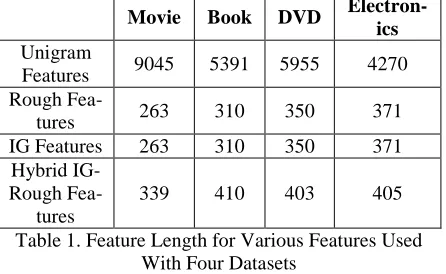
and proposed hybrid feature selection algorithm are called Rough features, IG features and Hybrid IG-Rough features respectively. Feature vector lengths for various features used for sentiment classification of different datasets are shown in Table 1. In the experiments, Firstly, RSAR algo-rithm is applied to get the best optimal feature subset. Further, according to the feature subset size obtained from RSAR method, threshold is set for IG based to get the feature vector, which is further used for classification. Experiments are conducted in this way so that results of Rough features and IG features can be compared.
Movie Book DVD Electron-ics
Unigram
Features 9045 5391 5955 4270 Rough
Fea-tures 263 310 350 371 IG Features 263 310 350 371
Hybrid IG-Rough
Fea-tures
[image:4.612.312.547.162.444.2]339 410 403 405
Table 1. Feature Length for Various Features Used With Four Datasets
Experimental results show that both feature selec-tion methods (RSAR and IG) are able to improve the performance from baseline (as shown in Table 2). For example from Table 2, F-measure is in-creased from 84.2% to 85.9% (+2.1) and 85.6% (+1.6) for Rough features and IG features respec-tively with SVM classifier when movie review dataset is considered. Similarly, when electronics dataset is used, SVM classifier increased the per-formance from 76.5% to 82.9% (+8.3) and 81.1% (+6.01) for Rough and IG features. It is due to the fact that RSAR algorithm removes the redundan-cy and selects the prominent feature subset, and IG selects the top ranked features by its im-portance to the class attribute.
When hybrid features selection approach is used for movie review dataset, F- measure is increased from 84.2% to 87.7 (+4.15) for SVM classifier as given in Table 1. Hybrid IG-Rough features gives better classification results as compare to other features with very small feature vector length. It is due to the fact that IG in its first phase elimi-nates the irrelevant and noisy features and in se-cond phase RSAR algorithm decreases the redundancy among features and extracts the op-timal feature subset. By combining both the methods, a more robust feature selection method
is developed for sentiment classification which is more efficient in selecting optimal feature set for massive dataset. Because when dataset size would be very large, RSAR algorithm will take much time and IG algorithm would be having problem of large feature size and pre-setting the threshold value. Uni-gram Fea-tures rough Fea-tures IG Fea-tures Hybrid IG-Rough Fea-tures Movie
SVM 84.2 85.9 (+2.1)
85.6 (+1.6)
87.7 (+4.15)
NB 77.1 78.7 (+2.1) 78.6 (+2.0) 80.9 (+4.9) Book
SVM 76.2 78.0 (+2.3)
77.0 (+1.0)
80.2 (+5.2)
NB 74.4 74.9 (+0.1) 76.3 (+2.5) 79.1 (+6.3) DVD
SVM 77.3 80.4 (+4.0)
79.1 (+2.3)
83.2 (+7.6)
NB 74.2 76.5 (+3.1) 75.1 (+1.2) 78.1 (+5.2) Elec-tronics
SVM 76.5 82.9 (+8.3)
81.1 (+6.0)
83.5 (+9.1)
NB 74.9 75.5 (+0.1)
75.2 (+.04)
78.1 (+4.2) Table 2 F-measure (in %) for various features with
four datasets
5
Conclusion
[image:4.612.73.296.240.377.2]References
Alexios Chouchoulas, Qiang Shen, “Rough set-aided key- word reduction for text categorization”, Applied Artificial Intelligence, Vol. 15, No. 9, pp. 843-873. 2001.
Basant Agarwal, Namita Mittal, “Categorical Probabil-ity Proportion Difference (CPPD): A Feature Selection Method for Sentiment Classification”, In Proceedings of the 2nd Workshop on Sentiment Analysis where AI meets Psychology (SAAIP), COLING 2012, pp 17–26, 2012.
Basant Agarwal, Namita Mittal, “Optimal Feature Se-lection Methods for Sentiment Analysis”, In 14th In-ternational Conference on Intelligent Text Processing and Computational Linguistics (CICLing 2013), Vol-7817,pp:13-24, 2013.
Bo Pang, Lillian Lee. “Opinion mining and sentiment analysis”, Foundations and Trends in Information
Retrieval, Vol. 2(1-2):pp. 1–135, 2008.
Bo Pang, Lillian Lee, Shivakumar Vaithyanathan, “Thumbs up? Sentiment classification using machine learning techniques”, In the Proceedings of the Con-ference on Empirical Methods in Natural Language Processing (EMNLP), pp. 79–86. 2002.
Bo Pang, Lillian Lee, “A sentimental education: sen-timent analysis using subjectivity summarization based on minimum cuts”, In the Proceedings of the Associa-tion for ComputaAssocia-tional Linguistics (ACL), 2004, pp. 271–278. 2004.
John Blitzer, Mark Dredze, Fernando Pereira, “Biog-raphies, Bollywood, Boom-boxes and Blenders: Do-main Adaptation for Sentiment Classification”, In Proc. Assoc. Computational Linguistics. ACL Press, pp 440-447, 2007.
Richard Jensen, Qiang Shen, “Fuzzy-Rough Sets As-sisted Attribute Selection”, In IEEE Transactions on
Fuzzy Systems, Vol. 15, No. 1, February 2007.
Richard Jensen, Qiang Shen, “A Rough Set-Aided System for Sorting WWW Bookmarks”. In N. Zhong et al. (Eds.), Web Intelligence: Research and Devel-opment. pp. 95-105, 2001.
Richard Jensen, Qiang Shen, “New Approaches to Fuzzy-Rough Feature Selection”, In the IEEE Trans-actions on Fuzzy Systems, vol. 17, no. 4, pp. 824-838, 2009.
Richard Jensen, Qiang Shen, “Webpage Classification with ACO-enhanced Fuzzy-Rough Feature Selection”,
In the Proceedings of the Fifth International Confer-ence on Rough Sets and Current Trends in Computing (RSCTC 2006), LNAI 4259, pp. 147-156. 2006
Richard Jensen, Qiang Shen “Fuzzy-Rough Attribute Reduction with Application to Web Categorization”.
In theTransaction on Fuzzy Sets and Systems 141(3),
pp. 469-485. 2004.
Songbo Tan , Jin Zhang “An empirical study of senti-ment analysis for chinese docusenti-ments”, In Expert
Sys-tems with Applications , pp:2622–2629 (2008).