Munich Personal RePEc Archive
Electrification in the Pacific Northwest
and Problem of Embeddedness
Green, Mitchell
Franklin Marshall College
12 November 2014
Online at
https://mpra.ub.uni-muenchen.de/59874/
Electrification in the Pacific Northwest and the Problem
of Embeddedness
Mitch Green
November 12, 2014
Abstract
The surplus approach of classical political economy is applied to the problem of
qualitative change in the social provisioning as concerns the Pacific Northwest. Two
features of the surplus approach, 1) emphasis on structural interdependence and 2) the
Sraffian notion of ‘viability’, allow for the economic history of the Pacific Northwest to be recast as a problem of embeddness. It is argued that two distinct provisioning
processes were embedded in two societies, and viability of each is mutually inconsistent
with the other. That is, capitalist use of the Columbia River watershed undermined the
viability of the non-capitalist provioning process that precedes it, in which indigenous
groups were central. Taking the social relation as the unit of analysis qualititive change
is examined with reference to the electrification of the region, and the subsequent
1
Introduction
Before the emergence of capitalism in the Pacific Northwest there was a social provisioning
process in which the Columbia River was central. From the end of the last ice age until
recently indigenous groups interacted directly with the river and the watershed that drained
it, provisioning themselves through a mix of salmon production and other hunter-gatherer
techniques. Complex kinship networks connected indigenous peoples of the region and
em-bedded them in a social fabric in which the institution of gift exchange was central1
. At the
center of this institutional fabric was the Columbia River and the ceremonial reproduction
of the salmon.
This system was viable in the classical since. A system is viable if it can reproduce
its own conditions of existence. The objective relations of production are organized so
they reproduce themselves within the system, with or without a surplus. In the ‘surplus
approach’(Cf. Chiodi, 2012; Mongiovi, 2011, Lee, 2012) viability of the simplest circular
production system can be expressed formally as
a+c!1 (1)
1 (a+c) 0 (2)
where a2(0,1) is the quantity of salmon used as a means of production per unit of salmon
produced, and c 2 (0,1) the quantity of salmon used as sustenance of persons engaged
in the production of production, as well as that used for gift exchange2
. Obviously, the
provisioning process was more complicated than suggested by equations (1) and (2). The
point here is to demonstrate that while the gift exchange economy in which tribal groups of
the Pacific Northwest were central was viable for several millenia following the last ice age,
1
Lichotawich (1999) provides a broad overview. Hunn (1990) provides a detailed analysis of the Mid-Columbia Indians with regard to the gift. The Lower-Mid-Columbia groups are studed in Hajda (1984).
2
it was rendered unviable as the region became increasingly incorporated into the capitalist
system. How did this happen?
Capitalists from the east managed to change the provisioning process so that it no longer
reproduced itself as an embedded process within the social system of the native Americans
of the Pacific Northwest. Because some persons embedded in capitalist social networks were
able to exert their agency over the region as whole, a new set of productive relations took
root that rendered the old system unviable. One of the central moments in this process
was the advent of the railroads and the capital that emerged with it in the region. Once
this capital structure was in place, those that sought to maintain its viability went to work
to incorporate other social technologies, such as electricity, in the process of creating and
maintaining markets in the region. This article examines the emergence of the electric utility
closely, because electricity will continue to play an important role in the transformation of
the regional economy in the 20th century. This analysis relies upon a relational approach so
that the electric utlity must always be taken in relation to factors immediately connected
to it, namely the railroad - finance nexus and the Columbia River basin in which all of this
unfolds historically. A schemeta of these relations are given below.
SP PG SP PC
Indigenous ⌧ Columbia ⌧ Settlement
& . & .
Salmon Electricity
(3)
In the economic system that precedes capitalism (SP PG) the provisioning process is
embed-ded in a society in which gift exchange and ceremonial reproduction of salmon are central.
In the capitalist economy that follows (SP PC) the provisioning process is embedded in a
service of the production and distribution of commodities. Accordingly, the relations that
govern the production and distribution of the surplus are determined on the basis of the
in-stitutional fabric in which the economy is embedded. In the Pacific Northwest white settlers
were granted property rights at the expense of previous institutions governing communal
use.
In the modern era the industrial economy determines, largely, the process by which the
river-region relationship is socially constructed to reflect the view that the Columbia ought to
serve as a great hydrological engine. The Federal Columbia River Power System (FRCRPS)
emerges as a set of multi-purpose dams that have reduced the once mighty Columbia into
a series of slow moving lakes. The Bonneville Power Administration, in concert with the
Army Corps of Engineers and the Bureau of Reclamation operate the Columbia so that it
functions, to use Richard White’s language, as an “Organic Machine” (1996). The organic
machine rationalizes and governs an electric utility industry that emerged from the capitalist
development of the region. Because we are interested in the question of qualitative change
in the social provisioning process in relation to the Columbia River, we enter the economic
history of the region by reference to the electric utility and examine how the men that built
and controlled these institutions acted in an institutional capacity, while embedded in a
social fabric.
2
Embeddedness and Change in the Social
Provision-ing Process
To begin with a discussion of power it is useful for the economist to conceptualize the
relation-ship between the embedded individual and the networks in which the person is embedded.
Changes in the social provisioning process to such a degree as that which we have witnessed
in settling the West, introducing commodity production for the sole purpose of realizing
central, involve a process whereby unequal power relations are brought to the fore (Robbins,
1994). In our quest to engage in a social theory that avoids the methodological errors of
re-ductionism, essentialism, reification and functional teleology (Sibeon, 2004), we may proceed
by conceiving of the problem as a relationship between social structure on the one hand and
agency on the other. The institutional fabric conditions, mediates, and gives form to the
social provisioning process; wherein individuals carry out their economic life process, acting
upon these structures and affecting reproduction. Power emerges as embedded individuals
realize the capacity to exert a disproportionate effect upon the reproduction of social
struc-tures relative to others, by leveraging their privileged positions at the central juncstruc-tures of
intersecting social networks.
2.1
On the embedded individual
In exploring how the concept of embeddedness contributes to the development of the
struc-ture – agency problem in social theory, John B. Davis in The Theory of the Individual,
writes:
to say that individuals are embedded in historical social relationships is quite close to saying that individuals disappear into those relationships. Indeed, many would argue that the embedded individual conception is not a conception of individuals at all, but rather a proposal to ignore individuals, in order to focus on groups, classes, movements, historical forces, history, and so on. According to this interpretation, in fact, rather than there being two traditions of thinking about the nature of the individual, there are really just two great traditions of thinking about society - one that is individualist and includes individuals as agents, and one that is collectivist in which it is not individuals that are agents but instead groups, classes, movements, etc. (2013, pg. 123)
Davis points out an important problem for the economist: how do we theorize about the
relationship between the individual and society without veering our analysis toward the
polar extremes of methodological individualism and methodological collectivism? One way
out of the dilemma is to seek to understand how the embedded individual affects the social
emergent outcome of the complex interaction of a range of social and institutional forces. In
doing so, we question how some individuals have the capacity to condition the evolution of
the institutional fabric whereas others do not. Such differences in so-called “agency” cannot
be reduced to the individual nor can they “disappear” into the social structure.
One challenge facing this analysis is the confusion in usage of the term embeddedness.
While it would be redundant to reproduce the work of a number of scholars that have
surveyed the literature on embeddedness, it is important that we define our usage and
un-derstanding of the term here to avoid further confusion of the issue (Cf. Krippner and
Alvarez, 2007; Dale 2011). Defining what embeddedness means in the context of the
capital-ist transformation of the Pacific Northwest requires that we engage some of these differences
in both the various strands of heterodox economics and economic sociology.
Krippner and Alvarez (2007) distinguish between approaches to embeddedness that
fol-low in either the Polanyian (1944) or Granovetterian (1985) traditions among economic
sociologists. When used as an analytical device for examining the degree to which the
econ-omy becomes embedded in or disembedded from the social, the research question follows
in the Polanyian tradition and is directed toward resolving macro-level problems; the
Gra-novetterian tradition focuses on micro or meso-level phenomena situated in social networks
(2007, pg. 221). For Krippner and Alvarez either approach serves as a “powerful platform
for launching a critique of neoclassical economics but is much less useful when turned
to-ward the task of developing a positive research program for economic sociologists” (2007,
pg. 221). Hence, insofar as embeddedness establishes the foundation for a research program
in economic sociology it fails in providing coherence and internal consistency apart from its
criticism of Homo economicus.
Supporting Krippner and Alvarez (2007), Dale (2011) argues that Granovetter (1985)
has cast the problem of embeddedness as a problem of economic action, situating the atomic
individual in a relational context in which social relations give meaning to action. By doing
established by Polanyi.
For our purposes here we are not so much interested in resolving the tension in divergent
approaches to embeddedness. Rather, in using the concept of embeddedness we acknowledge
that in our analysis of the cumulative development of the social provisioning process, we
must begin by situating those elements of the institutional fabric that are conceived of as
“economic” as mutually constitutive of the institutional fabric. The institutional fabric can
be analyzed in a relational manner, suggesting a role for the Granovetterian tradition a la
social network analysis, as well as from the Polanyian tradition of critiquing the liberal thesis
of the ontologically prior economy, as an analytic category with independent meaning. To
the extent that we employ embeddedness in the Polanyian fashion, we reject the notion of the
disembedded economy as a concept devoid of meaning (Cf. Beckert, 2007; Block, 2001, 2003;
Jessop, 2001; Krippner, 2001; Somers and Block, 2005; and Dale, 2011). Markets do not exist
in the absence of social systems and do not operate independent of them. Therefore, they
are always embedded in a nexus of social relations. Integrating the concept of embeddedness
with the understanding of the economy as a social provisioning process, allows us to envision
provisioning from an historically contingent vantage; the interplay between structure and
agency are seen as the moment at which the evolutionary process unfolds. The concept of
the embedded individual acting within an institutional framework enables analysis that does
not run afoul of Roger Sibeon’s four cardinal sins of social theory: reductionism, essentialism,
reification and functional teleology (2004).
3
Emergence of the Electric Utility Industry
Markets for electricity and electric products emerged toward the close of the 1870’s. At its
inception, electricity was developed for use in illumination. On-site or isolated systems for arc
lights were installed as early as 1878. While impractical for use in the modern experience, arc
illuminated commercial intersection, whose source of power was unseen. More marvelous was
Edison’s incandescent light, which did not burn and flicker as the arc light’s carbon filament
did when it shone. The warm, steady glow of the Edison light symbolized a progressive,
peaceful and clean view of the future (Nye, 1990). Homes, streets, and factories could be lit
by a device that safely contained the smoot and smog of the industrial city, keeping it away
from the daily experience of the modern city dweller. And light was just the beginning - with
electricity the future was ours to make and render submissive. The first act of controlling
Nature through fire was thought to have been completed and perfected with the electric light.
Consistent with the prevailing ideology of the day, technological achievement enshrined in the
electric light was hailed as yet another step toward to the ascension of man to its teleological
end (Cf. Spencer, 1851).
By the 1920s electricity had become big business. However, from 1880 to 1925, a period
marked by rapid growth, the new industry would settle into instituted norms concerning the
specific manner in which electricity would be provisioned and for whom it would generate
claims on the surplus. A number of possibilities would be settled: a) the type of technology
employed, b) market boundaries, and c) market governance.
A thoroughgoing analysis of the electric utility industry is not of primary interest to this
article. Rather, the focus lies in the interrelations between the utility, the railroads, and the
Columbia River basin. Men of railroads and finance played a significant role in recreating
the provisioning process in the Pacific Northwest (Green, 2014). The railroads in the region
provide a convenient entry point to this analysis, because the corporations involved and the
men who controlled them embodied the main thrust of the modern business enterprise. The
electric utility is nearly indistinguishable from the railroads with respect to the structure,
conduct and performance of the going concern. Railroads and utilities rely upon a large
complement of plant and equipment, and are governed by the same logic of the machine
process. The goodwill capital in each case emerges from the exclusive right of the going
is governed by the same businessmen, both in class and cohort. The social networks that
controlled the railroads also shaped the development of the electric utility, by capturing the
technology and shaping the development of its initial market boundaries.
3.1
The Railroad Roots of the Electric Utility
The development of the electric utility mirrors that of the railroads in terms of the social
construction of its markets. Such similarity should not be a surprise as it is clear that the
utility emerges from the same set of networks as the railroads. Figure 1 provides a glimpse
at the extent to which eastern financiers would direct the affairs of the railroads. The very
financial institutions, and in some cases particular financiers, went on to develop the electric
utilities. Most notable for our purposes here are J. P. Morgan and Henry Villard.
The House of Morgan was deeply involved with a range of financial matters of concern
to the railroads. Junius Morgan, through George Peabody, had dealt in railroad securities
during the 1850’s. Pierpont Morgan, with Morgan & Co. and Drexel, Morgan, acted as
financier to the Union Pacific as early as August 1869. According to Vincent Carosso (1987),
Morgan’s “long association with the [UP] provides a good illustration of the many different
types of financial transactions with which [the Morgans] concerned themselves.” Morgan
was instrumental in moving the railroad business toward greater coherence amongst their
interconnected balance sheets. In regards to systemic insolvencies facing railroads in the
1880s, Morgan reorganized the Philadelphia & Reading, Baltimore & Ohio, and Chesapeake
& Ohio systems, to name a few (Carosso, 1987).
The financial fragility that grew up with the extensive liability issues of the railroads,
“gave Morgan the authority to achieve the financial stability and orderly development of
railroad properties which the ‘gentlemen’s agreements’ had failed to attain” (Carosso, 1987).
J. P. Morgan hosted meetings in December, 1888 and January, 1889 to discuss the
estab-lishment of what would become the Interstate-Commerce Railway Association (Grodinsky,
Figure 1: Financial control of major railroads 1872-1894. Node scale is arbitrary. However, large nodes indicate either business enterprise or important financiers. Directors: 1. Henry Villard, 2. Frederick Billings, 3. Jay Gould, 4. Frederick Ames, 5. Oliver Ames, 6. Russel Sage, 7. Sidney Dillon, 8. Thomas Baring, 9. William S. Ladd, 10. William Endicott, Jr. Railroads: Missouri Pacific (MP), Northern Pacific (NP), Atlantic and Pacific (AP), Union Pacific (UP), Chicago and Northwestern (CNW), Chicago, Burlington and Quincy (CBQ), Burlington and Missouri (BMRR), Missouri Central (MC), and Atcheson, Topeka and Sante Fe (ATSF).
during the emergence of the electric utility industry, and would play a central role in its
development.
3.2
Villard and Edison
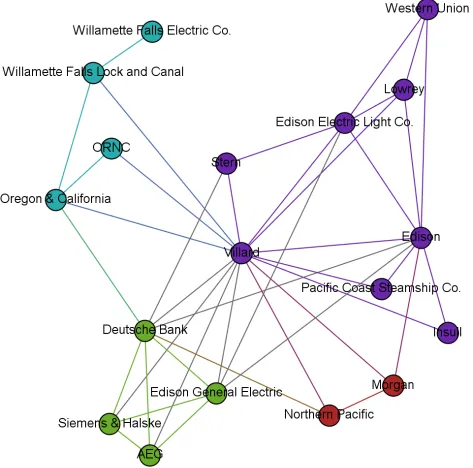
The electric utility bears a direct connection to the social networks in which Henry Villard
was embedded, whether we consider the emergence of the industry as a whole or the PNW
in particular (see Figure 2). Villard enters prominently in the history of the region. A
railroad concern in the Willamette Valley of Oregon had issued extensive liabilities to a
group of German bondholders in the early 1870s. After a default in 1873 a bondholder
protection committee was formed, and Villard was dispatched to Oregon to actively manage
the concerns obligated to make coupon payments on the outstanding liabilities. From 1874
onward Villard would exert his influence in the development of the region. Thus, relationships
between Villard and other parties outside the region are central to the analysis (see Green,
2014 for a more detailed account of Villard’s activities in the region). As early as 1879
Villard was in contact with Edison concerning the development of electricity for commercial
application (Buss, 1978). Villard was an early stockholder and director in the Edison Electric
Light Company.
The relationship between Edison and Villard was first established and introduced through
Grosvernor P. Lowrey, who served as general counsel for the Western Union telegraph, and
became quite acquainted with Thomas Edison as a result of extensive litigation surrounding
the issue of patent infringements (Buss, 1978). Lowrey and Villard met in conjunction
with the Kansas Pacific Railroad having been placed into receivership in 18783
. Given the
significant claims on the Kansas Pacific held by Frankfurt bondholders, Villard was sent to
receive the railroad, at which time Buss (1978) suggests the two likely discussed Edison’s
work, who by then was “something of a public prodigy for his invention of the phonograph
and stock market printing telegraph.” This connection proved to be important because
3
it was Lowrey that organized the interests at Western Union to subscribe funds for the
incorporation of Edison Electric Light Company in 1878. This initial capitalization provided
for the construction of Edison’s lab at Menlo Park.
In January, 1880 Villard had plans to join the interests of Edison with those of the
elec-trical equipment firms in Germany (Buss, 1978). Villard approached Lowrey to suggest the
exploitation of Edison’s patents throughout Europe, to which Lowrey was amiable4
. On
January 2, 1880 Lowrey wrote Edison to introduce the scheme5
. Provided Lowrey could
se-cure Edison’s support Villard planned to sell rights to Edison’s patents in Germany, Austria,
Russia, France, Italy and Spain for $450,000 in total. Villard would market these to Jacob
Stern, a well-connected Frankfurt banker. While Stern was less optimistic than Villard he
was willing to consider negotiating the sale of patent rights for Germany and France,
pro-vided the inventions that underlie their patents proved serviceable (Buss, 1978). In another
letter dated January 18, 1880, Lowrey informed Edison that he had arranged for a meeting
with Villard regarding the financing of Edison’s interests in Europe. Lowrey advised Edison,
“if you send him to me I think I can do very well for you...Drexel Morgan and Company were
not liberal enough.6
” Indeed domestic financiers during this period, especially with regards
to the emerging electric technology, were more reluctant than their European counterparts to
finance large ventures (McGuire, Granovetter, and Schwartz, 1993; Wilkins, 1989; Carosso,
1987)7
.
While in control of the Oregon Railway and Navigation Company (ORNC), Villard
com-missioned the S.S. Columbia and installed an Edison system so that he may introduce
Port-land to the possibilities of electric light (Hirt, 2012; Villard, 1904; Robley, 1938; Wollner,
4
Lowrey to Thomas Alva Edison (TAE), 2 Jan. 1880 (TAED D8026)
5
In the letter dated January 2, 1880 Lowrey refers to Villard as “a gentleman who is in intimate relations with some of the most important financial people in Germany.” Since Villard was on the board of directors for Edison Electric Light Company it is rather strange that he is not referred to by name.
6
Lowrey to TAE, 18 Jan. 1880, (TAED D8026)
7
Figure 2: Villard and Edison: 1879 - 1889
1990). Villard’s “Brilliant Spectacle”, as Paul Hirt terms it, was the first commercial
appli-cation of Edison’s system. According to Buss (1978) “Villard persuaded Edison to design an
incandescent lighting system for the vessel despite the protest of [John Roach, the shipright,]
and the objections of the marine underwriters association who feared a malfunction in the
system would set the ship ablaze.8
”Later, Villard would solicit the development of an electric
engine for use in freight rail, as he envisioned electric motors driving the system of feeder
lines for the Northern Pacific.
After Villard’s financial troubles following the downturn of 1883, he focused more on the
process of developing Edison’s central stations (Buss, 1978). Villard would later organize
the Edison General Electric Company, using the financial resources he had cultivated in the
Duetsche Bank. Using his connections in international financial circles, Villard was able
to facilitate investment between Edison and German electric interests. Villard managed to
placed Edison patents in Germany, as well as German investment in New York for a cable
plant that would serve as an input into the Edison system domestically.
After Villard’s resignation from the Northern Pacific, resulting from a combination of
mismanagement and tight credit following the recession of 1882, he left for Europe in the
spring of 18849
. However, Villard remained connected with Edison Electric Light Company
during this sojourn. While in Europe he cultivated his financial relationships with German
bankers, most notably, those connected with the Deutsche Bank, which included Jacob Stern
and Werner Siemens. According to Buss (1978) it was Villard’s association with Edison that
allowed him to establish a business relationships with Werner Siemens. Werner Siemens, as
well as brothers Friedrich, Karl and Wilhelm, had established considerable interests in the
production of electric cables. In addition, the Siemens brothers had established an
inter-8
See also Villard (1904, pg. 290).
9
European telegraph network (Buss, 1978). Meanwhile, Siemens and Halske had diversified,
building the first electric train in 1879. Villard also cultivated a relationship with George
Siemens of the Deutsche Bank beginning a period in which Villard would act as intermediary
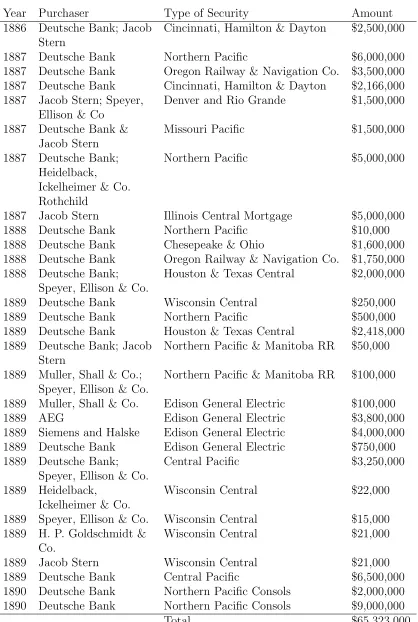
for German investment in US interests. See Table 1 delineating Villard’s promotional work
resulting in over $65 million dollars of securities purchased by the Deutsche Bank in US
railroads, and later Edison General Electric.
According to Wilkins (1989) there were two main firms in Germany that dominated the
industry of electrical equipment manufacture. These were Siemens and Halske and Deutsche
Edison Gesellschaft (formed in 1883 by Emil Rathenau). Deutsche Edison Gesellschaft
changed its name in 1887 to Allgemeine Elektrizitats Gesellschaft (A.E.G). George von
Siemens was chairman of the board of A.E.G, and was also a director at the Deutsche Bank.
George von Siemens was a cousin of Werner von Siemens of Siemens and Halske. Hence,
the two firms were connected via family relations. Villard was connected to each. Both
firms jointly owned patents on Edison’s technology in Germany, as result of an 1883 accord
between the two firms intended to bring about harmony in the German market (Wilkins,
1989)10
.
Villard planned to seize control of Edison interests in America and form the basis of
an international cartel centered in Germany (Wilkins, 1989)11
. Returning to the United
States in 1886 Villard acted as representative of the Deutsche Bank, charged with “exclusive
production rights” for the Siemens cable business (Wilkins, 1989). The idea was that Edison
interests in the United States and electric interests in Germany would be joined, through
the exchange of patents. Edison patents were in use in Germany while Siemens and Halske
patents would be used in United States. In this way, the two communities of interest may
10
Siemens and Halske was the largest single shareholder in A.E.G at the time of its founding. Wilkins (1989) notes that according to Buss (1978) Edison’s sojourn to Germany in 1884 was “ostensibly to market Edison generating plants.” However, apparently Villard used “Edison’s name to establish a relationship with Werner von Siemens of Siemens and Halske and Emil Rathenau of Deutsche Edison Gesellschaft at the same time renewed his earlier acquaintances with George von Siemens.” In 1887 Villard participated and assisted in the process which transformed Deutsche Edison into A.E.G, at which time the latter was wholly independent of American Edison interests.
11
be joined together in an international market. Given the high cost of imports in the United
States, Villard suggested that Siemens and Halske invest in the production of a US-based
plant to produce the cables. In April 1887 he was busy working out arrangements for such a
scheme. Villard intended for production of Siemens and Halske cables to be undertaken by
an Edison enterprise. As Villard returned to Germany in 1888 to report these developments
to Siemens and Halske, a new strategy emerged, whereby the German interests would seize
control of the Edison interest in the U.S (Wilkins, 1989). Because Edison in 1889 was starved
for liquidity, he was amenable to Villard’s suggestion that Edison interests be consolidated
under a new firm known as the Edison General Electric company. Buss (1978) notes that
$8.3 million out of the $12 million capitalization of the new Edison General Electric firm
represented investments from the German interests (see Table 1). After the reorganization,
Villard emerged as president of Edison General Electric. Once in control, he brokered the
ratification of the Siemens and Halske cable factory contract (Buss, 1978)12
.
3.3
Villard and the Central Station
Villard championed Edison’s central station concept (Buss, 1978; McGuire, 1986). In a letter
to Siemens and Halske dated April 5, 1887, Villard described his work promoting the central
stations (Buss, 1978). Villard stated that his promotional activities included the cities of
New York, Philadelphia, Boston, Washington, Cleveland, Chicago, St. Paul, Minneapolis,
and Denver. Whereas domestic financiers were reluctant to finance the development of the
electric utility industry around the central station concept, Villard and other German finance
capitalists provided support (McGuire, Granovetter, and Schwartz 1993; Carosso, 1987;
12
Table 1: German investment in U.S. securities resulting from Villard’s promotional work
Year Purchaser Type of Security Amount
1886 Deutsche Bank; Jacob Stern
Cincinnati, Hamilton & Dayton $2,500,000
1887 Deutsche Bank Northern Pacific $6,000,000
1887 Deutsche Bank Oregon Railway & Navigation Co. $3,500,000
1887 Deutsche Bank Cincinnati, Hamilton & Dayton $2,166,000
1887 Jacob Stern; Speyer, Ellison & Co
Denver and Rio Grande $1,500,000
1887 Deutsche Bank & Jacob Stern
Missouri Pacific $1,500,000
1887 Deutsche Bank; Heidelback, Ickelheimer & Co. Rothchild
Northern Pacific $5,000,000
1887 Jacob Stern Illinois Central Mortgage $5,000,000
1888 Deutsche Bank Northern Pacific $10,000
1888 Deutsche Bank Chesepeake & Ohio $1,600,000
1888 Deutsche Bank Oregon Railway & Navigation Co. $1,750,000
1888 Deutsche Bank; Speyer, Ellison & Co.
Houston & Texas Central $2,000,000
1889 Deutsche Bank Wisconsin Central $250,000
1889 Deutsche Bank Northern Pacific $500,000
1889 Deutsche Bank Houston & Texas Central $2,418,000
1889 Deutsche Bank; Jacob Stern
Northern Pacific & Manitoba RR $50,000
1889 Muller, Shall & Co.; Speyer, Ellison & Co.
Northern Pacific & Manitoba RR $100,000
1889 Muller, Shall & Co. Edison General Electric $100,000
1889 AEG Edison General Electric $3,800,000
1889 Siemens and Halske Edison General Electric $4,000,000
1889 Deutsche Bank Edison General Electric $750,000
1889 Deutsche Bank; Speyer, Ellison & Co.
Central Pacific $3,250,000
1889 Heidelback, Ickelheimer & Co.
Wisconsin Central $22,000
1889 Speyer, Ellison & Co. Wisconsin Central $15,000
1889 H. P. Goldschmidt & Co.
Wisconsin Central $21,000
1889 Jacob Stern Wisconsin Central $21,000
1889 Deutsche Bank Central Pacific $6,500,000
1890 Deutsche Bank Northern Pacific Consols $2,000,000
1890 Deutsche Bank Northern Pacific Consols $9,000,000
Wilkins, 1989). Morgan envisioned the development of the industry around the notion that
electric products would be sold as commodities, and that markets boundaries would reflect
proprietary claims on the patents underwriting such technology. Electric manufacturing
firms would buy the right to lease the patents for defined terms, thereby generating a flow
of income that may then be capitalized.
Edison, Insull and Villard sought to market electricity itself as a commodity. Centralized
production and distribution of electricity through, what would later be known as the utility,
offered a mechanism through which the new markets might be governed. Like the railway
empire Villard built in the PNW, the central station would pursue an aggressive growth
strategy, seeking to place itself at the center of a large network of financial flows related
to the provisioning of electricity. The transmission and distribution grid, like the network
of steel and wooden ties in the case of the railroads, would fix in space the boundaries of
the market. The business enterprise engaged in electricity provisioning along the central
station model would capitalize the load growth of cities within these boundaries. Further,
through the use of market governance institutions, the holding company in particular, it
could connect many urban systems into great, regional empires. To this end, the promise
of business enterprise exemplified in the central station concept was nearly indistinguishable
from that of the railroad corporations of the late 19th century.
3.4
The North American Company
The North American Company, one of the most important public utility holding companies
in the 20th century, was a creature of Villard’s and evolved from his earlier use of the holding
company as a market governance institution in the PNW. Villard had gained control of the
transportation and navigation situation in the PNW by leveraging his social network via
the “Blind Pool” (Hedges, 1930). However, to ensure ongoing control of both the Northern
Pacific and his own ORNC he incorporated the Oregon and Transcontinental Company
provided the legal right to hold stocks in other corporations prior to 1888, however, this
did not prevent Villard and others from seeking special legislative favors to enable them
to do so13
. Villard did experiment with other forms of market governance, such as traffic
pooling agreements. However, traffic agreements are typically not an enduring form of
market governance (Bonbright and Means, 1932). Since Villard was determined to ensure
that Portland would be the terminus for the transcontinental railroad in the region (Hedges,
1930; Villard, 1904; Buss, 1978; Grodinsky, 1962), he sought firmer control over the Northern
Pacific.
The holding company offered a mechanism through which control of large corporations
could be established with a minimum stake in the subsidiary concerns. Moreover, the Oregon
and Transcontinental charter allowed for a rather broad scope of market activity, to include
production of the primary commodity groups that would serve as the basis of its freight
traffic, such as agriculture, mining and lumbering. Indeed, Villard’s Oregon Improvement
Company was itself a holding company engaged in these activities, and was held by the
Oregon and Transcontinental Company. However, with the emergence of the electric utility,
his holding company system would evolve to conform with the pursuit of encapsulating this
13
The legitimacy for a concern to hold stocks in another company prior to 1888 was not explicitly provided for under the general incorporation acts in any state (Bonbright and Means, 1932). The implicit right to hold stock in other corporations was commonly referred to the courts. In 1888 New Jersey amended its general incorporation laws allowing explicitily for intercorporate stock holdings. Nevertheless, many holding companies did exist prior to 1888, sanctioned by “special favors of a legislature.” In 1868, the state of Pennsylvania granted the Continental Improvement Company the “full power and authority to hold and own securities of any form, either as collateral or otherwise, and to dispose of the same at pleasure” (Bonbright and Means, 1932). Bonbright and Means (1932) cite forty-one further instances between 1868 - 1872 in which holding companies were incorporated with identical favor as the Continental Improvement Company, and in many cases with the same language, for the same set of incorporators.
new technology under his corporate control.
In 1890 the Oregon and Transcontinental Company was dissolved in Oregon and
reorga-nized as the North American Company for incorporation in New Jersey, which allowed for a
broader scope of market activities permissible to the going concern. In this example, it would
be inappropriate to think of the two enterprises as distinct going concerns. The capital (in
the Veblenian sense) embodied in the Transcontinental was not diminished as a result of the
new charter. The plant and equipment associated with the underlying properties remained
unchanged, and the going business was still going. The only difference was that new markets
became available to the going concern as a result of the new charter, as well as new social
relationships to be capitalized. The purpose of the North American Company was to pursue
the development and proliferation of Edison’s central stations in the Midwest, where he was
well known among the German immigrant population, and thus carried the goodwill for the
concern (Buss, 1978).
4
Electrifying the Northwest
Histories of electricity in the region often begin by recounting its first demonstration in
Portland, Oregon. This “Brilliant Spectacle” (Hirt, 2012) was thought to be the moment
at which consumers would demand electricity and thereby pass into modernity (Nye, 1990).
It is easy to read into this history an inexorable drive toward electrification. Indeed, the
possibilities for a clean and “bright” future seemed within reach (Nye, 1990), prompting a
progressive, utopian response14
. Yet, the new technology was always under the control of
interests vested in the reproduction of a pecuniary, proprietary society, so that whatever
technological marvel electricity promised the actual application would be limited in scope.
Only those applications that generate a profit and do not undermine the viability of the
14
economic system as a whole, will be undertaken. For our purposes it will be of interest to
show how the development of the industry in the PNW was connected to the legacy of Henry
Villard and the railroads he commanded.
Because the electricity industries are governed by business enterprise this analysis begins
earlier than Villard’s symbolic, techno-spectacle, opting instead to trace its emergence to the
corporate roots that precede it. The political economy conjuncture resulting from private
control of the region’s watershed, provided the germ for the emergence of a new resource:
hydroelectric power. While placing rivers into service as sources of power for the machine
process is not unique to the PNW, with Lowell, Massechussetts as the most obvious example
in U.S. economic history15
, its modern practice reflects the region’s peculiar, institutional
development. In particular, the struggle over control of the river for the sake of a going
navigation business produced the conditions under which the Willamette Falls at Oregon City
would become a site of economic importance. The growth and development of Portland’s
first central station began with the development of hydroelectric power at the Willamette
Falls, therefore a brief examination of the economic processes that transformed that space
into a resource is warranted.
During the period 1860 - 1880 the Oregon Steam Navigation Company (OSN) enjoyed
monopoly over river traffic into the Inland Empire16
, along the Columbia River and upper
Willamette River (Johansen, 1941). Demand for navigation services was fueled primarily by
Idaho’s gold rush in the early 1860’s (Cf. Scott, 1917). Goods and persons were transported
by the OSN to Wallula (the landing at present day Walla Walla, WA) along the Columbia,
then transported by mule train to the various mining districts (Johansen, 1941; Johansen
and Gates, 1967). At first the region was wholly dependent upon imports, but by the
15
The immigration pamphlets published by corporations such as the Oregon Railway and Navigation Company and Oregon Improvement Company, as well as the city of Portland, described the region as possessing the water power potential of Lowell, MA. The verity of these claims was irrelevant; immigrants from the East understood what Lowell had achieved by placing its waterways into industrial service. Aside from the occasional mill, the rivers of the Columbia basin remained largely ungoverned until the reclamation projects of the New Deal era.
16
Table 2: Freight rates per ton
Leg Distance Rate (ton)
Portland - The Dalles
121 miles $10.00
Portland -Umatilla
217 miles $20.00
Portland -Wallula
240 miles $25.00
Portland -Palouse
317 miles $32.00
Portland -Penewawa and Almota
348 miles $37.50
Portland -Lewiston
401 miles $40.00
Fast freight Portland - The Dalles $2.50 per
ton extra Portland - all points
above The Dalles
$5.00 per ton extra Source: Poppleton (1908)
mid 1870’s the production of wheat in the Inland Empire formed the basis of an export
business. Charging “all the traffic can bear,” the OSN generated sufficient revenues to
further consolidate ownership of the portages and docks, maintain its growing fleet, and
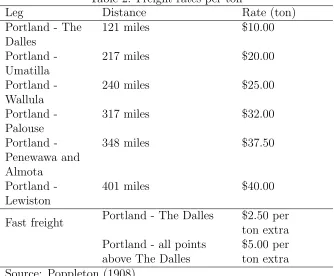
enrich its owners. Poppleton (1908) provides a glimpse of its rate structure effective April
1, 1877.
Compared to similar navigation concerns operating in the Midwest and Great Lakes
areas, OSN rates were unusually high. On average, the OSN’s rate per ton was ten times
that which prevailed on the Missouri, a notoriously dangerous river to navigate in the
pre-dam era (Poppleton, 1908). Whereas the OSN charged $40 per ton to move freight from
Portland to Lewiston, a distance of 401 miles, the same ton would travel 3,200 miles from
St. Louis, MO to Ft. Benton, MT.
Differences in convention help explain part of the regional divergence in rates. The OSN
maintained the convention among Columbia River steamboat captains to specify tonnage
three-dimension envelope in which the freight could be housed. For example, an ox cart would be
measured so that the length include the tongue fully extended, its height with the tongue
lifted vertically, and width calculated from wheel to wheel. The rule of thumb then yielded
one ton for each cubic feet of this notional envelope. Under no circumstances would volume be
deducted for empty space within the envelope. According to Poppleton (1908), this method
resulted in overestimates of weight by as much 300% when compared to practices in the
East. The geology of the Columbia River basin also added additional cost to navigation. At
various points along the Columbia, the river cuts through cascading falls, which prior to the
construction of a lock and canal system, required portage to make passage. Portage involves
transferring cargo to wagon teams, and later railroads, below the falls then transporting it
above the falls, where it is loaded on a new ship that continues unabated until it encounters
another obstacle. While Poppleton (1908) reflects the popular view that prevailed in the
1860s and 1870s that the OSN’s rates were almost all profit, Johansen (1941) points to the
high cost of portage as evidence that profit rates were probably lower than people imagined.
Nevertheless, the OSN’s rates were going concern prices: the mark up was sufficient to
reproduce the concern and generate a flow of income to its shareholders, sometimes as high
as 37% (Johansen, 1967), but usually around 12% (Poppleton, 1908).
Owing to the high cost of portage at the Willamette Falls (Oregon City) two concerns
endeavored to build lock and canal systems. In 1868 the People’s Transportation Company
built a crude, wooden system on the east side of the river. In the same year, a legislative act
provided for a state-subsidized corporation, the Willamette Falls Canal and Locks Company,
with the hope that prices might be regulated by competition (Robley, 1938; Stewart, 1950).
Large debts incurred in the construction of its canal, as well as the threat of a protracted rate
war between rival steam and rail concerns, resulted in the sale of the People’s Transportation
Company to Ben Holladay in 1871 (Wright, 1875; Villard, 1944). As discussed in Green
(2014), it was Holladay’s intention to control the railways in Oregon since his arrival in 1868.
with the hopes of renewing the goodwill embodied in his legal claim to the Oregon Central
Railroad’s (Cf. Hedges, 1930; Villard, 1944; Ganoe, 1924) land grant, required control over
the navigation business on the Willamette. However, by 1870 public opinion had soured
against Holladay and the Granger controlled legislature passed a bill that provided for further
subsidies to the Willamette Falls Canal and Locks Company, with the hope of dislodging
his control (Villard, 1944; U.S. War Department, 1899). It is important to emphasize that
the Grangers in Oregon viewed monopoly control over steamships, docks, and silos as the
source of their disadvantages, holding to the belief that market forces at the Liverpool grain
exchange would yield them a fair price (Cf. Buck, 1969; Carr, 1875).
The legal device that gave birth to the Willamette Falls Canal and Locks Company,
also spawned the creation of two concerns that would further threaten Holladay’s control:
Willamette River Transportation Company and the Farmers’ Dock and Warehouse Company.
Holladay promptly lowered rates in an effort to expel the contestants from the market, driving
the price below a sustainable level for the new concerns. The OSN joined Holladay on the
Lower Columbia17
(Villard, 1944).
In 1874 a comprise was struck between Holladay and Barney Goldsmith, who controlled
the opposing enterprises and acted as agent for the Willamette Falls Canal and Locks
Com-pany, so that all going concerns engaged in the Willamette navigation business were to
operate under a unified management, while the locks company would adopt the railroad
freight rates. Further, a system of subsidies between the concerns would be established to
level respective differences in cost.
However, the market governance agreement between Holladay and Goldsmith was foiled
as the OSN held that its pursuance would breach its previous agreement in 1863 with the
People’s Transportation Company, which divided the market (Villard, 1944; Johansen, 1941).
Per the agreement, the People’s Transportation Company would leave the Lower Columbia
market to the OSN, and vice versa regarding the Willamette. While Holladay purchased the
17
former concern in 1871, its going business remained intact. In this case the going business was
structured by the market division agreement with the OSN; should the agreement breakdown,
the web of financial relations that consitute the going business would begin to unravel.
In addition, state fiscal support to the Willamette Falls Canal and Lock Company was
insufficient to overcome the reduncancy of two competing canal concerns relative to the size
of the market, and so it would be absorbed by the larger, more solvent OSN. Holladay’s
navigation concerns, which by 1872 included the Oregon Steamship Company, would pass
into Villard’s control in 1876 while working in the interests of the Frankfort bondholders. In
1879, Villard organized the Oregon Railway & Navigation Company (ORNC), allowing him
to secure control of all railway and navigation concerns in the region, while freeing him from
the Frankfurt bondholders18
. The outcome was absolute control of the Willamette Falls,
which enabled him to initiate a process that would recreate the site as an electric resource.
In 1884 Villard, after he was ousted from the ORNC and the Northern Pacific, but
remaining in control of the Willamette Falls, commissioned a full survey of its waterpower
potential. In doing so, Villard sought to apply Edison’s technology controlled by the Edison
Electric Light Company to the property at the falls, which had become a resource as a result
of cumulative development of the institutional fabric. That is, a river does not naturally
yield power as a resource. To produce a resource requires a nexus of social and spatial
relations so organized that a proprietary relation may be conferred upon it, in conjunction
with the application of a specific technology (De Gregori, 1987).
On November 8th, 1888, Morey and Eastham, members of Portland’s business elite,
incorporated the Willamette Falls Electric Company. According to Wollner (1990), Easton
had formulated a plan to buy the Willamette Transportation Locks Company19
as early
as 1883, due to its monopoly on the falls. In 1887 he had purchased the rights sufficient
18
See Green (2014) for a detailed discussion of this reorganization.
19
Figure 3: Electric Utility Mergers in Portland, OR: 1884 - 1906
Vancouver Electric Light & Power Co. City - Eastside Electric Light Plant Albina Light & Water Co.
Union Power Co.
Portland Railway Co.
Oregon Water Power & Railway Co. U.S. Electric Lighting & Power Company
Willamette Falls Electric Co.
Portland General Electric
Portland Railway Light & Power Co. 1906 1893 1892
1905
1906 1906
1885
1888
1906
Source: MacColl (1976)
to grant him effective control over the Willamette Falls. Because the engineer’s report to
Villard had so thoroughly documented the enormous potential of waterpower at the falls,
Morey and Eastham were able to draw upon such accretion to the joint stock of knowledge20
.
On June 3rd, 1889, Willamette Falls Electric Company demonstrated the first long-distance
transmission of electricity from Oregon City to Portland using alternating current generation.
The Willamette Falls Electric Company was reorganized as Portland General Electric
in 1891. The new concern was capitalized at $4.25 million, most of which flowed from the
Old Colony Trust Company of Boston. The General Electric Company of Boston was also
a major investor in Portland General Electric (PGE), in order to establish ties between
Portland and the Boston firms so that the former would purchase equipment from the latter.
20
The Old Colony Trust Company, according to MacColl (1978), served as Boston’s “old
guard” financial institution21
.
The organization of PGE provides evidence in support of the claim that electric utilities
found roots in in the railroad - finance nexus. Frederick Ames, a director for the Old Colony,
was also a director at American Loan and Trust Co., as well as a number of important
railroads (see Figure 1, see Figure 4 for the Boston financial network in which Ames was
embedded). Henry Reed, secretary of the Lewis & Clark Centennial Exposition22
, reported
on July 7th 1904 that PGE had won the contract to suppy the Exposition with electric
current, valued at $82,000. Wollner (1990) dismisses the interconnections between PGE
executives23
, financiers, and the governance of the Exposition as superficial to the ongoing
development of the going concern. However, Wollner’s analysis is teleological, and the men
of electricity and finance in his corporate history of PGE are seen as heros, undertakers of
a progressive and inevitable technology. While PGE retained local control initially, when it
was incorporated into the Portland Railway, Light and Power Company (PRLP) 1906, such
control passed in the hands of Eastern capital24
. The controlling interest in PRLP lied in
the hands of the Clark family of Philadelphia. (MacColl, 1978). MacColl states that the
21
MacColl claims Boston as the center of high finance during the age in which the railroads, as well as the first great trusts in mining, textiles, and utilities, were most central. This claim is too ambitious: the financial center for these concerns encompassed networks that spanned Boston, New York, and Philadelphia in the U.S., as well as London, Berlin and Frankfort in Germany (White 2011; Wilkins 1987).
22
World fairs and expositions were a popular way to promote electrification. They were also platform from which to perpetuate the ideology of imperialism. The “Great White Way” in Chicago’s World Fair possessed double meaning: cities were white with illumination, with central boulevards emblazened with electric light, but the exhibitions were structured so that the brightest, and most central displays, were those of recent Western settlement and achievement in American history. Again, the Anglo-Saxon, Christian American was held up as the pinnacle of human achievement, whereas other cultures, both extant and extinct, were displayed so that they “dimmed” as they grew more distal to the center. Native American and African traditions were not illuminated at all and occupied the very edges of the expositions (Cf. Nye, 1990; Hirt, 2012).
23
At the time, Henry Goode was both president of the Exposition’s planning and governance board as well as Portland General Electric. Goode originated from the Northwest Thomson - Houston Company, which was strongly tied to Eastern financiers through Charles Coffin. James R. Thompson of Portland General Electric was also the fair’s electrical engineer (Wollner 1990). For a detailed account of the financial connections of the Northwest Thomson - Houston Company, regional subsidiary of the firm that would be merged with Edison General Electric to form General Electric, see the July 24th, 1895 issue of Electricity, a weekly publication.
24
Figure 4: Frederick Ames and Boston Finance circa 1891. Network constructed as union of two sets: the ego networks for Old Colony Trust Co. and American Loan and Trust Co., taken at two degrees of separation.
formation of the PRLP was “Portland’s first bona fide monopoly,” however, such a claim
is untenable given the Oregon Steam Navigation Company had consolidated total control
over river traffic as early as 1862 (Poppleton, 1908)25
. Figure 3 offers a summary of the
consolidation of Portland’s electric utilities between 1884 - 1906.
5
Conclusion
Marx (1852) remarked on the problem of cumulative development that, “[m]en make their
own history. . . under circumstances already existing, given and transmitted from the past.
The tradition of all dead generations weighs like a nightmare on the brains of the living.”
Considering the emergence of the electric utility in the Pacific Northwest in relation to the
Columbia River is an attempt to wake our brains from the nightmare. Tracing the roots
of the utility to its common roots with the railroad corporations that grew up with the
Columbia River trade, exposes the contingency surrounding alternate purposes for which a
watershed might be put to use. In doing so we expel an notion of universality or inevitability
governing the development of a social provisioning process.
The heterodox surplus approach, suggested by Lee (2012), focuses on the interplay
be-tween structure and agency. The surplus itself becomes the object of analysis, in which
decisions over its composition and magnitude provide a point of departure for a theory of
qualitative change as concerns economic systems.
Analyzing in detail social relationships, as we have done in the present article, centers the
analysis on agency as the locus of change. Agency is taken as contingent upon the historical
conditions in which it is socially embedded. Agency emerges as a relational phenomena.
In the 20th century the Columbia River basin becomes the site of large-scale public
works development for the sake of “reclaiming” a wasted river. The Columbia River that,
for 9,000 years, has served as a central part of the provisioning process for a gift economy,
25
becomes encapsulated within the capitalist machine process, rendering viable the production
of a new surplus as it destroys the viability conditions for another. Electrifying the region
with the organic machine builds upon the tradition ofsome generations - those of railroads,
References
Beckert, Jens. 2007. The Great Transformation of Embeddedness: Karl Polanyi and the
New Economic Sociology. MPIfG Discussion Paper.
Block, Fred. 2003. “Karl Polanyi and the Writing of the Great Transformation.” Theory
and Society 32 (3): 275–306.
Bonbright, James Cummings, and Gardiner Coit Means. 1932. The Holding Company. Its
Public Significance and Its Regulation, Etc. Pp. x. 398. McGraw-Hill Book Co.: New York & London.
Buck, Solon J. 1963. The Granger Movement; a Study of Agricultural Organization and
Its Political, Economic, and Social Manifestations, 1870-1880. Lincoln: University of Nebraska Press.
Buss, Dietrich G. 1978. Henry Villard: A Study of Transatlantic Investments and
Interests, 1870-1895. New York: Arno Press.
Carosso, Vincent P, and Rose C Carosso. 1987. The Morgans: Private International
Bankers, 1854-1913. Cambridge, Mass.: Harvard University Press.
Carr, Ezra S. 1875. The Patrons of Husbandry on the Pacific Coast. San Francisco: A.L.
Bancroft and Co.
Chiodi, Gugliemo. 2010. “The Mean of Subsistence and the ‘Notion’ of Viability in Sraffa’s Surplus Approach.” In Computable, Constructive & Behavioural Economic Dynamics: Essays in Honour of Kumaraswamy (Vela) Velupillai. Routledge.
Dale, Gareth. 2011. “Lineages of Embeddedness: On the Antecedents and Successors of
a Polanyian Concept.” American Journal of Economics and Sociology 70 (2):
306–39.
Davis, John B. 2013. The Theory of the Individual in Economics: Identity and Value. Routledge. De Gregori, Thomas R. 1987. “Resources Are Not; They Become: An Institutional Theory.” Journal of Economic Issues, 1241–63.
Electricity: A Popular Electrical Journal ... 1896. Electricity newspaper Company.
Gillette, P. W. 1904. “A Brief History of the Oregon Steam Navigation Company.” The
Quarterly of the Oregon Historical Society 5 (2): 120–32.
Granovetter, Mark. 1985. “Economic Action and Social Structure: The Problem of
Embeddedness.” American Journal of Sociology, 481–510.
Green, Mitchell R. 2014. “Of Railroads and Finance: The Making of Market Society in the Pacific Northwest.” MPRA Paper. May 13.
http://mpra.ub.uni-muenchen.de/55940/.
Gregory, Chris A. 1982. Gifts and Commodities. Academic Press London. Grodinsky,
Julius. 1962. Transcontinental Railway Strategy, 1869-1893; a Study of
Hajda, Yvonne P. 1984. “Regional Social Organization in the Greater Lower Columbia, 1792-1830.” University of Washington.
Hanson, Killeen, Emily Brodman, Stephanie Chan, and Richard White. 2009. “Western Railroads and Eastern Capital: Regional Networks on Railroad Boards of Directors, 1872-1894.” Stanford Spatial History Project.
http://www.stanford.edu/group/spatialhistory/cgi-bin/site/viz.php?id=115&project_id=0.
Hedges, James Blaine. 1967. Henry Villard and the Railways of the Northwest. New
York: Russell & Russell.
Hirt, Paul W. 2012. The Wired Northwest: The History of Electric Power, 1870s-1970s.
Hunn, Eugene S. 1990. “Nch’i-Wana," The Big River.” Mid-Columbia Indians and Their
Land University of Washington Press, Seattle, Washington.
Insull, Samuel, and Larry Plachno. 1992. The Memoirs of Samuel Insull. Polo, Ill.: Transportation Trails.
Jessop, Bob. 2001. “Regulationist and Autopoieticist Reflections on Polanyi’s Account of
Market Economies and the Market Society.” New Political Economy 6 (2): 213–
32.
Johansen, Dorothy O. 1941. “The Oregon Steam Navigation Company: An Example of Capitalism on the Frontier.” Pacific Historical Review 10 (2): 179–88.
doi:10.2307/3633635.
Johansen, Dorothy O., and Charles Marvin Gates. 1967. Empire of the Columbia: A
History of the Pacific Northwest. Harper & Row.
Krippner, Greta R. 2002. “The Elusive Market: Embeddedness and the Paradigm of
Economic Sociology.” Theory and Society 30 (6): 775–810.
Krippner, Greta R., and Anthony S. Alvarez. 2007. “Embeddedness and the Intellectual
Projects of Economic Sociology.” Annual Review of Sociology 33 (January): 219–
40. doi:10.2307/29737761.
Lee, Frederic S., and Tae-Hee Jo. 2011. “Social Surplus Approach and Heterodox
Economics.” Journal of Economic Issues 45 (4): 857–76.
Lichatowich, Jim. 1999. Salmon without Rivers: A History of the Pacific Salmon Crisis. Washington, D.C.: Island Press.
Lowrey, Grosvernor. 1880a. “Lowrey to TAE,” January 2. TAED D8026A. Thomas A. Edison Papers, Rutgers.
———. 1880b. “Lowrey to TAE,” January 18. D8026ZAB. Thomas A. Edison Papers, Rutgers.
MacColl, E. Kimbark. 1976. The Shaping of a City: Business and Politics in Portland,
Oregon, 1885-1915. Portland, Or.: Georgian Press Co.
Marx, Karl. 1994. The Eighteenth Brumaire of Louis Bonaparte. New York, N.Y.: Intl
Marx, Karl, and Friedrich Engels. 1983. Capital; a Critique of Political Economy. New York: International Publishers.
McGuire, Patrick, Mark Granovetter, and Michael Schwartz. 1993. “Thomas Edison and the Social Construction of the Early Electrical Industry in the United States.” Explorations in Economic Sociology.
McGuire, Patrick William. 1986. “The Control of Power: The Political Economy of Electric Utility Development in the United States, 1870-1930.” State University of New York at Stony Brook.
Minsky, Hyman. 1990a. “Schumpeter: Finance and Evolution.” Evolving Technology and
Market Structure, 51–74.
———. 1990b. “Schumpeter: Finance and Evolution.” Evolving Technology and Market
Structure, 51–74.
Mongiovi, Gary. 2011. “Demand, Structural Interdependence, and Economic
Provisioning.” American Journal of Economics and Sociology 70 (5): 1147–74.
New York Times. 1890. “Under a New Name, but Still the Oregon and Transcontintental,” June 16.
Nye, David E. 1990. Electrifying America: Social Meanings of a New Technology,
1880-1940. Cambridge, Mass.: MIT Press.
Polanyi, Karl. 1944. The Great Transformation: The Political and Economic Origins of
Our Time. Beacon Press.
Poppleton, Irene Lincoln. 1908. “Oregon’s First Monopoly—The O.S.N. Co.” The
Quarterly of the Oregon Historical Society 9 (3): 274–304.
Reich, Leonard. 1992. “General Electric and the World Cartelization of Electric Lamps.” In International Cartels in Business History: Proceedings of the Fuji Conference. Tokyo: University of Tokyo Press.
Robbins, William G. 1994. Colony and Empire: The Capitalist Transformation of the
American West. Lawrence, Kan.: University Press of Kansas.
Robley, Roy R. 1935. Portland Electric Power Company with Its Predecessor and
Subsidiary Companies, Dec. 16, 1860-Dec. 31, 1935. S.l.: s.n.].
Robley, Roy Reese. 1935. Portland [General] Electric Power Company, with Its
Predecessor and Subsidiary Companies: 1860-1935.
Schumpeter, Joseph A. 2003. The Theory of Economic Development: An Inquiry into
Profits, Capital, Credit, Interest, and the Business Cycle. New Brunswick, N.J.: Transaction Books.
Scott, Leslie M. 1917. “The Pioneer Stimulus of Gold.” The Quarterly of the Oregon
Historical Society 18 (3): 147–66.
Sibeon, Roger. 2004. Rethinking Social Theory. Sage.
Somers, Margaret R., and Fred Block. 2005. “From Poverty to Perversity: Ideas, Markets,
Review 70 (2): 260–87.
Spencer, Herbert. 1851. Social Statics, Or, The Conditions Essential to Human
Happiness Specified, and the First of Them Developed. London: John Chapman.
———. 1996b. Technology as Freedom: The New Deal and the Electrical
Modernization of the American Home. Berkeley: University of California Press.
Villard, Henry, and Oswald Garrison Villard. 1944. The Early History of Transportation
in Oregon,. Eugene, Or.: University of Oregon.
White, Richard. 1996. The Organic Machine: The Remaking of the Columbia River.
Fifteenth Printing edition. New York: Hill and Wang.
———. 2011. Railroaded: The Transcontinentals and the Making of Modern America.
New York: W.W. Norton & Co.
Wilkins, Mira. 1989. The History of Foreign Investment in the United States to 1914. Cambridge, Mass.: Harvard University Press.
Wollner, Craig. 1990. Electrifying Eden: Portland General Electric, 1889-1965.
Portland, Or.: Oregon Historical Society Press.