Munich Personal RePEc Archive
An integrative framework of attributions
after a business failure
Amankwah-Amoah, Joseph
University of Bristol
2014
Online at
https://mpra.ub.uni-muenchen.de/63384/
An integrative framework of attributions after a
business failure
Dr. Joseph Amankwah-Amoah* Bristol University
School of Economics, Finance & Management, Social Sciences Complex, 8 Woodland Road
Clifton, Bristol, BS8 1TN
E-mail: [email protected] Tel: 0044 (0) 117 3317936
Acknowledgments
Abstract
Purpose – Although business failure has garnered a plethora of scholarly attention, there remains an ambiguity and lack of clarity about the process and types of attribution after a business failure. This article examines types of attributions after a business failure.
Design/methodology/approach – The paper is based on a synthesis of the multiple streams of research on the subject. This led to the development of an integrated framework of attributions after business failure.
Findings – The paper integrates the business failure literature and attribution theory to develop a 2x2 conceptual framework which not only accounts for the effect on pace (time), but also locus of causality in the attribution process. Crossing the two main causes of business failure with two types of attribution produces the 2x2 matrix of types of attribution after a business failure which includes: early internal attribution, late internal attribution, early external attribution and late external attribution.
Research limitation/implications – Our theorisation of the literature offers a number of implications for theory and practice.
Originality/value – The study also explains the underlying processes inherent in learning
from others’ failures and consequences of business failure. Our framework removes some of
the ambiguity in the existing literature and outlines a number of fruitful avenues for future research.
Introduction
production planning and control, and strategic formulation (Shim et al., 2002; Osterwalder et al., 2005). It has been argued that they play a pivotal role in enabling organisations to minimise errors and achieve sustainable competitive advantage (Afuah, 2004).
Despite these assertions and considerable technological breakthroughs in decision support technologies, half of all decisions made within firms fail to achieve the desired outcome (Nutt, 1999) and business failure remains a regular occurrence often traced to decisions made within the firm (Dovey and Fenech, 2007). Against this backdrop, organisational leaders are expected to be judged by the outcomes of their decisions (Lipshitz, 1989), which provides a basis for rewards and punishment (Feather and Simon, 1973).
Broadly speaking, people have a natural tendency to search for meaning and explanations as to how and why things occur, to provide a basis for such attribution. Individuals who are able to achieve considerable successes through their decisions within an organisation are often rewarded with promotion and a pay rise. However, those whose decisions lead to business failure are also expected to be subjected to attribution by social arbiters. Despite decades of scholarly accomplishment on organisational failure (Mellahi and Wilkinson, 2004), some scholars (e.g., Yang and Aldrich, 2012) have indicated that our understanding of the relationship between business failure and attribution remains limited.
In addition, although attributions after business failure may be rendered at a different pace, scholars have often put together all attributions, ignoring the issue of pace (speed) in the
attribution process. Indeed, “common observations tell us that our explanations of events
change over time” and our attributions for individuals’ actions are often modified with the
The primary purpose of this paper is to develop an integrated framework of types of attributions after a business failure to help explain how attributions are rendered. We depart from much of the existing literature by developing a unified model of the subject. Specifically, we differentiate types of attributions and delineate the underlying processes and mechanisms through which they are rendered. In so doing, our study integrates business failure literature and attribution theory (Jones and Davis, 1965) to develop a 2x2 framework to delineate two types of attribution: immediately or delayed attribution, and two locus of causality: controllable and uncontrollable. Such typologies can significantly enrich our understanding of the subject (Doty and Glick, 1994).
Our work further contributes to the literature by clarifying the conditions and the underlying processes in post-exit attribution. Our article proceeds by first defining business failure, attribution and the role of social arbiters in rendering attribution. This is then followed by the development of an integrated framework for studying types of attributions and their effects on individuals. By working through the framework, we clarify the components and dimensions of attribution. The final section outlines implications for theory and practice.
Toward a typology of attribution after business failure paradigms
By business failure, we are referring to situations where the inability of the firm to meet
stakeholders’ expectations and obligations forces it to cease operations (Amankwah-Amoah,
2014a; Hamilton, 2006). Although some scholars have argued that business failure is bad (see Mellahi and Wilkinson, 2004), others have suggested that business failure is good for some stakeholders such as competitors, the communities and the wider economy by removing inefficient firms and thereby allowing effective competition to thrive (Knott and Posen,
with heightened motivation to succeed” (Johnson et al., 1997: 385). In entrepreneurial
ventures, recent studies provide evidence that some venture capitalists view past venture failure as a sign that the individual is willing to take risks and are willing to invest in their venture (McGrath, 2011).
To ground our model on a firmer theoretical footing, we draw on business failure literature (Whetten, 1987) and attribution theory (Kelley, 1967) to develop an integrative framework of attribution after business failure. We borrow the two main schools of thought on the causes of business failure: voluntaristic and deterministic views (Amankwah-Amoah and Debrah 2010; Whetten, 1987). The deterministic view contends that business failure is attributed to external factors such as economic recession, declining demand, bad luck and market forces which are beyond the control of decision makers rather than as an outcome of poor decision-making process, laziness, and lack of skills or ability. Failure may also stem from the process of natural selection or serendipity, which drives out inefficient firms (Andrews et al., 2006; Svensson and Wood, 2005) or natural disasters which stem from indiscriminate “Acts of
God” over which managers have little or no control (Fothergill, 2003). Nutt (2004a: 261)
puts it this way:
“Good decision-making practices cannot guarantee good outcomes, because of chance events. Bad luck, when product demand falls below expectations because of unexpected bad
weather and the like, can be mistaken for bad decision-making practices. Good luck, such as
windfall profits due to favourable turn on interest rates or consumer interest in a product, can
cover up failure-prone decision-making practices.”
The voluntaristic perspective argues that business failures are simply the result of managers
and their colleagues’ actions and inactions. This view attributes failure to factors such as the
even natural disasters as a cause of failure can be attributed to managers’ failure to anticipate and respond to risk in their environment, failure to take precautionary measures such as insurance or the decision to locate in high-risk areas (Fothergill, 2003). According to Nutt (2004b: 13),
“Failure almost always stems from decision-maker actions and not from bad luck or
situational limitations.” In other words, business failure is a result of a number of
controllable factors.
We employ these simplistic views of how business failure occurs in deducing our model. To build our matrix of attribution, we also borrow the notion of stigma to enrich our analysis.
Stigma can be defined as the “attribute or characteristic that conveys a social identity that is
devalued in a particular context” (Crocker et al., 1998: 505; see also McKinley et al., 1996).
We contend that in instances where the cause of business failure is attributed to internal organisational factors such as the inability to identify and respond to changing market conditions, risky investment and overpaying for acquisitions bringing about exit, it is likely to lead to stigma, where the attribution can be too powerful for the individual to hide from others.
Failure can sometimes be attributed to external factors such as recession and environmental disasters, for example fire, flood and heavy rainfall, which destroy all of the assets of the business forcing it to cease operation. Under these circumstances, the organisation’s
managers can claim “no fault” dissolution leading to minimal or no attribution of blame.
---
Insert Figure 1 about here
---
Attribution theory and society’s arbiters
We now turn to attribution theory because it provides a unique opportunity to enrich our understanding of how observers attach meanings to events. As Kelley (1973: 107) contends,
the theory is “about how people make causal explanations, about how they answer questions
beginning with 'why?'.” The theory has been found to be particularly useful for examining
events or issues that span over a long period of time (Burger, 1985). There are a number of schools of thought on the processes underlying attribution.
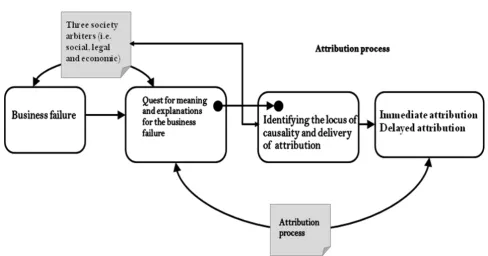
Broadly speaking, attribution by social arbiters or observers begins by identifying the key individuals and locus of causality, sense-making, and rendering sanctions (Wiesenfeld et al., 2008; see also Weick, 1995). Recent evidence pinpoints that the basis for attribution commences by seeking meanings and explanations for the business failure and factors that precipitated it (Wiesenfeld et al., 2008). Attribution after business failure can be seen as an iterative process which involves seeking the locus of causality and delivering attribution (see Figure 2).
---
Insert Figure 2 about here
---
Organisational failure triggers a range of issues to which arbiters attribute blame or rewards where necessary. We employ an evaluating audience or arbiters to refer to the three society arbiters (i.e. social, legal and economic) identified by Wiesenfeld et al. (2008). Social arbiters refer to stakeholders who possess legitimate platforms to provide an assessment of
individuals’ actions (Amankwah-Amoah, 2013). Legal arbiters refer to regulatory agencies
Economic arbiters encompasses executives and directors at other organisations who play a key role in deciding to engage with individuals from departed firms such as offering them a job. Different arbiters such as regulators and investors can see an individual’s involvement in business failure in completely different ways.
People have a general tendency to attribute success to their efforts and failure to outside forces beyond their control. According to the “egocentric bias” perspective (Ross and Sicoly, 1979), individuals have a greater tendency to give themselves credit for good organisational performance and remember more of their contributions relative to their colleagues.
However, individuals are less likely to either admit their involvement or contributions in driving an organisation into the ground. When an organisation ceases to exist, some former managers are more likely to engage in actions that allow them to take credit for the successful
phase in the firm’s life, whilst they attribute the declining period to colleagues or external
factors (Zuckerman, 1979). This “self-serving attribution bias” means that when failure happens it is up to the social arbiters as regulators, expert groups and government agencies to identify the locus of causality and then impose sanctions, blame and then punishment on managers involved with the failure (Wiesenfeld et al., 2008). Managers involved in failure are more likely to exaggerate their involvement in successful periods in organisational life and attribute less successful periods to co-workers. The observers or arbiters are required to identify key individuals seen to have committed a deviant act in bringing about the failure.
Types of attribution
examined the issue. This is largely because the individuals are often the first to be identified and they are often stigmatised because they might be in the public eye or have a prominent position of representing the company to the mass media. Immediately after business failure, there are executives who are automatically shamed in the media even before their culpability is established, however, there are also those who slip under the radar and never have their actions brought under the microscope.
One of the advantages inherent in early attribution of the individual is that it provides an early opportunity to engage in actions aimed at repairing trust and tarnished reputations. In so doing, such individuals can re-establish relationships with key stakeholders who have been lost due to their involvement in the failure. One of the effects of immediate attribution is that sometimes the wrong people have their reputation tarnished for events or decisions which were beyond their control or in which they had no involvement and the stigma can last wrongly forever.
Delayed attribution occurs when all of the factors precipitating the business failure are known. It is less likely to be potent given that memory may have faded and the emotional sentiments associated with the failure have taken a back seat. It may stay in the pipeline for months or even years after the event when the individual has “moved on” or even changed profession before being sanctioned by arbiters. With delayed attribution, individuals connected to business failure are less likely to be sanctioned. This can be attributed to the passage of time between the event and the attribution which also leads to the fading of memory and often the involvement of the legal profession to mitigate the damage.
“By the time of the delayed attribution, the salience of the general impression may have faded
partner, remained” (Burger and Rodman, 1983: 1238). Some individuals welcome early
attributions, others try to delay their attribution, whilst others do their very best to avoid attribution altogether. The delayed attributions may stem from a lack of information about an
individual’s involvement earlier during the immediate attribution phase or the sudden
emergence of new documents outlining that person’s direct involvement in directing and managing the failed venture.
Unlike immediate attributions which happen just after the event, those seen to have committed a deviant act or made the wrong decisions have little time or space to detach themselves from the guilt or shame following the business failure. Perhaps in some cases, delaying attribution may not be as harmful to an individual as early attribution and social consequences to help bring about closure. Under certain circumstances, the stigmatisation
might not be as severe as the individual expects or imagines. Since not all “attribution of
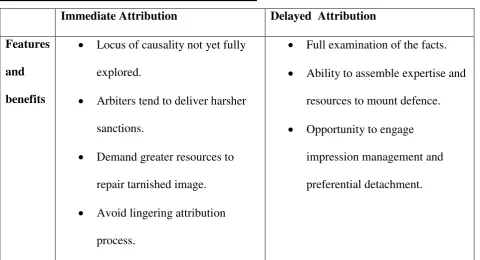
responsibility and allocation of rewards and punishments are made after the fact” (Lipshitz, 1989: 381), individuals who are able to delay investigation into their conduct or past decisions can get space to devise a strategy to deal with the consequences. Table 1 summarises the key features of the two types of attribution.
---
Insert Table 1 about here
---
Social arbiters such as professional bodies and regulators who place a high value on fairness are more likely to deliver harsh attributions after business failure whether delivered immediately or delayed. There is a sense in these bodies to ensure that all individuals are treated in the same way since those who receive delayed attribution have had the time to assemble resources and develop new expertise which enable them to mount a defence or
dramas use a number of devices for forestalling such criticism, including justifications,
rationalisations, and reinterpretations of the events” (Davies, 1987: 51).
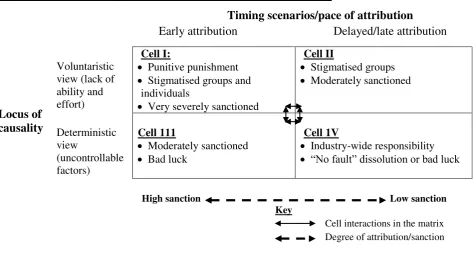
To simplify the discussion, we build on these views to develop a four-cell typology of the paradigms of attribution after business failure. Crossing the two main causes of organisational failure with two types of attribution, produces the 2x2 matrix of the types of attribution after a business failure (see Figure 3). The four combinations of nature of attribution (early or delayed) and locus of causality (controllable or uncontrollable factors) are represented by a 2x2 matrix. Figure 3 presents our matrix which delineates key features of attribution and the process model of the mechanism through which attribution is signalled by social arbiters.
---
Insert Figure 3 about here
--- Who are the recipients of attribution?
Past studies indicate that social arbiters through the labour market reward or penalise executives and managers for their decisions which bring about business failure or success (Fama, 1980). Broadly speaking, all members of a departed organisation are subjected to attribution, however, the labour market is unlikely to tar “all managers with the same brush
based on mere association with a failed firm” (Cannella et al., 1995: 209). One plausible
By top-tier managers/executives we are referring to corporate-level decision-makers such as the President, Chief Executive Officer, Board of Directors and corporate staff who are regarded as the linchpins in the strategic formulation and decision-making process. Such an elite and prestigious group are seen to be “competent, credible and trustworthy” and have a
degree of higher control and responsibility (D’Aveni, 1990; Pozner, 2008). In cases where,
top-tier managers are perceived to be highly skilled and more knowledgeable about their organisation and strategies required to deliver success (D'Aveni, 1989b), failure is more likely to lead to severely stigmatised reputations and status within their industry (Sutton and Callahan, 1987). Indeed, top-tier managers of failed firms are more likely to attain fewer successive jobs in the same industry than their subordinates, largely attributed to their role and the greater responsibility attached to their position (Cannella et al., 1995).
Individuals seen to have committed a deviant act or been culpable for bringing about failure are more likely to suffer from diminished human capital in future employment opportunities (D’Aveni, 1990; Sutton and Callahan, 1987). Human capital refers to the knowledge, skills and abilities possessed by individuals (Becker, 1964). Managers of failed firms are more likely to find a similar job position if social arbiters attribute the cause to external factors which are beyond their control and thereby suffer minimal decline in their human capital value (Sutton and Callahan, 1987). Top-tier managers with high degree of control have an important role in ensuring their firms’ survival by not engaging in extremely risky ventures.
Second-tier managers refer to functional or divisional heads that often support and help to ensure implementation of decisions made by the upper echelon managers/ managers.
Cannella et al.’s (1995) findings indicate that second-tier managers often play a minimal role
in their organisation and are unlikely to face severe sanctions relative to top-tier managers
These scholars also observed that managers of failed firms often secure fewer jobs in the same industry after business failure than managers from (non-failed) firms. The third-tier managers refer to functional low-level managers below second-tier managers who also play a role in strategic implementation. We also contend that third-tier managers can be seen as less-powerful and less-prestigious members of the organisation who are unlikely to be sanctioned by legal arbiters such as regulators often due to their minimal role and control of their organisation.
---
Insert Figure 4 about here
---
With regard to non-managerial staff, some scholars have observed that “lower-level members may perceive that it is not in their interest to convey information that suggests the existence
of potential performance problems to their bosses” (Fang et al., 2014: 1187). Such
concealment is likely to affect top-tier managers’ ability to identify root causes of organisational problems and deliver effective responses to avoid collapse. Such individuals operating in hierarchical organisational structures have a tendency to report positive feedback
accurately whilst “sugarcoating”, distorting or deleting negative feedback (Fang et al., 2014;
Morrison and Milliken, 2000). Such information distortions not only stifle interpretation of the data but also affect the manager’s response during decline (For a detailed review of organisational decline see Mone et al., 1998).
Although such low-ranking employees have a low level of control and decision-making
powers, they can affect how performance information is relayed through the organisational
channels and the interpretation of the information. Such upward communication has the
potential to enrich the internal workings of the firm and “employees can help stem illegal and
for improvement to the attention of those who can authorize action” (Detert and Edmondson,
2011: 461). However, individuals seen to have “sugarcoated” information are unlikely to avoid attribution. Therefore:
Proposition 1: Non-managerial employees seen to have sugar-coated or be
disinclined to disseminate negative information upwards in the organisation before
business failure are more likely to receive harsher attribution.
Individuals in declining firms may engage in responses such as doing nothing, opting for flight, staying the course and generating a turnaround. The “downward spiral” perspective of organisational failure posits that once an organisation enters a period of decline, there is a tendency for further incapacitating events to transpire such as the departure of top-tier
managers, customers’ dissatisfaction, defection of allies and shrinking of the resource base
with which to innovate (D’Aveni, 1989a, 1990; Hambrick and D’Aveni, 1988, 1992; Semadeni et al., 2008). These events within the organisational life become so incapacitating that it forces it to cease operation.
When a firm enters a downward spiral, executives with a degree of foresight can anticipate the potential stigma at the end of the tunnel and may therefore opt for flight before the organisation is forced into bankruptcy or exit (Sutton and Callahan, 1987). Such executives have access to inside information and can therefore anticipate, respond to and minimise potentially stigmatising events (Sutton and Callahan, 1987). Indeed, some studies have indicated that top-tier managers who “jump ship” two years prior to the failure are less likely to be stigmatised than those colleagues who remain with the declining firm (e.g. Semadeni et al., 2008).
limit the firm’s ability to attract new executive talent which accelerates the decline and brings
about the death of the organisation (D’Aveni, 1989a, 1990). Therefore, early attribution
might not be able to capture the intricacies of ‘jumping ship’ to avoid the stigma which
significantly affects who should be blamed for business failure. This is important because studies have demonstrated that observers sometimes err in rendering attribution either through incomplete information, faulty mechanisms in processing information about the role of others or new information coming to light (see Tetlock, 1985).
In the same way, the protracted delays before bankruptcy provide the space for some executives to opt for flight to avoid being stigmatised. Therefore, the attribution process of some individuals might be before the collapse and individuals with rich inside information about the nature of poor decisions and the potential impact on their reputations may opt to flee to deflect blame onto others. Prestigious top managers through elite affiliations are able to acquire and nurture legitimacy with respect to external agencies such as investors and shareholders, which are often lost when they depart declining organisations leading to failure
(D’Aveni, 1990). By opting to quit before exit, this group of people is able to engage in
A similar line of thinking suggests that the pace at which bankruptcy happens has the potential to shape the post-exit attribution. During the process of decline, not all prestigious
managers may ‘jump ship’ to avoid stigma, but for some their pay package may become
totally unaffordable to a financially troubled firm, leading to their exit (D'Aveni, 1989b). Their exit sometimes accelerates the process of failure because it often conveys signals to
stakeholders that “a financially troubled organisation is no longer worthy of their support”
and that there will be a further decline in the firm’s human capital base (D’Aveni, 1990: 138).
Based on the above discussion, we propose the following:
Proposition 2: Top-tier managers who jump ship before the business collapse, are
more likely to avoid early attribution but are unlikely to escape delayed attribution
(“Jeff Skilling effects”).
The typology of attribution after business failure
Having set out the recipients of attribution and the attribution process, we now turn our attention to the 2x2 matrix articulated at the outset of this article and its distinctive features.
Cell I: Early internal attribution
However, this rush to judgement may create conditions where individuals are immediately stigmatised or shamed for the actions and decisions of others within the departed organisation. This often happens because of the demands of the public for immediate punishment of those seen to have made the wrong decisions. Stigmatisation occurs when a
person possesses “some attribute or characteristic that conveys a social identity that is
devalued in a particular social context” (Crocker et al., 1998: 505). Shame refers to the
“public disapproval of some impropriety orpersonal shortcoming” (Tangney 1990: 102).
To illustrate this argument, we turn to the case of Spanair. The airline was founded in 1986 as a charter airline by Scandinavian Airlines System (SAS). At the outset, the firm was seen as one of the promising companies in the European airline industry. By the early 1990s, it had expanded to countries such as the United States and Mexico, however, its operations had remained largely unprofitable (Minder & Clark, 2012). In 2009, SAS sold its 80.1% stake to Catalan investors for a mere €1. The sale value exemplified the precarious financial position of the firm at the time.
After the sale, the prominent top executives recruited were confident that they could turn the fortune of the airline around. Over time, the constant media reports of its weak position meant that observers became more informed of the internal problems of the business. Indeed, the firm reported an operating loss of €115m (£96m) in 2010 and warned investors of potential future losses (The Guardian, 2012). In 2012, Spanair collapsed after a period of poor performances. The collapse led to the uncertain status of around 2,000 employees, cancellations of around 220 flights and 23,000 stranded passengers (Minder & Clark, 2012).
Ferran Soriano (Flottau, 2012; The 02b, 2012). They were also immediately condemned by the Spanish government and Ministry of Public Works. Their reputations were severely tarnished and competences seriously questioned given that they had closed the business and cancelled all flights at a mere half an hour's notice (Gulfnews, 2012; The 02b, 2012). The attribution was more potent given the thousands of angry and stranded passengers of the airline around the world.
In addition, the top executives were also found to have pursued a reckless strategy which had endangered the airline. Indeed, prior to its demise, the firm “became notorious among its competitors for offering aggressively low fares, far below what could reasonably be the airline's own break-even threshold” (Flottau, 2012: 24). This helped to protect its key market
and slowed down rivals’ encroachment, but it was an unsustainable strategy for the business.
In a nutshell, the top executives came to be stigmatised by the so-called “the ghost of
Spanair”, i.e., poor leadership and managerial issues (The 02b, 2012).
Cell II: Late internal attribution
This is where observers conclude that the locus of causality is internal but render late attribution. This often stems from a long drawn-out process of investigation and the need to identify all of the culprits rather than those immediately visible to the public eye. In this cell, the seriousness of the case and the wider impact force observers to engage in such investigation. The ability to allow things to settle down before an attribution is made, helps to take strong emotions out of the process and provides a basis for a better decision. Negative
internal late attribution is more likely to lead to a decline in former employees’ human capital
However, individuals receiving verification from social arbiters of having acted correctly or as being completely exonerated of precipitating business failure are more likely to see their human capital value enhanced in the current and future job market (see Deci and Ryan, 1985). However, such late attribution enables individuals to accumulate new resources and capability that then provide a basis for self-defence and demonstrate that lessons have been learnt.
To illustrate this point about the long drawn out attribution process and the effects on the individual, we turn to the UK financial industry and the case of the British arm of the
collapsed Icelandic bank Kaupthing. Following the bank’s demise, the UK Financial Services
Authority concluded after a protracted investigation that the behaviour of three former directors of the bank, Armann Thorvaldsson, Sigurdur Einarsson and Hreidar Mar Sigurdsson, was unprofessional and that they failed to act with due skill, care and diligence, and were banned from holding senior roles within the authorised British banking industry for five years (Treanor, 2012).
Cell III: Early external attribution
This is where the individual receives an early attribution but the failure is due to external factors over which he/she had limited control. Under these circumstances, the attribution is less likely to be severe. Despite the early nature of the attribution, the individual recipient has a better chance of diminishing or avoiding any stigmatisation from the event. Although people often attempt to conceal their stigma by suppressing thoughts about it (Smart and Wegner, 1999), there is greater likelihood that individuals with a tendency to withhold such information are more likely to be severely sanctioned when new information emerges
uncovering their stigma. However, when similar events occur in the future, observers’
attention will be drawn to past events which are often moulded into the collective consciousness of interested parties and those who seek further accountability even in the future.
To illustrate this argument, we turn to the case of Q-cells. The firm was a German-based company with production facilities in countries such as Malaysia and Sweden. After its formation, it gained a reputation as one of the leading solar photovoltaic (PV) manufacturers.
Indeed, it was regarded as “the energy company of the future” and ranked as the world's
biggest maker of solar panels in 2008 with an estimated value of €8 billion (Schultz, 2012). By 2010, its position at the top of solar PV cell manufacturers in the world had slipped (REN21, 2011). In April 2012, the firm announced bankruptcy proceedings. Following the Euro crisis and global economic crisis of 2008, governments in Europe and elsewhere sought to reduce government spending which affected the solar industry.
In 2012, the German government decided to reduce the subsidies for solar power production by up to 30% (Wiesmann, 2012). The decision to reduce the fixed price shrunk the revenue
assets were sold to South Korea's Hanwha. The reduction in subsidies alongside the increasing global competition and economic crisis sealed the fate of Q-cells. Perhaps more importantly, the demise of rival businesses such as Solar Millenium, Odersun and Solarhybrid within months of each other persuaded observers that failure was largely due to factors beyond the control of the top management team (Wiesmann, 2012; Schultz, 2012).
Cell IV: Late external attribution
Cell IV is where the causes of failure are attributed to external factors such as global competition, luck and natural disasters, but where attribution is delayed. The delay might be
due to the observers’ decisions to seek better sources of information on the individuals and
the decision-making processes in the departed firm. There are cases where the timing of the business failure becomes very important in the attribution process. For instance, when the firm ceases to exist during times of economic crisis and political instability, this is more likely to be viewed as a “no-fault dissolution”, where managers linked to the failure are less likely to be stigmatised (Forsman, 2001).
enable individuals to escape punishment or dodge any public scrutiny, or could simply not be traced by social arbiters (Wiesenfeld et al., 2008).
To illustrate this cell further, we turn to the case of Solyndra. The firm was once regarded as an exemplary business model of public-private partnership to help promote and develop expertise in the solar PV industry (Johnson & Suskewicz, 2009). The firm then received US government-backed loan guarantees of around $535 million in 2009. In addition to this, it also received the support of the US Department of Energy to open factories to manufacture solar panels.
The collapse in 2011 triggered a protracted Congressional investigation which meant that attribution was rendered late. Since it’s collapsed, the name Solyndra has become synonymous with government’s incompetence and ineffectiveness in picking “winners” and
“losers” in the marketplace (Lesser, 2011). It has also become the symbol ingrained in the
American political discourse that “federally subsidized solar-panel” manufacturers are unlikely to succeed in a competitive environment (Himmelman, 2012).
The demise was subsequently accompanied by political humiliation of politicians including the Vice-President Joe Biden who once stood at the company premises and declared “The
future is here” (Scherer, 2011: 34–37). After the initial euphoria, more information emerged
to shed light on the role of managers (see Committee on Energy and Commerce, 2012). With the passage of time, the public memory of the event had faded away after the investigations.
Moderating influences
inactions of key players (Wiesenfeld et al., 2008), we contend that hindsight plays an influential role in this process. Given that people have a tendency to view decisions that generate good results in a positive light, observers are likely to view decisions leading to business failure in a negative light. Indeed, it has been suggested that with hindsight, people not only exaggerate what things were foreseeable, but also overestimate the predictability of the event if it had led to a negative outcome such as failure (Davies, 1987; Lipshitz, 1989). Davies (1987: 50) further argued that “not only do hindsightful judges overestimate how much other people knew (or should have known) before the event, they even misremember their own foresight state of ignorance, recalling that they were wiser before the event than
was actually the case”.
In rendering attribution, “decision making processes are perceived as more satisfactory when
they lead to success, and successful decision makers are perceived more favourably than their
unsuccessful counterparts” (Lipshitz, 1989: 380). This is important because scholars have
long established that, even when instructed not to do so, observers have a tendency to take
into consideration outcomes when evaluating one’s actions and decisions (Fincham, 1985).
Another moderating influence is that some attributions are based on incomplete information, especially in the case of early attributions. Because of the inherent difficulties in identifying the causes of failure, it is often very difficult for observers to be certain, which often leads to errors such as attributing blame to innocent bystanders or parties (Cannella et al., 1995). In a way, delayed attribution may not be good for the public who demand immediate punishment, but it helps to thwart irrelevant information from impeding the attribution process.
management refers to the “psychological process by which people attempt to create and
maintain desired perceptions of themselves in the eyes of others” (Dutton et al., 1997: 409). It is worth noting that people have a tendency to defend themselves by arguing that social
arbiters have a “lack of perspicacity” and ignore key events surrounding the decision that
forced managers to engage in a particular course of action (Davies, 1987).
However, this often depends on the resources accumulated by the individual to mount a
defence or change others’ perceptions of them. We contend that “idiosyncratic credits”
(Hollander, 1958) such as networks of relationships developed by the individual, are more likely to moderate the effects of attribution. ‘Idiosyncrasy credit’ refers to a situation in
which the observers’ interpretations, sensemaking and attribution of business failure is
moderated by an individual or organisation’s past behaviour or actions (Hollander, 1958; Amankwah-Amoah, 2013).
Furthermore, dissociative steps such as preferential detachment from groups or colleagues can be an effective mechanism through which individuals can protect their colleagues as well as minimise the effects of stigma on others. With preferential detachment, we are referring to actions taken by individuals to minimise the effects of stigma or reduce risk to others unconnected to the business failure (Yu et al., 2008). Those who can demonstrate features that de-link them from the stigmatised others are more likely to minimise or alleviate the effects to preserve their reputation. Delinking activities can come from the stigmatised others who would mount a public defence of those connected to them. Based on the above arguments, we propose the following:
Proposition 3: On balance, former executives who take steps to assemble key
Discussion and conclusion
The primary purpose was to delineate the types of attributions after business failure and the underlying processes through which such attributions are rendered. The study tapped into the existing streams of research on attributions and business failure to develop a 2x2 matrix, which incorporates timing of attribution alongside the locus of causality. Crossing the two main causes of organisational failure (i.e., internal and external factors) with two types of attribution (i.e., immediate attribution and delayed attribution) produced the 2x2 matrix which entails: early internal attribution, late internal attribution, early external attribution and late external attribution. The conceptual strength of the matrix lies in enriching our understanding of the effects of pace in the attribution process.
Our analysis also suggests that either early or delayed attribution has varying effects on former first-tier, second-tier and third-tier managers, and other non-managerial employees of the departed firm. This is largely due to their degree of control, influences and expectations of the departed firm. Through their elite networks and resources, first-tier managers are able to assemble resources and capabilities to evade and/or mitigate attribution by jumping ship or responding better than second- and third-tier managers.
explicates the conditions and processes through which immediate and delayed attributions are rendered.
In addition, our paper contributes to ongoing efforts to develop theory which helps to deliver a better explanation of the post-exit effects (Wiesenfeld et al., 2008; Amankwah-Amoah, 2014b). Thus, we extend Hoetker and Agarwal’s (2007) findings on the post-exit effect by conceptualising the literature through the 2x2 framework, which offers clarity and removes some of the ambiguity in the existing streams of research on attribution after business failure.
Practical implications
The study offers a number of useful insights for practising managers. First, our findings suggest that there is a need for greater accountability of social arbiters to help reduce or even eliminate errors in both early and delayed attribution. Although recipients of incorrect early
attribution might be able to repair the damage, “what often results is not the acquisition of
fully normal status, but a transformation of self from someone with a particular blemish into
someone with a record of having corrected a particular blemish” (Goffman, 1963: 9). Correct
attribution is particularly important in ensuring that the wrong people are not punished or
stigmatised for others’ actions and inactions. This is pertinent given how society deals with
those who have been seen to have been involved in failure.
create conditions that make people afraid or unwilling to take a risk. There is also a need to ensure that attributions are not so severe such that they inhibit an individual’s ability to move on after the event, however, criminal behaviour should be punished to deter others.
“Since good processes are more likely (albeit not certain) to yield good outcomes, decision makers should not be rewarded for bad decisions that succeed, nor penalized
for good decisions that fail” (Lipshitz, 1989: 381).
Directions for future research
The typology has suggested a number of promising avenues for future research on attribution after business failure. A great deal remains to be learned about the role of organisational and national culture in the attribution process and the extent to which attribution differs across cultures. Unlike American society, many countries in the emerging world such as Ghana take a different attitude towards failure and often offer little or no opportunity for individuals to move on or recover (Amankwah-Amoah, 2013; Sandage, 2005). This area presents a fruitful avenue for scholars to enrich our understanding of attribution in general.
Another promising line of research would be to clarify the mechanisms through which some individuals are able to escape even delayed attribution for business failure and potential gains in such actions. This would be interesting given that those who are able to dodge attribution in the short term may require fewer resources and capabilities to repair their tarnished image. A great deal of thought is also required to examine how the attribution by social actors can help government craft policies that provide conditions for a “second chance” to flourish.
Our work also points to the need for future research to test the propositions identified and
involvement in business failure. There is a need to broaden our theoretical quest to incorporate the mechanisms through which such individuals can take on new identities in a new location.
One of the limitations of our 2x2 matrix is that it glosses over the complex process and issues involved in determining the extent to which internal and external factors interacted to affect attributions. There is great potential for exploring the complexities inherent in attributions after business failure. We hope that these efforts serve as a catalyst for more research on both pre- and post-business failure attributions.
References
Afuah, A. (2004), “Business models: A strategic management approach”, New York: Irwin/McGraw-Hill.
Amankwah-Amoah, J. (2011). Learning from the failures of others: The effects of post-exit knowledge spillovers on recipient firms. Journal of Workplace Learning, 23(6), 358–375.
Amankwah-Amoah, J. (2013), “Cauterising trial by fire: Observers’ interpretations of organisational failure”,
Journal of General Management, Vol. 38 No. 3, pp. 51–72.
Amankwah-Amoah, J. (2014a), “Old habits die hard: A tale of two failed companies and an unwanted
inheritance”, Journal of Business Research, Vol. 67 No. 9, pp. 1894–1903.
Amankwah-Amoah, J. (2014b), “A unified framework of explanations for strategic persistence in the wake of
others’ failures”, Journal of Strategy and Management, Vol. 7 No. 4, pp. 422–444.
Amankwah-Amoah, J. and Debrah, Y. A. (2010), “The protracted collapse of Ghana Airways: Lessons in organizational failure”, Group & Organization Management, Vol. 35 No. 5, pp.636–665.
Amankwah-Amoah, J., & Debrah, Y. A. (2011). Competing for scarce talent in a liberalized environment: Evidence from the aviation industry in Africa. International Journal of Human Resource Management, 22(17), 3565–3581.
Andrews, R., Boyne, G. A. and Enticott, G. (2006), “Performance failure in the public sector”, Public Management Review, Vol. 8 No. 2, pp. 273–296.
Arvey, R. D. and Jones, P. (1985), The use of discipline in organizational settings: A framework for future research, In BM Staw and LL Cummings (Eds.) Research in organizational behavior (Vol. 7: 367–408). JAI Press, Greenwich, C.
Becker, G. (1964), Human Capital, University of Chicago Press, Chicago.
Burger, J. M. (1985), “Temporal effects on attributions for academic performances and reflected-glory basking”,
Burger, J. M. and Rodman, J. L (1983), “Attributions of responsibility for group tasks: The egocentric bias and the actor-observer difference”, Journal of Personality and Social Psychology,Vol. 45 No. 6, pp. 1232–1242.
Cannella, A. A., Fraser, D. R. and Lee, D. S. (1995), “Firm failure and managerial labor markets: Evidence from
Texas banking”, Journal of Financial Economics, Vol. 38 No. 2, pp. 185–210.
Clignet, R. P. and Foster, P. J. (1964), “Potential elites in Ghana and the Ivory Coast a preliminary comparison”, American Journal of Sociology, Vol. 70 No. 3, pp. 349–362.
Committee on Energy and Commerce (2012). The Solyndra Failure. Washington: U.S. House of Representatives.
Crocker, J. and Major, B. (2003), “The self-protective properties of stigma: Evolution of a modern classic”,
Psychological Inquiry, Vol. 14 No. 3-4, pp. 232–237.
Crocker, J., Major, B. and Steele, C. (1998), “Social stigma”, In D. Gilbert, S. T. Fiske and G. Lindzey (Eds.), The Handbook of Social Psychology 4th ed (p. 504–53). New York: McGraw Hill.
D’Aveni, R. A. (1989a), “The aftermath of organizational decline: A longitudinal study of the strategic and
managerial characteristics of declining firms”, Academy of Management Journal, Vol. 32 No. 3, pp. 577–605.
D’Aveni, R. A. (1989b), “Dependability and organizational bankruptcy: An application of agency and prospect
theory”, Management Science, Vol. 35 No. 9, pp. 1120–1138.
D’Aveni, R. A. (1990), “Top managerial prestige and organizational bankruptcy”, Organization Science, Vol. 1 No. 2, pp. 121–142.
D’Aveni,R. A. and MacMillan, I. C. (1990), “Crisis and the content of managerial communications: A study of the focus of attention of top managers in surviving and failing firms”, Administrative Science Quarterly, Vol. 35 No. 4, pp. 634–657.
Davies, M. E. (1987), “Reduction of hindsight bias by restoration of foresight perspective: effectiveness of foresight-encoding and hindsight-retrieval strategies”, Organizational Behavior and Human Decision Processes,
Vol. 40 No. 1, pp. 50–68.
Deci, E. L. and Ryan, R. M. (1985), “Intrinsic Motivation and Self Determination in Human Behavior”, Plenum:
New York.
Detert, J. R. and Edmondson, A. C. (2011), “Implicit voice theories: Taken-for-granted rules of self-censorship
at work”, Academy of Management Journal, Vol. 54 No. 3, pp. 461–488.
Doty, D. H. and Glick, W. H. (1994), “Typologies as a unique form of theory building: toward improved understanding and modeling”, Academy of Management Review, Vol. 19 No. 2, pp. 230–251.
Dovey, K. and Fenech, B. (2007), “The role of enterprise logic in the failure of organizations to learn and
transform a case from the financial services industry”, Management Learning,Vol. 38 No. 5, pp. 573–590.
Dutton, J. E., Ashford, S. J., O’Neill, R. M., Hayes. E. and Wierba, E. E. (1997), “Reading the wind: How
middle managers assess the context for selling issues to top managers”, Strategic Management Journal, Vol. 18 No. 5, pp. 407–425.
Fang, C., Kim, J. H. and Milliken, F. J., (2014), “When bad news is sugarcoated: Information Distortion, organizational search and the behavioral theory of the firm”, Strategic Management Journal, Vol. 35 No. 8, pp. 1186–1201.
Feather, N. T. and Simon, J. G. (1973), “Fear of success and causal attribution for outcome”, Journal of Personality, Vol. 41 No. 4, pp. 525–542.
Fincham, F. D. (1985), “Outcome valence and situational constraints in the responsibility attributions of
children and adults”, Social Cognition, Vol. 3 No. 2, pp. 218–233.
Flottau, J. (2012), “Spanair's prolonged finish”, Aviation Week & Space Technology, Vol. 174 No. 5, pp. 24.
Forsman, T. (2001), “Failure as a badge of honor”,
http://www.businessweek.com/magazine/content/01_35/b3746632.htm (accessed 24 February).
Fothergill, A. (2003), “The stigma of charity: gender, class, and disaster assistance”, Sociological Quarterly,
Vol. 44 No. 4, pp. 659–680.
Goffman, E. (1963), Stigma: Notes on the management of spoiled identity, Englewood Cliffs, NJ: Prentice-Hall.
Grunwald, M. (2012), “Yes, more Solyndras”, Time, Vol. 180 No. 8, pp. B4.
Gulfnews (2012), “Sudden Spanair shut-down strands passengers”, http://gulfnews.com/news/world/other -world/sudden-spanair-shut-down-strands-passengers-1.972744 (accessed 31 July 2014).
Hambrick, D and D’Aveni, R. A. (1988), “Large corporate failures as downward spirals”, Administrative Science Quarterly, Vol. 33 No. 1, pp. 1–23.
Hambrick, D. and D’Aveni RA (1992), “Top team deterioration as part of the downward spiral of large
corporate bankruptcies”, Management Science, Vol. 38 No. 10, pp. 1445–1467.
Hamilton, E. A. (2006), “An exploration of the relationship between loss of legitimacy and the sudden death of organizations”, Group & Organization Management, Vol. 31 No. 3, pp. 327–358.
Himmelman, J. (2012), “Here comes the sell”, The Sunday Magazine, August 9, pp. MM24
Hoetker, G. and Agarwal, R. (2007), “Death hurts, but it isn’t fatal: The post-exit diffusion of knowledge created by innovative companies”, Academy of Management Journal, Vol. 50 No. 2, pp. 446–467.
Hollander, E. (1958), “Conformity, status, and idiosyncrasy credit”, Psychological Review, Vol. 65 No. 2, pp. 117–1127.
Johnson, E. A., Vincent, N. and Ross, L. (1997), “Self-deception versus self-esteem in buffering the negative
effect of failure”, Journal of Research in Personality, Vol. 31 No. 3, pp. 385–405.
Johnson, M.W. and Suskewicz, J. (2009), “How to jump-start the clean economy”, Harvard Business Review, Vol. 87 No. 11, pp. 52–60.
Jones, E. E. and Davis, K. E. (1965), From acts to dispositions: The attribution process in person perception’ In
L Berkowitz (ed.), Advances in Experimental Social Psychology (pp. 220–266). New York: Academic Press.
Knott, A. M. and Posen, H. E. (2005), “Is failure good?” Strategic Management Journal, Vol. 26 No. 7, pp. 617–641.
Lesser, J.A. (2011), “Sunburnt: Solyndra, subsidies, and the green jobs debacle”, Natural Gas & electricity, November, pp. 30–32.
Lipshitz, R. (1989), “Either a medal or a corporal”: The effects of success and failure on the evaluation of decision making and decision makers”, Organizational Behavior and Human Decision Processes,Vol. 44 No.
3, pp. 380–395.
Major, B. N. and O’Brien L. T. (2005), “The social psychology of stigma”, Annual Review of Psychology, Vol. 56, 393–421.
McGrath, R. G. (2011), “Failing by design”, Harvard Business Review, Vol. 89 No. 4, pp. 76–83.
McKinley, W., Ponemon, L. A. and Schick, A. G. (1996), “Auditors' perceptions of client firms: The stigma of
decline and the stigma of growth”, Accounting, Organizations and Society, Vol. 21 No. 2, pp. 193–213.
Mellahi, K. and Wilkinson, A. (2004), “Organizational failure: A critique of recent research and a proposed
integrative framework”, International Journal of Management Reviews, Vol. 5 No. 1, pp. 21–41.
Minder, R. and Clark, N. (2012), “Spain threatens fine after airline's quick close”, The International Herald Tribune, January, pp. 30.
Mone, M. A., McKinley, W. and Barker, V. L. (1998), “Organizational decline and innovation: A contingency
framework”, Academy of Management Review,Vol. 23 No.1, pp. 115–132.
Morrison, E. W. and Milliken F. J. (2000), “Organizational silence: A barrier to change and development in a pluralistic world”, Academy of Management Review, Vol. 25 No. 4, pp. 706–725.
Nutt, P. C. (1999), “Surprising but true: Half the decisions in organizations fail”, Academy of Management Executive (1993-2005), Vol. 13 No. 4, pp.75–90.
Nutt, P. C. (2002), Why decisions fail: Avoiding the blunders and traps that lead to debacles, Berrett-Koehler, San Francisco, C. A.
Nutt, P. C. (2004a), “Averting decision debacles”, Technological Forecasting and Social Change,Vol. 71 No.
3, pp. 239–265.
Nutt, P. C. (2004b), “Expanding search during strategic decision making”, Academy of Management Executive,
Vol. 18 No. 4, pp. 13–28.
NY Times (2012), “Solyndra”, May 31,
http://topics.nytimes.com/top/news/business/companies/solyndra/index.html.
Osterwalder, A., Pigneur, Y. and Tucci, C. L. (2005), “Clarifying business models: Origins, present, and future
of the concept”, Communications of the Association for Information Systems, Vol. 16 No.1, pp. 1–25.
Pozner, J.-E. (2008), “Stigma and settling up: An integrated approach to the consequences of organizational misconduct for organizational elites”, Journal of Business Ethics, Vol. 80 No.1, pp. 141–150.
REN21 (2011), Global Status Report, Paris: REN21 Secretariat.
Sandage, S. A. (2005), Born losers: A history of failure in America, Harvard University Press, Cambridge, MA.
Scherer, M. (2011), “The Solyndra Syndrome”, Time International (Atlantic Edition), Vol. 178 No. 14, pp. 34– 37.
Schultz, S. (2012). “Twilight of an industry bankruptcies have German solar on the ropes,” April 3,
www.spiegel.de/international/business/0,1518,825490,00.html(accessed 5 May 2012).
Semadeni, M., Cannella, A. A., Fraser, D. R. and Lee, D. S. (2008), “Fight or flight: Managing stigma in
executive careers”, Strategic Management Journal, Vol. 29 No. 5, pp. 557–567.
Shim, J. P., Warkentin, M., Courtney, J. F., Power, D. J., Sharda, R. and Carlsson, C. (2002), “Past, present, and
future of decision support technology”, Decision Support Systems, Vol. 33 No. 2, pp. 111–126.
Smart, L. and Wegner, D. M. (1999), “Covering up what can't be seen, Concealable stigma and mental control”, Journal of Personality and Social Psychology,Vol. 77 No. 3, pp. 474–486.
Sutton, R. I. and Callahan, A. L. (1987), “The stigma of bankruptcy: Spoiled organizational image and its management”, Academy of Management Journal, Vol. 30 No. 3, pp. 405–436.
Svensson, G. and Wood, G. (2005), “The serendipity of leadership effectiveness in management and business practices”,Management Decision, Vol. 43 No. 7/8, pp. 1001–1009.
Tangney, J. P. (1990), “Assessing individual differences in proneness to shame and guilt: Development of the self-conscious affect and attribution inventory”, Journal Of Personality and Social Psychology, Vol. 59 No.1, pp. 102–111.
Tetlock, P. E. (1985), “Accountability: A social check on the fundamental attribution error”, Social Psychology Quarterly, Vol. 48 No. 3, pp. 227–236.
The 02b (2012), “All the men of Spanair”,
ttp://www.02b.com/en/notices/2012/10/all_the_men_of_spanair_3014.php#.U9oV3vldV8E (accessed 31 July 2014).
The Guardian (2012), “The thousands of passengers stranded as Spanair ceases operations”,
http://www.theguardian.com/world/2012/jan/28/spanair-cancels-flights-legal-action (accessed 31 July 2014).
Treanor, J. (2012), “Kaupthing directors could run a bank again in 16 months”, The Guardian, June 26.
Wahrman. R. (1972), “Status, deviance and sanctions: A critical review”, Comparative Group Studies, Vol. 3 No. 1, pp. 203–223.
Weick, K. E. (1995), Sensemaking in organizations, Sage, Thousand Oaks, CA.
Whetten, D. A. (1987), “Organization growth and decline processes”, Annual Review of Sociology, Vol. 13, pp. 335–358.
Wiesenfeld, B. M., Wurthmann, K. A. and Hambrick, D. C., (2008), “The stigmatization and devaluation of
elites associated with corporate failure: A process model”, Academy of Management Review, Vol. 33 No.1, pp. 231–251.
Wiesmann, G. (2012), “Cuts cloud German solar power landscape,” Financial Times, March 28.
Yu, T., Sengul, M. and Lester, R. H. (2008), “Misery loves company: The spread of negative impacts resulting
from an organizational crisis”, Academy of Management Review, Vol. 33 No. 2, pp. 452–472.
Zuckerman. M. (1979), “Attribution of success and failure revisited, or: The motivational bias is alive and well
[image:34.595.72.553.454.714.2]in attribution theory”, Journal of Personality, Vol. 47 No. 2, pp. 245–287.
Table 1. Type of attributions after business failure
Immediate Attribution Delayed Attribution
Features
and
benefits
Locus of causality not yet fully
explored.
Arbiters tend to deliver harsher
sanctions.
Demand greater resources to
repair tarnished image. Avoid lingering attribution
process.
Full examination of the facts. Ability to assemble expertise and
resources to mount defence. Opportunity to engage
Figure 1: A continuum of attribution after business failure
Figure 2: An integrated framework of the attribution process
Severity of attribution
High Low
Deterministic (uncontrollable) factors
Voluntaristic (controllable) factors
[image:35.595.69.558.473.729.2]Figure 3: A four-cell typology of attribution after business failure
Timing scenarios/pace of attribution
Locus of causality
Early attribution Delayed/late attribution
Voluntaristic view (lack of ability and effort)
Cell I:
Punitive punishment
Stigmatised groups and individuals
Very severely sanctioned
Cell II
Stigmatised groups
Moderately sanctioned
Deterministic view
(uncontrollable factors)
Cell 111
Moderately sanctioned
Bad luck
Cell 1V
Industry-wide responsibility
“No fault” dissolution or bad luck
High sanction Low sanction Key
Cell interactions in the matrix Degree of attribution/sanction
Control
Low
Responsibility
Low High
Degree/strength of sanctions
Third-tier managers
Second-tier managers
Top-tier managers/ executives
High