MCWP 2-26 (formerly MCWP 2-12.1)
Geographic Intelligence
U.S. Marine Corps
6 July 2000
13 Jul 2004
E R R A T U M
to
MCWP 2-26
GEOGRAPHIC INTELLIGENCE
1. Change the publication short title to read “MCWP 2-26” (vice MCWP 2-12.1).
Washington, DC 20380-1775
6 July 2000
FOREWORD
Marine Corps Doctrinal Publication 2, Intelligence, and Marine Corps War-fighting Publication (MCWP) 2-1, Intelligence Operations, provide the doctrine and higher order tactics, techniques, and procedures for intelligence operations. MCWP 2-12.1, Geographic Intelligence, complements and expands upon this information by detailing doctrine, tactics, techniques, and procedures for the conduct of geographic intelligence and supporting geospatial information and services operations in support of the Marine air-ground task force (MAGTF).
The primary target audience of this publication is intelligence personnel respon-sible for the planning and execution of geographic intelligence operations. Per-sonnel who provide support to geographic intelligence or who use the results from these operations should also read this publication.
MCWP 2-12.1 describes aspects of geographic intelligence operations, includ-ing doctrinal fundamentals, command and control, communications and infor-mation systems support, planning, execution, equipment, security, and training. MCWP 2-12.1 provides the information Marines needed to understand, plan, and execute geographic intelligence operations in support of the MAGTF.
Reviewed and approved this date.
BY DIRECTION OF THE COMMANDANT OF THE MARINE CORPS
J. E. RHODES
Lieutenant General, U.S. Marine Corps Commanding General
Marine Corps Combat Development Command
iii
Table of Contents
Page
Chapter 1 Fundamentals
1001 What is Geographic Intelligence... 1-1 Geospatial Information ... 1-1 Geospatial Information Infrastructure ... 1-1 Geospatial Information and Services ... 1-2 Topography ... 1-2 Foundation Data... 1-2 Mission Specific Data Set... 1-3 1002 Categories of GEOINT ... 1-3 Strategic ... 1-4 Operational... 1-5 Tactical... 1-6 1003 Support to Intelligence Functions ... 1-7 Commander’s Estimate... 1-7 Situation Development ... 1-7 Force Protection ... 1-7 Targeting ... 1-7 Combat Assessment ... 1-7 1004 Support to Operations ... 1-8 Command and Control... 1-8 Maneuver ... 1-8 Fire Support ... 1-9 Aviation ... 1-9 Logistics... 1-9 1005 Multilevel GEOINT Support Operations... 1-9 Marine Expeditionary Force ... 1-9 Marine Expeditionary Unit (Special Operations Capable) ... 1-10 Joint and Theater... 1-10 National and Strategic Support ... 1-10 1006 GEOINT Cycle ... 1-10
Planning and Direction ... 1-11 Collection... 1-11 Processing and Exploitation... 1-12 Production ... 1-12 Dissemination ... 1-13 Utilization ... 1-13
Chapter 2 Organizations and Responsibilities
iv
MEF CE, G-2 Division, Imagery and Mapping Section... 2-3 Major Subordinate Commands ... 2-5 2002 Geographic Intelligence ... 2-5 Key MEF Intelligence Staff Planning and Direction Responsibilities ... 2-5 Key GEOINT Producers Responsibilities ... 2-12 2003 National Support ... 2-15 National Imagery and Mapping Agency... 2-15 Marine Corps Customer Support Team, NIMA ... 2-16 NIMA Customer Liaison Officer... 2-16 NIMA Geospatial Technical Representatives... 2-17
Chapter 3 Planning
Section I. Planning Process
3101 Marine Corps Planning Process ... 3-1 Mission Analysis... 3-1 COA Development ... 3-1 COA(S) War Game... 3-2 COA Comparison and Decision ... 3-2 Orders Development ... 3-2 Transition ... 3-2 3102 Joint Planning Processes ... 3-2 Joint Deliberate Planing... 3-2 Crisis Action Planning ... 3-3 3103 Roles of GI and GEOINT in the MCPP ... 3-3 3104 GEOINT Planning Considerations ... 3-4 Essential Elements of Terrain Information ... 3-4 Coordination Requirements ... 3-4 Position and Navigation... 3-4 Preferred Geodetic Datum ... 3-5 Global Positioning Systems ... 3-5 Product Accuracy... 3-5
Section II. Support to the Planning Process
v
Section III. GI and GEOINT to Support Planning
3301 Geospatial Foundation Data... 3-14 Digital Terrain Elevation Data, Level 2... 3-14 Digital Bathymetric Data Base ... 3-14 Foundation Feature Data... 3-14 Controlled Image Base... 3-14 Digital Point Positioning Data Base ... 3-14 Qualified Data... 3-15 3302 Geographic Intelligence ... 3-15 Intelligence Preparation of the Battlespace ... 3-15 Modified Combined Obstacles Overlay ... 3-17
Chapter 4 Geographic Intelligence Operations
vi
Chapter 5 Communications and Information Systems
5001 Communications and Information System Requirements ... 5-1 Capability to Command and Control Subordinate Topographic Units... 5-1 Ability to Receive Collected GI Data and Information ... 5-2 Ability to Provide GEOINT Products... 5-2 5002 Support to Command and Control Nodes... 5-2
MEF Command Element Intelligence C2 Nodes—Combat Intelligence
Center and Intelligence Operations Center ... 5-2 GEOINT CIS Support... 5-5 5003 Joint Communications and Information Systems ... 5-11 Planning ... 5-11 Mission Objectives ... 5-12 CIS Plans... 5-12 5004 MAGTF Communications and Information Systems ... 5-12 Architecture Planning ... 5-12 System Planning ... 5-12 Planning Considerations ... 5-13 5005 United States Imagery and Geospatial Information System ... 5-13 5006 Marine Corps Planning Factors Data Base ... 5-14 5007 Operations and Supporting Communications and Information Systems... 5-14
Chapter 6 Security
6001 Responsibilities ... 6-1 6002 Classification ... 6-1 6003 Classification Guidance for New GI and GEOINT ... 6-1 GI&S Products and Data Base... 6-2 Guide Preparation Considerations ... 6-2 6004 Disclosure and Release of NIMA Classified Products and Data Bases ... 6-3 NIMA Policy... 6-3 Disclosure Procedures... 6-3 Release of NIMA Classified Material ... 6-3 6005 Release of NIMA Unclassified Products and Data Bases ... 6-3 Release Categories ... 6-3 Release Guidance... 6-4 6006 Disposal of GI&S Products and Data Bases... 6-4 Disposal of Classified Products and Data Bases ... 6-4 Disposal of Unclassified Products and Data Bases ... 6-4
Chapter 7 Training
vii
Appendices
Fundamentals
MCWP 2-12.1 provides higher order tactics, tech-niques, and procedures in the use and production of geographic intelligence (GEOINT). The pur-pose of GEOINT is to present fused data about terrain, inland and coastal water, climate, and weather in intelligence products. These products help commanders increase their battlespace situa-tional awareness and make decisions.
When planning an operation, the commander and staff use GEOINT to help analyze the effects that terrain,coasts and waterways, and climatic condi-tions will have on the activities and capabilities of friendly and enemy forces. With highly accurate and pertinent GEOINT, Marine air-ground task forces (MAGTFs) will be better able to exploit the advantages of the terrain and avoid or mini-mize its unfavorable aspects.
1001. What is Geographic
Intelligence?
GEOINT is the process of collecting, organizing, analyzing, synthesizing, disseminating, and using all-source geospatial and other intelligence infor-mation with regard to the military aspects of the t e r r a i n i n s u p p o r t o f M A G T F o p e r a t i o n s . GEOINT can include cross-country movement (CCM) studies, line of sight (LOS) analysis, natu-ral and manmade obstacles, and various terrain studies (e.g., road, railroad, airfield, bridges, ports, helicopter landing zones). The GEOINT analysis focuses on intelligence preparation of the battlespace (IPB) and addresses key terrain, ob-servation and fields of fire, cover and conceal-ment, obstacles, and avenues of approach (KOCOA) to help answer MAGTF intelligence requirements (IRs). This analysis includes intensi-fication or veriintensi-fication of current information
from new sources and clarification of detail and resolution to meet tactical requirements.
a. Geospatial Information
Geospatial information (GI) is precise, spatially-referenced information about the Earth with tem-poral tags arranged in a coherent structure and format to support measurement, mapping, moni-toring, modeling, spatial reasoning applications, and terrain evaluation.
Digital GI forms the foundation for MAGTF bat-tlespace visualization. All military operations re-quire GI to provide the necessary framework on which all other relevant strategic, operational, and tactical information is layered and subsequent planning and decisionmaking is based.
b. Geospatial Information Infrastructure
To understand and exploit GEOINT, the Marine Corps must implement and sustain a geospatial information infrastructure (GII) that is interopera-ble with and supports joint and Service policies and doctrine; operational, system, and technical architectures; data standards and specifications; equipment technologies; and personnel, to include their training and education. (See figure 1-1.) The Marine Corps GII develops, implements, and sus-tains a collaborative production environment to support global expeditionary missions. It also
provides responsive access to the national intelli-gence production network to support Service, joint, and multinational operations.
c. Geospatial Information and Services
The terms GI and geospatial information and ser-vices (GI&S) replace mapping, charting, and ge-odesy (MC&G) to reflect the increasing need for digital geospatial data for command and control (C2) systems, intelligence systems, communica-tions and information systems (CIS), weapons systems, and high-end geographic information systems. While the Department of Defense (DOD) is transitioning from one term to the other, the term GI&S is being used to describe the func-tions and data associated with GI and GEOINT. GI&S defines the concept for collection, informa-tion extracinforma-tion, storage, exploitainforma-tion, and dissemi-nation of geodetic, geomagnetic, imagery, gravimetric, aeronautical, topographic, hydro-graphic, littoral, cultural, and toponymic data ac-curately referenced to a precise location on the Earth’s surface (see figure 1-2). GI&S encom-passes multiple functions as well as GI data.
These functions include—
l Defining requirements for training, exercises,
and operations.
l Providing a command and Service focal point
for GI&S expertise and consultation.
l Coordinating force and staff GI&S products,
data sets, prototypes, as well as specification and standards developed and produced by the National Imagery and Mapping Agency (NIMA).
l Providing guidance and coordination to the
GEOINT and broader intelligence cycles.
GI&S is the center of GI and GEOINT produc-tion. A traditional NIMA map is GI&S, but may also be considered a basic form of GEOINT. GEOINT production will use maps and other in-formation and intelligence sources to produce specialized intelligence tailored to a specific re-quirement, mission, force, and weapon system. The GEOINT cycle depends on both the data and the functionality of GI&S to provide the com-mander and forces GI in the refined form of GEOINT.
d. Topography
Topography is defined as the configuration of the ground to include its relief and all features. To-pography addresses both dry land and the sea floor (underwater topography).
e. Foundation Data
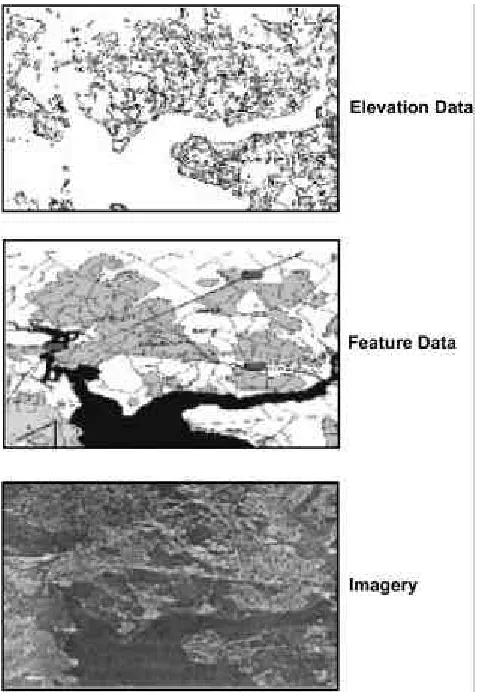
Foundation data (FD) is a seamless, integrated geospatial data base consisting primarily of eleva-tion data, map feature data, and imagery predomi-nantly at a medium equivalency of resolution (similar to a 1:250,000 scale chart). See figure 1-3.
[image:10.612.51.284.437.709.2]1984 (WGS-84) datum. The primary focus of FD is to support initial planning and to establish the framework for intensification of data within the objective area necessary to support specific operations.
f. Mission Specific Data Set
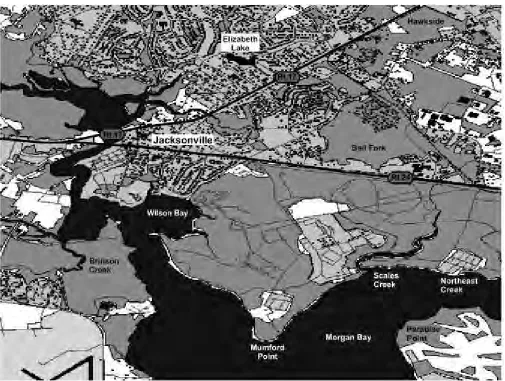
Mission specific data set (MSDS) is any user-defined enhancement of FD required to conduct a mission. MSDS is focused on a specific mission, operating area, and type force. It is developed by enhancing the information contained in the foun-dation data set and includes higher resolution con-trolled imagery, elevation and/or bathymetric depth information, and vector features (i.e., point, line or polygon) needed to meet a defined mission (see figure 1-4 on page 1-4). Within the MAGTF, the MSDS is managed, manipulated, and main-tained by the topographic platoon with each
Marine expeditionary force’s (MEF’s) intelli-gence battalion (intel bn).
1002. Categories of GEOINT
GEOINT provides the detailed framework critical for operations within the littorals.All phases of operation are influenced by environmental condi-tions. The conduct of operations requires detailed studies of the littorals, terrain, inland and coastal hydrography, weather, and environmental factors. GEOINT for amphibious operations includes depths, beach gradients, composition, and loca-tions of natural and manmade obstacles. The abil-ity to rapidly integrate, deconflict, and create a seamless framework for visualization is essential for coordination between forces, supporting fires, and other forces within the area of operations (AO). (See figure 1-5 on page 1-5.)
Terrain, inland and coastal water, climate, and weather factors are so interrelated that they must be considered together when planning ground, air, and logistics operations. Weather elements are capable of drastically altering terrain features and trafficability. Conversely, terrain features, such as mountains and ridge lines, exert influence on lo-cal weather and oceanographic elements. This re-lationship of terrain, oceanography, and weather must be carefully correlated in all operations to ensure an accurate description of environmental impacts to mission success. GEOINT supports ev-ery phase of a military operation and must be con-sidered during each phase to limit potential environmental impacts to friendly forces, while exploiting potential impacts to enemy forces.
[image:11.612.65.305.76.426.2]often studies problems that may arise some years ahead and applies GEOINT in a wide variety of hypothetical situations. Operational and tactical plannersare mostly engaged with missions and problems that currently involve their units and studying the geographic and terrain factors in their entire AO and interest.
a. Strategic
Strategic GEOINT concerns national and theater plans that include the military capabilities of na-tions. Strategic GEOINT is produced continuous-ly and requires the compilation and interpretation of information by specialized GEOINT personnel. Strategic GEOINT analysis is normally keyed to
small-scale or low-density source equivalents (e.g., 1:1,000,000 or smaller scale maps) to sup-port an entire country or regional area.
Strategic GEOINT includes macro descriptions and analyses of—
l Beaches, ports and facilities, inland waterways,
urban areas, and other major terrain features.
l Transportation and communication systems. l Types of soils and rocks.
l Underground installations. l Climate.
[image:12.612.49.554.74.455.2]l Vegetation. l Hydrography.
(1) Capabilities
Strategic GEOINT provides broad coverage of in-formation over countries and regions. It focuses primarily on helping develop the broad situational awareness to support the National Command Authorities (NCA) and the combatant commands’ commanders in chief (CINCs). Strategic GEOINT based on FD provides a stable base for intelli-gence intensification. This helps ensure a com-mon operational view of the battlespace across the political, theater, and military spectrums.
(2) Limitations
The primary limitation to strategic GEOINT is that the resolution and density of information is not high enough to support detailed planning of tactical operations. Strategic GEOINT is directed to the macro-relief within an entire country and will not provide the critical, focused information necessary to support lower command echelon operations.
b. Operational
Operational GEOINT is produced for use at the combatant command, joint task force (JTF), Ser-vice component commands, and MAGTF com-mand elements (CEs). Operational GEOINT is fluid and requires the compilation and interpreta-tion of informainterpreta-tion by specialized GEOINT per-sonnel within the joint intelligence centers (JICs), joint analysis centers (JACs), and Service intelli-gence centers. Normally focusing on the theater of operations, operational GEOINT is concerned primarily with the effects of weather, enemy, and terrain (WET) on mission accomplishment. Oper-ational GEOINT includes information derived from strategic analysis, but focuses more attention on detailed support for large military forces with-in the theater of operations. It with-includes detailed analysisand production on—
[image:13.612.69.558.81.372.2]l Landing areas and sites. l Inland waterways.
l Urban environments.
l Transportation and communication systems. l Climatic, terrain, and hydrographic effects on
potential courses of action (COAs) within the theater of operations.
Operational GEOINT is used for planning and co-ordinating missions within a theater and is based on information from all-source national, theater, and other intelligence assets. Operational GEOINT support can be focused on several dif-ferent types of missions, units, and weapon sys-tems occurring at the same time within the commander’s area of responsibility (AOR). Nor-mally, operational analysis is keyed to small-scale or low-density source equivalents (e.g., 1:500,000 or smaller scale maps) supporting an entire the-ater of operations.
(1) Capabilities
Operational GEOINT is produced for use by JTF headquarters (HQ), component commands, and, to some extent, the MEF CE during IPB activities. Within a MAGTF, normally GEOINT focuses on the MAGTF’s area of interest (AOI) and supports the integration and analysis of WET effects on MAGTF plans and capabilities. Operational GEOINT includes information derived from stra-tegic analysis, but it focuses more attention on de-tailed support for large maneuverand other forces (i.e., division, wing, service support) within the AOI. Operational GEOINT support can be fo-cused on several different missions, units, and weapon systems operating at the same time within the commander’s AOR.
(2) Limitations
As with strategic GEOINT, the major limitation of operational GEOINT is the resolution and den-sity of information. It is focused on a large area (e.g., theater of war), and the data content is not high enough to support lower echelons’ detailed planning, operations, and IRs. Operational GEOINT is directed to the macro-relief and may include limited evaluation of specified beaches, landing zones, airfields, and road networks. It will not provide the critical information necessary to
support infantry and artillery regiments, Marine aircraft groups, combat service support detach-ments, and smaller operations.
c. Tactical
Tactical GEOINT is produced from information collected locally and information provided by higher headquarters. It is concerned primarily with the effects of climate, terrain, and/or the lit-toral environment on the operations of the MAGTF within a specific AO. Tactical GEOINT is used in planning, coordinating, and conducting tactical or other operations within the MAGTF AO. At a MEF level, staff planners focus normal-ly on the AOR at a 1:250,000 scale equivalent and with appropriate data density (although 1:50,000 and 1:100,000 scale products are needed for spe-cific requirements), while their major subordinate commands (MSCs) require greater detail of anal-ysis to support mission requirements.
Tactical GEOINT analysis and production include information from the operational level and pro-vide greater detail based on imagery and local all-source intelligence collection and production ac-tivities. Tactical GEOINT is concerned primarily with the effects of the environment on a particular mission, unit, and/or weapon system. Specific products may include CCM analysis, lines of communication (LOC) analysis, and more fo-cused evaluation on the logistical support require-ments of commanders (i.e., staging areas and depot sites within the AO). Normally, tactical GEOINT is keyed to medium- or large-scale source equivalents and data density (i.e., 1:100,000 and larger scale maps) to support a spe-cific mission or operation.
(1) Capabilities
environment on a particular mission, unit, and/or weapon system.
(2) Limitations
Tactical GEOINT’s most significant limitation is the time necessary to collect, integrate, process, and analyze the data for each mission to produce tailored, focused GEOINT products to support MAGTF IRs. In addition, it is limited by the CIS available to disseminate and usethese products at lower echelons to support mission planning and execution.
1003. Support to Intelligence
Functions
During deliberate planning, GI and GEOINT pro-vide the initial geospatial framework to support battlespace visualization of the AOI. They help planners developtheir COAs and assess the ene-my’s COAs based on potential environmental conditions within the AOI. During crisis plan-ning, the FD allows planners to initiate planning while topographic Marines accelerate the GEOINT production and intensification processes to provide the MSDS required for MAGTF mis-sion execution.
a. Commander’s Estimate
The primary function of GEOINT when support-ing the commander’s estimate of the situation is ensuring the intensification, value-adding, and analysis of environmental features (to include me-teorological effects) within the IPB process and the Marine Corps planning process (MCPP). This provides the geospatial framework to support the commander’s visualization of the battlespace.
After GI is analyzed with respect to military as-pects of the terrain, it can be fused with other in-telligence and other functional information to support the commander’s battlespace situational awareness, planning, and decisionmaking needs. T h i s d o m i n a n t v i e w o f t h e a r e a i n w h i c h MAGTFs conduct operations allows commanders
at all levels to anticipate or react quickly to evolv-ing situations.
b. Situation Development
As potential trouble spots develop, topographic units use indications and warning (I&W) to pro-vide lead time in collectionof information and in-t e g r a in-t i o n o f in-t e r r a i n s in-t u d i e s , e n s u r i n g in-t h e geospatial framework is available to support MAGTF planning. With the ability to query and pull geospatial data and refined GEOINT from the national distributed production network, MAGTF topographic assets can provide an initial data base to support planning and situational awareness during the development of a situation.
c. Force Protection
GEOINT provides high-resolution analysis and MSDS to support maneuver,engineering, barrier, and rear area operations planning with detailed GI. This geospatial data base is alsofocused on the unique missions associated with rear area se-curity and supports the identification of ingress and egress routes, defensive barrier support using natural and manmade features, and identification of potential obstacles for reinforcement or mobili-zation plans.
d. Targeting
The imagery segment of FD provides high-resolution, orthorectified and georectified, stereo-scopic imagery for accurate identification and location of potential targets within the area of op-erations. Analysis of the surrounding environment provides potential air and ground ingress and egress routes and support evaluation of all mili-tary aspects of the terrain that could affect weap-on delivery systems.
e. Combat Assessment
intensification and deconfliction of tactical intelli-gence within a target area.
1004. Support to Operations
The primary principle behind GI and GEOINT support to any MAGTF operation is the need for a common geographic reference. Air, ocean, and land environments affect the composition, de-ployment, emde-ployment, sustainment, and rede-ployment of the MAGTF. The tactical geospatial data base provides the common reference for dif-ferent missions, forces or weapon systems to build a common view of the battlespace. This pro-vides critical support to achieving the common operational picture (COP) and common tactical picture (CTP) and allows the accurate positioning of information in operational and tactical context.
GI and GEOINT helpprovide visualization of in-telligence information in relationship to the envi-ronment, threat, and friendly forces to support IPB and the MCPP. They support the evaluation of different courses of action based on friendly and enemy capabilities and terrain limitations. The commander’s evaluation of various COAs should include critical geospatial and meteorolog-ical environmental factors and impacts. These factors must be evaluated when planning opera-tions and determining operational and tactical performance.
a. Command and Control
Command control encompassescritical support to all warfighting functions and operations. It is the means by which a commander recognizes what needs to be done and directs appropriate actions. The ability to picture and assess the battlespace, forces, weapon systems, and the interaction of the three are essential to C2.
Accurate depiction of the environment, as well as the accurate location of all entities engaged in that environment depend on the resolution level and detail of the GI and GEOINT and its integration with other intelligence. Whereas many
experi-enced practitioners of C2 have the inherent ability to intuitively picture the battlespace, it is very dif-ficult to convey their picture and intent without effective C2 and CIS. This requires a framework of GI and GEOINT to which specific information may be anchored. The requirement for higher lev-els of geospatial resolution and detail to support C2 are driving GI and GEOINT to find more effi-cient and effective means of providing the geospatial framework for the common operational and tactical pictures.
b. Maneuver
The connectivity and display of the C2 network directly supports maneuver operations by provid-ing detailed, mission-essential GEOINT to opera-tional forces. Identification of key transportation and main supply routes (MSRs) to facilitate the rapid movement of personnel and materials is critical to battlefield support. Detailed visualiza-tion of the terrain supports rapid transivisualiza-tion of ma-neuver and supporting forces during amphibious operations and also supports realistic mission re-hearsal during all phases of operations.
Maneuver is affected by the—
l Configuration and geometry of the Earth’s
sur-face.
l Soils, rocks, and vegetation composing that
surface.
l Surface water conditions. l Visibility.
l Wind.
l Precipitation.
l Cultural and other manmade modifications and
their impacts on the Earth’s physical features.
can move across terrain with ease, with difficulty or not at all.
c. Fire Support
Accurate positioning of weapon systems, coupled with integrated GI and GEOINT, provide fire sup-port planners with critical information needed to place rounds on target. Environmental impacts of the terrain, hydrographic, and weather elements support development of detailed descriptions of high-value targets (HVTs) and high-payoff targets (HPTs) and identify potential impacts to weapon delivery systems.
d. Aviation
GEOINT is critical to airspace analysis and can identify air avenues of approach and mobility cor-ridors. When integrated with weather information, GEOINT helps provide the framework for deter-mining the routes by which aircraft can enter and exit an AO. When integrated with aircraft attack profiles, GEOINT helps determine the potential aircraft approach routes to the target areas and the most effective deployment positions for air de-fense weapons and radars. Also, GEOINT can as-sist in determining the most likely positions for helicopter landing zones (HLZs), drop zones (DZs), forward arming and refueling points (FARPs), and the most likely approaches to these areas.
Through terrain-masking analysis, GEOINT helps provide the framework for mission planning sys-tems by determining where aircraft can ingress a target while screened from enemy air defense weapons and radar. This analysis also helps deter-mine where air defense radars and weapons are rendered ineffective by terrain and weather im-pacts. GEOINT helps the commander maximize battlespace air interdiction efforts and plan and counter airborne and air assault operations.
e. Logistics
One of the primary considerations in planning op-erations is the extent and general nature of the transportation network. Planners must consider the entire pattern of transportation infrastructure.
GEOINT support to logistic operations includes the transportation infrastructure analysis of an ar-ea (i.e., road networks, railways, and waterways over which forces and supplies can be moved).
The importance of a particular facility will de-pend on the units involved and the type of opera-t i o n . F o r e x a m p l e , a n a r e a w i opera-t h a d e n s e transportation network is usually favorable for major operations. An area crisscrossed with ca-nals and railroads but with few roads will limit the use of wheeled vehicles and the maneuver of ar-mor and motorized convoys. Railroads extending along the axis of advance will assume greater im-portance than those perpendicular to the axis, and the direction of major highways and waterways assumes similar significance. When preparing GEOINT studies and data bases in support of MAGTF operations, planners must carefully eval-uate all transportation capabilities and limitations to determine their effect on possible COAs.
1005. Multilevel GEOINT Support
Operations
a. Marine Expeditionary Force
Close coordination between topo plt and MAGTF meteorological and oceanographic (METOC) per-sonnel is important for comprehensive GEOINT support. The MEF senior weather officer within the G-2 division and the intelligence support co-ordinator (ISC) in the intel bn coordinate meteo-rological support to intelligence andimpacts on MAGTF operations. The meteorological mobile facility, located in the aviation combat element (ACE), is the hub for meteorological support to the MAGTF. This facility can process GCCS overlays for use by the topographic unit and intel-ligence analysts. (See MCWP 3-35.7, MAGTF Meteorology and Oceanography [METOC] Sup-port, for further information on MAGTF METOC support operations.)
b. Marine Expeditionary Unit (Special Operations Capable)
Within the Marine expeditionary unit (MEU) (special operations capable [SOC]) command ele-ment, GEOINT is produced by the geographic in-telligence team (GIT) that is task-organized from the topo plt and under the staff cognizance of the MEU intelligence officer. The GIT is connected to the internal ship communications links giving all elements of the MEU access to the TGIL. Us-ing the ship’s CIS, the GIT is supported in reach-back mode by the parent MEF’s topo plt and the Marine Corps Intelligence Activity (MCIA). This provides the MEU with a robust GEOINT pro-duction capability to integrate, deconflict, and in-t e n s i f y in-t h e l a n d , a i r , a n d w a in-t e r i n in-t e r f a c e environment.
c. Joint and Theater
During joint operations, the topo plt is connected to theater C2 networks providing access to the theater and other Services’ geospatial data base. The theater geospatial information library (GIL) provides operational GEOINT, ensuring interop-erability and standardization among all forces within the theater of operations. In the event of coalition or multinational operations, the GIL pro-vides a common framework for all forces to re-duce information uncertainty and enhance interoperability. At the theater level, access to JIC
and JAC GI&S branches provides GEOINT for production support and a repository for tactical production to ensure a common framework for vi-sualization throughout the theater.
d. National and Strategic Support
The MCIA provides a dedicated geospatial pro-duction support capability to Marine Corps oper-ating forces. A trusted coproducer in the national distributive intelligence production network, MCIA focuses on Marine Corps interests within the littoral zones of the world. MCIA maintains a global littoral data base and provides GEOINT tailored to mission requirements from a robust cli-ent and server configuration. Forces can access this GEOINT via the intelligence link (IN-TELINK), secret internet protocol router network (SIPRNET), nonsecure internet protocol router network (NIPRNET), and the Global Broadcast System (GBS) configurations. In addition, MCIA can rapidly generate an MSDS to support MAGTFs and link this data set to the NIMA litho-graphic presses for hard-copy production. MAGTFs, via MCIA, will be able to query the na-tional geospatial data base and receive GI and GEOINT from NIMA, Defense Intelligence Agency, Central Intelligence Agency, other Ser-vices, and commercial sources.
1006. GEOINT Cycle
GI and GEOINT activities occur in all phases of the intelligence cycle. GEOINT is interwoven throughout the cycle to ensure collection, integra-tion, analysis, disseminaintegra-tion, and use of intelli-gence data is tied to the geographic framework. Like the other forms of intelligence, GEOINT is a never-ending process that is continually updating intelligence studies, evaluations, estimates, and data bases.
Topographic methods of manipulating the GEOINT cycle will vary from unit to unit and will depend on the mission, commander’s intent, and IRs.
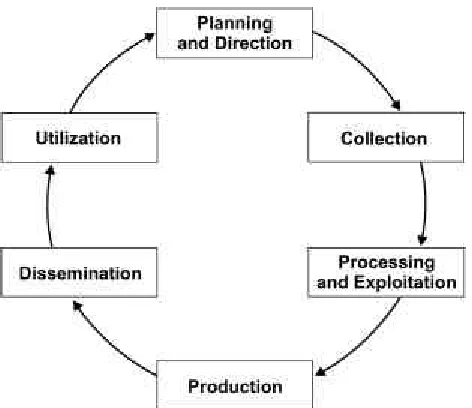
As with the intelligence cycle, the GEOINT cycle has six phases (i.e., planning and direction, col-lection, processing and exploitation, production, dissemination, utilization). (See figure 1-6.) Through these phases, GI is obtained, assembled, analyzed, and converted into tailored GEOINT products, then disseminated to commanders and other users.
a. Planning and Direction
GEOINT planning and direction phase is the spearhead of the GEOINT cycle. It supports—
l Defining the AO and AOI.
l Identifying information shortfalls and
associat-ed geospatial and GEOINT requirements.
l Accessing and reviewing existing data holdings
and intelligence products.
After a warning order has been issued and com-mander’s intent expressed, IRs are identified and prioritized. During the planning and direction phase, the intelligence staff officer (G-2/S-2) and GI&S staff, in conjunction with the operations
staff officer (G-3/S-3), must identify the com-mand’s AOI and AO. Specific objectives and tar-gets need to be identified as soon as possible to ensure requirements are levied for production and intensification.
As the planning and direction phase continues, commanders and planners identify and submit es-sential elements of terrain information (EETI) as an IR. The ISC and the collection management and dissemination officer (CMDO) coordinate with the MEF CE intelligence staff, and the pro-duction and analysis (P&A) cell to refine and pri-o r i t i z e r e q u i r e m e n t s , d e v e l pri-o p s u p p pri-o r t i n g intelligence plans, and then task appropriate col-lection assets against the requirements. Concur-rently, the GI&S staff coordinates GEOINT production requirements with the P&A cell OIC. Close integration with the MAGTF CE’s opera-tions and intelligence secopera-tions is critical to sup-port COA development and to identify potential GEOINT issues affecting mission alternatives.
Planning must always address connectivity be-tween intelligence assets and supported users. Plans should call for communications reliability, capacity, redundancy, and speed. The MAGTF CIS officer must always be included when planning GEOINT activities’ CIS support (see chapter 5). Accurate management and storage of theater and MAGTF geospatial and GEOINT data bases are critical to ensure availability and in-teroperability with all components of the MAGTF. Ready access to critical battlespace views by all commanders and planners requires adequate communications paths to all MAGTF command echelons and other supported units.
b. Collection
[image:19.612.64.300.266.470.2]solutions, source materials, and if required, the development of a request for intelligence (RFI) for tactical collection support.
Collection planning involves matching the multi-tude of GEOINT and other IRs with a finite pool of collection assets. Collection may include multi-source intelligence reports (e.g., imagery intelli-gence [IMINT], signals intelliintelli-gence [SIGINT], human intelligence [HUMINT]) and must be able to access tactical intelligence andreconnaissance reports (e.g., route reconnaissance, bridge studies, engineering reports), as well as information and reports available from non-intelligence sources (e.g., engineer, civil affairs, and military police units).
Other collection sources include riverine and oceanographic surveys as well as terrain and im-agery reconnaissance. Organic topographic col-lection activities include tactical geodetic and topographic surveys, analysis of riverine and oceanographic surveys, and terrain reconnais-sance. Organic MAGTF assets must always be considered first due to their advantages in respon-siveness and control. Prior to arrival in the AO, the MAGTF largely depends on external collec-tion resources. After the MAGTF begins opera-tions in the objective area, organic topographic, SIGINT, HUMINT, IMINT, engineer, reconnais-sance, and other assets are used for collection.
c. Processing and Exploitation
The processing and exploitation phase is the con-version of collected GI into a form suitable for GEOINT production and support to other intelli-gence products. It is a continual process generally accomplished concurrently during collection and/ or production. Processing and exploitation require topographic unit CIS connectivity to national, the-ater, JTF, and other geospatial information sourc-es. This phase includes the compilation and deconfliction of various sources to ensure a sin-gle, accurate geospatial data base to support MAGTF operations within the theater. The topo plt provides the capability to retrieve, integrate, deconflict, and store multisource GI and GEOINT
into a tailored, seamless data base to meet MAGTF requirements.
d. Production
Production is the conversion of GI into GEOINT and otherall-source intelligence products through evaluation, integration, intensification, analysis, and interpretation. This demands a focused ap-proach for managing, tasking, and operating a collaborative GEOINT production capability to ensure all efforts are prioritized and accomplished according to the needs of the MAGTF. (See ap-pendix A for a description of GEOINT products and reports.)
The topo plt provides the ability to analyze inte-grated data bases for specific applications, add valuable information or update features and attributes within the data base, and intensify the data base content to meet tailored mission re-quirements. The GEOINT specialist evaluates all-source terrain, littoral, hydrographic, geodetic, and weather information to support specific mis-sion requirements. Then the GEOINT specialist must intensify the information with other known information to develop GEOINT estimates associ-ated with the terrain’s military aspects.
which becomes the foundation for the IPB process and COA development.
e. Dissemination
Dissemination is the timely conveyance of GI and GEOINT, in an appropriate form and by any suit-able means, to those who need it. GEOINT must be effectively disseminated to MAGTF com-mander and planners, MAGTF subordinate ele-ments, and other forces and organizations in time for decisionmakers to assess and use it to affect COA development and analysis and other plan-ning and decisionmaking activities.
When determining the GEOINT dissemination re-quirements, the means, timeliness, and pertinence are the primary considerations. Dissemination does not occur automatically. It is a result of si-multaneous efforts at each MAGTF command echelon to push GI and GEOINT out to those needing itand to pull GI and GEOINT in from ev-ery available source. The ability to rapidly dis-seminate updated GEOINT to all users through a smart push capability will help ensure that critical GEOINT and other information are made avail-able to the entire MAGTF.
The Marine Corps is using an open technical ar-chitecture supporting the geospatial domain that has evolved within the United States Imagery and Geospatial Information System (USIGS)
architec-ture. It will support dissemination of geospatial data external to operational and tactical forces through the GCCS and the GBS.
Primary access to the topographic unit’s TGIL through the MAGTF’s tactical data network (TDN) ensures each level of command can access the tailored GEOINT products necessary to sup-port the mission. The platoon will use redundant CIS capabilities to support electronic dissemina-tion.
Local printer replication (limited copies) will sup-port hard-copy GEOINT products reproduction to support units requiring a paper medium. Mass production will continue to be supported through NIMA’s digital to lithographic press capabilities or from other external sources.
f. Utilization
Organizations and
Responsibilities
The Assistant Chief of Staff (AC/S), Command, Control, Computers, Communication, and Intelli-gence (C4I), Headquarters, U.S. Marine Corps (HQMC), is the functional leader for GI&S and GEOINT functions within the Marine Corps com-bat development system. Day-to-day management of these functions is delegated by AC/S, C4I, to the Director, MCIA. Marine Corps operating forces and supporting establishment GI&S and GEOINT missions, functions, organizations, and assigned responsibilities are discussed in this chapter. Organizational points of contact are pro-vided in appendix B. Specific responsibilities and tasks are provided in the appendix C matrix.
2001. Geospatial Information
and Services
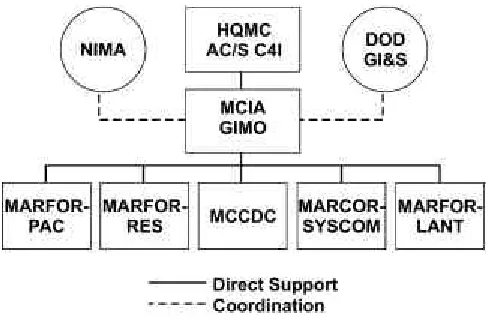
a. Marine Corps Geospatial Information Management Office
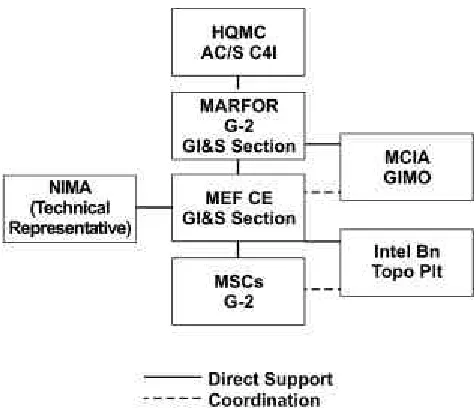
As a special staff office under the Director, MCIA, the Geospatial Information Management Office (GIMO) serves as the Marine Corps repre-sentative to the DOD GI&S community. GIMO supports the operating forces, HQMC, and the supporting establishment with technical assess-ments, evaluations, and review authority for all Marine Corps GI&S matters.
(1) Mission
GIMO provides GI and GEOINT support to the Marine Corps by coordinating Marine Corps GII matters including policy; proponency for service doctrine and tactics, techniques, and procedures (TTP); personnel; technologies; architectures; and standards required for Marine Corps GI and GEOINT support. This support includes serving
as the Marine Corps representative on appropriate GI&S forums, developing GI&S policies and po-sitions, and staffing joint and Service GI&S docu-ments. It also includes developing, validating, submitting, and advocating proponency of Ser-vice requirements for DOD and national GI&S production support of training bases, emerging systems, and military intelligence.
(2) Organization
MCIA established GIMO as a centralized man-agement office to coordinate Marine Corps geospatial support (see figure 2-1). By the table of organization (T/O), the Marine Corps GI&S offic-er is a major, military occupational specialty (MOS) 0202. In addition, the T/O provides for a general service (GS)-12 mapping officer and a GS-9 intelligence assistant.
(3) Responsibilities
[image:22.612.321.566.437.600.2]The GIMO provides a single point of contact for all Marine Corps GI&S and GEOINT issues with-in national, with-international, DOD, jowith-int, and Service forums. This provides an integrated and centrally managed approach across all functional aspects of GI&S and GEOINT within the Marine Corps.
The GIMO—
l Provides the Marine Corps direct interface to
the NIMA for all new GI development and pro-duction.
l Provides input to the technical design and
de-scription of emerging GI and products early in their development to ensure Marine Corps re-quirements are met.
l Ensures the interoperability of GI and GEOINT
standards to support legacy and emerging MAGTF C2, CIS, weapon delivery, and other systems.
l Coordinates with the following activities to
en-sure that all aspects of GEOINT support are ad-dressed and integrated:
n HQMC (policy, personnel, programs, and resources).
n Marine Corps Combat Development Command (MCCDC) (training, educa-tion, doctrine, total force structure, and requirements).
n Marine Corps Systems Command (MARCORSYSCOM) (all equipment and software generating or using GI).
l Coordinates with Headquarters, Marine Corps
Forces (MARFOR), the MEF CEs, intel bn MSCs, and topo plts to ensure interoperability, standardization, and compliance with Joint Chiefs of Staff (JCS), DOD, and Marine Corps directives.
l Supports the AC/S, C4I, with Service-level
oversight for all Marine Corps GI&S functional areas, to include—
n Evaluating development of terrain and oceanographic data and systems.
n Developing policy for Marine Corps GI&S standardization and interopera-bility.
n Validating Marine Corps GI&S require-ment submissions (training, research and development, and intelligence).
n Ensuring all aspects of the Marine Corps GI are compatible with doctrine.
(4) Tasks
Refer to appendix C.
b. Marine Corps Forces, GI&S Section
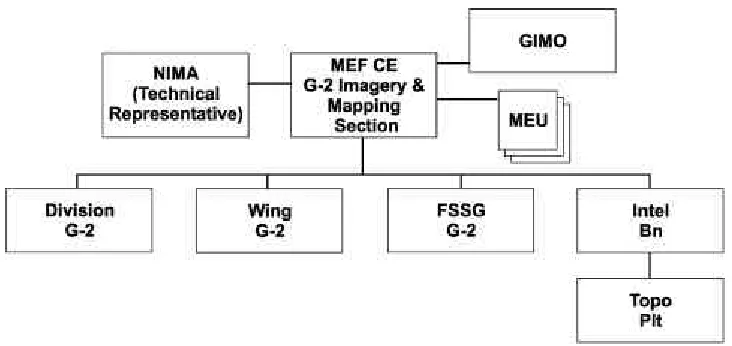
Under the functional control of the AC/S, G-2, the GI&S section serves as the MARFOR command-er’s technical representative with GI&S elements. In addition, the MARFOR GI&S section provides a dedicated point of contact for GI&S and/or GEOINT issues within the commander’s speci-fied theater or operational area. The MARFOR GI&S section provides an integrated approach to identifying, consolidating, and validating GEOINT production requirements and supporting operations (see figure 2-2).
(1) Mission
[image:23.612.312.550.319.523.2]The MARFOR GI&S section coordinates the de-velopment, validation, and establishment of MARFOR’s requirements for GI&S priorities, standard products, and supporting operations with the appropriate unified and subordinate com-mands. In addition, the GI&S section represents the MARFOR in appropriate GI&S forums re-sponsible for validating GI&S resource alloca-t i o n s a n d s y s alloca-t e m c a p a b i l i alloca-t i e s w i alloca-t h i n alloca-t h e MARFOR’s AO.
(2) Organization
The GI&S section consists of two GEOINT spe-cialists, MOS 0261. These billets require a gun-nery sergeant and sergeant with formal GI&S staff officer training by the Defense Mapping School (DMS), Ft. Belvoir, Virginia. This section is under the cognizance of the G-2 intelligence operations officer. It assists in the coordination of geospatial issues with intelligence plans, collec-tions, production, targeting, dissemination, coun-terintelligence, and other staff sections.
(3) Responsibilities
l Validates requirements and coordinates the
production of all GI&S, GI, and GEOINT re-quirements for the MARFOR headquartersand supported commands. This includes the follow-ing requirements:
n Global-sourcing GEOINTpersonnel with the MARFOR personnel division (G-1).
n Helping define the area of operations, mission objectives, and force list with the MARFOR operations division (G-3).
n Developing the distribution of hard-copy G I a n d G E O I N T p r o d u c t s w i t h t h e MARFOR logistics and supply division (G-4).
n Identifying production requirements for long-range objectives with the MARFOR future plans division (G-5) and intelli-gence production personnel.
n Coordinating GEOINT CIS requirements for national, theater, and MAGTF opera-tions with the MARFOR CIS division (G-6).
n Coordinating all national GI and GEOINT production requirements for Marine Corps training areas with the GIMO.
l Provides MARFOR oversight to theater GI&S
functions, to include policies, TTP architec-tures, technologies, and personnel. The GI&S section will influence the determination and de-velopment of unit and mission profiles to sup-port operations within their operational area to ensure tactical requirements are met.
l Ensures the interoperability of GI and GEOINT
standards within the operational area to support tactical MAGTF systems and weapon delivery systems.
(4) Tasks
Refer to appendix C.
c. MEF CE, G-2 Division, Imagery and Mapping Section
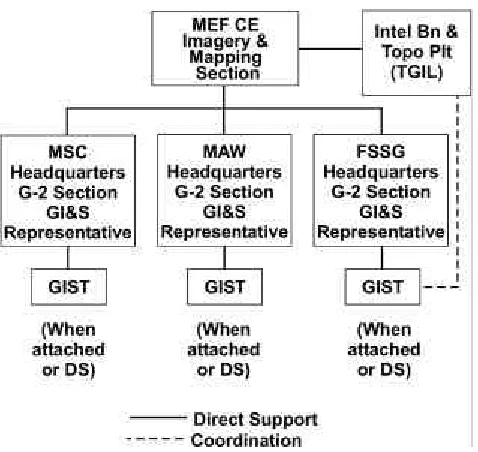
As a functional staff office under the cognizance of the MEF G-2 plans officer, the imagery and mapping (I&M) section serves as the MEF com-mander’s technical representative for GI&S activ-ities. This section provides a single point of contact for MEF GI&S and GEOINT issues with-in a specified theater or operational area. The MEF GI&S section coordinates with the ISC to provide an integrated approach to identifying, consolidating, and validating GEOINT produc-tion and operaproduc-tions requirements (see figure 2-3 on page 2-4).
(1) Mission
The MEF I&M section coordinates MEF GI&S matters, to include determining and developing MAGTF area requirements for GI&S priorities, standard products, and supporting operations with appropriate MARFOR and MSCGI&S offices. This section implements plans, policies, and sup-port to future plans to supsup-port collections, collab-orative production, and use of GEOINT. It also provides professional, technical GI&S and GEOINT advice and assistance to subordinate commanders. The MEF I&M section develops, coordinates, and forwards all recommendations on GI&S product specifications and standardiza-tion agreements to appropriate MARFOR GI&S offices. In addition, this section represents the MEF in appropriate Service and theater GI&S fo-rums responsible for validating topographic pro-duction resources and system capabilities within a theater of operations.
(2) Organization
and imagery officer (MIO) (major, 0202) and two geographic intelligence specialists (MOS 0261). The billets call for a gunnery sergeant and a staff sergeant with formal DMS GI&S staff officer training. The I&M section is under the cognizance of the intelligence plans officer. It assists the ISC and other intelligence personnel in the coordina-tion of geospatial issues with intelligence plans, collections, all-source production, dissemination, targeting, and other support.
(3) Responsibilities
l Validates requirements and coordinates the
production of all GI and GEOINT requirements and supporting operations for the command el-ement and subordinate elel-ements with appropri-ate GI and GEOINT organizations. These GI&Srequirements include—
n Global-sourcing personnel with the MEF G-1.
n Assisting the G-2, G-3, and future plan-ners with defining the area of operations, mission objectives, and force list.
n Assisting the ISC and MEF G-4 with de-veloping the distribution of hard-copy GEOINT and GI products.
n Identifying production requirements for long-range objectives with the MEF G-5 and intelligence personnel.
n Assisting the ISC and MEF G-6 with co-ordinating CIS requirements for national,
theater, and MAGTF GEOINT and GI distribution.
l Coordinates the development and submission
of all GI&S requirements from all MEF CE staff divisions during garrison and actual oper-ations.
l Coordinates the validation, prioritization, and
tasking of all GI&S requirements submitted by MEF subordinate units during garrison opera-tions.
l Coordinates all standard NIMA GI&S
produc-tion requirements with the MARFOR GI&S staff for validation to the GIMO (for training areas) or to the appropriate combatant com-mand (for contingency planning and operation-al areas).
l Provides coordinated oversight of all MEF
GI&S functions, to include policies, architec-tures, technologies, and personnel.
l Assists the G-2 plans officer and ISC with the
determination and development of unit and mission profiles to support operations within the operational area to ensure MEF require-ments are satisfied.
l Assists the ISC with oversight to the MAGTF’s
GII and TGIL to ensure compatibility with the intelligence concept of operations and support-ing plans as well as MEF operations and CIS concepts of operations and plans.
(4) Tasks
[image:25.612.118.484.73.246.2]Refer to appendix C.
d. Major Subordinate Commands
The Marine division, Marine aircraft wing (MAW), and force service support group (FSSG) do not have organic GI&S and GEOINT per-sonnel within their command. Instead, each MSC G-2 must designate a single point of contact for GI&S and GEOINT issues. This helps provide an integrated approach to identify, consolidate, and validate GI&S and GEOINT production require-ments from the MSC and the planning and execu-tion of supporting operaexecu-tions (see figure 2-4).
(1) Mission
The G-2 designated GI&S representatives coordi-nate the command’s GI&S requirements, opera-tions, and support to include determining and developing area requirements for GI&S priorities and standard products with intel bn, the ISC, and the MEF I&M section. In conjunction with the MEF I&M section, these representatives imple-ment plans, policies, procedures, and programs to support a collaborative process for GEOINT col-lection, production, dissemination, and use. They also develop and forward to the MIO (garrison operations) or ISC (actual operations) all recom-mendations on GI&S product specifications and
standardization agreements. In addition, they rep-resent their command in appropriate GI&S fo-rums responsible for validating GI&S resource allocations, system capabilities, and operations within their theater of operations.
(2) Organization
The MSC AC/SG-2 shall designate a GI&S rep-resentative within the G-2 section. Generally, this GI&S representative is under the control of the G-2 intelligence operations officer. The indi-viduals assigned this responsibility are trained at the DMS.
(3) Responsibilities
l Provides the command with a single point of
contact for validation and development of all GI&S and GEOINT requirements and support-ing operations from other MSC staff divisions and subordinate commands (e.g., regiments, groups, battalions, squadrons).
l Plans, directs, and coordinates GI and GEOINT
operations in support of the command’s re-quirements, including direction of any attached or direct support geographic intelligence sup-port team (GIST).
l Develops unit and mission profiles necessary to
acquire MSDS for tactical operations (see chapter 4).
l Provides guidance and assistance to support the
command request for GI&S products and GEOINT production.
(4) Tasks
Refer to appendix C.
2002. Geographic Intelligence
a. Key MEF Intelligence Staff Planning and Direction Responsibilities
(1) Assistant Chief of Staff, G-2
[image:26.612.60.299.248.474.2]The AC/S G-2 has staff responsibility for intelli-gence and intelliintelli-gence operations, to include G E O I N T . T h e c o m m a n d e r r e l i e s o n t h e intelligence officer to provide the necessary Figure 2-4. MSC GI&S and GEOINT
information on the weather, terrain, and enemy capabilities, status, and intentions. Through the intelligence operations plan and supporting intel-ligence and R&S plans, the MEF AC/S G-2 vali-dates and plans IRs, coordinates intelligence priorities, integrates collection, production and dissemination activities, allocates resources, as-signs specific intelligence and reconnaissance missions to subordinate elements, and supervises the GEOINT and overall intelligence and recon-naissance efforts. Specific all-source and key GEOINT responsibilities include—
l Developing and answering outstanding MEF
and subordinate units’ PIRs and IRs by plan-ning, directing, integrating, and supervising or-ganic GEOINT and multi-discipline MEF and supporting intelligence operations.
l Preparing appropriate GEOINT and other
intel-ligence plans and orders for the MEF and re-viewing and coordinating the GEOINT and all-source intelligence plans of JTFs, theaters, and other organizations.
l Submitting and coordinating all-source and
GEOINT collection, production, and dissemi-nation requirements beyond the capability of the MEF to satisfy to higher headquarters for JTF, theater or national GEOINT systems sup-port.
l Ensuring GEOINT and other intelligence
infor-mation is rapidly processed, analyzed, and in-corporated where appropriate in all-source intelligence products, and rapidly disseminated to all MEF and external units requiring these.
l Evaluating JTF, theater, and national GEOINT
and all-source intelligence support and adjust-ing stated IRs, if necessary.
l Identifying and correcting deficiencies in
GEOINT and other intelligence and reconnais-sance personnel and equipment resources.
l Incorporating exercise GEOINT in training
ex-ercises in order to improve MEF individual, collective, and unit readiness.
l Facilitating understanding and use of GEOINT
and other intelligence in support of the plan-ning and execution of MEF operations.
(2) G-2 Operations Officer
The G-2 operations officer, under the direction of the MEF AC/S G-2, has primary responsibility for intelligence support to the CG and the remainder of the MEF CE in support of current operations and future operations. Specific all-source and key GEOINT-related duties include (see figure 2-5)—
l Coordinating and providing intelligence
sup-port (to include key GEOINT supsup-port) to the CG, the G-3 operations section, and the rest of the MEF CE’s battlestaff.
l Serving as the G-2 representative to the MEF
CE crisis action team (CAT).
l Coordinating, providing and supervising
intel-ligence support to the MEF CE current opera-tions center (COC), future operaopera-tions center (FOC), and force fires.
l Planning, directing, and supervising the Red
Cell.
l Providing recommendations on PIR and IR
val-idation, prioritization, and taskings to the AC/S G-2 and the ISC.
l Coordinating and supervising the transition of
intelligence planning and operations from G-2 plans to G-2 future operations, and from G-2 future operations to G-2 current operations, in order to effectively support the MEF’s “single battle” transition process.
l Planning, directing, and supervising MEF
liai-son teams to external commands (e.g., the JTF and joint functional components headquarters) and intelligence organizations.
l Coordinating with the ISC and MEF MSCs’
G-2 operations officers to ensure unity of effort of MEF intelligence operations.
l Provide intelligence input and other support to
MEF warning and fragmentary orders and to operations related reporting (e.g., periodic situ-ation reports).
l Coordinating intelligence training for the MEF
G-2 section and providing G-2 oversight for and integration of the entire MEF intelligence training program.
l Accomplishing other intelligence support and
(3) G-2 Plans Officer
The G-2 plans officer, under the direction of the MEF AC/S G-2, has primary responsibility for in-telligence support to the MEF CE’s future plans cell. Specific all-source and key GEOINT-related duties include (see figure 2-5)—
l Planning the MEF concept of intelligence
oper-ations for approved by the AC/S G-2 and sub-sequent implementation by the ISC based upon the mission, threat, commander’s intent, guid-ance, and concept of operations. This concept of intelligence operations will include a sup-porting GEOINT concept of operations.
l Leading, coordinating, and providing
intelli-gence support to MEF G-5 future plans section.
l Planning and coordinating intelligence support
requirements for and the deployment of intelli-gence elements and resources into the AO.
l Providing recommendations on PIR and IR
val-idation, prioritization, and taskings to the AC/S G-2 and the ISC.
l Coordinating, in conjunction with the ISC, G-2
development of Annex B (Intelligence) and A n n e x M ( G e o s p a t i a l I n f o r m a t i o n a n d
Services) to MEF operations plans (OPLAN), their supporting appendices, and all intelli-gence input to other annexes of OPLANs.
l Keeping the G-2 section, other CE staff
sec-tions, intelligence liaison personnel, augment-ees, and others as appropriate apprised of MEF intelligence planning actions and requirements.
l Identifying requirements and providing
recom-mendations to the G-2 operations officer for MEF intelligence liaison teams to external commands (e.g., the JTF or other components’ headquarters) and intelligence agencies.
l Coordinating and developing policies for MEF
intelligence, CI, and reconnaissance operations.
l Planning, directing, and supervising the MEF
G-2’s imagery and mapping, CI/HUMINT, SIGINT, and weather sections.
l Accomplishing other intelligence support and
tasks as directed by the AC/S G-2.
(4) Intelligence Battalion Commander/Intelli-gence Support Coordinator
[image:28.612.177.430.76.354.2]intelligence, and providing counterintelligence support to the MEF, MEF MSCs, subordinate MAGTFs, and other commands as directed.
(a) Garrison
In garrison, the principal task of the intel bn com-mander is to organize, train, and equip detach-ments that support MAGTFs or other designated commands to execute integrated collection, intel-ligence analysis, production and dissemination of intelligence products. The composition of intel bn is shown in figure 2-6.
(b) Actual Operations
During operations, the intel bn commander is du-al-hatted as the ISC1, serving under the direct staff cognizance of the MEF AC/S G-2. The intel bn’s S-3 section with the operations center ele-ment of the MEF G-2 forms the core of the ISC support effort, with planning, direction, and C2 conducted within the IOC’s support cell. ISC is responsible to the MEF AC/S G-2 for the overall planning and execution of MEF all-source
intelli-gence operations. Specific all-source and key GEOINT responsibilities of the ISC during actual operations include—
l Implementing the concept of intelligence
oper-ations (and the supporting GEOINT concept of operations) developed by the G-2 plans officer and approved by the AC/S G-2.
l Establishing and supervising operation of the
MEF intelligence operations center (IOC), which includes the support cell, the surveil-lance and reconnaissance cell (SARC), and the P&A cell (see figure 2-7.). Generally, the IOC will be co-located with the MEF CE’s man command post.
l Developing, consolidating, validating, and
pri-oritizing2 recommended PIRs and IRs to sup-port MAGTF planning and operations.
l Planning, developing, integrating, and
coordi-nating MEF intelligence collection, production, and dissemination plans, to include the effec-tive organic and external integration and em-ployment of MAGTF GEOINT as well as MEF
1. During garrison operations, many of the tasks listed here are the responsibility of the G-2 operations officer.
[image:29.612.146.423.76.294.2]2. The ISC is tasked to perform PIR and IR validation only during actual operations when the IOC is activated. During routine peacetime operations the PIR/IR validation and prioritization tasks are the responsibility of the MEF CE’s G-2 operations officer.
IMINT, SIGINT, counterintelligence (CI), HUMINT, ground remote sensors, ground re-connaissance, and tactical air reconnaissance intelligence collections, production, and dis-semination operations.
l Developing and completing Annex B
(Intelli-gence) and Annex M (Geospatial Information and Services) to MEF operations orders (OPORD), their supporting appendices, and all intelligence input to other annexes of OPORDs in conjunction with the G-2 plans officer and G-2 operations officer.
l Planning, developing, integrating, and
coordi-nating intelligence and CI support to the com-mander’s estimate, situation development, indications and warning, force protection, tar-geting, and combat assessment.
l Managing and fusing the threat (or red) COP/
CTP inputs from subordinate units and external commands and intelligence agencies into the MEF CE's threat COP/CTP.
l Providing intelligence support to the MEF CE
G-2 section and the MSCs.
l Preparing the intelligence and CI estimates to
support G-2 plans.
l Planning, developing, and coordinating
intelli-gence communications and information sys-tems architecture, to include its integration with
and support of MEF GEOINT and other intelli-gence and reconnaissance requirements.
l Coordinating and integrating MEF GEOINT
and all-source intelligence operations with oth-er soth-ervice components, JTF joint intelligence support element (JISE), theater JIC or JAC, and national intelligence agencies and operations, to include all aspects of intelligence reach-back support.
l Assisting with the evaluation and improvement
of MEF GEOINT and all-source intelligence operations.
l Accomplishing other intelligence support and
tasks as directed by the AC/S G-2.
See table 2-1 on page 2-10 for a summary of the principal responsibilities of the AC/S, G-2’s, three principal staff subordinate officers.)
(5) Collection Management/Dissemination Officer
[image:30.612.140.483.73.291.2]to satisfy these. The CMDO receives validated PIRs and IRs and direction from the ISC, and then plans and manages the best methods to employ organic and supporting collection and dissemina-tion resources through the intelligence collecdissemina-tion and dissemination plans, which includes GEOINT elements.
The CMDO is also responsible for validating and forwarding national and theater GEOINT and oth-er collection requests from the MEF and MSCs typically using appropriate intelligence tools and TTP. The CMDO also is responsible for coordi-nating intelligence CIS requirements and main-taining awareness of available CIS connectivity throughout the MAGTF and with key external or-ganizations. During operations, the CMDO works within the support cell.
In coordination with the P&A cell OIC, the SARC OIC, G-2 operations officer, GEOINT-related unit COs/OICs, and the MEF G-6, the CMDO is r e s p o n s i b l e t o t h e I S C f o r t h e f o l l o w i n g GEOINT-related tasks.
l Determining and coordinating the collection
ef-fort of PIRs/IRs that may be collected via GEOINT and supporting resources (i.e., force reconnaissance company, UAVs, engineer units).
l Determining of PIRs/IRs and preparation of
re-quests for intelligence (RFI) that are beyond or-ganic capabilities and preparing submissions to higher headquarters and external agencies for support.
l Recommending dissemination priorities,
devel-opment of intelligence reporting criteria, and advising on and selecting dissemination means.
l Developing and coordinating GEOINT and
all-source intelligence collection plans, coordinat-ing and integratcoordinat-ing these with MEF, other com-ponents, JTF, theater, and national intelligence production operations.
l Developing and coordinating GEOINT and
[image:31.612.101.492.70.339.2]all-source intelligence dissemination operational plans and supporting architectures for both voice and data networked communications and coordinates and integrates these with MEF, other components, JTF, theater, and national intelligence CIS and dissemination operations. Table 2-1. AC/S G-2’s Principal Subordinate Staff
Officers and Their Responsibilities.
ISC G-2 OPS O G-2 PLANS O
Plan and execute of intel ops to support all MEF IRs
Intelligence support to MEF CE battlestaff and current ops cen-ter agencies
Intelligence support to the G-5 future planning team for future planning IRs
Establish and direct the IOC (P&A cell, SARC, and sup-port cell)
Coordinate support to higher and adjacent headquarters and agencies
Recommends IR validation, prioritization, and tasking to AC/S G-2
IR management (collection, production, and dissemina-tion) validation, prioritization, and tasking per AC/S G-2 direction
Recommends IR validation, prioritization, and tasking to AC/S G-2
Establish and direct the G-2 future planning intelligence element
Intel ops command of intel bn and staff cognizance over SIGINT, CI, HUMINT, MAS-INT, IMMAS-INT, and air-ground recon (includes staff cogni-zance of designated G-2 elements)
Establish and direct intelli-gence elements and support to the COC, FOC, tgt intel sec, force fires, red cell, and MEF intelligence liaison teams
l Monitoring the flow of GEOINT throughout
the MAGTF and ensuring that it is delivered to intended recipients in a timely fashion and sat-isfactorily meets their needs.
l Evaluating the effectiveness of MEF and
sup-porting GEOINT collection and dissemination operations.
(6) Surveillance and Reconnaissance Cell OIC
The SARC OIC is also an immediate subordinate of the ISC and is responsible for supervising the execution of the integrated organic, attached, and direct support intelligence collection and recon-naissance operations (see table 2-1). The SARC OIC is responsible to the ISC for accomplishing the following specific GEOINT-related responsi-bilities include—
l Coordinating, monitoring, and maintaining the
status of all ongoing GEOINT collection opera-tions. This includes—
n Missions, tasked ICRs, and reporting cri-teria for all collection missions.
n Locations and times for all pertinent fire support control measures.
n Primary and alternate CIS plans for both routine and time-sensitive requirements, both for GEOINT collectors as well as be-tween the collectors or the SARC and key MEF CE and MSC C2 nodes, in order to support ongoing C2 of GEOINT collec-tion operacollec-tions and disseminacollec-tion of ac-quired data and intelligence.
l Conducting detailed GEOINT collection,
plan-ning, and coordination with the MSCs and GEOINT organizations planners, with empha-sis on ensuring understanding of the collection plan and specified intelligence reporting crite-ria.
l Ensuring other MAGTF C2 nodes (e.g., the
current operations center, force fires) are ap-prised of ongoing GEOINT and other intelli-gence and reconnaissance operations.
l Receiving routine and time-sensitive
GEOINT-related reports from deployed collection
ele-ments; cross-cueing among intelligence collec-t o r s , a s a p p r o p r i a collec-t e ; a n d collec-t h e r a p i d dissemination of GEOINT reports to MAGTF C2 nodes and others in accordance with intelli-gence reporting criteria and dissemination plan.
(7) Production and Analysis Cell OIC
The P&A cell OIC is the third principal subordi-nate to the ISC, with primary responsibility for managing and supervising the MEF’s all-source intelligence processing and production efforts (see table 2-1).
Key all-source and GEOINT-related responsibili-ties include—
l Planning, directing, and managing operations
of the all-source fusion platoon (to include the fusion, order of battle, IPB, and target intelli-gence and/or battle damage assessment teams), the topographic platoon, the imagery intelli-gence platoon (IIP), the direct support teams (DST), and other analysis and production ele-ments as directed.
l Maintaining all-source automated intelligence
data bases, files, workbooks, country studies and other intelligence studies,
l Planning and maintaining imagery, mapping,
and topographic resources and other intelli-gence references.
l Administering, integrating, operating, and
maintaining intelligence processing and pro-duction systems, both unclassified general ser-vice (GENSER) and SCI information systems (e.g., the topographic production capability, image product library, JDISS, IAS).
l Analyzing and fusing GEOINT with other
in-telligence into tailored all-source inin-telligence products to satisfy all supported commanders’ stated or anticipated PIRs and IRs.
l Developing and maintaining current and future
b. Key GEOINT Producers Responsibilities
(1) Geospatia