A proposal for a new PhD level curriculum on quantitative methods for drug development
Jaki T1, Gordon A1, Forster P1, Bijnens L2, Bornkamp B3, Brannath W4, Fontana R5, Gasparini M5, Hampson LV1,6, Jacobs T2, Jones B3, Paoletti X7, Posch M8, Titman A1, Vonk R9, Koenig F8,*
1
Department of Mathematics and Statistics, Lancaster University, UK
2
Janssen Pharmaceutica N.V., Turnhoutseweg 30 Beerse, Belgium
3
Novartis Pharma AG, Switzerland
4
Faculty 3 – Mathematics / Computer Science, University of Bremen, Germany
5
Politechnico di Torino, Italy
6
Statistical Innovation Group, Advanced Analytics Centre, AstraZeneca, Cambridge, UK
7
INSERM CESP- OncoStat Institut Gustave Roussy, Villejuif, France
8
Center for Medical Statistics, Informatics, and Intelligent Systems; Medical University Vienna, Austria
9
Bayer AG, Germany
* Corresponding author: [email protected]
Abstract
This paper provides an overview of “Improving Design, Evaluation and Analysis of early drug development Studies” (IDEAS), a European Commission funded network bringing together leading academic institutions and small to large sized pharmaceutical companies to train a cohort of graduate-level medical statisticians. The network is comprised of a diverse mix of public and private sector partners spread across Europe which will host fourteen early stage researchers for 36 months. IDEAS training activities are comprised of a well-rounded mixture of specialist methodological components and generic transferable skills. Particular attention is paid to fostering collaborations between researchers and supervisors which span academia and the private sector. Within this paper, we review existing medical statistics programs (MSc & PhD) and highlight the training they provide on skills relevant to drug development. Motivated by this review and our experiences with the IDEAS project, we propose a concept for a joint, harmonized European PhD programme to train statisticians in quantitative methods for drug development.
1. Introduction
Drug development is a long and costly process. This, paired with the high levels of attrition seen even at late stages of the process, has increased the emphasis being placed on quantitative decision making during the biopharmaceutical development process. More quantitative assessment of risk is now performed when moving from early to late stage clinical trials, for example. To avoid lengthy and expensive confirmatory studies, the use of efficient methods for the design and analysis of early phase clinical studies is essential. The challenges faced by statisticians working in this field [1, 2, 3] range from model specification [4]; small sample sizes [5, 6]; complex in-silico simulations; to how relevant information can be translated and utilized. In recent years, demand for quantitative skills from both academia and industry has surged due to greater emphasis being placed on quantitative benefit-risk assessment, dose finding, extrapolation and the use of related data. For example, there are now several initiatives allowing access to individual patient data [7], which have resulted in the wider uptake of Bayesian methods as this facilitates the use of informative priors and innovative clinical trial designs [8, 9] to directly incorporate available information in decision making. One of the challenges with this more quantitative approach is that expertise in these methods is limited; this is in part due to them being quite specialised so that they are not routinely covered in standard educational programmes. Another important facet of a statistician’s work is that they collaborate with multidisciplinary teams, another aspect not captured by current training programmes. Although it is explicitly stated in ICH guidelines E6 [10] and E9 [11] that a statistician must be involved in the conduct of a clinical trial, and the multiple demands on a statistician in the pharmaceutical industry have been discussed in [12], there is no unique definition of what core training a statistician should receive. Despite the lack of unique definition, a survey by the European Federation of Statistician in the Pharmaceutical Industry in 1999 already shows that a notable portion of Statisticians (10-40%) in the European Industry has a PhD [13]. A follow on survey undertaken amongst IDEAS partners shows that this has risen to at least 30% by 2018 and in some companies and regions is well over 50%.
In this paper, we will describe the approach taken by the IDEAS network on “Improving Design, Evaluation and Analysis of early drug development Studies” (www.ideas-itn.eu) funded by the European Commission (EC) under the Marie Sklodowska-Curie Actions to overcome this challenge to educate world-class PhD-level researchers. We argue that an expanded pan-European curriculum is the logical next step towards ensuring a continued supply of well-educated statisticians who are prepared for careers in the pharmaceutical industry, regulatory agencies, or public sector medical research organisations. In section 2, we explore the training typically offered by relevant MSc programmes (e.g. MSc in (Medical) Statistics, MSc in Biometry). We then highlight the specific requirements of current European PhD schemes in Section 3, and subsequently summarize other relevant formal accreditations available from learned societies (Section 4). In Section 5 we describe the IDEAS approach, focusing on the added value of the programme before we state our case for the development of a harmonized curriculum and critically evaluate the impact and risk of such a venture (Section 6).
2. Existing MSc programmes
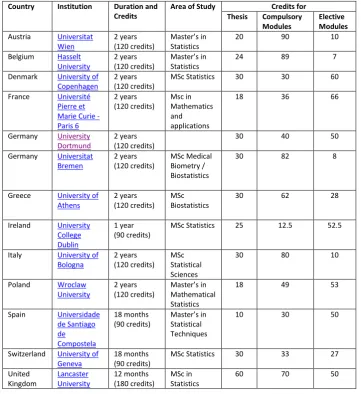
IDEAS partners are affiliated with. Typically full-time MSc studies last between 1 and 2 years and comprise of a set of compulsory and optional courses that culminate in a master’s thesis.
Table 1: Key aspects of MSc programmes in Europe on the example of countries affiliated with IDEAS.
Country Institution Duration and Credits
Area of Study Credits for Thesis Compulsory
Modules
Elective Modules Austria Universitat
Wien
2 years (120 credits)
Master’s in Statistics
20 90 10
Belgium Hasselt University
2 years (120 credits)
Master’s in Statistics
24 89 7
Denmark University of Copenhagen
2 years (120 credits)
MSc Statistics 30 30 60
France Université Pierre et Marie Curie - Paris 6 2 years (120 credits) Msc in Mathematics and applications
18 36 66
Germany University Dortmund
2 years (120 credits)
30 40 50
Germany Universitat Bremen 2 years (120 credits) MSc Medical Biometry / Biostatistics
30 82 8
Greece University of Athens
2 years (120 credits)
MSc Biostatistics
30 62 28
Ireland University College Dublin
1 year (90 credits)
MSc Statistics 25 12.5 52.5
Italy University of Bologna 2 years (120 credits) MSc Statistical Sciences
30 80 10
Poland Wroclaw University 2 years (120 credits) Master’s in Mathematical Statistics
18 49 53
Spain Universidade de Santiago de Compostela 18 months (90 credits) Master’s in Statistical Techniques
10 30 50
Switzerland University of Geneva
18 months (90 credits)
MSc Statistics 30 33 27
United Kingdom Lancaster University 12 months (180 credits) MSc in Statistics
60 70 50
It is also notable that none of the programmes explicitly cites training in transferable skills as part of their curriculum. Although some aspects such as consultancy and presentation skills will likely be covered at most institutions as part of the offered courses, the distinct lack of explicit training indicates that this is not a highly-valued part of the curriculum.
During the masters’ thesis component of the masters’ programmes (which in UK institutions will be around 3 months in length, but can be substantially longer at non-UK institutions - in France it usually lasts around 6 months), focus is on one specific research question while methods and results are recorded in a report of 30-50 pages in length. Topics include theoretical/simulation based as well as data based investigations. Pharmaceutical companies can either contribute topics and co-supervise students or occasionally host students subject to approval by the University. Clearly opportunities exist for projects with industry, but in our experience these are the exception rather than the norm.
As a result of the content and structure of these programmes, graduates can be expected to have a solid grounding in the foundations of statistics. Beyond that, however, they will have had limited training in the additional skills required for drug development.
3. Further training through a PhD
One path often taken by junior researchers on their way to employment in drug development (e.g., in industry, in a regulatory agency, in a contract research organisation (CRO) or in an academic clinical trials unit) is to follow their master’s degree with a PhD. Many different PhD programmes exist, but again the broad structure of these degrees is quite similar. The focus is on pursuing a research question. Though the question is often developed in conjunction with their supervisors, the student’s work should be undertaken independently with some guidance by the supervisor. Despite some dedicated initiatives from public sector funders through co-funded studentships (e.g. MRC CASE studentships) where students are hosted at academic institutions, or arrangements where the main basis of work can be within an industry partner (e.g. Baekeland mandates), joint PhD projects with industry remain, however, the exception. The MRC CASE studentships, for example, only make up around 15% of MRC funded PhD places.
While most doctoral programmes in Statistics in Europe have the expectation that the student should also undertake further training beyond the research project, the extent to which this training is compulsory is often limited.
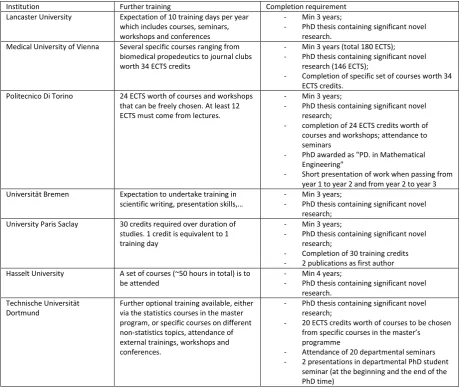
Table 2 summarizes the formal requirements and further training expectations for universities that are part of the IDEAS network. Whilst we do not claim that this is an exhaustive list of relevant PhD schemes, it does serve as a reference of what is considered typical for a PhD in Statistics (or related field) within Europe.
degree scheme. It is also noteworthy that, with few exceptions, only subject matter training is deemed important; training on generic or transferable skills is often not explicitly required.
[image:5.595.66.528.220.608.2]With this background, a new PhD graduate will be highly knowledgeable about their specific area of research but will often lack a broader awareness of the drug development process beyond the basics taught during their master’s programme. Some experience with industry is possible for students who have been fortunate enough to work on a joint project with industry or have had the opportunity to undertake an internship at a company.
Table 2 Summary of PhD requirements of universities enrolling students on the IDEAS project.
Institution Further training Completion requirement Lancaster University Expectation of 10 training days per year
which includes courses, seminars, workshops and conferences
- Min 3 years;
- PhD thesis containing significant novel research.
Medical University of Vienna Several specific courses ranging from biomedical propedeutics to journal clubs worth 34 ECTS credits
- Min 3 years (total 180 ECTS); - PhD thesis containing significant novel
research (146 ECTS);
- Completion of specific set of courses worth 34 ECTS credits.
Politecnico Di Torino 24 ECTS worth of courses and workshops that can be freely chosen. At least 12 ECTS must come from lectures.
- Min 3 years;
- PhD thesis containing significant novel research;
- completion of 24 ECTS credits worth of courses and workshops; attendance to seminars
- PhD awarded as "PD. in Mathematical Engineering"
- Short presentation of work when passing from year 1 to year 2 and from year 2 to year 3 Universität Bremen Expectation to undertake training in
scientific writing, presentation skills,…
- Min 3 years;
- PhD thesis containing significant novel research;
University Paris Saclay 30 credits required over duration of studies. 1 credit is equivalent to 1 training day
- Min 3 years;
- PhD thesis containing significant novel research;
- Completion of 30 training credits - 2 publications as first author Hasselt University A set of courses (~50 hours in total) is to
be attended
- Min 4 years;
- PhD thesis containing significant novel research.
Technische Universität Dortmund
Further optional training available, either via the statistics courses in the master program, or specific courses on different non-statistics topics, attendance of external trainings, workshops and conferences.
- PhD thesis containing significant novel research;
- 20 ECTS credits worth of courses to be chosen from specific courses in the master’s programme
- Attendance of 20 departmental seminars - 2 presentations in departmental PhD student
seminar (at the beginning and the end of the PhD time)
4. Professional qualifications from Learned Statistical Societies
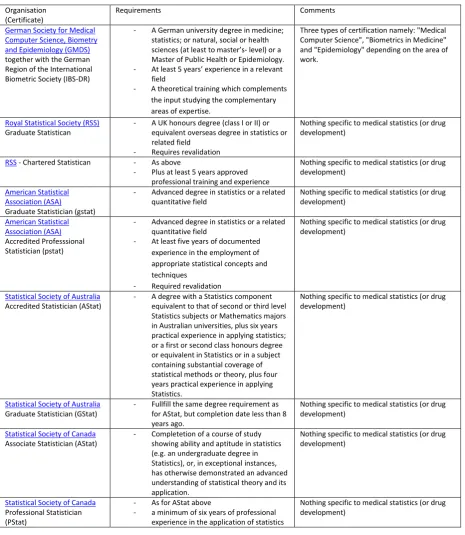
Biometry and Epidemiology (GMDS) offers, together with the German Region of the International Biometric Society (IBS-DR), a certification for Statisticians in Medicine.
[image:6.595.67.533.201.737.2]All accreditations build upon a relevant university degree and have additional requirements with respect to the extent of practical experience. Additionally, further continued professional development is typically required, although there is no explicit requirement that this should incorporate elements of transferable skills training.
Table 3 Professional Certifications for Statistician from professional societies
Organisation (Certificate)
Requirements Comments
German Society for Medical Computer Science, Biometry and Epidemiology (GMDS)
together with the German Region of the International Biometric Society (IBS-DR)
- A German university degree in medicine; statistics; or natural, social or health sciences (at least to master’s- level) or a Master of Public Health or Epidemiology. - At least 5 years’ experience in a relevant
field
- A theoretical training which complements the input studying the complementary areas of expertise.
Three types of certification namely: "Medical Computer Science", "Biometrics in Medicine" and "Epidemiology" depending on the area of work.
Royal Statistical Society (RSS)
Graduate Statistican
- A UK honours degree (class I or II) or equivalent overseas degree in statistics or related field
- Requires revalidation
Nothing specific to medical statistics (or drug development)
RSS - Chartered Statistican - As above
- Plus at least 5 years approved professional training and experience
Nothing specific to medical statistics (or drug development)
American Statistical Association (ASA)
Graduate Statistician (gstat)
- Advanced degree in statistics or a related quantitative field
Nothing specific to medical statistics (or drug development)
American Statistical Association (ASA)
Accredited Professsional Statistician (pstat)
- Advanced degree in statistics or a related quantitative field
- At least five years of documented experience in the employment of appropriate statistical concepts and techniques
- Required revalidation
Nothing specific to medical statistics (or drug development)
Statistical Society of Australia
Accredited Statistician (AStat)
- A degree with a Statistics component equivalent to that of second or third level Statistics subjects or Mathematics majors in Australian universities, plus six years practical experience in applying statistics; or a first or second class honours degree or equivalent in Statistics or in a subject containing substantial coverage of statistical methods or theory, plus four years practical experience in applying Statistics.
Nothing specific to medical statistics (or drug development)
Statistical Society of Australia
Graduate Statistician (GStat)
- Fullfill the same degree requirement as for AStat, but completion date less than 8 years ago.
Nothing specific to medical statistics (or drug development)
Statistical Society of Canada
Associate Statistician (AStat)
- Completetion of a course of study showing ability and aptitude in statistics (e.g. an undergraduate degree in Statistics), or, in exceptional instances, has otherwise demonstrated an advanced understanding of statistical theory and its application.
Nothing specific to medical statistics (or drug development)
Statistical Society of Canada
Professional Statistician (PStat)
- As for AStat above
- a minimum of six years of professional experience in the application of statistics
Nothing specific to medical statistics (or drug development)
In previous sections we have provided an overview of the conventional training paths available to statisticians and highlighted what we see as deficiencies in the training opportunities available to those interested in a career in drug development. These shortcomings are what motivated us to create the IDEAS network.
The network is comprised of eight partners (3 industrial and 5 academic) from seven European countries (Austria, Belgium, France, Germany, Italy, Switzerland, United Kingdom) that host one or more early stage researchers (ESRs) and is supplemented by seven associated partners (5 industry and 2 academic) that contribute to the training activities of the network. The network is funded by the European Commission (EC) under the Marie Sklodowska-Curie Actions. The funding covers salary of the ESRs, training costs (including costs of secondments) as well as management costs.
The primary objective of the network is train ESRs so that they are well equipped to work in drug development and have a good grasp of methods for studies in the early stages of drug development. Prior to joining, the fourteen network ESRs have, with one exception, completed a Master’s degree in Statistics or related field (one student started with a BSc and had completed the first year of a two year master’s). The funding application to the European Commission states specifically that the network seeks to:
a) train early-stage researchers in state of the art methods for designing, evaluating and analysing early phase studies;
b) develop novel methodology for early phase studies through individually supervised, collaborative, research projects;
c) provide an international, collaborative environment in which the academic research experience is paired with the challenges of undertaking drug development within the private sector;
d) raise awareness about cutting edge methods for designing and analysing early phase studies among statisticians, trialists and clinicians alike.
In line with the rest of the manuscript, we will focus on the training of the ESRs (who are completing a PhD in Statistics or related field as part of their network research) and particularly highlight the novel approach taken. Note that some elements of what is implemented in IDEAS is also offered as part of other training programmes: the combination of these elements as well as the focus on early drug development is, however, unique. It should also be noted that training activities offered by the network are supplementing local requirements (i.e. the university specific PhD curriculum) rather than superseding them. In some cases, aspects of the IDEAS training are counted as part of the local requirements (for example, training days for PhD students at Lancaster University). Day to day management of the network is undertaken by key representatives of each partner institution, along with two delegates representing the ESRs. Furthermore, management is overseen by an external advisory board comprised of representatives from academia, industry, regulatory agencies, and clinical experts.
keeping the needs of clinical colleagues and regulators in sight. To achieve this, IDEAS ESRs who are based primarily at academic institutions spend secondments in industry and vice versa.
Training activities within the network, detailed below, comprise four components:
(i) individually supervised research projects; (ii) transnational, cross-sectorial secondments; (iii) network-wide training activities;
(iv) individual training activities.
Individually supervised research projects
The individual research project is, as with all other PhD schemes, the core of the activity of the ESRs. The IDEAS network does, however, take a collaborative approach to this activity so that cross-sectorial cross-disciplinary teams supervise the researchers. Each researcher is supervised by a primary contact at their host institution, as is typical for PhD research projects. In addition, a second supervisor also works with the student. The set-up within IDEAS is such that the primary and secondary supervisors are based in complementary sectors so that a researcher at a university has a secondary supervisor from within industry, and vice versa. This setup helps to give the ESRs greater experience of different research environments.
Additionally, supervisor pairings are transnational to allow the ESRs to see beyond national requirements and traditions. To supplement the methodological aspects of the research project, a clinical advisor is associated with each project. The role of this advisor, who is a highly respected researcher in a clinical area relevant to the project and often has additional experience with regulatory agencies, is to provide high level input on the direction and practicability of the project, provide the researcher with challenging problems from his subject matter field and support implementation of the methods when appropriate. For example, in a project on Biosimilars [16], a review on experiences with EU approvals [17] was conducted together with the associated clinical advisor.
Transnational, cross-sectorial secondments
specific PhD projects and enables the ESRs to establish a valuable professional network which will benefit their future careers.
Network-wide training activities
Compulsory network-wide training sessions feature courses on relevant statistical methods specific to drug development as well as training on transferable skills. In addition, these events are also used to foster team building and joint research. Network-wide activities are structured as
a) Four 5-day summer schools;
b) Three e-learning courses in statistical methodology; c) One Think Tank meeting;
e) Regular interactive virtual discussion sessions run by and for the ESRs.
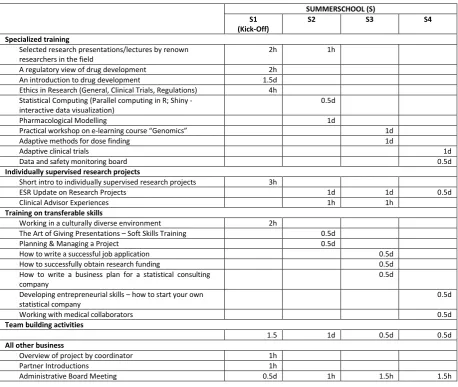
The objectives of the summer schools are to provide the ESRs with the relevant statistical skill set alongside more generic, transferable skills that are essential for any statistician working in medical statistics, and in the early phases of drug development in particular. Additionally, these events include strategies to strengthen network-wide interactions. See Table 6 in the Appendix for the complete summer school curriculum.
The e-learning courses (detailed in Table 7 in the Appendix) provide specialist courses in statistical methodology and computing, allowing the researchers to learn at their own pace, while ensuring personal interaction through online chat-sessions and a discussion forum. The content of some e-learning courses is subsequently reinforced in practical sessions at the summer schools.
The Think Tank meeting is held to ensure that the synergies between the different researchers can be utilized and provides the ESRs with an opportunity to experience and benefit from a cross-sectorial collaborative environment.
The final components of training are virtual interactive discussion sessions. These sessions are ESR led virtual meetings held every 2-3 weeks that allow the researchers to discuss amongst themselves their projects and the challenges they are encountering. For many of the sessions an ESR will present his/her current work, thereby developing their presentation skills while also providing them with the opportunity to receive constructive feedback on their research. The virtual sessions are also used to present and discuss individual research projects with the external advisory board of the IDEAS network which is comprised of one Statistician in academia, a Statistician working in industry, a member from a regulatory agency and an academic clinician. Other sessions invite experts to provide tailored training that the students feel they need. For example, a session on “outreach” has been identified in this way.
Training activities tailored to the individual researcher
University of Vienna and the University of Bremen have been made available to all ESRs in the network.
6. Added value of a joint curriculum in quantitative methods for drug development
In the previous section, we outlined the approach that the IDEAS network has taken to deliver a state of the art doctoral training programme for researchers interested in the statistical issues of the early phases of drug development. We believe that this initiative should be the first step towards ensuring an adequate pipeline of well-trained researchers who can work and lead in the statistics of drug development more broadly. Progressing this idea, we believe that the next logical step is to establish a dedicated PhD-level scheme which can be run across several academic institutions jointly with the pharmaceutical industry and regulatory authorities and broadening the scope to other phases of drug development. The pharmaceutical industry and regulatory agencies will contribute by (co-) supervising students on projects of interest to the organisation, teach on the training programme and provide secondment opportunities. Emerging topics such as data science and big data to analyse and integrate data from various sources, e.g., big data from clinical trials as well as real world evidence (RWE) generated, for example, from registries and health care providers [23,24] or new data sources such as Medical Internet of Things (MIoT, e.g. remote monitoring of patients with electronic devices) [25], will change the way in which evidence is gathered and impact upon the job profile of the clinical statistician. One advantage of a joint curriculum would be that core training components form an integral (and not optional) part of local doctoral requirements, as currently the case within IDEAS. Furthermore, a standardisation of the requirements for the thesis and courses, i.e., in terms of ECTS points, would also facilitate further mobility of ESRs across countries. We envisage that students would be able to enrol at any of the participating academic institutions. Once enrolled, their primary place of research would be at that institution or at a non-academic partner. However, all participating ESRs will undertake the same training and processes (in terms of monitoring as well as degree requirements) irrespective of their primary site of work. This has the immediate advantage that all graduates from the programme would benefit from an established international professional network that spans both academia and industry. At the same time this programme can be seen as a specialist certification that graduates have an excellent working knowledge of the statistics of drug development.
During the preparation of their thesis a student should be co-supervised by an academic and industry researcher. The PhD thesis should ideally consist of methodological work which should be of a standard suitable for publication in high quality peer-reviewed journals, supplemented by an overarching introduction and discussion. Ideally at least one paper should have been accepted by the time of submission, although it is recognized that these timelines are not within the control of the student. Therefore, the thesis should be assessed by two independent experts in the field and be defended at an oral examination (similar to the viva voce examination in the UK).
survival analysis for a project related to this topic). The compulsory training should be organized as training blocks and some additional courses should be offered online (with assessed components).
Table 4 Formal training for a curriculum in statistics in drug development
Overview of the drug development process
Relevance: Fundamental understanding of drug development Duration: 2 days (16 hours) F2F / 4 hours online
Topics: General overview on drug development (safety, pre-clinic, Phases I-IV, …), different study designs (such as parallel vs cross-over studies, superiority vs equivalence, …), sample size
determination, regulatory aspects (e.g., relevant guidelines and clinical trial regulation), quantitative methods for benefit-risk assessment, pharmacovigilance
Skills acquired: To adequately design studies and drug development program appreciating the legal requirements
Developing a clinical trial protocol
Relevance: Core to any clinical study is the protocol Duration: half day (4 hours) F2F
Topics: Role of a clinical trial protocol, regulation, elements (background, study objectives, study design, endpoints, eligibility criteria, …) and structure of a protocol. Difference between study protocol and separate statistical analysis plan (SAP), key elements for outlining randomisation, statistical analysis in protocol. Case studies of good and bad protocols.
Skills acquired: To adequately describe the clinical trial and the planned analysis. Being able to write especially the statistical parts for a clinical trial protocol.
Statistical Methods for Research and Preclinical Development
Relevance: Understanding of challenges and statistical solutions in the area of research and preclinical development
Duration: half day (4 hours) F2F
Topics: Introduction to statistics in research and preclinical development, reproducibility, complex statistical techniques in research, statistics in preclinical safety, Dunnett’s and William’s test, Bayes approach to Dose-Response characterisation, carcinogenicity
Skills acquired: understanding challenges in statistical consultation and evaluation of experiments in research and preclinical safety, basic understanding of common approaches
Dose-finding
Relevance: Dose-finding is one of the major tasks in drug-development Duration: 2 days (16 hours) F2F
Topics: Dose-finding in drug development (overview);
Sequential Phase I dose-finding trials to identify an optimal dose; Model-based Bayesian and likelihood methods for Phase I trials; Parallel group adaptive and non-adaptive Phase II dose-finding trials; MCP-Mod methodology;
Skills acquired: Understanding the dose-finding problem in and outside oncology. Practical design and analysis of dose-finding trials in Phase I and II.
Advanced design
Relevance: To make efficient use of incoming and external data for decision making Duration: 3 days (24 hours) F2F
Topics: Randomization and stratification, optimal designs, Trial designs allowing early stopping for futility or efficacy (i.e., group sequential design) and trials that can be altered based on accumulating data (e.g, sample size reassessment, treatment or subgroup selection, …). Statistical methodology will include methods with pre-fixed rules, combination tests, conditional error rates and worst-case adjustments and extension to more complex trial designs addressing multiple objectives (e.g., closed test procedures).
procedures.
Pharmacological Modelling
Relevance: Emphasis is on the estimation of physiologically relevant information characterizing the subject dependent drug exposure and relating it to a (un)wanted pharmacodynamical effect Duration: 1 day (8 hours) F2F
Topics: Pharmacometrics being the field closest related to biostatistics, the communalities and differences between the two expertises is highlighted. Noncompartmental methods are illustrated and explained. These are extended to compartmental pharmacokinetic models and pharmacokinetic models with differential equations. The connection with pharmacodynamics is explored, with the Emax model for physiological effects derived from first principles, and the importance of
pharmacological modelling to drug development in general is illustrated. More broadly, the course serves as an introduction to non-linear mixed effects modelling and its implementation in SAS Skills acquired: Understanding of pharmacokinetics and physiology inspired modelling. On successful completion of the course, students should be able to fit non-linear mixed effect models in SAS using proc nlmixed and interpret the SAS output.
Advanced computational skills including efficient computing
Relevance: Efficient use of computing is vital to conduct simulation studies or implement complex statistical techniques.
Duration: half a day (4 hours) F2F / 16 hours online
Topics: Parallel computing in R including simple approaches to making code parallelizable and the use of the parallel package in R. Dynamic report creation via the knitr package and RMarkdown. Guided-user interface-based data visualization using Shiny.
Skills acquired: Ability to utilize multicore processors to speed up simulations. Reproducible research methods
Statistical Methods for Evidence Synthesis
Relevance: To understand the statistical principles of systematic reviews and meta-analysis and become able to support such reviews from the statistical point of view
Duration: half a day (4 hours) F2F / 4 hours online
Topics: Overview of statistical evidence synthesis methodology, in particular, fixed effects and random effects approaches, measures of heterogeneity, meta-regression analysis, brief introduction to network meta-analysis
Skills acquired: Understanding the statistical principles for meta-analyses and systematic reviews
Statistical inference and multiple testing:
Relevance: Enabling valid conclusions Duration: 8 hours online
Topics: Frequentist and Bayesian approaches to address specific research questions,
pre-specification vs exploratorion.. Regression to the mean, decision theory, error rates in the context of testing single and multiple hypotheses, resampling based methods, closed testing.
Skills acquired: An in-depth understanding of statistical inference to design and analyse clinical trials
Statistical Learning
Relevance: Analysis of large biomedical data set Duration: 2 days F2F / 4 hours online
Topics: Interdisciplinary applications of machine learning and other data science techniques, for example in electronic health records, high throughput screening, genomics, pharmacovigilance covering methods as regression and classification, model selection, resampling methods, large scale multiple testing and clustering.
Skills acquired: Knowledge of the concepts of statistical learning; understanding of a select set of statistical learning approaches and their application in R.
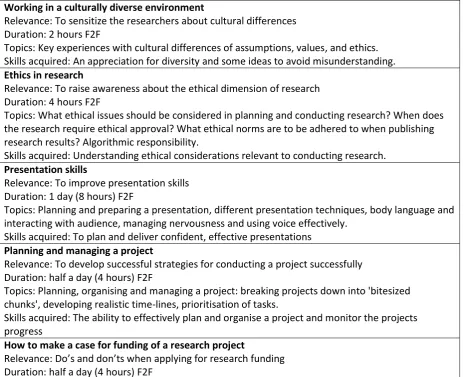
Table 5 Transferable and generic skills in joint curriculum
Working in a culturally diverse environment
Relevance: To sensitize the researchers about cultural differences Duration: 2 hours F2F
Topics: Key experiences with cultural differences of assumptions, values, and ethics. Skills acquired: An appreciation for diversity and some ideas to avoid misunderstanding.
Ethics in research
Relevance: To raise awareness about the ethical dimension of research Duration: 4 hours F2F
Topics: What ethical issues should be considered in planning and conducting research? When does the research require ethical approval? What ethical norms are to be adhered to when publishing research results? Algorithmic responsibility.
Skills acquired: Understanding ethical considerations relevant to conducting research.
Presentation skills
Relevance: To improve presentation skills Duration: 1 day (8 hours) F2F
Topics: Planning and preparing a presentation, different presentation techniques, body language and interacting with audience, managing nervousness and using voice effectively.
Skills acquired: To plan and deliver confident, effective presentations
Planning and managing a project
Relevance: To develop successful strategies for conducting a project successfully Duration: half a day (4 hours) F2F
Topics: Planning, organising and managing a project: breaking projects down into 'bitesized chunks', developing realistic time-lines, prioritisation of tasks.
Skills acquired: The ability to effectively plan and organise a project and monitor the projects progress
How to make a case for funding of a research project
Relevance: Do’s and don’ts when applying for research funding Duration: half a day (4 hours) F2F
Topics: Funding application work flow, funding schemes in Europe, differences between public and industry funding, case studies.
Skills acquired: Understanding the process to gain funding and tips for successful applications
Entrepreneurial skills for a start-up / small company
Relevance: Enhance future career options Duration: half a day (4 hours) F2F
Topics: i) How to create competitive business advantages, (ii) planning and controlling (business and financial planning, risk assessment, intellectual property right issues, …), (iii) how to reach clients (advertisement in print, social media, websites, presence at conferences, organisation of events), and (iv) customer acquisition (efficient presentations, contracting, price negotiations, developing customer loyalty).
Skills acquired: Ability to set up projects and enterprises.
Multidisciplinary collaborations
Relevance: Enabling successful collaboration in teams Duration: half a day (4 hours) F2F
Topics: Negotiations skills, layman´s presentations, e.g., explaining statistical terms to a non-statistical partner, input to non-non-statistical discussions, e.g., when developing a study protocol Skills acquired: Ability to communicate statistical concepts to non-experts; improved communication skills.
Reproducible research
Statisticians are often key collaborators in research and typically are involved in the analysis and interpretation of data. It is therefore important that these analyses are demonstrably reproducible and statisticians will need to learn the skills necessary to do this. This course will describe and illustrate the tools available in RStudio to help make research reproducible.
Duration: half a day (4 hours) F2F
Topics: Define reproducible research, highlight importance of reproducible research, become familiar with tools (such as RMarkup) to help make research reproducible.
Skills acquired: Ability to conduct reproducible research; knowledge of specialised tools for reproducible research.
With such a programme, students would be well placed to start work not only as statisticians within the pharmaceutical industry but also as academic researchers or within regulatory agencies. Having a harmonized European PhD curriculum in place might also help to define what educational and professional knowledge is needed to be a “statistician” in drug development.
6. Discussion
Whilst the early drug development phases are increasingly moving into the focus of applied pharmaceutical research, this seems to be less so in the education of statistical sciences. The desire for novel statistical methodology is no longer confined to late stage development, as the demand for quantitative methods to support decisions in the transition phases surges.
The IDEAS network is a first step towards harmonizing the academic education of PhD students with an interest in early phase studies. It brings together all of the key skills required for a career as a research scientist in academia, the pharmaceutical industry, contract research organisations or regulatory agency and for entrepreneurs embarking on statistical start-up companies.
The network provides access to European key opinion leaders, clinical trials experts and other stakeholders in the public and private sector. The extensive course programme ensures the development of statistical expertise in designing, conducting, analysing and assessing innovative early phase trials. Statistical courses provide a well-founded basis in traditional topics relevant for early development to ensure that graduates have a broad and in-depth competence on state of the art methods. As the consortium is comprised of experts in different fields, including novel methodology into the proposed curriculum and training courses is straightforward. This gives the graduates a head start, having learnt new methods directly from their originators and early adopters in industry.
The specific courses focusing on project planning as well as the work on the individual research projects will provide ESRS with the skills to independently develop research plans, write grant or project proposals, which are essential for a successful career as a research scientist in both the public and private sectors.
ensure that the researchers understand the needs and perspectives of different stakeholders and will enhance their multicultural competence to initiate and facilitate international research collaborations.
There is an increasing demand for biostatisticians with profound expertise in medical studies, especially in the highly regulated field of drug development so that the graduates of IDEAS will be in high demand from a range of different employers: they can have a career path as a scientific researcher at a university, a statistician/methodologist within the pharmaceutical industry or a statistician within a clinical trial unit. Similarly, regulatory and health technology assessment bodies have an increasing demand for qualified statisticians to assess increasingly complex trial designs and interpret the resulting data. The largest employers of biostatisticians are based in the pharmaceutical industry and contract research organizations, where biostatisticians are in constant high demand to work on clinical projects level as well as in methodology groups.
We believe that IDEAS is a step forward in the training of statisticians working in drug development. The IDEAS network does, however, have two key shortcomings. Firstly, it is focused on early drug development, while the need for similarly trained researchers covers the entire drug development process. Secondly, IDEAS is, at the moment, a single initiative on a relatively small scale (14 researchers will be trained through the programme) for a limited time (from 2015 to 2018). To overcome this, our vision is to build on the principles of IDEAS to develop a joint, harmonized PhD level programme that is cross-sectorial, cross-national for statisticians working in drug development. Having in place a harmonized European PhD curriculum, might also help to define what educational and professional background constitutes a “statistician” for drug development. The key to achieving this vision is continued and even strengthened interaction between industry and academia and a close collaboration between academic institutions across Europe and beyond.
In our proposal we have considered student to be full-time although there are a number of students with in an interest in pharmaceutical statistics that study part-time. Many of these students work at a pharmaceutical company or CRO alongside undertaking their PhD studies. The main challenges in accommodating such part-time students would be the integration of these students in the cohort of full-time students and the requirement to take part in (intensive) training weeks which might conflict with other work commitments.
Funding:
This project has received funding from the European Unions Horizon 2020 research and innovation programme under the Marie Sklodowska-Curie grant agreement No 633567 and by the Swiss State Secretariat for Education, Research and Innovation (SERI) under contract number 999754557. The opinions expressed and arguments employed herein do not necessarily reflect the official views of the Swiss Government. http://www.ideas-itn.eu/
References
2. Eichler, H. G., Bloechl-Daum, B., Brasseur, D., Breckenridge, A., Leufkens, H., Raine, J., Salmonson T., Scheider K., Rasi, G. (2013). The risks of risk aversion in drug regulation. Nature reviews Drug discovery, 12(12), 907-916.
3. Bauer, P., & König, F. (2014). The risks of methodology aversion in drug regulation. Nature Reviews Drug Discovery, 13(5), 317-318.
4. Pinheiro, J., Bornkamp, B., Glimm, E., & Bretz, F. (2014). Model‐based dose finding under model uncertainty using general parametric models. Statistics in medicine, 33(10), 1646-1661.
5. Hilgers RD, Roes K, Stallard N. (2016) Directions for new developments on statistical design and analysis of small population group trials. Orphanet Journal of Rare Diseases 14;11(1):78. doi: 10.1186/s13023-016-0464-5.
6. Hilgers RD, König F, Molenberghs G and Stephen Senn. (2017). Design and analysis of clinical trials for small rare disease populations. Journal of Rare Diseases Research & treatment 1(3): 53-60.
7. Koenig F, Slattery J, Groves T, Lang T, Benjamini Y, Day S, Bauer P, Posch M. Sharing clinical trial data on patient level: opportunities and challenges. Biometrical Journal. 2015 ;57(1):8-26. doi: 10.1002/bimj.201300283.
8. Bauer, P., Bretz, F., Dragalin, V., König, F., & Wassmer, G. (2016). Twenty‐five years of confirmatory adaptive designs: opportunities and pitfalls. Statistics in Medicine, 35(3), 325-347.
9. Eichler, H. G., Bloechl‐Daum, B., Bauer, P., Bretz, F., Brown, J., Hampson, L. V., Honig P., Krams M., Leufkens H., Lim R., Lumpkin MM, Murohy MJ, Pignatti F., Posch M., Schneeweiss S., Trusheim M, Koenig F., “Threshold‐crossing”: A Useful Way to Establish the
Counterfactual in Clinical Trials? Clinical Pharmacology & Therapeutics. 2016; 100(6), p 699– 712, December 2016, http://dx.doi.org/10.1002/cpt.515.
10. International Conference on Harmonisation of Technical Requirements for Registration of Pharmaceuticals for Human Use: ICH Harmonised Tripartite Guideline. Guideline for Good Clinical Practice E6(R1). Available at http://www.ich.org (last accessed 2017-02-15). 11.International Conference on Harmonisation of Technical Requirements for Registration of
Pharmaceuticals for Human Use: ICH Harmonised Tripartite Guideline. Statistical Principles for Clinical Trials E9. Available at http://www.ich.org (accessed 2017-02-15).
12.Chuang-Stein, C., Bain, R., Branson, M., Burton, C., Hoseyni, C., Rockhold, F., Ruhberg S, Zhang, J. (2010). Statisticians in the pharmaceutical industry: the 21st century. Statistics in Biopharmaceutical Research, 2(2), 145-152.
13. Morgan D. Qualified Statisticians in the European Pharmaceutical Industry: Report of a European Federation of Statisticians in the Pharmaceutical Industry (EFSPI) Working Group: EFSPI Working Group. Drug Information Journal. 1999;33(2):407-15.
14. Gerlinger, C., Edler, L., Friede, T., Kieser, M., Nakas, C. T., Schumacher, M., ... & Victor, N. Victor, N. (2012). Considerations on what constitutes a ‘qualified statistician’ in regulatory guidelines. Statistics in medicine, 31(11-12), 1303-1305.
15. Williams Z, Roes KB, Howitt N. Qualified statisticians in the European Pharma Industry: present and future directions. Drug Information Journal 2009; 43(05):573–583
16.
CHMP. Guideline on similar biological medicinal products CHMP/437/04 Rev1. 2014.
http://www.ema.europa.eu/docs/en_GB/document_library/Scientific_guideline/2014/1
0/WC500176768.pdf
17. Mielke, J., Jilma, B., Koenig, F., & Jones, B. (2016). Clinical trials for authorized biosimilars in biosimilars in the European Union: a systematic review. British journal of clinical
pharmacology, 82(6), 1444-1457.
18. Mozgunov P, Jaki T, Paoletti X. Randomized dose-escalation design for drugs combination combination cancer trials with immunotherapy. Submitted (2016)
19. Mielke J., Jones, B., Jilma B., König F., Sample size for multiple hypothesis testing in biosimilar development. Statistics in Biopharmaceutical Research (2017). Accepted. 20. Jimenez JL, Tighiouart M, Gasparini M. Cancer phase I trial design using drug combinations
combinations when a fraction of dose limiting toxicities is attributable to one or more agents. Submitted (2017)
21. Mozgunov P, Jaki T, Gasparini M, Symmetric loss functions in restricted parameter spaces. spaces. Submitted (2017)
22. Vradi E, Brannath W, Jaki T, Vonk R. Model selection based on combined penalties for for biomarker identification. Journal of Biopharmaceutical Statistics (2017). Accepted. 23. Eichler HG, Blöchl-Daum B, Abadie E, Barnett D, König F, Pearson S. Relative Efficacy of
of drugs, an emerging issue at the interface between regulatory agencies and third party payers. Nature Review Drug Discov. 2010 Apr;9(4):277-91.
24. Eichler HG, Bloechl-Daum B, Bauer P, Bretz F, Brown J, Hampson L, Honig P, Krams M, Leufkens H, Lim R, Lumpkin M, Murphy M, Pignatti F, Posch M, Schneeweiss S, Trusheim M, and Koenig F. Threshold-crossing: A useful way to establish the counterfactual in clinical trials? Clinical Pharmacology & Therapeutics. 2016 Dec;100(6):699-712. doi:
10.1002/cpt.515
Appendix
Table 6 Summer school (time is given in hours (h) and days (d), whereby a full day is equivalent to 8 hours)
SUMMERSCHOOL (S) S1
(Kick-Off)
S2 S3 S4
Specialized training
Selected research presentations/lectures by renown researchers in the field
2h 1h
A regulatory view of drug development 2h An introduction to drug development 1.5d Ethics in Research (General, Clinical Trials, Regulations) 4h Statistical Computing (Parallel computing in R; Shiny -
interactive data visualization)
0.5d
Pharmacological Modelling 1d
Practical workshop on e-learning course “Genomics” 1d
Adaptive methods for dose finding 1d
Adaptive clinical trials 1d
Data and safety monitoring board 0.5d
Individually supervised research projects
Short intro to individually supervised research projects 3h
ESR Update on Research Projects 1d 1d 0.5d
Clinical Advisor Experiences 1h 1h
Training on transferable skills
Working in a culturally diverse environment 2h
The Art of Giving Presentations – Soft Skills Training 0.5d
Planning & Managing a Project 0.5d
How to write a successful job application 0.5d
How to successfully obtain research funding 0.5d
How to write a business plan for a statistical consulting company
0.5d
Developing entrepreneurial skills – how to start your own statistical company
0.5d
Working with medical collaborators 0.5d
Team building activities
1.5 1d 0.5d 0.5d
All other business
Overview of project by coordinator 1h
Partner Introductions 1h
Administrative Board Meeting 0.5d 1h 1.5h 1.5h
Table 7 e-learning courses offered.
Year Course title
1 Computational skills in statistics
[image:18.595.67.526.115.502.2]