warwick.ac.uk/lib-publications
Original citation:
Boehning, Christian, Bothmer, Hans-Christian Graf von and Sosna, Pawel. (2017) On the dynamical degrees of reflections on cubic fourfolds. International Mathematics Research Notices. rnw311.
Permanent WRAP URL:
http://wrap.warwick.ac.uk/84254
Copyright and reuse:
The Warwick Research Archive Portal (WRAP) makes this work by researchers of the University of Warwick available open access under the following conditions. Copyright © and all moral rights to the version of the paper presented here belong to the individual author(s) and/or other copyright owners. To the extent reasonable and practicable the material made available in WRAP has been checked for eligibility before being made available.
Copies of full items can be used for personal research or study, educational, or not-for profit purposes without prior permission or charge. Provided that the authors, title and full bibliographic details are credited, a hyperlink and/or URL is given for the original metadata page and the content is not changed in any way.
Publisher’s statement:
This is a pre-copyedited, author-produced PDF of an article accepted for publication in . International Mathematics Research Notices following peer review. The version of record Boehning, Christian, Bothmer, Hans-Christian Graf von and Sosna, Pawel. (2017) On the dynamical degrees of reflections on cubic fourfolds. International Mathematics Research Notices. rnw311.is available online at: https://doi.org/10.1093/imrn/rnw311
A note on versions:
The version presented here may differ from the published version or, version of record, if you wish to cite this item you are advised to consult the publisher’s version. Please see the ‘permanent WRAP URL’ above for details on accessing the published version and note that access may require a subscription.
CUBIC FOURFOLDS
CHRISTIAN B ¨OHNING1, HANS-CHRISTIAN GRAF VON BOTHMER,
AND PAWEL SOSNA2
Abstract. We compute the dynamical degrees of certain compositions of reflections in points on a smooth cubic fourfold. Our interest in these computations stems from the irrationality problem for cubic fourfolds. Namely, we hope that they will provide numerical evidence for potential restrictions on tuples of dynamical degrees realisable on general cubic fourfolds which can be violated on the projective four-space.
1. Introduction
LetY be a smooth complex projective n-fold andf:Y 99KY be a bira-tional self-map. Given such anf, one can associate a tuple of real numbers λi(f), 0≤i≤n,λi(f)≥1,λ0(f) =λn(f) = 1, with it. These numbers, the
dynamical degrees, measure the dynamical complexity of f. Letting f run through the group of birational transformations of Y gives the dynamical spectrum Λ(Y) which is a birational invariant.
We are interested in how properties of Λ(Y) may reflect geometric proper-ties ofY. In particular, it is an interesting question whether the dynamical spectrum may even carry enough information to distinguish between (con-jecturally irrational) very general smooth cubic hypersurfacesX ⊂Pn+1and
projectiven-spacePnitself (forn≥4). The spectrum does “see” rationality in dimension 2: If S is an irrational surface, then Λ(S) is discrete, whereas for rational S the spectrum has accumulation points from below and, in fact, the accumulation points accumulate again, and so forth ad infinitum. Another instance which shows that Λ is closely connected with rationality is the following result: If for a projective n-fold Y there exists a birational self-mapf with a tuple of dynamical degrees such that any two consecutive λi(f) are distinct, thenY has Kodaira dimension 0 or−∞, see [DN11, Cor.
1.4].
From now on, letX be a very general smooth cubic fourfold, and denote by Bir0(X) ⊂ Bir(X) the subgroup generated by reflections σp in points
p∈ X. In this article we will try to obtain some constraints for the tuples of dynamical degrees (λi(g)) for g ∈Bir0(X). Our goal here is to compute
1
Supported by Heisenberg-Stipendium BO 3699/1-2 of the DFG (German Research Foundation).
2 Partially supported by the RTG 1670 of the DFG (German Research Foundation).
the dynamical degrees of many elements in Bir0(X) to get a feeling as to
which ones can be realized on a very general cubic. Our main results can be summarised as
Theorem 1.1. Let X be a very general smooth cubic fourfold.
(1) [See Theorem 4.1, (c)] For a generalN-tuple of points onX,N ≥3, the dynamical degrees of the composition of the reflections in these points are(1,2N,2N,2N,1).
(2) [See Theorem 5.7] Consider a general line L on X and a general plane section of X through L, which then decomposes as L ∪C, where C is a conic. Pick general points p, q ∈ L and r ∈ C. If
g=σrσqσp, then λ1(g) =λ3(g) = 5+
√
33
2 .
(3) [See Theorem 6.3] If p, q, r are the vertices of a triangle of lines on
X and g=σrσqσp, then λ1(g) =λ3(g) =
1+√5 2
3
.
We have not computed λ2 in the last two cases of the Theorem yet, but
see Remark 5.8 for some comments about the computations of λ2 in case
(2).
Let us now briefly describe a potential “Ansatz” to prove irrationality of a very general cubic fourfoldX: prove constraints for the dynamical degrees on X and show that these constraints are violated on P4 by construct-ing an example; note that for many examples of Cremona transformations, e.g. monomial ones [Lin13], the dynamical degrees are readily computable. These constraints could either be of an arithmetic nature, for example, which algebraic number fields theλilie in, or consist of new inequalities, for
exam-ple, bounds for the size of the ratio min{log(λ2)/log(λ1),log(λ2)/log(λ3)}.
Note, that there exist birational self-maps with interesting multi-degrees, but uninteresting dynamical degrees. Indeed, Pan in [Pan00] and [Pan13] constructed birational self-maps ofP3 of all bidegrees allowed by the Hodge and Cremona inequalities (see [Do12, Prop. 7.1.7 & Rem. 7.1.8]) just by considering de Jonquieres maps, i.e. maps extended fromP2 and preserving a linear fibration on P3. However, the dynamical degrees of these have λ1 = λ2 by [DN11]. Therefore, to prove constraints one will presumably
have to work with all iterates of a given birational map f and not only a sufficiently high power of f. This approach to distinguishing rational from irrational varieties ties in well with the old philosophy that varieties closer to rational ones should admit more or “wilder” birational self-maps; this goes back to the work on birational rigidity of Iskovskikh-Manin [I-M71], see also the book by Pukhlikov [Pu13] or the work of Cheltsov, e.g. [Ch05], for lots of developments in this direction. The main new point of view here is that we propose the dynamical spectrum as a means to measure the size
threefold, are very much alike in several qualitative aspects. For instance, in both one can find birational self-maps contracting surfaces birational to any given birational type of a ruled surface. But there are examples of two varieties where in each case the birational automorphism group contains elements contracting subvarieties of uncountably many birational types, but whose dynamical spectra can be seen to be distinct. For instance, one can take Pn+2 and Z = Pn×S, n ≥ 3, S a surface of general type without rational curves, hence no non-constant mapsPn99KS. Since every rational map Pn 99K S is constant, every map in Bir(Z) preserves the fibration Z //S, hence cannot have pairwise different consecutive dynamical degrees [DN11]. But Pn+2 does have maps with this property.
Conventions. We work over the field of complex numbers Cunless stated otherwise. By a variety we mean a possibly reducible reduced separated scheme of finite type over C. By a subvariety we mean a closed subvariety unless stated otherwise. If f: X 99K Y is a rational map, we denote by dom(f) the largest open subset ofX on whichf is a morphism. The graph Γf ⊂ X×Y of f is the closure of the locus of points (x, f(x)) with x ∈
dom(f).
2. Preliminaries
In his foundational paper on birational correspondences [Zar43], Zariski introduced the notations f[Z] resp. f{Z}, where f is a birational transfor-mation of a projective varietyX, for an irreducible subvarietyZ ⊂X which he called, respectively, the (birational) transform f[Z] and total transform
f{Z} ([Zar43, pp. 519–520]). Namely, the birational map f induces an automorphism of function fields
C(X) C(X)
f∗ '
o
o
and one says that irreducible subvarieties W, W0 of X correspond to each other under f if there is a (general) valuation v:C(X)∗ //Γ (possibly not necessarily divisorial or of rank 1), for some (totally ordered abelian) value group Γ, such that the center ofvon Xis W, and the center of v◦f∗ onX isW0.
Then f[Z] is the (possibly reducible) subvariety of X such that (1) each irreducible component of f[Z] corresponds to Z and (2) every irreducible subvariety ofX which corresponds to Z is contained in f[Z]. On the other hand, f{Z}is the locus of all points on X which correspond to some point inZ. We extend the definitions off[Z] andf{Z} to reducible Z’s compo-nentwise.
triangle of lines, thenf[Z] is a curve andf{Z}=f[Z]∪L. In this example, L corresponds top∈Z, butL does not correspond toZ!
Geometrically,f[Z] resp. f{Z}have the following meaning: Consider the graph Γf ⊂X×X with its two projectionsp1: Γf //X,p2: Γf //X:
Γf p1
~
~
p2
X f //X.
Then f[Z] consists of the images on X via p2 of all the irreducible
subvari-eties of Γf which maponto Z viap1;f{Z} consists of the images onX via
p2 of all the irreducible subvarieties of Γf which mapinto Z via p1.
Definition 2.1. If a birational map f: X 99KX is a composition of bira-tional maps
X f0 //X f1 //X f2 //. . . fN−1//X fN //X
we define, for everyi∈Z,Xi :=X, andfi:Xi99KXi+1 to be equal to the
mapfj,j∈ {0, . . . , N}, with j≡i(mod (N+ 1)).
LetZ ∈Xi be a subvariety. We define itsmove from positionito position
j as the subvariety ofXj given by
Mij[Z] := (fj−1◦ · · · ◦fi)[Z] ifj ≥i Mij[Z] := (f
−1
j ◦ · · · ◦f −1
i−1)[Z] ifj < i.
Of course, it makes sense to make the above definitions also with the brackets [·] replaced by {·} everywhere, and then speak of the total move
etc.
We now move on to the main subject of the article, the dynamical degrees. LetY be a smooth projective n-fold, f:Y 99KY be a birational map. The induced map f∗ on the group of algebraic cycles of codimension i modulo homological equivalence (with real coefficients)Ai(Y) is defined as follows: Choose a smooth resolution of f
Z
π1
π2
Y f //Y
and define f∗ = π1∗◦π2∗. It can be checked that the definition of f∗ does
not depend on the choice of a particular resolution.
Definition 2.2. LetY be as above and letg:Y 99KY be a birational map. Let ρi(g) be the spectral radius of g∗ on Ai(Y), i.e. the largest absolute
value of an eigenvalue ofg∗.
The i-th dynamical degree of a birational mapf:Y 99KY is λi(f) = lim inf
m //∞(ρi((f
The i-th dynamical degree can also be written as λi(f) = lim inf
m //∞(H n−i
.(fm)∗Hi)m1
for any ample divisorH; see [Gue10, Thm. 2.4].
Theλi(f) are invariant under birational conjugacy, see [Gue10, Cor. 2.7],
are related to the entropy of f in a precise sense (for example, the entropy h(f) is bounded above by maxi{log(λi(f)}, see [DS05]), and one way to
think of λi(f) intuitively may be as the entropy of f on algebraic cycles
of codimensioni, i.e. a measure of how much information the action of the iterates of f on cycles of codimension icarries.
Definition 2.3. Thedynamical spectrum of Y is defined as Λ(Y) :={(λ0(f), . . . , λn(f))∈Rn+1 |f ∈Bir(Y)}.
Clearly, Λ(Y) is a birational invariant of Y and as a subset of Rn+1 it comes with interesting point-set, metric or topological properties.
The sequenceλ0(f), λ1(f), . . . , λn−1(f), λn(f) is known to be always
log-concave, i.e. p //log(λp(f)) is concave, see [DN11] and references therein;
it implies that the sequence first strictly ascends for a while, then stays constant, then strictly descends again:
1 =λ0(f)<· · ·< λp(f) =· · ·=λp0(f)> λp0+1(f)>· · ·> λn(f) = 1.
Another important property we will frequently use is
(2.1) λ2j ≥λj−1λj+1∀j;
see [Gue10, Thm. 2.4].
Definition 2.4. A birational map f: Y 99K Y is said to be algebraically
i-stable if we have
(fm)∗ = (f∗)m ∀m∈N, on Ai(Y).
Lemma 2.5. Suppose that neither f:Y 99KY nor any iteratefj contract any divisors into the indeterminacy locus of f. Then f is algebraically 1 -stable. The converse also holds.
Proof. LetIf ⊂Y be the indeterminacy set off. SinceY is smooth,If has
codimension at least 2, and all preimages
(fk|
dom(fk))−1(If), k≥1,
have codimension at least 2 since no divisor is contracted into If under
any iterate of f. Hence, for any divisor class D, we have that f∗(f∗D) and (f2)∗(D) coincide in codimension 1, hence everywhere, and the same argument yields (f∗)n= (fn)∗.
Conversely, let us assume that some iterate off, without loss of generality f itself, contracts a divisor into the indeterminacy locus If of f. Then
Furthermore, we will use
Lemma 2.6. Let Y and f:Y 99K Y be as above. The dynamical degrees satisfy the equation
λn−i(f−1) =λi(f).
Proof. LetH be a general hyperplane section of Y. Then the map f (and each iterate of it) has a multidegree (d0(f), . . . , dn(f)) wherediis the degree,
relative toHn−i, of the birational transform ofHi. We will show that even dn−i(f) =di(f−1).
This follows immediately from the fact that Γf−1 =Γef where Γf−1 ⊂Y ×Y
is the graph of f−1 and
e
Γf is the image of the graph of f under the map
that switches the factors inY ×Y. By the same argument we also have dn−i(fm) =di(f−m)
for allm∈N, and the assertion about dynamical degrees follows by passing to the exponential growth rates, form //∞, on both sides of this equation.
We also recall the following special case of the main result in [DN11]. If X ⊂Pn+1 is an n-dimensional (smooth) cubic hypersurface, l ⊂ X a line,
and
πl:Xl= Bll(X) //Pn−1
the induced conic fibration, and if, moreover, f ∈ Bir(X) preserves this fibration, and f ∈ Bir(Pn−1) is the induced map, then [DN11, Thm. 1.1] implies
(2.2) λk(f) = max{λk(f), λk−1(f)} ∀k.
3. Geometry of a single reflection
We fix a smooth cubic fourfold X and a very general point p ∈ X, and want to describe in more detail the geometry of the birational reflection map σp and of its resolution. Moreover, we want to understand the geometry of
the indeterminacy locus and its resolution. There is a commutative diagram
e X
blS0(p)
ϕ
X0
blp
X σp //X.
Here blp is the blow-up of the pointp∈X. Its exceptional divisor on X0
is denoted byE0(p). Let
be the intersection ofXwith the embedded projective tangent spaceTpX'
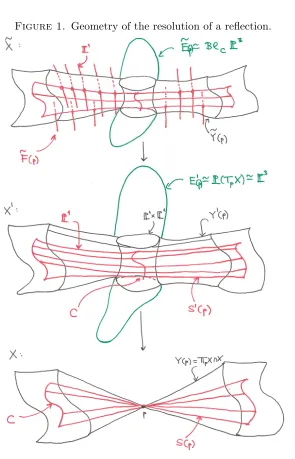
P4 toX inpinsideP5. ThenY(p) is a singular cubic threefold with a single node atp for a generic choice ofp, which was our standing assumption. Its strict transform inside X0 is denoted by Y0(p). InY0(p), the singular point phas been replaced by the projectivized tangent cone ofY(p) inp, which is P1×P1.
Remark 3.1. The indeterminacy locus ofσpis the locus of all lines through
p insideX.
Note that all the lines throughpinsideXform a surface S(p) insideY(p) which is a cone over a curve C(p) of bidegree (3,3) in P1×P1 where we view this P1×P1 here as the intersection of the tangent cone ofY(p) in p with a P3 inside TpX which does not pass throughp. Namely, by [FW89,
p. 187], the equation of a nodal cubic threefold in P4 (in our caseY(p)) can be written as
ξ4Q+R= 0
in appropriate homogeneous coordinates (ξ0 : · · · : ξ4) with Q resp. R in
C[ξ0, . . . , ξ3]2 resp. C[ξ0, . . . , ξ3]3 and the node equal to the point (0 : 0 : 0 :
0 : 1). Then a line throughp can be written in parameter form as (0 : 0 : 0 : 0 : 1) +λ(a:b:c:d: 0).
This lies on the nodal cubic if and only ifQ(a:b:c:d) =R(a:b:c:d) = 0. Generically, C(p) will be smooth, but, of course, singular (with various sorts of singularities) and/or reducible curves can occur if we drop the gen-erality assumption; the possibilities are listed and discussed in [FW89], see also [W87].
The strict transformS0(p) ofS(p) onX0 is a (smooth) ruled surface over C(p). In a second step, we blow up S0(p) inside X0 to obtain X, thus wee replace it by the projectivization of its normal bundle insideX0. The strict transforms of E0(p), Y0(p) onXe are denoted by E(p),e Ye(p). One has that
e
E(p) is the blow-up of E0(p) ' P3 in the curve C(p). Let Fe(p) be the exceptional divisor of blS0(p). It is a P1×P1-bundle over the curveC(p).
The geometry of the resolution is summarized in Figure 1 below.
One has that E(p) ande Fe(p) intersect in the exceptional divisor of the blow-up of P3 in C(p), a ruled surface over C(p); E(p) ande Ye(p) intersect in aP1×P1; and Fe(p) and Ye(p) intersect in a ruled surface isomorphic to S0(p).
Notice that in this case the birational self-mapσplifts to an automorphism e
σp:
e X
e σp //
e X
X σ p
/
Figure 1. Geometry of the resolution of a reflection.
LetHe be the strict transform of a general hyperplane section H of X.
Proposition 3.2. The morphism ϕ is given by the linear system
|2He −3E(p)e −Fe(p)|.
tangent hyperplane to X atp. The equation of X can then be written as X1X02+X0q(X1, . . . , X5) +c(X1, . . . , X5) = 0,
whereq is a homogeneous quadratic form andc a homogeneous cubic form in the variablesX1, . . . , X5. Then the reflection σp can be described as
σp(X0:. . .:X5) = (X0X1+q(X1, . . . , X5),−X12,−X1X2, . . . ,−X1X5).
Here, as was said above,{X1 = 0}=TpX, and{X1 = 0, q= 0} ⊂TpX 'P4 defines the tangent cone atpto the singular nodal cubic threefoldX∩TpX.
It is a cone over the quadric {X1 = 0, X0 = 0, q = 0} ' P1 ×P1 in the hyperplane P3∞ = {X1 = 0, X0 = 0} ⊂ P4 at infinity. The curve C(p) ⊂ P1×P1 corresponding to lines contained inX∩TpX (resp.X) is defined by
{X1= 0, X0= 0, q= 0, c= 0}. It is of bidegree (3,3) inP1×P1.
Now let (1 :1 :. . .:5) be a jet of orderkcentered atp, i.e. an element of
ˆ
OP5,p/(polynomials of degree> k in local coordinates xi =Xi/X0 centered
atp). The residues classes of thexi are thei. The condition that a 1-jet is
contained inX is 1 = 0, and the condition that a 2-jet is contained inX is
1= 0, q(0, 2, . . . , 5) = 0.
Hence σp vanishes on every 2-jet contained in X and centered at p. This
means that it is defined by a linear subsystem of|2He−3E(p)|e onX. More-e over, clearly σp is undefined on the surface {X1 = 0, q = 0, c = 0} = S(p)
insideXas well, so thateσpis given by a linear subsystem of|2H−3e E(p)−e Fe|. It is easy to check directly that the quadrics in the above formula forσp
gen-erate the space of all quadrics onX which vanish alongS(p) and contain all
2-jets centered atp.
More generally, we have that H,e E(p),e Fe(p) is a basis of Pic(X),e Ye(p)≡ e
H−2E(p)e −Fe(p), and the automorphism induced by eσp on Pic(X) can bee represented in the preceding basis by the matrix
2 1 0 −3 −2 0 −1 −1 1
.
4. First examples of dynamical degrees of compositions of reflections
configurations; however, only those configurations are of interest to us which are realizable on a very general cubic, since this is the situation where we want to get a feeling for which tuples of dynamical degrees (λ1, λ2, λ3)∈R3 can occur.
Theorem 4.1. Let N be a positive integer and let p= (p1, . . . , pN) ∈XN
be a very general N-tuple of points on a very general cubic fourfold X. Let
σp =σpN ◦. . .◦σp1
be the associated composition of reflections, and
λp = (λ1(σp), λ2(σp), λ3(σp))
the associated triple of dynamical degrees (note that, clearly,λ0(σp) =λ4(σp) =
1 are not interesting). Then the following holds:
(a) For all N, λp does not depend onp, but only onN.
(b) If N = 1, we have
λp = (1,1,1)
and forN = 2 we also get
λp = (1,1,1).
(c) For N ≥3 we have
λp = (2N,2N,2N).
Proof. Clearly, forN = 1, λp = (1,1,1), sinceσp1 is a single reflection and
therefore is of finite order.
IfN = 2, then we can assume thatp=p1 andq =p2 do not lie on a line
which is contained in X since we assumed the tuple of points to be a very general one. Letr=p3 be the third intersection point ofp1p2withX. Then
blowing upp1, p2, p3 yields a model Xe on which σp is algebraically 1-stable by Lemma 2.5. Indeed, there are only six divisors on this blow-up which a priori could be contracted into the indeterminacy locus, namely the three exceptional ones and the three strict transforms of the tangent hyperplane sections in the points. But note that the lift of every σpi is defined in the generic point of each of these six divisors and permutes them.
Let H be the pull-back of a hyperplane section of X to this blow-up X,e and letP, Q, Rbe the corresponding exceptional divisors (isomorphic toP3) lying over p, q, r respectively. In the ordered basis (H, P, Q, R) of Pic(X)e the matrix ofσq◦σp is equal to
4 2 0 1 0 0 1 0 −6 −3 0 −2
−3 −2 0 0
.
Indeed, first of all note that Qis first mapped to R under σp, then onto
the reflections). Similarly,R is mapped ontoQunder σp and so forth. This
argument gives the third column of the matrix.
Now note that H is transformed underσp into 2H−3P (this follows as
in the proof of Proposition 3.2), and similarly forσq. Henceσqσp(H) is just
2(2H−3Q)−3R.
The exceptional divisorP is transformed underσp into the divisor which
is the strict transform of the cubic Y(p) = X∩TpX on Xe (recall that the node at p gets resolved by replacing it by a P1 ×P1). On X, the lattere strict transform is equivalent toH−2P, which underσq is transformed into
2H−3Q−2R.
Lastly, R maps first to Q under σp, then σq maps Q onto the strict
transform of Y(q) which is equivalent to H−2Q.
Combining all these arguments gives the above matrix, whose character-istic polynomial is (x−1)4, henceλ1 = 1 and, therefore, allλi are equal to
1 by Equation (2.1).
We now turn to the general case N ≥3.
Notice that ifXitself is a model on whichσpis 1-stable, then the same will
hold for all q in the complement of countably many proper subvarieties of XN, i.e. for a very generalq: by Lemma 2.5, 1-stability can be characterized
geometrically by requiring that no iterate of f contracts a divisor into the indeterminacy locus off, and the contrary case can be expressed in terms of countably many algebraic equations forq: this follows from Lemmas 4.2 and 4.3 below. Thus, in this case we get σqH = 2NH (compare the arguments
above) for all suchq and, therefore,
λ1(σq) = 2N.
LetU ⊂XN be the complement of the countably many subvarieties one has
to remove to characterize the set of q; let U0 be the image of U under the map reversing the factors in XN, i.e. (x1, . . . , xN) //(xN, . . . , x1). Then
for all q0∈U0
λ3(σq0) = 2N
since the σq0 are nothing but the inverses of all the possible σq. Here we
used Lemma 2.6. Since for very general p we have U ∩U0 6= ∅, it follows that
λ1(σp) =λ3(σp) = 2N.
By Equation 2.1,λ2(σp)≥2N, but on the other hand, alsoλ2(σp)≤2N since
each σpi induces multiplication by 2 on the Chow group of codimension 2 cycles modulo homological equivalence. Here we use the submultiplicativity of [BBS16, Remark 4.5, Thm. 4.3]. Its proof uses the assumption that X be very general in the sense that we want the Chow group of codimension 2 cycles modulo homological equivalence to be one-dimensional.
Now take a tuple of points p1, . . . , pN in a general plane section E =
varietyX is already a model for whichσp is algebraically 1-stable. Indeed,
the indeterminacy locus of σp intersected withE is nothing but p1, . . . , pN
since E is smooth and contains no lines as components (recall that, by Remark 3.1, the indeterminacy loci of theσpi are precisely the lines through pi). Moreover, for general E and p1, . . . , pN on E, no composition σpj ◦ · · · ◦σpi+1 |E, j ≥ i+ 1, maps pi to pj+1. For instance, this will hold
if p1, . . . , pN ∈ E ' R2/Z2 are linearly independent over Z. This can be proven as follows: Notice that for pointsx, y∈E
σx(y) =−x−y.
Therefore, givenp1, . . . , pN, we have
σp2(p1) =−p1−p2
σp3(−p1−p2) =p1+p2−p3
. . .
and we will now check that for N even, this sequence never returns to p1,
whereas for N odd, it does, but always after the application of a σp1. Of
course, since the situation is symmetric, it is indeed sufficient to consider the case ofp1.
IfN is even, after application of the firstσp1, the coefficient in front ofp1
is zero and remains zero until we apply σp1 for the second time. Then the
coefficient is −1. After the next application of σp1, it is −2, after that −3
etc.
IfN is odd, a direct computation, paying special attention to signs, shows thatp1 is mapped back to itself for the first time after applying
σp1◦(σpN ◦ · · · ◦σp1)◦(σpN ◦ · · · ◦σp2) and that no element on the way equals one of thepi.
This finishes the proof of Theorem 4.1.
Lemma 4.2. Let Y ⊂Pn be a smooth projective variety and let F = (F0(x0, . . . , xn), . . . , FN(x0, . . . , xn))
be an N + 1-tuple of homogeneous polynomials Fi ∈ C[x0, . . . , xn]d of the
same degree d representing a birational map f: Y 99K Y (hence, in par-ticular, the Fi do not vanish simultaneously on Y). Then the subset of
those F ∈ P(C[x0, . . . , xn]⊕nd +1) giving rise to birational f’s and such that
F0=. . .=FN = 0does not contain a codimension one algebraic subset ofY
form a locally closed subvariety Pd of P(C[x0, . . . , xn]⊕nd +1). Those F such
that in addition an iterate of f contracts a purely one codimensional alge-braic subset Z ⊂ Y into the indeterminacy locus If of f form a countable
unionZ of closed algebraic subsets of Pd.
Proof. The fact that the F ∈ P(C[x0, . . . , xn]⊕nd +1) giving rise to
bira-tional f’s and such that F0 = · · · = FN = 0 does not contain a
P(C[x0, . . . , xn]⊕nd +1) can be proven analogously to [BBB14, Prop. 2.4 &
2.5].
Let us show the second assertion. Let H be one of the countably many components of finite type of the Hilbert scheme parametrizing purely one codimensional subschemes of Y, and let
π:H ⊂H×PN //H be the universal family. Let
Yi =
(h, x, Fi+1)∈ H × Pd⊂H×Pn× Pd|Fi+1(x) = 0 and consider the natural projection
α:Yi //H× Pd.
By upper semi-continuity of fiber dimension of α, the set
Xi={z= (h, F)⊂H× Pd|dimα−1(z)≥dimX−1}
is closed inH× Pd(note that we use that theFj do not vanish on a common
codimension one subset). The projectionp:H× Pd //Pdis proper, hence p(Xi) ⊂ Pd is closed. Taking the union over all iand the countably many components of the Hilbert scheme gives us the description of the subset Z
of Pd as claimed.
Lemma 4.3. Let X be a smooth cubic fourfold, p1, . . . , pN a tuple of points
inX as before. Then, using the notation of the preceding lemma and setting
d := 2N, there is an open neighborhood Ω of (p1, . . . , pN) in XN and a
morphism
s: Ω //Pd
such that s(q1, . . . , qN) represents the composite of reflections σq = σqN ◦ . . .◦σq1.
Proof. Each σqi can be defined by a six tuple of quadrics as in the proof of Proposition 3.2. Composing these, we obtain six tuples of homogeneous polynomials of degreed= 2N defining σq. The coefficients of these depend
algebraically on the coordinates of the qi.
We retain the notation of the preceding section and, in particular, of Theorem 4.1. Having settled the generic situation, we pass on to some more special configurations:
Proposition 4.4. Let p1, p2 be points in X such that p1p2 is contained in
X. Then
λp = (1,1,1).
Proof. It suffices to notice thatσp is a lift of the identity map on P3 along the conic fibration X 99K P3 given by projecting from p1p2. Hence, the
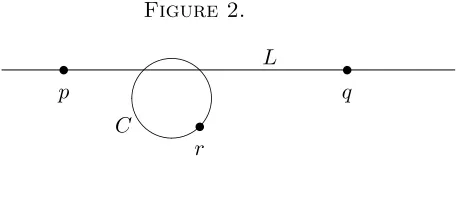
Figure 2.
• p
• q L
• r
&% '$
C
5. A conic and a line
We now begin with a discussion of a special configuration of points and the computation of dynamical degrees in this case. It is one of the first instances where more interesting dynamics arises.
5.1. The computational approach. Choose a plane P2 in such a way that
X∩P2 =L∪C,
where L is a line and C is a conic intersecting the line transversely. Let p, q, r be three points on L∪C with p, q ∈ L, r ∈ C. Let a, b be the two intersection points of C and L, and assume that neither of them coincides withp, q orr. The rough picture is shown in Figure 2.
We want to compute the first and third dynamical degrees of
g=σr◦σq◦σp.
We introduce some notation useful for the sequel: We will write p0 =
p, p1 =q, p2 = r occasionally when convenient for indexing purposes, Ti =
TpiX∩X for the tangent hyperplane sections, Li for the surface of lines on X through pi. Note that in the notation of Section 3, Ti = Y(pi) and
Li =S(pi).
Since computingλ1(g) andλ3(g) even in this at first glance comparatively
harmless case involves a lot of technical details and auxiliary considerations, let us outline first of all the general method we will be pursuing. We will compute λ3(g) and then deduceλ1(g) by using the symmetries of the
situ-ation.
Step 1. We start with a very general curve Γ⊂X which is the intersection of three members of a very ample linear system on X. Now
λ3(g) = lim inf
n //∞(deg((g n)∗
(Γ))n1
However, for these computations to work, we need several genericity as-sumptions to hold for Γ, and the hardest part of the computation consists in showing that the set of Γ satisfying all of them is actually not-empty.
Step 2. Let us explain how we will compute xν(1) := dν := deg(gν)∗(Γ)
for 0≤ ν < ∞ and determine the asymptotic growth rate of them. Apart from the degrees of the birational transforms of Γ we will also consider some auxiliary integers xν(2), . . . , xν(r) that capture the salient features of the
state of the discrete dynamical system generated by g at time ν, starting from a Γ∈(H)3, sufficiently well so as to determine the set of integers
(xν+1(1), . . . , xν+1(r))
for the next time moment ν + 1. For example, the xν(2), . . . , xν(r) may
encode some multiplicities, number of certain points lying on distinguished loci, etc., at timeν. See proof of Theorem 5.7 for one concrete example of this.The main point is that, if we introduce an integer vector
vν := (xν(1), . . . , xν(r))t∈Zr,
then the transition from one state of the system to the next will be affected by a linear transformationA:Zr //Zr
vν+1=Avν.
Moreover, usuallyx0(2) =· · ·=x0(r) = 0, i.e. we start with
v0 := (d0,0, . . . ,0)t.
Lemma 5.1. In the above set-up, suppose thatAhas eigenvalues µ1, . . . , µr
with a multiplicity one positive real eigenvalue µ1 of maximum absolute value, and assume the eigenvalues are ordered such that
µ1 =|µ1|>|µ2| ≥ · · · ≥ |µr|.
Suppose that v0 or, equivalently, the vectore1 = (1,0,0, . . . ,0)is not in the span of the eigenspaces for µ2, . . . , µr, and that the eigenspace for µ1 is not in the span of the vectors e2, . . . , er of the standard basis. Then the third
dynamical degree equals µ1.
Proof. The third dynamical degree is the exponential growth rate in n of the first entry in the vector
Anv0.
LetB be the base change matrix from the standard basis to the eigenbasis of A. Then we can rewrite
Anv0=B−1(BAB−1)n(Bv0)
and, since v0 is not in the span of the eigenspaces for µ2, . . . , µr, Bv0 =
(b1, . . . , br)t·d0 with bi∈C,b16= 0. Moreover, since
and the eigenspace forµ1 is not in the span of the vectors e2, . . . , er of the
standard basis, in other words, the (1,1)-entry of B−1 is nonzero, we get that the first entry inAnv0 can be written as
(c1µn1 +c2µn2 +· · ·+crµnr)·d0, ci ∈C, c1 6= 0.
Hence
lim
n //∞((c1µ n
1 +c2µn2 +· · ·+crµnr)·d0)
1 n
=µ1 lim
n //∞
c1+c2
µ2
µ1
n
+· · ·+cr
µr
µ1
n
·d0
n1
=µ1.
Step 3. The genericity properties which we need to compute the degree of (gν)∗(Γ), typically fall into two categories. Firstly, we need that for very
general choice ofX, L, C, p, q, r, andZ a tangent divisorTi, the backward in
time move Mik[Z] does not coincide with a tangent divisor Tk−1, for any k < i. Equivalently, Ti does not get contracted in the backward evolution
of the discrete dynamical system. This is needed because in this way it becomes possible to phrase the genericity properties the birational transform (gν)∗(Γ) must have with respect to Tν as properties that the initial curve
Γ must have with respect to Mν0[Tν]. We emphasize that this amounts to having genericity properties of the given configuration we start from, i.e. the dataX, L, C, p, q, r, and not the auxiliary Γ we choose later.
Step 4. Certain branches of the birational transforms (gν)∗(Γ) (we will make this precise only later below) must not pass through a distinguished point p, q, r at any time ν. It will turn out that this can be accomplished provided Γ intersects theMν0[Tν] sufficiently generically and provided the chosen configuration X, L, C, p, q, r has some additional genericity proper-ties. We prove that all these genericity properties can be satisfied, or, equiv-alently, that the corresponding countable intersections of Zariski open sets are non-empty.
5.2. Dynamics of tangent divisors. Our objective here is to show
Proposition 5.2. For a very general choice ofX, L, C, p, q, r andg =σr◦
σq ◦σp, the following holds: The subvariety Mik[Ti] is not contained in Tk−1 for k < i. In fact, even Mik[Li]is not contained in Tk−1 for k < i.
Remark 5.3. Note that, whenever Lis some line onX,p, q two points on it, we have (σp−1)∗(Tq) =Tq: a point tinTq offL spans aP2 together with L. This intersects X inL and a conic through q, which is invariant under reflection inp.
Proof. Each of theLi, in particular Ti, contains some line through pi. Fix
Note that all birational transforms
Mik[L
0] = (σ
k◦ · · · ◦σi−1)[L0] k < i, k ∈Z, lie on K. Moreover, we have
TxX∩K =TxK∩K ∀x∈K.
Let
Di =TpiK∩K fori∈Z.
It suffices to prove that none of theσk◦· · ·◦σi−1(L0) is equal to a component
ofDk−1. Moreover,Mik[L
0] can never equalLsinceL∪Cis invariant under
all three reflections. Let D0k−1 := Dk−1\L. Notice that on the surface K
all three reflections are defined everywhere except in the reflection point. Hence, it suffices to check that
σk◦ · · · ◦σi−1(pi) k < i, k∈Z,
does not coincide with a point in D0k−1 ∩(C ∪L) = {pk−1, p0k−1}. The
scheme-theoretic intersection has a doublepoint inpk−1 and a further third
point p0k−1.
We check that there is one example of a configurationX, L, C, p, q, r hav-ing this property by an explicit computer calculation. To reduce the problem to a finite computation, we use the following Lemma.
Lemma 5.4. Retain the notation above. If the linear map induced by
φ:=σpσqσrσpσqσr =σ0σ1. . . σ5
on L ' P1 ' P(C2) is diagonalizable with eigenvalues of distinct absolute
value, then the point λ=aor λ=bis an attractor for the iterates of φ. Assume without loss of generality thatb is the attractor. Moreover, let B
be the following set of “bad” points on L:
(σ5σ4σ3σ2σ1)(p0),(σ5σ4σ3σ2σ1)(p00),
(σ5σ4σ3σ2)(p1),(σ5σ4σ3σ2)(p01),
(σ5σ4σ3)(p2), p02.
Then, for each x∈L with|x−b|<min{|y−b|:y∈ B}, the point
σk◦ · · · ◦σi−1(x) k < i, k∈Z,
does not coincide with a point in Dk−0 1∩(C∪L) ={pk−1, p0k−1}.
A computer calculation [BBS15] shows that there exists an example of X, L, C, p, q, rand three different linesL0i,i= 0,1,2, such thatφsatisfies the assumptions of the Lemma, and there exists an integer k0 withk0 ≡0(mod
3) and the property that, defining
xk :=σk◦ · · · ◦σi−1(pi) k < i, k∈Z,
xk0 ∈ L with |xk0 −b| < min{|y −b| : y ∈ B} and xk 6= pk−1, p0k−1 for
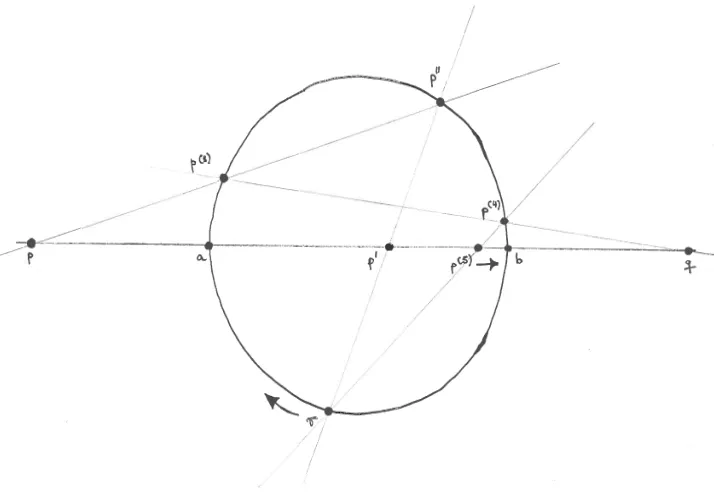
Proof. We divide the proof into steps. See Figure 3 for the geometric intu-ition.
Step 1. Let L0 and K be given; for p 6= x ∈ L ⊂ K, the reflection σp
is defined in x as a map from K to K in the following way. Consider the conic Cx defined by TxK∩K =L∪Cx. The image point of x is nothing
but the second intersection x0 of the conic with L. It follows that for any point x∈L not equal top,q,σp(q) or σq(p)
(σp◦σq)(x) = (σq◦σp)(x) =x.
Step 2. Note that by the preceding step,
φ=σrσpσqσr:L'P(C2) //L=P(C2)
is nothing but the return map toL. It is induced by a linear mapC2 //C2. If the matrix realizing this automorphism is diagonalizable with eigenvalues of distinct absolute values, then, in an appropriate basis, it has the form
µ1 0
0 µ2
.
Note that the eigenspaces are spanned exactly byaand bsinceσqσp(a) =a
and similarly for bby Step 1. Also note that only the ratio |µ1|
|µ2|
is important to determine the behavior of the iterates. If bis the attractor, the matrix can be assumed to be of the form
µ 0 0 1
and |µ|<1.
The last assertion of the Lemma follows from the fact that φ decreases distances to the attractor b, and by definition of the bad points, x cannot get mapped to pk−1, p0k−1 byσk◦ · · · ◦σi−1(x).
5.3. Dynamics of curve germs. Let L be a line on a cubic fourfold X, andx be a point onL. Furthermore, let ∆ be a curve germ (in the classical topology) through x; let x 6= z ∈ L be a point and consider σz. Then
σz[∆]∩Lis a point determined by the normal direction toTLz,xinduced by ∆ in x: this follows from the fact that blowing up z and the locus of lines through z we obtain a morphismeσz on this blow-up as in Section 3.
Lemma 5.5. Let X, L, C, p, q, r be a configuration on a cubic fourfold con-sisting of a line L⊂X, C a conic in a P2 such that the intersection L∩C
is transverse, p, q points onL away from L∩C, r a point on C away from
Figure 3. Attracting behavior under iteration of reflections.
(1) TLp,x = TLq,x for x ∈ L, x 6= p, q. Here we view these spaces as
embedded tangent spaces in the ambientP5. We denote the constant
two-dimensional subspace specified by the TLp,x simply by Π in the
sequel.
(2) Consider the “return map to L” given by F = σrσqσpσr. For x ∈
L\ {p, q},
dFx(Π) = Π.
Proof. We start by recalling some facts about lines on a cubic hypersurface Xn ⊂Pn+1, see [CG72, Sect. 6 & 7] or [Iza99, Sect. 1]: the normal bundle of a linel on X can be of the following two types
Nl/Xn ' Ol⊕ Ol⊕ Ol(1)⊕(n−3) : lines of the first type; Nl/Xn ' Ol(−1)⊕ Ol(1)⊕(n−2) : lines of the second type.
Pn+1 of dimension n−2, and the same holds for a line of the second type withn−2 replaced byn−1.
In our case, this means that a generic L will be of the first type, and since both TLp,x and TLq,x are planes contained in the intersection of all the embedded projective tangent spaces to X along L (since the tangent bundles of the conesLp resp. Lq are trivialized along a ruling), we conclude
thatTLp,x=TLq,x= Π is constant and equal to the intersection of tangent spaces along L. This proves (1).
For (2) remark that the differential dF of the return map F fits into a commutative diagram
NL/X
dF //
NL/X
L F //L and composing with
NL/X
η //
NL/X
L F
−1
/
/L
whereηis any lift of the projectivityF−1:L'
P1 //P1to the vector bundle NL/X =O⊕2⊕ O(1) preserving the summands O(1) and O⊕2, we get that
dF ◦η is a bundle automorphism of NL/X hence preserves the individual summands as well. Therefore,dF preserves Π which is spanned by the total
space ofO(1) andL.
The following genericity statement is a major ingredient for justifying the computations in Theorem 5.7 below.
Proposition 5.6. There is a sufficiently generic choice of the configuration
X, L, C, p, q, r and a curve Γ ∈ (H)3 such that the following holds for the moves M0ν[Γ],1≤ν <∞:
(1) Outside of C and L, the transform M0ν[Γ] intersects Tν
trans-versely in finitely many points which all lie outsideLν.
(2) In the notation of the preceding item, let us consider a germ∆(in the Euclidean topology) of M0ν[Γ] around any of the said intersection
points with Tν. Then for all ν+ 1 ≤ i < ∞, the move Mνi[∆] is
well-defined, and for ν+ 1≤i <∞, it is a smooth curve germ not passing through any of the points p, q, r, but some point on L or C
other than these three.
Proof. For (1), we use Proposition 5.2: we choose Γ in such a way that it intersects all Mν0[Tν] transversely in points away from Mν0[Lν] and Mj0[Tj] forj < ν. The map
is an isomorphism onto its image when restricted to the open X0 ⊂ X which is the complement of the Mj0[Tj] for j < ν. From (2), which we prove below, it follows that all points in
(σν−1◦ · · · ◦σ0)[Γ]\(σν−1◦ · · · ◦σ0)|X0(Γ∩X0)
are contained in C∪L. Hence we get (1).
To prove (2), for notational convenience, we will only give the proof for the case that ∆ is a curve germ passing through a point ofTp; i.e.,ν = 0, but
everything else is arbitrary. For the general case, we simply use Proposition 5.2 again, but otherwise no new arguments are needed. The main point is that a ∆ intersectingTp sufficiently generically will verify (2).
In fact, choosing ∆ generically, the birational transform ∆0 =σp[∆] will
have a generic tangent direction in p, i.e. we can realize an open dense subset of directions inTpX choosing a generic ∆. We will now consider the
sequence of birational transforms
σq[∆0],(σr◦σq)[∆0],(σp◦σr◦σq)[∆0], . . .
and the sequence of pointsx1, x2, x3, . . . onL∪C in which these curve germs
intersectL∪C. We will prove two statements about these now:
(A) The sequence x1, x2, . . . depends only on the element inP(NLp/X,p) which the tangent direction of ∆0 inp induces.
(B) None of the pointsx1, x2, . . . coincides with any ofp, q, rfor a generic
∆ resp. ∆0.
To prove (A) we use Lemma 5.5, (1). First of all, if ∆xi is a curve trait passing through xi on L, then clearly xi+1 =σp[∆xi]∩L and xi+2 =
(σqσp)[∆xi]∩Ldepend only on the initial normal direction toTLp,xi = Π that ∆xiinduces: by the geometry of a single reflection explained in Section 3 (see also Figure 1 in particular), σp maps ∆xi to a curve trait ∆xi+1 =σp[∆xi]
through a point xi+1 on L that is the image of the normal direction of
∆xi in x
i under π◦σep. Moreover, the normal direction to Π which ∆ xi+1
induces inxi+1 is determined by the fact that it is the one that underπ◦σep gets mapped back toxi: hence it is the one thatTX,xi∩TX,xi+1 induces in
xi+1. Then a similar argument for σq shows that also ∆xi+2 = (σqσp)[∆xi]
along with its normal direction to Π, and in particular xi+2, are completely
determined by the normal direction of the initial curve trait ∆xi.
Next, using Lemma 5.5 (2), we see that also the normal direction of F[∆xi+2] to Π is determined by that of ∆xi+2 hence of ∆xi. This shows (A) above.
Finally (B) follows from Proposition 5.2 which shows that all backward transforms of tangent divisors remain divisorial. Moreover, the forward moves of tangent divisors are first a point, then curves. Hence there is a rational map from Tp onto either L or C induced by σi ◦ · · · ◦σ0. Thus
there is an open subset of Tp on which this map is a morphism and maps
dominantly ontoLorC. If the initial curve germ ∆ intersectsTpgenerically
5.4. Determination of the dynamical degree. We have now assembled enough auxiliary results to justify our computations in
Theorem 5.7. For g =σr◦σq◦σp, with p, q, r ∈X in a plane, p, q on a
line on X satisfying Propositions 5.2 and 5.6, we have
λ1(g) =λ3(g) =
5 +√33
2 ≈5.37...
Proof. We will computeλ3(g) and then prove that λ1(g) =λ3(g).
Let Γ = Γ0 be a curve satisfying the conclusion of Proposition 5.6.
We compute the degrees of the birational transforms Γi = M0i[Γ] di-rectly. It will turn out that the degree δi of the birational transform Γi just
depends on how many points λi−1 of Γi−1 (counted with multiplicities) lie
onL, and how many pointsγi−1 of Γi−1 (counted with multiplicities) lie on
C in the preceding step of the iteration.
Suppose we start with some input data (λ, γ, δ). The following table summarizes how these numbers change by applyingσp,σq,σr successively:
λ γ δ
σp δ γ 2δ−λ
σq 2δ−λ γ 3δ−2λ
σr γ 5δ−3λ 6δ−4λ
To justify the numbers in the first line, note that, by Proposition 5.6, at this step there will be λpoints onL none of which coincides with p (orq). Moreover, by part (1) of the same proposition, there are δ−λ intersection points of the curve with Tp\ Lp outside ofL.
Reflection in p stabilizesC, and so does reflection in q, soγ remains the same in the first and second steps. The degree gets multiplied by 2, sinceσp
is given by a linear system of quadrics, and gets diminished by the number of points lying in the base locus ofσp, i.e. λ. After application of σp,δ−λ
points of Γ get mapped to p, and theλpoints already on L get mapped to some other points on L, adding to a total ofδ points on L.
Now consider the second row. Note that by Proposition 5.6, the curve intersectsTq\ Lqin (2δ−λ)−δ =δ−λpoints which get contracted intoqin
this step. Together with the δ points already onL, this gives the first entry of the second row. The degree changes to 2(2δ−λ)−δ (twice the preceding degree diminished by the number of points lying in the base locus, i.e. in L).
Consider the third row. The map σr interchangesC and L. Hence there
will then be γ points on L, (2δ−λ) + (3δ−2λ) points on C (the number of points on L in the preceding step plus the number of intersection points with TrX, which is the degree of the curve). Moreover, the degree of the
Thus the passage of the initial tuple to the next one is given by applying to the vector (λ, γ, δ)t the matrix
0 1 0 −3 0 5 −4 0 6
.
By Lemma 5.1, we find λ3(g) = (5 +
√ 33)/2.
To prove that λ1(f) = λ3(f) note that, since the roles of p and q are
interchangeable in the preceding argument, and all genericity assumptions continue to hold for the configuration X, L, C, p, q after interchanging the roles of p andq,
λ3(σr◦σq◦σp) =λ3(σr◦σp◦σq)
and since dynamical degrees are invariants for birational conjugacy
λ3(σr◦σp◦σq) =λ3(σr−1◦(σr◦σp◦σq)◦σr).
But σp◦σq◦σr is the inverse ofσr◦σq◦σp, hence by Lemma 2.6,
λ3(σr◦σq◦σp) =λ3(σp◦σq◦σr) =λ1(σr◦σq◦σp).
Remark 5.8. We suspect that in this case also λ2(g) = 5+
√
33
2 ≈ 5.37....
Conditional on some genericity assumptions, which, unfortunately, we have not yet been able to show are always realizable at the same time, we can prove this; the result is also supported by independent extensive computer calculations.
Remark 5.9. One should not be left with the impression that it is rea-sonable to suspect the equality λ1(g) = λ2(g) = λ3(g) for every g in the
subgroup of Bir(X) generated by reflections, let alone forgin all of Bir(X). For instance, in the case of two points on a line and N points general out-side of that line, we think that λ2 6= λ1, but cannot yet prove it.
Cer-tainly, obtaining bounds on the overall variance from its mean of the tuple (λ1(g), λ2(g), λ3(g)), forgranging over Bir(X), seems to be a main question
for proving irrationality of a very general X by this type of quantitative refinement of the Noether-Iskovskikh-Manin approach.
6. A triangle of lines
Here we discuss another interesting geometric configuration of three spe-cial points on X.
Let p, q, r be three distinct points on X which form the vertices of a triangle of lines on X. We again write p0 := p, p1 := q, p2 := r, and Lpipj for the line joiningpi andpj. We also retain the notationTi for the tangent
hyperplane section in pi and write once more
g=σr◦σq◦σp.
We start with a Lemma about matrices, which will be used in the proof of Theorem 6.3.
Lemma 6.1. Let
P0 =
2 0 0 −1 −1 0 1 1 0 −1 −1 0 1 0 1 −1 −1 0 1 0 0 0 −1 0 1 0 0 −1 0 0 0 0 0 0 0 0
, P1 =
1 1 0 −1 0 −1 0 2 0 −1 0 −1 0 1 1 −1 0 −1 0 1 0 0 0 −1 0 0 0 0 0 0 0 1 0 −1 0 0
,
P2 =
1 0 1 0 −1 −1 0 1 1 0 −1 −1 0 0 2 0 −1 −1 0 0 0 0 0 0 0 0 1 0 0 −1 0 0 1 0 −1 0
.
Also, as usual, for n ∈ Z, put Pn := Pj for that j ∈ {0,1,2} with n ≡ j
(mod 3). For i≥0, consider the product
Ai:=PiPi−1. . . P1P0. For a vectorv∈Z6denote itsk-th coordinate byv
k∈Z. We start numbering
components with zero. Consider v(0) = (1,0,0,0,0,0)t and v(i+1) =Aiv(0).
Moreover, consider the ideals in C[x0, . . . , x5]given by
I0:=h(x0, x1, x2)·(x0, x1, x2, x3, x4), x3x4, x0x5i,
I1:=h(x0, x1, x2)·(x0, x1, x2, x3, x5), x3x5, x1x4i,
I2:=h(x0, x1, x2)·(x0, x1, x2, x4, x5), x4x5, x2x3i.
The idealIl is generated by a spaceMl of quadratic monomials. Similarly to
the Pn, we also define In for n∈Z. Now for each monomial xµxν ∈Mi+1,
we consider the sum of vector components vµ(i+1)+vν(i+1) ∈Z, and the pair (µ0, ν0), for which this integer is minimal. Then
(µ0, ν0) = (3,4) fori≡2(3), (µ0, ν0) = (3,5) fori≡0(3),
(µ0, ν0) = (4,5) fori≡1(3).
Proof. From the structure ofIl, and more specifically Ml, and the position
of the zero rows in P0, P1 resp. P2, one sees that it is sufficient to prove
for all i that each of v0(i+1), v1(i+1), v(2i+1) is greater than or equal to each of v3(i+1), v4(i+1), v5(i+1). This is proved by induction. For example, suppose d(0)= (d(0)0 , . . . , d(0)5 )t∈Z6 is a vector for which this holds, and let us show
that it also holds ford(1)=P0·d(0). This is an immediate consequence of the
inequalities of the hypothesis, e.g. d(1)0 = 2d(0)0 −d(0)3 −d(0)4 ≥d(0)0 −d(0)4 = d(1)3 sinced(0)0 ≥d(0)3 . We omit the (mechanical) verification of all possible
Now choose coordinatesx0, . . . , x5 inP5 such that
p0= (0 : 0 : 0 : 0 : 0 : 1), p2= (0 : 0 : 0 : 0 : 1 : 0), p2= (0 : 0 : 0 : 1 : 0 : 0)
andTpiX={xi = 0}. In these coordinates, we can write
σp0 =(x20 :x0x1:x0x2 :x0x3:x0x4 :Q0) withQ0 ∈M0,
σp1 =(x1x0 :x21:x1x2 :x1x3:Q1 :x1x5) withQ1 ∈M1,
σp2 =(x2x0 :x2x1 :x22 :Q2:x2x4 :x2x5) withQ2 ∈M2.
Lemma 6.2. Consider a curve trait γ0 transverse to Tp0 given by (f0(0) :
f1 :· · · :f5(0)) where f (0)
j is a power series in a local parameter t of degree
d(0)j = 1 for j = 0and d(0)j = 0otherwise. Then, for d(0) := (d(0)0 , . . . , d(0)5 )t
and i≥0, the trait
γi+1 :=σpi◦ · · · ◦σp0[γ0]
is well-defined and given by local power series (f0(i+1) :· · · : f5(i+1)) with a degree vector d(i+1)=Aid(0).
Proof. Formally substituting (f0(0) : · · · : f5(0)) for (x0 : · · · : x5) in the
formula forσp0, we obtain a power series of degrees
(2d(0)0 , d(0)0 +d1(0), d(0)0 +d(0)2 , d0(0)+d(0)3 , d(0)0 +d(0)4 , d(0)3 +d(0)4 )
where we used Lemma 6.1 to justify the last entryd(0)3 +d(0)4 in this vector. Moreover, again by Lemma 6.1, all entries in this vector preceding the last one are bigger than or equal to the last one. This means that we can divide (f0(0) : · · · : f5(0)) by td(0)3 +d
(0)
4 to obtain local power series for the strict
transform
σ0[γ0].
Accordingly, these have degrees
(2d(0)0 , d(0)0 +d1(0), d(0)0 +d(0)2 , d0(0)+d(0)3 , d(0)0 +d(0)4 , d(0)3 +d(0)4 ) −(d(0)3 +d(0)4 )(1,1,1,1,1,1).
Hence the formula for P0; using Lemma 6.1 repeatedly, we obtain the full
assertion of Lemma 6.2.
Theorem 6.3. We have, for p, q, r the vertices of a triangle of lines onX,
λ1(g) =λ3(g) =
1 +√5 2
!3
= 4.236...
Remark 6.4. If you are into number mysticism, it will not have escaped you that 1+
√
5
Proof of Theorem 6.3. The fact that λ1 =λ3 follows from symmetry.
Multiplying the three matrices P0, P1, P2 we obtain
P :=
3 1 1 −3 −2 0 2 2 1 −3 −2 0 2 1 2 −3 −2 0 0 0 0 0 0 0 1 0 1 −1 −1 0 1 1 1 −2 −1 0
.
The matrix P has minimal polynomial
x2(x−1)2(x2−4x−1)
and the root of the last factor with the largest absolute value is
2 +√5 = 1 + √
5 2
!3
.
Thus, to finish the proof, it suffices to show that the growth behavior of the degrees of the power series defining the branch γi+1 coincides with the
growth behavior of the degrees of birational transforms Γi+1of a very general
curve Γ0 in H3 on X under the evolution of the dynamical system. This
will follow from the following
Claim: after application of
σp0σp2σp1σp0
all subsequent birational transforms Γi have no intersection points with any
of Tpi that lie outside of the plane Λ =hp0, p1, p2i, and in each step, all the intersection points are concentrated inp0, p1 orp2.
If the claim is true, the proof is complete, since then the growth behavior of the degrees of the birational transforms is the same as the one of the degrees of the power series defining the branches, since both grow as the intersection multiplicities of Γi with{x0 = 0},{x1= 0}resp. {x2 = 0}.
The claim, however, follows directly from two facts: (1) the tangent divi-sorsTpi are invariant under all three reflections since any two points lie on a line; (2) by the formulas in Lemmas 6.1 and 6.2, every trait γi+1 has center
in the plane after application ofσp0σp2σp1σp0 (a priori, it might get “pushed
outside” again in case it passes through pi when σpi is the next transfor-mation to be applied). These two facts imply that after one application of σp2σp1σp0 all intersection points of Γ0 withTp0,Tp1 andTp2 are contracted
inside the plane Λ, i.e., in the sequel there are no intersection points of any of the birational transforms with a Tpi outside of Λ. The assertion about the concentration of the intersection points in p0, p1 orp2 also follows from
References
[B-L14] J. Blanc and S. Lamy,On birational maps from cubic threefolds, preprint (2014), arXiv:1409.7778 [math.AG].
[BBB14] F. Bogomolov, Chr. B¨ohning and H.-Chr. Graf von Bothmer, Birationally isotrivial fiber spaces, European Journal of Mathematics, Volume2, Issue 1, (2016), 45–54
[BBS15] Chr. B¨ohning, H.-Chr. Graf von Bothmer and P. Sosna,
Macaulay2 scripts for On the dynamical degrees of reflec-tions on cubic fourfolds, available at http://www.math.uni-hamburg.de/home/boehning/research/DynamicalM2/M2scripts.
[BBS16] Chr. B¨ohning, H.-Chr. Graf von Bothmer and P. Sosna, Some properties of dynamical degrees with a view towards cubic fourfolds, Research in the Mathe-matical Sciences3:23 (2016), DOI: 10.1186/s40687-016-0071-z
[Ch05] I.A. Cheltsov,Birationally rigid Fano varieties, Russian Math. Surveys 60(5) (2005), 875–965.
[CG72] C. H. Clemens and Ph. A. Griffiths, The Intermediate Jacobian of the Cubic Threefold, Ann. of Math.95(1972), No. 2, 281–356.
[DN11] T.-C. Dinh and V.-A. Nguyen, Comparison of dynamical degrees for semi-conjugate meromorphic maps, Comment. Math. Helv. 86 (2011), no. 4, 817– 840.
[DS05] T.-C. Dinh and N. Sibony, Une borne sup´erieure pour l’entropie topologique d’une application rationnelle, Ann. of Math.161(2005), no. 3, 1637–1644. [Do12] I. Dolgachev,Classical Algebraic Geometry: A Modern View, Cambridge
Uni-versity Press, Cambridge (2012).
[FW89] H. Finkelnberg and J. Werner,Small resolutions of nodal cubic threefolds, Ned-erl. Akad. Wetensch. Indag. Math.51(1989), no. 2, 185–198.
[Gue10] V. Guedj, Propri´et´es ergodiques des applications rationnelles, Quelques as-pects des syst`emes dynamiques polynomiaux, Panor. Synth`eses30, Soc. Math. France, Paris (2010), 97–202.
[Ha00] B. Hassett,Special Cubic Fourfolds, Compositio Math.120(2000), no. 1, 1–23. [I-M71] V.A. Iskovskikh and Y. Manin,Three-dimensional quartics and counterexamples
to the L¨uroth problem, Math. USSR Sb.86(1971), no. 1, 140–166.
[Iza99] E. Izadi,A Prym construction for the cohomology of a cubic hypersurface, Proc. Lond. Math. Soc. (3)79(1999), 535–568.
[KH95] A. Katok and B. Hasselblatt,Modern Theory of Dynamical Systems, Encyclo-pedia of Mathematics and its Applications vol.54, Cambridge University Press, Cambridge, (1995).
[Lin13] J.-L. Lin,Pulling Back Cohomology Classes and Dynamical Degrees of Mono-mial Maps, Bull. Soc. Math. France,140(2013), no. 4, 533–549.
[Man74] Y.I. Manin,Cubic Forms: Algebra, Geometry, Arithmetic, North-Holland Pub-lishing Co., Amsterdam (1974).
[Pan00] I. Pan, Sur le multidegr´e des transformations de Cremona, C. R. Acad. Sci. Paris Ser. I Math.330(2000), no. 4, 297–300.
[Pan13] I. Pan, On Cremona transformations ofP3 with all possible bidegrees, C. R.
Math. Acad. Sci. Paris351(2013), no. 11-12, 467–469.
[Pu13] A. Pukhlikov, Birationally rigid varieties, Mathematical Surveys and Mono-graphs Vol.190, American Mathematical Society, Providence, RI (2013). [W87] J. Werner, Kleine Aufl¨osungen spezieller dreidimensionaler Variet¨aten,
The-sis, Bonner Mathematische Schriften 186, Universit¨at Bonn, Mathematisches Institut, Bonn, (1987), viii+119 pp.
Christian B¨ohning, University of Warwick, Mathematics Department, Zee-man Building, Coventry CV47AL, England
E-mail address: [email protected]
Hans-Christian Graf von Bothmer, Fachbereich Mathematik der Univer-sit¨at Hamburg, Bundesstraße 55, 20146 Hamburg, Germany
E-mail address: [email protected]
Pawel Sosna, Fachbereich Mathematik der Universit¨at Hamburg, Bundesstraße 55, 20146 Hamburg, Germany