On the use of Multi-scale Singular Value
Decomposition for OFDM Channel
Estimation
RAJU MANDA1
Dept. of Electronics & Communication Engineering,
Sree Chaitanya College of Engineering, Karimnagar, Telangana, India, [email protected]
HARIKRISHNA ETTE2
Dept. of Electronics & Communication Engineering, UCE Kothagudem, Kakatiya University, Warangal, Telangana, India,
ASHOKA REDDY KOMALLA3
Dept. of Electronics & Communication Engineering,
Kakatiya Institute of Technology and Science, Warangal, Telangana, India, [email protected]
Abstract : In order to meet the present day wireless communication requirements such as high data rate and high speed, a sophisticated communication technology to combat the shortcomings of inter symbol interference (ISI) and multi path interference (MPI) is the requirement. Orthogonal frequency division multiplexing (OFDM) is an important amicable solution to nullify the effect of ISI and MPI caused by high data rate communication system. OFDM channel estimation has been a challenging problem ever since the inception of wireless communication system. This paper presents a novel method based on multi-scale singular value decomposition (MS-SVD) for OFDM channel estimation. The method combines the advantages of wavelet transform (WT) and singular value decomposition (SVD). The efficacy of the proposed MS-SVD method is established by evaluating bit error rate (BER) analysis and comparing it with other well established methods.
Keywords: Wireless Communications; OFDM; Channel Estimation; Wavelet Transform; Singular Value Decomposition;
1. Introduction
Orthogonal Frequency Division Multiplexing (OFDM) has recently been applied widely in wireless communication systems due to its high data rate transmission capability with high bandwidth efficiency and its robustness to multi-path delay. OFDM benefits from it capacity to mitigate inter-symbol interference (ISI) by adding to the OFDM symbol a time guard interval which is longer than the channel impulse response length (or channel delay spread). It has been used in wireless LAN standards such as American IEEE802.11a and the European equivalent HIPERLAN/2 and in multimedia wireless services such as Japanese Multimedia Mobile Access Communications [1]-[5].
A dynamic estimation of channel is necessary before the demodulation of OFDM signals since the radio channel is frequency selective and time-varying for wideband mobile communication systems. The use of orthogonal frequency division multiplexing (OFDM) is now generalized in high data rate wireless communication systems [6]-[8]. Frequency-selective channel has been converted to a finite-number of parallel flat channels in the OFDM system owing to the adoption of orthogonal multicarrier technique implemented by fast Fourier transform (FFT). In addition to this, the multicarrier nature of OFDM gives the capability for this technique to overcome the complexity of time equalization method by using a simple frequency equalizer per subcarrier [9]-[13].
estimates is degraded by the noise component. The optimal FD channel estimation technique is minimum mean square error (MMSE) that however needs the information of channel statistic to perform the auto-covariance matrix of the channel frequency response and signal to noise ratio. The MMSE estimate has been shown to give 10-15 dB gain in signal-to-noise ratio (SNR) for the same mean square error of channel estimation over LS estimate, the complexity of MMSE is reduced by deriving an optimal low-rank estimator with singular-value decomposition [14]-[16].
The second, the comb type pilot channel estimation [15], has been introduced to satisfy the need for equalizing when the channel changes even from one OFDM block to the subsequent one. The comb-type pilot channel estimation consists of algorithms to estimate the channel at pilot frequencies and to interpolate the channel.
Transform domain channel estimation (TD-CE) methods [16], [17] are considered as one of the most promising alternative because it can provide very good results by significantly reducing the noise component on the LS estimated channel coefficients obtained in the frequency domain. These methods use discrete Fourier transform (DFT) or discrete cosine transform (DCT). The DFT based method presents the best result in term of noise reduction.
In this work, a novel method based on combining the advantages of wavelet transform (WT) and singular value decomposition (SVD) [4] named multi-scale singular value decomposition (MS-SVD) has been utilized for OFDM channel estimation.
2. OFDM System Model
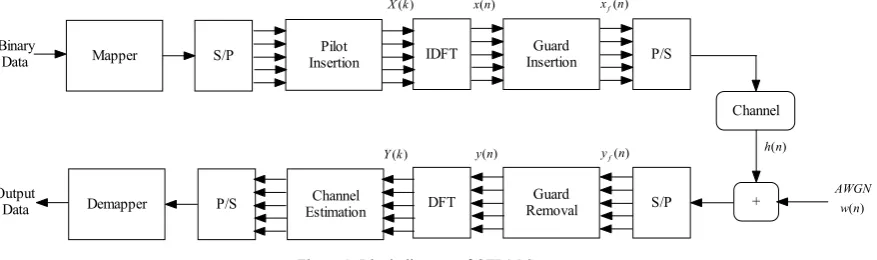
The system model based on pilot channel estimation is depicted in fig.1. The complexity reduction of the MMSE estimator consists of two separate steps. In the first step we modify the MMSE by averaging over the transmitted data, obtaining a simplified estimator [10]. In the second step, we reduce the number of multiplications required by applying the theory of optimal rank-reduction.
Mapper S/P InsertionPilot IDFT InsertionGuard P/S
Demapper P/S EstimationChannel DFT RemovalGuard S/P
Channel
+ Binary
Data
Output Data
( ) f
x n
( )
X k x n( )
( ) f
y n
( )
y n
( )
Y k h n( )
( )
AWGN w n
Figure 1. Block diagram of OFDM System
The binary information is first grouped and mapped according to the modulation for signal mapping. Then, pilots will be inserted to all sub-carriers uniformly between the information data sequence or with a specific period. IDFT block is used for transforming the data sequence of length
N X k
{ ( )}
into time domain signal {x(n)} as follow:( ) { ( )} 0, 1, 2, , 1
x n IDFT X k n N
1
(2 / )
0
( ) N
j kn N
k
X k e
(1)Where, N is the DFT length. Subsequent the DFT block, the guard interval, which is chosen to be larger than the delay spread, is inserted to avoid inter-symbol interference (ISI). This guard time includes the cyclically extended part of the OFDM symbol for eliminating inter-carrier interference (ICI), The OFDM symbol resulting from this succession is the follow:
( ), , 1, , 1
( ), 0,1, , 1
g g
f
x N n n N N
x
x n n N
(2)
Where, Ng is the length of the guard interval [13]. The transmitted signal xf(n) will pass through the channel
which is expected to be frequency selective and time with Rayleigh fading and with additive noise . The received signal is given by:
Wherever w(n) is Additive White Gaussian Noise AWGN and h(n) is the channel impulse response. The channel response h(n) can be represented by
1
(2 / )
0
( ) D ni ( ) 0 1
r
j N f T
i i
i
h n h e n N
(4)Where, r is the total number of propagation paths, hi is the complex impulse response of the ith path, fDi is the ith
path Doppler frequency shift, λ is the delay spread index, T is the sample period and
i is the ith path delaynormalized by the sampling time. Then, at the receiver, after passing to discrete domain through A/D block and low pass filter, guard time is removed
( ) 1
( ) ( ) 0,1, 2, , 1
f g
f g
y n for N n N
y n y n N n N
(5)
Then y(n) is driven to the DFT block for the following operation
1 (2 / )
0
( ) { ( )} 0, 1, 2, , 1
1
( ) N
j kn N
n
Y k DFT y n k N
y n e N
(6)The relation between the resulting Y(k) to H(k) = DFT{h(n)}, is given by
Y k( )X k H k( ) ( )I k( )W k( ) k0,1, 2, , N1 (7) Where I(k) is ICI because of Doppler frequency and W(k) = DFT{w(n)} and
1
(2 / )
0
2 ( )
1 1
(2 / ) (2 / ( )
0 0
sin( )
( ) ,
( ) 1
( ) .
1
Di i
i
Di
i Di
r
j f T D j kn N
i
D i
j f T k K r N
j N K i
j N f T k K i K
K k
f T
H k h e e
f T
h X k e
I k e
N e
(8)After passing through the DFT block, the pilot signals are extracted and the estimated channel He(k) for the data
sub-channel is obtained in channel estimation block. Then the transmitted data is estimated by:
( )
0, 1, 2, , 1 ( )
e e Y k
X k N
H k
(9)
Finally, the binary information data is restored back in the signal de-mapper block.
3. Proposed Method Using Multi-Scale Singular Value Decomposition (MS-SVD)
The multi-scale singular value decomposition (MS-SVD) combines the advantages of wavelet transform (WT) and singular value decomposition (SVD).
3.1. Wavelet Analysis
Wavelet transform (WT) is a representation of a square-integrable function by a certain orthonormal series generated by a mother wavelet of a wave-like oscillation with amplitude that begins at zero, increases, and then decreases back to zero. In the short-time Fourier transform (STFT), a single window will be slided across the data during the signal analysis. To capture the details in time-frequency domain, it is advantageous to use variable size window during data analysis. The WT does exactly the same by employing a variable adaptive size window. A long window will be used at low frequencies and a short sized window will be used at high frequency [18], [19].
Wavelet transform (WT) is a mathematical tool used for the analysis of non-stationary sequences, considering adaptive window size. Mathematically represented by the equation,
1 t a
X a,b x( t )
b
a (10)
Where, x(t) is a non-stationary time domain signal, ψ is a mother wavelet window, ‘a’ is shifting parameter, ‘b’ a scaling parameter X(a,b) is wavelet transform of a given signal x(t).
decomposition). In wavelet decomposition, the output coefficients are referred as; Aj, the approximate coefficients and Dj, the detailed coefficient (output coefficients of the LPF are referred to as ‘approximations’, defining its identity and that of the HPF are referred to as ‘details’, defining its imparts). The last level of approximation along with all levels of detail coefficients are sufficient to reconstruct the original signal using complementary filters considering ‘L’ as the length of the coefficients. In wavelet processing, selection of a suitable wavelet function plays an important role and it is purely dependent on type of signal processing application.
3.2. Singular Value Decomposition
Let X is an arbitrary n × m matrix and XTX be a rank r, square, symmetric m × m matrix.
1 2 3
ˆ ˆ ˆ ˆ
{ , , ... }v v v vr is
the set of orthonormal m×1 eigenvectors with associated eigenvalues for { , , ,... }
1 2 3
r the symmetric matrix XTX. [4]ˆ ˆ
( T )
i i i
X X v v (11)
i i
are positive real and termed the singular values { , , ... }u u uˆ ˆ ˆ1 2 3 uˆr is the set of n×1 vectors defined by
1
ˆi ˆi
i
u
X v (12)1 ˆ ˆ
0
i j
i j u u
i j
Eigenvectors are orthonormal.
ˆi i
X v
(13)The scalar version of singular value decomposition is
ˆi i ˆi
X v
u (14)X multiplied by an eigenvector of XTX is equal to a scalar times another vector. The set of eigenvectors
1 2 3
ˆ ˆ ˆ ˆ
{ , , ... }v v v vr and the set of vectors are { , , ... }u u uˆ ˆ ˆ1 2 3 uˆr both orthonormal sets and bases in r dimensional space.
1 0
0 0
(15)
1 2 3
are the rank-ordered set of singular values. Likewise we construct accompanyingorthogonal matrices,
ˆ ˆ ˆ1, , ...2 3 ˆr
V v v v v (16)
ˆ ˆ ˆ1, , ...2 3 ˆr
U u u u u (17)
Matrix version of SVD
XV U (18)
where each column of V and U perform the scalar version of the decomposition. Because V is orthogonal, we can multiply both sides by V−1 =VT to arrive at the final form of the decomposition.
T
XV U V (19)
3.3. Multi-scale Singular Value Decomposition
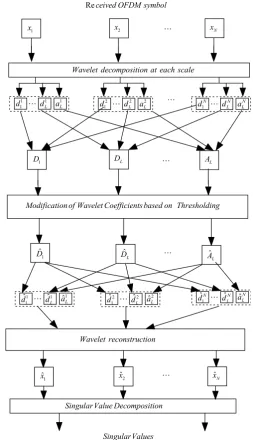
The proposed method based on multi-scale singular value decomposition (MS-SVD) for OFDM channel estimation, as shown in fig.2, has the following processing steps:
Step 1: For each OFDM symbol, compute wavelet transform and obtain approximate and detail coefficients.
Step 2: Form a wavelet matrix comprising of individual level of approximate and detail coefficients from a set of transformed OFDM symbols.
Step 3: Modify the wavelet matrix based on soft thresholding mechanism.
Step 5: Perform wavelet reconstruction on modified approximate and detail coefficients.
Step6: Wavelet reconstructed symbols are then processed by the SVD algorithm for the process of channel estimation.
1
x x2 xN
Wavelet decomposition at each scale
1 1
d 1
L
d 1
L
a 2
1
d 2
L
d 2
L
a 1
N
d N
L
d N
L a
1
D DL AL
Modification of Wavelet Coefficients based on Thresholding
1
ˆ
D ˆ
L
D ˆ
L
A
1 1
ˆ d ˆ1
L
d ˆ1
L
a 2
1
ˆ d ˆ2
L
d ˆ2
L
a ˆ1
N
d ˆN L
d ˆN L a
Wavelet reconstruction
1
ˆ
x xˆ2 xˆN
SingularValue Decomposition Received OFDM symbol
SingularValues
Figure. 2. Processing steps of the proposed MS-SVD
4. Results and Discussion
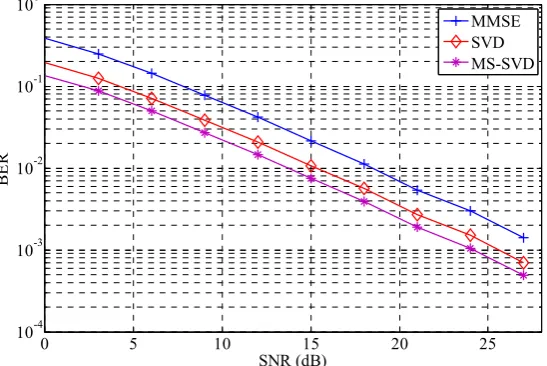
For the purpose of evaluation of proposed MS-SVD method, an OFDM system with 64-point FFT, 16-QAM signaling with multipath Rayleigh and Rician fading channels was considered. The length of the cyclic prefix (CP) is considered as 16 samples. Here at the receiver side, the received OFDM symbol is divided into three parts so as to create three single column vectors. The processing steps of MS-SVD as exploited in the block diagram were applied on created three single column vectors.
0 5 10 15 20 25 30 10-4
10-3 10-2 10-1 100
BE
R
SNR (dB)
SVD MS-SVD MMSE
Figure. 3. Bit error rate plot of OFDM transceiver system for Rayleigh multipath fading channel
0 5 10 15 20 25
10-4 10-3 10-2 10-1 100
BE
R
SNR (dB)
MMSE SVD MS-SVD
Figure. 4. Bit error rate plot of OFDM transceiver system for Rician multipath fading channel
5. Conclusion
In order to nullify the effect of inter symbol interference (ISI) caused by the high data rate, high bandwidth wireless communication systems, the orthogonal frequency division multiplexing (OFDM) has proven to be a best solution, which leads it to numerous applications in third generation, fourth generation and WiMAX applications. In this paper, a novel signal processing method based on multi-scale singular value decomposition (MS-SVD), by combining the attractive properties of wavelet transform (WT) and singular value decomposition (SVD) has been utilized for OFDM channel estimation. The bit error rate (BER) simulation results established the fact that the proposed MS-SVD method performed well over the conventional SVD and MMSE methods
References
[1] Sinem Coleri, Mustafa Ergen, Anuj Puri, and Ahmad Bahai, " Channel Estimation Techniques Based on Pilot Arrangement in OFDM Systems", IEEE Transactions on Broadcasting, vol. 48, no. 3, pp.223-229,September 2002.
[2] Jan-Jaap van de Beek, Ove Edfors, Magnus Sandell, Sarah Kate Wilson and Per Ola Borjesson, "On Channel Estimation In OFDM Systems", In Proceedings of Vehicular Technology Conference (VTC Ô95), vol. 2, pp. 815-819, Chicago, USA, September 1995. [3] Moussa Diallo and Maryline Hélard, "Channel Estimation methods with low complexity for 3GPP/LTE", ARIMA Journal, vol. 18, pp.
93-116, 2014.
[4] Ove Edfors, Magnus Sandell, Jan-Jaap van de Beek, Sarah Kate Wilson and Per Ola Borjesson, "OFDM Channel Estimation by Singular Value Decomposition", IEEE Transactions on Communications, vol.46 no.7, pp. 931-939, July 1998.
[5] Bradaric, I. and Petropulu, A.P. "Performance of training-based OFDM systems in the presence of time varying frequency-selective channels," in proc. of IEEE int. conf. on Acoustics, Speech, and Signal Processing (ICASSP '04), vol. 4, pp. 737-740, 17-21, May 2004.
[6] T. Hwang, Chenyang Yang, Gang Wu, Shaoqian Li, and Li, G.Y. "OFDM and its wireless applications: A Survey," IEEE Trans. Veh. Technol., vol. 58, no. 4, pp. 1673-1694, May 2009.
[8] Coleri, S., Ergen, M., Puri, A., and Bahai, A., “Channel estimation techniques based on pilot arrangement in OFDM systems,” IEEE Trans. Broadcasting, vol. 48, no.3, pp. 223–229, September 2002.
[9] Ye(Geoffrey) Li, “Pilot-symbol-aided channel estimation for OFDM in wireless systems”, IEEE Transaction on Vehicular Technology, vol. 49, no. 4, pp. 1207-1215, 2000.
[10] Lau, H.K. and Cheung, S.W., “A pilot symbol-aided technique used for digital signals in multipath environments,” in proc. of IEEE Int. conf. on commun., vol. 2, pp. 1126–1130, May 1994.
[11] Van de Beek, J.J., Edfors, O., Sandell, M., “Analysis of DFT-based channel estimators for OFDM,” Personal Wireless Commun., vo. 12, no.1, pp. 55–70, January 2000.
[12] Lyman, R.J. and Edmonson W.W., “Decision-directed tracking of fading channels using linear prediction of the fading envelope,” in proc. of 33rd Asilomar Conference on Signal Processing, Systems, and Computers, vol. 2, pp.1154–1158, 24-27, October 1999, CA, USA.
[13] Hoeher, P. and Tufvesson, F., “Channel estimation with superimposed pilot sequence,” in proc. IEEE Global Telecommunications Conf. (GLOBECOM’99), pp. 2162–2166, 5-9, December 1999.
[14] T. Al-Naffouri, “An EM-based forward-backward Kalman filter for the estimation of time-variant channels in OFDM,” IEEE Trans. Signal Processing, vol. 55, no. 7, pp. 3924–3930, July 2007.
[15] H. M. Mahmoud, A. S. Mousa and R. Saleem, “Channel estimation based in comb-type pilots arrangement for OFDM system over time varying channel,” Journal of networks, vol. 5, no. 7, pp. 766-772, July 2010.
[16] G. Taubock, F. Hlawatsch, and H. Rauhut, "Compressive estimation of doubly selective channels: exploiting channel sparsity to improve spectral efficiency in multicarrier transmission," IEEE J. Select. Topics in Signal Processing, vol. 4, no. 2, pp. 255-271, May 2010.
[17] Liu. Y., Tan, Z., Hu, H., Cimini, L.J., and Ye Li, G., “Channel estimation for OFDM,” IEEE Communications Surveys & Tutorials, vol. pp. 99, May 2014.
[18] E. H. Krishna, K. Sivani, K. A. Reddy, "OFDM channel estimation and equalization using multi scale independent component analysis", IEEE International Conference on Signal Processing, Informatics, Communication and Energy Systems (SPICES), pp.1-5, 19-21, February 2015.