warwick.ac.uk/lib-publications
Original citation:Argyris, Nikolaos and French, Simon. (2017) Nuclear emergency decision support : a behavioural OR perspective. European Journal of Operational Research, 262 (1). pp. 180-193.
Permanent WRAP URL:
http://wrap.warwick.ac.uk/88451 Copyright and reuse:
The Warwick Research Archive Portal (WRAP) makes this work by researchers of the University of Warwick available open access under the following conditions. Copyright © and all moral rights to the version of the paper presented here belong to the individual author(s) and/or other copyright owners. To the extent reasonable and practicable the material made available in WRAP has been checked for eligibility before being made available.
Copies of full items can be used for personal research or study, educational, or not-for-profit purposes without prior permission or charge. Provided that the authors, title and full bibliographic details are credited, a hyperlink and/or URL is given for the original metadata page and the content is not changed in any way.
Publisher’s statement:
© 2017, Elsevier. Licensed under the Creative Commons Attribution-NonCommercial-NoDerivatives 4.0 International http://creativecommons.org/licenses/by-nc-nd/4.0/
A note on versions:
The version presented here may differ from the published version or, version of record, if you wish to cite this item you are advised to consult the publisher’s version. Please see the ‘permanent WRAP URL’ above for details on accessing the published version and note that access may require a subscription.
Date printed: 18/05/17 - 1 -
Nikolaos Argyris Simon French
School of Business and Economics, Loughborough University, UK
Department of Statistics, University of Warwick, UK
Abstract
Operational researchers, risk and decision analysts need consider many behavioural issues. Despite many OR applications in nuclear emergency decision support, the literature has not paid sufficient attention to behavioural matters. In working on designing decision support processes for nuclear emergency management, we have encountered many behavioural issues. In this paper we synthesise the findings in the literature with our experience and identify a number of behavioural challenges to nuclear emergency decision support. In addition to challenges in model-building and interaction, we pay attention to a behavioural issue that is often neglected: the analysis itself and the communication of its implications may have behavioural consequences. We introduce proposals to address these challenges. First, we propose the use of models relying on incomplete preference information, outlining a framework and illustrating it with data from a previous decision analysis for the Chernobyl Project. Moreover, we reflect on the responsibility that rests on the analyst in addressing behavioural issues sensitively in order to lessen the effects on public stress. In doing so we make a distinction between System 1 Societal Deliberation and System 2 Societal Deliberation and discuss how this can help structure societal deliberation in the context of nuclear emergencies.
Keywords: behavioural OR; incomplete preference information; multi-criteria decision analysis (MCDA); nuclear emergency preparedness and management; societal decision-making.
1
Introduction
decision-Date Printed: 18/05/17 - 2 -
making need be explicitly analytic and open to audit. This has meant that many techniques of risk and decision analysis have found early applications within the sector, particularly in developing emergency planning, management and recovery processes post-Chernobyl.
Despite many OR applications in nuclear emergency decision support, the literature has not paid sufficient attention to behavioural matters. For instance, our discussion surfaces a behavioural impact that is not so obvious in other contexts. In any human activity, there is potential for unintended effects. In the case of nuclear safety, the very logic, process and reporting of an analysis can have behavioural consequences leading to impacts that are of the same order as those that are being addressed (see Section 3.3). In our experience, behavioural issues are also overlooked in practice. For instance, in our recent experience with supporting an exercise with a group of scientific experts in devising national-level emergency plans for Government, we found that experts may not only be unaware of the behavioural biases that can affect their understanding, but also confident that, as experts, they will not be misled by such behavioural issues (French et al. 2016). There is therefore a gap in the literature (and in practice) about the behavioural issues affecting nuclear emergency decision support. Our paper aims to specify this in detail and put forward proposals to address it. In this endeavour we take a Behavioural OR perspective.
Behavioural OR is a nascent discipline, and its boundaries and definitions are still unclear. Behaviour is itself a portmanteau concept carrying many meanings. Here we aim to be inclusive of those covered in the Behavioural OR literature so far (see, e.g., Becker 2016, Franco and Hämäläinen 2016), covering issues relating to both model-building and interaction as well as impacts that stem from actual use of the models in practice. Specifically, our discussion identifies behavioural challenges to the application of decision analytic methods in nuclear emergency management: behavioural effects in the elicitation of judgements and values; the cognitive load on DMs, experts and stakeholders; and behaviourally induced psycho-social and health impacts arising from the poor communication of model results. We explore two routes for addressing these challenges:
The use of robust decision-analytic models relying on incomplete information; we shall detail how this can help with behavioural issues in preference elicitation and model-interaction.
Structuring deliberation processes with stakeholders and the public with regard to risk-mitigation and communication. We note the need to consider the behavioural impacts arising from the justification and presentation of the underpinning analysis and its conclusions.
Date Printed: 18/05/17 - 3 -
(i.e. conscious decision-making driven by analysis). We also provide a brief review of the use of multi-criteria decision analysis in a nuclear-emergency context. In Section 3 we outline a set of challenges for decision analysis and societal decision processes in the context of nuclear emergency management. We synthesise the findings in the relevant literature but also highlight issues that have not been discussed in this so far. In Section 4 we suggest two ways of addressing these challenges. First, we look to developments in decision analysis for working with incomplete preference information. We put forward a framework for evaluation under incomplete information in nuclear emergency decision support and illustrate this with an example using data from the International Chernobyl Project. Second, we develop a distinction between informal System 1 Societal Deliberation and formal, constitutionally allowed or required System 2 Societal Deliberation, which parallel that between System 1 and System 2 Thinking in individuals. We use this to make suggestions on how to structure societal deliberation in the context of nuclear emergencies. Finally, in Section 5 we draw some conclusions and summarise a research agenda.
2
Background: nuclear emergency management, behavioural and
decision science.
This section provides some background for our discussion. Firstly, we discuss how are nuclear emergencies planned for and managed, and what societal decision processes are needed in long term recovery. Secondly, we discuss the process of prescriptive decision analysis and how may it can be and has been used in this context – in doing so, and because our later discussion will draw on the behavioural findings on individual choice and judgement, we also briefly discuss System 1 and System 2 thinking in individuals.
2.1
Nuclear emergency planning and management
The Daiichi Fukushima Disaster, coming 25 years after Chernobyl, emphasised that society must have robust, sensitive emergency management processes to respond to any future radiation accident. Much general guidance on these has been developed by, e.g., the International Commission on Radiation Protection (ICRP) and the International Atomic Energy Agency (IAEA). During the normal running of nuclear plants, many preparations, including exercising, for potential emergencies, without which no site would be licensed.
Date Printed: 18/05/17 - 4 -
as: warning the public; distributing stable iodine tablets; advising people to shelter; evacuating those most at risk. If a significant release occurs, further countermeasures include food-bans, restrictions on activities, and establishing an exclusion zone. In the longer term, it may be necessary to consider permanent relocation of some inhabitants, and changes in agricultural practice, business and economic activity. Early decisions will be driven primarily by the imperative to avert radiation dose; later ones, however, will need consider stress-related health, socio-economic and environmental impacts. Such decisions are clearly societal issues. It is acknowledged that the values of all stakeholders, and the public in general, should be an input to the decision-making process, along with input from technical modelling, experts and economic information (see e.g. ICRP 2009, IAEA 2011).
Many aspects of emergency management rest upon OR analyses (see Altay and Green 2006, Tomasini and Wassenhove 2009 for recent surveys, Galindo and Batta 2013), but our focus is on multi-criteria decision analysis (MCDA), stakeholder engagement and public participation to support to the development of responses.
2.2
System 1 and System 2 Thinking in individuals
Intuitive judgements and decision-making are examples of System 1 Thinking (Chaiken et al. 1989, Milkman et al. 2009, Kahneman 2011). Such thinking tends to be superficial, on the fringes or outside of consciousness, and subject to behavioural biases; indeed, its literature is often somewhat pejoratively labelled heuristics and biases (Kahneman and Tversky 1974). Behavioural studies have found numerous examples of System 1 behaviour (Kahneman and Tversky 2000, French et al. 2009, Morton and Fasolo 2009, Montibeller and von Winterfeldt 2015). A repeated finding is that, individuals consistently fail to take into account relevant information other than the most easily discernible (see e.g. Tversky et al. 1988, Payne et al. 1993). Similarly, individuals fail to consider objectives consistently (Bond et al. 2008). Particular issues facing emergency management are how individuals and groups understand communications about risk, uncertainty and conflicting objectives (Fischhoff 1995, Bennett and Calman 1999, Kasperson et al. 2003, Maule 2008, Bennett et al. 2010), their responses being mediated by national, organisational and professional culture (Douglas 1992, Hofstede 1994).
Date Printed: 18/05/17 - 5 -
(e.g., Keeney and Raiffa 1976, French 1986, Bouyssou et al. 2006). We adopt a perspective based on subjective probability, and particularly value and utility theories (French and Rios Insua 2000, Smith 2010).
[image:6.595.140.459.403.587.2]2.3
Prescriptive decision analysis for nuclear emergency management
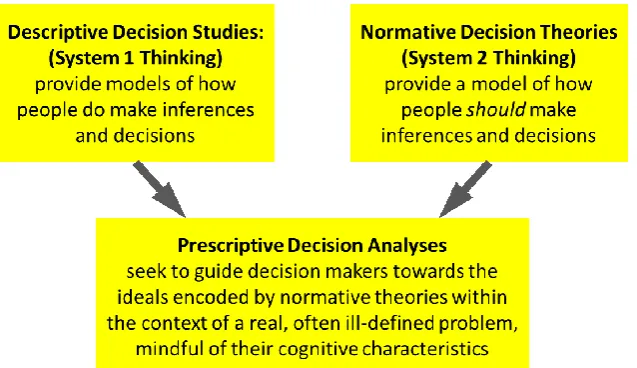
Many writers on decision analysis have discussed processes, interactions and ways of communicating which enable analysts help individuals break out of System 1 Thinking and follow System 2 analyses (French 1984, Bell et al. 1988, Katsikopoulos and Fasolo 2006, Edwards et al. 2007, French et al. 2009, Milkman et al. 2009). DMs think and respond instinctively with System 1 Thinking; yet we need to draw them into the rational System 2 Thinking that underpins the analyses: see Figure 1. Indeed, even careless analysts may fall prey to System 1 Thinking. Effective elicitation procedures have been developed to help DMs, experts and stakeholders respond to questions about their understandings, uncertainties and values in ways compatible with the assumptions underpinning the analysis. The processes catalyse reflection and learning, helping make a more informed decision. Thus the processes are aimed at modifying their System 1 behaviours through the growth of understanding (see, e.g., Phillips 1984, Bell et al. 1988, Edwards and Fasolo 2001, O'Hagan et al. 2006, Edwards et al. 2007, French et al. 2009).Figure 1: Prescriptive Decision Analysis
Date Printed: 18/05/17 - 6 -
anyone to explore and understand their perspective on the issues (Atherton and French 1999, Morton et al. 2009). Many papers have appeared examining methodological and practical aspects of using MCDA in nuclear emergencies ( French et al. 2007, Papamichail and French 2013). MCDA is not a quick process, so it has not been seriously proposed for use during the threat and release phases, instead finding its place in training exercises as a means to articulate discussion of potential trade-offs. In the recovery phase there is time to deliberate and balance costs and benefits; again MCDA proving to be a very useful tool.
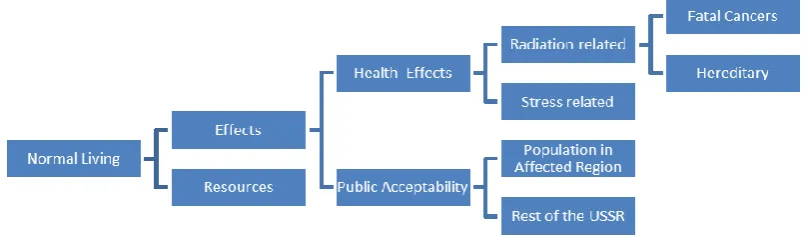
[image:7.595.120.524.392.512.2]One of the first applications of MCDA within the context of nuclear accidents was in five decision conferences arranged as part of the International Chernobyl Project (IAEA 1991, Lochard et al. 1992, French et al. 2009). Their purpose was to investigate the factors driving decision-making in the affected areas of Ukraine, Belarus and the Russian Federation. A clear conclusion was that decision-making had sought to balance the costs and effects, but the effects included not just radiological impact, but also stress-related health effects and political acceptability to different groups of the population: see the attribute hierarchy shown in Figure 2. Socio-political consequences of countermeasures, e.g. psychological stress and political acceptability, were significant factors, although not taken into account by conventional cost-benefit analysis (CBA).
Figure 2: Final Attribute Hierarchy developed in the Summary Decision Conference
The decision conferences involved many government stakeholders, although not the public. Today these would be termed stakeholder workshops, and were an early step towards more participatory decision-making in the nuclear sector. Papamichail and French (2013) provide a comprehensive survey1 of
subsequent developments and conclude that (p. 484): “MCDA has supplanted CBA to become the main approach to supporting decision-making on recovery after a major radiation accident”. French et al. (1992) described the Chernobyl workshops as ‘group interviews’, taking a strongly behavioural view of their design and value. Generally, however, the OR literature on decision support has not paid substantial attention to many behavioural aspects of the interaction of models with people. In hindsight
Date Printed: 18/05/17 - 7 -
this seems surprising, since stakeholders’ preferences and judgements are an integral component of the decision-analytic process.
3
Behavioural challenges
In this section we discuss behavioural challenges to the use of MCDA in decision support for nuclear emergency management. Firstly, we examine the normative foundations of MCDA and consider how common assumptions have important implications in terms of the behavioural patterns that the analysis is able to encompass. Secondly, we consider prescriptive modelling, particularly the behavioural challenges to elicitation and interaction with stakeholders. Thirdly, we consider model use and highlight the unintentional impacts that even sound modelling can have in practice.
3.1
Normative modelling: multi-attribute risk-aversion
Most, if not all, existing work within the nuclear-emergency management literature is grounded on the established paradigm of Multi-Attribute Value/Utility Theory (MAUT/MAVT). In this setting, additive value/utility functions are most commonly used to model preferences elicited from individuals/groups and structure the discussion. There are indeed very good reasons for this: a) additive models are easy to explain and seem intuitive to DMs, and b) the use of additive models has a long tradition in practice. Whilst recognising this, we want to highlight, via the following example, a feature of these models with problematic implications in the nuclear emergency management context.
Nuclear accidents affect wide areas where radionuclides are deposited, which may necessitate the establishment of exclusion zones and relocation of the population (as was the case for Chernobyl) or the establishment of zones where agriculture and economic activity is banned. Thus, part of longer-term remediation involves efforts to restore portions of such areas to the extent possible. Consider a choice between two such alternative strategies, A and B, for restoring local Urban and Rural Environments. Their effectiveness is scored on a common 0 – 100 scale, where 0 and 100 denote complete success and complete failure of the restoration processes. The effectiveness of both strategies is uncertain (so they are lotteries) and each have a 50/50 chance of yielding the results specified in Figure 3.
𝐴: {
50% (0,0)
50% (100,100)
𝐵: {
50% (100,0)
50% (0,100)
Figure 3: A choice between two lotteries A and B. (U, R) denote the Urban and Rural scores.
Date Printed: 18/05/17 - 8 -
the choice between these lotteries should be subject to debate – and that, within an MCDA-driven process, this dialogue would be part of preference elicitation. Yet, this would be pointless! The reader can easily verify that for any additive multi-attribute utility function (where 𝑢1(∙), 𝑢2(∙) are the partial
utility functions for each attribute respectively), the overall expected utility of these lotteries will be the
equal: 𝑢1(0) + 𝑢2(0) + 𝑢1(100) + 𝑢2(100). Further, if a multiplicative multi-attribute function is
employed, then lottery A will necessarily be deemed preferable to lottery B: (𝑢1
(
100)
−𝑢1
(
0))(
𝑢2(
100)
− 𝑢2(
0)) > 0
.
Often in practice, rather than eliciting utilities, an additive value function is used. This is either used as a reasonable proxy for a utility function, or, alternatively, the analysis involves further applying a concave transformation to the value function scores, so as to encompass risk-aversion. In the former case, the above problem persists. In the latter, the transformation requires a) establishing a parametric form for the transformation, and b) eliciting values for its parameters. This last task is far from straightforward. as evidence from behavioural experiments provide no clear answer about the nature of the transformation between value and utility (see e.g. Smidts 1997, Abdellaoui et al. 2007).Clearly any model requires assumptions; but it is also clear from the above example that the normative tools employed impose heavy assumptions about stakeholder preferences. Can these assumptions reasonably encompass pertinent patterns of behaviour? We suggest not: consider the case of multi-attribute risk-aversion. One of a few concepts of risk-aversion in the multi-multi-attribute setting is correlation-aversion (see e.g. Richard 1975, Denuit et al. 2010), which effectively describes a DM who prefers to hedge bets2. Such a DM would be averse to choosing strategy A in the above example, and
instead prefer strategy B which offers the certainty of some type of environment restoration in any event.
One may make the case that in mitigating disastrous consequences, DMs would be likely to opt for strategies that offer a reasonable chance of success in every scenario considered, hence exhibiting correlation-aversion. At any rate, we argue that if such patterns of behaviour are to be discounted, this should not be done a priori, rather endogenously, as a result of the dialogue and elicitation process. This would require models that are able to encompass different attitudes of multi-attribute risk-aversion – a point that we shall pick up again later in Section 4.1.2.
Date Printed: 18/05/17 - 9 -
3.2
Preference elicitation and prescriptive modelling
In this section we collect evidence from case-studies on the challenges facing MCDA for nuclear emergency management, focussing on two aspects: a) problem structuring and model-building; and b) elicitation of preferences.
3.2.1
Model-building and model-interaction
Several problems are reported in the literature relating to behavioural issues in model-building and model-interaction. One such is the effect of behavioural issues in the problem-structuring phase and the construction of the value tree (i.e. the hierarchy of attributes). Hämäläinen et al. (2000) report that constructed value trees differed in a set of nuclear-emergency planning exercises. In the related problem of disposal of nuclear waste, Borcherding and von Winterfeldt (1988) report similarly that re-structuring the value tree had an effect on the elicited attribute weights. Further, there are concerns about the capacity of DMs and stakeholders to understand or accept the concepts/tools used in engagement and deliberation. In the context of a planning exercise for a nuclear emergency Hämäläinen et al. (2000) note that the elicitation of utility functions was particularly problematic and question whether they did actually represent the participants’ risk-attitudes. Morton et al. (2009) report similar problems about the elicitation of (swing-) weights in the context of nuclear-waste disposal; participants indicated, instead, that a holistic comparison of disposal strategies appeared more meaningful.
Since Chernobyl there have been many studies reflecting back on Chernobyl or developed around hypothetical future accidents. The broad family of the criteria in Figure 4 have been repeatedly identified (Hämäläinen et al. 2000, Geldermann and Rentz 2003, Mustajoki et al. 2007, Andrews et al. 2008, Larsson et al. 2010). However, during our work on the NREFS project3, we became concerned
that there may a tendency to consider too few criteria, e.g. ignoring environmental aspects. Perhaps we are being blinded by the specifics of the Chernobyl Accident and failing to think as widely as may be needed for a quite different accident. If we are, that would be an example of a behavioural bias on the part of analysts becoming anchored on the available memory of a past event.
3.2.2
Trade-off and preference elicitation
Preference elicitation is, in general, known to be affected by several biases, including both the elicitation of partial value or utility functions and the elicitation of attribute weights. In their extensive review, Montibeller and von Winterfeldt (2015) report – inter alia – that the elicitation of partial values is particularly affected by anchoring bias, gain-loss bias and the certainty effect; and also that the elicitation of weights is prone to splitting and equalising biases. We take these findings as read, and do
Date Printed: 18/05/17 - 10 -
we refer the reader to Montibeller and von Winterfeldt (2015) for a detailed discussion. Instead, we focus on preference elicitation issues particular to the setting of nuclear emergency decision support. In this setting, many of the decisions require a trade-off to be made between the potential dose averted and costs; and that means that either explicitly or implicitly the DMs have to put a value on a life. Such judgements are not easy and many find them impossible to make. Arguably, these trade-offs may be seen as taboo trade-offs which individuals are known to be generally unwilling to make(Tetlock et al. 2000). Furthermore, in the aftermath of a nuclear emergency people may be adjusting to their new conditions and, indeed, their values may be changing (French et al. 1997, Heriard Dubreuil et al. 1999). This makes elicitation more difficult. The effect is that judgemental inputs elicited from stakeholders could be highly biased and, as such, produce biased results. The issue is further compounded by potentially different attitudes among stakeholders, leading to a wide disagreement about the ‘right’ off values to guide the analysis. In our experience, insisting on the elicitation of contentious trade-offs amplifies dissonance in the group and ultimately the credibility of both the process and the results are hindered.
In addition, several studies have reported that different preference elicitation methods can lead to fundamentally different results (see e.g. Lichtenstein and Slovic 1971 who first reported preference reversals between different elicitation methods in the context of risk preferences, Knetsch and Sinden 1987 in the context of eliciting certainty-equivalents). The elicitation of preferences is also plagued by ‘noise’, taken to mean changes in responses to the same question repeated at different times
3.3
Behavioural impacts arising from analyses
Analysis inevitably has costs: time, effort and computational costs are obvious. But there are other costs and one of these is little appreciated. Namely, the logic and assumptions of analysis can cause impacts, usually through stakeholder and public concerns and stress, which can be very significant. An example is provided by a simple mathematical model developed as the basis for risk management and licensing of nuclear plant and radiation related activities (ICRP 2007); but if not fully understood or used inappropriately, it has a huge potential to raise public stress and change behaviour.
Date Printed: 18/05/17 - 11 -
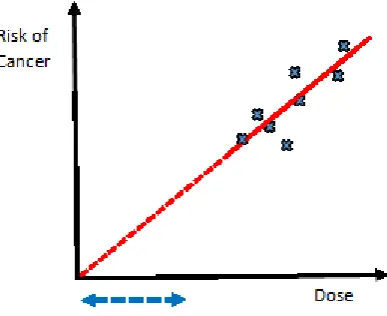
[image:12.595.216.410.154.312.2]Atmospherically dispersed contamination is often assumed to cover the entire planet and to provide equal risk wherever radiation occurs. With the world population around 7 billion, and some radionuclides having half-lives of thousands of years, it is easy to calculate expected numbers of cancers arising in the thousands, if not tens of thousands (Steinhauser et al. 2014).
Figure 4: The Linear No-Threshold (LNT) Model. Note that for the purposes of schematic representation, we do not give units nor values.
This conservative LNT assumption is eminently sensible in risk management since it ensures a continual downward pressure to reduce exposures and their health effects. Yet the same analysis presented in risk communication can lead to the opposite outcome: creating negative health effects through raised stress. During the International Chernobyl Project, it became apparent stress-related health effects were of the same order as those caused the radiation risk (Havenaar et al. 2003, Rahu 2003, IAEA 2006, Bromet and Havenaar 2007). In 1996, 10 years after the Accident, morbidity estimates arising from stress4 in contaminated areas of Belarus suggested that more than two thirds of the public were affected
(Karaoglou et al. 1996). Early indications are similar about the Daiichi Fukushima Disaster (Nomura et al. 2013, IAEA 2015, Murakami et al. 2015).
We argue that such behavioural impacts stem from a lack of appreciation of the difference risk management and emergency management. Risk management, concerns what might happen: one is considering a wide range of potential scenarios and wishes to guard against untoward consequences in a conservative way, so that modelling assumptions are always on ‘the safe side’. Emergency management concerns what has happened: one needs to manage an actual situation and ideally the consequence models should be unbiased, representing what is really likely to happen. However, in crises, modellers often lean to the familiar and quickly available. The modellers know the assumptions and limitations of these, but the DMs and, subsequently, the public and stakeholders may not. Few
Date Printed: 18/05/17 - 12 -
reporters and, sadly, far from all scientists realise that in using models designed conservatively for risk management they may grossly overestimate the consequences of an actual accident. As the consequences of the Chernobyl Accident have shown: misusing and misunderstanding mathematical models can cause real harm (Blandford and Sagan 2016). We noted the extensive literature on the communication of risk in Section 2.2; however, the particular issue of the behavioural impacts that can arise from oversimplified presentation of the results of mathematical models has received less attention.
3.4
Societal deliberation
Decision-making in groups, organisations and companies has formal accountabilities, responsibilities and authorities defined in the governance structures which stipulate how decisions should be made. Democratic constitutions provide carefully structured deliberative and communication systems to allow citizens to participate in deliberative democracy. Yet the behaviours and interactions that actually determine the decisions may be much more informal. ‘Water-cooler’ discussions can effectively bypass formal discussion. Information Systems studies in organisations (see e.g. Chan 2002) often reflect on tensions between hierarchical organisational charts with carefully structured lines of authority and the informal processes used in day to day activities to shortcut the overheads that such formality brings. Discussions on Twitter may lead public debate as much as any government guidance, particularly in times of crisis (see, e.g., Thomson et al. 2012 for interactions on Twitter after Fukushima). The Social Amplification of Risk is an example of an early theory that over the years has suggested explanations of negative effects of informal public debate and how better public risk communication mitigate these (Kasperson et al. 2003)
Date Printed: 18/05/17 - 13 -
Misunderstandings of the issues may increase and, in our context, this may raise psychological stress and its health impacts. Reflecting back to the Chernobyl Accident, the Soviet Union invited the IAEA to organise the International Chernobyl Project because of public concerns and protests, i.e. disruptive System 1 Societal behaviours, against the ‘35 REM’ recovery strategy that was then being proposed. They hoped that the Project would stimulate a formal debate, i.e. a System 2 Societal Deliberation, which would help reassure and calm the public concern. The challenge was and remains how to balance Systems 1 and 2 Societal Deliberation in managing the response and recovery.
4
Addressing the challenges: proposals
The literature on MCDA within nuclear emergency management has not, so far, considered how to address behavioural issues in elicitation and model interaction, nor in societal deliberation. Here, we make several proposals to address them. Firstly, we start with a proposal for structuring MCDA processes on the basis of models relying on incomplete information. We discuss their advantages in practice, both in general but also in relation to the challenges identified previously. We then discuss a general evaluation framework under incomplete information and specify how this may be used for nuclear emergency decision support. Secondly, we discuss proposals for structuring societal deliberative behaviours, paying attention to the interplay between formal constitutional processes and informal stakeholder and public discussion.
4.1
Robust decision-analytic models for nuclear emergency decision
support
4.1.1
Use of incomplete preference information
We propose the use of MCDA methods that can accommodate ‘incomplete preference information’ (see e.g. Salo and Hämäläinen 1992, Salo and Hämäläinen 2010 and the references therein). We provide a specific example of how such methods can be applied to nuclear emergency decision support. Broadly speaking, these approaches work on the principle that precise judgemental values need not be elicited from DMs where this proves difficult. For example, upper and lower bounds can be used for the value-of-life, and we would be expect such weaker statements to be easier to agree than an exact figure. Various other forms of such ‘incomplete information’ can also be elicited, and we discuss several in the following sections. The main principle being that there is a gamut of alternative questioning modes with differing judgmental loads, and that the analysis should only consider those which the DMs can comfortably provide. Relating to the challenges identified earlier, this can have several advantages.
Date Printed: 18/05/17 - 14 -
required of DMs can be onerous. This may be because the judgements relate to a genuinely contentious task (cf. trade-offs between costs and averted radiation doses), or because DMs may find it hard to understand and relate to the questions and tools used (cf. the elicitation of utility functions for life-expectancy, deaths averted, etc. or the use of disaggregate comparisons in general). There is a fundamental question (see e.g. Harrison 1992) about the precision of elicitation methods: whether we could meaningfully elicit point estimates – a common practice in MCDA for nuclear emergency management – or whether instead interval responses is the best possible. Given the evidence reported above, one may indeed raise questions about the validity of such responses, especially in regards to judgements that implicitly place a value on life. The use of incomplete (preference) information can be of obvious help: use can be made only of “cognitively valid” (Larichev 1992) responses, i.e. to questions which the DM is considered able (or reports being able) to understand and relate to; alternatively, the elicitation of ranges can be pursued instead of point estimates. We shall discuss later and in more detail how this may be performed in nuclear emergency decision support and provide an illustrative example. Furthermore, evidence from Behavioural Economics suggests that use of incomplete preference information may also help in avoiding biases. Hey et al. (2009) conduct an experimental study to compare the combined effect of bias and noise using different elicitation methods: pairwise choices (incomplete information) and a number of mechanisms for certainty-equivalent elicitation (point estimates). Their results indicate that pairwise choices are in most cases superior to the precise elicitation mechanisms, “having in general smaller noise and no significant bias”. Our view is that while the use of models relying on incomplete information cannot altogether avoid biases, it may be able to do so partially: if a precise elicitation mode (e.g. eliciting a value for life) subsumes the information conveyed by one using incomplete information (e.g. eliciting bounds on the value for life), one might reasonably expect that the latter should be no more prone to bias than its precise counterpart. In any case, the use of incomplete information can be an alternative to de-biasing techniques: if certain responses are (experimentally) found to or suspected to be biased, then the analysis can proceed utilising only partial (hence incomplete) preference information.
Date Printed: 18/05/17 - 15 -
on ranges and weaker statements initially e.g. bounds on the value of an averted death. Thus it is possible to incrementally uncover judgmental issues which are genuinely contentious, in the sense that any disagreement does affect the results, rather than via undertaking back-end sensitivity analysis. Overall this permits the elicitation process to focus where there is genuine need for more attention and removes unnecessary stumbling blocks to consensus.
3. Robustness and wider Acceptability. In addition to the disagreement between workshop participants about contentions value judgements, experience from Chernobyl and Fukushima has shown that the public itself may have a very different attitude about these judgements (Drottz-Sjöberg and Sjoberg 1990, Tateno and Yokoyama 2013). However sound the analysis and recommendations of a participative decision analysis, its recommendations are inevitably part of a wider societal process that may be influenced by other political or popular factors (see also Section 4.2). In the related problem of nuclear waste disposal in the UK decisions national participative decision analysis led to the adoption of geological disposal (Morton et al. 2009), but local participative decision making has completely stalled the process (Gilbert et al. 2016). In view of this, we suggest that, instead of placing the focus of the analysis on identifying a unique recommendation, this can shift to identifying a set of acceptable strategies which would be more robust against a wide set of preference scenarios (see also Roy 2010 for a wider discussion on robustness in MCDA). Incomplete preference information offers a route to achieving this, as shown in an example below. A particular point to note is that building models based on incomplete information allows for assurance levels to be introduced through appropriate constraints. Specifically, models can be built to ensure that any recommendation will be unanimously preferable to a set of targets and reference outcomes (e.g. the outcomes of a past crisis or a minimally acceptable outcome in terms of morbidity/mortality characteristics). This last point is particularly important in view of the lessons learnt about public acceptability through the International Chernobyl Project.
4.1.2
Use of non-additive models
In Section 3.1 we noted the issues posed by different attitudes to multivariate risks in the use of additive or multiplicative value/utility functions and suggested that models that are able to encompass such attitudes may be required. This, we argue, is particularly true in the context of disaster management and recovery: following a major disaster, DMs (and policy makers) would be particularly averse to strategies with high probability of failing or underperforming across all pertinent attributes and may thus prefer options where that allow for ‘hedging’ risks. This necessitates the use of non-additive models.5
Date Printed: 18/05/17 - 16 -
The literature, particularly at the interface with Economics and Statistics, offers a set of methods, dealing with multi-attribute Stochastic Dominance which could prove valuable (see e.g. Eeckhoudt et al. 2007, Shaked and Shanthikumar 2007, Denuit and Eeckhoudt 2010, Abbas 2011). In general these derive rules for comparing multi-attribute lotteries under different preference patterns (e.g. related to risk-aversion as discussed in Section 3.1). These, however, are not immediately applicable in our setting. Firstly, they concern specific cases where attributes can be a priori classified as complementary or substitutable6 – which may prove difficult to ascertain and restrictive to assume over the entire
attribute domain. Secondly, the methods have only normative imperatives and little has been done to develop them into prescriptive tools.
A recent approach, CUT (Argyris et al. 2014), offers a way to address these issues. This can accommodate elicited preference information and so can be used prescriptively. Moreover, it employs general concave multi-attribute utility functions and thus is not restricted to the specific preference patterns of additive and multiplicative models discussed earlier, nor does it require specifying whether the attributes are global complements or substitutes. The same is true of a similar approach by Armbruster and Delage (2015). Finally, the CUT approach can decompose risk attitudes and preferences over multi-attribute bundles. This means that preferences may be elicited in a riskless context and the same judgements can be fed into a model comparing lotteries with no adjustment and without assuming risk neutrality (we refer the reader to the aforementioned paper for details). We shall illustrate this later with an example. This is an important advantage in the context of nuclear emergencies (and crises in general), where the elicitation of preferences under certainty is itself already contentious to DMs and the introduction of probabilities can overburden them as discussed earlier in Section 3.2.1.
We consider that these methods promise a way forward. We do, however, re-iterate the more general case for using incomplete information in this setting, and recognise that other MCDA methods will have much to contribute in this relatively unexplored research topic. For a further discussion on this topic, we refer to the proposals in the paper by Larsson et al. (2010).
4.1.3
A framework for nuclear emergency decision support
We introduce a framework for nuclear emergency decision support: namely, how the evaluation of alternative strategies can be structured under a prescriptive protocol and relying on incomplete
and not to models that are necessarily incompatible with such a decomposition: preferences fed to these models may well move them towards an additive form, but this is not assumed a-priori. In this sense a more accurate, yet stylistically awkward, terminology would be “not-necessarily additive models”.
Date Printed: 18/05/17 - 17 -
information. The following section introduces the general structure on which the framework is based; the subsequent one describes it in detail in the context of nuclear emergencies.
4.1.3.1 Evaluation under incomplete information
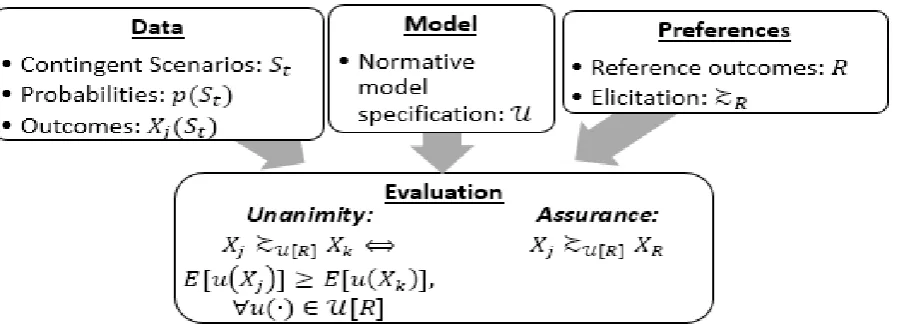
[image:18.595.78.527.334.497.2]A general structure of how evaluation under incomplete information can proceed is provided in Error! Reference source not found. below. The framework consists of three components: Data, Model and Preferences. We underline that this is not a new alternative to various frameworks in the literature based on different MCDA methods. Our focus here is not on the methods used, rather on the specification of this general framework in the setting of nuclear emergency decision support, which we detail in the following section. Thus the structure below is deliberately general: it can be used with different MCDA methods e.g. those based on non-additive models discussed in the preceding section. The structure is rooted on the literature on evaluation based on the Stochastic Dominance, used in decision and risk analyses (see e.g. Buckley 1986). In contrast to this, however, the framework is prescriptive and specifically designed to be used with elicited preferences.
Figure 5: General Evaluation Framework under Incomplete Preference Information
4.1.3.2 Specification for nuclear emergency decision support
In the following we provide a more detailed discussion of the framework and describe it specifically in the context of decision support for nuclear emergencies.
Data
The Data component falls within the remit of scientific modelling and expert judgement, often under the direction of a government bodies and politicians. For example, in the United Kingdom the Scientific Advisory Group for Emergencies is responsible for coordinating scientific advice to inform decision-making and reports to senior Government. Such a body can be responsible for devising scenarios (𝑆𝑡)
to consider in emergency planning and training exercises – e.g. the particulars of radionuclide release into the atmosphere, the weather, the location – and a set of response strategies (𝑋𝑗) to be considered –
Date Printed: 18/05/17 - 18 -
technical modelling (e.g. atmospheric dispersion models) to estimate consequence data for all strategies (𝑋𝑗(𝑆𝑡), where 𝑗 and 𝑡 index the strategies and scenarios respectively) across a number of attributes
(e.g. those in Figure 2). In French et al. (2016) we report on constructing such scenarios and associated consequences during a recent UK study involving many experts. French et al. (2007) provide a discussion on incorporating technical consequence modelling into nuclear emergency decision support. Furthermore, experts can be asked to provide probabilities for each scenario (𝑝(𝑆𝑡)). We note here that
the elicitation of probabilities from experts is itself subject to behavioural biases (see e.g. Montibeller and von Winterfeldt 2015). The issue is however distinct from the behavioural issues relating to preferences and societal deliberation considered here. For an extensive discussion and practical guidance on eliciting and aggregating expert judgment, see O'Hagan et al. (2006).
Model and Preferences
The Model and Preferences components of the framework fit with the practice of facilitated stakeholder workshops. There is a variety of approaches for structuring and conducting such work workshops in the OR literature; Franco and Montibeller (2010) provide an extensive review. Here we focus on facilitated MCDA in the spirit of previous work in the nuclear emergency setting (see e.g. Papamichail and French 2013). Traditionally, the facilitator engages the group, and through dialogue elicits their preferences and constructs a utility model, i.e. a utility function 𝑢(∙) (or, sometimes, a value function) assumed to belong to some class of functions 𝒰 with certain properties. In the proposed framework, elicitation does not seek to fully specify 𝑢(∙). Instead, it leads to a set of incomplete/imprecise preference statements over a set of reference outcomes 𝑅, collectively denoted ≿𝑅. These statements could take
several forms:
To address the problems reported by Morton et al. (2009), regarding the acceptability of disaggregated comparisons by stakeholders concerning radioactive waste disposal, holistic ordinal comparisons can be elicited: of the form 𝑋(𝑆𝑡) ≿𝑅𝑌(𝑆𝑡′). The advantage of holistic vs disaggregated choices is that participants would not have to worry about ‘unknown’ levels in the attributes that not being compared. To avoid the difficulty in comparing several criteria at a time the outcomes 𝑋(𝑆𝑡) and 𝑌(𝑆𝑡′) can be chosen to differ in one or a small number of
attributes only. The use of outcomes under certainty also avoids the problem that DMs have difficulty understanding and relating to the concept of utility functions, as reported by Hämäläinen et al. (2000) for a nuclear emergency planning exercise. Further, with an appropriate model (Section 3.2.1), considering outcomes under certainty also avoids the problem of pre-specifying how to transform a value scale to a utility scale. The example below illustrates this preference elicitation in the nuclear emergency context.
Date Printed: 18/05/17 - 19 -
be elicited. These take the form 𝑋 ≿𝑅𝑌, where 𝑋 and 𝑌 are strategies (lotteries). The strategies
can differ in one or several attributes, across scenarios, or in their probability profiles.
To help individuals and groups respond to contentious questions (e.g. implicit trade-offs between cost vs mitigation of health impacts of radiation, see Section 3.2.2) we suggest the elicitation of ranges or relative ranges for utility/value and expected utility scores. Ranges take the form: 𝑢(𝑋(𝑆𝑡)) ∈ [𝑢𝐿, 𝑢𝐻] or 𝐸[𝑢(𝑋)] ∈ [𝐸𝐿, 𝐸𝐻]. Relative ranges take the form:
𝑢(𝑋(𝑆𝑡)) ∈ [𝛼𝑢(𝑌(𝑆𝑡′)), 𝛽𝑢(𝑌(𝑆𝑡′))] or 𝐸[𝑢(𝑋)] ∈ [𝛼𝐸[𝑢(𝑌)], 𝛽𝐸[𝑢(𝑌)]]. Again, with a
suitable model such preference statements can also be taken into account. The reduced cognitive load from specifying ranges or making simple comparisons may be more acceptable to DMs uncomfortable with the concept of a utility function, and thus also alleviate some of the problems reported by Hämäläinen et al. (2000).
The elicitation modes above are listed in increasing order in terms of cognitive load: from simple ordinal queries to more demanding ratio queries. All, however, are weaker than the elicitation of precise values and trade-offs as is commonplace in MCDA. We do not prescribe here the use of some of these vs others. Instead, all should be considered as available questioning modes used to capture whatever preferences the DMs can comfortably or practically provide.
Evaluation
In Section 4.1.1 we suggested that it is more realistic to consider the recommendations of nuclear emergency decision support as input to a wider societal/political process. We argued that a more practical focus of the analysis should be on identifying a set of acceptable strategies which would be robust against a wide set of preference scenarios. We also argued that public acceptability can addressed by introducing assurance levels in the evaluation, through the use of reference outcomes that exemplify minimally acceptable outcomes. The framework introduced above is structured exactly on these two ideas.
The (incomplete) preferences elicited in the facilitated workshops would do not instantiate a model, i.e. construct a unique utility function 𝑢(∙). Instead, they define a restricted class of utility functions 𝑢[𝑅] ⊂
𝒰 : those compatible with both modelling assumptions and elicited preferences ≿𝑅. This class does not
normally identify a single ‘optimal’ strategy. Instead, the paradigm shifts towards identifying just those recommendations that can be unanimously agreed. Specifically, a strategy 𝑋𝑗 is declared preferable to
(or dominates) another 𝑋𝑘 if this is unanimously the case for all 𝑢(∙) ∈ 𝒰[𝑅] compatible with the
incomplete preference information (i.e. if 𝐸[𝑢(𝑋𝑗)] ≥ 𝐸[𝑢(𝑋𝑘)] for all compatible 𝑢(∙) ∈ 𝒰[𝑅].). We
use ≿𝒰[𝑅] to denote unanimous dominance between strategies 𝑋𝑗. The non-dominated strategies would
Date Printed: 18/05/17 - 20 -
stakeholder engagement back to scientific expertise and, perhaps more importantly, a political process, which can encompass specialist evaluation.
The evaluation of strategies within the proposed framework can be enriched further by ‘filtering’ strategies that perform unanimously better than specified assurance levels. In particular, reference strategies 𝑋𝑅 can be devised, corresponding to what might be seen as targets to beat. Then the set of
proposed strategies can be filtered by identifying those unanimously dominated by one or more of the 𝑋𝑅. Such targets can be set to help reassure the public that minimum levels of effectiveness will be
kept. Alternatively they may be set to correspond to particularly poignant reference outcomes, e.g. based on some past event. We do, however, note that this raises an issue about precedent, which we discuss further in Section 4.2.1.
We will not describe here the mathematical formulation for computing unanimity-dominance, i.e. whether 𝑋 ≿𝒰[𝑅]𝑌 holds for a pair of strategies 𝑋, 𝑌. This is of course model-specific. We have argued
for the use of concave utility functions, for which the formulations can be found in Argyris et al. (2014), and we shall illustrate this with an example in the following section. There are also many models available based on additive utility functions: see e.g. Jacquet-Lagreze and Siskos (1982), Siskos et al. (2005), Salo and Hämäläinen (1992) and Salo and Hämäläinen (2010).
4.1.4
Illustrative example: the Chernobyl Project revisited
We provide an illustrative application of the proposed evaluation framework in the context of nuclear emergency decision support, specifically how to best protect the public following the consequences of a nuclear accident.
Data
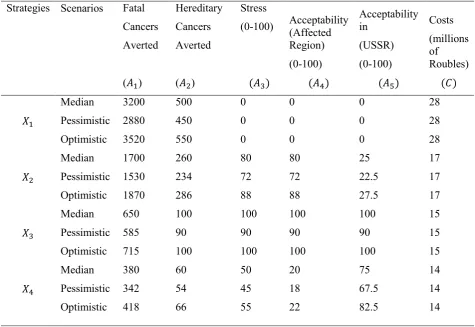
We use the only real data from an application of MCDA in this setting: data from the Chernobyl Project (Lochard et al. 1992, French 1996). The Chernobyl Project used MCDA to evaluate four alternative strategies (𝑋1, … , 𝑋4) under certainty. Each of these strategies corresponded to different levels of
relocation of the local population. To illustrate the proposed framework in a more complex setting (uncertainty) we modified the data to convert each of the four original strategies into a lottery. This was done by considering the original data for each strategy as a most likely ‘median’ scenario to which a probability of 50% was assigned. Two further scenarios were considered, an ‘optimistic’ and a ‘pessimistic’ one, each being assigned a probability of 25%7. The data for all four strategies (lotteries)
are given in Table 1. The attributes correspond to the tree used in the final decision conference of the Chernobyl Project, see Figure 2. Some of the data are based on radiological calculation (numbers of
Date Printed: 18/05/17 - 21 -
cancers and costs in millions of Roubles) and the rest (e.g. acceptability) were are judgemental values elicited from stakeholders. The data can be used as is in the proposed evaluation framework (but could also converted to a 0-100 scale for all attributes).
Strategies Scenarios Fatal Cancers Averted
(𝐴1)
Hereditary Cancers Averted
(𝐴2)
Stress (0-100)
(𝐴3)
Acceptability (Affected Region) (0-100)
(𝐴4)
Acceptability in
(USSR) (0-100)
(𝐴5)
Costs (millions of Roubles) (𝐶) 𝑋1
Median 3200 500 0 0 0 28
Pessimistic 2880 450 0 0 0 28
Optimistic 3520 550 0 0 0 28
𝑋2
Median 1700 260 80 80 25 17
Pessimistic 1530 234 72 72 22.5 17
Optimistic 1870 286 88 88 27.5 17
𝑋3
Median 650 100 100 100 100 15
Pessimistic 585 90 90 90 90 15
Optimistic 715 100 100 100 100 15
𝑋4
Median 380 60 50 20 75 14
Pessimistic 342 54 45 18 67.5 14
[image:22.595.71.547.159.486.2]Optimistic 418 66 55 22 82.5 14
Table 1: Dataset for the illustrative example.
Model
To evaluate the strategies we adopt a utility function with the following decomposition and taking its expectation over scenarios:
𝑢 (𝑋𝑗(𝑆𝑡)) = 𝑤 × 𝑈𝐴(𝐴1,𝑗(𝑆𝑡), … , 𝐴5,𝑗(𝑆𝑡)) − (1 − 𝑤) × 𝑈𝐶(𝐶),
𝐸[𝑢(𝑋)] = ∑ 𝑝(𝑆𝑡) × 𝑢 (𝑋𝑗(𝑆𝑡))
𝑡 .
In the above we assume that the utility function 𝑈𝐴(∙) is a concave function over the first five attributes (i.e. except the cost). This is done to capture different attitudes to multi-attribute risks as discussed in Section 3.1. Utility function 𝑈𝐶(∙), on the other hand, is a single attribute function over costs, which is
Date Printed: 18/05/17 - 22 -
functions 𝒰 which includes all concave functions that are non-decreasing in their respective attributes. An additive decomposition of the two functions is used, using weight 𝑤 for 𝑈𝐴(∙) and (1 − 𝑤) for
𝑈𝐶(∙). While this framework is not restricted to this case, we adopt it partly to illustrate that additive
decompositions can be accommodated. More importantly, this decomposition for the trade-off between costs and all other attributes seems a reasonable assumption. In the background, cost represents all other (foregone) uses that the money can facilitate; since there are a multitude of such uses preferential independence between cost, on the one hand, and the rest of the attributes, on the other hand, seems acceptable. Finally, we will illustrate that the framework can be used without specifying a specific value for 𝑤. Instead we will consider the entire range 𝑤 ∈ [0,1] and thus ascertain whether this trade-off does impact on the results and to what extent.
Preferences
As discussed in Section 4.1.3.2, the framework can accommodate a multitude of elicited preference statements. Here we chose the preferences fed to the model based on four criteria. Firstly, we want to illustrate that the model allows elicitation to merely consider outcomes under certainty. The class of functions 𝒰[𝑅] includes all concave functions that are compatible with a set of preference statements: as such it will include not only value functions that represents the statements under certainty, but also all concave transformations of these functions, i.e. all utility functions that not only represent the original statements, but also the risk-attitude of the DM (Argyris et al. 2014). Secondly, and perhaps most importantly, we chose the preference statements to use so that, in the absence of a real DM, they are as realistic as possible. To achieve this we use preference statements elicited as part of the decision conferences of the Chernobyl Project (French 1996). This involved, inter-alia, the elicitation of ‘swing weights’, by comparing two attributes at a time and eliciting a precise value between the swing of receiving nothing vs the maximum attainable outcome in one vs another attribute. As these correspond to a disaggregate comparison (i.e. assuming that the level of the attributes not being compared is immaterial), we generalised them to holistic comparisons as follows: a) we considered the swing between a pair of attributes while fixing the other attributes at some level (the average level across all attainable outcomes in each attribute); b) we did not use precise ratings, but used instead only the ordinal preferences implied by each swing-weigh elicitation; c) for two statements only we allowed for specification of conservative lower bounds for the ratio of two pairs of utility/value scores (again, these were also implied by the answers elicited in the Project). All in all, the preference statements used (i.e.
≿𝑅) were four ordinal statements and two bounded ratio statements:
𝑈𝐴(1483, 230, 100, 50, 50) > 𝑈𝐴(3520, 230, 58, 50, 50) > 𝑈𝐴(1483, 230, 58, 100, 50)
> 𝑈𝐴(1483, 550, 58, 50, 50) > 𝑈𝐴(1483, 230, 58, 50, 100),
Date Printed: 18/05/17 - 23 -
𝑈𝐴(1483, 230, 58, 100, 50) ≥ 1.2 × 𝑈𝐴(1483, 550, 58, 50, 50).
We used no preference information on the trade-off between cost and non-cost attributes. Further, we did not specify any statements that might help with restricting the utility function over costs −𝑈𝐶(∙): we merely assumed that this is a concave and non-decreasing function.
Results
We computed unanimity dominance (i.e. ≿𝒰[𝑅]) for all pairs of strategies considered (by solving a
[image:24.595.189.404.267.330.2]modified linear optimisation problem in Argyris et al. (2014) to allow for the additive decomposition between costs and the other attributes). Figure 6 below summarises the results.
Figure 6: Results of the illustrative example
The results bring to the fore some very robust conclusions. Firstly, strategy 𝑋1 should never be
implemented as it is dominated for any value of the trade-off 𝑤. Further, strategy 𝑋4 is dominated for
the significant majority of the range for 𝑤 (i.e. for any 𝑤 ≥ 0.13); thus this may also be considered an unacceptable strategy in view of this very small value. This leaves two potentially acceptable strategies:
𝑋2 and 𝑋3, and these may be considered as the shortlist that can be brought forward to be part of a wider
political/societal debate. Comparing the results here with the MCDA of the original Chernobyl Project, these do seem to be broadly in line. In the original project strategy 𝑋1 was also always dominated.
Strategy 𝑋4 was non-dominated as well but as here would only be chosen for very low values of 𝑤. The
only significant difference between these results and the results of the Chernobyl Project is that in the latter, strategy 𝑋2 was always dominated whereas here it is always non-dominated. This is not so
surprising: after all, we considered only a small portion of the preferences used in the Project and under more general assumptions. Our results can be refined further by considering more and stronger preference statements, particularly in regards to the utility function for costs which was here not touched at all in the elicitation. This however is less important than what we think is the conclusion drawn from these results: that even under more general assumptions, less elicited preferences and in the presence of uncertainty, most of the Project’s conclusions seem to hold true, and can thus now be evidenced to be robust.
0 1
𝑤
0.13
Dominated Strategies
Date Printed: 18/05/17 - 24 -
4.2
Structuring societal deliberative behaviours
As decision analysts we should develop decision processes within System 2 Societal Deliberative mechanisms to ensure that the ultimate decision is legitimate, but we should be aware of possible System 1 Societal Deliberations and use these positively where possible. Moreover, we need to watch for potential negative effects of System 1 Societal Deliberations and calm any negative effects of these, reducing stress and encouraging wiser behaviours. Many of the developments in risk communication, public participation and deliberative democracy may be seen as steps to reduce the gap between System 1 and 2 Societal Deliberation and the potential effects of this gap (McDaniels and Small 2004, O'Hagan et al. 2006, Renn 2008, Bennett et al. 2010). Contrast the formal structured approach to nuclear emergency management and response common 15 to 25 years ago (Lindell 2000, Carter and French 2006) with the much more inclusive approach incorporating formal and informal interactions currently being promoted by organisations such as NERIS (www.eu-neris.net) or Nuclear Transparency Watch (NTW 2015).
4.2.1
Precedence and societal anchoring
One of the consequences of taking any decision is that it sets a precedent and expectations for any future similar decision. This may be seen as anchoring within System 1 Societal Deliberation; c.f. the anchoring bias identified within System 1 Thinking (Kahneman and Tversky 1974). In both the Chernobyl and Fukushima Accidents, it was feasible to evacuate the local population and create an exclusion zone. In the case of Chernobyl, Pripyat was a substantial town, but it was the only substantial town within 30km of the plant and, moreover, the majority of its economy revolved around the plant, the rest of the region being agricultural with no other significant infrastructure or economic activity within 30km of the plant. The creation of an exclusion zone was costly, but feasible. In the case of Fukushima, the radiation accident was a part of a much larger catastrophe in which the Tsunami had devastated large swathes of land and infrastructure and killed around 20,000 people. Evacuating the population and creating an exclusion zone was a dreadful consequence of the radiation release; but, in the context of the Tsunami’s devastation, it would seem less dramatic and thus more feasible. The circumstances of a future accident may be such that it is feasible politically or economically much less physically to establish an exclusion zone. Even sheltering may be difficult, if housing is not of a sufficient standard to provide sufficient shielding. Moreover, sheltering can only continue for a few hours, perhaps a day or two; so if the release continues for an extended period, people will need to be evacuated through the plume.
Date Printed: 18/05/17 - 25 -
report that such behaviours and the growth of stress related health impacts is becoming manifest in the regions around the Fukushima plant (IAEA 2015).
4.2.2
Prescriptive Decision Analysis for Groups
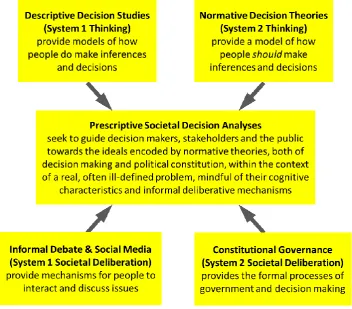
Above we identified a number of challenges pertaining to behavioural issues for MCDA in supporting nuclear emergency management. Much has already been done on the impacts and effectiveness of public risk communication (e.g., Drottz-Sjöberg and Sjoberg 1990, Havenaar et al. 2003), but much still remains to be done to understand how individuals and society will respond and participate in in the event of a future accident. Indeed, there is still much to be done generally in managing Societal System 1 and 2 Deliberative behaviours effectively in many contexts. In Section 2.3, we noted the complex interplay between System 1 and System 2 Thinking in supporting individuals. We need to recognise the need for a similar interplay between System 1 and System 2 Societal Deliberation in designing processes for stakeholder engagement and public participation: compare Figure 7 and Figure 1. We need deliberation processes which lead to decisions being made according to constitutional rules of government, but which are informed by and broadly commensurate with all the informal discussions among stakeholders and the public.
In the aftermath of the Daiichi Fukushima Disaster, the tension between the very formal processes of Japanese constitutional governance and the informal public debate is very clear. Efforts are being made to introduce more participatory methods, but there are cultural issues in taking methods developed elsewhere into Japan. The FAIRDO project is a good example of this8; see also the discussion in Suzuki
(2014) which focusses more on System 2 Societal Deliberation. Building trust is clearly important (Tateno and Yokoyama 2013), as might be expected from many previous more general studies (Renn and Levine 1991, Slovic 1993, Beierle and Konisky 2000, French et al. 2002). Participatory methods are also seen as key in developing agreement on longer term remediation and nuclear waste disposal (Lawless et al. 2011).
We are a long way from being able to design decision analyses embedded in processes which effectively balance System 1 and 2 Societal Deliberation perspectives. Bayley and French (2008) suggested that MCDA resource allocation models might be used to design public participation processes that encourage positive participation and avoid some of the negative effects of System 1 Societal Deliberation, though they did not use this terminology. The recent use of system dynamics to model the social amplification of risk may offer an alternative way forward (Busby and Onggo 2012, see also Gilbert et al. 2016). However, as Bayley and French (2011) noted, we need many more studies of different forms of participatory methods to identify best practice. There have been few comparative
Date Printed: 18/05/17 - 26 -
[image:27.595.121.474.249.558.2]studies to establish the relative effectiveness of different participatory methods. When, for instance, is a citizens’ jury more appropriate than a town hall meeting? Marttunen et al. (2013) compare five stakeholder engagements in the environmental domain; while Slotte and Hämäläinen (2014) make some suggestions about good practice based on the little existing evidence. But research is needed if we are to design processes to mitigate the negative effects of System 1 Societal Deliberation. The NERIS network(www.eu-neris.net) is currently trying to make such comparative evaluations with a view to identifying further best practice in the context of nuclear emergency planning and the recovery from such events. But it will be a long time before usable results emerge; and there is a need for much broader, more substantial research.
Figure 7: Prescriptive Societal Decision Analysis
5
Conclusions
Date Printed: 18/05/17 - 27 -
Firstly, we need to recognise that individuals may understand and offer judgements on the basis of System 1 Thinking, thus risking irrational and inconsistent behaviour. To protect against this we need prescriptive approaches which challenge System 1 Thinking, driving participants towards explicit, auditable and more rational analyses based on System 2 Thinking. We have also suggested that it may be possible to base such analyses on less complete preference elicitation than has been the case in the past. In particular, we have discussed how we can work with incomplete information on the more contentious preference judgements and proposed a framework for structuring analyses on this basis. Most MCDA analyses in the context of nuclear emergency management have used multi-attribute value approaches and then softened the assumptions underpinning these through sensitivity techniques. Incomplete preference elicitation may be as effective in a more direct manner.
Secondly, we have noted that groups may interact in a variety of ways, some formal, some informal. The former we have termed System 2 Social Deliberation and by this we mean the open, formal ways of discussing and deciding which are established in the governance structures of groups. But equally we have recognised that there are many informal, less public, less auditable forms of communication and discussion outside those recognised by the governance structures. These shape the thinking of individuals and subgroups but are seldom addressed and considered in the design of decision processes. We noted that Bayley and French (2008) suggested how multi-attribute resource allocation ideas might be used to think about the design (see also Marttunen et al. 2013), but to do so we need much more comparative information on the effectiveness of different formal public participation and deliberative methods. This requires much more attention to the comparative evaluation of such methods than has been common in previous studies (Bayley and French 2011).