Computationally Intelligent Techniques for Resource
Management in mmWave Small Cell Networks
Hamnah Munir
∗, Haris Pervaiz
†, Syed Ali Hassan
∗, Leila Musavian
‡, Qiang Ni
§, Muhammad Ali Imran
¶and
Rahim Tafazolli
†∗
School of Electrical Engineering & Computer Science (SEECS),NUST, Pakistan
{
14mseehmunir, ali.hassan
}
@seecs.edu.pk
†
Institute for Communication Systems (ICS), Home of 5G Innovation Center (5GIC), University of Surrey, UK
{
h.pervaiz, r.tafazolli
}
@surrey.ac.uk
‡
School of Computer Science & Electronic Engineering, University of Essex, UK
[email protected]
§
School of Computing & Communications, Lancaster University, UK
[email protected]
¶
School of Engineering, University of Glasgow, UK
[email protected]
Abstract—Ultra densification in heterogeneous networks (HetNets) and the advent of millimeter wave (mmWave) technol-ogy for fifth generation (5G) networks have led the researchers to redesign the existing resource management techniques. A salient feature of this activity is to accentuate the importance of computationally intelligent (CI) resource allocation schemes offering less complexity and overhead. This paper overviews the existing literature on resource management in mmWave-based HetNets with a special emphasis on CI techniques and further proposes frameworks that ensure quality-of-service requirements for all network entities. More specifically, HetNets with mmWave-based small cells pose different challenges as compared to an all-microwave-based system. Similarly, various modes of small cell access policies (e.g., closed versus open) and operations of base stations in dual mode, i.e., operating both mmWave and microwave links simultaneously, offer unique challenges to resource allocation. Furthermore, the use of multi-slope path loss models becomes inevitable for analysis owing to irregular cell pat-terns are blocking characteristics of mmWave communications. This paper amalgamates the unique challenges posed because of the aforementioned recent developments and proposes various CI-based techniques including game theory and optimization routines to perform efficient resource management.
Index Terms—Heterogeneous networks, radio resource man-agement, millimeter wave, Nash equilibrium, non-cooperative game , Lagrangian dual decomposition, optimization.
I. INTRODUCTION ANDMOTIVATION
A
CCORDING to a report from Cisco, the mobile data traffic is expected to reach 587 exabytes annually, by 2021 [1]. In this regard, future fifth generation (5G) wireless networks have gained tremendous attention in the wireless industry, with the intention to manage the exponential growth of wireless data traffic and to meet the demands for higher data rates. A core factor enabling these above-mentioned demands in the next generation wireless networks is densification, i.e.,the deployment of a large number of base stations (BSs) in a given area. Heterogeneous networks (HetNets) realize den-sification by deploying low-powered BSs to complement the conventional cellular network and thus have a great potential to cope with the exponential increase in wireless data traffic by allowing the fusion of technologies, frequency bands, diverse cell sizes, and network architectures [2].
On the other hand, the fusion of diverse frequency bands in HetNets has paved the way of bandwidth expansion by integrating millimeter wave (mmWave) bands into the current cellular network. This bandwidth expansion has the potential to overcome the problem of capacity shortage. MmWave technology, in fact, represents the next advance in the wireless industry to provide ubiquitous high data rates [3]. The pos-sibility of utilizing this fragment of spectrum, ranging from 10-300 GHz, has stolen the limelight as a promising solution to provide high data rates to the users. While transmission in the mmWave bands can improve network performance, it faces many challenges including hardware expenses, non-line-of-sight (NLoS) channels and long range communication. However, recent research results provide promising solution to these challenges. With the help of highly directional antennas and beamforming, significant signal strength can be achieved within a range of about 150-200 meters to overcome the blocking effects. The coalition of mmWave small cells with conventional microwave (µW) network in a hybrid HetNet has the potential to bolster network capacity and improve the mobile user experience. However, resource management becomes crucial when various technologies are combined.
optimiza-tion theory, game theory and fuzzy/neural system etc, some of which are briefly highlighted below.
Optimization theory deals with finding the best possible solution involving the minimization or maximization of the objective function given certain resource constraints. The opti-mization techniques mostly used for resource management are Lagrangian Dual Decomposition method, Lagrange multiplier method, Karush–Kuhn–Tucker (KKT) conditions and parti-cle swarm optimization [5]. A single-objective optimization problem yields a single optimal solution corresponding to the minimum/maximum value of a single objective function. On the contrary, in the multi-objective optimization, sev-eral conflicting objectives are considered [6]. The interaction among these conflicting objectives results in a wide range of alternative solutions with different trade-offs known as Pareto optimal solutions (non-dominated solutions). After finding the Pareto optimal solutions, a decision-making to find a single most preferred solution is done by the decision-maker (DM) that expresses preference information related to the alternatives. Preferences refer to the relative importance of different objectives where each objective has an individual utility function/loss function representing the relative impor-tance of its objective. All individual objective functions are integrated into one objective function, which models the DM’s preferences.
Game theoryis another powerful mathematical modeling tool used for interactive decision making in resource optimiza-tion. It allows to design flexible distributed schemes with less overhead. The players constituting users and BSs interact with each other in a cooperative or a non-cooperative manner to maximize their utility thus achieving equilibrium. This utility can be any parameter depending on the requirement of the player. Cooperative game allows bargaining among players, who cooperate with each other to attain mutual benefits. On the other hand, in non-cooperative games, players maximize their own utility without any alliance. One of the most common assumptions in game theory is rationality, which implies that all players act in their own best interest. However, in the future wireless network, different players can have different objec-tives and thus one player maximizing its energy efficiency (EE) is considered irrational by some other player whose objective is to maximize spectral efficiency (SE).
The rest of this article is organized as follows. Section II explains the use of mmWave for next generation wireless networks. Section III presents the recent literature on the radio resource management in multi-tier 5G hybrid networks. Sec-tion IV presents the modeling and analysis of CI-enabled radio resource allocation frameworks for various simulated scenarios in 5G mmWave HetNets. Finally, Section V concludes the paper.
II. USE OF MMWAVE FOR5G NETWORKS
The future generation networks such as 5G systems are expected to provide higher throughput in gigabit-per-second (Gbps) and support heavier traffic loads that are impossible to accommodate in the current sub-6 GHz networks. In this recent trend, mmWave bands are emerging as a key enabler for
the future generation networks due to their extensive available radio spectrum. It is worthwhile to mention that the propaga-tion characteristics in mmWave bands are unpredictable due to its shorter wavelength, highly directional communication, and severe penetration losses due to the solid objects, human body, and rain. This can lead to frequent transmission interruptions and handovers between the serving mmWave small cells. However, initial access design (consisting of cell search (CS) procedure over the downlink and random access (RA) proce-dure on the uplink), is a challenging task in mmWave enabled cellular networks due to its highly directional communication paradigm.
Furthermore, the higher density of mmWave radio access technology (RAT) may be needed in order to reduce the blockage probability due to the high propagation and pen-etration losses of mmWave radio signals and also enhance the line-of-sight (LoS) connections. Hence, this integration of mmWave bands and ultra-densification in future cellular network has, however, led us to a new challenge of centralized monitoring with high complexity. In this regard, user-centric schemes have emerged as a key potential solution to overcome the complexity of centralized monitoring by allowing users to make their individual decisions which can reduce the computational complexity. In fact, traditional cellular networks are inherited with network-centric approaches, which make solely coordinated decision but usually fall short in providing trenchant user requirements [4]. User-centric approaches for which a user is at the center of decision making with or without network-assistance [4], have come to aid in realizing users’ preferences and requirements.
III. RECENTADVANCES INMULTI-TIER5G HYBRID HETNETS
With the advent of mmWave communications and den-sification, the future HetNets will offer significant increase in SE and EE. However, these future technologies will cause challenges in different aspects of wireless communication radio resource management, cell association, interference man-agement, network planning, etc. Thus the design and im-plementation of efficient resource management schemes are required in order to realize the true benefits of HetNets. In this section, we overview the existing research on the computationally intelligent resource allocation frameworks in HetNets exploiting future technologies.
Macrocellular networks cannot provide further significant increase in capacity. The next generation multi-tier HetNets offer massive deployment of small cells (microcell, picocell, femtocell) over macro-cellular network to ensure the better coverage for cell edge users, thereby increasing capacity gains [7]. However, dense deployment makes scalable and distributed radio resource management difficult and complex in HetNets due to increased interference. Several schemes have been proposed for efficient resource allocation using game theory, graph theory, stochastic spectrum allocation, distributed learning and optimization techniques [8]–[10]. A comprehen-sive literature on resource allocation for HetNets has been presented ensuring interference mitigation, fairness, reduced complexity and quality-of-service (QoS) using different ap-proaches [8]. However, the next generation wireless networks will feature the mmWave communication, densification and massive data traffic in a complex HetNet, which will bring an exceptionally high complexity and increased overhead for resource management.
With the extreme shortage of available spectrum and demand for higher data rates, mmWave communication has triggered a great deal of interest in future 5G networks. The mmWave frequency bands for cellular network were first studied in 1980’s. The mmWave cellular networks, however, face many challenges, including high sensitivity to blocking and strong directionality requirements [11]. Indeed, the re-alization of a reliable communication network can only be achieved when mmWave network coexist with conventional
µW networks. In single mode hybrid network, BSs can operate exclusively on one frequency band wherein macro BSs mainly operate on µW band which is in interference-limited regime and small cells operating on mmWave band which is noise-limited in nature. A preliminary study regarding mmWave HetNets exploiting different frequency bands to boost the throughput with improved bandwidth efficiency have been discussed in [12]. On the other hand, in dual mode hybrid network, the BSs exploit dual frequency bands simultaneously to achieve performance enhancements in a reliable manner while overcoming the challenges associated with mmWave links. Most of the existing literature allows only single fre-quency band at each BS in a HetNet. However, in the most recent work, dual band BSs have been studied in [9]. The study in [9] formulates a two-stage game theoretic frame-work for context-aware scheduling and resource allocation.
In the first stage, resource allocation at µW band is done using two-sided stable matching between user applications and
µW resource blocks. Second stage caters the scheduling and selection of the user applications, which were not scheduled in the first stage, over the mmWave frequency band on priority basis using 0-1 knapsack problem. The proposed framework achieves effective solution with polynomial time complexity. A downlink mmWave HetNet with MBS operating on mmWave (V-band and E-band) and LTE bands, and small cells operating only on mmWave band is considered in [10]. Relays are also incorporated to guarantee reliable coverage.
In cellular networks, many physical factors including ground reflections, scattering and interference, make path loss modeling a complex task. The standard path loss models characterize all the links in a cell with a single path loss exponent (PLE), which lacks precision. While this model is easy to study and analyze, it sometimes characterize the network unrealistically. In fact, this simplest path loss model does not provide the precise dependence between the PLEs and the link distances. There is an increasing need for an accurate path loss model for future wireless networks which is mostly influenced by network densification and mmWave communi-cations. The network densification causes more irregularities in cell patterns, which affect the interference composition and thus, the links cannot be accurately approximated by a single PLE. Dual slope path loss model can better approximate the line-of-sight (LoS) and NLoS links, in mmWave systems, using different PLEs.
IV. MODELING ANDANALYSIS OFCI-ENABLED RESOURCEMANAGEMENT IN5GMMWAVEHETNETS
In this section, we propose a computationally intelligent resource allocation framework for various scenarios. A snap-shot of a two-tier HetNet where all BSs use dual slope path loss model, is shown in Fig. 1a. This model considers different slopes above and beyond the critical distance, which can be used to approximate the two regimes of LoS and NLoS links [13]. The critical distance is the distance where the first Fresnel zone becomes obstructed, and below this distance all links are considered LoS. In mmWave communication, this distance is an environment dependent random variable, which increases with low blocking environment, but can be approximated by taking the average LoS link distance [14].
The first simulated scenario deals with the current state-of-the-art networks where the system operates on conventional
µW frequency band only. The second scenario highlights the importance of mmWave frequency band and capabilities of a hybrid system exploiting both µW and mmWave frequency bands. The third scenario presents dual mode hybrid network, which supports both µW and mmWave frequency band si-multaneously, thereby providing higher degree of freedom for resource allocation. We consider the uplink of a two-tier Het-Net composed of a set ofMsmall cell base stations (SCBSs) overlaid on a macrocell where a set of No macrocell user
equipments (MUEs) are randomly distributed. The macrocell base station (MBS) is represented by Mo. The set of home users served by themth SCBS is represented by N
Macro BS
Critical radius (Macrocell)
Critical radius (Pico cell)
Pico BS
(a) A two-tier heterogeneous network with dual slope path loss model
Macrocell User
Small Cell Home User
Microwave Link
mmWave Link
[image:4.612.60.571.66.290.2](b) A two-tier heterogeneous network with dual-mode SCBSs
Figure 1: Snapshot of Multi-Tier Hybrid HetNet
NM =
M S
m=1
Nm be the set of all the small cell home users. The set of all the users in the system is represented asN=NM∪No.
A. Scheme-1: Single Mode µW Networks
In this section, the heterogeneous deployment is con-sidered in accordance with the 3GPP LTE-Advanced (LTE-A) standard. Here, all BSs as well as users operate on conventional µW network. We propose a hierarchical game theoretical framework consisting of two sub-games. The first game strategically decides the preferred access policies of SCBSs followed by the second game where MUEs finalize their association using a user-centric approach. To solve this, we devise a distributed scheme which always reaches a pure strategy Nash equilibrium.
We assume that all the BSs operate on µW frequency band. The system bandwidth,B, is allocated to the MBS. The same bandwidth, B, is reused in the small cell tier, i.e., the available bandwidth per SCBS isBm, whereBm= |BM|, where |M|is the cardinality of setM. This orthogonal bandwidth dis-tribution has been considered to avoid the co-tier interference among small cells.
The proposed approach involves two non-cooperative games played in a sequential order. The first game models the preferred access policy of the SCBSs among open, closed and hybrid. Open access policy permits SCBSs to connect MUEs in order to reduce interference at the expense of resource sharing, whereas the closed access saves resources at the price of interference. On the other hand, the hybrid access policy is the tradeoff between interference avoidance and the resource sharing. In order to analyze these conflicting interests, the SCBSs play a non-cooperative game to select their access policies with the goal of maximizing their utility function, i.e.,
the data rate of their home users. The strategy vector/actions of the mth SCBS is the fraction of frequency band assigned
to the MUEs. The utility function of the mth SCBS is the
sum rate of its home users. In order to maximize the utility function, each SCBS explores the favorable set of MUEs to connect in each iteration, given the strategy vectors of other SCBSs. To avoid complexity, the SCBS could find optimal set of MUEs with the help of greedy algorithm as used in [15] rather than testing all possible combinations of MUEs. Greedy algorithm helps SCBSs by finding highly interfering MUEs in each iteration. These iterations continues until the algorithm reaches a pure strategy Nash equilibrium (PSNE) while achieving stable action profiles.
After maximizing the rates of small cell home users, MUEs play the next game to maximize their rates using user-centric approach. MUEs which are connected to SCBSs, as a result of previous game, examine the rates they are getting from SCBS and MBS. The second non-cooperative game allows MUEs to re-evaluate their connectivity under QoS constraint. The strategy vector of thenthMUE is the fraction
of band allocated to it by all the BSs and the utility function is its data rate. The algorithm ensures that each MUE opts for the strategy where system is not affected and it gets the rate greater than a defined minimum rate requirement threshold Rmin. If the constraint of Rmin is not met, the particular MUE goes into outage. This proposed algorithm optimizes the network performance while achieving PSNE.
5 10 15 20 1.8
2 2.2 2.4 2.6 2.8 3 3.2x 10
8
Number of small cells
Sum−rate (bits/sec)
Closed scheme
[image:5.612.66.310.59.261.2]Optimized user−centric scheme Optimized network−centric scheme
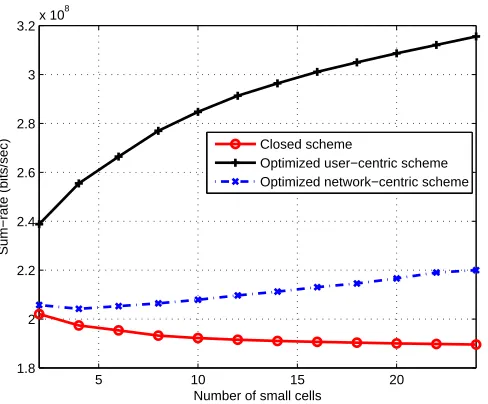
Figure 2: Sum rate of an all closed, optimized network-centric and proposed optimized user-centric schemes for varying num-ber of small cells for single mode µW network for |N|= 7,
Rmin= 0.5 Mbps andBµW= 10MHz.
the number of small cell increases, the sum rate increases for the proposed scheme. This is because the likelihood of the SCBSs playing open access increases with an increase in the number of small cells, which in return service the interfering MUEs; thus improving the performance of the system and decreasing the outage probability. The same trend of sum-rate is followed in the network-centric scheme but user-centric scheme yields a significant improvement in terms of utilities. In the case of all closed access scheme, the sum-rate almost remains constant, although the number of small cells increases. This is due to the fact that as the density of small cells increases in the network, the MUEs appear closer to them resulting in increased interference.
In order to investigate the effect of dual slope path loss model on the performance of a HetNet, we analyzed this scheme under both the single slope and dual slope path loss models. We compare the performance of the proposed game theoretic framework with different path loss models in a HetNet where it is desirable to shift the traffic load from the macrocell to the small cells. Dual slope model pushes the users to the nearby BS using smaller PLE within the critical radius, which represents less attenuation. Thus, the dual slope model reduces the number of edge users in comparison to the single-slope model by offloading the majority of users to the closest BSs, and thus improves the network performance. The dual slope path loss model is beneficial for user offloading from macro tier to the small cell tier. This offloading effect will be more strong when dual slope model is used with biasing in the small cell tier. However, this increasing trend in offloading will result in connecting almost all the users to small cell tier, whereas the power budget at SCBS is small compared to the MBS, which decreases the received power. This decrease in received power results in decreased SE. However, with the decrease in power consumption, the weighted EE shows a huge
0 5 10 15 20 25 30
0.2 0.4 0.6 0.8
Weighted spectral efficiency (Kb/s/Hz)
Biasing factor of small cell tier (dB)
0 5 10 15 20 25 300
0.02 0.04 0.06
Weighted energy efficiency (Kb/J/Hz)
[image:5.612.320.586.65.262.2]Macro−tier Single−slope, Pico−tier Single−slope Macro−tier Dual−slope, Pico−tier Dual−slope Macro−tier Single−slope, Pico−tier Single−slope Macro−tier Dual−slope, Pico−tier Dual−slope
Figure 3: Weighted SE and EE for single modeµW network for |N|= 25,|M|= 5, critical radius (small cell)= 60m and critical radius (macro cell)= 375m.
improvement for these schemes, as shown in Fig. 3.
B. Scheme-2: Single Mode Hybrid Networks
The second scheme presents a two layer framework for mmWave overlay with HetNet. The outer layer models the access policy of the SCBSs along with the selection of frequency band between µW and mmWave. The solution to this non-cooperative game can be obtained using PSNE. The inner layer ensures the energy efficient user association method subject to the minimum rate, maximum transmission power and maximum tolerable interference threshold constraints by using Lagrangian dual decomposition approach.
We assume that the SCBSs can operate exclusively either on µW frequency band or mmWave frequency band. Each SCBS operating on mmWave frequency band has the entire mmWave band, Bmm, whereas the SCBSs operating onµW frequency band has the entire µW band, BµW. The µW
frequency band,BµW, is reused in the macro-tier.
A two-layer framework for energy efficient resource allocation in a hybrid HetNet is considered. In the outer layer, each SCBS needs to choose its preferred access policy between either open or closed access for both mmWave and
5 10 15 20 25 30 106
107 108 109
Number of small cells
Energy efficiency(bits/J)
[image:6.612.326.575.56.255.2]Single mode hybrid (With power control) Single mode hybrid (Without power control) Single mode µW (With power control) Single mode µW (Without power control)
Figure 4: EE with and without power control across varying number of small cells for scheme 1 and scheme 2 for |N|= 100,|NM|= 5,Bmm= 2 GHz andBµW= 20MHz.
and the MUEs connected to it. This non-cooperative game achieves convergence using the solution of PSNE.
At the end of the aforementioned game, each SCBS has decided its operating frequency band along with its access policy. Now, the macrocell user association and optimal power allocation is done jointly, in the inner layer, to maximize the EE of the network. Letδn,m∈ {0,1} indicate the connection between thenthuser and themthBS. In case of connectivity, δn,m = 1, otherwise δn,m = 0. The EE is defined as the amount of energy consumed by the system to transmit the data and the optimisation problem to maximise the system EE is formulated as follow:
max
δn,m,pn,m
ηEE=
RT PT
s.t.
C1: X m∈M∪Mo
Rn,m≥Rmin, ∀n∈No,
C2: X m∈M∪Mo
δn,mpn,m≤Pnmax, ∀n∈No,
C3: X
ˆ
m∈M∪Mo ˆ
m6=m
X
n∈No
δn,mgn,mˆpn,m≤Imax,
(1)
where RT is the overall rate of the network and PT is the total transmit power consumed by the network. The constraint C1 guarantees that the achievable rate of the user is at least as high asRmin. The constraint C2 limits the transmission power of each MUE to its maximum allowable budget, i.e., Pnmax.
The constraint C3 ensures that the maximum interference introduced by the MUEs should be less than the allowable interference threshold, Imax. The optimal solution for the above optimization problem is found by using Lagrangian dual decomposition approach. The optimal solution of (1) is given as p∗n,m=min(pn,m, Pmax
n ), where pn,m is the optimal
transmit power of the nth user connected to the mth BS obtained by the dual decomposition approach.
−0.20 0 0.2 0.4 0.6 0.8 1 1.2
0.5 1 1.5 2 2.5x 10
8
Ratio of mmWave SCBSs to the total no. of SCBSs
Energy efficiency(bits/J)
−0.2 0 0.2 0.4 0.6 0.8 1 1.20
1 2 3 4 5 x 10⁹
Sum rate (bits/sec)
Figure 5: Sum rate and EE for single mode hybrid scheme across varying the ratio of mmWave SCBSs to the total number of SCBSs for|N|= 55,|M|= 10,Bmm= 2GHz andBµW=
20MHz.
This proposed scheme allows SCBSs to decide their access policy in the best interest of their users and MUEs to finalize their connectivity to maximize the EE while fulfilling all the constraints. It outperforms the single modeµW scheme, as shown in Fig.4, because the µ network provides better coverage for the cell edge users, whereas mmWave network provides better coverage for near located users. This fusion of µW and mmWave networks leads to better performance. The increasing trend in all schemes in the sum-rate and EE with increasing number of small cells is due to the fact that as SCBSs increases, they connect more MUEs and thus reduce the interference in the network. The performance of this hybrid scheme further improves when power control is applied. By limiting transmit power to an optimal value, the cross-tier interference reduces, which increases the SINR; thus improving sum-rate and EE.
The trends of sum rate and EE across the ratio of mmWave SCBSs to the total number of SCBSs for this scheme is shown in Fig. 5. We can observe that the sum rate and EE is very small when the density of mmWave SCBSs is zero, i.e., single modeµW scheme. As the ratio, i.e., the density of SCBSs operating on mmWave increases, the users located near the SCBSs will get better coverage and thus the performance improves. This trend becomes steady after a while as the SCBSs serving the MUEs start dominating. This reveals the fact that the MUEs connecting with the mmWave SCBSs over long distances experience greater attenuation and obstructions and it is in the best interest of the network that these SCBSs should operate on µW band. Thus, a hybrid approach offers better performance than stand-alone µW network and stand-alone mmWave network.
C. Scheme-3: Dual Mode Hybrid Networks
[image:6.612.65.307.65.260.2]4 6 8 10 12 14 16 18 20 22 24 0
0.2 0.4 0.6 0.8 1 1.2 1.4 1.6 1.8
2x 10 10
No. of small cells
Sum rate (bits/sec)
Scheme 1− Single mode µW network
Scheme 2− Single mode hybrid network
Scheme 3− Dual mode hybrid network
(a) Sum rate
4 6 8 10 12 14 16 18 20 22 24
106 107 108 109 1010
No. of small cells
Energy efficiency(bits/J)
Scheme 1− Single mode µW network
Scheme 2− Single mode hybrid network
Scheme 3− Dual mode hybrid network
[image:7.612.72.549.72.272.2](b) Energy Efficiency
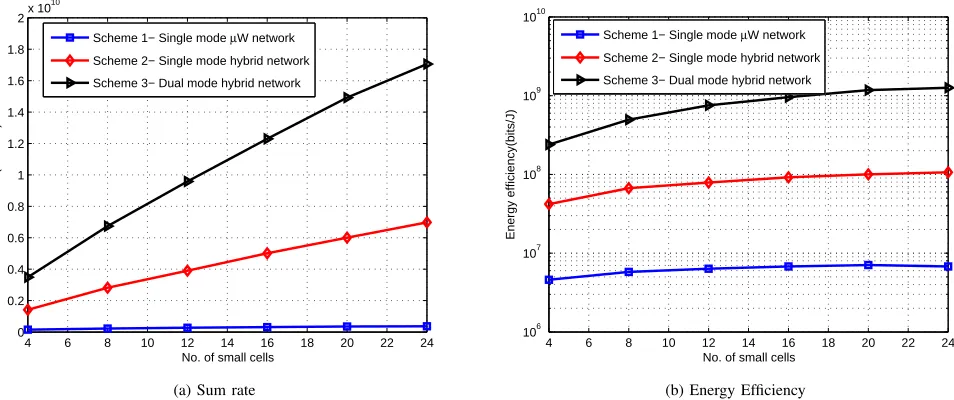
Figure 6: Comparison of all the three proposed schemes across varying number of small cells for |N0| = 150, |Nm| = 8,
Bmm= 2GHz and BµW= 20MHz.
the goal of maximizing the sum-rate and EE of the network. The SCBSs operate on dual mode, thus supporting both µW and mmWave frequency bands simultaneously, whereas the MBS operates only onµW frequency band. We assume that all SCBSs are equipped with both frequency bands RF interfaces. Each SCBS has the entire mmWave band,Bmm, and the entire
µW frequency band,BµW. TheµW frequency band,BµW, is
reused in the macro-tier. The proposed approach caters users with different objective functions. We assume that small cell home user aim at maximizing their data rates, whereas, MUEs aim at maximizing their EE. At SCBS, theµW frequency band is assigned to MUEs, whereas mmWave frequency band is assigned to home users as shown in Fig. 1b.
We develop a game theoretic framework for resource al-location in a hybrid HetNet exploiting bothµW and mmWave frequency bands simultaneously. The resource allocation at each frequency band is modeled as two-sidedstable matching
problem between users, represented in set N, and subcarriers, denoted by set K. Stable matching achieves perfect matching between two sets of disjoint players according to their pref-erence relations, with no unstable pair. The unstable player is defined as a pair,(n, k), where playernprefers playerkover currently assigned´kand playerkprefers playernover player
´
n. The problem is designed as one-to-many matching game, where one user can be matched to multiple subcarriers.
For mmWave resource allocation problem, a matching game is played between two disjoint sets, i.e., the home users of a SCBS,Nm, and set of mmWave subcarriers,Kmm, at each
SCBS. The utility function of the user, Un(kmm)and subcar-rier,Ukmm(n)is the data rate of then
thuser connected to the
mth SCBS over k
mm subcarrier, i.e, Ukmm(n) = Un(kmm) =
Rm(n, kmm).
For µW resource allocation problem, a matching game is played between the connected MUEs and the set of µW subcarriers, KµW, at each SCBS. The utility function of the
user,Un(kµW)and the subcarrier,UkµW(n)is the EE achieved
by the nth user connected to the mth SCBS over kµW subcarrier where Un(kµW) = UkµW(n) = ηm(n, kµW). The
EE,ηm(n, kµW)is defined as
ηm(n, kµW) =
Rm(n, kµW)
pn,m[kµW] +pc
, (2)
where pn,m[kµW] is the transmit power of the nth user connected to themthSCBS overk
µWsubcarrier andpc is the
circuit power. At MBS, theµW resource allocation is done in the same way as done at SCBS forµW frequency band.
The comparison among the above-mentioned schemes in terms of sum rate and EE is shown in Fig. 6. The goal of the proposed schemes is to efficiently optimize the network resources using CI techniques. We have used optimization and game theory to develop these resource allocation frameworks. It can ne noticed that both the hybrid schemes outperform the
the co-existence of µW and mmWave frequency bands in the network can provide seamless and reliable coverage with significant capacity gains.
V. CONCLUSION ANDFUTUREWORK
CI techniques are a promising solution to meet the increasing complexity and overheads associated with the next generation wireless systems. This article highlighted the resource optimization problem in hybrid mmWave HetNets and proposed solutions using various CI techniques including optimization and game theory. Various recent advancements in wireless industry have been incorporated to build the system models and the simulation results validate the effectiveness of CI-based proposed frameworks under mmWave technology, dual mode BSs, and using dual slope path loss model.
There are numerous open issues in this domain. For instance, the integration of dual mode BSs and dual slope path loss model in a hybrid HetNet exploiting both µW and mmWave frequency bands should be studied. The objective is to achieve the high capacity gains with robust and re-liable coverage under various constraints. This can further be integrated where the central BS can be assumed to be a massive multiple-input multiple-output (MIMO). However, integrating various technologies for the future mobile networks pose unique challenges and sophisticated CI techniques are required to obtain QoS. Machine learning, deep learning using convolutional neural networks, and reinforcement learning are new paradigms in CI approaches, which are actively been under research for various solutions in mobile networks. Simi-larly, another new direction is the downlink/uplink decoupling, which allows a UE to connect to one tier of BSs in the downlink (e.g., µW MBS) and another tier in the uplink (e.g., mmWave SCBS). This situation further complicates if BSs operate on dual mode. Therefore, elegant CI techniques are utmost necessary to solve various design issues in the aforementioned scenarios.
ACKNOWLEDGMENT
We would like to acknowledge the support of the Uni-versity of Surrey 5GIC members for this work.
REFERENCES
[1] CISCO, “Cisco Visual Networking Index: Global Mobile Data Traffic Forecast Update,” 2013–2018, Feb. 2014.
[2] A. Ghosh, et al., “Heterogeneous cellular networks: From theory to practice,”IEEE Commun. Mag., vol. 50, no. 6, pp. 54–64, 2012. [3] T. S. Rappaport, R. W. Heath Jr., R. C. Daniels, J. N. Murdock, Millimeter
Wave Wireless Communication, Prentice Hall, 2014.
[4] S. Albayrak, M. A. Khan, F. Sivrikaya, A. C. Toker, and C. Troung, “Performance Analysis of User-Centric Network Selection and Network-Centric Resource Allocation Approaches in Wireless Networks”, Com-munications: Wireless in Developing Countries and Networks of the Future, Springer, pp. 252-264, 2010.
[5] S. Boyd, and L. Vandenberghe,Convex Optimization, Cambridge Univer-sity Press, 2004.
[6] R. T. Marler, and S. A. Jasbir, “Survey of multi-objective optimization methods for engineering”,Struct. Multidisc. Optim., vol. 26, no. 6, pp. 369-395, 2004.
[7] A. Damnjanovic, J. Montojo, Y. Wei, T. Ji, T. Luo, M. Vajapeyam, T. Yoo, O. Song, and D. Malladi, “A survey on 3GPP heterogeneous networks,”
IEEE Wireless Commun., vol. 18, no. 3, pp. 10–21, 2011.
[8] L. Y. Loong, T. C. Chuah, J. Loo, and A. Vinel, ”Recent advances in radio resource management for heterogeneous LTE/LTE-A networks”, IEEE Commun. Surveys Tuts., vol. 16, no. 4, pp. 2142-2180, Jun. 2014. [9] O. Semiari, W. Saad, and M. Bennis, “Joint millimeter wave and
microwave resources allocation in cellular networks with dual-mode base stations”, arXiv:1606.08971, Jun. 2016.
[10] S. Niknam, A. A. Nasir, H. Mehrpouyan, and B. Natarajan, “A multi-band OFDMA heterogeneous network for millimeter wave 5G wireless applications”,IEEE Access, vol. 4, pp. 5640-5648, 2016.
[11] J. G. Andrews, T. Bai, M. Kulkarni, A. Alkhateeb, A. Gupta, and R. W. Heath, “Modeling and analyzing millimeter wave cellular systems”,
IEEE Trans. Commun., 2016.
[12] H. Mehrpouyan, M. Matthaiou, R. Wang, G. Karagiannidis, and Y. Hua, “Hybrid millimeter-wave systems: A novel paradigm for HetNets,”IEEE Commun. Mag., vol. 53, pp. 216–221, Jan. 2015.
[13] J. G. Andrews X. Zhang G. D. Durgin A. K. Gupta, “Are we approaching the limits of wireless network densification?”, IEEE Commun. Mag., 2016.
[14] T. Bai and R. W. Heath, Jr., “Coverage and rate analysis for millimeter-wave cellular networks”,IEEE Trans. Wireless Commun., vol. 14, no. 2, pp. 1100-14, Feb. 2015.