© 2019, IRJET | Impact Factor value: 7.211 | ISO 9001:2008 Certified Journal
| Page 4428
Smart City Platform Development for Waste Management
G. Paulin Nancy
1, R. Resmi
21
Student, M.E. (CEM), Civil Engineering Department, Sri Ramakrishna Institute of Technology, Coimbatore, India.
2Assistant professor, Civil Engineering Department, Sri Ramakrishna Institute of Technology, Coimbatore, India.
Abstract: Coimbatore city is one of the smart cities. There are many projects going on for the development of Coimbatore as a smart city. Waste management has become a challenge before society as it is being continuously neglected in the field of environment which is getting harmful for the health of living organism’s as well as the environment. Effective waste management strategies are required that involves a synchronized system of controlling the production and disposal of wastes. Most of the waste management techniques like landfills, incineration, sanitary landfills provide a variety of environmental benefits but have negative impacts too like emission of large amount of green house gas. This paper reveals the risk and issues occurred during all stages of waste management and find the smart solution for those major issues thereby developing the platform of smart city for waste management.
Key words: smart city, waste management, issues, risk, smart solution
1.
INTRODUCTION
Smart city is that a city equipped with basic infrastructure to give a decent quality of life, a clean and sustainable environment through applications of smart solution. Around 100 cities are set to be developed as smart cities civic bodies have to redraw long term vision in swm (solid waste management) and rework their strategies. The government of India had announced the municipal solid waste (management and handling) rules in 2000,thereby making it mandatory for all urban local bodies in the country to engage in collection, segregation, secondary storage in covered bins, transportation in covered vehicles, processing through composing or waste to energy technologies and disposal of rejects in engineered sanitary landfills.
The smart city consist of several services for the betterment of urban area .Thus this paper is all about the identification of the prevalent issues and risk in the existing solid waste management system and finding the smart solutions for those issues.
2.
METHODOLOGY
Fig-1: Flowchart for methodology
Identifying the key risk factors of waste management process by reviewing the literature and through the additions that could be made by the participants i.e. workers .Questions are prepared based on the identified risk factors such as storage system, lack of proper segregation, area coverage, capacity issue, climatic change, etc.
Major factors and issues are identified with the help of questionnaire survey. Providing practical suggestions and recommendations pointing toward upgrading waste management process and improve the performance of workers thereby create platform of smart city.
3. QUESTIONNAIRE SURVEY
Based on the literature reviews related to waste management ,various major factors are identified .questions are prepared for questionnaire survey by considering the major factors like risk factors such as storage system, lack of proper segregation, area coverage, capacity issue, climate change, awareness programme,etc.
LITERATURE REVIEW
DETERMINATION OF MAJOR FACTORS
QUESTION DESIGN
QUESTIONNAIRE SURVEY
ANALYSIS OF DATA
RESULT AND DISCUSSION
© 2019, IRJET | Impact Factor value: 7.211 | ISO 9001:2008 Certified Journal
| Page 4429
4.
ANALYSIS
[image:2.612.54.271.158.410.2]4.1 Segregate & disposal
Table – 1: Segregation and Disposal
Values
Row
Labels
Sum of
FREQUENCY
Sum of
PERCENT
NO
46
0.46
NO ANS
3
0.03
YES
51
0.51
Grand
Total
100
1
Chart – 1: Segregation and Disposal
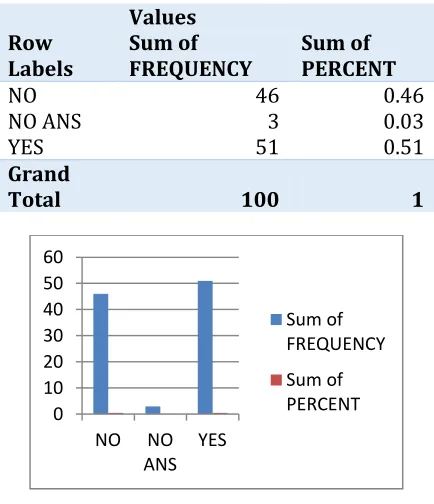
The survey has been conducted for segregation & disposal of wastes and the results were tabulated. From the chart, it was known that 51% of people segregate and disposed their wastes properly whereas remaining people were not doing it properly.
4.2 Difficult to handle
Chart – 2: Difficult to handle
From the survey about difficulties in handling of wastes, it was known that the segregation of glass wastes found to be more difficult to handle when compared with other wastes because they affect the workers and cause severe
injuries to them. In addition, liquid wastes also difficult to handle as it creates a disgusting feel to the workers in that field.
[image:2.612.335.563.191.398.2]4.3 Climate change
Table – 3: Climate change
Values
Row
Labels
Sum of
FREQUENCY
Sum of
PERCENT
NO
31
0.31
YES
69
0.69
Grand
Total
100
1
Chart – 3: Climate change
The chart 5.9 shows that employees face difficulties due to climate change. For example during rainy season wastes spread over the road.
[image:2.612.61.275.523.668.2]4.4 Regular disposal
Table – 4: Climate change
Values
Row
Labels
Sum of
FREQUENCY
Sum of
PERCENT
NO
32
0.32
NO ANS
4
0.04
YES
64
0.64
Grand
Total
100
1
0 10 20 30 40 50 60
NO NO
ANS YES
Sum of FREQUENCY
Sum of PERCENT
0 50 100
Troublesome in handling of wastes
Total
0 20 40 60 80
NO YES
Sum of FREQUENCY
© 2019, IRJET | Impact Factor value: 7.211 | ISO 9001:2008 Certified Journal
| Page 4430
Chart– 4Regular disposal
The chart 4 shows the regular disposal of wastes by the people in every area. Because of regular door to door collection practice followed by workers of municipality, waste disposal was done regularly.
5.
RESULT AND DISCUSSION
From the survey following risk and issues are identified
5.1
Primary collection
Issues:
1. Absence of waste storage system source; 2. Lack of proper segregation;
3. Low service area coverage; and
4. Lack of capital investment with the ULB as infrastructure replacement is high due to lower life span of the equipments.
Risk Associated in Service Delivery: 1. Manpower intensive activity;
2. Requires diligent supervision and management skills; and
3. Inefficient working of the service providers has high risk of time and cost over runs.
5.2
Secondary
Collection
and
Waste
Transportation
Issues:
1. Location of secondary waste collection points/public dealing;
2. High O&M cost of infrastructure for secondary collection; and
3. Improper design/infrastructure of storage points.
Risk Associated in Service Delivery:
1. Design Fault – Risk associated in improper routing or allotment of vehicles, etc.
2. Inconsistent assumption;
3. Occurrence of mishaps (accidents), and 4. Environmental risks.
5.3 Intermediate Storage at the Transfer Station
Issues:
1. Lack of adequately trained human resource having adequate managerial capabilities.
2. Lack of capital investment.
3. Vehicle maintenance and repairs of the transfer station.
Risk Associated in Service Delivery:
1. Land allotment in densely populated areas may lead to time and cost overrun;
2. Clearances – as transfer stations are located inside city boundaries,
3. Public resistance (NYMBI Criteria);
4. Design - Waste generation is more than critical mass of the transfer station;
5. Waste quality razes transfer station mechanical components – C&D waste, large tree cuttings as part of garden waste;
5.4 Treatment and Disposal Issues:
1. Capacity issues - Lack of technical and managerial expertise;
2. Issues related to the treatment process based on waste quality;
3. Lack of Funds for capital investment.
4. Lack of market linkage for products and co-products. 5. Linked to collection and transportation.
6. Lack of inclusive projects considering local waste pickers.
7. Land allocation.
Risk Associated in Service Delivery: 1. Timely availability of land.
2. Environmental risks due to non-compliance to norms. 3. Design and construction risk.
4. Revenue risks – due to factors like change in tariff rates, inadequate MSW generation, quality of MSW, and inadequate demand for products and co-products
6.
RECOMMENDED SOLUTIONS
6.1
Automated sorting
It is found to be one of the helpful practices of solid waste separation for recycling. This technique can provide aid to obtain the suitable sorting process for the source separated solid waste management. It also
0 20 40 60 80
NO NO
ANS YES
Sum of FREQUENCY
© 2019, IRJET | Impact Factor value: 7.211 | ISO 9001:2008 Certified Journal
| Page 4431
presented various techniques as sorting and commutingrequired for segregating all recyclable waste materials. Here, the discussion takes place about the ways of sorting various types of materials by using suitable sensors. It is obtained that automated sorting can be categorized into two parts: - Direct sorting and indirect sorting. Direct sorting is the process of applying external fields as eddy current, magnetic current and gravity. It apply sorting on the basis of material properties as density, magnetic susceptibility for heavy media separation Indirect sorting uses the sensors in order to detect the availability and position of the recyclable waste.
6.2
Automated solid waste management
-
Fig-1: Flowchart for Automated solid waste management6.3
SMART PLANNING
Web Camera
Camera is placed above the Garbage Can to capture images of various level of garbage in it. A webcam is a video camera which feeds its image in real time or through a computer to computer network. When "captured" by a computer, the video stream may be viewed, saved or sent to other networks through the email.
When these data are sent to a remote location, the video stream may be viewed, saved and sent there, which is unlike an IP camera connected by using a USB cable, or by similar kind of cables.
Load Sensor
The LOAD cell will continuously give the readings (Weight) in voltage format, and then it is transferred to a signal conditioning unit which amplifies the voltage and will give it to the μC. The μC would then converts the analog signal into digital format.
A load cell is a transducer which is used to sense and convert the force into an electrical signal. The output of the transducer is used to calculate the force applied to the transducer. There are various types of load cells which includes Hydraulic load cells sensor, Pneumatic load cells sensor and Strain gauge load cells sensor.
6.4 SMART GARBAGE BIN
Every smart bin is equipped with ultrasonic sensors that measure the level of dustbin being filled. The container is divided into three levels of garbage and because of continuous usage the levels get filled gradually with time. When the garbage crosses a level the sensors will receive the data of the filled level. These collected data is further send to the garbage analyzer as instant message using GSM module. Every message which is received at the garbage analyzer at the end will be saved as a data and used for analysis and predictive modeling. The received data at real time is used by the application interface for better viewing of the filled level.
The data received is saved in the database with time and date. For Prediction and report making, the department of data analysis use the data collected in months. By using the interface application, the real time level will be shown to the garbage analyzer and using that data it will direct its team of garbage collector to collect the garbage to avoid overflow.
7.
CONCLUSION
From the survey report, several risk factors such as storage system, lack of proper segregation, area coverage, capacity issue, climatic change were identified. Based on these risk factors, smart solutions
recommended were automated sorting system,
automated solid waste management, smart planning by using web camera & load sensor, Smart garbage.
© 2019, IRJET | Impact Factor value: 7.211 | ISO 9001:2008 Certified Journal
| Page 4432
various smart technologies in the waste managementprocess an effective platform for smart city has been developed and also improves the quality of society. This help to develop the clean and healthy environment free from solid waste.
REFERENCES
[1].Nasrin Khansari, Ali Mostashari and Mo Mansouri
Mohammad Ali “Impacting Sustainable Behaviour and Planning in Smart City ”.,International journal of sustainable land use and urban planning ISSN 1927-8845 VOL.1 NO 2,pp.46-61(2013)
[2].Kazi Akib Bin Asad, Nadim Reza Khandaker
“Municipal Solid Waste Landfill in Dhaka:A
Sustainable Approach for Energy
Generation”.IJSR,Index Copernicus value(2015):78.96
[3].Vincenzo Catania and Daniela Ventura “An approach
for monitoring and smart planning of urban solid waste management using smart-m3 platform” [4].Parul dixit, Shailendra deva “Automated solid waste
management for smart cities: A review”. ELK ASIA Pacific journal of mechanical engineering research ISSN 2394-9368
[5].Andre Castro lundin,Ali gurcan ozkil “Smart cities: A
case study in waste monitoring and
management”2017
[6].Jose M.Gutierrez,Michal Jensen,Morten Henius and
Tahir Riaz “Smart waste collection system based on location intelligence” Proscenia Computer Science 61 ( 2015 ) 120 – 127
[7].KuldeepSingh, NehaSharma and Pranay Gunna.
“Smart cities in India :key areas and challenges-case study of Chandigarh city ” IJMSS Vol.04 Issue-01 (January, 2016) ISSN: 2321-1784
[8].Akashi Patel, Bharat Jhamnani “Optimization Model
for Integrated Solid Waste Management in Gurugram”.IJSR ISSN: 2319-7064 Index Copernicus Value (2016): 79.57 | Impact Factor (2017): 7.296 [9].Romano fistola, Rosa Anna la rocca “ Smart city
planning : a systemic approach” Conference Paper · September 2013
[10]. F. Pirlone and I. Spadaro “Towards a waste
management plan for Smart cities”
www.witpress.com, ISSN 1743-3541
[11]. Riya A. Kanase, Yuvraj K. Kanse Review Paper on
IoT Based Smart Garbage Alert System”ISSN :
2319-7064, Volume 7 Issue 5, May 2018,www.ijsr.net
[12]. A.Sivasankari , V.Priyavadana “Smart planning in
solid waste management for a sustainable smart city"e-ISSN: 2395 -0056,Volume: 03 Issue: 08 |Aug -2016, www.irjet.net
[13]. S.A. Mahajan, Akshay Kokane, Apoorva
Shewale,and Mrunaya Shinde “Smart Waste
Management System using IoT”,ISSN: 2349-6495(P),
Vol-4, Issue-4, Apr- 2017,www.ijaers.com
[14]. Suraj A Sutra, Sagar M. Gawande “Solid Waste
Management in Rural Areas emerging towards growth centre through GIS system- Mahalung,
Solapur”Volume 4 Issue 7, July 2015,www.ijsr.net
[15]. Maaz Allah Khan, Mohd Zafar Siddiqi, Mohd
Waqar Waseem and Nizamuddeen “Solid Waste
Management” Volume 6 Issue 4, April 2017,
www.ijsr.net
[16]. Rishabh Srivastava “Waste Management:
Developed and Developing Countries”Volume 5 Issue
3, March 2016 , ISSN : 2319-7064,www.ijsr.net
[17]. Omkar Parishwad, Trishubh Singh “Analyzing and
Rating Smart City Development in India” ISSN:
2349-8404, Volume 1, Number 6; August,
2014http://www.krishisanskriti.org/jceet.html
[18]. Ramamurthy Venkatesh, Chintan Vadgama And
Madhavi Damle“Smart cities – challenges and implementation approaches: comparison perspective
in India, uae and Singapore”
https://www.researchgate.net/publication/3173577 32, September 2016
[19]. Olga Rybnytska, Frada Burstein, and Arkady
Zaslavsky A. Zuraida, S.Norshahida “Decision support for optimizing waste management”.ISSN:1246-0125, http://www.tandfonline.com/loi/tjds20, 2018, Vol. 2 7.
[20]. Lakshmi Devi P, Chandan B“IOT Based Waste
Management System for Smart City”.ISSN NO:
2394-8442, VOLUME 4, ISSUE 7, DEC/2017.