Original Research Article
Knowledge regarding dengue disease among people in an
urban area: a cross sectional study
Nitin T. Basole
1, Sulakshana S. Baliga
2*, Mubashir Angolkar
1INTRODUCTION
Vector borne diseases are one of the major public health problems in India occurring in epidemic form almost on an annual basis.1,2 They account for more than 17% of all infectious diseases.3
Aedes mosquito is the vector for dengue. Aedes mosquito is usually found in manmade containers.4,5 Dengue fever is characterized by high fever, headache, muscle and joints pain, and rash.6,7 In India dengue is endemic in 31 states.8
National vector borne disease control programme is one of most comprehensive and multifaceted public health
activities in India including prevention and control of mosquito-borne diseases.9 In India during 2014, 33,320 cases and 86 deaths have been reported.10
Since there is no vaccine available, vector control is the ideal way to control dengue. But vector control methods can be successful with community participation. Hence it becomes important to assess the community’s knowledge regarding the disease, its mode of transmission and breeding sites. Knowledge study act as educational diagnosis of population. So study of this kind will not only help in assessing the level of awareness and relation to dengue disease as well as also help Government and policy makers to formulate strategies to fill the gap in level of awareness and implementation of control programme acceptable to risk population. Hence the
ABSTRACT
Background: Vector borne diseases are one of the major public health problems worldwide. There is significant disease burden contributed to morbidity and mortality due to Dengue. Vector control is the ideal way to control dengue. But vector control methods can be successful with community participation. Hence it becomes important to assess the community’s knowledge regarding the disease. The objective of the study was to assess the knowledge regarding the dengue disease among people in an urban area.
Methods: A community based cross sectional study was conducted among 400 participants. Participants were selected by using systematic random sampling method. Data was collected by house to house visit using predesigned questionnaire.
Results: Majority of them (87.75%) identified fever as a cardinal symptom of dengue fever. Only 32.25% knew that dengue fever is transmitted by Aedes mosquitoes. 42% of participants had good knowledge of dengue The main source of information on dengue was from the television.
Conclusions: Key finding of this study is that knowledge is poor among the study participants although majority of people had clear understanding of fever, headache, joint pain as common signs and symptoms of dengue fever.
Keywords: Knowledge, Dengue fever, Breeding sites
1
Department ofPublic Health, 2Department of Community Medicine, JNMC, KAHER, Belagavi, Karnataka, India
Received: 25 July 2018
Accepted: 28 August 2018
*Correspondence:
Dr. Sulakshana S. Baliga,
E-mail: [email protected]
Copyright: © the author(s), publisher and licensee Medip Academy. This is an open-access article distributed under the terms of the Creative Commons Attribution Non-Commercial License, which permits unrestricted non-commercial use, distribution, and reproduction in any medium, provided the original work is properly cited.
present study was planned to assess the knowledge, among people in urban area regarding dengue disease.
METHODS Source of data
The present study was conducted in urban field practice area of Department of Community Medicine, Jawaharlal Nehru Medical College, KAHER, Belagavi.
Methods of collection of data
House to house survey with questionnaire.
Study design
A community based cross sectional study.
Study period
The study was conducted over a period of one year from January 2017 to 31st December 2017.
Study population
Residents residing in Ashoknagar area.
Sample size
As per literature review due to varied prevalence of knowledge regarding dengue disease “p” was taken as 50% and sample size was calculated as 400.
Sampling procedure
The population of Ashoknagar, an urban field practice area was 24,794.
Ashoknagar field practice area has six areas out of which one area i.e. Ashoknagar was randomly selected for the study. Total households in Ashoknagar area is 1388.
First house (1st) was selected randomly. There after every third (3rd) house was selected by systematic random sampling method for collecting information.
In the selected house, an adult member in the family, who was present at the time of visit, was interviewed
Inclusion criteria
Residents who are residing in Ashoknagar area at least for the period of one year in the study.
Exclusion criteria
Residents residing for less than one year in study area.
Data collection procedure
The subjects were interviewed by using predesigned and pre-tested questionnaire. A detailed questionnaire included information on:
Socio-demographic information (age, sex,
occupation and education).
Knowledge about dengue disease.
All the subjects were informed about the purpose of study and after obtaining informed consent, they were interviewed.
The overall knowledge of study participants was assessed using mean scores.
Knowledge was assessed by scoring: 1-Yes, 0-No.
Mean score >13 was considered as good knowledge.
Mean score <13 was considered as poor knowledge.
Ethical considerations
The study was approved by the institutional ethics committee.
RESULTS
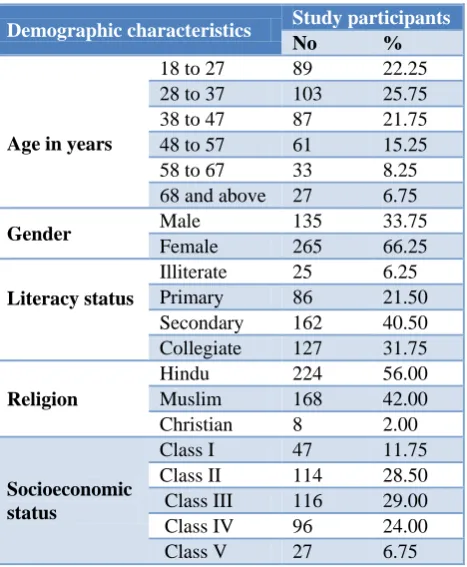
In the present study, out of 400 respondents 89 (22.25%) were aged 18 to 27 years, 103 (25.75%) were aged 28 to 37 years followed by 87 (21.75%) aged 38 to 47years, 61 (15.25%) aged 48 to 57 years, 33 (8.25%) aged 58 to 67 years and 27 (6.75%) were aged 68 years and above. The mean age (±S.D) of study participants was 40.43±15.14 years.
In our study, 224 (56.00%) of the participants were Hindus, followed by 168 (42.00%) were Muslims and eight (2.00%) were Christians.
In our study, according to modified B.G. Prasad classification maximum 116 (29.00%) of study participants were from socioeconomic class III and 114 (28.50%) were from class II, 96 (24.00%) from class IV, 47 (11.75%) and 27 (6.75%) from classes I and V respectively.
In the present study among the total participants 232 (58%) had poor knowledge regarding dengue disease and only 168 (42%) had good knowledge.
Table 1: Demographic characteristics (n=400).
Demographic characteristics Study participants
No %
Age in years
18 to 27 89 22.25
28 to 37 103 25.75
38 to 47 87 21.75
48 to 57 61 15.25
58 to 67 33 8.25
68 and above 27 6.75
Gender Male 135 33.75
Female 265 66.25
Literacy status
Illiterate 25 6.25
Primary 86 21.50
Secondary 162 40.50
Collegiate 127 31.75
Religion
Hindu 224 56.00
Muslim 168 42.00
Christian 8 2.00
Socioeconomic status
Class I 47 11.75
Class II 114 28.50
Class III 116 29.00
Class IV 96 24.00
Class V 27 6.75
Table 2: Distribution of study participants according to their overall knowledge, regarding dengue.
Variable Number Percentage (%)
Mean score
Knowledge Poor 232 58 <13.0
Good 168 42 >13.0
Table 3: Distribution of study participants according to their knowledge of symptoms.
Variables
Yes No
No. Percentage
(%) No.
Percentage (%)
Fever 351 87.75 49 12.25
Headache 289 72.25 111 27.75
Joint pain 272 68.00 128 32.00
Abdominal
pain 194 48.50 206 51.50
Muscular
pain 203 50.75 197 49.25
Vomiting 236 59.00 164 41.00
Skin rashes
or Spots 100 25.00 300 75.00 Pain
behind the eyes
79 19.75 321 80.25
Multiple 323 80.75 77 19.25
Table 4: Distribution of study participants according to their knowledge of transmission.
Variables Number Percentage (%) Is dengue transmitted by Aedes mosquito
Yes 129 32.25
No 271 67.75
Total 400 100.00
Dengue is transmitted by (n=271)
All mosquitoes 93 8.95
Ticks 71 6.84
Houseflies 65 6.26
Person to person 120 11.60
Unhygienic food 166 15.99
Drinking water 184 17.72
Sexual contact 47 4.52
Needle stick injury 136 13.10
Blood transfusion 156 15.02
Total 1038 100.00
Table 5: Distribution of study participants according to their knowledge of breeding places of mosquitoes
causing dengue.
Variables Number Percentage (%) Does mosquito causing dengue breed in artificially collected water sources?
Yes 157 39.25
No 243 60.75
Other Mosquito breeding places (n=243)
Dirty water 55 10.95
Mud 113 22.50
Garbage 168 33.50
Plants and vegetation 166 33.05
Total 502 100.00
Table 6: Distribution of study participants according to their knowledge regarding protective measures.
Variables Yes No
No. % No. % Covering water
containers 351 87.75 49 12.25 Screening of windows
and use of bed nets 309 77.25 91 22.75 Covering of body with
full sleeved clothes 351 87.75 49 12.25 Insecticide sprays 276 69.00 124 31.00
Removal of stagnant
water 355 88.75 45 11.25
Use of mosquitoes
repellents 257 64.25 143 35.75
Table 7: Source of information on cause and spread of dengue.
Sources of information Number Percentage (%)
Television 258 64.50
News paper 60 15.00
Radio 23 5.75
Friends and relatives 33 8.25
Doctor and health staff 26 6.50
Total 400 100.00
DISCUSSION
Mean age±SD of participants was 40.43±15.14 years. Majority of the study participants were in the age group of 18-47 years. Around 66.25% participants were females and only 6.25% were illiterates. Similar findings were seen in a study conducted in Kannamangala village,
Bengluru.11 Almost half of them were from
socioeconomic status class-III and class-IV. A study conducted in urban area of Jhansi (UP)showed that half of the participants were from the upper middle class.12
42% of participants had good knowledge of dengue which was similar to study conducted in Jhansi city (UP) which reported 56%, whereas study conducted in Kuala Kangsar district reported figure of 68.5% while a study in Kuala Lumpur reported 14.3% knowledge of participants on dengue.12-14
Only 32.25% of respondents knew that the dengue is transmitted by Aedes mosquitoes. Whereas study conducted in Chitradurga, Karnataka showed that 18.63% correctly responded the causative vector.8 About 39.25% of study participants had knowledge that dengue mosquito breeds in artificially collected water sources. Similarly a study conducted at Jhansi city (UP) revealed that 82% of participants had knowledge about breeding site as standing clean water.12
Correct knowledge regarding protective measures against dengue as covering of water containers, screening of windows and use of bed nets, covering of body with full sleeved clothes, use of insecticide sprays, removal of stagnant water and use of mosquito repellents was known by 87.75%, 77.25%, 87.75%, 69.00%, 88.75% and 64.25% participants respectively. Similar results were reported from a studies conducted in Yemen, Bihar and Patiala.6,15,16
In our study, 64.50% participants had information regarding dengue from television. Similarly study conducted in Patiala showed that 69.27% had information regarding dengue from television, whereas study conducted in Laos showed that 43.9% of the participants got the information from friends and relatives.6,17 Various studies have shown that mass media has a major role in
disseminating information about dengue whereas in Thailand, Jhansi city (UP).12,18
Limitation
Since the study is cross-sectional it cannot show cause and effect relationship between different factors with outcome variables.
CONCLUSION
Key finding of this study is that knowledge is poor among the study participants although majority of people had clear understanding of fever, headache, joint pain as common signs and symptoms of dengue fever. However a considerable proportion exhibited vague perception of other signs and symptoms including muscular pain and skin rashes. Only few of them knew that dengue is caused by mosquito bite, and were aware that the mosquito causing dengue breeds in artificially collected water.
ACKNOWLEDGEMENTS
The authors would like to thank the Principal, Staff of Department of Public Health, Community Medicine JNMC, Belagavi and study participants for their co-operation throughout the study. We are also thankful to Dr. Shivanand B. Jawali for his help in Statistical analysis and Dr. Prashant Giribhattanavar for technical support.
Funding: No funding sources Conflict of interest: None declared
Ethical approval: The study was approved by the Institutional Ethics Committee
REFERENCES
1. Shobha, Saraswathi S, Mukhopadyay A, Rao A,
Ranganath TS. A cross sectional study of perception and preventive practices, regarding dengue disease among population of Bangalore District, South India. Asian J Pharm Health Sci. 2014;4(3):1056-61.
2. Park K. Park’s Textbook of Preventive and Social Medicine. 23rd ed, Jabalpur: Banarasidas Bhanot; 2015: 246.
3. Bhatnagar PK, Garg SK, Bano T, Jain S.
Knowledge, attitude and practice regarding dengue and chikungunya secondary school children in a city of North India. Eur J Pharm Med Res. 2016;3(11):423-8.
4. Vaishnavi GB, Churi S, Narahari MG, Kurian J,
Lalremruata B, Laldinpuii E,et al. Study of impact of health education on knowledge, attitude and practice related to dengue fever. World J Pharmacy Pharm Sci. 2015;4(10):748-61.
5. Qadir S, Ahmad I, Akhtar MN, Naeem H.
fever among local population. Gomal J Med Sci. 2015;13(2):87-90.
6. Malhotra V, Kaur P. The community knowledge,
attitude and practices regarding Dengue fever in field practice area of urban training health centre of Patiala. Int J Res Develop Health Community Med. 2014;2(1):19-26.
7. Yboa BC, Labrague LJ. Dengue knowledge and
preventive practices among rural residents in Samar province, Philippines. Int J Public Health Sci. 2013;2(2):59-66.
8. Payghan BS, Kadam SS, Mali SC, Ramya V.
Knowledge attitude and practices regarding Dengue infection among pre-university college students. Int J Med Sci Clin Intervent. 2014;1(7):371-8.
9. Vala M, Patel U, Joshi N, Zalavadiya D, Bhola C, Viramgami A. Knowledge and practices regarding commonly occurring mosquito borne diseases among people of urban and rural areas of Rajkot District, Gujarat. J Res Med Dental Sci. 2013;1(2):46-50.
10. National vector borne disease control programme. Available from http://nvbdcp.gov.in/Doc/Annual-report-NVBDCP-2014-15.pdf. Accessed on 21 January 2017.
11. Pradeep C, Achuth KS, Manjula S. Awareness and practice towards dengue fever in Kannamangala village, Bangalore, Karnataka, India. International J Community Med Public Health. 2016;3:1847-50.
12. Gupta S, Malhotra AK, Verma SK, Deka M, Rai P,
Yadav R, et al. A study on knowledge, attitude and practices regarding dengue fever among people living in urban area of Jhansi city (up). J Evol Med Dental Sci. 2014;3(73):15388-98.
13. Hairi F, Ong CHS, Suhaimi A, Tsung TW, Anis
Ahmad MA, Sundaraj C, et al. A knowledge, attitude and practices study on dengue among selected rural communities in the Kuala Kangsar
district. Asia-Pacific J Public Health.
2003;15(1):37–43.
14. Wan Rozita WM, Yap BW, Veronica S,
Muhammad AK, Lim KH, Sumarni MG.
Knowledge, attitude and practice (KAP) survey on dengue fever in an urban Malay residential area in Kuala Lumpur. Malaysian J Public Health Med. 2006;6(2):62–7.
15. Alyousefi TAA, Ghani RA, Mahdy MAK, Eryani
SM A, Al-Mekhlafi AM, Raja YA, et al. A household-based survey of knowledge, attitudes and practices towards dengue fever among local urban communities in Taiz Governorate, Yemen. BMC Infect Dis. 2016;16:543.
16. Mohapatra S, Aslami AH. Knowledge, attitude and practice regarding dengue fever among general patients of a rural tertiary-care hospital in Sasaram, Bihar. Int J Community Med Public Health. 2016;3(2):586-91.
17. Mayxay M, Cui W, Thammavong S, Khensakhou
K, Vongxay V, Inthasoum L, et al. Dengue in peri-urban Pak-Ngum district, Vientiane capital of Laos: a community survey on knowledge, attitudes and practices. BMC Public Health. 2013;13:434.
18. Swaddiwudhipong W, Lerdlukanavonge P,
Khumklam P, Koonchote S, Nguntra P,
Chaovakiratipong C. A survey of knowledge, attitude and practice of the prevention of dengue hemorrhagic fever in an urban community of Thailand. Southeast Asian J Tropical Med Public Health. 1992;23:207–11.
Cite this article as: Basole NT, Baliga SS, Angolkar
M.Knowledge regarding dengue disease among