REVIEW
The importance of vector control for the
control and elimination of vector-borne
diseases
Anne L. WilsonID1*, Orin Courtenay2, Louise A. Kelly-Hope3, Thomas W. ScottID4, Willem Takken5, Steve J. Torr1, Steve W. Lindsay6
1 Department of Vector Biology, Liverpool School of Tropical Medicine, Liverpool, United Kingdom, 2 Zeeman Institute and School of Life Sciences, University of Warwick, Coventry, United Kingdom,
3 Department of Tropical Disease Biology, Liverpool School of Tropical Medicine, Liverpool, United Kingdom, 4 Department of Entomology and Nematology, University of California Davis, Davis, California, United States
of America, 5 Department of Plant Sciences, Wageningen University and Research, Wageningen, the Netherlands, 6 Department of Biosciences, Durham University, Durham, United Kingdom
Abstract
Vector-borne diseases (VBDs) such as malaria, dengue, and leishmaniasis exert a huge burden of morbidity and mortality worldwide, particularly affecting the poorest of the poor. The principal method by which these diseases are controlled is through vector control, which has a long and distinguished history. Vector control, to a greater extent than drugs or vaccines, has been responsible for shrinking the map of many VBDs. Here, we describe the history of vector control programmes worldwide from the late 1800s to date. Pre 1940, vec-tor control relied on a thorough understanding of vecvec-tor ecology and epidemiology, and implementation of environmental management tailored to the ecology and behaviour of local vector species. This complex understanding was replaced by a simplified dependency on a handful of insecticide-based tools, particularly for malaria control, without an adequate understanding of entomology and epidemiology and without proper monitoring and evalua-tion. With the rising threat from insecticide-resistant vectors, global environmental change, and the need to incorporate more vector control interventions to eliminate these diseases, we advocate for continued investment in evidence-based vector control. There is a need to return to vector control approaches based on a thorough knowledge of the determinants of pathogen transmission, which utilise a range of insecticide and non–insecticide-based approaches in a locally tailored manner for more effective and sustainable vector control.
Author summary
Vector-borne diseases (VBDs) such as dengue, Chagas disease, human African trypanoso-miasis (HAT), leishmaniasis, and malaria exert a huge burden of morbidity and mortality worldwide. The principal method by which these diseases are controlled is through vector control. The authors chart the history of vector control through time from elucidation of the transmission route of VBDs to the present day. Pre-1940 vector control relied heavily
a1111111111 a1111111111 a1111111111 a1111111111 a1111111111
OPEN ACCESS
Citation: Wilson AL, Courtenay O, Kelly-Hope LA,
Scott TW, Takken W, Torr SJ, et al. (2020) The importance of vector control for the control and elimination of vector-borne diseases. PLoS Negl Trop Dis 14(1): e0007831.https://doi.org/10.1371/ journal.pntd.0007831
Editor: Roberto Barrera, Centers for Disease
Control and Prevention, Puerto Rico, UNITED STATES
Published: January 16, 2020
Copyright:©2020 Wilson et al. This is an open access article distributed under the terms of the
Creative Commons Attribution License, which permits unrestricted use, distribution, and reproduction in any medium, provided the original author and source are credited.
Funding: ALW and SWL received funding from the
UK’s Global Challenges Research Fund, supported by the Biotechnology and Biological Sciences Research Council, Medical Research Council and Natural Environment Research Council (BOVA Network, grant reference number: BB/R00532X/1)
Competing interests: The authors have declared
on environmental management and larval control based on a thorough understanding of pathogen transmission but was replaced by insecticide-based vector control, often deployed as a monotherapy. The authors call for increased political will and investment in vector control and a return to locally tailored vector control that draws on the entire toolbox of interventions available.
Introduction
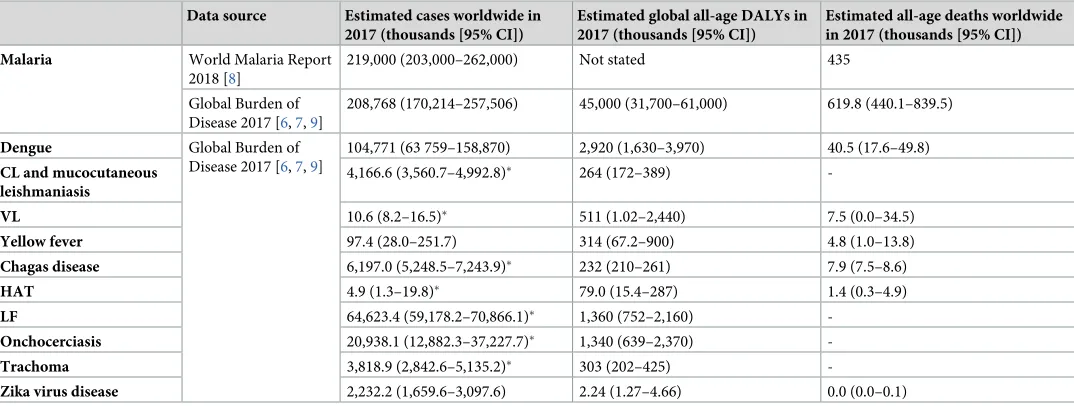
[image:2.612.36.573.450.653.2]Vector-borne diseases (VBDs) are infections caused by pathogens that are transmitted by arthropods such as mosquitoes, triatomine bugs, blackflies, tsetse flies, sand flies, lice, and ticks. Dengue, Chagas disease, Japanese encephalitis, leishmaniasis, lymphatic filariasis (LF), malaria, and yellow fever threaten over 80% of the world’s population and disproportionately affect the poorest populations living in the tropics and subtropics [1]. Many of these VBDs are co-endemic, and it is estimated that more than half the world’s population live in areas where 2 or more VBDs are present [1]. VBDs contribute significantly to the global burden of disease, accounting for 17% of the global estimated burden of all infectious diseases [2]. Perhaps the best known VBD, malaria, is a major cause of morbidity and mortality, particularly in sub-Saharan Africa (SSA), with approximately half the world’s population predicted to be at risk of malaria (Table 1) [3]. Many VBDs are classified as neglected tropical diseases (NTDs), e.g., arboviral diseases like dengue and chikungunya, Chagas disease, human African trypanosomi-asis (HAT), leishmanitrypanosomi-asis, LF, and onchocercitrypanosomi-asis [4]. The burden of NTDs is poorly under-stood, and until the last 5 to 10 years, these diseases have suffered from a lack of prioritisation and investment. Important aspects of NTD biology, epidemiology, and prevention remain inadequately understood. While the global numbers of deaths from vector-borne NTDs is lower than for malaria, vector-borne NTDs continue to cause high levels of morbidity and rep-resent a significant public health burden; e.g., from 1990 to 2013, dengue cases increased
Table 1. Global burden of VBDs.
Data source Estimated cases worldwide in 2017 (thousands [95% CI])
Estimated global all-age DALYs in 2017 (thousands [95% CI])
Estimated all-age deaths worldwide in 2017 (thousands [95% CI])
Malaria World Malaria Report 2018 [8]
219,000 (203,000–262,000) Not stated 435
Global Burden of Disease 2017 [6,7,9]
208,768 (170,214–257,506) 45,000 (31,700–61,000) 619.8 (440.1–839.5)
Dengue Global Burden of Disease 2017 [6,7,9]
104,771 (63 759–158,870) 2,920 (1,630–3,970) 40.5 (17.6–49.8)
CL and mucocutaneous leishmaniasis
4,166.6 (3,560.7–4,992.8)� 264 (172–389)
-VL 10.6 (8.2–16.5)� 511 (1.02–2,440) 7.5 (0.0–34.5)
Yellow fever 97.4 (28.0–251.7) 314 (67.2–900) 4.8 (1.0–13.8)
Chagas disease 6,197.0 (5,248.5–7,243.9)� 232 (210–261) 7.9 (7.5–8.6)
HAT 4.9 (1.3–19.8)� 79.0 (15.4–287) 1.4 (0.3–4.9)
LF 64,623.4 (59,178.2–70,866.1)� 1,360 (752–2,160)
-Onchocerciasis 20,938.1 (12,882.3–37,227.7)� 1,340 (639–2,370)
-Trachoma 3,818.9 (2,842.6–5,135.2)� 303 (202–425)
-Zika virus disease 2,232.2 (1,659.6–3,097.6) 2.24 (1.27–4.66) 0.0 (0.0–0.1)
�Prevalence.
Abbreviations: CL, cutaneous leishmaniasis; DALY, disability-adjusted life year; HAT, human African trypanosomiasis; LF, lymphatic filariasis; VBD, vector-borne
disease; VL, visceral leishmaniasis
nearly 450% globally [5]. Some zoonotic NTDs have an additional veterinary health burden [6,7].
[image:3.612.39.566.328.667.2]Vector control is the principal method available for controlling many VBDs—both histori-cally and today. Moreover, for some diseases, such as dengue (a vaccine is licensed but is not widely used due to safety concerns [10]), chikungunya, Zika, and West Nile disease, vector control is currently the only method available to protect populations. Vector control aims to limit the transmission of pathogens by reducing or eliminating human contact with the vector. A wide range of vector control tools exist, which can be broadly classified into chemical- and non–chemical-based tools (Table 2). Tools targeting immature vectors can act by killing the immature stages (e.g., chemical or biological larvicides and predator species) or by removing suitable aquatic habitats (e.g., habitat modification or manipulation). Tools targeting the adult vectors function by killing the vector (e.g., indoor residual spraying [IRS], space spraying) and/or reducing vector contact (blood-feeding success) with human and/or animal reservoir hosts (e.g., topical repellents, house screening, treated bed nets [ITNs], insecticide-treated dog collars). There are also several novel vector control tools under development, e.g., genetic manipulation of mosquitoes, bacterial infection of vectors (e.g.,Wolbachia), and insec-ticide-treated eave tubes (Box 1).
Table 2. Categories and examples of vector control methods [11].
Chemical Immature Chemical larvicides Contact pesticides affecting insect nervous system (e.g., temephos) or endocrine system (insect growth regulators, e.g., pyriproxyfen)
Adult ITNs Pyrethroid-treated ITNs or combination ITNs (e.g., pyrethroid plus synergist piperonyl
butoxide) for malaria, LF, and leishmaniasis control
Insecticide-treated materials for personal protection
Insecticide-treated clothing for workers and mobile populations
IRS Spraying of residual insecticides (typically either pyrethroids, carbamates, or
organophosphates) indoors for malaria andAedes-borne disease control
Space spraying Aircraft, vehicle or hand-held space spraying for dengue epidemic and otherAedes-borne
disease control
Insecticidal treatment of habitat Focal, perifocal, ground, or aerial insecticide spraying
Insecticide-treated cattle Pour-on or spot-on pyrethroids for control of tsetse
Insecticide-treated traps and targets Targets for control of HAT and insecticide-treated adulticidal oviposition traps forAedes -borne diseases
Topical repellent Chemicals (e.g., N,N-diethyl-meta-toluamide [DEET], picaridin) applied to the skin to reduce vector biting
Spatial repellent Transfluthrin/metafluthrin passive emanators or coils
Nonchemical Immature Microbial larvicides Bacillus thuringiensisvar.israelensis,B.sphaericus
Predator species Predatory fish or invertebrates
Habitat modification, i.e., a permanent change of land and/or water
Drainage of surface water, land reclamation and filling, and coverage of large water storage containers (or complete coverage of water surfaces) with a material that is impenetrable to mosquitoes, such as expanded polystyrene beads
Habitat manipulation, i.e., a recurrent activity
Water-level manipulation, exposing habitats to the sun (depending on the ecology of the vector), flushing of streams, drain clearance, and source reduction, including rubbish disposal and regular emptying and cleaning of domestic containers (e.g., flowerpots, animal drinking water troughs)
Regulatory measures Removal of man-made aquatic habitats and appropriate waste disposal
Adult House improvement and screening Closing eaves, door and window screening
Removal trapping Solar-powered mosquito trapping system for malaria control and sticky adulticidal oviposition traps forAedes-borne diseases
Abbreviations: HAT, human African trypanosomiasis; IRS, indoor residual spraying; ITN, insecticide-treated bed net; LF, lymphatic filariasis
Our goal was to review the history of vector control from the 1800s to the present day, highlighting what tools and approaches were adopted and the impacts they had on vectors and infection and disease. This Review focuses on the main VBDs:Aedes-borne viruses, Chagas
Box 1. Examples of novel vector control interventions being
developed
Gene drive
Gene drive is a method of genetic modification that can be used to spread favourable traits through interbreeding populations of malaria mosquitoes [12]. The gene drive allows genes to spread through populations in a self-sustaining manner, even if they con-fer a fitness cost. The technique can be used for population replacement (reducing the ability of mosquitoes to transmit a pathogen) or population suppression (reducing the size of the vector population by, e.g., reducing fertility of females or biasing the sex ratio towards males). The ‘Target Malaria’ group started initial work in Burkina Faso, in prep-aration for releases of gene drive mosquitoes.
Wolbachia
Wolbachiais a genus of bacteria that naturally infect some insect species but are not nor-mally found inAedesmosquitoes. Introduction ofWolbachiaintoAedesmosquitoes reduces transmission of dengue and other arboviruses to people [13]. Mosquitoes carry-ingWolbachiaare released by field teams and mate with the wild mosquito population, and over time the percentage of mosquitoes carryingWolbachiaincreases. The ‘World Mosquito Program’ is conducting a randomised controlled trial and programmatic eval-uations in several countries worldwide (e.g., [14,15]).
Spatial repellents
Spatial repellents are chemicals that prevent a vector from entering a space occupied by a potential human host to reduce encounters between the vector and the host [16]. They are typically used against malaria orAedesmosquitoes and can be used indoors or out-doors, where they may serve as a useful tool in combating outdoor transmission of malaria. Spatial repellents exist in a number of formats, including coils, passive emana-tors, and impregnated fabric. Although several small trials of spatial repellent coils have been performed [17,18], spatial repellents are not yet recommended for disease preven-tion. Results from randomised controlled trials for malaria and dengue are currently being analysed. A research programme was recently funded by UNITAID to carry out a second efficacy evaluation of spatial repellent passive emanators against malaria, and a second trial is being considered for dengue.
Eave tubes
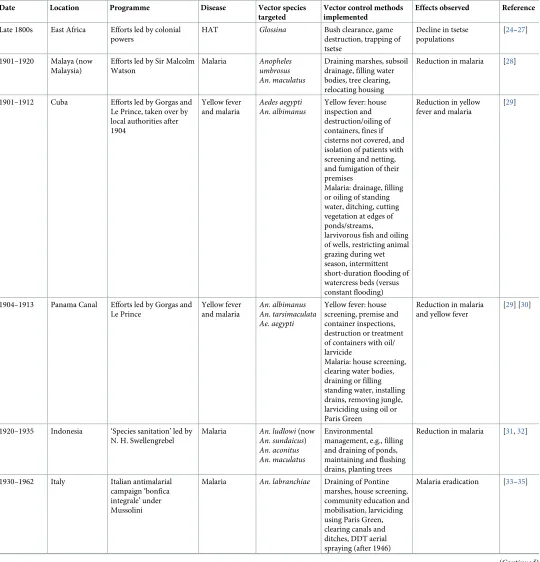
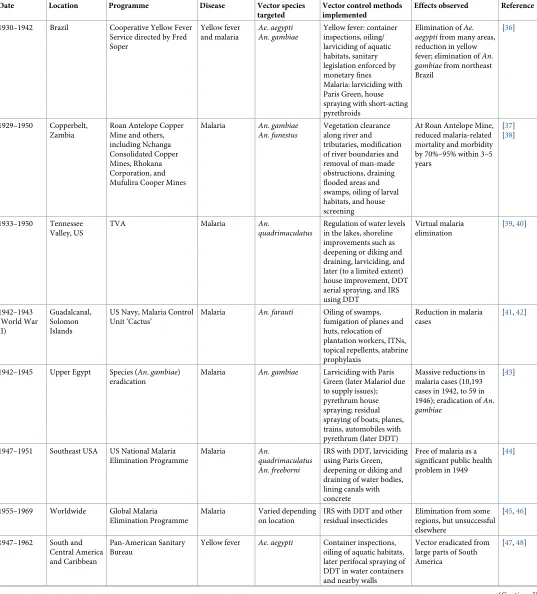
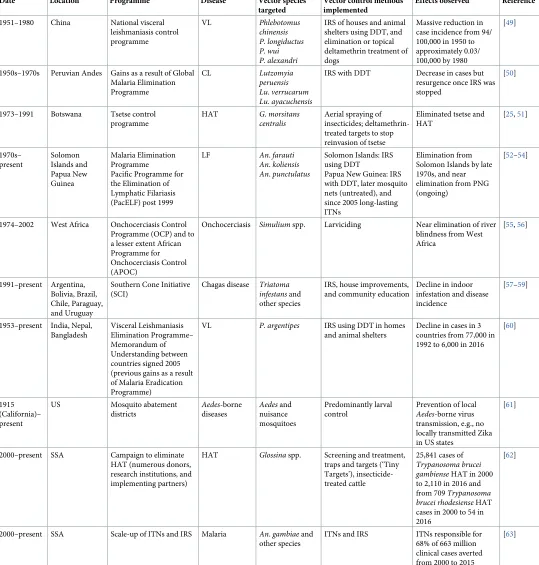
disease, HAT, leishmaniasis, LF, malaria, and onchocerciasis. Malaria is the dominant focus of the Review given the high burden of morbidity and mortality and well-documented history of thinking on malaria vector control [21,22]. The manuscript uses some terminology that is often misused in the public health literature and may require definition: ‘control’ refers to deliberate efforts to reduce disease incidence, prevalence, morbidity, or mortality to a locally acceptable level; ‘elimination’ refers to interruption of local transmission requiring continued efforts to pre-vent reestablishment of transmission; and ‘eradication’ refers to permanent reduction to zero of the worldwide incidence of infection as a result of deliberate efforts, so that intervention measures are no longer needed [23]. A summary of the programmes and campaigns discussed is given in Fig 1andTable 3. The World Health Organization (WHO) calls for effective, locally adapted, and sustainable vector control in its recent Global Vector Control Response (GVCR) 2017–2030 strategy [2]. Increasing our understanding of the different types of vector control tools that were used in the past, what settings they were used in, and their impacts on vectors and disease can hopefully help us to select and promote new and existing vector control methods to sustainably reduce the burden and threat of VBDs. We conclude by drawing out key lessons from the history of vector control and identifying how these can be applied now and in the future.
A brief history of vector control
Elucidation of the transmission route of VBDs and early vector control
In the 1890s and early 1900s, the transmission route of Chagas disease, HAT, LF, malaria, and yellow fever were elucidated, primarily in response to the germ theory of Pasteur and Koch and advancements in microscopy [64–69]. The first VBD of humans to be identified was malaria when in 1897, ground-breaking work by Sir Ronald Ross showed thatAnopheles mos-quitoes transmitted malaria parasites [66]. However, vector control had been taking place prior to this, mainly due to an awareness of the connection between fevers and proximity of swamps and marshes. For example, historical reports from Greek (circa 550 B.C.) and Roman times describe large drainage schemes and reductions in ‘plague’ and fever [70,71]. There are reports of the use of mechanical vector control methods, such as sleeping in high buildings, where mosquitoes were unable to fly due to wind; the use of bed nets in Egypt (as noted by Herodotus 484–425 B.C.) and by the Romans; and the use of bed curtains, as noted by Marco Polo during his travels to India in the 13th century [70]. Sanitary measures helped to control yellow fever in the US in the late 1700s, including cleaning sewers and pumping bilge water out of ships, which was practiced in Philadelphia during a large outbreak in 1793 when refugee ships from Saint Dominigue (now Haiti) inadvertently brought in theAe.aegyptivector [72,73].
Environmental management as the primary tool for control of VBDs
Fig 1. A short history of vector control. CL, cutaneous leishmaniasis; DDT, dichlorodiphenyltrichloroethane; GMEP, Global Malaria Eradication Programme; HAT,
Table 3. Historical overview of notable vector control programmes and their effects.
Date Location Programme Disease Vector species targeted
Vector control methods implemented
Effects observed Reference
Late 1800s East Africa Efforts led by colonial powers
HAT Glossina Bush clearance, game
destruction, trapping of tsetse
Decline in tsetse populations
[24–27]
1901–1920 Malaya (now
Malaysia)
Efforts led by Sir Malcolm Watson
Malaria Anopheles
umbrosus
An.maculatus
Draining marshes, subsoil drainage, filling water bodies, tree clearing, relocating housing
Reduction in malaria [28]
1901–1912 Cuba Efforts led by Gorgas and
Le Prince, taken over by local authorities after 1904
Yellow fever and malaria
Aedes aegypti
An.albimanus
Yellow fever: house inspection and destruction/oiling of containers, fines if cisterns not covered, and isolation of patients with screening and netting, and fumigation of their premises
Malaria: drainage, filling or oiling of standing water, ditching, cutting vegetation at edges of ponds/streams,
larvivorous fish and oiling of wells, restricting animal grazing during wet season, intermittent short-duration flooding of watercress beds (versus constant flooding)
Reduction in yellow fever and malaria
[29]
1904–1913 Panama Canal Efforts led by Gorgas and Le Prince
Yellow fever and malaria
An.albimanus
An.tarsimaculata
Ae.aegypti
Yellow fever: house screening, premise and container inspections, destruction or treatment of containers with oil/ larvicide
Malaria: house screening, clearing water bodies, draining or filling standing water, installing drains, removing jungle, larviciding using oil or Paris Green
Reduction in malaria and yellow fever
[29] [30]
1920–1935 Indonesia ‘Species sanitation’ led by N. H. Swellengrebel
Malaria An.ludlowi(now
An.sundaicus)
An.aconitus
An.maculatus
Environmental management, e.g., filling and draining of ponds, maintaining and flushing drains, planting trees
Reduction in malaria [31,32]
1930–1962 Italy Italian antimalarial
campaign ‘bonfica integrale’ under Mussolini
Malaria An.labranchiae Draining of Pontine
marshes, house screening, community education and mobilisation, larviciding using Paris Green, clearing canals and ditches, DDT aerial spraying (after 1946)
Malaria eradication [33–35]
Table 3. (Continued)
Date Location Programme Disease Vector species targeted
Vector control methods implemented
Effects observed Reference
1930–1942 Brazil Cooperative Yellow Fever
Service directed by Fred Soper
Yellow fever and malaria
Ae.aegypti
An.gambiae
Yellow fever: container inspections, oiling/ larviciding of aquatic habitats, sanitary legislation enforced by monetary fines Malaria: larviciding with Paris Green, house spraying with short-acting pyrethroids
Elimination ofAe.
aegyptifrom many areas,
reduction in yellow fever; elimination ofAn.
gambiaefrom northeast
Brazil
[36]
1929–1950 Copperbelt,
Zambia
Roan Antelope Copper Mine and others, including Nchanga Consolidated Copper Mines, Rhokana Corporation, and Mufulira Cooper Mines
Malaria An.gambiae
An.funestus
Vegetation clearance along river and tributaries, modification of river boundaries and removal of man-made obstructions, draining flooded areas and swamps, oiling of larval habitats, and house screening
At Roan Antelope Mine, reduced malaria-related mortality and morbidity by 70%–95% within 3–5 years
[37] [38]
1933–1950 Tennessee
Valley, US
TVA Malaria An.
quadrimaculatus
Regulation of water levels in the lakes, shoreline improvements such as deepening or diking and draining, larviciding, and later (to a limited extent) house improvement, DDT aerial spraying, and IRS using DDT
Virtual malaria elimination
[39,40]
1942–1943 (World War II) Guadalcanal, Solomon Islands
US Navy, Malaria Control Unit ‘Cactus’
Malaria An.farauti Oiling of swamps,
fumigation of planes and huts, relocation of plantation workers, ITNs, topical repellents, atabrine prophylaxis
Reduction in malaria cases
[41,42]
1942–1945 Upper Egypt Species (An.gambiae) eradication
Malaria An.gambiae Larviciding with Paris
Green (later Malariol due to supply issues); pyrethrum house spraying; residual spraying of boats, planes, trains, automobiles with pyrethrum (later DDT)
Massive reductions in malaria cases (10,193 cases in 1942, to 59 in 1946); eradication ofAn.
gambiae
[43]
1947–1951 Southeast USA US National Malaria Elimination Programme
Malaria An.
quadrimaculatus
An.freeborni
IRS with DDT, larviciding using Paris Green, deepening or diking and draining of water bodies, lining canals with concrete
Free of malaria as a significant public health problem in 1949
[44]
1955–1969 Worldwide Global Malaria
Elimination Programme
Malaria Varied depending
on location
IRS with DDT and other residual insecticides
Elimination from some regions, but unsuccessful elsewhere
[45,46]
1947–1962 South and
Central America and Caribbean
Pan-American Sanitary Bureau
Yellow fever Ae.aegypti Container inspections, oiling of aquatic habitats, later perifocal spraying of DDT in water containers and nearby walls
Vector eradicated from large parts of South America
[47,48]
[image:8.612.38.575.93.687.2]Table 3. (Continued)
Date Location Programme Disease Vector species targeted
Vector control methods implemented
Effects observed Reference
1951–1980 China National visceral
leishmaniasis control programme
VL Phlebotomus
chinensis P.longiductus P.wui P.alexandri
IRS of houses and animal shelters using DDT, and elimination or topical deltamethrin treatment of dogs
Massive reduction in case incidence from 94/ 100,000 in 1950 to approximately 0.03/ 100,000 by 1980
[49]
1950s–1970s Peruvian Andes Gains as a result of Global Malaria Elimination Programme
CL Lutzomyia
peruensis
Lu.verrucarum
Lu.ayacuchensis
IRS with DDT Decrease in cases but
resurgence once IRS was stopped
[50]
1973–1991 Botswana Tsetse control
programme
HAT G.morsitans
centralis
Aerial spraying of insecticides; deltamethrin-treated targets to stop reinvasion of tsetse
Eliminated tsetse and HAT
[25,51]
1970s– present Solomon Islands and Papua New Guinea Malaria Elimination Programme
Pacific Programme for the Elimination of Lymphatic Filariasis (PacELF) post 1999
LF An.farauti
An.koliensis
An.punctulatus
Solomon Islands: IRS using DDT
Papua New Guinea: IRS with DDT, later mosquito nets (untreated), and since 2005 long-lasting ITNs
Elimination from Solomon Islands by late 1970s, and near elimination from PNG (ongoing)
[52–54]
1974–2002 West Africa Onchocerciasis Control
Programme (OCP) and to a lesser extent African Programme for Onchocerciasis Control (APOC)
Onchocerciasis Simuliumspp. Larviciding Near elimination of river
blindness from West Africa
[55,56]
1991–present Argentina, Bolivia, Brazil, Chile, Paraguay, and Uruguay
Southern Cone Initiative (SCI)
Chagas disease Triatoma
infestansand
other species
IRS, house improvements, and community education
Decline in indoor infestation and disease incidence
[57–59]
1953–present India, Nepal, Bangladesh
Visceral Leishmaniasis Elimination Programme– Memorandum of Understanding between countries signed 2005 (previous gains as a result of Malaria Eradication Programme)
VL P.argentipes IRS using DDT in homes
and animal shelters
Decline in cases in 3 countries from 77,000 in 1992 to 6,000 in 2016
[60]
1915 (California)– present
US Mosquito abatement
districts Aedes-borne diseases Aedesand nuisance mosquitoes Predominantly larval control
Prevention of local
Aedes-borne virus
transmission, e.g., no locally transmitted Zika in US states
[61]
2000–present SSA Campaign to eliminate
HAT (numerous donors, research institutions, and implementing partners)
HAT Glossinaspp. Screening and treatment,
traps and targets (‘Tiny Targets’), insecticide-treated cattle
25,841 cases of
Trypanosoma brucei
gambienseHAT in 2000
to 2,110 in 2016 and from 709Trypanosoma
brucei rhodesienseHAT
cases in 2000 to 54 in 2016
[62]
2000–present SSA Scale-up of ITNs and IRS Malaria An.gambiaeand
other species
ITNs and IRS ITNs responsible for
68% of 663 million clinical cases averted from 2000 to 2015
[63]
Abbreviations: CL, cutaneous leishmaniasis; DDT, dichlorodiphenyltrichloroethane; HAT, human African trypanosomiasis; IRS, indoor residual spraying; ITN,
insecticide-treated bed net; LF, lymphatic filariasis; SSA, sub-Saharan Africa; TVA, Tennessee Valley Authority; VL, visceral leishmaniasis
[image:9.612.37.576.98.663.2]Environmental management flourished in both Malaya (now Malaysia) and Netherlands East Indies (now Indonesia) in the early 1900s. British doctor Sir Malcolm Watson joined the Malayan Medical Service in 1900, where he led vector control efforts against malaria based on an understanding of the ecology of local vectors [28]. Drainage of aquatic habitats controlled malaria in 2 coastal towns in the state of Selangor and allowed resumption of port develop-ment. Later, Watson’s work expanded to lowland areas—where he controlledAn.umbrosusby clearing the forest within 0.8 km of plantation labourer houses so that water bodies were exposed to the sun—and in 1909 to hilly regions, where subsoil drainage was successful against An.maculatus. Watson also oversaw successful drainage schemes in Singapore in 1911, where local malaria transmission was practically eliminated [28]. The Dutch zoologist Nicolaas Swel-lengrebel was inspired by Watson and set out to replicate the work throughout the Indonesian archipelago between 1920 and 1935, terming his methods ‘species sanitation’ [31]. Swellengre-bel aimed to control malaria primarily through environmental management, such as filling in or draining ponds and lagoons, maintaining and flushing drains, or planting shade trees depending on the vector species present and its ecology.
The Pontine marshes, near Rome, Italy, suffered from high malaria transmission for over 1,000 years. Large-scale drainage from 1930 onwards was highly successful in malaria control against the Italian malaria vectorAn.labranchiae[34]. This was done as part of the three-pronged ‘bonifica integrale’ campaign, or ‘bonification’, instigated by Mussolini. The cam-paign included agricultural improvements—e.g., draining swamps to increase agricultural land; hygienic measures, such as building sturdy, well-screened brick housing; and quinine distribution.
Another excellent example of environmental management for malaria control was in the Zambian Copperbelt during the 1920s and 1930s [37,38,77]. Control measures launched at the Roan Antelope Copper Mine in 1929—including vegetation clearance, modification of river boundaries, draining swamps, oil application to open water bodies, and house screening—were highly effective in targetingAn.gambiaeandAn.funestus[37]. In 3 to 5 years, malaria-related mortality and morbidity declined by 70%–95%, and over a 20-year period, the programme averted an estimated 4,173 deaths and 161,205 malaria attacks.
Environmental management was also being implemented on a large scale in the southern US. The Tennessee Valley Authority (TVA) was set up in 1933 to exploit the Tennessee River’s potential for hydroelectric power and improve the land and waterways for agricultural devel-opment of the region [39,40]. At the time, the region was highly endemic for malaria, and the creation of artificial lakes would have exacerbated the problem. Vector control tools imple-mented included regulation of water levels in lakes, shoreline improvements such as deepening or diking and draining, larviciding, house screening, and later dichlorodiphenyltrichlor-oethane (DDT) spraying. Massive reductions in malaria were seen, and the disease was essen-tially eliminated from the area by the late 1940s.
1901 [29]. Later theAedesprogramme was expanded to includeAnophelescontrol by drainage, filling or oiling of standing water, ditching in a herringbone pattern, cutting vegetation at edges of ponds or streams, the addition of larvivorous fish or oil to wells, restricting animal grazing during the wet season to avoid creating habitats in flooded footprints, and intermittent short-duration flooding of watercress beds in Havana (versus constant flooding). This resulted in a fall in malaria deaths from 5,643 between 1890 and 1900 to 444 deaths between 1900 and 1910, despite a greatly increased human population [29].
In 1904, Gorgas became Chief Sanitary Officer during the building of the Panama Canal and with the aid of Le Prince eliminated yellow fever and kept malaria at low levels [29]. Con-trol was achieved by screening living quarters, draining or filling standing water, installing drains, and larviciding using oil or Paris Green [30]. Paris Green is not used currently due to high human toxicity and ecological concerns, and we now have much less toxic chemicals that can be applied in a more targeted manner. After these successes, similar campaigns were launched by Joseph White in Havana, Oswaldo Cruz in Rio de Janeiro, and Emilio Ribas in Santos [79]. Successful control was followed by a period of apathy. Complacency was brought to a halt by an epidemic of yellow fever in Rio de Janeiro in 1928 in which population densities ofAe.aegyptiwere again at high levels. The Cooperative Yellow Fever Service, a collaboration between the Brazilian Government and the Rockefeller Foundation, was established under the direction of Fred Soper with the aim of eradicatingAe.aegyptifrom Brazil. From 1930 to 1934, Soper led a well-organised campaign, with control measures including oiling of water contain-ers and house searches for larvae and adults. Campaigns initiated by the Cooperative Yellow Fever Service also succeeded in eliminatingAn.gambiaefrom the northeast of Brazil in 1942 largely using larviciding with Paris Green, complemented in some areas by house spraying with short-acting pyrethroids [36].
In the late 1800s, colonial expansion in SSA and massive outbreaks of HAT led to a number of scientific missions to study the disease. In 1903, David Bruce and colleagues found that the trypanosome that causes HAT was transmitted byGlossina palpalis(nowG.fuscipes) [69]. In colonial times, game destruction and bush clearing were widely practised for tsetse control in many countries. The impetus for game destruction was a natural experiment—a rinderpest epizootic in the 1890s eliminated wild hosts and domestic stock across large parts of east and southern Africa [80]. This led to the disappearance of tsetse from large areas, but as the game populations recovered, so did the tsetse. Game destruction was first introduced in Southern Rhodesia (now Zimbabwe) in 1919, and by 1921, cases of trypanosomiasis were greatly reduced [81]. From 1922 until the early 1980s, game destruction was generally adopted as a tsetse control method [26]. In the 1950s, game destruction in Shinyanga, Tanzania, succeeded in eradicating an isolated tsetse population [25]. Full or partial habitat destruction was also practiced. For example, riverine tsetse species were eradicated from rivers and streams in Ghana and Nigeria by removing short bush and trees with low branches [24]. Despite these successes, the huge environmental impact of bush clearing and game destruction would be unacceptable today.
From 1942 to 1945,An.gambiaewas eradicated from Upper Egypt (Aswan, Qena, Girga, and Asyuˆt Provinces) through a meticulous campaign of weekly larviciding using Paris Green and, to a lesser extent, house spraying using pyrethrum [43]. Residual treatment of trains, automobiles, and planes was also performed to prevent spread ofAn.gambiaeto uninfested areas to the north. The number of malaria cases in the region fell from 10,193 cases in 1942 to 59 in 1946.
Prior to the use of residual insecticides, environmental management was also the standard control method against phlebotomine sand fly transmission ofLeishmaniaspecies causing human cutaneous leishmaniasis (CL) and visceral leishmaniasis (VL). Early attempts towards the end of World War I to control sand flies was in response to epidemics of sand fly fever (rather than to leishmaniasis) that disrupted British troops in the Middle East and Mediterra-nean regions. Based on investigations of local sand fly ecologies and larval development loca-tions, environmental management included the following: pitching camps away from refuse, debris, and loose friable rocks; pitching camps on levelled drained ground; sealing soil cracks with cresol, sand, or sawdust; and treatment with lime—all to render the ground impermeable to ovipositing and emerging sand flies. Additional chemical control included spraying cresol, crude oil, or paraffin or treating with tar around tents and the lower 3 feet (0.9 m) of buildings [86]. Similarly, in India, naphthalene in kerosene with petrol and carbon disulphide was applied 120 yards (110 m) around army barracks, resulting in a 50% reduction in sand flies [86]. Few chemical advances were made against adult sand flies during this period. Bed nets needed to be fine mesh sizes due to the small size of sand flies and were considered too uncom-fortable in hot climates. Thus, sand fly control was in existence prior to its definitive incrimi-nation as a vector ofLeishmania, the result of cumulative experiments between 1904 and 1942 [86–88]. Plastering walls of houses, cattle sheds, and latrines with lime and mud to eliminate cracks used as diurnal resting sites byPh.argentipes, a vector in the Indian subcontinent, con-tinues to be part of an integrated approach to sand fly control [89].
Post–World War II era and the advent of DDT
The first residual insecticide DDT was added to the vector control toolbox in the early 1940s, consequently increasing the popularity of insecticide-based control. World War II had stemmed the supply of pyrethrum (derived from chrysanthemum flowers) from Japan, and alternatives were urgently needed [90]. The first major demonstration of DDT use was at the end of World War II when the allies used the insecticide to control an epidemic of typhus, transmitted by body lice, amongst the populations of war-torn Europe [91].
prevent mosquito bites—was abandoned, and only later were antimalaria drugs included in the strategy. The GMEP succeeded in eliminating malaria from Europe, North America, the Caribbean, and parts of Asia and South-Central America, primarily where there were more temperate climates, seasonal transmission, and well-functioning control programmes. The northern part of Venezuela was the first to be WHO certified as malaria free in June 1961 through the use of IRS with DDT, sanitary engineering (water management and house improvement), and larviciding [95]. Parasite resistance to drugs, mosquito resistance to insec-ticides, lack of community participation, and reduced funding led to abandoning the GMEP in 1969 after it was realised that elimination was not possible everywhere with the approach adopted [45].
Also around this time, the Pare-Taveta Malaria Scheme, a pilot project to test the feasibility of malaria eradication in Africa, was initiated [96]. Between 1954 and 1966, the project evalu-ated the effect of IRS with dieldrin on malaria and mortality in the Taveta subdistrict of Kenya and the Pare district of Tanganyika (now Tanzania). The project succeeded in reducing malaria to low levels, but intensive IRS could not be sustained, and malaria bounced back after the intervention was stopped.
In 1947, Brazil called for elimination ofAe.aegyptiacross the whole South American conti-nent, a task that was coordinated by the Pan-American Sanitary Bureau with the continued involvement of Fred Soper [47]. Brazil was encouraged by the success of the Cooperative Yel-low Fever Service in northeast Brazil but also understood thatAe.aegypticould not be eradi-cated from Brazil unless frontiers and ports were protected from invasion from other countries in the region. Container inspections, oiling of larval development sites, and later perifocal spraying of DDT in water containers and nearby walls succeeded in eradicatingAe. aegyptifrom large parts of South America during the 1950s and 1960s. By October 1961, 16 countries in the Western Hemisphere were free ofAe.aegypti(Bolivia, Chile, Ecuador, Guate-mala, Nicaragua, Paraguay, Uruguay, French Guiana, Brazil, Costa Rica, El Salvador, Hondu-ras, Panama, Peru, Canal Zone, and British Honduras) [48]. During the 1940s and 1950s, yellow fever was virtually eliminated in the Americas, but unfortunately, this success became the downfall of the programme. As yellow fever subsided, political support for the eradication campaigns waned despite warnings from Soper about the risk that could result from pulling back the hemisphere-wideAe.aegypticontrol programme [97]. Weak vector control and sur-veillance meant, as predicted, thatAe.aegyptigradually returned to many countries, most likely due to re-infestation from countries that had not achieved eradication, including Argen-tina, French Guyana, the US, Venezuela, and several Caribbean countries.
Much of the historical control of leishmaniasis has been attributed to IRS using DDT, both targeted specifically againstLeishmaniavectors, or as a beneficial consequence of the GMEP in the 1950s. In China, approximately 530,000 cases of co-circulating zoonotic and anthroponotic Leishmaniaspecies were reported north of the Yangtze River prior to the creation of the Peo-ple’s Republic in 1949. The national VL control programme, which started in 1951, included human VL case detection and treatment, IRS of houses and animal shelters using DDT, and elimination or topical deltamethrin treatment of dogs. This campaign reduced the case inci-dence from 94 per 100,000 population in 1950 to approximately 0.03 per 100,000 population by 1980, with clear effects associated with IRS interventions alone in some regions [49]. In Bra-zil, where zoonotic VL occurs, the government commission to investigate leishmaniasis and other diseases—created in 1936 and headed by Evandro Chagas—led to the first use of DDT in the 1950s in northeast Brazil. VL case incidence was reduced by 58% in 14 sprayed areas com-pared to a rise of 12% in 14 untreated areas [104]. Implementation of an integrated approach similar to that adopted in China (without the option of topical insecticide for dogs) led to con-siderable reductions in the number of cases, though with some reservations about the residual-ity of DDT on adobe houses [105,106].
Reductions inLeishmaniavectors—as well as human incidence, though this is less well reported—have been attributed to the GMEP operating in various countries [107]. In Rio de Janeiro, Brazil, DDT IRS circumstantially led to a reduction from 12.7% prevalence in 1947 to 0.3% in 1953 [108]. IRS spraying during the Indian National Malaria Eradication Programme of 1958 to 1970 apparently resulted in zero cases of VL being reported from the State of Bihar during that time period [109]. Perhaps the more compelling evidence is the rise in VL cases once the GMEP largely ceased in the late 1960s [107,110]. For example, in the subsequent VL epidemic in Bihar, India, case numbers rose from a few to 40,000 cases by 1978 [109]. Similar rebounds were reported in several countries [107,110,111]. Retrospective analysis of house-hold survey data from the Peruvian Andes showed that IRS with DDT from the 1950s until the 1970s resulted in a decrease in CL cases. Cases increased after IRS was discontinued [50].
GMEP abandoned—What next for malaria?
After the GMEP was abandoned, many countries switched from eradication to malaria con-trol, even though WHO reaffirmed that eradication was still the ultimate goal [112]. During the 1970s and 1980s, malaria was poorly controlled. There were epidemics in the Indian sub-continent (1973–1976) and Turkey (1977) and focalisation of the malaria problem where there was sociopolitical instability or limited socioeconomic development, including countries in SSA, Brazil, and Sri Lanka [46,113]. The economic crisis in the early 1970s and reorientation of collaborating agencies like the United Nations Children’s Fund (UNICEF) towards general health (rather than malaria) meant less funding for malaria control, oil shortages led to increases in insecticide prices, drug and insecticide resistance were increasing, and operational capacity in programmes was reduced [45]. Also of note was a large WHO-funded research study conducted from 1969 to 1976 in Garki, northern Nigeria, known as the Garki Project [114]. Despite the GMEP not being implemented in Africa, WHO wanted to test whether IRS with propoxur and mass drug administration (MDA) with chloroquine and sulfadoxine-pyri-methamine would interrupt malaria transmission. The measures were successful in reducing parasite prevalence from 80% to 30%, but 1 year after stopping control, malaria rebounded back to pre-intervention levels.
World Health Assembly (WHA) in 1978 [115] and further developed at the Seventeenth WHO Expert Committee on Malaria in 1979 [116]. In the early 1990s, WHO devised with member states a new global malaria control strategy, which was endorsed by the WHA in 1993 [117]. The new strategy called for a selective approach in determining whether and where to attempt vector control (and if so, what method to use) and deemphasised IRS, stating that ‘the proper use of insecticides is a complex matter, involving considerable expense and trained per-sonnel and demanding sustained application, usually for many years.’ A renewed focus on research led to new vector control tools becoming available.
In the early 1970s, ITNs emerged as a vector control idea because many communities were already sleeping under untreated bed nets. At this time, synthetic pyrethroids were developed (permethrin, cypermethrin, and deltamethrin), which were safe to use for impregnation of ITNs [118]. Following pioneering trials on ITNs, including those in The Gambia in the 1980s that showed huge impacts on malaria infection and mortality [119–121], WHO recommended the use of ITNs for children and pregnant women [122]. In the early 2000s, the late Chris Cur-tis and others were strong advocates for ITNs as a public good and for their provision via the public sector with financial assistance from donors [123]. Following several studies that showed a community-level effect of ITNs [124–126] through mass killing of mosquitoes, there was an increasing push for ITNs to be provided to entire communities, rather than just high-risk groups [127]. As a result, the WHO position statement was strengthened in 2007 to rec-ommend the use of long-lasting ITNs (with long-lasting pyrethroid formulations that last for 3 years) distributed either free or highly subsidised and used by all community members [128]. A major stimulus for malaria control at this time was the recognition that malaria restrained economic development and that eliminating malaria in SSA would lead to rapid development [129]. Political will and resources for malaria increased, and in 2007, malaria eradication hit the agenda again following calls by the Bill and Melinda Gates Foundation to eradicate malaria with massive scale-up of existing and experimental interventions [130]. ITN coverage
increased rapidly from 2000, predominantly financed through the Global Fund to fight AIDS, Tuberculosis and Malaria [131,132], and an estimated 50% of the population at risk of malaria of SSA were sleeping under an ITN in 2017 [8]. IRS was used only in specific areas, and there-fore only 7% of the population at risk in SSA was covered by IRS in 2017 [8]. Much of the IRS conducted in SSA was funded by the US Presidents Malaria Initiative [133].
NTDs—Lagging behind in vector control
Vector control for vector-borne NTDs, including Chagas disease, Gambian HAT, leishmania-sis, LF, and onchocercialeishmania-sis, took longer to gain traction compared to efforts against anopheline andAedesvectors.
Despite the early discovery by Sir Patrick Manson of transmission of the main LF parasite— Wuchereria bancrofti—by mosquitoes in 1878 [67,140], vector control against LF played a lesser role than for other VBDs. Uniquely among VBDs, LF can be transmitted by 5 genera of mos-quito (Anopheles,Aedes,Culex,Mansonia, andOchlerotatus), although it typically requires a large number of infective mosquito bites over many years to result in an infectious human host [141]. Although vector control for LF is advocated by WHO [142], much of the focus today is on use of MDA to eliminate microfilariae from the blood of infected humans in order to inter-rupt mosquito transmission. Despite this, there are several examples from the Pacific region of elimination of LF using vector control alone—including IRS using DDT againstAnopheles vec-tors in the Solomon Islands and Papua New Guinea [52–54], as well as sanitation campaigns against culicine vectors in Australia [143]. It is likely that the recent massive rollout of ITNs in SSA has contributed to a decline in LF, although the evidence is equivocal [144–147]. In Papua New Guinea, however, an MDA campaign from 1994 to 1998 reduced transmission, but large declines in mosquito and human infection were not seen until ITNs were introduced in 2009 [148], which was consistent with the notion that combining drugs with vector control would be more effective than either approach alone. Polystyrene beads used in pit latrines against culicine vectors were also shown to augment MDA in India and Zanzibar in the 1980s and 1990s [149– 151]. In 1997, WHO called for eradication of LF and 5 other infectious diseases. In 2000 the Global Programme to Eliminate Lymphatic Filariasis (GPELF) was launched, with vector con-trol currently playing a minor role to MDA as a supplementary intervention [152,153].
Vector control has also been highly effective against Chagas disease as illustrated by suc-cesses of the Southern Cone Initiative (SCI) initiated during 1991 in Argentina, Bolivia, Brazil, Chile, Paraguay, and Uruguay [57–59] and similar initiatives launched in 1997 in Central America and Andean Pact countries. Interventions against the vectorT.infestansfocused mainly on IRS, house improvements (replacement of mud walls and floors with cement, and thatched roofs with corrugated metal), and community education. In the 1980s, there were thought to be between 16 and 18 million people infected withTrypanosoma cruzi, and the SCI achieved a decline in infestation rate and a sharp decline in the infection rates of children [160]. Uruguay became the first Latin American country to eliminate Chagas disease in 1997 [161], and domestic transmission was effectively eliminated in Chile (1999); Brazil (2006); sub-stantial areas of Argentina, Bolivia, and Paraguay; and parts of Central America [162]. Despite these successes, there are estimated to be still over 6 million people infected with the parasite [6], and continued vigilance is necessary to combat peridomestic and sylvatic vector popula-tions, which can re-invade houses or mediate transmission outside the home [162]. In some regions, successful vector control to maintain low house infestation rates is a prerequisite for human treatment [163].
Vector control continues to play an important role in the fight against leishmaniasis, partic-ularly where sand flies are endophilic [50,109,111,164,165]. Control is complex, however, due to the numerous aetiologies and transmission cycles, many of which in the Americas are sylvatic, and mostLeishmaniaspecies involve a zoonotic reservoir. To tackle anthroponotic VL, an elimination initiative was launched by India, Bangladesh, and Nepal in 2005 incorpo-rating an IRS component alongside screening and treatment, which was associated with a reduction in VL cases from over 77,000 in 1992 to fewer than 6,000 cases in 2016 [60]. A large cluster randomised trial of ITNs in India and Nepal against anthroponotic VL, however, failed to show effectiveness against infection or disease [166], perhaps due to the vector being more exophagic than expected [167]. In contrast, successful deployment of bed nets reduced anthro-ponotic CL incidence in a variety of Old World foci [110]. Against zoonotic VL, an alternative insecticide application is deltamethrin-impregnated dog collars, which provide high levels of individual protection against canine infection [168]. Community-level dog collar implementa-tion in Iran reduced human infecimplementa-tion incidence by 43% [169] and infantile clinical VL by 50% [168].
riverine tsetse and insecticide-treated cattle for savannah flies [175,176]. WHO aims to eliminate HAT as a public health problem by 2020 (with elimination of transmission by 2030) and has developed a roadmap to achieve this goal [177]. Active screening and treatment of human cases provides the mainstay of efforts to achieve the elimination goal. Increased control efforts have coincided with plummeting case numbers from 25,841 cases ofT.b.gambienseHAT in 2000 to 2,110 in 2016 and from 709T.b.rhodesienseHAT cases in 2000 to 54 in 2016 [62]. While active screening and treatment have been responsible for the majority of this decline, in the last decade, new cost-effective methods of controlling riverine species of tsetse—the important vectors ofT. b.gambiense—have begun to make an important contribution to the global effort. In particular, ‘Tiny Targets’ are—despite their small size—proving highly effective in reducing the density of riverine species where active screening and treatment alone is not predicted to achieve the elimi-nation goals [178,179]. Tiny Targets are currently deployed by control programmes in Chad, Coˆte d’Ivoire, the Democratic Republic of Congo, Guinea, and Uganda.
In Europe, the US, and Australia—where VBDs such as malaria were once endemic—effec-tive disease control programs were replaced by the control of nuisance biting mosquitoes and the intermittent control of epidemics caused by viruses, such as West Nile virus, dengue, and Zika [180]. In Europe, large-scale mosquito control is confined largely to the Rhine Valley, where authorities are conducting larviciding and environmental management [181,182]. In the US, mosquito abatement districts are present in many states, including large-scale pro-grammes in California and Florida. The abatement district programme has been successful— e.g., in 2018, there were no locally transmitted Zika cases in US states despite importation of cases due to travellers returning from affected areas [61]. The distribution ofAe.aegyptiin Australia is restricted to Queensland, where routine control measures include IRS (targeting the premises of contacts of dengue cases), lethal ovitraps, barrier/harbourage spraying, treat-ment of containers with residual chemicals, and source reduction [183].
The growing global threat of
Aedes
-borne diseases
Discussion
Vector control has been the principal method of preventing VBDs for over 100 years and remains highly effective, when comprehensively applied and sustained. It remains, for several diseases, the only control tool we currently have at our disposal. Key lessons that we can learn from the history of vector control are discussed further as follows and summarised in the ‘Key learning points’.
History shows that complacency and lack of investment in vector control leads to VBD resurgence. A striking example comes from South America, where,—despite achieving eradi-cation ofAe.aegyptiin 16 countries—after control programmes were scaled back the vector reinvaded, flourished, and caused hemisphere-wide epidemics from multiple different viruses [48]. It is estimated that 91% (68/75) of malaria resurgence events from the 1930s to the 2000s were attributed, at least in part, to weakened vector control programmes [190]. Complacency in tsetse control and surveillance led to flareups of HAT in the early 2000s.
Political will and central coordination clearly have important roles to play. For example, the current successes in reducing VL incidence between 2012 and 2017 in the Indian subcontinent [191] are attributed to the advocacy and political support generated with substantial donations from pharmaceutical industry, governments, and nongovernmental agencies [192]. The VL initiative and other programmes—including the Pan American Sanitary Bureau efforts to eliminateAe.aegyptifrom the South American continent, the OCP, and the SCI—all involved strong cross-border collaboration [48,55,59]. These large-scale collaborations enabled effec-tive coordination and dialogue, sharing of best practices, and cross-border containment. Effec-tiveness of this approach is exemplified today by the Elimination8—a collaboration between 8 countries in southern Africa to eliminate malaria (https://malariaelimination8.org/).
It is imperative that political will and investment in vector control is maintained, particu-larly as we approach elimination targets when the cost per VBD case averted will inevitably increase. Despite this, vector control is chronically underfunded, for research and develop-ment (R&D) and at programme level. Investdevelop-ment in vector control R&D is dwarfed by that for drugs, diagnostics, and vaccines [193]. For example, for malaria, only 18 million US$ (3% of total R&D investment) supported vector control in 2014. Although we have seen an increase in investment in dengue vector control R&D from 5 million US$ in 2010 to 21 million US$ in 2014 (an increase from 8% to 25% of total R&D investment), there is negligible or no invest-ment in vector control R&D for other VBDs such as LF. At the programme level, additional funding is needed to increase vector control capacity and build health systems. Programmes lack skilled personnel, in particular public health entomologists and vector control technicians [194]. Surveillance systems and monitoring and evaluation need significant strengthening to allow programmes to target interventions, track progress against programmatic indicators, and make adjustments as needed. Huge funding shortfalls are a roadblock to more effective intervention—even for malaria, which is better funded than other VBDs. Global financing for malaria control and elimination was 2.9 billion US$ in 2015, which represents only 46% of the Global Technical Strategy 2020 annual investment milestone of 6.4 billion US$ [195,196]. NTDs received only 0.6% of Official Development Assistance in 2012, compared to 6.8% for malaria and 47.2% for HIV/AIDS [197]. At the international level, vector control is losing expertise fast with a massive reduction in the number of entomologists working at WHO’s headquarters in Geneva. To sustain and further the gains already made, political will must be enhanced and investment in vector control dramatically increased.
(as noted by Keiser and colleagues for malaria control [22]). Work by Watson and Schwellen-grebel, which took an ecological perspective [28,31], shows that success can be achieved when we have a thorough understanding of the vector and context for transmission as a knowledge base on which to build vector control efforts. Similarly, the development of highly effective baits for tsetse would not have been possible without a rational and detailed understanding of vector behaviour. Unfortunately, the success of this approach is often forgotten in the search for seemingly more easily scalable solutions. Insecticides such as DDT gained favour because they gave a rapid result and were often less labour intensive to implement than environmental management. The availability of residual insecticides initiated a fundamental shift in vector control approaches from locally tailored approaches based on an understanding of the epide-miology and ecological, environmental, economic, and social determinants of VBDs to a focus on deployment of uniform insecticide-based commodities, particularly for malaria. In essence, entomologists stopped being thinkers and became monolithic deployment automatons.
Many of the historical vector control examples involved collaboration with the non-health sector. For example, public–private partnerships such as those in the Zambian Copper Belt and the pioneering work of Celli on improved housing against malaria [37,38,74,77]. This has been largely taken over by health-sector–led vector control. There is huge potential for engagement of the non-health sector for greater resilience against VBDs and increased sustain-ability of vector control. For instance, farmers can be mandated to dry their fields regularly to reduceAnopheleshabitats [198], the private sector (e.g., extractive industries) can implement vector control to maintain the health of their workforce and surrounding communities [199], and the housing sector can be engaged to implement housing improvements (e.g., screening) that can dramatically reduce house entry of anopheline andAedesmosquitoes [200].
Development and testing of novel vector control tools is essential. While we are waiting for new tools to come to the market, however, the vector control community should draw upon the full toolbox of interventions that are currently available, including noninsecticidal tools like environmental management. This is particularly important given the changing landscape of VBDs, which mandates a transformation in how we do vector control. For example, insecti-cide resistance inAnophelesandAedesvectors is on the rise and threatens to undermine con-trol of these diseases [134,201]. Social and environmental change such as urbanisation, climate change, agricultural expansion and intensification, water resource development, defor-estation, natural resource exploitation, trade, and population movement are creating enabling conditions for VBD transmission, and current tools do not fully address these VBD determi-nants [202]. It is increasingly acknowledged that in order to control VBD more effectively and/or drive VBD transmission to zero, multiple interventions need to be applied based on local conditions and needs, and that this may not be achievable with the current tools being used [189,203–205]. For example, in many settings—even in the presence of universal cover-age with core malaria interventions—malaria vectors are able to maintain robust transmission through outdoor biting, feeding on nonhuman animal hosts, and resting outdoors [206]. Envi-ronmental management—e.g., house screening against malaria—can also play a role after VBD elimination has been achieved by reducing the risk of reestablishment of transmission.
There is an increasing recognition of the role that vector control can play in disease preven-tion. For example, the WHO GVCR strategy came about following calls from countries to strengthen vector control in the wake of the Zika epidemic [2]. The GVCR has 4 pillars of action, to (i) strengthen inter- and intra-sectoral action and collaboration; (ii) engage and mobilize communities; (iii) enhance vector surveillance and monitoring and evaluation of interventions; and (iv) scale up and integrate tools and approaches, within the health sector and—where relevant—outside the health sector. Rather than a one-size-fits-all approach, the GVCR advocates for locally appropriate solutions (insecticidal and noninsecticidal) based on solid epidemiological and entomological evidence, which harks back to the approach used by many successful historic vector control programmes. The GVCR will help to galvanise this transformative approach to vector control and should be supported by the entire vector con-trol community.
Conclusion
Vector control has been shown to be highly effective, historically and presently. Lack of fund-ing and weak programmatic capacity undermine programmes and mean that we are not well equipped to face the pressing new challenges to VBD control, such as environmental change, insecticide resistance, and population growth. There is an urgent need for increased invest-ment in strengthening programmatic capacity for surveillance and control, as well as the devel-opment of new vector control tools. We cannot afford to wait until new tools and strategies, such asWolbachiaand genetically modified mosquitoes, are available. Instead, we should revisit successful programs from the past and adopt a problem-solving approach that imple-ments tailored vector control solutions drawing upon our entire toolbox of available interven-tions, including insecticide and non–insecticide-based control methods.
Key learning points
• Political will and investment in capacity and capability must be maintained in order to keep VBDs and vector control as public health priorities. If this is not done, disease resurgence is inevitable.
• Train and retain entomologists at all programme levels—a better understanding of the vectors will enable more effective control.
• Encourage cross-border collaboration and regional efforts where possible.
• Expand the toolbox of vector control to include environmental management and larval control and develop the role of sectors outside health to deliver environmental interventions.
Acknowledgments
The authors would like to thank Manuela Bernardi for her assistance in producingFig 1.
References
1. Golding N, Wilson AL, Moyes CL, Cano J, Pigott DM, Velayudhan R, et al. Integrating vector control across diseases BMC Med. 2015; 13:249.https://doi.org/10.1186/s12916-015-0491-4PMID:
26423147
2. World Health Organization. Global Vector Control Response 2017–2030 Geneva: WHO, 2017.
3. World Health Organization. Global Technical Strategy for Malaria 2016–2030. Geneva: WHO, 2016.
4. Hotez PJ. Forgotten People, Forgotten Diseases: The Neglected Tropical Diseases and their Impact on Global Health and Development. UK: ASM Press; 2013.
5. Vos T, Barber RM, Bell B, Bertozzi-Villa A, Biryukov S, Bolliger I, et al. Global, regional, and national incidence, prevalence, and years lived with disability for 301 acute and chronic diseases and injuries in 188 countries, 1990–2013: a systematic analysis for the Global Burden of Disease Study 2013. Lan-cet. 2015; 386(9995):743–800.https://doi.org/10.1016/S0140-6736(15)60692-4PMID:26063472 6. James SL, Abate D, Abate KH, Abay SM, Abbafati C, Abbasi N, et al. Global, regional, and national
incidence, prevalence, and years lived with disability for 354 diseases and injuries for 195 countries and territories, 1990–2017: a systematic analysis for the Global Burden of Disease Study 2017. Lan-cet. 2018; 392(10159):1789–858.https://doi.org/10.1016/S0140-6736(18)32279-7PMID:30496104 7. Roth GA, Abate D, Abate KH, Abay SM, Abbafati C, Abbasi N, et al. Global, regional, and national
age-sex-specific mortality for 282 causes of death in 195 countries and territories, 1980–2017: a sys-tematic analysis for the Global Burden of Disease Study 2017. Lancet. 2018; 392(10159):1736–88.
https://doi.org/10.1016/S0140-6736(18)32203-7PMID:30496103
8. World Health Organisation. World Malaria Report 2018. Geneva: WHO, 2018.
9. Kyu HH, Abate D, Abate KH, Abay SM, Abbafati C, Abbasi N, et al. Global, regional, and national dis-ability-adjusted life-years (DALYs) for 359 diseases and injuries and healthy life expectancy (HALE) for 195 countries and territories, 1990–2017: a systematic analysis for the Global Burden of Disease Study 2017. Lancet. 2018; 392(10159):1859–922.https://doi.org/10.1016/S0140-6736(18)32335-3
PMID:30415748
Top five papers
1. World Health Organization. Global Vector Control Response 2017–2030. Geneva: WHO; 2017.
2. Watson M. The prevention of malaria in the Federated Malay States. Liverpool: John Murray; 1921.
3. Takken W, Snellen WB, Verhave JP, Knols BGJ, Atmosoedjono S. Environmental measures for malaria control in Indonesia: an historical review on species sanita-tion. Wageningen: Wageningen Agricultural University Papers; 1990.
4. Soper FL. The elimination of urban yellow fever in the Americas through the erad-ication ofAe.aegypti. Am J Public Health. 1963;53:7–16.
10. Sridhar S, Luedtke A, Langevin E, Zhu M, Bonaparte M, Machabert T, et al. Effect of dengue serosta-tus on dengue vaccine safety and efficacy. N Engl J Med. 2018; 379(4):327–40.https://doi.org/10. 1056/NEJMoa1800820PMID:29897841
11. World Health Organization—Vector Control Advisory Group. Overview of intervention classes and pro-totype/products under Vector Control Advisory Group (VCAG) review for assessment of public health value (as of 09 May 2019). Geneva: World Health Organization, 2019.
12. Hammond AM, Galizi R. Gene drives to fight malaria: current state and future directions. Pathog Glob Health. 2017; 111:412–23.https://doi.org/10.1080/20477724.2018.1438880PMID:29457956 13. Flores HA, O’Neill SL. Controlling vector-borne diseases by releasing modified mosquitoes. Nat Rev
Microbiol. 2018; 16(8):508–18.https://doi.org/10.1038/s41579-018-0025-0PMID:29777177 14. Anders KL, Indriani C, Ahmad RA, Tantowijoyo W, Arguni E, Andari B, et al. The AWED trial (Applying
Wolbachia to Eliminate Dengue) to assess the efficacy of Wolbachia-infected mosquito deployments
to reduce dengue incidence in Yogyakarta, Indonesia: study protocol for a cluster randomised con-trolled trial. Trials. 2018; 19:302.https://doi.org/10.1186/s13063-018-2670-zPMID:29855331 15. O’Neill SL, Ryan PA, Turley AP, Wilson G, Retzki K, Iturbe-Ormaetxe I, et al. Scaled deployment of
Wolbachia to protect the community from dengue and other Aedes transmitted arboviruses [version 2;
referees: 2 approved]. Gates Open Res. 2018; 2.
16. Achee NL, Bangs MJ, Farlow R, Killeen GF, Lindsay S, Logan JG, et al. Spatial repellents: from dis-covery and development to evidence-based validation. Malar J. 2012; 11(1):164.
17. Hill N, Zhou HN, Wang P, Guo X, Carneiro I, Moore SJ. A household randomized, controlled trial of the efficacy of 0.03% transfluthrin coils alone and in combination with long-lasting insecticidal nets on the incidence of Plasmodium falciparum and Plasmodium vivax malaria in Western Yunnan Province, China. Malar J. 2014;13.https://doi.org/10.1186/1475-2875-13-13
18. Syafruddin D, Bangs MJ, Sidik D, Elyazar I, Asih PBS, Chan K, et al. Impact of a spatial repellent on malaria incidence in two villages in Sumba, Indonesia. Am J Trop Med Hyg. 2014; 91(6):1079–87.
https://doi.org/10.4269/ajtmh.13-0735PMID:25311699
19. Knols BG, Farenhorst M, Andriessen R, Snetselaar J, Suer RA, Osinga AJ, et al. Eave tubes for malaria control in Africa: an introduction. Malar J. 2016; 15:404. https://doi.org/10.1186/s12936-016-1452-xPMID:27515306
20. Sternberg ED, Cook J, Ahoua Alou LP, Aoura CJ, Assi SB, Doudou DT, et al. Evaluating the impact of screening plus eave tubes on malaria transmission compared to current best practice in central Coˆte d’Ivoire: a two armed cluster randomized controlled trial. BMC Public Health. 2018; 18:894.https://doi. org/10.1186/s12889-018-5746-5PMID:30021543
21. Gachelin G, Garner P, Ferroni E, Verhave JP, Opinel A. Evidence and strategies for malaria preven-tion and control: a historical analysis. Malar J. 2018; 17(1):96. https://doi.org/10.1186/s12936-018-2244-2PMID:29482556
22. Keiser J, Singer BH, Utzinger J. Reducing the burden of malaria in different eco-epidemiological set-tings with environmental management: a systematic review. Lancet Infect Dis. 2005; 5(11):695–708.
https://doi.org/10.1016/S1473-3099(05)70268-1PMID:16253887
23. World Health Organization. Eliminating Malaria. Available from:http://www.who.int/malaria/ publications/atoz/eliminating-malaria/en/. Geneva: WHO, 2016. [cited 2019 May 28].
24. Ford J. Control of trypanosomiasis by control of wildlife. Geneva, Switzerland: Joint World Health Organization/Food and Agriculture Organization of the United Nations African Trypanosomiasis Infor-mation Service, 1970 Contract No.: Tryp/Inf/70.38.
25. Hargrove JW. Tsetse eradication: sufficiency, necessity and desirability. DFID Animal Health Pro-gramme, Centre for Tropical Veterinary Medicine, University of Edinburgh, UK., 2003.
26. Scott WN. Tsetse control by game destruction. Oryx. 1966; 8(4):244–8.
27. Green CH. Bait methods for tsetse fly control. In: Baker JR, Muller R, Rollinson D, editors. Adv Parasi-tol. 34: Academic Press; 1994. p. 229–91.
28. Watson M. The prevention of malaria in the Federated Malay States. Liverpool: John Murray; 1921.
29. Le Prince JA, Orenstein AJ. Mosquito control in Panama; the eradication of malaria and yellow fever in Cuba and Panama. New York/London: Putnam; 1916.
30. Simmons JS. Malaria in Panama. The American Journal of Hygiene Mongraphic Series, No. 13, Janu-ary 1939. Baltimore: Johns Hopkins Press; 1939.
![Table 2. Categories and examples of vector control methods [11].](https://thumb-us.123doks.com/thumbv2/123dok_us/9420347.444811/3.612.39.566.328.667/table-categories-examples-vector-control-methods.webp)