© 2019, IRJET | Impact Factor value: 7.211 | ISO 9001:2008 Certified Journal
| Page 1302
Utilization of Waste Plastic & Stone Dust in Paver Block in the
Construction of Pedestrian in Akkalkuwa
Shaikh Hujefa
1, Adil Ahmed
2, Furqan Shaikh
3, Shailesh Lohar
4, Parth Pardeshi
5, Ayesh Ali
61
Asst. Professor, Jamia Institute of Engineering & Management Studies, Akkalkuwa, North Maharashtra University
2,3,4,5,6
Final Year Civil Engineering, Jamia Institute of Engineering & Management Studies, Akkalkuwa, North
Maharashtra University
---***---
Abstract – Our group’s main aim to perform this project is, to totally replace the cement with the waste plastic and use 20% of sand with the waste stone dust, in the manufacturing of paver block. As we can see now-a-days, problem regarding plastic waste increasing day by day. And decomposition of the plastic also takes thousands of years. Stone dust from the stone crushers produce air pollution and land degradation. So, we use these two things, which are affecting the environment very badly. And these two things (waste plastic & stone dust) are cheap, easily available and easy to work on that. And to make the construction economical.
Keywords – Waste Plastic, Stone Dust, Sand, Fire Resistance, Water absorption, Compressive Strength, Split Tensile Strength, Hardness, Acid Resistance.
1. INTRODCUTION
Paver blocks are used in now-a-days in very excess in the construction field. Because it’s gives an aesthetically attractive, cost effective and required very least maintenance. Mostly the paver blocks are manufactured by the use of two main components fine aggregate (sand) and cement. These two materials are natural and environmental product. They are easily available but have very high cost. And also cement produce the CO2 in very large extent by
adding water into it and which is be the one of the reason for the global warming.
So, we are making an attempt towards the safety of environment and to make the environment pollution free. That’s why we are adding the waste plastic & stone dust in the replacement of the cement.
As we know the waste plastic is the major problem now-a-days for polluting the land and river. In year 2018 the waste plastic produce worldwide is about 400 million tons, in which only 9% is consumed for recycled, the report is of April,2018. India itself produce 5.6 million tons of waste plastic till April 2018. So, it is very big problem of the disposal of the waste plastic. That’s why we are using this waste plastic in the manufacturing of the paver blocks. By using waste plastic in the paver blocks we can utilize the waste plastic in some extent, and give a hand toward pollution free environment.
We totally replace the cement with waste plastic and use stone dust (20% of fine aggregate). And we perform various test on the paver block manufacture with the waste plastic like, compressive strength test, tensile strength test, fire resistance test, hardness test, acid resistance test etc. with different proportions.
2. MATERIALS USED
2.1 Waste plastic
A plastic has to many definitions, according to Oxford Dictionary, “a synthetic material made from a wide range of organic polymers such as polyethylene, polyvinyl chloride(PVC), nylon, LDPE, HDPE, polypropylene etc. that can be molded into a rigid or slightly elastic form.” Mostly the plastic is used for the carrying and transporting the materials like food, powder, ice, water storage etc. Once the plastic used for its intentional purpose, it becomes waste material. And accumulation of such waste is very hazardous for the environment as well as for living things. Because plastic is not decomposing easily, it takes millions of year to decompose. If they manage in right way like recycling, so it will not be a pollutant for environment. If they are not recycled, then it will be a very big problem of managing the huge amount of waste plastic. It accumulates on land, and it not allowed the water to percolate into the Earth and it is also poisonous.
2.2 Stone Dust
© 2019, IRJET | Impact Factor value: 7.211 | ISO 9001:2008 Certified Journal
| Page 1303
2.3 Sand
Sand is also called as fine aggregate. It is own from the marine environment. Fine aggregate which passes through the 9.5mm sieve. On the basis of local rock condition and sources the composition of sand varies. Silicon dioxide(SiO2) is the most common type of constituent of
sand in the form of quartz. Sand is the most common and very important in all construction work.
3. MIX DESING
3.1 Definition
Mix design is the science of determining the relative proportion of the ingredients of concrete to achieve the desired proportion in the most economical way to achieve certain strength and durability as much as possible. The mix design taken in this Akkalkuwa Side Walkway Project is based upon the maximum utilization of the waste plastic and stone dust.
3.2 Mix Ratio
In these, Akkalkuwa Side Walkway Project, we casted three types of blocks with different proportion. For each proportion we casted 12 blocks.
3.2.1 Block Type – 1 (M-1)
We casted 10 blocks of type – 1 mix ratio (1:2) provide below:
Waste Plastic = 1 Sand = 2
Stone dust = 20% of Sand
3.2.2 Block Type – 2 (M-2)
We casted 10 blocks of type – 2 mix ratio (1:3) provide below:
Waste Plastic = 1 Sand = 3
Stone Dust = 20% of Sand
3.2.3 Block Type – 3 (M-3)
We casted 10 blocks of type – 3 mix ratio (1:4) provide below:
Waste Plastic = 1 Sand = 4
Stone dust = 20% of Sand
3.3 Preparation of Blocks
For block type – 1, firstly we weighed waste plastic, sand & stone dust according to mix proportion. For one block we took 1 part of the waste plastic. Then we weighed sand, we
took 80% of sand and remaining 20% was of stone dust we added in the plastic.
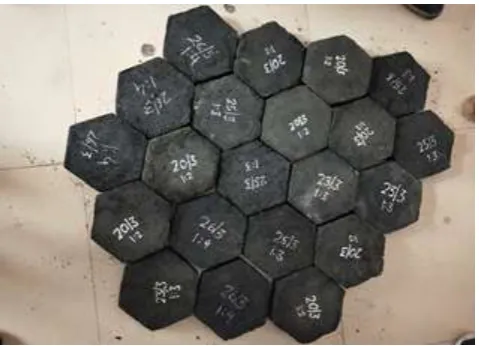
After this, we melt the waste plastic in the aluminum cane and after melting of waste plastic, we added the remaining two materials in the melted plastic. So, we got the desired mix proportion paste. Then, we mauled it into the regular hexagonal mould of edge length 10cm and height 06cm. After that we put out the block from the mould. And so we got the paver block in hexagonal shape.
[image:2.595.312.552.255.428.2]The procedure is same for casting the other two types of blocks.
Fig – 1 Plastic Paver Block Casted
4. TESTS & RESULTS
4.1 Compressive Strength Test
It is one type of test which is perform on the blocks. In this test block experience opposing forces that push inward upon the specimen from opposite sides or is otherwise compressed, squashed, crushed or flattened. The test block is generally placed in between two plates that distribute the applied load across the entire surface area of two opposite faces of the test blocks and then the plates are together by a universal testing machine causing the sample to flatten. A compressed is usually shortened in the direction of the applied forces and expands in the direction perpendicular to the forces.
© 2019, IRJET | Impact Factor value: 7.211 | ISO 9001:2008 Certified Journal
| Page 1304
whether or not the material is suited for specific applications or if it will fail under the specified stresses. In these, Akkalkuwa Side Walkway Project we test the paver block of different proportion for 7days and 28days for compression test.
Table:01 Compressive Strength of M-1 Mix Ratio (1:2)
Table:02 Compressive Strength of M-2 Mix Ratio (1:3)
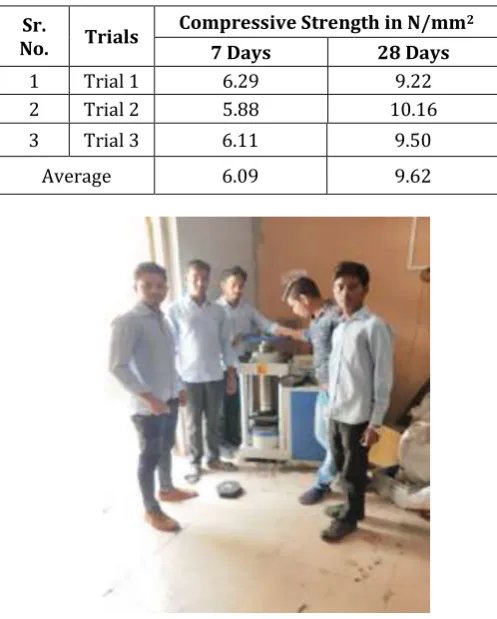
[image:3.595.309.558.283.376.2]Table:03 Compressive Strength of M-3 Mix Ratio (1:4)
Fig – 2 Testing of Paver Blocks
4.2 Tensile Strength Test
This test is also known as tension testing. It is fundamental engineering test in which a sample is subjected to a controlled tension until failure. Properties which are directly measured via a tensile test are ultimate tensile strength, breaking strength, maximum elongation and reduction. From these measurements the following properties can also be determined like Young’s Modulus, Poisson’s ratio, yield Strength and strain hardening characteristics.
In these project we test the paver block for tensile test for 28days.
[image:3.595.31.280.435.745.2]Table:04 Split Tensile Strength of M-1 Mix Ratio (1:2)
Table:05 Split Tensile Strength of M-2 Mix Ratio (1:3)
4.3 Fire Resistance Test
This test on paver block made up of plastic, shows that, the duration for which a plastic paver block can withstand a standard fire resistance test. For this test, we put the plastic paver block after 28 days of casting in the oven for 1 hours after observation it’s condition will be verified.
Sr. No. Trials Compressive Strength in N/mm2
7 Days 28 Days
1 Trial 1 11.06 14.65
2 Trial 2 10.33 15.92
3 Trial 3 10.02 14.92
Average 10.47 15.16
Sr.
No. Trials
Compressive Strength in N/mm2
7 Days 28 Days
1 Trial 1 8.37 12.36
2 Trial 2 8.83 11.93
3 Trial 3 7.98 12.23
Average 8.39 12.17
Sr.
No. Trials
Compressive Strength in N/mm2
7 Days 28 Days
1 Trial 1 6.29 9.22
2 Trial 2 5.88 10.16
3 Trial 3 6.11 9.50
Average 6.09 9.62
Sr.
No. Trials Split Tensile Strength in N/mm 2
7 Days 28 Days
1 Trial 1 12.83 24.67
2 Trial 2 13.36 23.92
3 Trial 3 13.12 24.47
Average 13.10 24.35
Sr.
No. Trials Split Tensile Strength in N/mm 2
7 Days 28 Days
1 Trial 1 9.91 21.24
2 Trial 2 10.21 20.87
3 Trial 3 10.09 21.11
Average 10.07 21.07
Sr.
No. Trials Split Tensile Strength in N/mm 2
Average 8.12 19.04
Table:06 Split Tensile Strength of M-3 Mix Ratio (1:4)
7 Days 28 Days
1 Trial 1 8.17 18.87
2 Trial 2 7.93 19.19
© 2019, IRJET | Impact Factor value: 7.211 | ISO 9001:2008 Certified Journal
| Page 1305
Table:07 Fire Resistance Test After 28 Days for 1Hours
Table:08 Water Absorption Test After 28 Days for 24hours
4.6 Acid Resistance Test
In this test, we put the plastic paver block in the concentrated Sulphuric acid (H2SO4) for 24 hours after
28days of casting. In
chemicals, that, it will withstand with the different chemical or not.
Table:09 Acid Resistance Test After 28 days for 24hours
5. CONCLUSIONS
On the basis of this project we conclude the following results:
1. The main advantage of this project, is that, we are utilizing the waste plastic in the paver block to reduce the disposal problem of plastic.
2. Cost of the waste plastic is less than the cement. So, the paver block manufactured with the plastic is economical.
3. Paver block manufactured with waste plastic, stone dust and sand have shown better result.
4. The waste plastic is easily available, so, it is to not difficult to go somewhere to find it.
5. As compare to concrete paver block the compressive strength is low, so, it can be used in sidewalks, garden’s walkway, light traffic road etc.
6. REFERENCE
1. https://en.m.wikipedia.org/wiki/Sand
2. https://en.oxforddictionaries.com/definition/plastic
3. https://www.aquacalc.com/mobile/page/densitytable/ substance/sand-coma-and-blank-dry
4. https://www.testresources.net/applications/testtypes/ compression-test/
5. https://en.m.wikipedia.org/wiki/Tensile_testing
6. https://www.researchgate.net/publication/303273892
7. https://www.downtoearth.org.in ›
8. https://ourworldindata.org › plastic-pollution
9. www.sphinxsai.com
10. https://acadpubl.eu
11. https://www.thehindu.com
Sr.
No. Ratio Mix Effect of Acid (Conc.H2SO4)
1 M1 Slightly affect
2 M2 Slightly affect
3 M3 Slightly affect
Sr.
No. Ratio Mix Water absorb in %
1 M1 1.2
2 M2 1.14
3 M3 0.96
Sr.
No. Ratio Mix Temperature in ºC Changes
1 M-1
50 No Change
75 No Change
100 Slightly melt
2 M-2
50 No Change
75 No Change
100 Slightly melt
3 M-3
50 No Change
75 No Change
100 Slightly melt
4.4 Hardness Test
It is a measure of the resistance to localized plastic deformation induced by mechanical indention or abrasion. Macroscopic hardness is generally characterized by strong intermolecular bonds, but the behavior of solid materials under is complex; therefore, there are different measurements of hardness: scratch hardness, indentation hardness and rebound hardness.
Hardness is dependent on ductility, elastic stiffness, plasticity, strain, strength, toughness, viscoelasticity, and viscosity.
In these project we test the hardness of plastic paver block for 28 days.
The hardness of the paver blocks of all three types have high hardness. The scratches made on the paver block not show much effect on the surface.
4.5 Water Absorption Test
© 2019, IRJET | Impact Factor value: 7.211 | ISO 9001:2008 Certified Journal
| Page 1306
BIOGRAPHIES
Name: Shaikh Hujefa Ayyub
Address: 32, Chakradhar Colony, Nimzari Naka, Shirpur, Dist.-Dhule (MH)
Name: Adil Ahmed
Address: 43/1 Jawahar Marg, Nagda, Dist.-Ujjain (M.P.)
Name: Furqan Shaikh
Address: Behind Old Post Office, Navapur, Dist.-Nandurbar (MH)
Name: Shaileshkumar Raju Gadilohar
Address: At post vanyavihir, Taluka-Akkalkuwa, Dist.-Nandurbar (MH)
Name: Parth Sanjay Pardeshi
Address: At Post, Maratha Chouck, Taloda, Dist.-Nandurbar (MH)
Name: Md Ayesh Ali