ELUCIDATING HOW LEISURE EXPERIENCE FACILITATES WISDOM TRANSFORMATION IN
Department of Health Care and Social Work, Taipei University of Maritime
ARTICLE INFO ABSTRACT
Leisure is the primary lifestyle and center of life for older people. Developing interests and hobbies is particularly crucial for elderly adults. Therefore, this study established a model of wisdom transformation through exploring the
experiences enhance their perspectives of wisdom. Initially, a questionnaire survey was administered to preliminarily investigate elderly adults’ views of wisdom. Subsequently, adopting a qualitativ approach to interpretive phenomenology, this study conducted in
to analyze the transformative process of how their leisure experiences shaped their wisdom. The results indicate that wisdom transformation attributed t
integration, action and practice, and positive effects of cognition, affect, and reflection. Furthermore, wisdom transformation occurred through 4 stages: (a) leisure experience; (b) reflection and development; (c)
Copyright © 2018, Chia Hui Hou. This is an open access distribution, and reproduction in any medium, provided
INTRODUCTION
The pursuit of wisdom is an ongoing goal for individuals, societies, and cultures. The continuing and rich life experiences of elderly adults energize and support them during the aging process. Psychologists mostly regard wisdom as essential to pursuing healthy living, enhancing life quality, and improving cultures and societies (Holliday
1986). However, wisdom cannot be attained quickly. It is demonstrated in daily life by people that have exerted a considerable amount of effort and faced numerous challenges in their lives; furthermore, it is practiced by applying integrated knowledge to real-world scenarios. Elderly adults have more opportunities to participate in leisure activitie they retire and have more free time. Consequently, how to realize the truth of life and acquire wisdom through participating in leisure activities is crucial for fostering active aging among elderly adults and promoting social progress.
According to Toward the Aged Society: The White Book of
Policies for Senior Education (Ministry of Education, 2006),
elderly adults require learning activities that are intellectual, leisurely, and healthy; leisurely learning not only enables elderly adults to serve society, but also enhances their value of life. To elderly adults, leisure is gradually developed in life. Judging from leisure’s benefits, functions, and meaning for
*Corresponding author: Chia Hui Hou,
Department of Health Care and Social Work, Taipei University of Maritime Technology, R.O.C.
DOI: https://doi.org/10.24941/ijcr.32390.09.2018
ISSN: 0975-833X
Vol. 10, Issue, 09,
Article History:
Received 10th June, 2018
Received in revised form 27th July, 2018
Accepted 05th August, 2018 Published online 30th September, 2018
Citation: Chia Hui Hou, 2018. “Elucidating how leisure experience facilitates wisdom transformation in elderly adults Research, 10, (09), 73385-73392.
Key Words: Wisdom transformation, Elderly adults, Leisure experience.
RESEARCH ARTICLE
ELUCIDATING HOW LEISURE EXPERIENCE FACILITATES WISDOM TRANSFORMATION IN
ELDERLY ADULTS
*Chia Hui Hou
Department of Health Care and Social Work, Taipei University of Maritime Technology
ABSTRACT
Leisure is the primary lifestyle and center of life for older people. Developing interests and hobbies is particularly crucial for elderly adults. Therefore, this study established a model of wisdom transformation through exploring the process and effectiveness of how elderly adults’ leisure experiences enhance their perspectives of wisdom. Initially, a questionnaire survey was administered to preliminarily investigate elderly adults’ views of wisdom. Subsequently, adopting a qualitativ approach to interpretive phenomenology, this study conducted in-depth interviews on 11 elderly adults to analyze the transformative process of how their leisure experiences shaped their wisdom. The results indicate that wisdom transformation attributed to leisure experience was embodied in the integration, action and practice, and positive effects of cognition, affect, and reflection. Furthermore, wisdom transformation occurred through 4 stages: (a) leisure experience; (b) reflection and development; (c) action and practice; and (d) positive effects.
access article distributed under the Creative Commons Attribution License, the original work is properly cited.
The pursuit of wisdom is an ongoing goal for individuals, societies, and cultures. The continuing and rich life experiences of elderly adults energize and support them during Psychologists mostly regard wisdom as essential to pursuing healthy living, enhancing life quality, and Holliday and Chandler, 1986). However, wisdom cannot be attained quickly. It is hat have exerted a considerable amount of effort and faced numerous challenges in their lives; furthermore, it is practiced by applying world scenarios. Elderly adults have more opportunities to participate in leisure activities after they retire and have more free time. Consequently, how to realize the truth of life and acquire wisdom through participating in leisure activities is crucial for fostering active aging among elderly adults and promoting social progress. Toward the Aged Society: The White Book of (Ministry of Education, 2006), elderly adults require learning activities that are intellectual, leisurely, and healthy; leisurely learning not only enables society, but also enhances their value of life. To elderly adults, leisure is gradually developed in life. Judging from leisure’s benefits, functions, and meaning for
University of Maritime
elderly adults, leisure significantly influences the
psychological, physiological, emotional, and social aspects of elderly adults, and it is a vital factor for maintaining their physical and mental health. The development of wisdom is related to a person’s welfare. Through leisure, elderly adults
can retrospectively contemplate their interpersonal
dependency, care for life, and explore themselves and other people or things related to the four aforemention
obtain the essential experiences of life to reach a state of ego integrity or despair according to Erikson’s stages of psychological development. With rich life experience, elderly adults can offer their experiences, learning, life events, imagination, retrospections, reflections, and actions as the foundation of historical, cultural, and social heritage, thus nurturing their minds into a state of wisdom. Exploring this mechanism may elucidate how elderly adults develop awareness, spiritual growth, and wisdom, and may assist in determining the relations between elderly adults’ leisure activity experiences and their wisdom. Education institutes for elderly adults can use the results of this study as a reference for strategic planning and arranging learning activities. Moreover, the results can guide elderly adults to focus on leisure planning, value leisure learning
developing wisdom. This study was conducted to investigate the development and implications of elderly adults’ wisdom transformation induced by leisure experience, and construct a model of elderly adults’ wisdom transformation.
International Journal of Current Research
Vol. 10, Issue, 09, pp.73385-73392, September, 2018
Elucidating how leisure experience facilitates wisdom transformation in elderly adults
Available online at http://www.journalcra.com
z
ELUCIDATING HOW LEISURE EXPERIENCE FACILITATES WISDOM TRANSFORMATION IN
Technology
,
R.O.C
Leisure is the primary lifestyle and center of life for older people. Developing interests and hobbies is particularly crucial for elderly adults. Therefore, this study established a model of wisdom process and effectiveness of how elderly adults’ leisure experiences enhance their perspectives of wisdom. Initially, a questionnaire survey was administered to preliminarily investigate elderly adults’ views of wisdom. Subsequently, adopting a qualitative depth interviews on 11 elderly adults to analyze the transformative process of how their leisure experiences shaped their wisdom. The o leisure experience was embodied in the integration, action and practice, and positive effects of cognition, affect, and reflection. Furthermore, wisdom transformation occurred through 4 stages: (a) leisure experience; (b) reflection and
License, which permits unrestricted use,
elderly adults, leisure significantly influences the
psychological, physiological, emotional, and social aspects of elderly adults, and it is a vital factor for maintaining their h. The development of wisdom is related to a person’s welfare. Through leisure, elderly adults
can retrospectively contemplate their interpersonal
dependency, care for life, and explore themselves and other people or things related to the four aforementioned aspects to obtain the essential experiences of life to reach a state of ego integrity or despair according to Erikson’s stages of psychological development. With rich life experience, elderly adults can offer their experiences, learning, life events, agination, retrospections, reflections, and actions as the foundation of historical, cultural, and social heritage, thus nurturing their minds into a state of wisdom. Exploring this mechanism may elucidate how elderly adults develop self-awareness, spiritual growth, and wisdom, and may assist in determining the relations between elderly adults’ leisure r wisdom. Education institutes for elderly adults can use the results of this study as a reference for strategic planning and arranging learning activities. Moreover, the results can guide elderly adults to focus on leisure planning, value leisure learning, and have an active role in developing wisdom. This study was conducted to investigate the development and implications of elderly adults’ wisdom transformation induced by leisure experience, and construct a model of elderly adults’ wisdom transformation.
INTERNATIONAL JOURNAL OF CURRENT RESEARCH
Development of Wisdom with Age: According to Assmann (1994), Baltes and Smith (1990), and Holliday and Chandler (1986), wisdom is a cognitive ability that continuously develop with age. As the most quintessential product of human mental capacity, acquiring wisdom can facilitate living a good life, reconciling interpersonal conflicts, and enhancing community welfare. Moreover, a person’s wisdom can often guide the direction of their life and improve their quality of life (Yang, 2008). According to the balance theory of wisdom (Sternberg, 1998, 2003), wisdom is defined as how people employ practical intelligence and creativity to balance extra personal, interpersonal, and intrapersonal benefits with the aim of achieving a common good. Wisdom refers to a person’s ability to apply knowledge and experience to develop a keen and profound understanding of relevant factors in a scenario (including all relevant people and conditions), make timely and optimal judgments for taking action to solve problems in life, or to realize life’s ideals. In summary, elderly adults’ learning emphasizes empirical knowledge, promoting wisdom through knowledge, the ability to understand the meaning and relations embedded in knowledge so as to recognize scenarios in which it is produced, and the ability to apply knowledge to daily life situations.
Theory and Application of Transformative Learning:
Transformative learning is a process through which individuals integrate previous learning experiences as well as new knowledge and perspectives to modify their internal viewpoints and shape or forge new self-views through a series of critical-thinking processes that occur while reflecting on various meaning perspectives such as value of life, beliefs, assumptions, and expectations. According to Merriam, Caffarella, and Baumgartner (2007), the three essential concepts of transformative learning are experience, critical reflection, and development. On the basis of the three concepts, Mezirow (1991) proposed three types of reflection: (a) content reflection, which focuses on experience itself; (b) process reflection, which is directed at the methods of handling experience (i.e., problem-solving strategies); and (c) premise reflection, which refers to the premises, beliefs, and values that
societies attach to experience. The perspective of
transformation proposed by Mezirow (1991) is central to the process of adult development, in which various ideas and experiences are constructed to promote self-development and effect changes that lead to development. The present study verified the various dimensions of thinking in transformation theory. On the basis of this theory, we reviewed the leisure experiences of elderly adults and reinterpreted the relationship between their transformative experience and wisdom development to elucidate the theoretical developments in this field.
Studies on Elderly Adult Leisure Activities and Wisdom:
Aristotle classified leisure into the modes of amusement, recreation, and contemplation. Ibn Khaldun, both a historian and socialist, regarded leisure as one of the five fundamental needs of humans, and placed leisure at the top of the five needs. Godbey (1997) regarded leisure as enjoyable activities that people freely choose to engage in as well as a process of pursuing happiness and exploring the meaning of life. According to the meaning perspective of leisure, leisure is the highest value of life. It describes an ideal state of freedom and the enlightenment of the spirit and intellect. Kelly (1996) emphasized the perception of freedom and argued that freedom is the essence of leisure that includes (practiced) actions in
addition to the three elements of time, activity, and experience. Consequently, participating in leisure activities has positive effects on elderly adults’ adjustment to retired life. Regarding leisure’s functions for elderly people, Bammel and Burrus-Bammel (1996) indicated that leisure involves multiple effects, and leisure activities are beneficial to human’s innate social needs, desire for self-expression, instinctual approach to nature, opportunities for physical exercise, and ability to learn new knowledge and innovation. Furthermore, both the functions and benefits of leisure have a considerable influence on elderly people’s physical condition, life, and the society as a whole. For elderly adults, leisure can promote longevity and prevent disease. In terms of daily life, leisure can enhance elderly adults’ quality of life and enable them to develop positive social relationships and enrich themselves. At the society level, leisure can facilitate developing social values of lifelong learning and reducing the social cost associated with caring for elderly adults. Pursuing wisdom is a common goal of humans, and the process involves concerns such as investigating the meaning of life and approaches to overcoming life obstacles (Ardelt, 2000). Whether an individual can develop self-reflective ability to obtain wisdom is related to whether that individual can adopt an open attitude to the various knowledge domains, life’s issues, and internal and external life experiences (Achenbaum and Orwoll, 1991). Edginton and Chen (2008) regarded leisure as a type of transformation that is facilitated by forming and enhancing the following nine crucial skills, knowledge types, or attitudes: (a) learn to master new technologies; (b) use language skillfully; (c) maintain an active and ambitious attitude; (d) develop a good character; (e) develop the habit of self-reflection; (f) join professional organizations; (g) practice the principle of moderation; (h) learn to think philosophically; and (i) think creatively. Accordingly, the present study investigated the process of wisdom transformation employed by elderly adults and attempted to determine the relationships between leisure and wisdom development among elderly adults.
MATERIALS AND METHODS
Participants: This study recruited 11 elderly adults as its participants, among whom four were men and seven were women.
Questionnaire survey: To understand the participants’ opinions and levels of wisdom, this study compiled a wisdom evaluation questionnaire based on several psychological perspectives and wisdom scales.
In-depth interview: Focusing on the influence of the participants’ leisure on their wisdom, this study considered the participants’ history, the social development contexts in which they grew up, and their physical and mental health conditions. An interview outline was prepared after referring to wisdom-related interview questionnaires.
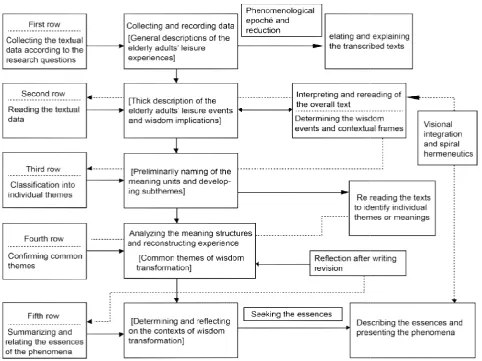
Data Analysis: This study conducted a thematic analysis to interpret the interview transcripts, which were analyzed and compiled following a whole-part-whole process, in which textual the data were repeatedly read, and keywords, themes, subthemes, and concepts were clarified. Figure 1 depicts the data analysis process. To reduce the complexity of cross meaning units, this study used Microsoft Access to extract units from the textual content and encoded the data according to the required conditions in order to enhance the validity and reliability of the data analysis by repeatedly reviewing and reading the textual data.
RESULTS
Three Aspects of Wisdom: Cognition, Affect, an Reflection: The participants offered numerous and varying descriptions of wisdom, including being a capable leader and dedicated to service; being lively and cheerful; working in search of cultural roots after retirement; being organized, discreet, conscientious, and responsible; talking patiently; being attentive, diligent, and careful; exhibiting the demeanor of a dignified elderly adult; being willing to help; exercising strong leadership; being persistent; not taking things personally or carelessly; being generous, self-sacrificing, and attentive to the general good; being responsible and brave; being amiable; having an ongoing passion for learning even in old age; and being kind, patient, and willing to help others. Overall, the
participants mostly described the characteristics and
[image:3.595.59.542.55.416.2]dispositions of a wise person from holistic aspects such as personal traits, social skills and attitudes, and wisdom reflected in actions.
Figure
73387 International Journal of Current Research,
This study conducted a thematic analysis to interpret the interview transcripts, which were analyzed and whole process, in which textual the data were repeatedly read, and keywords, themes, subthemes, and concepts were clarified. Figure 1 depicts the data analysis process. To reduce the complexity of cross-case meaning units, this study used Microsoft Access to extract e textual content and encoded the data according to the required conditions in order to enhance the validity and reliability of the data analysis by repeatedly reviewing and
Three Aspects of Wisdom: Cognition, Affect, and
The participants offered numerous and varying descriptions of wisdom, including being a capable leader and dedicated to service; being lively and cheerful; working in search of cultural roots after retirement; being organized, ientious, and responsible; talking patiently; being attentive, diligent, and careful; exhibiting the demeanor of a dignified elderly adult; being willing to help; exercising strong leadership; being persistent; not taking things personally sacrificing, and attentive to the general good; being responsible and brave; being amiable; having an ongoing passion for learning even in old age; and being kind, patient, and willing to help others. Overall, the
scribed the characteristics and
dispositions of a wise person from holistic aspects such as personal traits, social skills and attitudes, and wisdom reflected
These descriptions are similar to the concepts numerous scholars (Baltes and
Birren, 1980; Kramer, 1990; Sternberg, 2001; Yang, 2008).
Stage 1: Experience from Participating in Leisure Activities
A person encounters millions of experiences in life because life is essentially a series of activities, events, and observations, in which experiences are revisited and transported to current moments, engaging in a continuous establishment and correction to a person’s life wisdom and self-discovery. Thus, illness makes a
importance of health; failure makes a person seize opportunities for success; being helped makes a person more likely to help others; having positive learning experiences makes a person realize the joy of learning; and being “ordinary” makes a person realize the greatness of being extraordinary. Table 1 presents the 11 participants’ experiences of participating in leisure activities. The experiences were categorized under two themes: (a) delightful leisure experience, and (b) reflection a
Positive leisure experiences (i.e., delightful leisure tours) comprise eight meaningful and conceptual
experience outdoor recreation, leisure experience
craftsmanship, leisure experience knowledge, leisure
experience sociability, leisure experience
leisure experience entertainment, leisure experience
and social leisure with public service. The negative leisure experience (i.e., reflection and acceptance in adversity) also comprise eight meaningful and conceptual structures:
Figure 1. Framework of the qualitative data analysis
International Journal of Current Research, Vol. 10, Issue, 09, pp.73385-73392, September
These descriptions are similar to the concepts described by and Smith, 1990; Clayton and Birren, 1980; Kramer, 1990; Sternberg, 2001; Yang, 2008).
Stage 1: Experience from Participating in Leisure
A person encounters millions of experiences in life because essentially a series of activities, events, and observations, in which experiences are revisited and transported to current moments, engaging in a continuous establishment and correction to a person’s life wisdom and discovery. Thus, illness makes a person realize the importance of health; failure makes a person seize opportunities for success; being helped makes a person more likely to help others; having positive learning experiences makes a person realize the joy of learning; and being akes a person realize the greatness of being extraordinary. Table 1 presents the 11 participants’ experiences of participating in leisure activities. The experiences were categorized under two themes: (a) delightful leisure experience, and (b) reflection and acceptance in adversity. Positive leisure experiences (i.e., delightful leisure tours) comprise eight meaningful and conceptual structures: leisure
outdoor recreation, leisure experience–
aftsmanship, leisure experience knowledge, leisure
perience sociability, leisure experience physical exercise, entertainment, leisure experience–hobbies, and social leisure with public service. The negative leisure experience (i.e., reflection and acceptance in adversity) also
ight meaningful and conceptual structures:
humiliation, distress, unbearable lightness of being, difficult experiences, difficult beginnings, frustrating processes, setbacks, and regret.
Stage 2: Reflection and Development
After experience initiates transformative learning, reflection and development then facilitate transformation. In other words, experience per se cannot lead to transformation (Criticos, 1993). Critical thinking is developed through practice; therefore, people become a superior critic through critical
thinking (Merriam et al., 2007). In the present study, the types
of reflection elderly adults’ experienced include content reflection, critical reflection, process reflection, reflection after action, and reflection for action. Ardelt (2000) argued that elderly adults still possess the ability to develop wisdom, and the development and learning of wisdom are the primary goals of elderly adults participating in learning activities. Farquhar (2012) indicated that the acquisition of wisdom can be observed in a person’s attitudes and behaviors, and willingness to reflect is particularly beneficial to enhancing wisdom among elderly adults. The present study discussed and e
internal transformation of the 11 participants following their leisure experiences from the perspective of wisdom development among elderly adults. Subsequently, we summarized the themes, subthemes, and initial meaning units of the participants’ internal developments. The seven themes are as follows: (a) expectation and longing; (b) ambivalence and distress; (c) determination; (d) self-awareness and the meaning perspectives of leisure; (e) dispute avoidance and contentment; (f) recognition of self-positioning; and (g) optimism and happiness in life.
Table 1. Participants’ Experience of Participating in Leisure Activities
Type of leisure activities Leisure activity
Outdoor recreation Hiking, mountain hiking, visiting hot springs, walking, traveling, and fishing Physical exercise Table tennis, dancing, swimming, yoga, biking, and football
Knowledge Computers, attending workshops, reading, and blogging Craftsmanship/hobbies Painting, gardening (flowers), handicrafts, and calligraphy Entertainment Singing, watching TV, listening to music, and playing mahjong
Sociability Gathering with friends, chatting over the telephone, and engaging in volunteer work
Figure 2. First stage of wisdom transformation. This diagram depicts the concept of leisure experience
humiliation, distress, unbearable lightness of being, difficult experiences, difficult beginnings, frustrating processes,
After experience initiates transformative learning, reflection and development then facilitate transformation. In other words, experience per se cannot lead to transformation (Criticos, is developed through practice; therefore, people become a superior critic through critical 2007). In the present study, the types of reflection elderly adults’ experienced include content reflection, reflection after action, and reflection for action. Ardelt (2000) argued that elderly adults still possess the ability to develop wisdom, and the development and learning of wisdom are the primary goals ng activities. Farquhar (2012) indicated that the acquisition of wisdom can be observed in a person’s attitudes and behaviors, and willingness to reflect is particularly beneficial to enhancing wisdom among elderly adults. The present study discussed and explored the internal transformation of the 11 participants following their leisure experiences from the perspective of wisdom development among elderly adults. Subsequently, we summarized the themes, subthemes, and initial meaning units ’ internal developments. The seven themes are as follows: (a) expectation and longing; (b) ambivalence awareness and the meaning perspectives of leisure; (e) dispute avoidance and positioning; and (g)
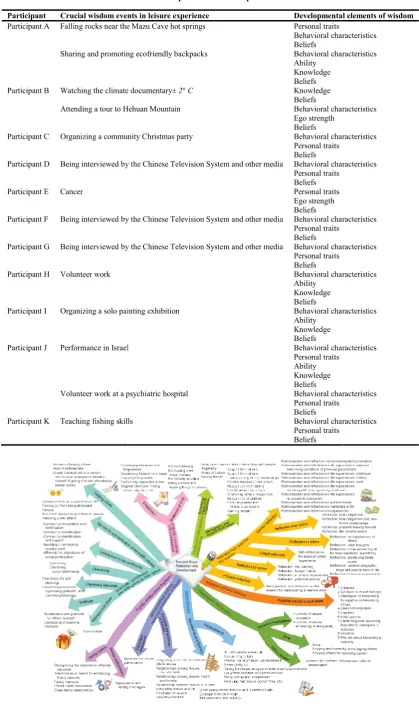
Table 2 presents the developmental elements of wisdom that were influenced in the crucial events that led to wisdom development (hereafter, crucial wisdom events) in participants’ leisure experiences.
types of reflection and personal development that the 11 participants in this study underwent after undergoing leisure experiences of various attributes. Most of the participants experienced content and critical reflection as well as development in individual cognition, affect, and reflection. This result corresponded with the balance theory of wisdom proposed by Stenberg (1998) and the concept of integration in the process view of wisdom p
Wisdom development refers to the process through which wisdom elements reach a state of equilibrium, namely individual mental integration, through a series of learning experiences and stimuli.
Stage 3: Action and Practice
The transformative learning process proposed by Mezirow involves the exercise of reflecting on the basis of existential experience and knowledge to achieve critical reflection and ultimately obtain broad and profound knowledge and experience to facilitate action (
Accordingly, transformative learning must ultimately be put into action, with new perspectives forming the basis for interpreting new experiences and actions associated with other people (Mezirow, 1995; Merriam
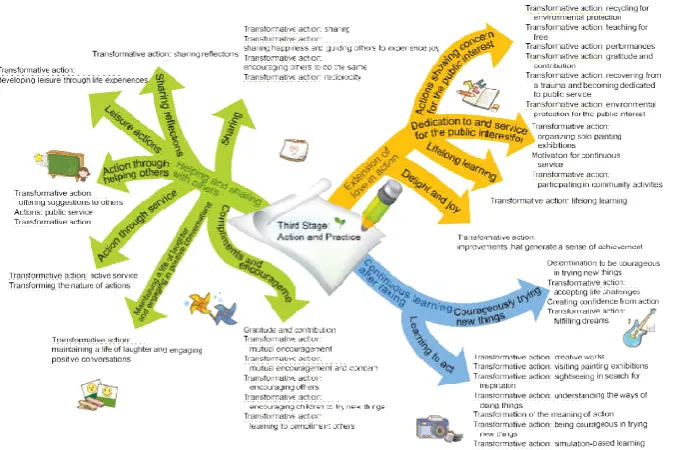
1998). The 11 participants in the present study became engaged in self-reflection and developing personal meaning perspectives immediately after being inspired by their leisure experiences, consequently shaping the development of the seven elements and three aspects of wisdom (Table 3).
Table 1. Participants’ Experience of Participating in Leisure Activities
Leisure activity
[image:4.595.85.506.104.396.2]Hiking, mountain hiking, visiting hot springs, walking, traveling, and fishing Table tennis, dancing, swimming, yoga, biking, and football
Computers, attending workshops, reading, and blogging Painting, gardening (flowers), handicrafts, and calligraphy Singing, watching TV, listening to music, and playing mahjong
Gathering with friends, chatting over the telephone, and engaging in volunteer work
stage of wisdom transformation. This diagram depicts the concept of leisure experience
Table 2 presents the developmental elements of wisdom that were influenced in the crucial events that led to wisdom-development (hereafter, crucial wisdom events) in the participants’ leisure experiences. Table 2 presents the various types of reflection and personal development that the 11 participants in this study underwent after undergoing leisure experiences of various attributes. Most of the participants ed content and critical reflection as well as development in individual cognition, affect, and reflection. This result corresponded with the balance theory of wisdom proposed by Stenberg (1998) and the concept of integration in the process view of wisdom proposed by Yang (2001). Wisdom development refers to the process through which wisdom elements reach a state of equilibrium, namely individual mental integration, through a series of learning
sformative learning process proposed by Mezirow involves the exercise of reflecting on the basis of existential experience and knowledge to achieve critical reflection and ultimately obtain broad and profound knowledge and
experience to facilitate action (Merriam et al., 2007).
Accordingly, transformative learning must ultimately be put into action, with new perspectives forming the basis for interpreting new experiences and actions associated with other people (Mezirow, 1995; Merriam and Caffarella, 1999; Taylor, 1998). The 11 participants in the present study became reflection and developing personal meaning perspectives immediately after being inspired by their leisure experiences, consequently shaping the development of the
and three aspects of wisdom (Table 3).
Table 1. Participants’ Experience of Participating in Leisure Activities
Hiking, mountain hiking, visiting hot springs, walking, traveling, and fishing
Gathering with friends, chatting over the telephone, and engaging in volunteer work
Table 2. Developmental Elements of Wisdom that were Influenced in the Crucial Wisdom Events in
Participant Crucial wisdom events in leisure experience
Participant A Falling rocks near the Mazu Cave hot springs
Sharing and promoting ecofriendly backpacks
Participant B Watching the climate
Attending a tour to Hehuan Mountain
Participant C Organizing a community Christmas party
Participant D Being interviewed by the Chinese Television System and other media
Participant E Cancer
Participant F Being interviewed by the Chinese Television System and other me
Participant G Being interviewed by the Chinese Television System and other media
Participant H Volunteer work
Participant I Organizing a solo painting exhibition
Participant J Performance in Israel
Volunteer work at a psychiatric hospital
[image:5.595.89.503.201.780.2]Participant K Teaching fishing skills
Figure 3. Second stage of wisdom transformation. This diagram depicts the processe
73389 International Journal of Current Research,
Developmental Elements of Wisdom that were Influenced in the Crucial Wisdom Events in the Participants’ Leisure Experiences
Crucial wisdom events in leisure experience Developmental elements
Falling rocks near the Mazu Cave hot springs Personal traits
Behavioral characteristics Beliefs
Sharing and promoting ecofriendly backpacks Behavioral characteristics Ability
Knowledge Beliefs Watching the climate documentary± 2° C Knowledge
Beliefs
Attending a tour to Hehuan Mountain Behavioral characteristics Ego strength
Beliefs
Organizing a community Christmas party Behavioral characteristics Personal traits
Beliefs
Being interviewed by the Chinese Television System and other media Behavioral characteristics Personal traits
Beliefs Personal traits Ego strength Beliefs
Being interviewed by the Chinese Television System and other media Behavioral characteristics Personal traits
Beliefs
Being interviewed by the Chinese Television System and other media Behavioral characteristics Personal traits
Beliefs
Behavioral characteristics Ability
Knowledge Beliefs
Organizing a solo painting exhibition Behavioral characteristics Ability
Knowledge Beliefs
Performance in Israel Behavioral characteristics
Personal traits Ability Knowledge Beliefs
psychiatric hospital Behavioral characteristics Personal traits
Beliefs
Teaching fishing skills Behavioral characteristics
Personal traits Beliefs
Figure 3. Second stage of wisdom transformation. This diagram depicts the processes of reflection and development
International Journal of Current Research, Vol. 10, Issue, 09, pp.73385-73392, September
Developmental Elements of Wisdom that were Influenced in the Crucial Wisdom Events in
Developmental elements of wisdom
Behavioral characteristics
Behavioral characteristics
Behavioral characteristics
Behavioral characteristics
Behavioral characteristics
Behavioral characteristics
Behavioral characteristics
Behavioral characteristics
Behavioral characteristics
Behavioral characteristics
Behavioral characteristics
Behavioral characteristics
reflection and development
Table 3. Actions and Practices of Wisdom and Types of Transformative Action Among the
Participant Theme
Participant A Helping and sharing with others Extending love through action Continuous learning after taking action Participant B Helping and sharing with others
Extending love through action Participant C Helping and sharing with others
Continuous learning after taking action Participant D Helping and sharing with others
Continuous learning after taking action Participant E Helping and sharing with others
Continuous learning after taking action Participant F Helping and sharing with others
Continuous learning after taking action Participant G Helping and sharing with others Participant H Helping and sharing with others Participant I Helping and sharing with others Extending love through action Participant J Helping and sharing with others
Extending love through action
Continuous learning after taking action Participant K Helping and sharing with others
[image:6.595.133.471.328.553.2]Note. * refers to individual change, rather than change arising from nonsocial action.
[image:6.595.120.473.589.781.2]Figure 4. Third stage of wisdom transformation:
Table 3. Actions and Practices of Wisdom and Types of Transformative Action Among the
Action and practice of wisdom
Sharing and promoting the making of ecofriendly backpacks Promoting and practicing ecofriendliness
Continuous learning after taking action Planning learning projects independently
Sharing knowledge of environmental protection through blogs Being a corporate energy conservation consultant
Organizing community activities and recording community stories taking action Learning photography skills and organizing related activities
Complimenting and encouraging friends’ paintings Continuous learning after taking action Visiting painting exhibitions
Encouraging neighbors to learn painting together Continuous learning after taking action Observing and learning from others’ paintings
Complimenting and encouraging friends’ paintings Continuous learning after taking action Taking outdoor trips to seek inspiration for painting
Complimenting and encouraging friends’ paintings Community volunteer work
Organizing solo painting exhibitions
Dedication to painting as a means for recording the history of Taiwan Assisting with establishing the Saisiyat Networking Dance Association Dance performances
Public education films as well as the letters written by and speeches about children receiving early intervention
Continuous learning after taking action Guiding the learning of psychiatric patients Teaching fishing skills
* refers to individual change, rather than change arising from nonsocial action.
Figure 4. Third stage of wisdom transformation: diagram of action and practice
Figure 5. Model of wisdom transformation
Table 3. Actions and Practices of Wisdom and Types of Transformative Action Among the Participants
Type of
transformative action
Sharing and promoting the making of ecofriendly backpacks Change Change Choice, change Sharing knowledge of environmental protection through blogs Change
Adaptation, change Organizing community activities and recording community stories Change
Learning photography skills and organizing related activities Adaptation, change Change
Change Choice, change Change Change Change Change Change Change painting as a means for recording the history of Taiwan Change
Assisting with establishing the Saisiyat Networking Dance Association Adaptation, change
Public education films as well as the letters written by and speeches
Change
Change Change
After the process of transformative learning, the participants applied their newly acquired perspectives to their lives and services. Figure 3 illustrates the framework of this stage of wisdom transformation.
Stage 4: Positive Effects
Sternberg (2003) regarded wisdom as the attainment of a common good after achieving a balance among extrapersonal, interpersonal, and intrapersonal benefits. Theories of wisdom also emphasize that living a good life is necessarily related to wisdom (Ardelt, 2000; Baltes and Staudinger, 2000; Kramer, 1990). Positive effects mark the final stage of the wisdom process, which can be described from the aspects of the self and others. People apply their wisdom to accomplish life goals or tasks, thus leading the ideal life that that they envision. Through this process, people obtain a relatively greater and richer sense of happiness. Regarding the aspect of others, wisdom entails a strong goodwill that usually enhances the welfare of the self and that of others, and positively affects the surrounding community (Yang, 2008). Consequently, the present study discussed the positive effects from internal and external perspectives under the two themes of self-transcendence and external accomplishment.
Model of Wisdom Transformation
In accord with the results of other studies, the present study determined that the experience of participating in leisure activities facilitates positive wisdom transformation that involves the stages of reflection, development, and action. Figure 5 depicts the proposed wisdom transformation model, comprising the four stages of leisure experience, reflection and development, action and practice, and positive effects. The proposed model can serve as a reference for future studies and practical planning related to elderly adult learning.
1. Leisure experiences can be divided into positive and
negative experiences.
2. Reflection and development are not only the integration
of cognition, affect, and reflection, but also the integration of the seven elements of wisdom (i.e., belief, ability, ego strength, personal traits, behavioral characteristics, balance of interests, and knowledge).
3. Action and practice represent the process of choice,
adaptation, and change.
Conclusion
This study determined that wisdom is a multidimensional concept rather than being composed of only one single cognitive dimension. Moreover, when viewed from the perspective of functional theory, wisdom is the ability of knowing when and how to apply intellect, experience, understanding, and common sense, as well as a series of integrated workings of wisdom elements for creating a balanced common good for individuals, organizations, and society. To accomplish the life goal of achieving wisdom, elderly adults can extend their leisure experience, enhance the probability of wisdom transformation, and improve their reflective and developmental capabilities through leisure learning in order to courageously take action and enhance their transformational wisdom. In addition, we recommend that practitioners in this field formulate diverse and interactive leisure learning programs for elderly adults, create innovative
leisure opportunities, establish a leisure resource network, and guide elderly adults through integrating leisure into their lives to facilitate wisdom development and transformation. By continuously accumulating and increasing leisure experience, elderly adults can integrate their life experiences and knowledge to realize the goal of active aging.
REFERENCES
Achenbaum, W. A., and Orwoll, L. 1991. Becoming wise: A psycho-gerontological interpretation of the book of job. International Journal of Aging and Human Development, 32, 21–39. http://dx.doi.org/10.2190/419R-X8FC-Q6NE-0M85
Ardelt, M. 2000. Intellectual versus wisdom-related
knowledge: The case for a different kind of learning in the
later years of life. Educational Gerontology, 26, 771–789.
http://dx.doi.org/10.1080/036012700300001421
Assmann, A. 1994. Wholesome knowledge: Concepts of wisdom in a historical and cross-cultural perspective. In D. L. Featherman, R. M. Lerner, and M. Perlmutter (Eds.), Life-span development and behavior (Vol. 12, pp. 187– 224), Hillsdale, NJ: Lawrence Erlbaum.
Baltes, P. B., and Smith, J. 1990. Toward a psychology of wisdom and its ontogenesis. In R. J. Sternberg (Ed.), Wisdom: Its nature, origins, and development (pp. 87– 120). New York, NY: Cambridge University Press.
Baltes, P. B., and Staudinger, U. M. 2000. Wisdom: A metaheuristic (pragmatic) to orchestrate mind and virtue
toward excellence. American Psychologist, 55, 122–136.
Bammel, G., and Burrus-bammel, L. L. 1996. Leisure and
Human Behavior. Dubuque, IA: Brown and Benchmark
Publishers.
Brooks, A. K. 2000. Cultures of transformation. In A. L.
Wilson and E. R. Hayes (Eds.), Handbook of adult
education(pp. 161–170). San Francisco, CA: Jossey-Bass.
Brooks, A. K. 2000. Cultures of transformation. In A. L.
Wilson and E. R. Hayes (Eds.), Handbook of adult
education (pp. 161–170). San Francisco: Jossey-Bass.
Clayton, V. P., and Birren, J. E. 1980. The development of wisdom across the life span: A reexamination of an ancient
topic. In P. B. Baltes and O. G. Brim (Eds.), Life-span
Development and Behavior (Vol. 3,pp. 103–135). San
Diego, CA: Academic Press.
Criticos, C. 1993. Experiential learning and social
transformation for a post-apartheid learning future. In D.
Boud, R. Cohen, and D. Walker(eds.), Using Experience
for Learning. Buckingham, England, and Bristol, PA:
Society for Research into Higher Education and Open University Press.
Edginton, C. R., and Chen, P. 2008. Leisure as transformation.
Champaign, IL: Sagamore.
Farquhar, L. 2010. Wisdom in a learning retirement institute. Educational Gerontology, 36 , 641–653.
Godbey, G. 1997. Leisure in your life: An exploration (4th
Ed.). State College, PA: Venture Publishing.
Godbey, G. 1999. Leisure in your life: An exploration (4th
Ed.). State College, PA: Venture Publishing.
Holliday, S. G., and Chandler, M. J. 1986. Wisdom:
Explorations in adult competence.Basel, Switzerland:
Karger.
Kelly, J. R. 1996. Leisure(3rd ed.). Boston, MA: Allyn and
Bacon.
Kramer, D. A. 1990. Conceptualizing wisdom: the primacy of
affect-cognition relations. In R. Sternberg (Ed.), Wisdom:
Its nature, origins, and development (pp. 279–309). Cambridge, MA: Cambridge University Press. DC:
Hemisphere Publishing.
Lynn F. 2010. Wisdom in a learning in retirement institute.
Educational Gerontology, 36, 641–653. http://dx.doi.org/
10.1080/03601277.2010.480875
Merriam, S. B., Caffarella, R. S., and Baumgartner, L. M.
2007. Learning in adulthood: A comprehensive guide (3rd
ed.). San Francisco, CA: Jossey-Bass.
Mezirow, J. 1991. Transformative Dimensions of Adult
Learning. San Francisco: Jossey-Bass.
Mezirow, J. 1995. Transformation theory of adult learning. In
M. R. Welton (Ed) (pp. 39–70), In Defense of the
Lifeworld, New York: State University of New York Press.
Ministry of Education 2006. Toward the aged society: The
white book of policies for senior education. Taipei, Taiwan:
Ministry of Education.
Sternberg, R. J. 1998. A balance theory of wisdom. Review of
General Psychology, 2,347–365. http://dx.doi.org/10.1037/
1089-2680.2.4.347
Sternberg, R. J. 2001. Why schools should teach for wisdom: The balance theory of wisdom in educational settings.
Educational Psychologist, 36, 227–245.http://dx.doi.org/
10.1207/S15326985EP3604_2
Sternberg, R. J. 2003. Cognitive psychology (3rd ed.).
Belmont, CA: Wadsworth.
Yang, S. Y. 2001. Conceptions of wisdom among Taiwanese
Chinese. Journal of Cross-cultural Psychology, 32, 662–
680.
Yang, S. Y. 2004. Preliminary investigation into the
Implications and Process of Wisdom. Indigenous
Psychological Research in Chinese Societies,29, 185–238.
Yang, S. Y. 2004. Wisdom, a Taiwanese Chinese perspective.
Poster presented in 112th Annual Convention of American
Psychological Association, Honolulu, Hawaii, USA.
Yang, S. Y. 2008. A process view of wisdom. Journal of Adult
Development, 15, 62–75.
http://dx.doi.org/10.1007/s10804-008-9037-8.