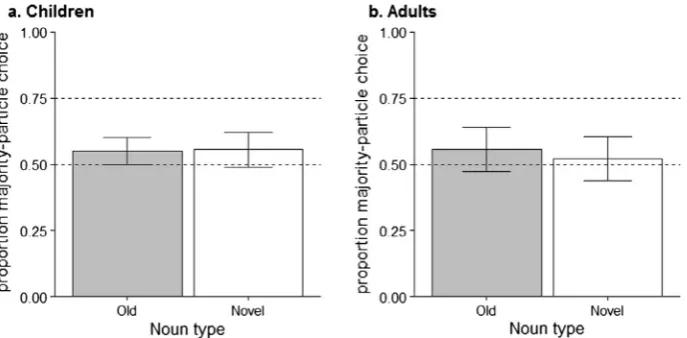
Acquiring variation in an artificial language: Children and adults
are sensitive to socially conditioned linguistic variation
Anna Samara
a,⇑, Kenny Smith
b, Helen Brown
c, Elizabeth Wonnacott
aa
Division of Psychology and Language Sciences, University College London, United Kingdom b
School of Philosophy, Psychology and Language Sciences, University of Edinburgh, United Kingdom c
Department of Psychology, University of Warwick, United Kingdom
a r t i c l e i n f o
Article history:
Accepted 20 February 2017 Available online 21 March 2017
Keywords:
Artificial language learning Language acquisition Statistical learning Sociolinguistic variation Regularization
a b s t r a c t
Languages exhibit sociolinguistic variation, such that adult native speakers condition the usage of linguistic variants on social context, gender, and ethnicity, among other cues. While the existence of this kind of socially conditioned variation is well-established, less is known about how it is acquired. Studies of naturalistic language use by children provide various examples where children’s production of sociolinguistic variants appears to be con-ditioned on similar factors to adults’ production, but it is difficult to determine whether this reflects knowledge of sociolinguistic conditioning or systematic differences in the input to children from different social groups. Furthermore, artificial language learning experiments have shown that children have a tendency to eliminate variation, a process which could potentially work against their acquisition of sociolinguistic variation. The current study used a semi-artificial language learning paradigm to investigate learning of the sociolinguis-tic cue of speaker identity in 6-year-olds and adults. Parsociolinguis-ticipants were trained and tested on an artificial language where nouns were obligatorily followed by one of two meaningless particles and were produced by one of two speakers (one male, one female). Particle usage was conditioned deterministically on speaker identity (Experiment 1), probabilistically (Experiment 2), or not at all (Experiment 3). Participants were given tests of production and comprehension. In Experiments 1 and 2, both children and adults successfully acquired the speaker identity cue, although the effect was stronger for adults and in Experiment 1. In addition, in all three experiments, there was evidence of regularization in participants’ pro-ductions, although the type of regularization differed with age: children showed regulariza-tion by boosting the frequency of one particle at the expense of the other, while adults regularized by conditioning particle usage on lexical items. Overall, results demonstrate that children and adults are sensitive to speaker identity cues, an ability which is fundamen-tal to tracking sociolinguistic variation, and that children’s well-established tendency to regularize does not prevent them from learning sociolinguistically conditioned variation. Ó2017 The Authors. Published by Elsevier Inc. This is an open access article under the CC BY
license (http://creativecommons.org/licenses/by/4.0/).
1. Introduction
Variation is ubiquitous in natural language and occurs at all levels of analysis, be it phonetic, morphological, syntactic, semantic, or lexical. However, the usage of linguistic variants tends to beconditioned, so that variation is rarely, possibly
http://dx.doi.org/10.1016/j.cogpsych.2017.02.004
0010-0285/Ó2017 The Authors. Published by Elsevier Inc.
This is an open access article under the CC BY license (http://creativecommons.org/licenses/by/4.0/).
⇑Corresponding author at: Division of Psychology and Language Sciences, University College London, Chandler House, 2 Wakefield Street, London WC1N 1PF, United Kingdom.
E-mail address:[email protected](A. Samara).
Contents lists available atScienceDirect
Cognitive Psychology
never, fully unpredictable. A clear example of deterministic conditioning is the regular past tense marker in English (written as –ed), which can be realized as [t], [d], or syllabic [ɪd] (as inliked,loved,hated), with the choice of variant dependent on the phonological features of the final segment of the stem. However, conditioning contexts may also be probabilistic. For exam-ple, in English, a final (–t, d) segment in a final cluster is variably deleted (nestvs.nes’) with the probability of deletion affected by a variety of linguistic factors, including the phonological features of the following segment (e.g., /t/ or /d/ fol-lowed by an obstruent is more likely to be deleted than /t/ or /d/ folfol-lowed by a liquid), morphological class (e.g., final /t/ or /d/ in monomorphemes delete more frequently than weak past tense forms) and the presence of a following pause, as well as social factors such as the speaker’s gender and social context. We will refer to patterns of variation involving these latter kinds of social conditioning factors associolinguistic.
Although the existence of sociolinguistic variation is well-established in adult language, less is known about how children respond to socially conditioned variation during acquisition. For example, can young children pick up on the fact that differ-ent speakers use differdiffer-ent variants, even when that relationship is probabilistic (as is often the case in adult languages)? How does the learning of socially conditioned variation interact with their well-demonstrated tendency to regularize experimenter-created miniature languages that exhibit fully unpredictable variation? The current paper explores these questions using a statistical learning framework, comparing children’s and adults’ learning of a form of sociolinguistic vari-ation (variable forms cued by speaker identity) in an artificial language.
1.1. Sociolinguistic variation in adult learners
In his seminal work,Labov (1963)demonstrated that linguistic variation may be subject to probabilistic, extra-linguistic social constraints. He found that the pronunciation of some vowels on Martha’s Vineyard (an island off the coast of Mas-sachusetts) was changing from the standard American pronunciation, and that this was affected by social identity: age, occu-pation, and social group were all important factors, with those who identified most closely as natives of the island using the incoming forms most frequently. Social influences on linguistic choice were further established inLabov’s (1966)‘‘New York department store study”, which examined differences in the pronunciation of postvocalic /r/ (e.g., as occurring infourth, floor) in New York speech. Rhotic varieties (where /r/ is pronounced post-vocalically) were associated with prestige in New York, and were favoured by employees of an upper-middle class shopping center, whereas /r/-dropping was more fre-quently used by employees in a shopping center with a more working-class clientele. This work also revealedwithin-speaker variation and correlations between language style and context, with rhoticity notably higher in the context of careful or emphatic speech, particularly so among employees catering for a middle-class clientele.
Over the last 50 years, a wide range of sociolinguistic studies have since confirmed Labov’s early findings, showing that in adult language, production of phonological and grammatical variation is in accordance with a number of extra-linguistic social factors. For example, there is a large literature demonstrating differences in male and female language use (e.g.,
Labov, 1966, 2001; Neu, 1980; Trudgill, 1974; Wolfram, 1969). This shows that speakers may associate certain variants with gender and avoid variants they perceive as gender-inappropriate (Cameron, 2005; Eckert & McConnell-Ginet, 1999). Women may also use forms that represent stable social variables (i.e., ‘‘standard” forms) in their speech more frequently than men (Labov, 1990). Age (e.g., speech before and after adolescence) and ethnicity (i.e., ethnically marked ways of speaking) have been further shown to exert an influence on linguistic choices (e.g.,Eckert, 1997; Foulkes, Docherty, & Watt, 2005; Hoffman & Walker, 2010; Knack, 1991; Mendoza-Denton, 2008).
1.2. Sociolinguistic variation in child language
Traditionally, sociolinguistic research has focused on adult language users rather than addressing questions of acquisi-tion. An early reason was an assumption (originating withLabov, 1964) that child speech is monostylistic early in develop-ment, with little sociolinguistic competence before the age of 12. The methodological complications in working with children (e.g., the inadequacy of the sociolinguistic interview for the elicitation of speech in young children, practical diffi-culties in obtaining corpus of data large enough to locate sociolinguistic variation;Foulkes, Docherty, & Watt, 2001; Roberts, 1994) also proved a barrier.Labov (1989)was among the first to empirically address the question ofwhenchildren first exhi-bit adult-like command of sociolinguistic variables. He analysed the speech of three Philadelphian children (aged 6, 7, and 9 years) during family interaction, focusing on two sociolinguistic target variables, namely (–t, d) deletion and alternations between /ɪ
N
/ and /ɪn/ in progressive inflection on verbs. In both of the 6- and 7-year-old’s speech, there was some evidence that some patterns of variation seen in their parents’ speech and their local dialect were present (for example, /t/ and /d/ were hardly ever deleted before pauses), although other constraints were not mastered (for example, unlike adults, they did not show greater likelihood of deletion in certain phonological contexts). While other work has not replicated these pre-cise findings with this variable, the emerging literature confirms that conditioned variationdoesappear in children’s speech from early ages, and that the older the children get, the more factors condition variation in their speech (Shin, 2016). Impor-tantly, the exact age of mastery differs across variables and constraints, possibly due to their differential distributional ten-dencies in the input and their complexity (Shin, 2016). For example,Roberts (1997)studied (-t,-d) deletion in sixteen 3– 4 year olds in Philadelphia using an elicitation paradigm. She found that even these young children had acquired some rel-evant grammatical and phonological constraints (in contrast to Labov’s findings); however, patterns of (t- d) deletion did not differ as a function of formal versus informal speech (elicited using different activities), or style of interaction (studied byeliciting speech addressed towards different interlocutors such as the experimenter or a puppet). A similar pattern was found bySmith, Durham, and Fortune (2009)in data from 11 Scottish 2- to 3-year-olds in naturalistic interactions with their caregivers: children largely mirrored the patterns of phonological conditioning present in their caregivers’ speech, but did not have the same patterns of conditioned variation for morphological class and style shifting. Smith, Durham, and Richards (2013; see also Smith, Durham, & Fortune, 2007)used similar methods with 29 2- to 4-year-olds and analysed a number of lexical, phonological and morpho-syntactic variables. For these variables, they found good evidence that linguistic constraints had been acquired, even in the youngest children, who used these variables similarly to their caregivers. Style-shifting constraints (different usage of the variables in teaching vs. play and routine vs. discipline), were only found in older children (>3 years) and only for certain variables. Interestingly, caregiver’s speech during these interactions did not exhibit evidence of style shifting for many variables, highlighting the importance of considering the actual input available to chil-dren (see alsoFoulkes et al., 2005), as opposed to the norms of adult-adult speech.
Research has also explored whether children are sensitive to sociolinguistic conditioning based on various components of speaker identity. For example,Díaz-Campos (2005)looked at usage of phonological variation in Spanish (retention or dele-tion of intervocalic /d/) and found that, like adults, 5-year-old children from higher socioeconomic backgrounds showed more usage of the standard form (see alsoReid, 1978; Romaine, 1978, 1984). Note, however, that this is likely directly tied to the frequency of the standard form in their input. Although the children did show some style shifting (indicating some knowledge of the differing social values of the variants), there was no evidence that they were actually aware of the differ-ential usage by different groups of speakers.
Gender differences have also been explored. For example, an early study byRomaine (1978)looked at socially marked variants of word-final /r/ in Scottish English and found that, as with adults, girls used the standard variants more frequently.
Habib (2016)studied usage of two socially marked phonological variants of /q/ in Arabic, rural [q] versus urban [ʔ], and found that, like adults, children showed gender differences, with girls using the newer, more urban variant more frequently than boys (although not until after the age of 8). However, it is again possible that gendered usage of linguistic variants could stem from input differences. There is evidence that such differences can occur:Foulkes et al. (2005)analysed parents’ use of / t/-glottaling in contexts with clear sociolinguistic patterning for adults and found that speech to girls generally contained more standard variants than speech to boys. This work highlights the difficulty of establishing when and whether children’s language reflects internal knowledge of sociolinguistic conditioning contexts, as opposed to simply reflecting frequencies in their input.
In sum, there is good evidence in the literature that children exhibit use of linguistic variants from an early age and that their usage of these variants may be constrained by some of the probabilistic conditioning factors which they encounter in their input. In particular, it is clear that linguistic constraints (phonological, morphological, lexical) can be learned in early childhood, although these may emerge at different ages for different variants. There is also evidence that, in some cases, chil-dren’s usage of linguistic variants may be consistent with adult social norms. However, on the basis of naturalistic data it can be difficult to establish whether and when they have actually acquired the relevant sociolinguistic conditioning cues, or whether their output merely reflects systematic biases in the input to children from different social groups. In the current work, we explore children’s learning of sociolinguistically conditioned variation using theartificial language learning method-ology, which allows direct experimental control over the input to be learnt.
1.3. Artificial language learning and the acquisition of variation
Artificial language learning – where learners are exposed to and tested on experimenter-created miniature languages – provides a methodology for exploring the types of linguistic regularities which learners can acquire. There is evidence that artificial languages can be processed similarly to natural languages (Ettlinger, Morgan-Short, Faretta-Stutenberg, & Wong, 2015; Magnuson, Tanenhaus, Aslin, & Dahan, 2003; Wonnacott, Newport, & Tanenhaus, 2008). This method now has a long history in the field of language acquisition (e.g.,Braine, 1963) and has been used to address such topics as word segmenta-tion (e.g.,Saffran, Aslin, & Newport, 1996), word learning (e.g.,Smith & Yu, 2008; Yu & Smith, 2007), the acquisition of phonology (Chambers, Onishi, & Fisher, 2010) and syntax (Frigo & McDonald, 1998; Gerken, Wilson, & Lewis, 2005; Reeder, Newport, & Aslin, 2013; Wonnacott, Boyd, Thomson, & Goldberg, 2012; Wonnacott et al., 2008) in both adults and children. Much of this work focuses on how sensitivity to statistically based patterns in the input can aid the extraction of linguistic generalizations.
Most relevant to the current study is a set of statistical learning experiments looking at the learning of artificial languages which exhibitunpredictable variation. In a seminal study,Hudson Kam and Newport (2005)exposed adults and children (5- & 6-years old) to an artificial language in which nouns could be followed by particles.1These particles occurred variably in the input presented to the learners and could be included or omitted: this variation was probabilistic in that one form had higher frequency in the input than the other (e.g., in one condition, particles were included 60% of the time a noun was produced and omitted 40% of the time) but, importantly, unlike natural languages, there were no further conditioning cues (either determin-istic or probabildetermin-istic) which determined inclusion or omission of a particle (e.g., the probability of occurrence/omission of the
1
post-nominal particle was the same for all nouns and in all syntactic contexts). After exposure to the language, children and adults underwent a production test where their own usage of the variant particles was examined. The central finding was that, rather than reproducing the unpredictable variability in their own input, children showedregularization, so that their own pro-ductions were systematic: children either removed variation altogether (either by always using the particle or by dropping it altogether) or (more rarely) by conditioning particle use on noun type or sentence position (including the particle only after the object nouns, or only in transitive and not intransitive sentences). In contrast, adults reproduced the unpredictable variabil-ity present in their input and matched the frequency usage of the particle (a behaviour known as probabilvariabil-ity matching).Austin, Newport, and Wonnacott (2006)found similar results in an artificial language with two competing particles (rather than pres-ence/absence variability), although here children almost always regularized by boosting the frequency of the more frequent form in the input.
Other work using similar paradigms suggests that adults can also be induced to regularize, at least in some circumstances.
Hudson Kam and Newport (2009)found that both adults and children showed regularization when variation was more com-plex (where there was one frequent particle and multiple low frequency alternatives), although adults still regularized less than children.Wonnacott and Newport (2005)looked at the learning of adults exposed to artificial languages containing unpredictable variation in either particle usage or word order and found more regularization with both types of variation in sentences involving novel (i.e., untrained) lexical items.Smith and Wonnacott (2010)demonstrated that even when adults appear to be probability matching, they may actually show a small but measurable tendency for regularization. They looked at the behaviour of adults who were exposed to a semi-artificial language, with nouns borrowed from English, where novel post-nominal particles marking plurality alternated unpredictably between two competing forms. Virtually all participants produced variable output given this variable input, and the population’s mean production frequency of the two particles matched that of their input, indicators which are normally taken to be diagnostic of probability matching. However, in a sec-ond phase of this experiment, the miniature languages produced by this initial group of participants were given to a secsec-ond group of participants to learn as a new target language, and then the output of those participants was passed in turn to a third group of participants, and so on in an iterated learning design. This transmission process revealed a regularization bias in adult learners, sufficiently subtle to be hard to identify in individuals but revealed by the amplifying effect of filtering the language through multiple adult learners (see alsoReali & Griffiths, 2009; Smith et al., 2017). Interestingly, the regularization
Smith and Wonnacott (2010)observed in adults often involved introducing lexical conditioning: participants maintained usage of the two variants, but differentially associated them with different nouns, a type of conditioning that has not been reported in experiments with children.
Some types of linguistic variability are also more prone to regularization than others. Culbertson, Smolensky, and Legendre (2012)showed that adult learners given input exhibiting variable word order will over-produce harmonic orders in their own output, favouring orders where modifiers appear consistently before or after the head of a phrase, with some nonharmonic orders being particularly dis-preferred; children showed a similar pattern of effects, with a stronger overall tendency to regularize and produce harmonic orders (Culbertson & Newport, 2015).
Finally, just as adults may sometimes regularize to some extent, children do not always fully regularize.Wonnacott (2011)demonstrated that 6-year-olds learning a semi-artificial language similar to that inSmith and Wonnacott (2010)
(i.e. two particles, one more frequent than the other2) did not generally show the strong, absolute regularization found by
Hudson Kam and Newport (2009), although they did show weaker but measurable regularization.Wonnacott (2011)speculated that the lack of strong regularization in children could be due to greater ease of lexical access due to the use of semi-artificial materials (see alsoHudson Kam & Chang, 2009;Hudson Kam & Newport, 2009).
In sum, the artificial language literature provides evidence that when learners are presented with a language containing unpredictable variation, they do not veridically reproduce that unpredictability; instead, they impose some systematicity in their own productions. This tendency to regularize appears stronger in children than adults, at least where the two have been directly compared. The results suggest thatbothchild language acquisition and learning and usage of languages by adults might play a role in removingunpredictablevariation from natural language. This could explain the fact that variation in natural language is generally conditioned. But does this literature have implications for understanding the acquisition of naturally occurring sociolinguistic variation? It is worth noting that the seminal experiments byHudson Kam and Newport (2005)were not designed to explore the learning of stable sociolinguistic variation; rather, their unpredictable input lan-guages were designed to mimic the type of language produced by late language learners, i.e., individuals who are incorrectly using linguistic structures inconsistently in obligatory contexts (Newport, 1990; Sorace, 2000). This is a type of variability that learners should not actually reproduce if they are to end up with a correct, native-like grammar. The finding that chil-dren did not acquire and reproduce these inconsistencies in the artificial languages was in line with the findings of Newport and colleagues (Newport, 1999; Ross & Newport, 1996; Singleton & Newport, 2004) who studied the language development of a profoundly deaf child (‘‘Simon”) who received American Sign Language (ASL) input only from his late-learner parents. In particular, Simon’s parents were found to use a particular class of ASL morphemes inconsistently (around 70% of the time in contexts where it would be obligatory in native ASL), whereas Simon largely regularized away this variation and used the forms very consistently (around 90% of the time in obligatory contexts), despite receiving no other linguistic input (see
Ross & Newport, 1996, for similar findings with deaf children learning ASL from hearing parents).
2
We refer here to the Generalist Language inWonnacott (2011)Experiment 1.
Turning to consider the learning of sociolinguistic variation, there is an obvious question: does the bias to regularize, which has been framed in terms of an advantage in ‘‘improving” inconsistent input, actually workagainstthe learning of probabilistic, socially conditioned variation? Could regularization cause learners to eliminate the variation they encounter, rather than learn the conditioning contexts? There is some evidence that sociolinguistic variability can make acquisition slower, such that, for example, Chilean Spanish-speaking children take longer to acquire the variable plural marking of their language (plural /-s/ is sometimes produced and sometimes omitted) relative to Mexican Spanish-speaking children learning the consistent plural marking of their language (plural /-s/ is categorically produced) (Miller & Schmitt, 2012). None of this work has, however, considered the presence of strong regularization in early child language, except forHabib’s (2016)study of the Arabic rural /q/ [ʔ] variants discussed above: in this study, children at the youngest ages (prior to 8) used one variant categorically (the /q/ variant, more associated with female usage in adults and older children), moving to the adult-like, gen-dered usage only later. However, it is again difficult to know the extent to which this pattern reflected the input, for example, if early input came primarily from female caregivers and little usage of [ʔ] was encountered. Thus, it is not clear that regu-larization does occur when children learn ‘‘natural” linguistic variation.
Artificial language learning can also be used to look at the learning of conditioned variation.Hudson Kam and Newport (2009)showed that adults could successfully learn a complex artificial language where particle usage was conditioned on the noun, even though they showed regularization in a matched artificial language where particles and nouns were equally frequent but used inconsistently.Austin et al. (2006)andWonnacott (2011)also showed that children could learn lexically conditioned variation in an artificial language.
Note that, in those experiments, the conditioning of particles was deterministic. Only one artificial language experiment to date has looked at the learning of probabilistic conditioned variation (Hudson Kam, 2015).Hudson Kam (2015)reports two experiments, one with adults and one with children (using somewhat different languages and methods), each compar-ing the learncompar-ing of an artificial language in which the particles were used inconsistently (i.e., exhibitcompar-ing unpredictable vari-ation) with the learning of a matched language where usage of the particles was probabilistically conditioned on syntactic position. Results from adults confirmed that they reproduced unconditioned variation, as in the original experiments (although, note that only absolute or near-absolute regularization was considered in these experiments, rather than more subtle reductions in variability as tested for inSmith & Wonnacott, 2010), and also showed that they were also able to approximate the conditioned patterns of usage in their input (they used particles more often in subject position than object position when this occurred in their input language, and vice versa). Children again showed strong regularization given inconsistent input, but importantly regularized the conditioned language less. Interestingly, this was despite the fact that children did not appear to have learned the actual conditioning in their input (they did not use particles more with subjects than with objects, despite that occurring in their input). Instead, there was some evidence that, at least some children, were imposing an alternative pattern of conditioning, whereby they were more likely to use particles in intransitive rather than transitive sentences. One possibility discussed byHudson Kam (2015), is that children had picked up that the variation is conditioned but were initially tracking over the wrong variables, as has also been observed in the sociolinguistic literature (Labov, 1989).
The results ofHudson Kam (2015)suggest that, when languages contain probabilistic conditioning cues, variation may be more learnable. However, it has not yet been demonstrated experimentally that children can acquire the actual patterns of conditioning which are present in their input, nor how this learning interacts with regularization when it occurs. In addition, whileHudson Kam (2015)focused on a language-internal cue (syntactic conditioning), no experiment to date has looked at a language-external social cue. This is important since, as discussed in Section 1.2, it is particularly difficult to establish through observations of naturalistic linguistic behaviour whether children can learn such cues. In the current study, we use artificial language learning techniques to explore whether learners can acquire variation conditioned on the sociolinguis-tic cue of speaker identity. The ability to track association between different speakers and their usage of different forms is necessary in order to acquire any conditioning which is indexed by speaker identity, such as gender, social status, or ethnic-ity. In these experiments, we consider whether both adult and child learners can acquire this type of conditioning in an arti-ficial language, and also explore the interaction with their bias for regularization.
1.4. The present study
FollowingWonnacott (2011), we usedsemi-artificiallanguages, adapted for use with young children. This version of arti-ficial language learning minimizes vocabulary learning during the experiment, thus, any age differences in the learning of morphosyntax cannot be due to differences in word learning ability (where adults outperform children). Furthermore, as shown byWonnacott (2011; see also Wonnacott, Samara, Saul, & Smith, in preparation), semi-artificial languages reduce children’s otherwise strong tendency to eliminate variation entirely, allowing us a better chance of seeing whether children can reproduce conditioned variability from their input.
to produce particles on behalf of a particular speaker) and comprehension (where they indicate which utterances are more appropriate for the different speakers). In Experiment 2, we repeated the experiment such that conditioning on speaker iden-tity was (more naturalistically) probabilistic (e.g., the male speaker usedtid75% of the time andkem25% of the time; the female speaker used 75%kemand 25%tid). In both experiments, in addition to exploring participants’ knowledge of cor rect/more-speaker-appropriate particle usage, when analysing production data we tested for the presence of any regulariza-tion, either through eliminating one particle, or through conditioning particle use lexically. Since these latter analyses sug-gested interesting differences between children and adults, in Experiment 3, we sought to explore whether these same patterns occurred even when there was no conditioning around speaker identity: we did this by training participants on lan-guages where each of the two speakers used both particles equally.
We also used (i) tests of verbal and nonverbal short term and working memory ability to ensure that our participant groups across experiments were balanced in working memory capacity, and (ii) a post-experiment ‘‘structured interview” (seeAppendix Afor list of questions) to obtain subjective reports of participants’ awareness of the relationship between par-ticle usage and speaker identity. The relationship between explicit awareness and artificial language learning performance is not well understood, although it has received some interest in recent years (e.g.,Hama & Leow, 2010; Leung & Williams, 2011; Williams, 2004, 2005). For sociolinguistic variables, the question of learner awareness is potentially interesting since, at least by adulthood, speakers are generally aware of the social values associated with different variants.
2. Experiment 1
2.1. Method
2.1.1. Participants
Participant details are show inTable 1. Thirty 5–6 year-old children and 30 adults took part in the study. Half (in each age group) were monolingual native English speakers and the other half spoke another (or more than one) language in addition to English.3Participants had no known hearing, language, or speech disorders and were matched for standardized memory per-formance across experiments (adults: allps > 0.510; children: allps > 0.109).4All-but-two participants completed the experi-mental sessions on four consecutive days; one child and one adult completed them over 5 days. Children were recruited from Year 1 and 2 of public primary schools in Coventry, Warwickshire, Greater London, Hertfordshire, and Scotland.5Children were rewarded with stickers and a certificate for their participation. Written consent was obtained from their parents prior to the first session, and verbal consent was obtained from the children at the beginning of each session.
[image:6.544.40.510.73.151.2]Adult participants were recruited through a university participant panel. They provided written consent at the beginning of the first session and were paid for their participation.
Table 1
Mean age and Automated Working Memory Assessment (AWMA) task performance in Experiments 1–3.
m; f mono; biling Age (yrs) WordReca
MazMema
BackDigReca
Exp. 1 Children 20; 10 15; 15 5.99 (0.35) 100.93 (14.76) 115.00 (15.10) 107.57 (20.78) Adults 8; 22 15; 15 21.26 (2.61) 91.29 (20.10) 100.00 (13.68) 105.77 (14.58)
Exp. 2 Children 13; 17 15; 15 6.12 (0.33) 102.90 (19.17) 110.20 (16.48) 103.30 (15.10) Adults 7; 23 15; 15 22.07 (3.55) 90.86 (17.22) 104.27 (12.82) 105.30 (16.32)
Exp. 3 Children 15; 15 15; 15 6.03 (0.45) 104.83 (14.89) 109.89 (17.23) 113.27 (18.11) Adults 13; 17 15; 15 22.88 (4.81) 92.33 (20.31) 104.27 (21.29) 107.30 (14.25)
Notes. Standard deviations in parentheses.
m = male; f = female; mono = monolingual; biling = bilingual; WordRec = Word Recall; MazMem = Mazes Memory; BackDigRec = Backwards Digit Recall. a
Standard scores.
3
Artificial language learning experiments often use only monolingual English speakers as participants, but this restriction is difficult for recruitment in Greater London. In addition, it is potentially of interest to see if bilinguals differ in their sensitivity to speaker identity cues, due to their greater experience in associating different individuals with different linguistic forms. We therefore aimed to recruit equal numbers of bilinguals and monolinguals for each condition and language group was initially included in all of the analyses to investigate any systematic differences between monolingual and bilingual participants. We found that there was no significant effect or interaction with language group, therefore, this factor was dropped from the analyses reported here.
4
It has been previously suggested (Hudson Kam & Newport, 2009; see alsoHudson Kam & Chang, 2009) that memory limitations could play a role in inducing regularization, potentially explaining why children regularize inconsistent input more than adults. To test this view,Perfors (2012)used a battery of measures to capture individual differences in memory ability among adults and assessed whether these predicted their differential performance on an artificial language learning task. In a similar vein, we also carried out a series of exploratory Pearson’s correlations between children and adults’ memory performance and the entropy scores reported in Sections2.2.5.1,3.2.4.1, and 4.2.2.1. Although one must always be cautious about inferring from a null result, similar to
Perfors (2012), we consistently found no significant relationship between the extent of regularization and any of the memory tests we administered in any of the three experiments.
5
Due to differences in school-age entry between England and Scotland, child participants living in Scotland were recruited from Year 2 (referred to as Primary 2 in Scotland). All child participants recruited from schools in England were attending Year 1.
2.1.2. Input language and stimuli
Participants were exposed to a set of input sentences (n= 8), each repeated 32 times across the four experimental ses-sions. Every sentence described a picture of two cartoon animals and was three words long. The form of the sentence wasglim NOUN PARTICLE, whereglimwas a novel verb meaning ‘‘THERE-ARE-TWO”, NOUN was the relevant English label for the animal (e.g., ‘‘pig”), and PARTICLE was one of two particles (particle 1 or particle 2) and carried no semantics. Particles were monosyllabic nonwords (bup,dak,fod,gos,jeb,kem,pag,tid,wib,yav); for each participant we selected 2 at random from a set of 10, to minimize the impact of preferences for certain particles or certain particle-noun associations. Nouns were drawn from a set of 16 English nouns (bear,cat,cow,dog,elephant,fox,giraffe,horse,lion,monkey,mouse,pig,rabbit,sheep, squirrel,zebra; mean age of acquisition 4.24 years,SD= 0.61,Kuperman, Stadthagen-Gonzalez, & Brysbaert, 2012) with 8 nouns used during the training and 8 reserved to be used as novel nouns during testing (random by-participant assignment of nouns to the trained/withheld sets).
Auditory stimuli (sentences in the semi-artificial language) were recorded by two speakers, speaker 1 (a female RP-English speaker) and speaker 2 (a male RP-RP-English speaker).
Audio stimuli were recorded as separate words with appropriate prosody for their position in the sentence using a Sony PCM-M10 digital audio recorder. Peak amplitude was normalised using Audacity (http://audacity.sourceforge.net/). Clipart pictures of the 16 nouns were selected from free online clipart databases, and were edited to generate pictures that showed pairs of items (e.g., two lions). Two cartoon pictures of a male and female face (with speech bubbles) were created to enhance speaker identity cues. The experiment ran in the Exbuilder software, a custom built experiment program written at the University of Rochester. This software carried out the by-participant vocabulary assignment and concatenated sound files to create the sentence stimuli in training and testing.
2.1.3. Procedure
Participants were tested individually in a quiet space in their school (children) or in a laboratory (adults), using identical instructions. Tasks were administered in a fixed order. Each session lasted approximately 20 min.
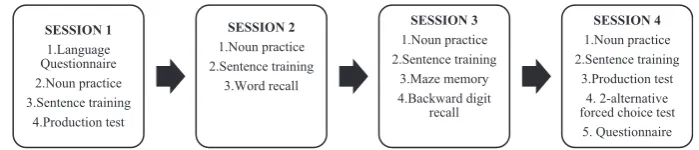
2.1.3.1. Semi-artificial language learning task. Participants were told that they were going to meet Henry and Katie who speak another language and that their task was to try to learn to speak like them. They completed four experimental sessions held on four consecutive days (notwithstanding two exceptions listed above). The tasks completed in each session, and the order in which they were administered, are summarised inFig. 1and described in more detail below. Briefly: Language training occurred on all four sessions. A production test probing learning of the association between speaker and particle usage was administered on day 1 and day 4. A two-alternative forced choice task assessing sensitivity to the speaker identity cues was administered on day 4.
2.1.3.1.1. Noun practice. Participants first practiced saying the names of all 16 pictures. On day 1, they viewed a picture (e.g., one lion) while hearing its English name (‘‘lion”) and were required to say the name aloud. Names were spoken by the (female, non-RP) experimenter to avoid confusion with the critical male/female voice manipulation that predicted particle usage later in the experiment. Subsequently, participants viewed the same pictures and were asked to produce their names without prompts. This second naming task was repeated at the beginning of all subsequent sessions (days 2, 3, and 4) to ensure that participants labelled the pictures correctly (some pictures were consistent with more than one possible label; e.g.,rabbit,bunny). When incorrect labels were provided, participants were corrected.
[image:7.544.93.443.599.674.2]2.1.3.1.2. Sentence training. Participants saw a picture of the noun (e.g., two lions) in the center of the screen and a car-toon picture of the male/female speaker with a speech bubble in the bottom left corner of the screen (Fig. 2). They heard a sentence describing the picture (e.g., glim lion bup) and were asked to repeat it aloud. If any element of the sentence was mispronounced, feedback was provided (‘‘Almost, this one was ‘‘glim lion bup”. Can you say that?”). There were 8 repetitions per session (4 in male, 4 in female voice) of each of 8 nouns, for a total of 64 trials in each sentence training block. Critically, the occurrence of the two particles during sentence training was fully predictable according to speaker identity: speaker 1 used particle 1 100% of the time and speaker 2 used particle 2 100% of the time. There were no other cues to particle usage (e.g., facing direction of the animal). In sum, each particle was equally frequent and equally associated with each noun both in each session and across the language, but only produced by one of the two speakers.
2.1.3.1.3. Production test. On each trial, participants saw a picture (e.g., two lions), heard the first word of the sentence (‘‘glim”) spoken by the male or female voice (accompanied by the cartoon picture of the speaker), and were asked to com-plete the rest of the sentence on behalf of Henry/Katie. If the noun was produced incorrectly participants were given correc-tive feedback (e.g., ‘‘Good try, but this one is a lion, not a tiger”) and asked to say the sentence again using the correct noun. These trials were scored as incorrect unless the nouns produced were synonymous with the target noun (e.g.,bunnywas accepted in place ofrabbit). No corrective feedback was provided regarding the sentence-final particles. If no particle was produced (e.g., ‘‘glim lion”) after approximately 10 s, the experimenter enquired whether the participant was ready to move on to the next trial. There were 64 trials presented in a semi-randomized order precluding consecutive repetitions of the same noun. Thirty-two production trials tested performance on 4 of the 8 trained nouns (each noun encountered 8 times, 4 times with the female speaker prompt and 4 times with the male speaker prompt). The remaining 32 tested performance on 4 novel nouns (each presented 4 times with the female speaker prompt and 4 times with the male speaker prompt). Dif-ferent novel nouns were used on days 1 and 4.
2.1.3.1.4. 2 Alternative forced choice (2AFC) test. On each trial, a picture of the noun (e.g., two lions) appeared centrally at the top of the screen. One second later, the cartoon picture of either the male or the female face (with a speech bubble) appeared in the bottom left corner of the screen and produced the appropriate (i.e., involving the particle used by that speaker) or inappropriate (i.e., using the other particle) sentence to describe the picture. The same cartoon face (with a speech bubble) then appeared in the bottom right corner of the screen and produced the other possible (i.e., appropriate/inappropriate) sen-tence. Participants were asked to click on the picture of the speaker who produced the sentence that described the picture ‘‘best”. The order in which the appropriate and inappropriate descriptions occurred was randomised across trials. Partici-pants were tested on all 8 of the trained nouns and all 8 novel items that had been used in the production test. Half of the items in each set (i.e., trained vs. novel) were heard in the female voice and the other half were heard in the male voice.
2.1.3.2. Other tests.The Word Recall subtest of the Automated Working Memory Assessment (Alloway, Gathercole, Kirkwood, & Elliott, 2008), was administered in session 2 to assess verbal short-term memory ability. Mazes Memory and Backwards Digit Recall task from the same standardized memory test were administered in session 3 to assess nonverbal short-term memory and working memory ability, respectively.
2.1.3.3. Awareness questionnaire. At the end of the fourth session, all participants completed a verbal questionnaire probing explicit awareness of the association between speaker and particle usage (Appendix A). The same questions were adminis-tered to children and adults, although the former were prompted further, if necessary. Answers to this questionnaire were coded such that participants who did not indicate awareness of any patterns within the language received a score of 0, and those who explicitly mentioned that the 2 different voices used the particles in different ways received a score of 1.
2.2. Results
2.2.1. Statistical approach
Raw data from this project and analysis scripts are available on the Open Science Framework,http://osf.io/g67pe. The final R pub script can be found here:http://rpubs.com/AnnaSamara/248957. For each of the analyses reported in Sections
2.2.2 and 2.2.3and Sections3.2.1 and 3.2.2, the dependent variable was binary (i.e., whether the particle in the response was correct/incorrect) and this data was analysed using logistic mixed effects models (Baayen, Davidson, & Bates, 2008; Fig. 2.Scene from a sentence training trial. Participants heard Katie produce a sentence describing the picture in her language (e.g., glim dog dak) and were asked to repeat it.
Jaeger, 2008; Quené & Van den Bergh, 2008) in the packagelme4(Bates, Maechler, Bolker, & Walker, 2015) for the R com-puting environment (R Core Team, 2012). These models allow binary data to be analysed with logistic models rather than proportions, as recommended by Jaeger (2008). To avoid anti-conservative conclusions (Barr, Levy, Scheepers, & Tily, 2013), we specified a full random effect structure in our models, including intercepts for subjects and by-subject random slopes for all within-subject factors and their interactions. These models converged with Bound Optimization by Quadratic Approximation (BOBYQA optimization;Powell, 2009). In all models, predicting variables (including discrete factor codings) were coded as centered numerical predictors to reduce the effect of collinearity between main effects and interactions and in order that main effects were evaluated as the average effects over levels of the other predictors.
For each of the analyses reported in Sections 2.2.5,3.2.4, and 4.2.2, the dependent variables of entropy and mutual information were continuous and this data was analysed usingttests or mixed ANOVAs. However, since the data were severely skewed and did not meet the criteria for parametric inferential statistics, we computed lower and upper bootstrapped 95% confidence intervals of the mean(s) for allt tests and boostrapped thepvalues using the R functions bwtrimbt (2-way ANOVAs) and bwwtrimbt (3-way ANOVAs)6(Wilcox, 2012). Categorical data were analysed using chi-square or Fisher’s exact tests.
2.2.2. Production data
Our main analyses excluded trials where children did not produce a correct sentence of the form(glim) NOUN PARTICLE where the particle was clearly identifiable as one of the two occurring in the child’s input. Errors included producing an incorrect noun, producing English or random utterances, or producing something in place of the particle which could not be identified as one of the two particles occurring in the child’s input (e.g. ‘‘glim mouse glim”, ‘‘glim squirrel sleep”) or produc-ing a blend of the two particles ‘‘glim cat jem”, where the two input particles were ‘‘jeb” and ‘‘kem”). Mispronunciations which were identifiable as one of the two particles (e.g. a single phoneme substitutions as in jeb?jep) were not excluded. All nonparticle responses which entailed a single-phoneme substitution were evaluated by two independent coders (the first author and a trained research assistant) and, when possible, were recoded to match one of the two particles (e.g. jep?jeb). Inter-rater agreement on these items was very high (ICC = 0.95).
The proportion of valid sentences produced provides a baseline measure of learning. This is therefore also reported and analyses were included in order to investigate how these errors were distributed across testing days and noun types.
2.2.2.1. Baseline. Overall, 9.77% of children’s data was excluded according to the criteria above. Two of the thirty children pro-duced no usable data on day 1 and did not contribute to the analyses on choice of particle (Section2.2.2.2). A logistic mixed effects model predicting the occurrence of an excluded sentence, with day (day 1, day 4) and noun type (old, novel) as fixed effects found no effect of either day (b=5.69,SE= 6.73,z=0.85,p= 0.398) or noun type (b=0.26,SE= 1.77,z=0.15, p= 0.884) and no interaction between day and noun type (b=2.23,SE= 3.83, z =0.58,p= 0.560). Thus, the proportion of excluded responses was stable across days and noun types.
2.2.2.2. Choice of particle. Participants’ use of correct (i.e., speaker appropriate) particles is shown inFig. 3. On inspection, the proportion of correct responses appears to be above chance (50%), and adults generally outperform children. Both of these observations were statistically confirmed.
The effect of age on performance was tested in a logistic linear mixed effect model predicting accuracy with age group (children, adults), day (day 1, day 4), and noun type (old, novel) as fixed effects. The model showed a significant intercept (b= 4.83, SE= 0.39, z= 12.32, p< 0.001) which suggests that mean performance was significantly greater than chance (50% accuracy)7and a significant effect of age group (b=3.63,SE= 0.71,z=5.13,p< 0.001) (adults:M= 0.97,SD= 0.16; chil-dren:M= 0.84,SD= 0.37). No other effects were significant, allps > 0.312.
Both children and adults showed strong learning of the deterministic speaker identity cues and used this information in the production task, although the effect was greater for adults than children. For both age groups, speaker appropriate par-ticle usage was already present after one session and held equally for trained nouns and novel nouns.
2.2.3. 2AFC data
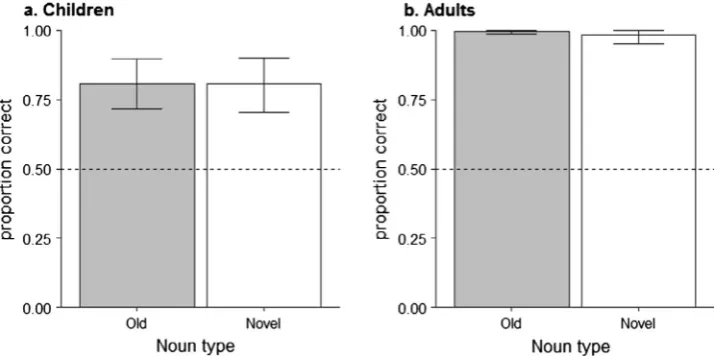
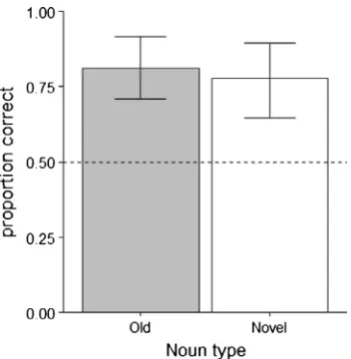
Proportions of correct responses in the 2AFC task (i.e., choosing the sentence with the speaker appropriate particle) as a function of noun type are shown separately for children and adults inFig. 4. On inspection, it is clear that 2AFC performance was better than chance across age groups and noun types, and better in adults than children.
This was confirmed in a logistic mixed effect model with age group (adults, children) and noun type (old, novel) as fixed effects. There was a significant intercept (b= 6.89,SE= 1.40,z= 4.91,p< 0.001) showing that mean performance was signif-icantly greater than chance, and a significant effect of age group (b=4.55,SE= 1.72,z=2.65,p= 0.008) (adults:M= 0.99, SD= 0.11; children:M= 0.81,SD= 0.39). There were no other significant effects, allps > 0.485.
6
Note that bwtrimbt and bwwtrimbt do not generate bootstrappedFstatics, thus, only bootstrapped p values are reported. 7
In sum, as in the production data, both children and adults made speaker identity appropriate particle choices more fre-quently than expected by chance, with adults producing more correct responses than children. This held equally across trained and untrained nouns.
2.2.4. Questionnaire data
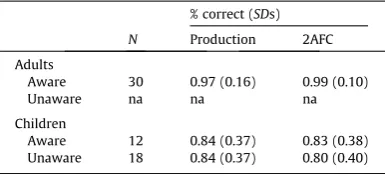
Responses on the post-experiment interview were binary coded to indicate whether participants were explicitly aware of the association between particle usage and speaker identity. To be classified as ‘‘aware”, participants had to verbally report (in response to either question 3, 4, or 5; seeAppendix A) that they had noticed the association between particle usage and speaker identity. As expected, children’s and adults’ ‘‘aware” responses differed in their level of sophistication, however, they all made mention of the face/head/gender of the speaker (e.g., ‘‘I chose based on the gender: Katie said bup and Henry said gos”). Examples of ‘‘unaware” responses often included that particle choice was ‘‘fair”, due to ‘‘careful listening of what Henry/Katie said” or was based on an irrelevant aspect of the pictures (e.g., the direction that animals were facing, which was actually random). All responses were coded by the first author and an independent coder, producing an ICC of 0.97 for children and 1.00 for adults.
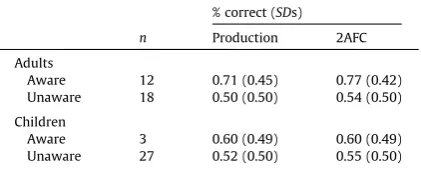
[image:10.544.118.454.54.219.2]All adults and 40% of the children reported that particle usage was conditioned on the identity of the speaker (seeTable 2). To investigate whether significant learning performance was always accompanied by explicit awareness, for children, we repeated the analyses reported above excluding participants who were classified aware. These analyses, reported in Appen-dix B, suggested that both production and 2AFC performance remained significant when ‘‘aware” children were excluded.
Fig. 3.Correct particle usage by noun type (old, novel) and day (day 1, day 4) in the production task (Experiment 1). Error bars indicate bootstrapped 95% confidence intervals. Dashed lines show chance performance (50%).
Fig. 4.Correct particle choice by noun type (old, novel) in the two forced choice task (Experiment 1). Error bars indicate bootstrapped 95% confidence intervals. Dashed lines show chance performance (50%).
[image:10.544.96.454.288.466.2]2.2.5. Regularization analyses
2.2.5.1. Overall regularization. One method by which participants might reduce the unpredictability of particle usage in their own productions is to boost the frequency of one of the two particles at the expense of the other. To capture this type of regularization, we computed the total entropy of each participant’s particle use, given by:
Entropy¼ XPðiÞlog2PðiÞ
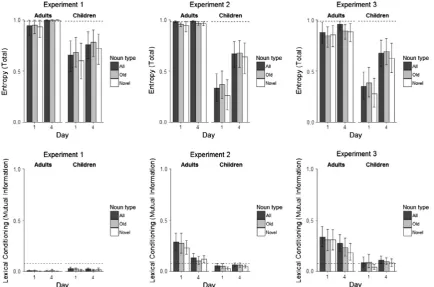
where the sum is over the two possible particle choices, andP(i) is the frequency of particleiin a participant’s productions. Entropy measures how variable a participant’s productions are: entropy of 0 corresponds to a participant who consis-tently uses a single particle, and entropy is at a maximum (entropy = 1) when both particles are used equiprobably (as in the input). It is also possible that participants may regularize differently across familiar (i.e., trained) and novel items (Wonnacott & Newport, 2005): we therefore calculated total entropy separately for each participant in each session for both old nouns and novel nouns, and across all productions combined (i.e., old + novel nouns).8Fig. 5(first row, left panel) shows the mean entropy for each of these measures for adults and children in each session; the dotted line shows the average entropy predicted if participants produced particles at random, with each particle being produced with equal probability on any given trial (0.988, obtained via simulation).
Beginning with whole-language entropy, we used a mixed ANOVA with age group (adults, children) as a between-subjects factor and day (day 1, day 4) as a within-subject factor. This showed a significant difference in mean whole-language entropy (mean = 0.83; 95% CIs = [0.75, 0.91]) relative to the previously computed chance entropy (0.988) and a significant main effect of age group (p= 0.014), indicating that children’s productions have lower entropy (mean entropy = 0.71) (i.e., they are more regular) than those of adults (mean entropy = 0.97). There was also a main effect of day (p= 0.041), reflecting greater regularization on day 1 (mean entropy = 0.80) than day 4 (mean entropy = 0.88), and no interaction between day and age group (p= 0.101).
We were also interested in establishing whether each age group showed above chance regularization on each day, thus, we also compared the whole-language entropy of each group on each day to chance. This revealed that children’s entropy was below chance on both days (day 1: 95% CIs = [0.49, 0.80]; day 4: 95% CIs = [0.60, 0.89]); adults’ entropy was not significantly below chance on day 1 (95% CIs = [0.85, 1.00]) and was actually significantlygreaterthan chance on day 4 (95% CIs = [0.999, 1.00]). This last result reflects the fact that, by the final day, adults strongly condition particle usage on speaker, and therefore are using the two particles much more evenly across the language than would be predicted by chance usage.
To see if there was any difference in regularization across old and novel nouns, we also ran a second analysis using the data from old and novel nouns and including noun type (old, novel) as a within-subjects factor along with age group (chil-dren, adults), day (day 1, day 4) and their various interactions. This model confirmed the main effect of age group and day and the absence of an interaction between these factors, but also found a main effect of noun type (p= 0.038), suggesting that children and adults showed significantly more regularization for novel nouns (mean entropy = 0.82) than old nouns (mean entropy = 0.86); there were no other significant effects,p> 0.065.
[image:11.544.174.367.73.161.2]As a subsidiary analysis, we also evaluated whether each individual participants’ entropy was reduced relative to the input languageto a greater extentthan would be predicted by chance (i.e., with each particle being produced with equal probability on any given trial, with the total number of trials for each participant being matched to the number of valid data points they actually produced; this was obtained via simulating 1000 ‘‘random” production datasets for each participant, and observing the proportion of those datasets that had entropy less than or equal to the actual entropy of that participant’s data). We focused on the whole language measure of entropy and tookp< 0.05 as our level of significance, and simply counted how many participants were producing significantly more regular output than expected by chance. Classified in this way, 13/28 children (recall that two did not produce either particle) and 2/30 adults regularized on day 1 (a significant age
Table 2
Performance in Experiment 1 by aware and unaware participants.
% correct (SDs)
N Production 2AFC
Adults
Aware 30 0.97 (0.16) 0.99 (0.10)
Unaware na na na
Children
Aware 12 0.84 (0.37) 0.83 (0.38) Unaware 18 0.84 (0.37) 0.80 (0.40)
Notes. 2AFC = 2 alternative forced choice. na = non-applicable.
8
difference:
v
2= 11.94, p= 0.001); 11/30 children and 0/30 adults regularized on day 4 (a significant age difference:v
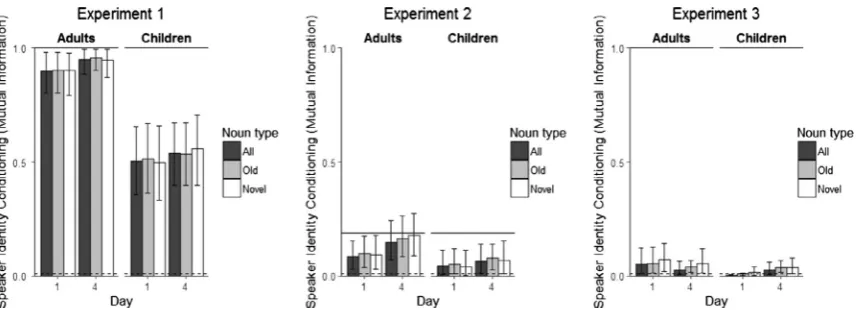
2= 13.47, p< 0.001).9 This suggests that there were no significant qualitative changes in children’s regularization status due to the additional training received between day 1 and day 4. It is worth noting that some of these significant regularizers wereabsoluteregularizers (i.e., only used one particle, producing output with entropy = 0). 6/13 children on day 1, 1/2 adults on day 1, and 5/11 children on day 4 were absolute regularizers, in other words the majority of regularizers werenotabsolute reg-ularizers, even for children; rather, they produced output which featured both particles, but featured one particle significantly more often than would be expected if they were probability matching.Fig. 5.Regularization performance in Experiments 1, 2 and 3. The first row shows entropy particle usage (with high entropy indicating more variable particle usage) for the two testing sessions, for productions involving old nouns, novel nouns, or taken across all nouns in the language. The dashed line indicates the expected entropy if participants were producing the two particles according to the trained frequencies. The second row shows lexical mutual information of particle usage, indicating the extent to which particle choice is conditioned on the noun, with high mutual information indicating more conditioned (less unpredictable) particle usage. The dashed line indicates the expected mutual information if participants were producing the two particles at random according to the trained frequencies. Error bars indicate bootstrapped 95% confidence intervals.
9
Another question of interest is whether individual participants produced the same patterns of regularization on days 1 and 4. That is, for a given participant, how different were his/her rates of particle production across days? We addressed this question by computing a measure of participants’ self-consistency across days and comparing it against the level of self-consistency expected under the null hypothesis that participants arenotself-consistent across days (i.e., participants’ particle usage on day 4 no more resemble their day 1 particle usage than expected by chance). For every participant, we calculate a difference score based on their particle usage on day 1 and day 4; this difference score can simply be calculated on the overall usage of particle 1 on both days, or calculated on noun-specific proportions. For example, a participant who uses particle 1 at approximately the same frequency on day 1 and day 4 (either averaging across nouns, or per noun) will have a low difference score; a participant who changes more dramatically from day 1 to day 4 (e.g., going from never to always using particle 1) will have a high difference score. We then compare the mean of the veridical difference scores to a distribution of mean difference scores generated by shuffling day 4 data across participants (e.g. re-attributing the data produced by participant 1 on day 4 to participant 2 and so on; we generate 1000 such random re-assignments to obtain a distribution of mean difference scores), which captures the null hypothesis that participants are no more self-consistent across days than we would expect by chance, given the observed distribution of responses on day 1 and day 4. We then obtain apvalue for the observed level of self-consistency by calculating the proportion of samples from this null distribution that exhibit mean difference scores which are equal to or lower than the veridical mean difference score; if less than 5% of the random samples have equal or lower mean difference, we can reject the null hypothesis atp< 0.05 and conclude that participants are more self-consistent than we expect by chance. This analysis produced clear evidence that children were more self-consistent than expected by chance in all 3 experiments, regardless of whether we look at overall or noun-specific particle usage (allps < 0.002). For adults, there is only clear evidence of levels of self-consistency greater than chance in Experiment 3 (ps < 0.011); for Experiments 1–2 these tests indicate no more self-consistency than expected by chance (Experiment 1:ps > 0.999; Experiment 2:ps > 0.094). However, adults performed very homogeneously in the presence of speaker-based conditioning (i.e. in Experiments 1 and 2), which means that it is difficult to demonstrate self-consistency greater than chance under our conservative null model: for example, in Experiment 1, most participants produce particle 1 on 50% of all trials on day 4; consequently, shuffling across participants yields a difference scores essentially identical to the observed difference score, which means that we cannot reject the null hypothesis in these cases.
2.2.5.2. Lexical conditioning. Previous work (e.g.,Hudson Kam & Newport, 2009; Smith & Wonnacott, 2010) suggests that, in addition to regularizing across the language, participants might also regularize around lexical items, i.e., condition their par-ticle use on the noun preceding the parpar-ticle, producing particular parpar-ticles more frequently with particular nouns (despite particles being used equally frequently with each noun in the input). For example, inHudson Kam and Newport’s (2009)
study, a few adult participants who imposed regularities on the inconsistent target language did so by systematically asso-ciating individual determiners with individual lexical nouns. We sought to systematically explore this type of regularization by considering entropy for each participant’s productions per lexical item. One possible metric would simply be to consider the conditional entropy of particle use given the noun being marked, which is simply the average entropy of particle use for each noun considered separately (where the average is weighted by noun frequency). However, this measure fails to differ-entiate between regularization at the lexical level (which yields low conditional entropy) and regularization across the lan-guage as a whole: participants who predominantly used one particle in most of their productions would have low entropy for the whole language and, as a consequence, for each lexical item. To isolate purely lexically based regularization, we there-fore computed theMutual Information (MI)of particle use and lexical identity, consisting of:
Mutual InformationðMIÞ ¼total entropyconditional entropy of particle gi
v
en nounLexical MI of 0 indicates that a participant shows no lexically based regularization (i.e., the variability of each noun mir-rors that of the language as a whole), while scores of 1 would indicate perfect lexical conditioning of particle use on the noun (i.e., the language as a whole would exhibit high variability, but each noun would exhibit zero variation in particle use).Fig. 5
(second row, left panel) shows the mean MI for each of these measures for adults and children in each session; the dotted line shows the average predicted MI if participants produced particles at random, with each particle being produced with equal probability on any given trial (MI = 0.080, obtained via simulation). It can be seen that participants have MI scores very close to 0, indicating the absence of lexical conditioning. A mixed ANOVA with age group (adults, children) as a between-subjects factor and day (day 1, day 4) as a within-subject factor showed that the overall lexical MI was significantly less than chance (mean MI = 0.02; 95% CIs = [0.01, 0.02]); there was a significant effect of age group (p= 0.006), due to lower MI in adults (Mean MI = 0.00) than children (Mean MI = 0.03), no effect of day (p= 0.240), and no interaction between age group and day (p= 0.362). In spite of the age difference in terms of MI, both groups’ lexical MI was significantly less than chance (adults: 95% CIs = [0.00, 0.01]); children: 95% CIs = [0.02, 0.04]). These results are due to the fact that both age groups were spreading their production of particles more evenly across the words than would be predicted by chance usage, due to their learning of the conditioning on speaker.
A further mixed ANOVA using the data from old and novel nouns with age group (children, adults), day (day 1, day 4), and the additional within-subject factor noun type (old, novel) confirmed the above pattern of results and further showed that there was no effect of noun type (p= 0.218), and no interaction with this factor (noun type by age group:p= 0.371; noun type by day:p= 0.145; noun type by day by age group:p= 0.215).
We also computed via simulation for each participant whether their MI differed from that predicted by chance (given both the number of each of the two particles they produced and the number of valid productions they generated). This was not the case for any child or adult participant, again indicating the absence of spontaneous lexical conditioning of vari-ation in this experiment.
2.2.5.3. Summary of regularization data: Experiment 1. Children show greater regularization in particle usage across the lan-guage (i.e., greater reduction of entropy) than adults. The extent of regularization decreased over the course of exposure to the language, from day 1 to day 4. There was also evidence of greater regularization with novel nouns than with old nouns. No lexically based conditioning was seen in this experiment.
2.3. Summary and discussion
Six-year-old children and adults were exposed to and tested on a semi-artificial language using identical procedures. The critical feature of the language was that nouns were followed by one of two particles whose use was fully predictable from the identity of the speaker: sentences produced by the female speaker were 100% associated with particle 1 and sentences produced by the male speaker were 100% associated with particle 2. To assess learning, participants were administered a production task at the end of the first and last training session (days 1 and 4) and a 2AFC task at the end of the last training session (day 4).
The second series of analyses aimed to assess whether either age group showed evidence of regularization, as seen in pre-vious studies (Hudson Kam & Newport, 2005, 2009; Smith & Wonnacott, 2010). We used analyses of entropy and MI to look both for regularization across the whole language (i.e., boosting the frequency of one particle over the other) or lexical reg-ularization (i.e., producing particular particles more frequently with particular lexical items). Only the first type of regular-ization was seen and only in children. This age difference is similar to that reported byHudson Kam and Newport (2005, 2009), although it is important to note that, in our experiment, the fact that children and adults are able to learn and exploit the conditioning of variation based on speaker should lead to the lower levels of regularization. Similarly, we saw less reg-ularization on day 4, which could reflect better learning of the input patterns following greater exposure. There was also more regularization for novel than old nouns (mirroring the results fromWonnacott & Newport’s, 2005experiment with adults and extending that finding to another age group). We leave further consideration of this findings for Section5.
Returning to our key result, Experiment 1 demonstrates that 5- to 6-year-old learners (and adults) can track sociolinguis-tic variation conditioned on speaker identity. This is important since it suggests that the previously reported tendency to regularize – which is still present in our results – does not prevent the learning of variation when that variation is condi-tioned. This ability to track conditioning on speaker identity must underpin the ability to acquire any sociolinguistic varia-tion which is indexed by speaker identity or group membership.
In this experiment, speaker identity conditions variant use deterministically. In natural languages, the social and stylistic constraints governing sociolinguistic variation tend to be probabilistic rather than deterministic (Kroch, 1989; Labov, 1989). It is therefore important to establish whether children and adults can also learn sociolinguistically constrained variation from such probabilistic input. We address this question in Experiment 2.
3. Experiment 2
3.1. Method
3.1.1. Participants
Thirty 5–6 year-old children and 30 adults without known hearing, language, or speech disorders participated in the study (Table 1). All participants completed the experiment on four consecutive days. Children were recruited from Year 1 and 2 of public primary schools in Coventry, Warwickshire, Greater London, Hertfordshire, and Scotland. Adults were recruited through a university participant panel and received monetary compensation.
3.1.2. Stimuli, design and procedure
The stimuli and procedure were identical to Experiment 1. In Experiment 2, particle usage during training was partially consistent such that the female speaker used particle 1 75% of the time and particle 2 25% of the time, whereas the opposite held true for the male speaker. The partial consistency applied across the entire training set and also for each noun, such that, in each training session, participants heard each noun 4 times in total (3 times with particle 1 and once with particle 2) in one of the voices, and vice versa in the other voice.
3.2. Results
Data analysis procedures and baseline criteria for data point inclusion were identical to those employed in Experiment 1. ICC for nonparticle responses in children’s data was 0.98.
3.2.1. Production data
3.2.1.1. Baseline. Overall, 8.35% of data for children did not meet the baseline. The proportion of rejected responses was stable across days and noun types: a logistic mixed effects model predicting the occurrence of an excluded sentence with day (day 1, day 4) and noun type (old, novel) as fixed effects found no effect of day (b=2.43,SE= 2.78,z=0.87,p= 0.383) nor noun type (b=0.94, SE= 1.95, z =0.48, p= 0.629), and no day by noun type interaction (b=5.55, SE= 3.89, z =1.43, p= 0.153).
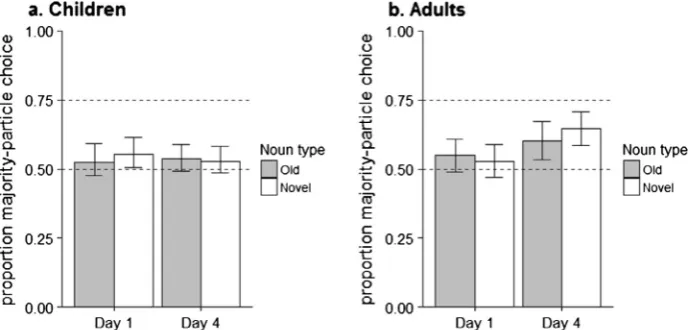
3.2.1.2. Choice of particle.As in Experiment 1, we investigated children’s and adults’ ability to produce speaker-appropriate particles across days and noun types. As seen inFig. 6, there was some indication of differences between children’s and adults’ performance on day 4, with adults being closer to the trained frequencies on day 4. A logistic mixed effect model with age group (adults, children), day (day 1, day 4), and noun type (old, novel) as fixed effects was fitted to the proportion of majority-particle (i.e., speaker appropriate) produced. The model showed a significant intercept (b= 0.28, SE= 0.08, z= 3.55,p< 0.001), no significant effect of age group (b=0.22,SE= 0.16,z=1.38,p= 0.166), no significant age group by day interaction (b=0.14, SE= 0.08,z=1.78, p= 0.075), and a significant effect of day (b= 0.08,SE= 0.04,z= 1.99, p= 0.046). The only other significant effect in the model was the three-way interaction between age group, day, and noun type (b= 0.15,SE= 0.07,z= 2.20,p= 0.028).
We also considered task performance separately for children and adults. The model predicting adults’ production of the majority particle as a function of day and noun type showed a significant intercept (b= 0.40,SE= 0.12,z= 3.26,p= 0.001),