Emerging Sounds Through Implicit Cooperation: A Novel Model for Dynamic
Music Generation
M´ario Escarce Junior
1,2∗, Georgia Rossmann Martins
1∗, Leandro Soriano Marcolino
2,
Yuri Tavares dos Passos
31Phersu Interactive, Belo Horizonte, Brazil
2School of Computing and Communications, Lancaster University, Lancaster, United Kingdom 3Centro de Ciˆencias Exatas e Tecnol´ogicas, Universidade Federal do Recˆoncavo da Bahia, Brazil
{mario,georgia}@phersu.com.br,[email protected],
Abstract
Normally agents cooperate when they have a joint goal or are able to get a higher payoff by doing so. We present a new perspective, where an agent cooperates with another without an explicit intention. We study this perspective in the context of Art Games, by introducing a novel algorithm where a human agent cooperates with a video game system in generating music in an emergent fashion, without needing awareness that he/she is doing so. We present a theoretical analysis of our system, and preliminary experiments with human subjects.
Introduction
Cooperative agents are able to accomplish hard tasks through their joint work. However, most systems assume that agents explicitly collaborate, by having a joint goal, an utility func-tion that foster collaborafunc-tion, or even pre-specified coordi-nation rules. In many situations, however, we may have a system where the actions of an agent unintentionally help another. In particular, we may be able to use the actions of an agent to produce works of art in an emergent fashion, without requiring artistic knowledge from the agent, nor an explicit intention to create an artistic piece.
Recent works view the creative process as a collaboration between a human and an AI system (d’Inverno and McCor-mack 2015). Pachet et al. (2013) present a system where a human musician plays a music sample, and an AI system, after learning the basic music pattern, joins the musician in producing music. Hence, both human and system “jam” to-gether, creating a unique music that neither would construct alone. Moreira, Roy, and Pachet (2013) show a set of agents that react to human musicians, and human and agents cooper-ate in producing a live music performance. However, in all these works the user has to explicitly collaborate with the AI system in the music generation process, even requiring musical background in order for the system to work well.
In this work we present a new algorithm where the actions of a user are used to dynamically emerge a musical piece. This system may be used in the context of Art Games, a new genre that views games as an artistic experience rather than just entertainment. Our algorithm places (invisible) musical
Copyright c2017, Association for the Advancement of Artificial Intelligence (www.aaai.org). All rights reserved.
* M. Escarce Junior and G. R. Martins are both first authors.
cells on the floor of a virtual scenario, which are arranged in a way that fosters the musical production. We present a theoretical analysis of our algorithm, where we show that: (i) our algorithm correctly generates grids that foster the generation of arpeggios, but maintaining the diversity of notes; (ii) we can generate complete grids for an odd number of notes; (iii) a human agent walking in our grids has a higher likelihood of generating music than random walks or randomly drawing notes. Additionally, we develop an Art Game with our algorithm, and evaluate our approach with real human players. We show that real humans, without realizing the effect of their actions, effectively generate a large number of arpeggios, and classify the product of the system as “music”.
Related Work
This work is related to the study of cooperation in multi-agent systems and mechanism design; the study of AI for video games and music generation; and computational creativity.
Cooperation is an important topic in multi-agent systems (Cohen and Levesque 1991; Tambe 1997), where agents have joint intentions and objectives. It is also possible to coordinate a team through task allocation, for instance with the contract net protocol (Smith 1980). Large groups may also present a global, organized behavior by following local coordination rules (Marcolino et al. 2017). Additionally, in Cooperative Game Theory (Branzei, Dimitrov, and Tijs 2008), agents form groups when it allows them to achieve a higher payoff. Our implicit cooperation approach for music generation, how-ever, is essentially different than these previous works. Our work also relates to mechanism design (Hurwicz and Reiter 2006), a model in game theory that focuses on designing the rules of a game in order to achieve desired objectives. Tradi-tionally, mechanism design assumes rational agents, while our approach does not need rationality assumptions (in fact, our model is not based on game theory).
non-player characters (NPCs) that make the game enjoyable, often by using scripts and simple techniques (Robertson and Watson 2014). Designers also explicitly program the agents to make mistakes (Lid´en 2004). They still hold the belief, however, that the major role of AI is for creating realistic (or human-like) agent behavior (Scott 2002).
AI techniques have also been used to automatically cre-ate levels of games. For example, Sorenson, Pasquier, and DiPaola (2011) combine genetic algorithms and constraint satisfaction for automatically generating “enjoyable” levels. Similarly, Zook and Riedl (2011) present an approach where the difficulty level of the game adjusts dynamically to the current player, in order to make the game enjoyable. In Art Games, however, the objective is in creating a new expressive experience, and not necessarily in making a game “fun”.
Concerning music generation, many works create music without human intervention, by applying machine learning techniques over a music corpus (Eigenfeldt and Pasquier 2010). Others, however, see the creative process as a col-laboration between a human and an AI system (d’Inverno and McCormack 2015; Pachet et al. 2013; Moreira, Roy, and Pachet 2013), which aligns with our view. These systems, however, require the human to explicitly join the music gen-eration process, and the human must be an expert in music.
The collaboration between a human and a computer system is an active topic in computational creativity: e.g., in Roberts et al. (2017) a user plays some notes for the melody on a MIDI keyboard, and the system responds with variations on this melody and also with a bass accompaniment; in Jacob and Magerko (2015) a human and an agent collaborate to produce movement-based performance pieces; and in Davis et al. (2016), a user takes turn with a computer AI system when drawing in the same canvas. In these systems, however, the user has to be actively engaged in the creation process.
Art Games
Recently a new line of research has been drawn on the digital arts horizon. Composed of mixtures of innovative gameplay mechanics, disturbing narratives and surreal aesthetics, the Art Games are normally produced with a low budget and focus on breaking expectations and paradigms, on being provocative, and on creating unique experiences. The term
Art Gamewas first used in Holmes (2002), and it can be understood as a game whose structure is destined to produce different reactions in the audience. Similarly to entertainment-focused games, they normally have audio and video output and interactive interfaces, but in a non-conventional way. Within the Art Games genre, there are sub-genres focused on specific artistic segments, such as music, as we can observe onMusic Video Games. In these games, the mechanics are oriented around the interaction with very elementary musical elements, such as rhythm, which makes them easily associa-ble with many traditional puzzle games that uses rhythmic structures to overcome obstacles (for example, in Vib-Ribbon (Sony Interactive Entertainment, 1999) and Patapon (SIE Japan Studio, 2007)). The creative expressiveness of the user in the current projects of this genre is very restricted, since the only action allowed for the player is usually to press de-termined buttons at predede-termined moments. Another project
worth mentioning is ElectroPlankton (Iwai 2005). In Elec-troPlankton a user interacts with objects in virtual scenarios, which affects the movement of digital “planktons” that play musical notes, generating music. However, he/she must still be engaged in the music generation process, and must reason about the music generation mechanics of the game during play. Our implicit cooperation approach is, hence, fundamen-tally different.
Implicit Cooperation
Implicit cooperation consists of a multi-agent system where agents collaborate without theintentionof doing so. That is, while an agent is pursuing its own objectives, its actions “end up” aiding another agent.
In this paper we study a restricted version of implicit coop-eration, where we will focus in systems with only two agents. Additionally, we will study these systems in the context of human-computer interaction. Hence, we will consider the following two agents: (i) a human controlled one (a character in a digital game), which seeks the objectives given in the game; (ii) the computer system itself, which uses the actions of the user to accomplish another objective. Therefore, we will design systems which will accomplish their objectives with the help of a user, but without requiring from him/her an explicit intention of collaborating with the system.
That is, given an agentφ, which receives a rewardrafor each actiona, according to the current world state. Let’s assume that φwants to maximize its total reward (for in-stance, explore the world as much as possible, or collect items in a virtual environment). Given now a systemS, with an objectiveO(for instance, generate music with a certain characteristic). The implicit cooperation problem under study in this paper is: how can the system S induce agentφto accomplish objectiveO?
We solve this problem for emergent music generation. Hence, in the next section we present an algorithm that allows the systemSto change the floor of the scenario of a digital game, in order to produce music according to the movements of the agentφin that scenario.
Emergent Music Generation
We present a system where the movement of an agent pro-duces music in an emergent fashion. First, we provide a definition of “music” in the context of our work.
Figure 1: The C Major Scale, all possible triads of thirds, and an example of all possible inversions for the triad CEG.
them together forming new patterns in a way to preserve an initial structure, making it easier for our brains, an avid “devourer of patterns” (Koster 2004) to easily assimilate it and recognize it as music. According to Elizabeth Hellmuth (Margulis 2014), if we are asked whether a particular piece is music or not, a remarkably large part of the answer appears to be: “I know it when I hear it again.” She also stated that repetition serves as a “handprint” of human intent, and a phrase that might have sounded arbitrary at first may sound reasonable the second time it is heard.
The other concept ischord. Chords are any harmonic set of three or more notes that are heard resonating simultaneously (Karolyi 1965). The most frequent type of chords are the triads, that consists of three notes: the fundamental; the third, which is the note next to the one following the fundamental; and the fifth, which is the note next to the one following the third (Karolyi 1965). Hence, a triad is a sequence of thirds, where the next note in the scale is always skipped. There is also a different type of chord calledpower chord, commonly executed with the effect of distortion on electric guitars (Walser 1993). In this arrangement, only two notes are played: the fundamental and the fifth. For example, CEG and CG are examples of a triad and a power chord, respectively. It is possible to form chords when playing only one note at a time. These are calledarpeggios, which is the successive execution of the notes of a chord (in any order) (Policastro 1999). In our system, we have only one note being played at a time. Hence, we focus on the presence of arpeggios rather than chords. Figure 1 shows an example of possible arpeggios of triads, and all possible orders for the CEG case.
Emergent Generation:We consider our agent as a char-acter in a scenario, controlled by a human player. This agent pursues some objective: for instance, collect items or explo-ration. The actual objective depends on the system designed using our technique, and does not affect our approach.
Figure 2: 7x7 building block. We place musical cells on the floor
of the scenario: we divide the environ-ment in a grid, where each cell corre-sponds to a piano key. When the agent steps in a cell, the corresponding key plays. The grid may be invisible to the agent, and it may or may not be aware of this construction. We also consider that the agent can jump on the same place, and that would re-play the same
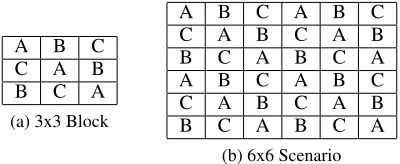
note. When placing the grid, we use a “building block”, which is concatenated in all directions to cover the full scenario. This can also be seen as if the block is a torus: upon going right in the last column, the agent will reach the first column; upon going down in the last row, the agent will reach the first
A B C
C A B
B C A
(a) 3x3 Block
A B C A B C
C A B C A B
B C A B C A
A B C A B C
C A B C A B
B C A B C A
[image:3.612.339.539.53.135.2](b) 6x6 Scenario
Table 1: Example of a 3x3 block covering a 6x6 scenario.
row. We show in Table 1 (a) one 3x3 block, and in Table 1 (b) how it would cover a 6x6 scenario.
We generate the blocks in a way that when the agent moves towards the south, it follows a sequence of thirds, and thus creates arpeggios. Similarly, if the agent moves towards the east, it follows a sequence of fifths, also creating arpeggios. For example, in the case of 7 keys, we can use the block shown in Figure 2 (where the colors help visualize different keys). These blocks can be generated as follows. LetM=
{m1, ..., mn}be a set of notes, andBann×nmatrix. We generate our proposed block by the Algorithm 1. We start from the upper left corner, and fill in each cell of the first row in a progression of fifths (i.e., skip the next 3 elements of the set). Then, we fill all columns in a progression of thirds (i.e., skip the next element of the set).
Algorithm 1:Block generation algorithm.
1 B[1,1] := 1;
2 forc:= 1. . . n−1do
3 B[1, c+ 1] :=mod(B[1, c] + 4, n); 4 end
5 forc:= 1. . . n do 6 forl:= 1. . . n−1 do
7 B[l+ 1, c] :=mod(B[l, c] + 2, n); 8 end
9 end
Therefore, Figure 2 shows the case where M =
{C, D, E, F, G, A, B}. Note that in this example we start with C, following the usual musical scale, but different start-ing notes could be used. Also, when movstart-ing north the agent will play a decreasing sequence of thirds, and likewise when moving west a decreasing sequence of fifths. As a conse-quence, for|M| = 7we also have that: (i) When moving northeast or south, the agent plays a sequence of thirds; (ii) When moving north or southwest, the agent plays a sequence of sixths; (iii) When moving west, the agent plays a sequence of fourths; (iv) When moving east, the agent plays a sequence of fifths; (v) When moving southeast, the agent moves in a sequence of sevenths; (vi) When moving northwest, the agent moves one tone up. This shows that even though we empha-size the generation of thirds/fifths, the agent can still generate a great variety of notes from its current position, increasing the diversity of the musical production (in fact, for|M|= 7, we can generate any possible note from a given position).
[image:3.612.320.559.369.479.2]⊕1 ⊕5 ⊕2 B[i-1,j-1] B[i-1,j] B[i-1,j+1]
⊕3 ⊕0 ⊕4
B[i ,j-1] B[i ,j] B[i ,j+1]
⊕5 ⊕2 ⊕6
[image:4.612.98.251.52.123.2]B[i+1,j-1] B[i+1,j] B[i+1,j+1]
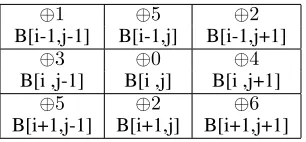
Table 2: Neighborhood of a cell as stated in Observation 1 for|M|= 7.
of notes of size different than 7. That could represent, for instance, notes of the next octave; or even a non-traditional division of a given frequency range inndifferent notes.
Analysis:We will start by analyzing the correctness of Algorithm 1. It is clear that there exists a bijective function that maps the setMtoZn. Also, the “third” of a notemi is equivalent to the notem(i+2) modn. In a general way, a notemichanges in a sequence ofk-th tom(i+k−1) modn. Therefore, we can consider the cyclic group(Zn,⊕), with⊕ representing addition modulon, as an isomorphism to setM
under operation of changing in a sequence ofk-th.
The following theorem (from Ledermann (1949)) will be useful to prove Algorithm 1 correctness:
Theorem 1. Let (G,∗)be a cyclic group,|G| =n,ak =
a∗a∗ · · · ∗a(ktimes). Ifa∈Gis a generator ofGandk is relatively prime ton, thenakis also a generator ofG.
Hence, considering the group(Zn,⊕),1is its generator. Also, we have for every integerk >0that1k =k modn. So, every0< k < nrelatively prime tonis also a generator. The following observation states that generating a progres-sion of thirds and fifths in south and east direction respec-tively allows the agent to move as enumerated above. Con-sider below that an integerk > nis the same ask modn
and for anya ∈ Zn, its inverse is−a = n a = n−a modn. Letb=B[i, j].
Observation 1. IfB[i, j+ 1] =b⊕4∧B[i+ 1, j] =b⊕2, then: B[i−1, j−1] = b⊕ −6, B[i−1, j] = b⊕ −2, B[i−1, j+1] =b⊕2,B[i, j−1] =b⊕−4,B[i+1, j−1] =
b⊕ −2,B[i+ 1, j+ 1] =b⊕6
As it is valid for every integeri, j,B[i, j−1] =b⊕ −4 andB[i−1, j] =b⊕ −2is trivially true. Thus we have that:
B[i−1, j−1] =B[i−1, j]⊕ −4 =b⊕ −2⊕ −4 =b⊕ −6;
B[i−1, j+ 1] =B[i−1, j]⊕4 = b⊕ −2⊕4 = b⊕2;
B[i+ 1, j−1] =B[i+ 1, j]⊕ −4 =b⊕2⊕ −4 =b⊕ −2;
B[i+ 1, j+ 1] =B[i+ 1, j]⊕4 =B[i+ 1, j]⊕2⊕4 =
B[i+ 1, j]⊕6.
Table 2 shows Observation 1 applied to moves in a set
|M|= 7. Note that positive relations (B[i−1, j+ 1],B[i+ 1, j+ 1],B[i+ 1, j],B[i, j+ 1]) will remain as in Table 2 for any set sizen, while negative relations will change according to the calculation of the inversen−a modn. Also, we will use the following lemma:
Lemma 1. If for every integer i ∈ {1, . . . , n−1} and j ∈ {1, . . . , n}, B[i+ 1, j] = B[i, j]⊕2 and for all j ∈ {1, . . . , n−1}B[1, j+ 1] = B[1, j]⊕4, then:∀i ∈ {1, . . . , n}:∀j ∈ {1, . . . , n−1}:B[i, j+ 1] =B[i, j]⊕4.
Proof. We use induction oni.Base: As hypothesis is given fori= 1, we begin withi= 2. Thus, for everyj ≤n−1,
B[i, j+1] =B[2, j+1] =B[1, j+1]⊕2 =B[1, j]⊕4⊕2 =
B[2, j] 2⊕4⊕2 =B[2, j]⊕4 =B[i, j]⊕4.Induction: As induction hypothesis, consider that∀i∈ {1, . . . , n−1}:
∀j ∈ {1, . . . , n−1} : B[i, j+ 1] = B[i, j]⊕4. So, for
i = n, we have: B[n, j + 1] = B[n−1, j+ 1]⊕2 =
B[n−1, j]⊕4⊕2 =B[n, j] 2⊕4⊕2 =B[n, j]⊕4.
Now we can show the correctness of Algorithm 1:
Theorem 2. Algorithm 1 generates blocks so that the agent movement plays notes in the proposed way.
Proof. By Observation 1, we only need to prove that Algo-rithm 1 generates blocks such thatB[i, j+ 1] =B[i, j]⊕
4andB[i+ 1, j] = B[i, j]⊕2, for every integersi, j. At end of line 4 we have the following postcondition:B[1,1] = 1∧ ∀j ∈ {1, . . . , n−1}:B[1, j+ 1] =B[1, j]⊕4.We need to show that second for loop has the following postcondition:
∀j ∈ {1, . . . , n} : ∀i ∈ {1, . . . , n−1} : B[i+ 1, j] =
B[i, j]⊕2.
This is done by showing a postcondition for the innermost for loop, and then the postcondition above. At innermost for (lines 6-8), we have the following precondition:1 ≤ c ≤ n+ 1 ∧ ∀i∈ {1, . . . , n−1}:∀j∈ {1, . . . , c−1}:B[i+ 1, j] =B[i, j]⊕2,and state the following loop invariant in innermost for:1≤c≤n∧1≤l≤n∧∀i∈ {1, . . . , n−1}:
∀j ∈ {1, . . . , c−1} : B[i+ 1, j] = B[i, j]⊕2 ∧ ∀i ∈ {1, . . . , l−1} : B[i+ 1, c] = B[i, c]⊕2. Initialization: Until comparisonl ≤n−1at line 6, this is trivially true;
Maintenance: At line 7,B[i+1, c]becomesB[i, c]⊕2. Then, for every lineifrom1tol,B[i+ 1, c] =B[i, c]⊕2. After increment ofl, loop invariant is maintained;Termination: All linesi < nin columncobeysB[i+ 1, c] =B[i, c]⊕2. Thus, we have as postcondition of innermost for:1 ≤c≤ n ∧ ∀i∈ {1, . . . , n−1}:∀j ∈ {1, . . . , c}:B[i+ 1, j] =
B[i, j]⊕2.
Now, for outermost loop (lines 5-9), we state the following loop invariant:1 ≤ c ≤ n+ 1 ∧ ∀i ∈ {1, . . . , n−1} :
∀j ∈ {1, . . . , c−1} : B[i+ 1, j] = B[i, j]⊕2. Initial-ization: After initialization of c, loop invariant is trivially true;Maintenance: Loop invariant is precondition of inner-most for, hence, before increment, for every linei < nin columnc,B[i+ 1, c] =B[i, c].After increment, invariant is maintained;Termination: Whencbecomesn+ 1, loop invariant becomes:∀j∈ {1, . . . , n}:∀i∈ {1, . . . , n−1}:
B[i+ 1, j] =B[i, j]⊕2.
This proposition together with postcondition of first for (line 4), give us:B[1,1] = 1∧ ∀j ∈ {1, . . . , n} : ∀i ∈ {1, . . . , n−1}:B[i+1, j] =B[i, j]⊕2∧∀j∈ {1, . . . , n−
1}:B[1, j+ 1] =B[1, j]⊕4.Hence, by Lemma 1, we have the result.
In the following Corollary, we show that the blocks will always by cyclic, i.e., will allow the agent to navigate as exemplified in Table 1.
Proof. Algorithm 1 generate the same pattern of notes for every cell withi, j > n, because for everyi, j:B[i+n, j] =
B[i+n−1, j]⊕4 = B[i+n−2, j]⊕4⊕4 = ... =
B[i, j]⊕Ln
k=14 =B[i, j],andB[i, j+n] =B[i, j+n− 1]⊕2 =B[i, j+n−2]⊕2⊕2 =...=B[i, j]⊕Ln
k=12 =
B[i, j].
Besides generating thirds and fifths, we also need a system that generates all possible notes, increasing the richness of the musics produced. Hence, we call a block “complete” when it has all elements ofM. In the next proposition, we show the conditions for our algorithm to generate complete blocks:
Proposition 1. Algorithm 1 generates complete blocks for any setMwith|M|not divisible by 2 or 4 and B[1,1] set initially with anym∈M.
Proof. By Theorem 1, we have that every0 < k < n rela-tively prime tonis a generator of the group(Zn,⊕). Hence, for|M|not divisible by 2 or 4, we have that both 2 and 4 will be generators. Therefore, all row and columns in B will have all elements inM.
Let’s assume now random walks in our proposed blocks. We will consider two different kinds of random walks: (i) From a given cell, uniform probability to move to any neigh-boring cell; (ii) Greater probability of moving in straight and lateral directions (i.e., “human”-like movement). We will focus our analysis now in blocks where|M|= 7.
In the analysis below, we define music as a repetition of a sequence of notes containing a sequence of thirds or fifths, with other notes between repetitions. In other words:
Definition 1. Let N, M ∈ N, and M ≥ N. A sequence of notes{ai}i∈{1,...,M} ∈ Zn is amusic, if there is a
se-quence of notes A = ha1, a2, . . . , aNi, such that ∀i > 1 : ai+1 −ai ∈ {2,−2,4,−4}, and {ai}i∈{1,...,M} =
hA, B1, A, B2, . . . , A, BKi, for a given K ∈ N; andBi
are any sequence of notes of any size, even size zero.
Proposition 2. Random walks in blocks generated by Algo-rithm 1 have a higher probability of generating music than randomly selecting notes.
Proof. Clearly, sequences of type {ai}i∈{1,...,M} =
hA, B1, A, B2, . . . , A, BKi,will be generated with higher probability as the probability of generating a sequenceA=
ha1, a2, . . . , aNi,gets higher. Hence, we focus on studying the probability of generating a sequenceA. Given a sequence
Aof sizeN, the first note can be any fromM, so there are seven possibles outcomes with 1/7probability. From our definition of music, fori >1, thei-th note must be any of four possibles notes among seven fromM. Thus, the prob-ability for generating music from this sequence randomly is Pr.p.(A) = 717Q
N i=2
4 7 = (
4 7)
N−1, assuming uniform distribution for drawing notes.
Algorithm 1 generates 8 neighbors and the agent can re-peat the same note when jumping in the same cell. Hence, random walks in the neighborhood of a cell at every iteration has 9 possible notes and 2 repeated notes for a third above, 2 repeated notes for a third below, and one cell for a fifth above, and another cell for fifth below (see number of cells
for +2, +5, +4, and +3 respectively in Table 2). Assuming uniform probability to move to any of these nine blocks, and that the first note is chosen randomly, the random walk probability of a sequenceA={a1, . . . , aN}isPr.w.(A) = 7p(a1)QN
i=2p(ai|ai−1) = 717Q N
i=2p(ai|ai−1) = (69)N−1, since, for i > 1: p(ai|ai−1) = 69,ifai ai−1 ∈
{2,−2,4,−4};1
9,otherwise. Hence, whatever note chosen initially, a random walk has probability69at each step for gen-erating music, because there are six directions that contribute for generating a sequence A: north, east, west, south, south-west and northeast (Table 2). Against 47 probability when randomly drawing notes, it is more probable for random walking in our proposed blocks to generate music.
Additionally, we assume that when humans are playing a game, it is more likely that they move in horizontal and verti-cal directions (north, south, east, west) than diagonals. For instance, there are no diagonals keys in computer keyboards, which would make these movements less likely. Therefore:
Proposition 3. Humans have a higher probability of gen-erating music than random walks, when moving in blocks generated by Algorithm 1.
Proof. By the assumption above, human agents move ac-cording to the following probability: p(move) = p +
, move ∈ {north, south, east, west};p,otherwise. Addi-tionally, we have that >0, p >0, and:
9p+ 4= 1. (1)
Thus, a human has, at each step, a probability of4×(p+
) + 2×pto generate music. As observed in Proposition 2, random walking has probability 69. We must have:
4×(p+) + 2×p > 6
9, (2)
for human moves to be more probable to generate music. The line segment of Equation 1, restricted to >0andp >0, is always inside the region determined by Equation 2. Hence, any value ofpandgreater than zero that satisfies Equation 1, also satisfies Equation 2, completing the proof.
Results
We evaluate our approach in experiments with human players. For comparison, we analyze 3 different systems: (i)Random:
Every time the agent steps in a cell, a note drawn uniformly randomly fromMis played; (ii)Biased Random:Similar toRandom, but notes that are the third or the fifth of the note that was played previously are drawn with70% proba-bility (equally distributed), while all other notes are drawn with30%probability (equally distributed); (iii)Cooperative:
Follows our implicit cooperation scheme described in the pre-vious section. Hence, inRandomnotes are drawn arbitrarily; whileBiased Randomstill draws notes randomly, but follow-ing the basic principle from music theory that thirds and fifths should appear with higher likelihood, forming arpeggios.
purpose of motivating the users to explore the environment. We uniformly randomly select 3 cells that are currently visi-ble to contain objects. Once new cells become visivisi-ble (due to the user movement), we repeat the same procedure. We display a score based on how many items were collected, to represent the system as a “video game” to the users.
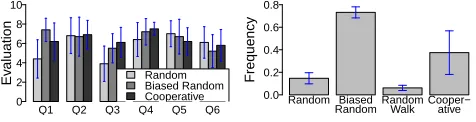
We had 10 users, and each one played all 3 systems. We randomized the order that each user played each system, in order to avoid ordering issues. Additionally, the users did not know how our system works, nor which one of the 3 systems they were currently playing (the 3 variations were presented to them as X, Y and Z). Each variation was played for 180s, and after that they had to fill in a form about their experience. We queried the users the following questions: (i) On a scale of 0 to 10, where 0 means “completely arbitrary” and 10 means “very interesting”, how do you classify the audio of the system?; (ii) On a scale of 0 to 10, where 0 means “no relation at all” and 10 means “very related”, how do you classify the relation between your actions and the audio of the system?; (iii) If you believe there is a relation, on a scale of 0 to 10, where 0 means “very rarely” and 10 means “very frequently”, how do you classify the occurrence of a major motivation to “compose” a song while exploring the virtual environment?; (iv) On a scale of 0 to 10, where 0 means “definitely not” and 10 means “absolutely”, do you classify the sound output of the system as “music”?; (v) On a scale of 0 to 10, where 0 means “very disturbing” and 10 means “very pleasant”, how do you classify the audio experience provided by the system?; (vi) On a scale of 0 to 10, where 0 means “not engaging at all” and 10 means “very immersive”, how do you classify your experience with the system as a whole? We can see the result in Figure 3 (a). It seems that humans could perceive thatRandomproduced more arbitrary sounds, while the sounds produced byBiased Randomand Coopera-tivewere considered more interesting (Q1). We also notice that users were not able to distinguish the importance of their actions in the audio generation process across the three sys-tems (Q2). Additionally, when queried to assume that there is a relation, they seem to consider feeling a stronger motivation to generate music inCooperative, even though they did not perceive that their actions had a greater effect inCooperative
(Q3). We also notice that the audio ofCooperativehad the greatest tendency to be classified as “music”, withBiased Randomclose behind.Cooperativealso had the lowest vari-ance in this aspect, indicating that users were more likely to agree in classifying the system as producing “music” than in the other systems (Q4). Interestingly, although users tended to agree more thatCooperativegenerates music, they also tended to perceive it as more “disturbing” than in the other systems (Q5). Finally, in terms of feeling engaged with the system, bothRandomandCooperativehad similar results, withBiased Randomright behind (Q6).
We performed a t-test in our results. We do not have yet strong statistical significance, but we are able to show some possible trends. In Q4, we findp = 0.3when comparing
RandomandCooperative. Although it is not yet the desired
p < 0.1, it already gives a 70%confidence that users are more likely to classify the audio output as “music” than when randomly drawing notes. Additionally, as mentioned, the
Ev
aluation
0 2 4 6 8 10
Q1 Q2 Q3 Q4 Q5 Q6
Random Biased Random Cooperative
(a) Survey comparing the differ-ent systems. Error bars show the 90% confidence interval.
Frequency
0.0 0.2 0.4 0.6 0.8
[image:6.612.320.558.55.116.2]Random Biased Random Cooper− Random Walk ative (b) Frequency of triads of thirds. Error bars show standard devia-tion.
Figure 3: Results of the experiment with real users.
result forCooperativeis quite stable, and we find that the mean is between 6.81 and 8.18 withp <0.1, indicating that there is a strong tendency for humans to classify the output as “music”. ForRandomandBiased Random, users had a much higher variance, giving it a larger confidence interval bar. Additionally, in Q1 we findp= 0.24, giving76%confidence that users found the output more “interesting” inCooperative. Meanwhile, for Q2 we findp≈0.9(when comparing with both random systems). This is a very positive result, giving us high confidence that users are not able to distinguish the effect of their actions, showing “implicit cooperation”. Finally, in Q3, we havep= 0.11(betweenRandomandCooperative). It is interesting to note that users were not able to perceive that their actions had a greater effect in the music generation process in theCooperativesystem, but they were more likely to classify the audio ofCooperativeas “music”, and also felt a greater motivation to produce a song inCooperative. It is also interesting that users seem to perceive the experience as more “disturbing”. We do not see that as a negative result, as art does not necessarily have to be pleasant; providing a disturbing experience is also one of the main objectives of contemporary arts (Henley 1997).
We also analyzed the audio produced. In Figure 3 (b) we show the frequency of occurrences of triads of thirds (in any order) across 10 executions.Random Walkrefers to walk-ing in our blocks with uniform probability to any direction (including jumping in the same cell), whileCooperativeis the data with 10 real human users. Hence, as we can see, the presence of a human agent is essential in our system for the formation of arpeggios (which increase the sound quality), even though the user is not aware of how our system works, and is not actively trying to generate those structures. Addi-tionally, even thoughBiased Randomhas a higher frequency of arpeggios, it did not have a higher tendency to be classified as music than our proposed system.
Note that it is not our objective to overpassBiased Random
in terms of frequency of arpeggios: it could be easily tuned to generate as many arpeggios as we want, we just use it to compare the user perception; and to see the arpeggio fre-quency ofCooperativein relation to an “upper bound” where those are directly generated. In terms of power chords, we find a frequency of24.3%(±8.9%)in the real executions of
Cooperative.
Conclusion
In our system, a human agent collaborates in emergent music generation. The agent collaborates as a “side-effect” of its behavior: it does not need to be actively involved, and is not required to be a music expert. We prove the correctness of our algorithm, and study the probability of generating music, showing that it is greater with a human agent. Our experiments show a larger frequency of arpeggios when a human uses our system, indicating musical quality. We find that users were not aware of their impact, but they seem to be likely to define the product of our system as “music”. It will be necessary to run experiments with a larger pool of human subjects, in order to better confirm our experimental results.
Acknowledgments:We would like to thank Anderson Rocha Tavares for the careful review of this work. We would also like to thank the School of Computing and Communications, and the AIIDE Doctoral Consortium for their support.
References
Bellemare, M. G.; Naddaf, Y.; Veness, J.; and Bowling, M. 2013. The arcade learning environment: An evaluation plat-form for general agents. Journal of Artificial Intelligence Research47:253–279.
Branzei, R.; Dimitrov, D.; and Tijs, S. 2008. Models in Cooperative Game Theory. Springer Berlin Heidelberg. Cohen, P. R., and Levesque, H. J. 1991. Confirmation and joint action. InProceedings of the International Joint Con-ference on Artificial Intelligence, IJCAI.
Davis, N.; Hsiao, C.-P.; Yashraj Singh, K.; Li, L.; and Magerko, B. 2016. Empirically studying participatory sense-making in abstract drawing with a co-creative cognitive agent. InProceedings of the 21st International Conference on Intel-ligent User Interfaces.
d’Inverno, M., and McCormack, J. 2015. Heroic versus Collaborative AI for the arts. InProceedings of the 24th International Joint Conference on Artificial Intelligence. Eigenfeldt, A., and Pasquier, P. 2010. Realtime generation of harmonic progressions using constrained Markov selec-tion. InProceedings of the First International Conference on Computational Creativity, ICCC.
Gelly, S.; Wang, Y.; Munos, R.; and Teytaud, O. 2006. Mod-ification of UCT with patterns in Monte-Carlo Go. Technical report, Institut National de Recherche en Informatique et en Automatique.
Henley, D. 1997. Art of disturbation: Provocation and cen-sorship in art education.Art Education50(4):39–45. Holmes, T. 2002. Art games and breakout: New media meets the american arcade. InComputer Games and Digital Cultures Conference.
Hurwicz, L., and Reiter, S. 2006. Designing Economic Mechanisms. Cambridge University Press.
Iwai, T. 2005. Electroplankton.
Jacob, M., and Magerko, B. 2015. Interaction-based au-thoring for scalable co-creative agent. InProceedings of the Sixth International Conference on Computational Creativity, ICCC.
Karolyi, O. 1965. Introducing Music. Penguin Books; Reissue edition.
Koster, R. 2004. A Theory of Fun for Game Design. Paraglyph Press.
Ledermann, W. 1949. Introduction to the theory of finite groups. Oliver and Boyd.
Lid´en, L. 2004. Artificial stupidity: The art of intentional mistakes. In Rabin, S., ed.,AI Game Programming Wisdom, volume 2. Charles River Media. 41–48.
Marcolino, L. S.; dos Passos, Y. T.; de Souza, ´A. A. F.; dos Santos Rodrigues, A.; and Chaimowicz, L. 2017. Avoid-ing target congestion on the navigation of robotic swarms.
Autonomous Robots41(6):1297–1320.
Margulis, E. H. 2014. On repeat: how music plays the mind. New York, NY: Oxford University Press.
McAnally, J. K. 1995. Edwin Franko Goldman, Richard Franko Goldman, and the Goldman Band: Professionals and Educators. The Bulletin of Historical Research in Music Education17(1):19–58.
Moreira, J.; Roy, P.; and Pachet, F. 2013. Virtualband: Inter-acting with styslistically consistent agents. InProceedings of the 14th International Society for Music Information Re-trieval Conference.
Pachet, F.; Roy, P.; Moreira, J.; and d’Inverno, M. 2013. Reflexive loopers for solo musical improvisation. In Pro-ceedings of the SIGCHI Conference on Human Factors in Computing Systems.
Policastro, M. A. 1999. Understanding How to Build Guitar Chords and Arpeggios. Mel Bay.
Roberts, A.; Engel, J.; Hawthorne, C.; Simon, I.; Waite, E.; Oore, S.; Jaques, N.; Resnick, C.; and Eck, D. 2017. Inter-active musical improvisation with Magenta. InProceedings of the Thirty-first Annual Conference on Neural Information Processing Systems (NIPS). (Demonstration).
Robertson, G., and Watson, I. 2014. A review of real-time strategy game AI. AI Magazine35(4).
Scott, B. 2002. The illusion of intelligence. In Rabin, S., ed.,
AI Game Programming Wisdom, volume 1. Charles River Media. 16–20.
Smith, R. G. 1980. The contract net protocol: High-level communication and control in a distributed problem solver.
IEEE Transactions on ComputersC-29(12).
Sorenson, N.; Pasquier, P.; and DiPaola, S. 2011. A generic approach to challenge modeling for the procedural creation of video game levels. IEEE Transactions on Computational Intelligence and AI in Games3(3).
Tambe, M. 1997. Towards flexible teamwork. Journal of Artificial Intelligence Research7:83–124.
Walser, R. 1993. Running with the devil: Power, gender, and madness in heavy metal music. Middletown, Connecticut: Wesleyan University Press, p. 9.