ISSN Online: 2162-5344 ISSN Print: 2162-5336
DOI: 10.4236/ojn.2018.88040 Aug. 24, 2018 531 Open Journal of Nursing
Avoiding the Gap of College Students’
Internship Expectations and Perceptions—
A Case Study in Taiwan
Yi-An Hou
St. Mary’s Junior College of Medicine, Nursing and Management, Taiwan
Abstract
Internship is believed to be vital in bridging the gap of theory and practice because of its providing students many realities they couldn’t find on campus. In fact, successful internships can play the role of “win-win-win” triangular partnership among schools, students, and industries, especially to benefit students to well equip themselves for good opportunities in the future career development. However, internship experiences that fail to meet students’ ex-pectation may also discourage them or turn them away from entering the in-dustry. Hence, to be aware of and to avoid the potential gap of students’ ex-pectation cannot be underestimated. The study aimed to explore students’ expectation of internships from an aspect of gender and multiple intelligences expecting to avoid the potential gap beforehand. Subjects were eighty college Hospitality students who were ready to conduct their internships out of campus. They helped to fill out the questionnaires dealing with their personal demographic information, multiple intelligences, and expectations of intern-ship. Findings revealed that genders and multiple intelligences did make a difference in students’ expectations of internship which may bring about fru-stration or disappointment in their real internship world. Suggestions and implications for the triangular partnership of schools, students, and indus-tries were provided with a better understanding of factors relevant to stu-dents’ expectations for a more appropriate internship program to avoid the potential gap in advance.
Keywords
Internship, Expectation, Satisfaction, Gender
1. Introduction
To provide students with an experiential learning experience that they couldn’t
How to cite this paper: Hou, Y.-A. (2018) Avoiding the Gap of College Students’ Internship Expectations and Perceptions— A Case Study in Taiwan. Open Journal of Nursing, 8, 531-551.
https://doi.org/10.4236/ojn.2018.88040
Received: July 8, 2018 Accepted: August 21, 2018 Published: August 24, 2018
Copyright © 2018 by author and Scientific Research Publishing Inc. This work is licensed under the Creative Commons Attribution International License (CC BY 4.0).
DOI: 10.4236/ojn.2018.88040 532 Open Journal of Nursing find on campus, to bridge the gap between theory and practice, and to help stu-dents well equip themselves for good opportunities in the future career devel-opment, many higher education institutions have been offering their students some type of internships for decades. Hence, internships are vital to bridge the gap between schools, and industries. More specifically, a successful internship program can benefit the three stakeholders as a “win-win-win” situations [1], in-cluding the main benefit of being more marketable for students, having risk-free-trial access to potential future employees for industries, and being able to strengthen the connections to business community for schools [2]. Due to the mutually beneficial nature of internships, the effectiveness of the latter has been widely supported by such as those of studies [3][4][5][6][7]. For instance, Gi-sela, et al.[5] analyze studies relevant to possible variables that may affect the outcomes and satisfaction of students’ internship experience, including the qual-ity of mentoring [8] [9], challenging assignments [8], ongoing feedback and greater autonomy [10]; keeping a journal [8][9], a dedicated supervisor [9][10], and appropriate prerequisite [9], as well as a positive attitude [6] [8]. On the other hand, there are still many drawbacks related to an internship experience, especially when students’ expectations differ from that of their employers [6], or even when students’ expectations and perceptions are unmet, which may bring about their frustration or dissatisfaction, and discourage them to stay in the field. Hence, the present study intends to find out the possible factors relevant to students’ expectations of internship, hoping to avoid the gap between their ex-pectation and perception of internship in advance.
1.1. Aims and Purpose of the Study
The study aimed to investigate Taiwanese college students’ expectations of in-ternships and factors relevant to their expectations from an aspect of genders and multiple intelligences.
1.2. Research Questions
The study expected to provide answers to the two main research questions: 1) What are Taiwanese college students’ expectations of internship?
2) How genders and multiple intelligences relate to students’ expectations of internship?
2. Literature Review
2.1. Internship and Expectations
be-DOI: 10.4236/ojn.2018.88040 534 Open Journal of Nursing ing a continuous challenging in the field. Nevertheless, it takes two to make it work; in the case, not only students need to know more about themselves and realize some of their own expectations are unrealistic and try best to enhance themselves to be matured, but also the employers had better be aware that the young generation was regarded as Generation Y (born between 1981-2000) and provide students with more tolerance and chances. Normally, the Generation Y was regarded as those who “tend to highly value their personal lives, pay, pro-motion, flexibility, and challenges in their job; value their non-work time for leisure and vacations and consider their job a source to fund their lifestyle” [16] [17]. Members of this generation were more independent, entrepreneurial, chal-lenge-taking, creative, technologically savvy, and knowledgeable [18]. It is hard for them to retain in the workplaces because they not only value their personal life and are willing to leave their current jobs if the change is more beneficial for them, but also they experience the biggest age gap in the workplace, which can be crucial determinant of intention to leave the jobs [19][20]. As a result, to have a better understanding of the characteristics of the young generation is ne-cessary for both educators and employers, and even students themselves, and trying to encourage them/themselves to remain and to reduce turnover intention of those who complete hospitality management programs and transition into jobs within the hospitality industry. Overall, it has been agreed that internships are satisfactory and beneficial experiences for all the involved parties of students, schools, and industries in many ways, though some improvements still need to be improved for more successful internship programs.
2.2. Multiple Intelligences (MI)
lean-DOI: 10.4236/ojn.2018.88040 536 Open Journal of Nursing ers. The same is true in the industry site, when employers provide training to the student interns in work, if they have a better understanding about the characte-ristics of the young generation and keep more aware of the interns’ individual differences, in particular, their personality and multiple intelligences, it may function better and enhance the relationship between employers and student in-terns in work and lead to a more successful inin-ternship in the end.
2.3. Gender Differences
In light of gender differences, the study would focus on discussing relevant to multiple intelligences, education, and job satisfaction. Firstly, regarding to gender differences in multiple intelligences, males were normally found to be stronger with Logical/Mathematical Intelligence, Spatial Intelligence, Bodily In-telligence, and Interpersonal Intelligences; while females were stronger in Ver-bal/Linguistic Intelligences and Musical Intelligences [42][43]. Secondly, males, especially in many Asian countries, are expected to have higher education to take more responsibilities for their family; hence, many parents are ready to in-vest more cost relative in their sons’ education, as Hou [35] pointed out that “gender matters from the beginning”, when early in elementary schools, boys were provided with more parental homework guidance, but girls were found to have stronger motivation and better English performance as well. Thirdly, as more and more females have been entering into the work force, it has generated considerable interest in the issues relevant to gender differences in the job mar-ket, for example, salary, position, performance, satisfaction, etc. To take job sa-tisfaction as an example, job sasa-tisfaction is the degree to which an individual feels positively or negatively about his/her job, and the overall job satisfaction depends on what one expects and what he/she receives [44], such as the tasks, leadership, peer relationships, organizational politics, as well as other physical and social conditions of the workplace. Generally speaking, in the society, fe-males are not like fe-males to be expected to take more responsibilities to support a family, consequently, as Clark [45] mentioned that more females are happy at work and outperform [46], because they tend to be less likely to identify earning as the most important aspect of a job. In fact, to identify social relations at work is one of the benefits for many female employees, consequently, there is a signif-icant gender difference in expectations about jobs which correlates with levels of job satisfaction, and many findings reveal that females have higher satisfaction about jobs [47][48]. However, there are still some cases that males are found to have higher levels of satisfaction about jobs in which their expectations and per-ception are met [49]. Hence, as Ehrman [50] pointed out that to enhance the success of both males and females, attention to such variables may suggest ways as interests, culturally determined gender roles, sex-related personality differ-ences, and learning circumstances.
3. Methodology
DOI: 10.4236/ojn.2018.88040 537 Open Journal of Nursing instruments, and 4) procedure. They were described below:
The study was a quantitative design, and a case study was used for the re-search methodology because it focused on a case not the whole population. In addition, a case study has the advantages of combining qualitative and quantita-tive data in a complementary way [51] and in providing a depth study of a spe-cial case as well. “Some case studies are highly impersonal and statistical” (p. 256) [51]. It is the study of a bounded system, which is in a particular circums-tance and with a particular problem, and also gives readers “space” for their own opinions.
3.1. Subjects of the Study
Subjects were 80 Hospitality Management major students in a private five-year junior college in North-Eastern Taiwan, including 34 males (43%) and 46 fe-males (57%). They were the whole population of the fourth graders who were ready to do their off-campus internship mainly in restaurants starting from the following semester for one year. Furthermore, like many other schools, for con-ducting English homogeneous grouping instruction, based on their English scores of Junior College Entrance Exam, the students were divided into two classes of Regular level (52.5%) and Advanced level (47.5%). Among them, 56% of the males were included in the Advanced Class, while 50% of the females were equally included in the advanced class and Regular class.
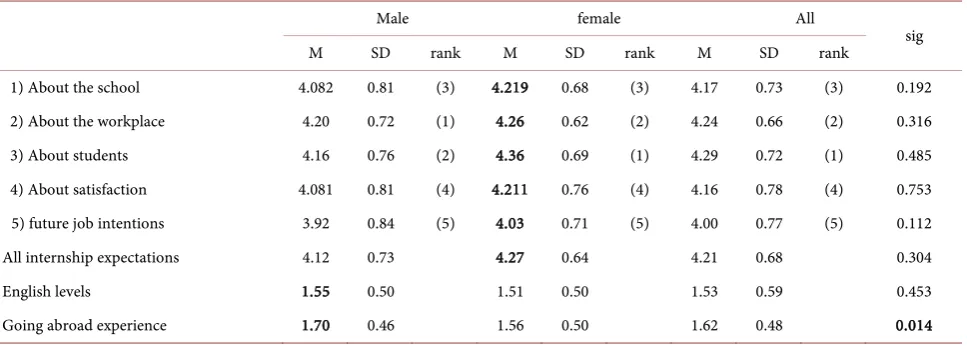
Based on students’ self-reported information, 29.9% of their fathers had junior high school (or below) education, 49.8% had senior high school education, and the rest 20.3% had college (or above) education; while 27.7% of their mothers had junior high school (or below) education, 59.8% had senior high school edu-cation, and the rest 12.5% had college (or above) education. As for their parents’ occupations, more than half of their fathers (53.9%) worked in the field of in-dustry/business, 14.0% worked as public servicers, and the rest 32.1% did other stuff, while 38.4% of their mothers worked in the field of industry/business, 8.1% worked as public servants, and more than half did other stuff (53.5%). In addi-tion, only slightly higher than one third (37.5%) of the students had the chance to go abroad for cross-cultural exchange experience; in particular, among the items dealing with students’ demographic information, a significant gender dif-ference only existed in students’ going-abroad experience, while males had higher mean than females (p < 0.05). Students’ demographic information was presented in Table 1.
3.2. Research Instruments
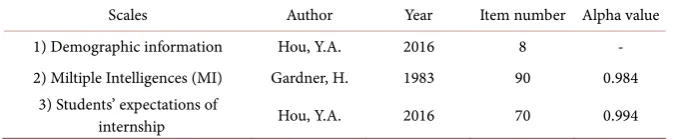
The research instrument is a 168-item questionnaire, including eight items dealing with students’ background information, Multiple Intelligences (MI) (90 items), and Expectations of Internship (70 items). The reliability of Multiple Intelli-gences (MI) and Expectations of Internship, was Cronbach’s Alpha 0.984 (n = 90) and 0.994 (n = 70), respectively. The research instruments were displayed in
DOI: 10.4236/ojn.2018.88040 538 Open Journal of Nursing
Table 1. Students’ demographic information.
Demographic Information
Items gender M SD sig
My father’s education 1) junior high (below) 2) senior high 3) college(above)
male 1.93 0.65 0.580 female 1.87 0.67
all 1.90 0.66
My mother’s education 1) junior high (below) 2) senior high 3) college (above)
male 2.00 0.60 0.391 female 1.86 0.60
all 1.92 0.59
My father’s occupation 1) public servicer 2) industry/businessperson 3) others
male 2.18 0.78 0.055 female 2.27 0.59
all 2.36 0.67
My mother’s occupation 1) public servicer 2) industry/businessperson 3) others
male 2.47 0.66 0.142 female 2.54 0.54
all 2.50 0.59
My English class 1) regular 2) advance
male 1.55 0.50 0.462 female 1.51 0.50
all 1.53 0.50
Having going-abroad experience 1) no 2) yes
male 1.70 0.46 0.014 female 1.56 0.50
all 1.62 0.48
Table 2. Instrument of the study.
Scales Author Year Item number Alpha value
1) Demographic information Hou, Y.A. 2016 8 -
2) Miltiple Intelligences (MI) Gardner, H. 1983 90 0.984 3) Students’ expectations of
internship Hou, Y.A. 2016 70 0.994
3.3. Procedure and Data Analysis
[image:8.595.205.542.464.534.2]DOI: 10.4236/ojn.2018.88040 539 Open Journal of Nursing
4. Findings and Discussions
4.1. Findings
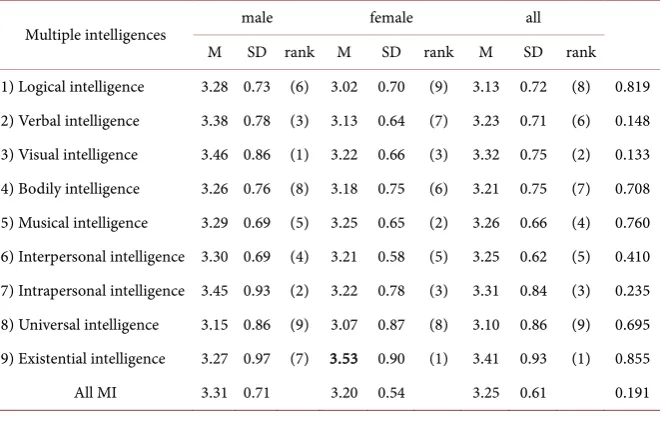
The results revealed that students had a moderate level of multiple intelligences with a mean of 3.25 out of 5.00 and high internship expectations of a mean of 4.22 out of 5.00. Comparatively, only a slightly more than one third of the stu-dents had going-abroad experience (37.5%) (Table 3). In addition, except for Existential Intelligence, male students had higher means in the other eight types of intelligence, though the differences didn’t reach significant levels. Specifically, males were stronger with Visual/Spatial, Intrapersonal, Verbal/Linguistic, Inter-personal intelligences, but weaker in Musical/ Rhythmic, Logic/Mathematic, Ex-istential, Bodily intelligence, and Universal/Naturalist intelligences. On the con-trary, females were stronger with Existential, Musical/Rhythmic, Visual/Spatial, Intrapersonal intelligences, but weaker with interpersonal, Bodily intelligence, Verbal/Linguistic, Universal/Naturalist intelligences, and Logic/Mathematic. Though there was no significant gender difference in multiple intelligences
(Table 4), yet males tended to be significantly stronger with some individual
items in Verbal/Linguistic, Visual/Spatial, and Intrapersonal intelligences than females (Table 5).
Table 3. Descriptive analysis of MI, internship expectations, English levels, and going
abroad experience.
Questionnaire N Min Max M SD
[image:9.595.206.540.398.482.2]Multiple intelligences (MI) 80 1 5 3.25 0.61 Internship expectations 80 1 5 4.21 0.68 English levels (1 = Regular, 52.5%; 2 = Advanced, 47.5%) 80 1 2 1.44 0.52 Going abroad experience (1 = without, 63.5%; 2 = with, 37.5%) 80 1 2 1.37 0.48
Table 4. Analysis of gender differences in multiple intelligences.
Multiple intelligences male female all
M SD rank M SD rank M SD rank 1) Logical intelligence 3.28 0.73 (6) 3.02 0.70 (9) 3.13 0.72 (8) 0.819 2) Verbal intelligence 3.38 0.78 (3) 3.13 0.64 (7) 3.23 0.71 (6) 0.148 3) Visual intelligence 3.46 0.86 (1) 3.22 0.66 (3) 3.32 0.75 (2) 0.133 4) Bodily intelligence 3.26 0.76 (8) 3.18 0.75 (6) 3.21 0.75 (7) 0.708 5) Musical intelligence 3.29 0.69 (5) 3.25 0.65 (2) 3.26 0.66 (4) 0.760 6) Interpersonal intelligence 3.30 0.69 (4) 3.21 0.58 (5) 3.25 0.62 (5) 0.410 7) Intrapersonal intelligence 3.45 0.93 (2) 3.22 0.78 (3) 3.31 0.84 (3) 0.235 8) Universal intelligence 3.15 0.86 (9) 3.07 0.87 (8) 3.10 0.86 (9) 0.695 9) Existential intelligence 3.27 0.97 (7) 3.53 0.90 (1) 3.41 0.93 (1) 0.855
[image:9.595.208.539.517.728.2]DOI: 10.4236/ojn.2018.88040 540 Open Journal of Nursing
Table 5. Gender differences in individual items of multiple intelligences.
Multiple Intelligences
Types of MI Items gender M SD sig
Verbal/Linguistic
Intelligence I feel comfortable to give a speech and talk to people.
male 3.23 1.07 0.045 female 3.00 0.86
all 3.09 0.95
Verbal/Linguistic
Intelligence I consider myself with good writing ability.
male 3.32 1.00 0.019 female 2.97 0.77
all 3.12 0.88
Verbal/Linguistic
Intelligence I can remember names, places and numbers easily.
male 3.32 1.00 0.031 female 3.17 0.73
all 3.23 0.85
Verbal/Linguistic
Intelligence I can pronounce every word with ease.
male 3.52 0.86 0.046 female 3.19 0.71
all 3.33 0.79
Verbal/Linguistic Intelligence
I easily remember nice turns of phrase or memorable quotes and
use them deftly in conversation.
male 3.44 0.92 0.009 female 3.04 0.72
all 3.20 0.83
Verbal/Linguistic
Intelligence I enjoy word games, such as doing crossword puzzles.
male 3.47 1.02 0.005 female 3.15 0.72
all 3.28 0.86
Visual/Spatial Intelligence
If I have to memorize something, I drew a diagram to help
me remember.
male 3.58 0.98 0.014 female 3.19 0.74
all 3.35 0.87
Visual/Spatial
Intelligence I like to visualize some solution.
male 3.32 1.09 0.006 female 3.10 0.70
all 3.19 0.88
Intrapersonal
intelligence I like to work alone.
male 3.50 1.26 0.046 female 3.28 0.98
all 3.37 1.10
Intrapersonal
intelligence I always work alone without cooperating with others.
male 3.35 1.09 0.023 female 2.97 0.88
all 3.13 0.98
Intrapersonal
intelligence I can express myself precisely.
male 3.38 1.25 0.016 female 3.19 0.88
all 3.27 1.04
Intrapersonal
intelligence When I get hurt or disappointed, I bounce back quickly.
male 3.50 1.23 0.031 female 3.30 0.91
DOI: 10.4236/ojn.2018.88040 541 Open Journal of Nursing Moreover, male students had significantly more going-abroad experiences than females (p < 0.05). On the other hand, females had higher overall intern-ship expectations, including the five factors of internintern-ship expectations about the school, the workplace, students, satisfaction, and future job intentions, yet the difference didn’t reach a significant level (Table 6).
Furthermore, the nine types of multiple intelligence were strongly correlated to one another (p < 0. 01) (Table 7), and the same as that of five factors of in-ternship expectations about the school, the company, students, satisfaction, and future job intention (p < 0.01) (Table 8).
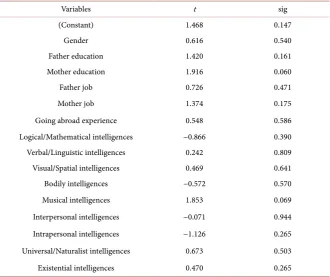
Lastly, none of students’ genders, parental education and jobs, as well as mul-tiple intelligences was relevant to their English levels (Table 9).
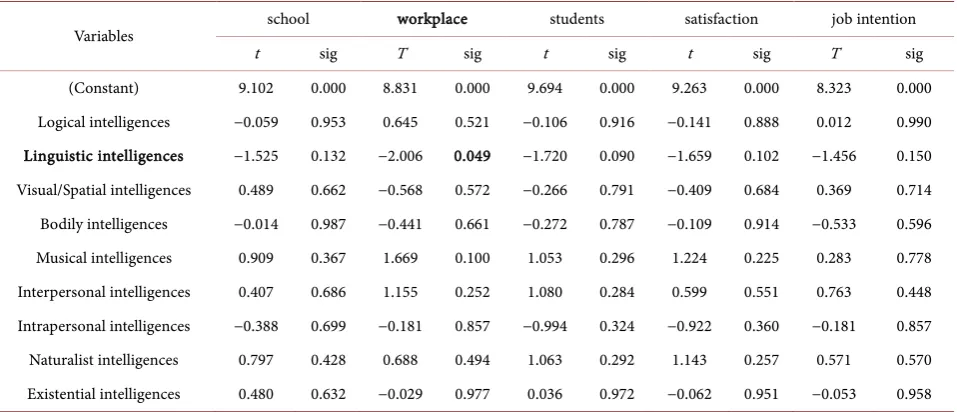
However, students’ going-abroad experience was found to be relevant to their internship expectations about school (p < 0.05), workplace (p < 0.05), and satis-faction (p < 0.05). Furthermore, though overall MI was not predictive to stu-dents’ internship expectations (Table 10), yet among individual types of MI, Verbal/Linguistic intelligence was relevant to students’ internship expectation about the company, negatively (p < 0.05) (Table 11).
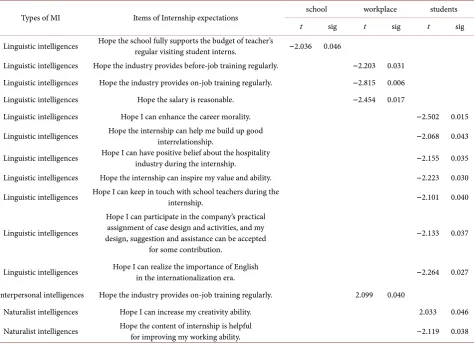
[image:11.595.57.541.554.735.2]In particular, students with stronger Verbal/Linguistic intelligences tended to have lower expectations about school’s supporting the budget of teachers’ regu-lar visiting student interns; industry’s providing before-job and on-job training, reasonable payment; self-expectations about their enhancing career morality; building up good interrelationship; having positive belief about the hospitality industry; inspiring the value and ability; keeping in touch with school teachers; participating in the company’s practical assignments; and recognizing the im-portance of English in the modern era. On the country, students with stronger Interpersonal intelligence had higher expectation about the industry’s providing on-job training, while students with stronger Naturalist intelligence had higher expectation about enhancing their creativity ability, but lower expectation about improving their practical skills (Table 12). All led to the conclusion that stu-dents’ MI did predict to their internship expectations to some extent.
Table 6. Analysis of gender differences of internship expectations, English levels and going abroad experience.
Male female All
sig
M SD rank M SD rank M SD rank
1) About the school 4.082 0.81 (3) 4.219 0.68 (3) 4.17 0.73 (3) 0.192
2) About the workplace 4.20 0.72 (1) 4.26 0.62 (2) 4.24 0.66 (2) 0.316
3) About students 4.16 0.76 (2) 4.36 0.69 (1) 4.29 0.72 (1) 0.485
4) About satisfaction 4.081 0.81 (4) 4.211 0.76 (4) 4.16 0.78 (4) 0.753 5) future job intentions 3.92 0.84 (5) 4.03 0.71 (5) 4.00 0.77 (5) 0.112
All internship expectations 4.12 0.73 4.27 0.64 4.21 0.68 0.304
English levels 1.55 0.50 1.51 0.50 1.53 0.59 0.453
DOI: 10.4236/ojn.2018.88040 542 Open Journal of Nursing
Table 7. Correlation among nine types of multiple intelligences.
Logic Linguistic Spatial Bodily Musical Interper-sonal Intrapersonal Naturalist Existential
Logic Pearson 1 0.779 (**) 0.721 (**) 0.699 (**) 0.593 (**) 0.676 (**) 0.397 (**) 0.555 (**) 0.371 (**)
Sig (2-tail) 0.000 0.000 0.000 0.000 0.000 0.000 0.000 0.001
N 80 80 80 80 80 80 80 80 80
Linguistic Pearson 0.779 (**) 1 0.748 (**) 0.583 (**) 0.699 (**) 0.753 (**) 0.561 (**) 0.502 (**) 0.499 (**)
Sig (2-tail) 0.000 0.000 0.000 0.000 0.000 0.000 0.000 0.000
N 80 80 80 80 80 80 80 80 80
Spatial Pearson 0.721 (**) 0.748 (**) 1 0.708 (**) 0.647 (**) 0.701 (**) 0.537 (**) 0.545 (**) 0.572 (**)
Sig (2-tail) 0.000 0.000 0.000 0.000 0.000 0.000 0.000 0.000
N 80 80 80 80 80 80 80 80 80
Bodily Pearson 0.699 (**) 0.583 (**) 0.708 (**) 1 0.630 (**) 0.703 (**) 0.475 (**) 0.572 (**) 0.432 (**)
Sig (2-tail) 0.000 0.000 0.000 0.000 0.000 0.000 0.000 0.000
N 80 80 80 80 80 80 80 80 80
Musical Pearson 0.593 (**) 0.699 (**) 0.647 (**) 0.630 (**) 1 0.693 (**) 0.567 (**) 0.524 (**) 0.556 (**)
Sig (2-tail) 0.000 0.000 0.000 0.000 0.000 0.000 0.000 0.000
N 80 80 80 80 80 80 80 80 80
Interpersonal Pearson 0.676 (**) 0.753 (**) 0.701 (**) 0.703 (**) 0.693 (**) 1 0.609 (**) 0.593 (**) 0.550 (**) Sig
(2-tail) 0.000 0.000 0.000 0.000 0.000 0.000 0.000 0.000
N 80 80 80 80 80 80 80 80 80
Intrapersonal Pearson 0.397 (**) 0.561 (**) 0.537 (**) 0.475 (**) 0.567 (**) 0.609 (**) 1 0.787 (**) 0.790 (**)
Sig (2-tail) 0.000 0.000 0.000 0.000 0.000 0.000 0.000 0.000
N 80 80 80 80 80 80 80 80 80
Naturalist Pearson 0.555 (**) 0.502 (**) 0.545 (**) 0.572 (**) 0.524 (**) 0.593 (**) 0.787 (**) 1 0.738 (**)
Sig (2-tail) 0.000 0.000 0.000 0.000 0.000 0.000 0.000 0.000
N 80 80 80 80 80 80 80 80 80
Existential Pearson 0.371 (**) 0.499 (**) 0.572 (**) 0.432 (**) 0.556 (**) 0.550 (**) 0.790 (**) 0.738 (**) 1 Sig (2-tail) 0.001 0.000 0.000 0.000 0.000 0.000 0.000 0.000
N 80 80 80 80 80 80 80 80 80
**p < 0.01, *p < 0.05.
4.2. Discussions
DOI: 10.4236/ojn.2018.88040 543 Open Journal of Nursing
Table 8. Correlation among five factors of internship expectations.
school workplace student satisfaction job intention School Pearson 1 0.840 (**) 0.872 (**) 0.870 (**) 0.778 (**)
Sig (2-tail) 0.000 0.000 0.000 0.000
N 80 80 80 80 80
Workplace Pearson 0.840 (**) 1 0.862(**) 0.858 (**) 0.665 (**)
Sig (2-tail) 0.000 0.000 0.000 0.000
N 80 80 80 80 80
Student Pearson 0.872 (**) 0.862 (**) 1 0.918 (**) 0.738 (**)
Sig (2-tail) 0.000 0.000 0.000 0.000
N 80 80 80 80 80
Satisfaction Pearson 0.870 (**) 0.858 (**) 0.918 (**) 1 0.733 (**)
Sig (2-tail) 0.000 0.000 0.000 0.000
N 80 80 80 80 80
Job intention Pearson 0.778 (**) 0.665 (**) 0.738 (**) 0.733 (**) 1 Sig (2-tail) 0.000 0.000 0.000 0.000
N 80 80 80 80 80
Table 9. Regression analysis of factors predictive to students’ English levels.
Variables t sig
(Constant) 1.468 0.147
Gender 0.616 0.540
Father education 1.420 0.161
Mother education 1.916 0.060
Father job 0.726 0.471
Mother job 1.374 0.175
Going abroad experience 0.548 0.586
Logical/Mathematical intelligences −0.866 0.390
Verbal/Linguistic intelligences 0.242 0.809
Visual/Spatial intelligences 0.469 0.641
Bodily intelligences −0.572 0.570
Musical intelligences 1.853 0.069
Interpersonal intelligences −0.071 0.944
Intrapersonal intelligences −1.126 0.265
Universal/Naturalist intelligences 0.673 0.503
Existential intelligences 0.470 0.265
Dependent variable: students’ English levels.
[image:13.595.208.539.373.650.2]DOI: 10.4236/ojn.2018.88040 544 Open Journal of Nursing
Table 10. Regression analysis of factors predictive to students’ internship expectations.
Variables school workplace students satisfaction job intentions All expectation
t sig t sig t Sig t sig t sig t sig
(Constant) 5.013 0.000 5.603 0.000 5.807 0.000 5.581 0.000 5.004 0.000 5.246 0.000 Gender −0.522 0.603 −0.507 0.614 0.320 0.750 −0.291 0.772 −0.386 0.700 0.329 0.743 Father education −0.771 0.443 −0.246 0.806 0.181 0.857 −0.001 1.00 −0.141 0.888 −0.211 0.833 Mother education −1.311 0.194 −0.501 0.628 −0.217 0.829 −0.464 0.644 −0.627 0.533 −0.467 0.642 Father job 0.157 0.876 0.421 0.675 0.125 0.901 −0.048 0.962 0.723 0.472 0.217 0.829 Mother job 0.431 0.668 −0.966 0.337 −1.154 0.253 −0.770 0.444 −1.188 0.239 −0.621 0.537 English levels 1.299 0.199 −0.151 0.881 −0.048 0.962 0.485 0.630 0.709 0.481 0.547 0.586 Going abroad
experience 2.225 0.029 2.137 0.036 1.741 0.086 2.149 0.035 1.597 0.115 2.073 0.042 Multiple
intelligences −1.035 0.304 −0.113 0.911 −1.485 0.142 −1.906 0.061 −1.084 0.282 −1.157 0.252 Dependent variables: internships expectation about the school, the company, students, satisfaction, and future job intention.
Table 11. Regression analysis of MI predictive to students’ internship expectations.
Variables school workplace students satisfaction job intention
t sig T sig t sig t sig T sig
(Constant) 9.102 0.000 8.831 0.000 9.694 0.000 9.263 0.000 8.323 0.000 Logical intelligences −0.059 0.953 0.645 0.521 −0.106 0.916 −0.141 0.888 0.012 0.990 Linguistic intelligences −1.525 0.132 −2.006 0.049 −1.720 0.090 −1.659 0.102 −1.456 0.150 Visual/Spatial intelligences 0.489 0.662 −0.568 0.572 −0.266 0.791 −0.409 0.684 0.369 0.714 Bodily intelligences −0.014 0.987 −0.441 0.661 −0.272 0.787 −0.109 0.914 −0.533 0.596 Musical intelligences 0.909 0.367 1.669 0.100 1.053 0.296 1.224 0.225 0.283 0.778 Interpersonal intelligences 0.407 0.686 1.155 0.252 1.080 0.284 0.599 0.551 0.763 0.448 Intrapersonal intelligences −0.388 0.699 −0.181 0.857 −0.994 0.324 −0.922 0.360 −0.181 0.857 Naturalist intelligences 0.797 0.428 0.688 0.494 1.063 0.292 1.143 0.257 0.571 0.570 Existential intelligences 0.480 0.632 −0.029 0.977 0.036 0.972 −0.062 0.951 −0.053 0.958 Dependent variables: internships expectation about school, workplace, students, satisfaction, and future job intention.
level of MI (M = 3.25/5.00) and high level of internship expectation (4.22/5.00). Particularly, male students had higher means in MI, including Logical/Mathematic intelligence and Bodily Intelligence; on the other hand, females were stronger with Verbal/Linguistic Intelligence and Musical Intelligence, which was consis-tent with Hou’s [53], and Hou, et al.’s [42].
[image:14.595.61.540.335.541.2]DOI: 10.4236/ojn.2018.88040 545 Open Journal of Nursing
Table 12. Regression analysis of MI predictive to variables of students’ internship expectations.
Types of MI Items of Internship expectations school workplace students
t sig t sig t sig
Linguistic intelligences Hope the school fully supports the budget of teacher’s regular visiting student interns. −2.036 0.046
Linguistic intelligences Hope the industry provides before-job training regularly. −2.203 0.031 Linguistic intelligences Hope the industry provides on-job training regularly. −2.815 0.006 Linguistic intelligences Hope the salary is reasonable. −2.454 0.017
Linguistic intelligences Hope I can enhance the career morality. −2.502 0.015
Linguistic intelligences Hope the internship can help me build up good interrelationship. −2.068 0.043
Linguistic intelligences Hope I can have positive belief about the hospitality industry during the internship. −2.155 0.035
Linguistic intelligences Hope the internship can inspire my value and ability. −2.223 0.030
Linguistic intelligences Hope I can keep in touch with school teachers during the internship. −2.101 0.040
Linguistic intelligences
Hope I can participate in the company’s practical assignment of case design and activities, and my design, suggestion and assistance can be accepted
for some contribution.
−2.133 0.037
Linguistic intelligences Hope I can realize the importance of English in the internationalization era. −2.264 0.027
Interpersonal intelligences Hope the industry provides on-job training regularly. 2.099 0.040
Naturalist intelligences Hope I can increase my creativity ability. 2.033 0.046
Naturalist intelligences Hope the content of internship is helpful for improving my working ability. −2.119 0.038
Dependent variables: internship expectations about school, workplace, students, satisfaction, and future job intention.
DOI: 10.4236/ojn.2018.88040 546 Open Journal of Nursing were strongly correlated to one another, which supported that internship is a triangular partnership among students, schools, and industry [12]; consequently, the triangular network should cooperate to run well for a successful internship program to benefit the main three stakeholders. The findings revealed that nei-ther students’ demography factors (gender, parents’ education and jobs, going- abroad experience), nor types of multiple intelligences was predictive to stu-dents’ English levels (Table 7). The possible reason might due to students’ Eng-lish proficiency in the study was only divided into two levels instead of being more specific classified by their scores. Regarding to internship expectations, in general, only students’ going-abroad experience was found to be relevant to their internship expectations about the school (p < 0.05), the company (p < 0.05), and satisfaction (p < 0.05) (Table 8), but if all the nine types of MI were analyzed, it was found that Verbal/Linguistic intelligence was negatively predictive to stu-dents’ expectation about workplace (p < 0.05) (Table 9). In particular, some negative prediction of Verbal/Linguistic intelligence and Universal/Naturalist intelligence existed in students’ expectations about workplace and students themselves. In other words, students with weaker Verbal/Linguistic intelligence and Universal/Natural intelligence had higher internship expectations about workplace and themselves. In the study, male students were found to be stronger with Verbal/Linguistic intelligence than females, hence, it might bring about some lower internship expectations for male students about workplace and themselves (Table 5, Table 12). In addition, it was found that some items of In-terpersonal intelligence and Naturalist intelligence were positively predictive to workplace (p < 0.05) and students (p < 0.05), respectively, indicating that stu-dents with stronger interpersonal intelligence had higher expectation about workplace’s providing on-job training, while students with stronger Naturalist intelligence expected more that they could increase their creativity ability (Table 12). On the other hand, both males and females had weaker Universal/Naturalist intelligence, ranked last and the next to last, respectively (Table 4). Consequent-ly, students needed to be aware that it might lead to some high optimistic or un-realistic internship expectations. For example, students’ highest expectation about the workplace was “reasonable payment” (rank 1st out of 12 items), but for their self-expectation, “devoting myself to the work” only ranked 24th out of 30 items). Another example was that students had high expectation about them-selves to realize the importance of English in the modern world (rank 12th out of 30 items), but they didn’t self-expect much to try to use time to study English and improve their English ability (rank the last out of 30 items). In fact, students should know that “You reap what you sow,” so they should try their best to de-vote themselves to the work, then reasonable payment can be expected.
5. Implication and Limitation
5.1. Implication
stake-DOI: 10.4236/ojn.2018.88040 547 Open Journal of Nursing holders, hence, it must be well defined and cohesive. On one hand, both the school and industry should collaborate closely to develop a well-organized qual-ity internship program, on the other hand, students need to be ready and aware of their expectations prior to commencing the internship, their perception af-terwards, their overall internship satisfaction level, and the relationship between the gap of expectations and perceptions and overall satisfaction. First, in the network, schools should take the lead to organize the internship programs and involve students and employers to participate in the planning stage. To begin with, schools should help students to nurture realistic expectations regarding to the internship demands and reward. In addition, to arrange the right person in the right place, schools should take the responsibility for all pre-placement activ-ities to prepare students for the internship programs by collecting information about needs and interests of students as well as employers by way of formal channels of questionnaires by mails, e-mails, or interviews, and informal chan-nels of comprising casual talk with students and employers. More importantly, there should be a full-time specialist staff, preferably with industrials experience, to administer the internship program at school, and to serve as the bridge build-er among the three stakeholdbuild-ers during the whole process of intbuild-ernship. Second, students should appreciate the valuable opportunity of internship to apply their theoretical knowledge with the actual practice experience for future job. Fur-thermore, they need to fully understand themselves and to be sure that the in-ternships best fit their personality traits and commit them to the values govern-ing the modern hospitality industry and to nurture realistic expectations re-garding to the internship demands and reward. Also, they need to build good rapport with both school and industry as they are the middle source of the in-ternship program. Third, with understanding the purpose and the benefits of the internship program, industries should cooperate with the school closely and ac-tively for a successful completion. In addition to the careful preparation, during the process, managers or industry mentors should have a better understanding about the characteristics of the new Generation Y employees, be aware of the student interns’ expectations about the internship, and to arrange formal or in-formal meetings with them to discuss various issues related to their observation, training progress, or problems, and try to help student interns to engage them with jobs that are fulfilling significant, and challenging [54] [55]. All in all, in addition to good beginning, supervising process, and expected completion of the internship, there should be a program-end meeting for the three stakeholders again so that the representatives of schools, students, and industries have the chance to evaluate the program and provide some suggestions for the improve-ment of more successful in the future.
DOI: 10.4236/ojn.2018.88040 548 Open Journal of Nursing enough to support the findings; therefore, to provide an appropriate English test is quite necessary in the future study. Second, the sample size was small (n = 80), hence, the results may not be representative for other schools. Last but not least, many studies have proved that personality and intelligence are good predictors for performance in school text (and in work site) [38][39][41]. However, inves-tigations normally only include the personality traits of Big Five (OCEAN) and general intelligence to be relevant to students’ performance, and exclude the nine types of Multiple Intelligence (MI). If both the Big Five personality traits and the nine types of Multiple Intelligence can be taken into consideration to explore the possible relations among the personality, intelligence, and perfor-mance. Hence, it is needed to cover all the Big Five, Nine Multiple Intelligences, and performance in both school and work in the future studies.
Acknowledgements
Special thanks go to the college’s support and the participating students’ cooper-ation to make the research possible.
Conflicts of Interest
The authors declare no conflicts of interest regarding the publication of this pa-per.
References
[1] Fender, L. and Watson, L. (2005) OSH Internships: One Program’s Perspective on Benefits for Students, Employers, and Universities. Professional Safety, 50, 36-40. [2] Divine, R., Linrud, J., Miller, R. and Wilson, J. (2007) Required Internship
Pro-grams in Marketing: Benefits, Challenges and Determinants of Fit. Marketing Edu-cation Review, 17, 45-52. https://doi.org/10.1080/10528008.2007.11489003
[3] Chen, C.T., Tu, J.L., Wang, C.C. and Chen, C.F. (2011) A Study of the Effects of In-ternship Experiences on the Behavioral Intentions of College Students Majoring in Leisure Management in Taiwan. Journal of Hospitality, Leisure, Sport & Tourism Education, 10, 61-73. https://doi.org/10.3794/johlste.102.294
[4] Cook, S.J., Parker, R.S. and Pettijohn, C.E. (2004) The Perceptions of Interns: A Longitudinal Case Study. Journal of Education for Business, 79, 179-185.
[5] Velez, G.S. and Giner, G.R. (2015) Effects of Business Internships on Students, Em-ployers, and Higher Education Institutions: A Systematic Review. Journal of Em-ployment Counseling, 52, 121-130.
[6] Swanson, S. and Tomkovick, C. (2012) Marketing Internships: How Values and Search Strategies Differ across the Student-Employer Dyad. Marketing Education Review, 22, 251-262. https://doi.org/10.2753/MER1052-8008220305
[7] Weible, R. and McClure, R. (2011) An Exploration of the Benefits of Student in-ternships to Marketing Departments. Marketing Education Review, 21, 229-240.
https://doi.org/10.2753/MER1052-8008210303
[8] Coco, M. (2000) A Try before You Buy Arrangement. SAM Advanced Management Journal, 65, 41-47.
DOI: 10.4236/ojn.2018.88040 549 Open Journal of Nursing
Career Perceptions through Internships. Journal of Hospitality, Leisure, Sport, & Tourism Education,12, 70-78. https://doi.org/10.1016/j.jhlste.2012.11.003
[10] Kim, I.S. (2009) The Relevance of Multiple Intelligences to CALL Instruction.
Reading Matrix, 9, 1-21.
[11] Narayanan, V.K., Olk, P.M. and Fukami, C.V. (2010) Determinants of Internship Effectiveness: An Exploratory Model. Academy of Management Learning & Educa-tion, 9, 61-80.
[12] Zopistis, A. (2007) Hospitality Internships in Cyprus: A Genuine Academic Expe-rience or a Continuing Frustration? International Journal of Contemporary Hospi-tality Management,19, 65-77. https://doi.org/10.1108/09596110710724170
[13] Fox, T. (2001) A Sense of Place. Caterer and Hotelkeeper, 189, 4160.
[14] McMahon, U. and Quinn, U. (1995) Maximizing the Hospitality Management Stu-dent Work Placement Experience: A Case Study. Education and Training, 37, 13-17. https://doi.org/10.1108/00400919510088870
[15] Kandampully, J., Mok, C. and Sparks, B. (2001) Service Quality Management in Hospitality, Tourism, and Leisure. Haworth Hospitality Press, New York.
[16] Kerslake, P. (2005) Words from the Ys. New Zealand Management,52, 44-46. [17] Morton, D.L. (2002) Targeting Generation Y. Public Relations Quarterly, 47, 46-48. [18] Martin, C. (2005) From High Maintenance to High Productivity: What Managers
Need to Know about Generation Y. Industrial and Commercial Training, 37, 39-44.
https://doi.org/10.1108/00197850510699965
[19] Barron, P., Maxwell, G., Broadbridge, A. and Ogden, S. (2007) Careers in Hospital-ity Management: Generation Y’s Experiences and Perceptions. Journal of Hospital-ity, Tourism Management,14, 119-128. https://doi.org/10.1375/jhtm.14.2.119
[20] Weingarten, R.M. (2009) Four Generations, One Workplace: A Gen X-Y Staff Nurse’s View of Team Building in the Emergency Department.Journal of Emer-gency Nursing, 35, 27-30. https://doi.org/10.1016/j.jen.2008.02.017
[21] Gardner, H. (1983) Frames of Mind: The Theory of Multiple Intelligences. Basic Books, New York.
[22] Ramos-Ford, V. and Gardner, H. (1991) Giftedness from a Multiple Intelligences Perspective. In: Colangelo, N., Schumacker, R.G.A. and Lomax, R., Eds., A Begin-ner’s Guide to Structural Equation Modeling,2nd Edition, Lawrence Erlbaum As-sociates, Mahwah, NJ.
[23] Visser, B., Ashton, M. and Vernoon, O. (2006) Beyond g: Putting Multiple Intelli-gences Theory to the Test. Intelligence, 34, 487-502.
https://doi.org/10.1016/j.intell.2006.02.004
[24] Akbari, R. and Hosseini, K. (2008) Multiple Intelligences and Language Learning Strategies: Investigating Possible Relations. System,36, 141-155.
[25] Dastgoshadeh, A. and Jalizadeh, K. (2011) Multiple Intelligences-Based Language Curriculum for the Third Millennium. International Proceedings of Economics Development & Research, 18, 57-62.
[26] Tapia, C.E., Carmen, S.C. and Susana, C.V. (2013) A Mexican Study of Multiple In-telligences for Pre-Service Teachers of English as a Foreign Language. HOW, 20, 170-189.
DOI: 10.4236/ojn.2018.88040 550 Open Journal of Nursing
[28] del Mar Palenzuela Perez, M. and Ruz, N.R. (2014) Multiple Intelligences Theory Applied to Second Language Acquisition. Language, Individual & Society, 8, 313-321. https://www.scientific-publications.net/en/
[29] Lin, S.-C. (2009) Gender and Major Differences in Self-Estimates of Different As-pects of Gardner’s Multiple Intelligences: A Study of the Undergraduate Pre-Service Teachers in Taiwan. Asian Social Science,5, 3-14.
https://doi.org/10.5539/ass.v5n5p3
[30] Hou, Y.-A. (2013) Does Gender Matter with Multiple Intelligences in Language Learning—A Case Study of Taiwanese High School Students. Journal of Teaching and Education,2, 185-191.
[31] Kuo, S.-C. (2016) A Study about Learning Attitude and Multiple Intelligences for Higher Grade Primary Students in New Taipei City. Unpublished Master’s Thesis. Ming Chuan University, Taiwan.
[32] Hou, Y.-A. (2013) How Students’ Strategies Are Linked to Learning Styles and In-telligences—A Case Study in Taiwan. The International Journal of Learner Diversity and Identities, 19, 75-96.
[33] Hou, Y.-A., Hou, Y.-J. and Cheng, H.Y. (2015) Analysis of Some Factors Predicting Students’ English Performance. Journal of National United University, 12, 17-42. [34] Hou, Y.-A. (2015) The Relationship of Multiple Intelligences, Foreign Language
Learning Anxiety and ENGLISH Proficiency—A Case Study of Taiwanese EFL Col-lege Students. The International Journal of the Communication and Linguistic Stu-dies, 12, 15-29.
[35] Hou, Y.-A. (2016) The Impacts of Multiple Intelligences on Tolerance of Ambiguity and English Proficiency—A Case Study of Taiwanese EFL College Students. Open Journal of Modern Linguistics, 6, 255-275. https://doi.org/10.4236/ojml.2016.64028
[36] Hou, Y.-A. (2017) Revisit MI with the Role of Motivation, Attitude, Anxiety, and English Learning—A Case Study. Open Access Library Journal, 11, 1-19.
[37] Ackerman, P.L. and Heggestad, E.D. (1997) Intelligence, Personality, and Interests: Evidence for Overlapping Traits. Psychological Bulletin, 121, 219-245.
https://doi.org/10.1037/0033-2909.121.2.219
[38] Farsides, T. and Woodfield, R. (2003) Individual Differences and Undergraduate Academic Success: The Roles of Personality, Intelligences, and Application. Perso-nality and Individual Difference, 34, 1225-1243.
https://doi.org/10.1016/S0191-8869(02)00111-3
[39] Heaven, P. and Ciarrochi, J. (2012) When IQ Is Not Everything: Intelligence, Per-sonality and Academic Performance at School. Personality and Individual Differ-ences,53, 518-522. https://doi.org/10.1016/j.paid.2012.04.024
[40] Poropat, A.E. (2009) A Meta-Analysis of the Five-Factor Model of Personality and Academic Performance. Psychological Bulletin, 135, 322-338.
https://doi.org/10.1037/a0014996
[41] Rosander, P., Backstorm, M. and Stenberg, G. (2011) Personality Traits and General Intelligence as Predictors of Academic Performance: A Structural Equation Model-ing Approach. Learning and Individual Differences,21, 590-596.
https://doi.org/10.1016/j.lindif.2011.04.004
[42] Hou, Y.-J. and Cheng, H.Y. (2014) The Nine Intelligences and Six Learning Styles in College Students’ Academic Performance—A Case Study. Journal of National United University,11, 35-62.
DOI: 10.4236/ojn.2018.88040 551 Open Journal of Nursing
Aspect of Multiple Intelligences and Ambiguity Tolerance. International Journal of Teaching and Education, 5, 32-56. https://doi.org/10.20472/TE.2017.5.2.003
[44] Krishna, G.S. (2015) Gender Difference and Job Satisfaction: A Study among Facul-ties of Private Colleges in India. PEOPLE: International Journal of Social Science, 1, 227-137.
[45] Clark, A. (1997) Why Are Women So Happy at Work? Labour Economics, 4, 341-372. https://doi.org/10.1016/S0927-5371(97)00010-9
[46] Deary, I.J., Strand, S., Smith, P. and Fernanedes, C. (2006) Intelligence and Educa-tional Achievement. Intelligence,35, 13-21.
https://doi.org/10.1016/j.intell.2006.02.001
[47] Bender, K.A., Donohue, S.M. and Heywood, J.S. (2005) Job Satisfaction and Gender Segregation. Oxford Economic Papers,57, 479-496.
https://doi.org/10.1093/oep/gpi015
[48] Okpara, J.O., Squillace, M. and Erondu, E.A. (2005) Gender Difference and Job Sa-tisfaction: A Study of University Teachers in the United States. Women in Man-agement Review,20, 177-190. https://doi.org/10.1108/09649420510591852
[49] Nadjla, H. and Hasan, A.R. (2009) Gender Differences and Job Satisfaction of the Iranian Public Librarians. Journal of Education and Psychology, 16, 112-191. [50] Ehrman, M. (1990) Owls and Doves: Cognition, Personality, and Learning Success.
In: Alatis, J.E., Ed., Georgetown University Round Table on Language and Linguis-tics, Georgetown University Press, Washington DC, 413-437.
[51] Stake, R.E. (1988) Case Study Methods in Educational Research: Seeking Sweet Wa-ter. In: Jaeger, R.M., Ed., Complementary Methods for Research in Education, American Educational Research Association, Washington DC, 253-300.
[52] Shen, P.W. (2001) A Study of the Relation among Parents’ Attitude, English Anxie-ty and English Learning Motivation of Yi-Lan CounAnxie-ty’s Junior High School Stu-dents. Unpublished Thesis, National Kaohsiung Normal University, Kaohsiung. [53] Hou, Y.-A. (2010) Multiple Intelligences and Foreign Language Learning—A Case
Study in Taiwan. Whampou Journal, 58, 1-30.
[54] Gursoy, D., Chi, C.G. and Karadag, E. (2013) Generational Differences in Work Values and Attitudes among Frontline and Service Contact Employees. Internation-al JournInternation-al of HospitInternation-ality Management,31, 40-48.
https://doi.org/10.1016/j.ijhm.2012.04.002