doi:10.4236/eng.2011.39113 Published Online September 2011 (http://www.SciRP.org/journal/eng)
Fuzzy Approach to the Selection of Material Data in
Concurrent Engineering Environment
Adavi Balakrishna1, G. Ravi Chandra2, Balakrishna Gogulamudi3, Chinta Someswararao4 1Department of Mechanical Engineering, SRKR Engg College, Bhimavaram, India
2Department of Mechanical Engineering, Vardhaman College
of Engineering, Hyderabad, India
3Department of Mechanical Engineering, PVP Siddartha Institute
of Technology, Vijayawada, India
4Department of CSE, SRKR Engg College, Bhimavaram, India
E-mail: [email protected]
Received June 27, 2011; revised August 24, 2011; accepted September 2, 2011
Abstract
The selection of proper materials for a structural component is critical in engineering design. Existing design procedures may currently be sufficient, especially where experience exists, but fierce industrial competition is spurring the search for improved methods and tools. The main drivers are quality, life-cycle cost, and time-to-market. Improved design efficiency and accuracy may have an enormous impact on the economic viability of the final product. The use of computer-aided systems can assist the designer in selecting the ap-ropriate material these may potentially reduce product cost and time-to-market while assisting the concurent engineering activities, thereby resolving problems related to materials presented during the initial phase of design. This paper focuses on specific issues such as material selection at early design stage. In this paper material selection algorithm is developed using fuzzy logic technique for selection of proper material from database as per design engineers’ criteria. The information obtained from the selection algorithm is ex- changed through a properly secured web page through pure internet communication to different users in the enterprise so that it can create concurrent engineering environment throughout the product life cycle.
Keywords: Material Properties, Concurrent Engineering, Fuzzy Logic and Material I.D., Web Pages, CPD
1. Introduction
In the Concurrent Engineering (CE) environment, tech- niques, algorithms and software tools are provided to allow designers and developers to interact with each oth-er effectively and efficiently. Implementation of CE, would naturally consume more time and money at the initial design stage so as to ensure that the concept selec- tion is optimized, companies can reduce design changes at a later stage, leading to better engineered products with an advantage in total quality, time and cost com- petitiveness.
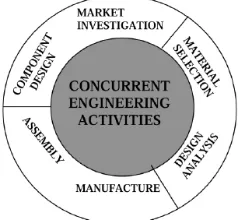
Material selection is one of the most important active- ties for a product development process. In the modern design and manufacturing environment, such as, newly - developed CE methodology, material selection plays as important role as other activities in the total design mod-el such as market investigation, product design
[image:1.595.364.483.582.692.2]specifica-tion, component design, design analysis, manu- facture and assembly is shown in Figure 1 [1]. Material selec-tion is one of the CE strategies. The integrated ma- terial selection system thus plays a major role in product de-velopment to optimize the cost of product.
The selection of the most suitable material for particu-lar application is crucial function in the design of an ar- tifact. The performance of materials is important in terms of service conditions, processing and its economic, the availability of candidate materials, the company’s make orbuy decision for the system components; the customer preferences; and most importantly, the total life-cycle cost. In practice, it may be necessary to express the per- formance in terms of fuzzy numbers. The design engi- neer is responsible for selecting relevant properties and assessing the importance of the selected properties based on the requirements of a particular application.
This paper discusses one of the CE integration strate- gies i.e., ‘selection of material’ using Fuzzy Logic that can be adapted for successful integration within industry and beyond using web services. Each material in the da- tabase is an alternative to be selected for the application. A computerized system, which provides access to mate- rial data, is not necessarily a material selection system, although access to data is essential to facilitate selection. The material selection system assess the suitability of all materials in the database, eliminates unsuitable materials from further consideration, and gives a final ranking to all of the suitable materials.
2. Review of CE Environment and Material
Selection Systems
The CE philosophy can be implemented through differ- ent strategies considering the diverse requirements of users and the conditions of the companies. Pallot and V. Sandoval [2] emphasized the communication and sharing of design data, integration and interoperability of the application systems in design and manufacturing, and the coordination between the upstream and downstream ac- tivities to support concurrent activities for multi-disci- plinary teams. According to Prasad [3], materials are the common elements enumerating parts in a product reali- zation process. Normally, design engineers rely on the materials that they are familiar with. However, when the design requirements exceed the constraints of such mate- rials or exceed the constraints on material properties, CE team members must consider alternative materials. With direct online access to a materials database, the CE team members could select materials that are lighter, stronger and lower in cost.
Within the engineering design and manufacturing con- text, there have been many research works for the inte- gration of various engineering data, models or software tools, besides the SHAred Dependency Engineering pro-ject (SHADE), Component Agent Design-Oriented Model (CADOM), Responsible Agents for Product- Process Integrated Design (RAPPID), Knowledge
Inten-sive Engineering Framework (KIEF) and Karlsruhe’s Virtual Documentation (KaViDo). These are only the beginning and more work remains to be done in this di-rection [4]. Besides all these technologies, information exchange systems supporting distributed engineering, CE and Collaborative Product Development (CPD) are being reviewed in this paper.
Masaharu Yoshioka [5] discussed Knowledge Inten- sive Engineering Framework (KIEF) tool for supporting various kinds of engineering tools that can be integrated by intensively storing engineering knowledge base and representing the relationship among them. Karlsruhe’s Virtual Documentation, a web-based system tool for col- laborative research and development, is presented by Oliver Tamine and Rudiger Dillmann [6]. It ensures that product information and construction knowledge are shared between the project collaborators. A CPD System boundary [7] developed under the DST project at our institute is used in the present paper. It integrates de- signer, analyzer and manufacturer, as clients to the main server in an extended enterprise using web page so that it creates a CE environment. White [8] emphasised the importance of computer aided materials selection over manual selection of materials from hand books. S.M. Sapuan [9] discussed the importance of Knowledge Based System (KBS) in the context of concurrent engi- neering and studied KBS in material selection in an en- -gineering design process.
CE design requires simultaneous evaluation and mate- rial selection of several design attributes, including man-ufacturing costs, weights, quality, and mechanical design considerations. The interrelationships between these fac-tors have not been considered in the design process until recently. Dong-Hyun jee and Ki-Ju Kang [10] proposed a method for optimal material selection using TOPSIS to rank the candidate of materials. A manual procedure is adopted for ranking.
The values of material properties are often qualita- tively described or imprecisely measured using ranges. Material properties are also of varying degrees of impor- tance for different design requirements. The desired val-ue and importance of weights of material properties are usually described in a linguistic fashion. It is not easy to precisely quantify the rating of each alternative mate- rial. This impreciseness in the material selection process mo-tivates us to develop a multi criteria decision-making method using fuzzy set theory. Fuzzy set theory [11] was developed exactly based on the premise that the key elements in human thinking are not numbers, but linguis tic terms or labels of fuzzy sets.
Singer [13] described a fuzzy decision method for plan- ning the maintenance of urban infrastructural systems consisting of a large number of subsystems when the resources available are inadequate. Maeda and Murakami [14] proposed a fuzzy decision-making method for a multiple-objective problem to decide what kind of com- puter system could be acquired for research and educa- tion in a computer engineering department.
Cebon and Ashby [15,16] developed a computerized materials selection system called Cambridge Materials Selector. The system uses materials selection charts, which are displaying material property data through the use of fuzzy technique.
Materials data supports many different functions in manufacturing organizations from the initial phases of design to the disposal requirements at the end of a prod- ucts life cycle [17]. The most critical of these functions is the process of analysis used to predict the products’ per- formance and its end use in the environment.
The introduction of computerized design and analysis systems offered the promise of selecting the right mate- rial for an optimized design early in the product devel- opment cycle. This paper proposes a material selection system to select required material from database using fuzzy logic technique and exchange data in CE environ- ment. This work is one of the supporting tools to the ex- isting CPD system developed under the DST project at our institute.
3. Modelling of Material Selection Using
Fuzzy Logic
The developments of fuzzy decision making theories have greatly contributed to their gradually increased ap- plications including material selection.
3.1. Fuzzy Material Properties
Physical properties include density, specific heat, ther- mal expansion and conductivity, melting point, and elec- trical and magnetic properties. Important mechanical properties are strength, toughness, hardness, elasticity, fatigue, creep, and strength-to-weight ratio. These mate- rial properties can be generally classified into the fol- lowing two categories based on the way they are meas- ured:
1) Qualitative Properties: Some material properties cannot be easily quantified, but instead are qualitatively described in fuzzy terms such as “recommended,” “ac- ceptable,” “not recommended,” or other terms such as “excellent,” “good,” “fair,” “poor,” and so on. One ex- ample of such a property is corrosion resistance.
2) Quantitative Properties: Such properties can be ex-
pressed numerically. Due to the stochastic nature of ma- terial processing operations, such properties are usually not fixed, but range between two values (minimum and maximum). For example, the hardness of stainless steel is approximately (270,420) HB. Such quantitative prop- erties are represented as fuzzy numbers of type 1. Some-times, the minimum and maximum for the range interval are not certain either. Such quantitative properties can be considered as fuzzy numbers of type 2. The present study confined to fuzzy numbers of type 1.
3.2. Suitability of a Material
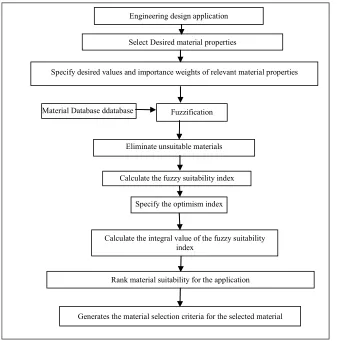
The database used in this work has six different materials from which a relevant material can be retrieved, for dif-ferent cases, based on the proposed methodology. A sys-tematic approach to the material selection problem by using the concept of fuzzy set theory is proposed. The procedure for material selection to find the ranked list of materials from the database is explained in flow chart shown Figure 2.
A fuzzy suitability index is proposed to indicate the suitability of a material for an engineering design appli- cation[18]. The index accounts for the ambiguities in- volved in the evaluation of the appropriateness of alter- nate materials and the importance of material properties. Liou and Wang [19] are proposed a method of ranking fuzzy numbers with integral value is used in this paper for ranking the suitable materials.
4. Framework of the Program
C language is employed in present work for generalizing the material selection problem. The menu driven user interactive version is quite flexible in obtaining outputs of complex material properties. The input parameters used in this program are design engineer criteria (desired material property values). The main objective of the pro- gram is to generate an output displaying the selected materials with ranks, along with the number of combina- tions of criteria such as high and low. This information can be useful for the designer to check the suitability of the selected material as per his choice, there by he (de- signer) can resolve concurrency in the material selection. The following steps explain fuzzy logic procedure.
Step-1: The membership functions can be formed by graphical representations. The graphical representations may include different shapes like triangle, trapezoidal, Gaussian, etc. The trapezoidal membership function is considered here.
The desired material property values (specified by de- signer) are converted into trapezoidal fuzzy numbers. Let
Engineering design application
Select Desired material properties
Specify desired values and importance weights of relevant material properties
Fuzzification Material Database ddatabase
Eliminate unsuitable materials
Calculate the fuzzy suitability index
Specify the optimism index
Calculate the integral value of the fuzzy suitability index
Rank material suitability for the application
[image:4.595.132.469.78.419.2]Generates the material selection criteria for the selected material
Figure 2. Flow chart of material selection based on fuzzy set theory
1 10 3 0 0.3f x x x (1) values and Pij = (paij, pbij, pcij, pdij) be the property value
of property j. The value of Dj is usually specified in terms of a rough number or a range by the design engineer. Once the value is specified, the system automatically converts it into a trapezoidal fuzzy number. Let a desired value of the relevant property be 270 (D1), so that the corresponding trapezoidal fuzzy numbers is given by D1 = (243, 270, 270, 300).
5 2 5 0.3x x 0.5
(2)
: 0.2, 0.5,0.5, 0.8 M
10 3 2 3 0.2 0.5f x x x (3)
8 3 10 3 0.6x x 0.8
(4)
: 0.5,0.7,0.7,1 H
Step-2: The important weights of material properties are transformed into trapezoidal fuzzy numbers. The importance of a particular property in material property set can be determined by assigning weight to that prop- erty. Design engineer assigns a sample of weights to de- sired properties based on the design criteria. For example meaning “Low”, “medium”, and “high”, to evaluate the importance of a material property. The im- portance of weight is a linguistic variable with the set of possible values subjectively determined using equations (1) to (6). The upper bound and lower bound are set to be 0 and 1 as per convention. The important weights can be assessed by requesting the design engineer to weigh the property through the designed rating scale. L: (0, 0.3, 0.3, 0.5)
L M H, ,
5 5 2 0.5 0.7f x x x (5)
10 3 10 3 0.7x x 1
(6) Regardless of which approach is used, the importance of weights need to be represented as trapezoidal fuzzy numbers, denoted by wj = (waj, wbj, wcj, wdj), before
they can be used for assessing the suitability of a mate- rial.
Step-3: The values of the relevant material properties in the database are converted into trapezoidal fuzzy num- bers as explained in the step-1.
Material ‘i’ is concluded to be unsuitable if pdij≤ daj
whenever a large value of property j is desired or paij ≥
ddj whenever a small value of property j is desired.
Step-5: Material rating is calculated and assigned as
Sij to material ‘i’ for property ‘j’. Sij is evaluated based on
the compatibility between the adjusted material property
APij and the desired property Dj for the application. The
value of Dj is usually specified in terms of a rough num-
ber or a range by the design engineer. Once the value is specified, the system automatically converts it into a tra-pezoidal fuzzy number as discussed in step 1. Sij value
calculated using equations from (7) to (12) for given Pij
and large value of Djis desired. Sij is a trapezoidal fuzzy
number and is denoted by (saij, sbij, scij, sdij).
ij ij j j
S AP D D (7)
where
, , ,
ij j ij ij ij ij
AP nd pa pb pc pd (8)
and
min
j ij j
nd pa dd (9)
On the other hand it is desired to calculate Sij value
using equations from (10) to (12) for given Pij and
smaller value of Dj.
ij j ij j
S D AP D (10)
where
, , ,ij ij ij ij ij
jAP pa pb pc pd nd (11)
and
max
j j
nd da pdij (12)
Step-6: Final fuzzy suitability index is computed for material Si from the set of materials ‘i’ using Equation
13.
1 1
2 2
1i i i in
S n S w S w S wn
(13) where n is the total number of relevant material proper- ties selected for the engineering design application.Step-7: Material rank is computed using total integral values. If ‘A’ is a fuzzy number with membership func- tion fA(x), then the total integral value with index of op-
timism μ is defined as Equation (14).
1
T R L
II A I A (14)
where IR
A and IL
A are the right and left integralvalues of A respectively, and
0,1 . IL
A and
R
I A are defined as
0 d L L A 1I A
g y
1
0d
R
R A
I A
g y y (16)where L
Ag y and R
Ag y are the inverse functions of
L A
f y and R
Af y , respectively. The index of opti- mism (μ) represents the degree of optimism of a decision maker. The larger value of μindicates a higher degree of optimism.
The inverse functions of L
Af y and R
Af y for trapezoidal fuzzy numbers are L
A
g y y
and R
A
g y y, respectively. Thus
1
1
0 0
d d
2
L
L A
I A
g y y
y y (17)
1
1
0 0
d d
2
R
R A
I A
g y y
y y (18)Given the value μ (the design engineer decides it), the total integral value of the trapezoidal fuzzy number A can be directly obtained as:
1
1
2T
I A (19)
The ranking of material 1 is said to be higher than material 2 if IT
S1 IT
S2 . The total integral value of the trapezoidal fuzzy number ‘A’ can be calculated for different values μ, i.e.μ = 1, 0, & 0.5, using Equation (19).C-Program for fuzzy logic approach is being devel- oped in the present work. Execution of this program ge-nerates an output displaying the selected materials with ranks, along with the number of combinations of criteria such as high and low. This information can be useful for the designer to check the suitability of the se- lected ma-terial as per engineer’s choice there by resolv- ing con-currency in the material selection.
5. Case Study
Fuzzy logic approach developed in this paper is tested for selection of material for propulsor. The small data- base is considered, after initial screening material data- base, because to represent property value in graphically for validating results. The results are presented here on propulsor because small data and also validate result graphically also.
Problem Description of Propulsor
Ships and Under-water vehicles like Torpedoes, Subma- rines, Submersibles, etc., are used in defense applications. These weapons require propulsor to drive the vehicle. The performance of the vehicle depends on the effi- ciency of the propulsor and its material. Propulsor is de signed for moderate and extreme depth and requires minimization of structural weight for increasing payload
Table 1. Material data of aluminum alloys.
S.No Name of the Al-alloy
Tensile strength
(MPa) Brinell hardness Strength/Weight % of elongation
Melting Point (˚C)
Proof Stress (MPa)
1 Al-24345 280 105 103.7 2 650 230
2 Al-6061 310 95 114.81 17 580 276
3 Al-6009 230 62 85.185 25 619 125
4 Al-5083 330 84 124.5 17 570 240
5 Al-5251 210 58 78.06 14 625 165
6 Al-6262 360 120 132.8 3 582 330
performance/speed and operating range. Hence, the ma- terial used for propulsor must be light, strong, and ductile, easy to cast and machine, resistant to corrosion. Ship propulsor may be manufactured from commercially available materials like gray cast iron, low carbon steels, chromium-stain less steel, chromium-nickel, austenitic stainless steel, manganese bronze, nickel-manganese bronze, nickel-aluminum bronze, naval brass, and forged aluminum.
In the past design engineers were selecting the mate- rial by experience, on the basis of strength. The list of currently available materials is so lengthy that it even challenges the ability of the materials’ engineer to make the most effective material selection. A user interactive object oriented program is developed to determine the material I.D, which satisfies design criteria and designer requirement.
Aluminum alloys are taken for the application purpose because of its vital role in the marine application, since the corrosion resistance and the life is long, the weight is light, price is low, and having more strength. Different series and quantitative properties of Aluminum alloy are presented in Table 1.
6. Results
The designer enters input data based on the experience. Design Engineer specifies choices of material properties, quantitatively or qualitatively, through Material Seletion Webpage. Let the designer select criteria for above said case such as <tensile strength> 300 MPa, <hardness>100 BHN, <Strength/Weight value> 100, <percentage of elongation> 1, <melting point> 580˚C, <proof stress> 220 MPa. The fuzzy logic program generates output of Al-24345. Thus designer entered data corresponds to the alloy with ID of Al-24345.
The above case is verified graphically. A graph is drawn by taking the property number on horizontal axis
and normalized property values on vertical axis. Property numbers 1 to 6 are used in graph instead of properties such as tensile strength, hardness, Strength/Weight value, percentage of elongation, melting point and proof stress respectively. The input data entered by designer coin- cides with the required material i.e., Al-24345 as shown in Figure 3. In the graph, the legend 1 represents Al-24345 and legend 7 represents input data.
7. Conclusions
A fuzzy approached is proposed to support the material selection decisions in CE environment. A quantitative relationship between mechanical properties of aluminum alloys is presented through the fuzzy logic methodology. This method is extendable to any design application. The implementation of the methodology can be used to inte- grate material database with designer criteria and also assist designer to select material automated for intended application. This provides material data in machine readable electronic format to clients such as analysis engineers and manufacturing engineers in the CPD sys- tem. The weights are fixed
8. Acknowledgements
[image:6.595.314.532.596.694.2]This work is partially supported by Department of Sci-ence & Technology, Government of India, New Delhi
110016, Project ref. No.SR/S3/MERC-81-SERC Engg.
9. References
[1] S. M. A. Sapuan, “Concurrent Engineering Design Sys-tem for Polymeric-Based Composite Automotive Compo- nents,” PhD Thesis, De Montfort University, Leicester, 1998.
[2] M. Pallot and V. Sandoval, “Concurrent Enterprise in the Era of the Internet and Electronic Commerce,” Kluwer Academic Publishers, New York, 1998.
[3] B. Prasad, “Concurrent Engineering Fundamentals, Vo- lume II, Integrated Product and Process Organization,” Prentice Hall, New Jersey, 1996.
[4] Y.-E. Nahm and H. Ishikawa, “Integrated Product and Process Modeling for Collaborative Design Environ-ment”, Concurrent Engineering: Research and Applica-tions, Vol. 12, No. 1, March 2004, pp. 5-21
[5] M. Yoshioka, “Knowledge Intensive Engineering Frame- work: KIEF (formerly known as SYS- FUND) Manual,” The University of Tokyo, National Center for Science Information Systems, Tokyo, 2000.
[6] O. Tamine´ and R. Dillmann, “KaViDo—A Web-Based System for Collaborative Research and Development Processes,” Computers in Industry, Vol. 52, No. 1, 2003, pp. 29-45. doi:10.1016/S0166-3615(03)00067-8
[7] A. Balakrishna, R. S. Babu, D. N. Rao, et al., “Integration of CAD/CAM/CAE in Product Development System Us- ing STEP/XML,” International Journal on Concurrent Engineering: Research and Application, Vol. 14, No. 2, 2006, pp. 121-128.
[8] P. J. White “Materials Selection: Is the Machine Really Smart Enough?” Proceedings of Society of Plastics Engi- neers Conference, Hartfort, 1995.
[9] S. M. Sapuan, “A Knowledge-Based System for Materi-als Selection in Mechanical Engineering Design,” Mate-rials and Design, Vol. 22, No. 8, 2001, pp. 687-695. doi:10.1016/S0261-3069(00)00108-4
[10] D.-H. Jee and K.-J. Kang, “A Method for Optimal Mate-rial selection Aided With Decision Making Theory,” Journal of Materials and Design, Vol. 21, No. 3, June 2000, pp. 199-206. doi:10.1016/S0261-3069(99)00066-7 [11] L. A. Zadeh, “Fuzzy Sets,” Information and Control, Vol.
8, No. 3, 1965, pp. 338-353. doi:10.1016/S0019-9958(65)90241-X
[12] R. Knosala and W. Pedrycz, “Evalution of Design Alter-natives in Mechanical Engineering,” Fuzzy Sets and Sys-tems, Vol. 47, No. 3, 1992, pp. 269-280.
[13] D. Singer, “Fuzzy Algorithms for Planning the Mainte- Nance of large Systems with Insufficient Resources,” In- ternational Journal of Systems Science, Vol. 21, No. 11, 1990, pp. 2199-2208.
[14] H. Maeda and S. Murakami, “The use of a fuzzy Decision –Making Method in a Large Scale Computer System choice problem,” Fuzzy Sets and Systems, Vol. 54, No. 3, 1993, pp. 235-249. doi:10.1016/0165-0114(93)90369-S [15] D. Cebonand M. F. Ashby, “Computer-Aided Materials
Selection for Mechanical Design,” Metals and Materials, Vol. 8, No. 1, 1992, pp. 25-30.
[16] D. Cebonand M. F. Ashby, “Picking a Winner: Optimiz-ing Materials Selection,” Mater World, Vol. 4, No. 11, 1996, pp. 646-648.
[17] P. Barnard, “Materials Database Save Time,” Material Database, News Issue 2, August 1996.
[18] T. W. Liao, “A Fuzzy Multicriteria Decision Making Method for Material Selection,” Journal Manufacturing Systems, Vol. 15, No. 1, 1996, pp. 1-12.