EFFECT OF POTASSIUM APPLICATION ON YIELD AND NUTRIENT UPTAKE BY COTTON
*Kadam, Y. B., Kharche, V. K.
Department of Soil Science and Agricultural Chemistry, Dr. Panjabrao
ARTICLE INFO ABSTRACT
The present investigation was carried out in
potassium application on yield and nutrient uptake by Bt Cotton. This was carried out by conducting field experiments on research farm of Department of Soil Science and Agricultural Chem
Krishi Vidyapeeth, Akola and similarly on five farmer`s fields in intensive cotton growing area of Vertisols in Akola district during 2012
K2O ha
stages of cotton along with addition of equivalent quantity of sulphur through bensulf and control without potassium. It has been observed that
potassium was found to have significant response and improved the yield of cotton. It was observed that the increasing levels of potassium caused significant increase in yield of co
at control where only nitrogen and phosphorous was applied without any potassium application. Application of K2O @ 25 kg ha
further increased the yields statistically over control indicating that cotton has shown response to application of potassium in Vertisols. However, the source of potassium
record statistically significant difference in the seed cotton yield. along with increase in the levels of potassium from 0, 25 and 50 kg K
has been observed due to application of potassium and the increase in levels of potassium also leads to increase in boll weight of cotton. The application of potassium @ 50 kg K
sources s
increasing levels of potassium indicating necessity of balance nutrition (NP and K) under Vertisols. The foliar application of SOP @1.5% at flowering and
The study also suggests the necessity of inclusion of application of potassium in the fertilization of cotton grown on Vertisols for increasing productivity as well as increasing nutrient
fertility and to arrest mining of potassium in soils.
Copyright©2017, Kadam et al. This is an open access article distributed under the Creative Commons Att distribution, and reproduction in any medium, provided the original work is properly cited.
INTRODUCTION
Cotton is the most important fiber crop of India and backbone of our textile industry, accounting for 70 per cent of total fiber consumption in textile sector, and 38 per cent of the country’s export. Area under cotton cultivation in India (7.6 million ha) is highest in the world and employs seven million people for their living. Cotton is a crop most suited to dry
flourished there despite the vagaries of nature and poor monsoons. The cotton is mostly grown on black cotton soils, the typical swell-shrink soils of Deccan Plateau. The cotton crop is grown in the kharif season and sowing is
done with onset of monsoon. It is grown in the entire state except Konkan and Eastern Maharashtra. The main reason for low productivity of cotton in Maharashtra is its large scale rainfed cultivation (97 per cent). Potassium is required in large quantities by cotton, from 3 to 5 kg K ha
1976). The total quantity of K taken up by the plant is related
*Corresponding author: Kadam, Y. B.
Department of Soil Science and Agricultural Chemistry, Dr. Panjabrao Deshmukh Krishi Vidyapeeth, Akola
ISSN: 0975-833X
Article History:
Received 05th October, 2016 Received in revised form 28th November, 2016 Accepted 08th December, 2016 Published online 31st January,2017
Key words:
Potassium nutrition, Yield of cotton, Soil fertility, Balance nutrition and Cotton production.
Citation: Kadam, Y. B., Kharche, V. K., Borkar, V. S., Katkar, R. N., Konde, N. M. and Gabhne, V. V. 2017.
and nutrient uptake by Cotton”, International Journal of Current Research
RESEARCH ARTICLE
EFFECT OF POTASSIUM APPLICATION ON YIELD AND NUTRIENT UPTAKE BY COTTON
Kharche, V. K., Borkar, V. S., Katkar, R. N., Konde, N. M. and
Department of Soil Science and Agricultural Chemistry, Dr. Panjabrao Deshmukh
ABSTRACT
The present investigation was carried out in Vertisols of Akola district of Maharashtra to ascertain the effect of potassium application on yield and nutrient uptake by Bt Cotton. This was carried out by conducting field experiments on research farm of Department of Soil Science and Agricultural Chem
Krishi Vidyapeeth, Akola and similarly on five farmer`s fields in intensive cotton growing area of Vertisols in Akola district during 2012-13 and 2013-14. The treatments comprised of various levels of potassium (0, 25, 50 kg O ha-1) applied through either MOP or SOP and additional foliar sprays of SOP @1.5 per cent at critical growth stages of cotton along with addition of equivalent quantity of sulphur through bensulf and control without potassium. It has been observed that despite the soils having high soil available potassium, the application of potassium was found to have significant response and improved the yield of cotton. It was observed that the increasing levels of potassium caused significant increase in yield of cotton. The lowest cotton yield was recorded at control where only nitrogen and phosphorous was applied without any potassium application. Application of
O @ 25 kg ha-1 under farmer`s practice further increased the yields of cotton. Application of 50 kg K
further increased the yields statistically over control indicating that cotton has shown response to application of potassium in Vertisols. However, the source of potassium viz, MOP and SOP used in the present study did not record statistically significant difference in the seed cotton yield. The number of bolls per plant was increased along with increase in the levels of potassium from 0, 25 and 50 kg K2O ha
has been observed due to application of potassium and the increase in levels of potassium also leads to increase in boll weight of cotton. The application of potassium @ 50 kg K2O ha-1 either through MOP or SOP irrespective of sources showed highest seed cotton yield and nutrient uptake. The yield of cotton was increased along with the increasing levels of potassium indicating necessity of balance nutrition (NP and K) under Vertisols. The foliar application of SOP @1.5% at flowering and boll development stage was beneficial to enhance seed cotton yield. The study also suggests the necessity of inclusion of application of potassium in the fertilization of cotton grown on Vertisols for increasing productivity as well as increasing nutrient uptake by cotton besides maintaining soil fertility and to arrest mining of potassium in soils.
is an open access article distributed under the Creative Commons Attribution License, which distribution, and reproduction in any medium, provided the original work is properly cited.
Cotton is the most important fiber crop of India and backbone for 70 per cent of total fiber consumption in textile sector, and 38 per cent of the country’s export. Area under cotton cultivation in India (7.6 million ha) and employs seven million people for suited to dry lands and has flourished there despite the vagaries of nature and poor The cotton is mostly grown on black cotton soils, shrink soils of Deccan Plateau. The cotton season and sowing is generally done with onset of monsoon. It is grown in the entire state except Konkan and Eastern Maharashtra. The main reason for low productivity of cotton in Maharashtra is its large scale Potassium is required in large quantities by cotton, from 3 to 5 kg K ha–1 day–1 (Halevy, 1976). The total quantity of K taken up by the plant is related
Department of Soil Science and Agricultural Chemistry, Dr. Panjabrao
to the level of available soil-
1965; Kerby and Adams, 1985) and yield demand of the crop. An average mature cotton crop is estimated to contain between 110 and 250 kg ha–1 of K, of which about 54 % is in the vegetative organs and 46% is in the reproductive organs. of the black soils were thought to be well supplied with K and thus it was presumed that they do not need K application. However, in view of potential of newly released high yielding varieties of crops these soils may not be well supplied with K. In view of the high potassium content in swell shrink soils it was not the general practice to recommend potassium like regular application of N and P fertilizers. Among the major nutrients, potassium not only improves yields but also benefits various aspects of quality. Although the potassium content of Vertisols and associated intergrades is high, many crops have been found to give good response to application of potassium. Most crops absorb as much or more K than they absorb N from the soil. The nutrient removal exceeds nutrient addition. Potash balance in Maharashtra is negative and mining of soil K reserves is going on at an alarming pace.
International Journal of Current Research
Vol. 9, Issue, 01, pp.45374-45381, January, 2017
INTERNATIONAL
OF CURRENT RESEARCH
Kadam, Y. B., Kharche, V. K., Borkar, V. S., Katkar, R. N., Konde, N. M. and Gabhne, V. V. 2017. “Effect of potassium application on yield
International Journal of Current Research, 9, (01), 45374-45381.
EFFECT OF POTASSIUM APPLICATION ON YIELD AND NUTRIENT UPTAKE BY COTTON
M. and Gabhne, V. V.
Krishi Vidyapeeth, Akola
Vertisols of Akola district of Maharashtra to ascertain the effect of potassium application on yield and nutrient uptake by Bt Cotton. This was carried out by conducting field experiments on research farm of Department of Soil Science and Agricultural Chemistry, Dr. Panjabrao Deshmukh Krishi Vidyapeeth, Akola and similarly on five farmer`s fields in intensive cotton growing area of Vertisols in 14. The treatments comprised of various levels of potassium (0, 25, 50 kg ) applied through either MOP or SOP and additional foliar sprays of SOP @1.5 per cent at critical growth stages of cotton along with addition of equivalent quantity of sulphur through bensulf and control without despite the soils having high soil available potassium, the application of potassium was found to have significant response and improved the yield of cotton. It was observed that the tton. The lowest cotton yield was recorded at control where only nitrogen and phosphorous was applied without any potassium application. Application of under farmer`s practice further increased the yields of cotton. Application of 50 kg K2O ha-1 has further increased the yields statistically over control indicating that cotton has shown response to application of , MOP and SOP used in the present study did not The number of bolls per plant was increased O ha-1. Significant increase in boll weight has been observed due to application of potassium and the increase in levels of potassium also leads to increase in either through MOP or SOP irrespective of howed highest seed cotton yield and nutrient uptake. The yield of cotton was increased along with the increasing levels of potassium indicating necessity of balance nutrition (NP and K) under Vertisols. The foliar boll development stage was beneficial to enhance seed cotton yield. The study also suggests the necessity of inclusion of application of potassium in the fertilization of cotton grown uptake by cotton besides maintaining soil
ribution License, which permits unrestricted use,
and fertilizer K (Bennett et al., 1965; Kerby and Adams, 1985) and yield demand of the crop. An average mature cotton crop is estimated to contain between of K, of which about 54 % is in the getative organs and 46% is in the reproductive organs. Most of the black soils were thought to be well supplied with K and thus it was presumed that they do not need K application. However, in view of potential of newly released high yielding varieties of crops these soils may not be well supplied with K. iew of the high potassium content in swell shrink soils it was not the general practice to recommend potassium like regular application of N and P fertilizers. Among the major nutrients, potassium not only improves yields but also benefits of quality. Although the potassium content of Vertisols and associated intergrades is high, many crops have been found to give good response to application of potassium. Most crops absorb as much or more K than they absorb N from oval exceeds nutrient addition. Potash balance in Maharashtra is negative and mining of soil K reserves is going on at an alarming pace.
INTERNATIONAL JOURNAL OF CURRENT RESEARCH
MATERIAL AND METHODS
The present investigation was carried out by conducting field experiments on the research farm of Department of Soil Science and Agricultural Chemistry, Dr. Panjabrao Deshmukh Krishi Vidyapeeth, Akola and similarly on five farmer’s fields in intensive cotton growing area of Akola in Vertisolsduring 2012-13 and 2013-14. Soils were processed (<2 mm) and analysed for pH (1:2.5 Soil water suspension), electrical conductivity, organic carbon, available nutrients (N, P,K and S) and NH4OAc extractable K following standerd procedures (Jackson 1973). The treatment wise plant samples were selected randomly from each net plot and cut near the ground surface at 50 per cent boll bursting stage and at harvesting stage. The plants were partitioned into stem, leaves and reproductive parts. The samples were firstly cleaned with clothes, followed by rinsing with detergent 0.02 N HCl and finally with deionized water. After cleaning the plant samples were dried in shade and then placed in oven at 64 0C till the constant weight obtained. The oven dried weights were recorded. These plant samples were ground in electrically operated stainless steel blade grinder (Willey mill) up to maximum fineness. The ground samples stored in polythene bags with proper labeling for chemical analysis. The total nutrients content in stem, leaves and reproductive parts was determined and uptake was computed by multiplying respective nutrient concentration in per cent by dry matter yield. Total nitrogen was determined by digesting the plant sample in microprocessor based digestion system (KES-12L) using conc. H2SO4 and salt mixture (Micro- Kjeldahl’s method) (Chapman and Pratt, 1961). Phosphorus was estimated from di-acid extract by vanadomolybdate phosphoric acid yellow colour method (Piper, 1966) using UV based double beam spectrophotometer. Potassium was estimated from di-acid extract by using flame photometer (Piper, 1966). Sulphur was determined from di-acid extract by turbidimetric method (Chesnin and Yien, 1950) using UV based double beam spectrophotometer. Seed cotton was picked from the five observation plants and net plots in all the replications and yield per plant, yield per plot and yield per hectare was calculated.
RESULTS AND DISCUSSION
Response of cotton to potassium fertilization
Yield of cotton at university farm and farmer`s fields
The data in respect of seed cotton yield as influenced by different levels and sources of potassium is presented in (Table 3). It was observed that the increasing levels of potassium caused significant increase in yield of cotton. The lowest cotton yield was recorded at control where only nitrogen and phosphorous was applied without any potassium application. Application of K2O @ 25 kg ha-1 under farmer`s practice (T2) further increased the yields of cotton. However, this increase in yield was not significant during both the years of study. Application of 50 kg K2O ha-1 has further increased the yields statistically over control K (0) (T1) indicating that cotton has shown response to application of potassium in Vertisols.
However, the source of potassium viz, MOP and SOP used in
the present study did not record statistically significant difference in the seed cotton yield. The yields of cotton recorded at 50 kg K2O ha-1 through MOP (T3) and SOP (T4) are on par with each other during both the years and on both
the sites including university farm and farmer`s fields. It was further noted that additional two foliar sprays of SOP with 50 kg MOP (T5) and 50 kg SOP (T6) have recorded numerical increase in yield however it was on par with only soil application of MOP (T3) and SOP (T4) indicating that 50 kg K2O ha-1 through MOP or SOP are equally beneficial and superior over 0 and 25 kg K2O ha-1. The slight numerical increase in the yield of cotton due to SOP is attributed to the additional quantity of sulphur applied through SOP. Similarly the numerical increase in cotton yield due to additional two sprays of SOP can be attributed to the supply of potassium and sulphur through foliar spray made to crop during flowering and boll development stage which must have benefitted for additional yield.
The significant increase in yield of cotton at 50 kg K2O ha-1 over 25 kg K2O ha
-1
reveals that application of potassium @ 50 kg K2O ha-1 is necessary for improving yield of cotton and increase in yield which can be attributed to the balanced supply of potassium with nitrogen and phosphorus which is useful for improving the efficiency of N and P resulting into more uptake of N and P which is beneficial ultimately for causing overall increase in yield. The seed cotton yield was increased by 23 percent at 50 kg K2O ha-1 along with two sprays of [email protected] per cent at university farm trial and 21 percent at farmer`s fields over control K (0). The application of 25 kg K2O ha-1 under farmer`s practice recorded 12.5 per cent increase while increasing the levels of potassium upto 50 kg K2O ha-1 through MOP recorded 18.8 percent increase in yield. Only foliar application of potassium through foliar sprays during flowering and boll development stage recorded 8.9 and 13.2 per cent increase in yield over control indicating that application of potassium through foliar spray`s during critical growth stage for cotton is beneficial. Nutrients play an important role in increasing the production and improving the quality of fiber crops and among them potassium is important because of its role in various physiological processes. Cultivation of cotton with very low rates or without application of potassium results in poor seed cotton yield and causes depletion of potassium reserves in soil. Balanced fertilization assumes greater significance for sustained productivity and better fiber quality (Singh et al., 2010). Inspite of considerable amount of available potassium in the Vertisols under study the results in present study indicate that the crop responds to application of potassium upto 50 kg K2O ha
-1
. This further suggests that the existing potassium limits used for categorization of available potassium status of soils are not appropriate and do not reveal the fertilizer need of the crops in Vertisols. It has also been reported by many workers in Vertisols that many crops grown in these soils responds to application of potassium even at more than 300 kg potassium ha-1. The negative balance of potassium has been observed under the long term experiments under continuous application of N and P without K. The results thus suggests that under continuous cropping without application of potassium the potassium mining occurs in these soils which justifies the response of crop obtained to the application of potassium besides high potassium status of soils. Usually soils analyzing <120 kg ha-1 K+ (144 kg ha-1K2O) are rated low in available potassium, between 120 and 280 kg ha-1 K+ (144- 336 kg ha -1
K2O) medium and above 280 kg ha
-1
Vertisols having high potassium as per the existing categorization. It thus appears that it is essential to relook into the existing limits used for categorization of potassium levels in Vertisols.
Solankey et al. (1992) have studied the response of two wheat varieties to potassium on farmer`s field in shrink-swell soils. Though soils were adequate in ammonium acetate extractable potassium, crop responded to 30 kg ha-1 K2O. Gajbhiye et al. (1993) using cotton, sorghum and wheat as a test crops established a critical limit of 165 mg kg-1 soil ammonium acetate K+ in Vertisols. They also showed that yield of the test crops increased beyond the potassium levels of 200 mg kg-1 soil. They attributed the lack of response below 200 mg kg-1 ammonium acetate K+ to state of “Soil hunger” for K+. In the
field experiment conducted on Otur series (Typic
Chromusterts) having ammonium acetate extractable
potassium (437-1,992 kg ha-1) Akolkar and sonar (1994), established a critical limit of potassium at 750 kg ha-1 for sorghum. These fore mentioned studies on Vertisols, grouped on the basis of water soluble or the upper limit based on ammonium acetate extractable for the “Soil hunger” (200 mg kg-1) to test the response of crops on Vertisols and established caliberated system for potassium fertilizer recommendation (Gajbhiye et al., 1993). Although the available potassium status soil is higher the availability of potassium to the crop in black soil under the dynamic equilibrium of potassium is limited which necessitates additional application of potassium demanded by the high yielding crops. The uptake of potassium is nearly of the magnitude of nitrogen and thus in view of its huge requirement the capacity of soils to supply potassium needs to be improved by replenishing additional potassium. The synergistic relationship between nitrogen and potassium also demands the need for considerable potassium to be supplied along with nitrogen. The only foliar application of potassium @ 1.5 per cent SOP along with N and P and without soil application of K (T7) on farmer`s field (Table 10) recorded significant increase in yield over control (T1) indicating that foliar application of potassium in the critical growth stages of cotton is beneficial under the situation of no potassium application through soil. However, in the soil sustainability point of view and also in view of significantly higher yield of cotton recorded under soil application of potassium in the present study it becomes apparent that soil application of potassium either through SOP or MOP is more beneficial.
Application of equivalent quantity of sulphur to that added through SOP was applied through bensulf (T8) which has recorded significant increase in yield over control and at par with soil application of SOP indicating that the increase in yield due to SOP over MOP is due to additional sulphur applied through SOP. Moreover the yield of cotton under SOP recorded on par yields with MOP as well as with MOP plus sulphur through bensulf indicating that slight numerical increase in the yield under the treatment of SOP is due to simultaneous supply of sulphur and comparatively more solubility of SOP. It is also due to supply of nutrients at sensitive critical stages. This further suggests that time of application of nutrients (K and S) with their various sources and methods have more importance. The increased yield of cotton due to application of potassium also justified the fact that the cotton under study has been grown under rainfed conditions with supplementary two protective irrigations. Thus under the dry land conditions the increase in yields can be attributed to the efficient utilization of soil moisture by the
crop under conjoint application of potassium with N and P. An increase in potassium concentration is known to lower the osmotic potential and increase the turgor potential. Malate has been found to be an organic counter ion of potassium and showed that highest potassium contents and malate were associated with maximal growth rate of cotton fiber (Dhindsa
et al., 1975). The major demand for potassium by the cotton at
boll set even in soil rated high in available K, during critical growth stages K shortage can develop due to its heavy demand during rapid boll set (Gormus and Yucel, 2002).
Number of bolls at university and farmer`s fields
Bolls are the major sink for potassium. Thus, the need for K increases during early boll set. About 70 per cent of uptake of potassium occurs after first bloom (Mullins and Burmester, 2010). The data pertaining to no. of bolls recorded at university farm and farmer`s fields under various treatments is presented in (Table 4). The number of bolls per plant was increased along with increase in the levels of potassium from 0, 25 and 50 kg K2O ha-1. The number of bolls per plant at university farm during both the years of study showed significant increase upto 50 kg K2O ha-1. However the pooled data did not show significant increase in number of bolls at university farm. The number of bolls at farmer`s fields during both the years showed significant increase upto 50 kg K2O ha-1 and pooled data also showed that the number of bolls per plant were
significantly increased due to application of 50 kg K2O ha-1. The number of bolls showed significant increase under all
the treatments having 50 kg K2O ha-1 irrespective of the source of potassium either through MOP or SOP. The number of bolls were also significantly increased due to only foliar application of SOP (T7). The application of sulphur through bensulfalong with 50 kg K2O ha-1 through MOP also showed significant increase in number of bolls. The significant reduction in number of bolls per plant has been recorded at control with N and P application without K at both the sites. The increase in yield of cotton due to increasing levels of potassium is thus attributed to the significant increase in number of bolls per plant as well as boll weight. The balanced supply of potassium in conjunction with N, P might have helped in reducing shedding of squares and bolls in cotton and enhanced the photosynthetic activity which in turn resulted into increase in boll weight which is evident in the data obtained in the present investigation (Bondada and Oosterhuis, 2000).
Boll weight of cotton at university and farmer`s field
The data pertaining to boll weight recorded at university farm and farmer`s fields under various treatments is presented in (Table5).Significant increase in boll weight has been observed due to application of potassium and the increase in levels of potassium also leads to increase in boll weight of cotton. The increased weight of boll can be attributed to balanced supply of nutrients. The potassium applicaton to cotton is responsible for decreasing abscission of buds and bolls, reduced boll shedding ultimately increasing boll weight and yield (Zakaria, 2006). Irrespective of sources of potassium all the treatments involving 50 kg K2O ha-1 recorded significant increase in boll weight of cotton. Foliar application of 1.5 per cent SOP recorded significant increase. It is thus apparent that there is significant reduction in boll weight if potassium is not supplied along with N and P and for the crop like cotton the application of potassium upto 50 kg K2O ha
-1
Table 1. Farmer`s detail (2012)
RI RII RIII RIV RV
Anil Ingle Village: Changephal Tehsil: Barshitakkli Dist. Akola
Anil Ingle Village: Changephal Tehsil: Barshitakkli Dist. Akola
Pravin Ingle Village: Changephal Tehsil: Barshitakkli Dist. Akola
DilipDhore Village: Alanda Tehsil: Barshitakkli Dist. Akola
GopalDhore Village: Alanda Tehsil: Barshitakkli Dist. Akola
Table 2. Farmer`s detail (2013)
RI RII RIII RIV RV
DilipDhore Village: Alanda Tehsil: Barshitakkli Dist. Akola
AnantJanorkar Village: Alanda Tehsil: Barshitakkli Dist. Akola
Sunil Janorkar Village: Alanda Tehsil: Barshitakkli Dist. Akola
Pradip Ingle Village: Changephal Tehsil: Barshitakkli Dist. Akola
[image:4.595.81.521.228.355.2]Anil Ingle Village: Changephal Tehsil: Barshitakkli Dist. Akola
Table 3. Seed cotton yield as influenced by Potassium application
Treatments
Seed cotton (qha-1)
University farm Farmer`s fields
2012-13 2013-14 Pooled 2012-13 2013-14 Pooled T1 Control K (0) 18.70 21.96 20.33 29.41 28.76 29.08 T2 FP K2O@25 kg ha-1 (MOP) 22.18 24.32 23.25 31.06 31.58 31.32 T3 K2O@ 50 kg ha-1(MOP) 23.39 26.71 25.05 32.78 34.67 33.73 T4 K2O@ 50 kg ha-1(SOP) 24.06 27.34 25.70 34.36 34.99 34.68 T5 K2O@ 50 kg ha-1 (MOP) + 2 Sprays (SOP) 23.63 28.50 26.06 35.26 37.17 36.22 T6 K2O@ 50 kg ha-1 (SOP) + 2 Sprays (SOP) 24.42 28.88 26.65 36.56 37.48 37.02 T7 2 Sprays @1.5 % (SOP) 21.14 23.49 22.32 32.05 34.93 33.49 T8 K2O@ 50 kg ha-1 (MOP) + S @ 18 kg ha-1 23.83 25.84 24.84 34.56 35.35 34.95
SE(m)± 1.10 0.73 1.32 1.18 0.67 1.35
[image:4.595.70.531.382.508.2]CD @5% 3.34 2.21 4.01 3.41 1.93 3.92
Table 4. Number of bolls as influenced by Potassium application
Treatments
University farm Farmer`s fields No. of bolls
2012-13 2013-14 Pooled 2012-13 2013-14 Pooled
T1 Control K (0) 21.77 19.80 20.78 31.68 31.72 31.70
T2 Farmer ‘s Practice K@25 kg ha-1 (MOP) 23.87 22.00 22.93 34.52 34.14 34.33 T3 K@ 50 kg ha-1(MOP) 25.07 23.27 24.17 37.14 36.44 36.79 T4 K@ 50 kg ha-1(SOP) 24.27 22.77 23.52 38.62 36.52 37.57 T5 K@ 50 kg ha-1 (MOP) + 2 Sprays (SOP) 25.40 26.00 25.70 39.52 38.24 38.88 T6 K@ 50 kg ha-1 (SOP) + 2 Sprays (SOP) 22.53 26.23 24.38 42.28 38.44 40.36 T7 2 Sprays @1.5 % (SOP) 24.53 21.73 23.13 41.82 36.40 39.11 T8 K@ 50 kg ha-1 (MOP) + S @ 18 kg ha-1 22.07 22.23 22.15 38.68 36.36 37.52
SE(M)± 0.80 0.58 2.35 1.54 0.90 1.74
[image:4.595.85.512.533.661.2]CD 5% 2.44 1.75 7.14 4.45 2.59 5.04
Table 5. Boll weight as influenced by Potassium application
Treatments
University farm Farmer`s fields Boll weight (g)
2012-13 2013-14 Pooled 2012-13 2013-14 Pooled
T1 Control K (0) 3.27 3.30 3.28 3.88 3.83 3.86
T2 Farmer ‘s Practice K@25 kg ha-1 (MOP) 3.43 3.35 3.39 4.10 4.02 4.06 T3 K@ 50 kg ha-1(MOP) 3.57 3.54 3.56 4.34 4.38 4.36 T4 K@ 50 kg ha-1(SOP) 3.67 3.56 3.61 4.26 4.38 4.32 T5 K@ 50 kg ha-1 (MOP) + 2 Sprays (SOP) 3.27 3.57 3.42 4.26 4.42 4.34 T6 K@ 50 kg ha-1 (SOP) + 2 Sprays (SOP) 3.47 3.59 3.53 4.22 4.43 4.33 T7 2 Sprays @1.5 % (SOP) 3.73 3.37 3.55 4.18 4.17 4.18 T8 K@ 50 kg ha-1 (MOP) + S @ 18 kg ha-1 3.70 3.41 3.56 4.08 4.26 4.17
SE(M)± 0.13 0.02 0.22 0.09 0.02 0.10
[image:4.595.51.555.694.803.2]CD 5% NS 0.05 0.66 0.27 0.06 0.28
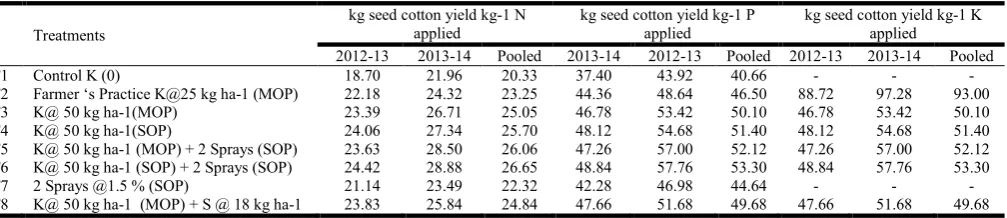
Table 6. Partial factor productivity of cotton cultivation at university farm
Treatments
kg seed cotton yield kg-1 N applied
kg seed cotton yield kg-1 P applied
kg seed cotton yield kg-1 K applied
Table 7. Partial factor productivity of cotton cultivation at farmer`s fields
Treatments
kg seed cotton yield kg-1 N applied
kg seed cotton yield kg-1 P applied
kg seed cotton yield kg-1 K applied
[image:5.595.82.507.208.306.2]2012-13 2013-14 Pooled 2013-14 2012-13 Pooled 2012-13 2013-14 Pooled T1 Control K (0) 29.41 28.76 29.08 58.82 57.52 58.16 - - - T2 Farmer ‘s Practice K@25 kg ha-1 (MOP) 31.06 31.58 31.32 62.12 63.16 62.64 124.24 126.32 125.28 T3 K@ 50 kg ha-1(MOP) 32.78 34.67 33.73 65.56 69.34 67.46 65.56 69.34 67.46 T4 K@ 50 kg ha-1(SOP) 34.36 34.99 34.68 68.72 69.98 69.36 68.72 69.98 69.36 T5 K@ 50 kg ha-1 (MOP) + 2 Sprays (SOP) 35.26 37.17 36.22 70.52 74.34 72.44 70.52 74.34 72.44 T6 K@ 50 kg ha-1 (SOP) + 2 Sprays (SOP) 36.56 37.48 37.02 73.12 74.96 74.04 73.12 74.96 74.04 T7 2 Sprays @1.5 % (SOP) 32.05 34.93 33.49 64.10 69.86 66.98 - - - T8 K@ 50 kg ha-1 (MOP) + S @ 18 kg ha-1 34.56 35.35 34.95 69.12 70.70 69.90 69.12 70.70 69.90
Table 8. Potassium use efficiency under cotton cultivation at farmer`s fields
Treatments kg seed cotton yield kg-1 P applied 2013-14 2012-13 Pooled
T1 Control K (0) - - -
T2 Farmer ‘s Practice K@25 kg ha-1 (MOP) 6.60 11.28 8.96
T3 K@ 50 kg ha-1(MOP) 6.74 11.82 9.30
T4 K@ 50 kg ha-1(SOP) 9.90 12.46 11.20
T5 K@ 50 kg ha-1 (MOP) + 2 Sprays (SOP) 11.70 16.82 14.28 T6 K@ 50 kg ha-1 (SOP) + 2 Sprays (SOP) 14.30 17.44 15.88
T7 2 Sprays @1.5 % (SOP) - - -
[image:5.595.38.560.337.466.2]T8 K@ 50 kg ha-1 (MOP) + S @ 18 kg ha-1 10.30 13.18 11.74
Table 9. Total N, P and K uptake by cotton at university farm as influenced by potassium application
Treatments
50 per cent boll bursting stage
N kg ha-1 P kg ha-1 K kg ha-1
2012-13 2013-14 Pooled 2012-13 2013-14 Pooled 2012-13 2013-14 Pooled T1 Control K (0) 43.02 61.54 52.28 27.69 19.38 23.53 50.64 63.44 57.04 T2 Farmer ‘s Practice K@25 kg ha-1 (MOP) 44.97 62.61 53.79 29.28 19.81 24.54 51.48 64.40 57.94 T3 K@ 50 kg ha-1(MOP) 48.72 63.78 56.25 31.79 20.27 26.03 52.43 65.71 59.07 T4 K@ 50 kg ha-1(SOP) 47.82 63.14 55.48 31.78 20.04 25.91 52.02 65.01 58.51 T5 K@ 50 kg ha-1 (MOP) + 2 Sprays (SOP) 49.88 64.89 57.39 33.52 20.77 27.15 52.80 66.44 59.62 T6 K@ 50 kg ha-1 (SOP) + 2 Sprays (SOP) 50.45 64.43 57.44 32.49 20.35 26.42 52.56 65.75 59.15 T7 2 Sprays @1.5 % (SOP) 46.29 63.01 54.65 30.89 20.05 25.47 52.00 64.96 58.48 T8 K@ 50 kg ha-1 (MOP) + S @ 18 kg ha-1 46.84 63.13 54.98 31.56 20.07 25.81 52.03 65.01 58.52
SE(M)± 0.03 0.02 0.04 0.06 0.02 0.06 0.02 0.02 0.03
CD 5% 0.09 0.07 0.12 0.17 0.07 0.18 0.06 0.06 0.08
Table 10. Total N, P and K uptake by cotton at university farm as influenced by potassium application
Treatments
At harvest
N kg ha-1 P kg ha-1 K kg ha-1
2012-13 2013-14 Pooled 2012-13 2013-14 Pooled 2012-13 2013-14 Pooled T1 Control K (0) 38.18 44.28 41.23 21.69 13.97 17.83 45.33 48.04 46.69 T2 Farmer ‘s Practice K@25 kg ha-1 (MOP) 43.92 50.85 47.39 23.65 15.16 19.41 47.50 52.98 50.24 T3 K@ 50 kg ha-1(MOP) 49.61 55.51 52.56 25.41 16.19 20.80 52.97 55.61 54.29 T4 K@ 50 kg ha-1(SOP) 48.58 55.47 52.03 25.89 16.25 21.07 54.65 57.48 56.07 T5 K@ 50 kg ha-1 (MOP) +
2 Sprays (SOP)
55.61 61.80 58.71 28.45 17.73 23.09 55.81 58.59 57.20
T6 K@ 50 kg ha-1 (SOP) + 2 Sprays (SOP) 55.93 61.71 58.82 30.44 18.61 24.52 58.71 61.40 60.05 T7 2 Sprays @1.5 % (SOP) 45.38 51.57 48.47 24.14 14.63 19.39 48.54 51.19 49.87 T8 K@ 50 kg ha-1 (MOP)
+ S @ 18 kg ha-1
45.69 53.69 49.69 24.78 15.40 20.09 48.89 52.94 50.92
SE(M)± 0.04 0.04 0.06 0.05 0.02 0.05 0.09 0.10 0.14
CD 5% 0.13 0.12 0.18 0.16 0.05 0.17 0.27 0.31 0.41
Table 11. Total N, P and K uptake by cotton at farmer`s fields as influenced by potassium application
Treatments
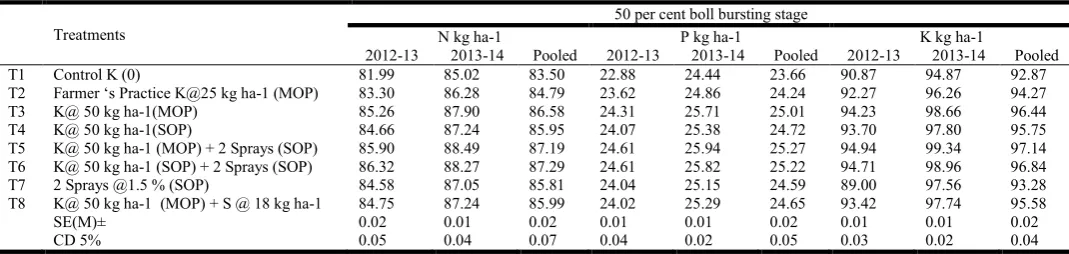
50 per cent boll bursting stage
N kg ha-1 P kg ha-1 K kg ha-1
2012-13 2013-14 Pooled 2012-13 2013-14 Pooled 2012-13 2013-14 Pooled T1 Control K (0) 81.99 85.02 83.50 22.88 24.44 23.66 90.87 94.87 92.87 T2 Farmer ‘s Practice K@25 kg ha-1 (MOP) 83.30 86.28 84.79 23.62 24.86 24.24 92.27 96.26 94.27 T3 K@ 50 kg ha-1(MOP) 85.26 87.90 86.58 24.31 25.71 25.01 94.23 98.66 96.44 T4 K@ 50 kg ha-1(SOP) 84.66 87.24 85.95 24.07 25.38 24.72 93.70 97.80 95.75 T5 K@ 50 kg ha-1 (MOP) + 2 Sprays (SOP) 85.90 88.49 87.19 24.61 25.94 25.27 94.94 99.34 97.14 T6 K@ 50 kg ha-1 (SOP) + 2 Sprays (SOP) 86.32 88.27 87.29 24.61 25.82 25.22 94.71 98.96 96.84 T7 2 Sprays @1.5 % (SOP) 84.58 87.05 85.81 24.04 25.15 24.59 89.00 97.56 93.28 T8 K@ 50 kg ha-1 (MOP) + S @ 18 kg ha-1 84.75 87.24 85.99 24.02 25.29 24.65 93.42 97.74 95.58
SE(M)± 0.02 0.01 0.02 0.01 0.01 0.02 0.01 0.01 0.02
[image:5.595.31.560.497.641.2] [image:5.595.29.564.672.799.2]Moreover application of sulphur through bensulf along with potassium @50 kg K2O ha-1 through MOP (T8) also recorded significant increase in weight of boll which is again attributed to the balanced supply of secondary nutrient viz, sulphur along with N, P and K. This further justifies increase in boll weight under the treatment of SOP due to simultaneous addition of sulphur. Thus the overall increase in yield of cotton might have caused due to increase in number of bolls and weight of boll achieved through balanced supply of sulphuralong with N, P and K in the sulphur deficient soils of the study area. The soils on the university farm are marginal in sulphur while on farmer`s fields they are deficient in sulphur which further justifies the response recorded by the crop. Foliar application of nutrients is highly beneficial, as crop benefits are achieved when roots are unable to meet the nutrient requirement of crop at critical growth stage (Ebelhar and Ware, 1998). Foliar applications of potassium when soil application may not be feasible to correct the deficiency quickly and efficiently (Oosterhuis, 1995; Weir et al., 1996). Brar et al. (2008) reported improvement in seed cotton yield with foliar application of potassium irrespective of soil status and soil applied K fertilizers. Foliar application of potassium has been recommended to supplement soil application in cotton belt of Punjab (Sekhon and Singh, 2013).
Nutrient use efficiency
Partial factor productivity of cotton cultivation as influenced by N, P and K application
The partial factor productivity of cotton cultivation was found to be increased under balance application of nitrogen, phosphorus and potassium indicating that the cotton crop under study responds more to application of fertilizer in a balance amount. The partial factor productivity is given in kg seed cotton yield per kg of nutrient applied. For nitrogen, phosphorus the partial factor productivity was found to be
increased along with different treatments of potassium. The synergistic relationship between nitrogen and potassium and reduce fixation of phosphorus resulted in improving the overall cotton productivity (Table 6 and 7). Further under different levels of potassium 25, 50 kg K2O ha-1 the partial factor productivity is higher under K2O@ 25 kg ha-1 (T2) at both the year and at both the sites. The partial factor productivity under supplemental foliar application is higher than only soil application of potassium this indicating the beneficial effect of supplemental spray during critical growth stages of cotton. The potassium use efficiency was observed to be quite variable under the various treatments studied (Table 8). The potassium use efficiency expressed in kg seed cotton yield per kg K applied revealed that it was increased along with the increasing levels of potassium from 25 to 50 kg K2O ha-1. It was further improved when the sources of potassium used was SOP. The results indicate that the efficiency of potassium fertilizer is improved under balance supply of potassium along with nitrogen and phosphorus. It further becomes apparent that 50 kg K2O ha
-1
appears to be the optimum potassium dose which is evident from increased efficiency. The additional increase in potassium use efficiency of potassium @ 50 kg K2O ha-1 applied through SOP indicate that the efficiency of potassium is again improved due to balance supply of NPK and S. The highest potassium use efficiency was recorded under the balance application of NPK and S (T8). It thus becomes clear that application of sulphur along with NPK in the Vertisols under intensive cotton cultivation is beneficial for improving the nutrient use efficiency and yield of the crop. This can be attributed to the deficiency of sulphur in the soils on the farmer’s fields.
Nutrient uptake by cotton
[image:6.595.46.553.76.205.2]The Vertisols of the present investigation recorded higher content of available potassium that is more than 300 kg K ha-1 which conclude that these soils are adequate in native potassium supply however the neglect of potassium application
Table 12. Total N, P and K uptake by cotton at farmer`s field as influenced by potassium application
Treatments
At harvest
N kg ha-1 P kg ha-1 K kg ha-1
2012-13 2013-14 Pooled 2012-13 2013-14 Pooled 2012-13 2013-14 Pooled T1 Control K (0) 67.96 77.01 72.48 22.37 26.15 24.26 70.97 73.95 72.46 T2 Farmer ‘s Practice K@25 kg ha-1 (MOP) 74.01 83.64 78.82 25.05 28.77 26.91 79.62 82.84 81.23 T3 K@ 50 kg ha-1(MOP) 84.97 94.54 89.76 27.75 31.56 29.66 83.79 86.86 85.33 T4 K@ 50 kg ha-1(SOP) 87.52 97.11 92.32 30.45 34.39 32.42 90.04 93.52 91.78 T5 K@ 50 kg ha-1 (MOP) + 2 Sprays (SOP) 95.09 104.98 100.03 32.70 36.94 34.82 99.16 102.66 100.91 T6 K@ 50 kg ha-1 (SOP) + 2 Sprays (SOP) 96.90 106.38 101.64 32.34 36.64 34.49 99.77 102.97 101.37 T7 2 Sprays @1.5 % (SOP) 82.40 91.81 87.10 25.62 30.32 27.97 85.88 89.39 87.64 T8 K@ 50 kg ha-1 (MOP) + S @ 18 kg ha-1 83.60 101.33 92.46 26.03 32.52 29.28 87.35 89.69 88.52
SE(M)± 0.01 0.01 0.02 0.01 0.01 0.02 0.01 0.01 0.02
CD 5% 0.04 0.03 0.06 0.04 0.04 0.06 0.04 0.02 0.04
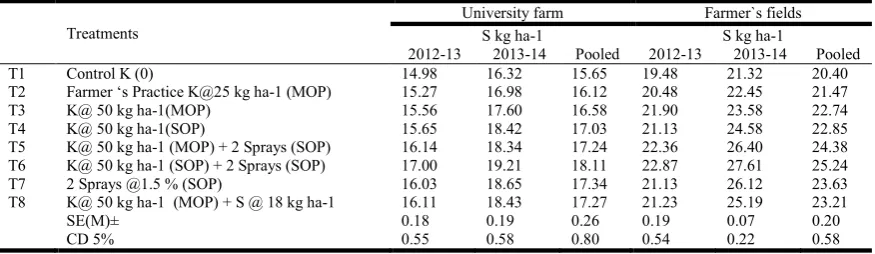
Table 13. Total sulphur uptake by cotton at 50 per cent boll bursting stage as influenced by Potassium application
Treatments
University farm Farmer`s fields S kg ha-1 S kg ha-1
2012-13 2013-14 Pooled 2012-13 2013-14 Pooled T1 Control K (0) 14.98 16.32 15.65 19.48 21.32 20.40 T2 Farmer ‘s Practice K@25 kg ha-1 (MOP) 15.27 16.98 16.12 20.48 22.45 21.47 T3 K@ 50 kg ha-1(MOP) 15.56 17.60 16.58 21.90 23.58 22.74 T4 K@ 50 kg ha-1(SOP) 15.65 18.42 17.03 21.13 24.58 22.85 T5 K@ 50 kg ha-1 (MOP) + 2 Sprays (SOP) 16.14 18.34 17.24 22.36 26.40 24.38 T6 K@ 50 kg ha-1 (SOP) + 2 Sprays (SOP) 17.00 19.21 18.11 22.87 27.61 25.24 T7 2 Sprays @1.5 % (SOP) 16.03 18.65 17.34 21.13 26.12 23.63 T8 K@ 50 kg ha-1 (MOP) + S @ 18 kg ha-1 16.11 18.43 17.27 21.23 25.19 23.21
SE(M)± 0.18 0.19 0.26 0.19 0.07 0.20
[image:6.595.81.519.235.362.2]or imbalance fertilization reveals that the removal of potassium in proportion to that of nitrogen or higher than N indicating that continuous imbalance of N and P without adequate K leads to potassium mining under cotton cultivation this has been evidenced by (Yadav et al., 1998). The data pertaining to the total nitrogen, phosphorus and potassium uptake by cotton different plant parts at (leaves, stem, fruiting bodies) at peak growth stage and (burs tissues, immature fruiting bodies, leaves, stem and seeds)as influenced by different levels and supplementary foliar sprays of potassium fertilizers presented in (Table 9 to 13). There is a significant reduction in the total nitrogen, phosphorus and potassium uptake by cotton under control in which the soil application of N and P without K indicating reduction in the yield including decrease in number of bolls and boll weight which is evident in data obtained in the present investigation at both the sites (Katkar et al., 2002). It becomes apparent that the efficient utilization and assimilation of N, P and K by cotton during critical growth stage in turn increasing nutrient uptake and resulted in increasing seed cotton yield. Close scrutiny of the data reveals that the nutrient uptake by cotton increased with advancement of age towards maturity (Ravankar and Deshmukh, 1994). Further this has been also recorded that there is complementary effect of potassium application @ 50 kg K2O ha
-1
alongwith nitrogen and phosphorus increase uptake of nitrogen by cotton (Dibb and Thompson, 1985). Similarly Mengal et al. (1976) also recorded that K+ ion competes with nitrogen for selective binding sites in the adsorption process. Kruss (1993) suggested that increase in potassium allowed for rapid assimilation of nitrogen in the plant furthermore the neglect of potassium application affect the translocation of photosynthetic assimilates out of leaves in to developing bolls (Ashley and Goodson, 1972). This can be attributed that adsorption of nitrogen requires chemical energy that is derived from photosynthetic assimilates however K deficiency adversely affect the ability of cotton to utilize soil nitrogen (Streeter and Barta, 1984). Phosphorus requires adequate amount of potassium for the crop response to added P (Adepetu and Akapa, 1977). This can be supported by the study conducted on a solution culture of P with cowpeas reveals that K deficiency resulted into significant decrease in the P uptake indicating that a specific P ion adsorption sites existing that is activated by application of potassium. Adams (1980) also supported the statement that P-K interaction in plant as a part of cation- anion balanced system in which K play a significant role.
It has been evident from the data that the total sulphur uptake by cotton during peak growth stage was statistical significant increaseaong with increasing levels of potassium application. The significantly higher uptake was recorded under the treatments receiving 50 kg K2O ha
-1
through SOP + 2 sprays of 1.5 % SOP (T6) indicating the necessity of sulphur from sulphate of potash attributed to increase in overall yield of cotton. Further this has been also recorded that there is increase in sulpuruptake by cotton under only sprays of SOP along with N and P (T7) this reveals significant increase in sulphuruptake over control (Ko) (T1) and farmer`s practice potassium application @ 25 kg K2O ha-1attributing the role of secondaryn utrient sulphur during critical growth stages of cotton. The typical Vertisols of the present investigation reported low to medium in available sulphur category thus such application of potassium sources along with sulpur has a greater significance in increasing cotton production. Suresh and Chellamuthu (2004) reported increasing uptake of N, P
and K with the advancement of age of the crop due to increase in biomass accumulation. The uptake of N by cotton ranged from (7.25 to 8.72), (22.98 to 24.92) and (36.06 to 39.92) kg ha-1 at 60, 90 and 120 days after sowing respectively. The P uptake varied from (2.08 to 3.24), (4.94 to 6.72) and (6.83 to 8.68) kg ha-1 at 60, 90 and 120 days after sowing respectively. The K uptake varied from (8.15 to 9.59), (24.89 to 26.83) and (38.02 to 43.87) kg ha-1 at 60, 90 and 120 days after sowing respectively. The uptake of K in general was higher than P and N.
Conclusion
From the present investigation it can be concluded that the application of potassium @ 50 kg K2O ha-1either through MOP or SOP irrespective of sources showed highest seed cotton yield, nutrient uptake and improvement in soil fertility. Application of potassium @ 50 kg K2O ha-1 was found beneficial for improving quality of cotton including boll weight. The foliar application of SOP @ 1.5% at flowering and boll development stage was beneficial to enhance seed cotton yield. Application of potassium in conjunction with nitrogen and phosphorus showed beneficial effect on various pools of potassium in soil and consequently their synergistic effect on availability and utilization of nutrients by crop resulting into increased nutrient use efficiency.
REFERENCES
Adams F. 1980. Critical levels of soil and nutrient solution calcium for vegetative growth and fruit development of floruner peanuts, Soil Sci. Soc. of America Jou., 43: 1159- 1164
Adepetu, L.A and L.K. Akapa, 1977. Root growth and nutrient uptake characteristics of some cowpea varieties. Agronomy
Journal, 69: 940-943.
Akolkar, V. M. and K. R. Sonar. 1994. Different forms of potassium as influenced by potash application to sorghum
in an Inceptisol. Journal of Maharashtra Agiculture
Universities, 24(1) : 14-16.
Ashley, D. A. and R. D. Goodson, 1972. Effect of time and
plant potassium status on C-labelledphotosynthate
movement in cotton. Crop Sci., 12: 686-690.
Bennett, O. L., R. D. Rouse, D. A. Ashley and B. D. Doss 1965. Yield, fiber quality and potassium content of irrigated cotton plants as affected by rates of potassium.
Agronomy Journal, 57: 296-299.
Bondada, B. R., and D. M. Oosterhuis. 2000. Yield response of cotton to foliar application of nitrogen as influenced by sink strength petiole and soil nitrogen, J. Plt. Nut., 24(3): 413-422.
Brar, M.S. , M. S. Gill, K.S. Sekhon, B.S. Sindhu, P. Sharma and A. Singh, 2008 Effect of foliar application of nutrients on yield and nutrient concentration in Bt. cotton. Depaartment of Soils Punjab Agricultural University, Ludhiana, 126-131.
Chapman, H.D. and P.F. Pratt. 1961. Methods of Analysis for Soils, Plants and Waters, Divisions of Agricultural Science, University of California, Berkeley, U.S.A.
Chesnin, L. and C. H. Yien. 1950. Turbidimetric determination of available sulphur. Soil Sci. Soc. Am. Proc., 15:149-151. Dhindsa, R.S., Beasley, C.A., and Ting, I.P. 1975.
Osmoregulation in cotton fiber. Plant Physiol., 56:394-398 Dibb, D.W. and L.F. Welch, 1976. Corn growth as affected by
Journal 68: 89-94. Environment. Kluwer Academic Publishers, Japan.
Ebelhar, M. W. and J. O. Ware. 1998. “Summary of cotton yield response to foliar applications of potassium nitrate and urea”. Proceedings of 1998 Beltwide cotton production Res. Conf. National Cotton Council of America, Memphis, 1998, pp 683-687.
Gajbe, M. N., S. T. Gaikwad and K. S. Bhaskar 1976. Studies on available potassium and crop response in soils of Sawangi watershed in Vertisol region of Vidarbha. J. of
Potassium Res., 9(3): 233-240.
Gajbhiye, K. S. 1985. Forms of Potassium in some Inceptisols and Entisols. Journal of the Indian Society of Soil Science, 33: 412-415.
Gormus, O. and D. Yukul. 2002. Effect of rate and time of potassium application cotton yield and quality in Turkey, J.
Agron. And Crop Sci., 188:382-388.
Halevy, J. 1976. Growth rate and nutrient uptake of two cotton cultivars grown under irrigation. Agronomy Journal, 68: 701-705
Jackson, M.L. 1973. Chemical composition of soils. In Bear F.E., (ed). Chemistry of Soils ACA Momgraph, No, 160, 2nd Edn. Indian reprinted by Oxford and IBH, Van Noster and Reinhold, Newyork, 71-141.
Katkar, R.N., A.B. Turkhede; V.M. Solanke and S.T. Wankhede, 2002. Effect of integrated nutrient management of organic manures and fertilizers on soil properties and yield of cotton. J. Cotton Res. Dev., 16 : 89-92.
Kerby, T. A. and F. Adams, 1985.Potassium nutrition of cotton. In: “ Potassium in Agriculture” (R.D. Munson, ed) p. 843-860. ASA/CSSA/SSSA, Madison, WI.
Krauss, H. A. 1993 Agroclimaticanalogus in transfer of technology In Proceedings International Symposium on Development and Transfer of Technology for Rainfed Agriculture 28 Aug- 1 Sept. 1993, ICRISAT Centre, India. Palacheru, A.P.
Mengal, K., M. Viro and G. Hehl, 1976. Effects of potassium on uptake and incorporation of ammonium N of rice plants. Plant and Soil, 44: 547-558.
Muhr, G. R., N. P. Datta, H. Shankara Subramaney, V. K. Leley, and R. L. Donahu. 1965. Soil Testing in India, USAID, New Delhi. 120.
Mullins, G. L. and C. H. Burmester, 1990. Dry matter nitrogen, phosphorus and potassium accumulation by four cotton cultivars. Agron. J., 82: 729-736.
Oosterehuis, D. M. 1995. Potassium nutrition of cotton with emphasis on foliar fertilization, pp 133-146. In C. A. Constable and N. W. Forrester (eds.) Challenging the future Proc. World Cotton Res. Conf. I. CSIRO, Aus. Piper, C.S. 1966. Soil and Plant Analysis. Asian Report. Hans,
Publisters, Bombay. pp.363. Potassium in Agriculture. American Society of Agronomy, Madison, WI.
Ravankar, H.N. and V.A. Deshmukh. 1994a. Studies on the agronomic requirements of promising cotton varieties. PKV Res. J., 18(1): 11-13.
Sekhon, N. K. and C. B. Singh. 2013. Plant nutrient status during boll development and seed cotton yield as affected by foliar application of different sources of potassium, Am.
J. Plt. Sci., 4(7) 115-124.
Singh, V., C. K. Pallaghay and D. Singh, 2010. Potassium nutrition and tolerance of cotton to water stress: I seed cotton yield and leaf morphology, field Crops Res., 96: 191-198.
Solankey, B. S. D. S. Shinde and M. S. Mandloi, 1988. Potassium status of two swell-shrink soil series of Madhyra Pradesh. Journal of Potassium Research, 4 : 135-145. Streeter, J. G. and A. L. Barta 1984. Nitrogen and minerals. In
physiological basis of crop growth and development Tesar M B (ed) Am. Soc. Agron. Madison, WI pp. 175- 200. Suresh, P. and V. Chellamuthu, 2004. Seed cotton yield and
uptake of nutrients by cotton cultivars as influenced by different fertilizer levels under irrigated condition in the coastal region of Karaikal. In:International symposium on “Strategies for sustainable cotton production–A global vision” 2. Crop Production, 23-25, Nov. 2004, UAS, Dharwad : 98-102.
Weir, A.H. 1965. Potassium retention in montmorillonite. Clay Minerals, 6: 17-22.
Yadav, R. L., Kamta Prasad and K. S. Gangwar 1999. Prospects of Indian Agriculture with special reference to nutrient management through Integreted Nutrient Supply (Eds. A. Swarup, D. Damodar Reddy and R. N. Prasad), IISS, Bhopal, India 1-335.
Zakaria M. 2006. Cotton seed: protein, oil yields and oil properties as influenced by potassium application and foliar application of zinc and phosphorudrasses Y. Aceites, 58, 40-48.