ISSN Online: 2327-5227 ISSN Print: 2327-5219
DOI: 10.4236/jcc.2018.69009 Sep. 28, 2018 126 Journal of Computer and Communications
Analysis and Improvement on Routing
Protocols for Wireless Sensor Networks
Yonglin Gao, Xiaorong Cheng
North China Electric Power University, Baoding, China
Abstract
Routing protocols are perceived to be growing hotspots and required to de-vote more time and work to studying it. Research on routing protocols of wireless sensor networks is significantly important to accurately guide the application. Theoretical analysis and comparison are one of the key steps in the protocol research. Restricted by irreversible factors of power and others, lifetime of wireless sensor networks is very short. In this paper, we analyze and compare the characteristics and application fields of existing protocols. On the basis of that, this paper mainly proposes an improved directed diffu-sion exploring the phase of reinforcing path, which chooses the way to strengthen the path after evaluating the critical factors. It was determined by simulation that improved directed diffusion has a higher transmission rate, and it satisfies the requirements, which balancing the energy consumption and prolonging the lifetime.
Keywords
Wireless Sensor Networks, Routing Protocols, Directed Diffusion Protocol, Energy Consumption
1. Introduction
Since the 2000s, and particularly in today, WSN continues to attract considera-ble attention. It includes rapid technologies: embedded computing, distributed processing, wireless communications and sensing technology [1] [2]. The sensor network system detects the information constantly in the deployment environ-ment area, collecting and transmitting information through the routing algo-rithm. Due to low maintenance, self-organization and rapid deployment, WSN is being widely applied in different fields monitoring enemy movement, control-ling traffic, protecting environment, exploring space and many more [3].
How to cite this paper: Gao, Y.L. and Cheng, X.R. (2018) Analysis and Improve-ment on Routing Protocols for Wireless Sensor Networks. Journal of Computer and Communications, 6, 126-131.
https://doi.org/10.4236/jcc.2018.69009
Received: July 31, 2018 Accepted: September 25, 2018 Published: September 28, 2018
Copyright © 2018 by authors and Scientific Research Publishing Inc. This work is licensed under the Creative Commons Attribution International License (CC BY 4.0).
DOI: 10.4236/jcc.2018.69009 127 Journal of Computer and Communications
Routing protocol is one of the key technologies in wireless sensor networks
[4] [5], which is the basis of mutual communication between nodes. Protocols
try to find one or more efficient and energy-saving paths between the source node and the target node, and the data can be transmitted from the source node to the target node quickly, so as to achieve the optimal and reliable transmission.
In this paper, we will be introducing a modified directed diffusion protocol. The rest of the paper is organized as follows: In Section 2 we will give a general review of routing protocols and its characters. Our proposed protocol is elabo-rately introduced in Section 3. Section 4 gives simulation and results and lastly we conclude a conclusion in Section 5.
2. Routing Protocols of WSN
2.1. Analysis and Classification
There are many routing protocols on wireless sensor networks. Most of which have been applied in reality [6]. Real analyses show that the routing protocol can be classified into four main categories: data-centric routing protocols, clus-ter-based routing protocols, location-based routing protocols and energy-aware routing protocols [7] [8].
1) Data-centric routing protocols: It is data-based, query-driven, and the pro-tocol focuses on perceptual data in the monitoring area. Typical propro-tocols are: DD protocol, SPIN protocol, Rumor-routing, TTDD, etc. The process of di-rected diffusion protocol is that the Sink node broadcasts the request informa-tion to the perceptual node region. Simultaneously gradient is established in re-verse. Then Nodes start to carry on the data transmission. The disadvantage is that interest’s propagation waste network power consumption.
2) Cluster-based routing protocols: With certain mechanisms, Nodes are di-vided into several clusters, and each cluster contains a cluster head and several cluster members. Clusters are equal between each other. Cluster head is designed to transmit the aggregate data to the remote sink node. Disadvantage is energy consumption asymmetric of node. The relevant protocols are LEACH, TEEN, PEGASIS, etc.
3) Location-based routing protocols: Most protocols locate nodes based on the angle and distance [9]. Each node stores the geographic information of neighbor nodes and target nodes, not routing tables and network topology. Protocols finish routing and forwarding data by the way of location. The development of localization technology promotes the progress of protocols. Available protocols are GEM, GPSR, LCR, etc.
4) Energy-aware routing protocols: A number of learners paid much attention to the energy use ratio on WSN [10]. Based on the principle of minimum energy consumption, the protocol selects the minimum energy routing after measuring the residual energy probability of nodes, commonly, GEAR, EAR, etc.
2.2. Comparison of Protocols
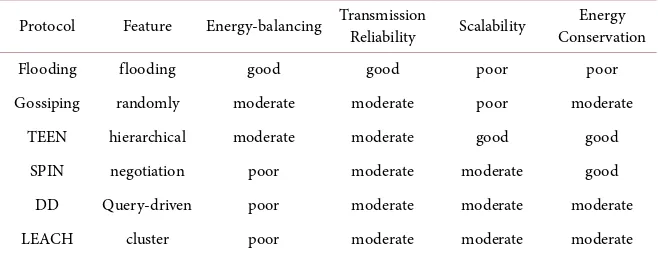
DOI: 10.4236/jcc.2018.69009 128 Journal of Computer and Communications Table 1. Comparison of classical routing protocols.
Protocol Feature Energy-balancing Transmission Reliability Scalability Conservation Energy
Flooding flooding good good poor poor
Gossiping randomly moderate moderate poor moderate TEEN hierarchical moderate moderate good good
[image:3.595.210.539.90.218.2]SPIN negotiation poor moderate moderate good DD Query-driven poor moderate moderate moderate LEACH cluster poor moderate moderate moderate
Table 2. comparison of application fields of classical routing protocols.
Protocol Application Filed
Flooding Low expansion, reliable transmission, more nodes, rapid diffusion information Gossiping Low scalability, high latency
TEEN It can detect the environment in real time, and is not suitable for the periodic acquisition system
SPIN Moderate scalability, more nodes, unsuitable to topology containing central node DD Fewer nodes, Large storage capacity, persistent query
LEACH Used in small sensor networks, arranged in a cluster
comparison of the classical routing protocols in the application field.
3. Protocol Improvement
3.1. Improvement Notion
In this paper, a new modified directed diffusion routing protocol based on the idea of multi-objective optimization is proposed. Our proposed protocol ma-jored in the phase of data transmission. In order to maintain the life cycle of the network as far as possible, it is necessary to select the path to be strengthened with characters of high energy, few hops and a short distance in the path streng-thening stage. We address to use energy, hop count, and distance factor infor-mation as an indicator of the optimal path.
3.2. Improvement Scheme
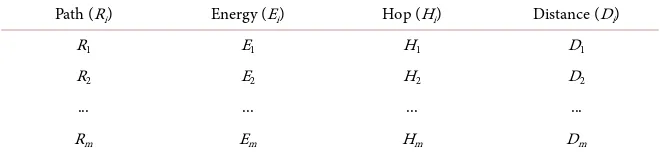
These include, but are not limited to, addresses of source nodes, perceived hops between source nodes and destinations, too much node energy to pay transmis-sion, distance between pertinent nodes. At the completion of each way transmit-ting data, sink node identifies three attributes relatransmit-ting to the efficiency of proto-col: essential energy, perceived hops, distance. Each attribute is considered. Consequently, greatest way is to be selected. Table 3 provides partly parameters of the transmission path.
DOI: 10.4236/jcc.2018.69009 129 Journal of Computer and Communications Table 3. parameter of transmission path.
Path (Ri) Energy (Ei) Hop (Hi) Distance (Di)
R1 E1 H1 D1
R2 E2 H2 D2
... ... ... ...
Rm Em Hm Dm
Notes: 1) i denotes number of routing path; 2) Ri is the path from the source node to the destination node; 3)
Ei is the sum of residual energy from the source node to the destination node; 4) Hi is the total sum of hops
from the source node to the destination node; 5) Di is the total sum of distances from the source node to the
destination node.
( )
i ( )i( )
iK E S
C H T D
α
β γ
=
⋅ (1)
Therein to, α β γ+ + =1.
Where, α, β and
γ
denote the weight coefficient of three factors from source node to sink node for adjusting proportion. And we define w=(
α β γ, ,)
.If n experts give the J indexes for the evaluation. r given by specialist is the fuzzy weight of the first j index. For index j, the judgment matrix is denoted as
1 2, ,...,j nj
R= r r r . The fuzzy comprehensive evaluation matrix is denoted as R.
Each expert is set to have the same weight 1
[
1 ,1,...,11]
Te= J× . Lastly, weight is
defined as
w e R= ⋅ (2)
( ) ( ) ( )
i , i , iK E C H T D represent the influencing factors of evaluation
crite-rion, which is energy, hop and distance. We normalize the data and formula is defined as:
( )
( )
min, 1,..., , 1,..., max( ) min
ij kj
ij
kj kj
a a
x j n k n
a a
−
= = =
− (3)
ij
a denotes the data of row i column j as Table 3.
4. Simulation and Analysis
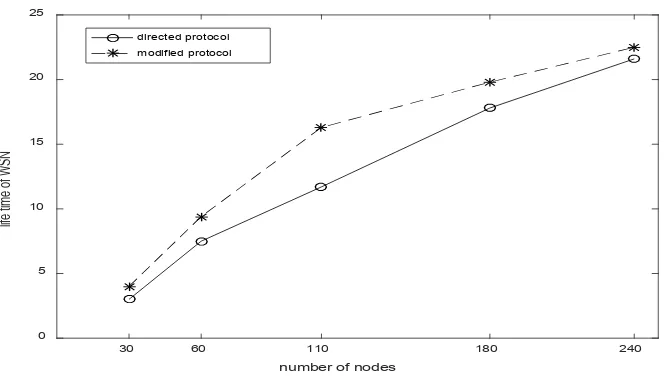
The simulation is carried out in MATLAB. To measure the modified protocol and we consider two metrics: Energy consumption and life time, as showed in the following.
Nodes are distributed in an area about 500 m × 500 m and simulation time is set to be 200 s. MAC Type is Mac/802.11. Nodes range from 30 - 250.
From Figure 1, we can see in addition to the finding that the power
consump-tion are increasing with the scale increasing, the finding that the modified pro-tocol has lower consumption than DD. Figure 2 revealed that modified protocol can prolong the life time of network.
5. Conclusions
DOI: 10.4236/jcc.2018.69009 130 Journal of Computer and Communications Figure 1. Comparison of power comparison.
Figure 2. Life Time of WSN.
networks are analyzed and compared. Aiming at the problem of uneven energy consumption in directed diffusion routing protocol (DD), a modified method for valuable optimization is proposed. After comparing influencing factors in different paths, a best path is selected to be strengthened. Simulation shows that the improved method is effective in improving the network life cycle, ener-gy-balancing.
This study was small in scale and exploratory in nature. At present, there are still a lot of important problems to be solved in routing protocols for wireless sensor networks. And there are still many technologies to be improved, such as data fusion, routing security, energy saving and QoS. The method presented in this paper will provide reference for further research on routing protocols.
Conflicts of Interest
The authors declare no conflicts of interest regarding the publication of this paper.
30 60 110 180 240
number of nodes
3100 3200 3300 3400 3500 3600 3700 3800 3900 4000
comparison of power consumption
modified protocol directed protocol
30 60 110 180 240
number of nodes
0 5 10 15 20 25
life time of WSN
[image:5.595.208.540.288.477.2]DOI: 10.4236/jcc.2018.69009 131 Journal of Computer and Communications
References
[1] Ke, J.X. (2014) Research of the Theoretical Foundation of EIMN Sensor Network and Wireless Remote Image Monitoring System Technology. 2014 IEEE Workshop on Advanced Research and Technology in Industry Applications (WARTIA), Ot-tawa, ON, 29-30 September 2014, 721-723.
https://doi.org/10.1109/WARTIA.2014.6976368
[2] Cao-Hoang, T. and Duy, C.N. (2017) Environment Monitoring System for Agricul-tural Application Based on Wireless Sensor Network. 2017 Seventh International Conference on Information Science and Technology (ICIST), Da Nang, 16-19 April 2017, 99-102. https://doi.org/10.1109/ICIST.2017.7926499
[3] EL Brak, M., EL Brak, S., Essaaidi, M. and Benhaddou, D. (2014) Wireless Sensor Network Applications in Smart Grid. 2014 International Renewable and Sustainable Energy Conference (IRSEC), Ouarzazate, 17-19 October 2014, 587-592.
https://doi.org/10.1109/IRSEC.2014.7059881
[4] Samara, K. and Hosseini, H. (2015) A Routing Protocol for Wireless Sensor Net-works with Reliable Delivery of Data. 2015 IEEE International Conference on Data Science and Data Intensive Systems, Sydney, NSW, 11-13 December 2015, 632-635.
https://doi.org/10.1109/DSDIS.2015.85
[5] Cao, N., Wu, M., Wang, Y., Wang, X., Cao, G. and Wang, G. (2017) The Compari-sons of Different Hierarchical Routing Protocols in Wireless Sensor Networks. 2017
IEEE International Conference on Computational Science and Engineering (CSE)
and IEEE International Conference on Embedded and Ubiquitous Computing
(EUC), Guangzhou, 21-24 July 2017, 310-315.
https://doi.org/10.1109/CSE-EUC.2017.243
[6] Gu, Y., Ma, L., Guo, J. and Jing, D. (2014) Improved Directed Diffusion Protocol Based on Visible Forwarding Path and Promoted Evaluation Criterion. 2014 Second International Conference on Advanced Cloud and Big Data, Huangshan, 20-22 November 2014, 174-179. https://doi.org/10.1109/CBD.2014.29
[7] Zheng, M.C. and Zhao, X.C. (2013) Research on Directed Diffusion Routing Proto-col in Wireless Sensor Networks. 2013 10th International Computer Conference on Wavelet Active Media Technology and Information Processing (ICCWAMTIP), Chengdu, 17-19 December 2013, 53-57.
https://doi.org/10.1109/ICCWAMTIP.2013.6716599
[8] Raj, D.A.A. and Sumathi, P. (2016) Analysis and Comparison of EEEMR Protocol with the Flat Routing Protocols of Wireless Sensor Networks. 2016 International Conference on Computer Communication and Informatics (ICCCI), Coimbatore, 7-9 January 2016, 1-5.
[9] Cao, N., et al. (2017) The Comparisons of Different Location-Based Routing Proto-cols in Wireless Sensor Networks. 2017 IEEE International Conference on Compu-tational Science and Engineering (CSE) and IEEE International Conference on Em-bedded and Ubiquitous Computing (EUC), Guangzhou, 21-24 July 2017, 324-327.
https://doi.org/10.1109/CSE-EUC.2017.246