FUZZY MODEL TO PREDICT AMOUNT OF DELAY IN THE CONSTRUCTION OF PUBLIC
*Husam H. Hajjar, Mahomud A. Taha, Ph.D. and Waleed H. Khushefati, Ph.D.
Department of Civil Engineering, King Abd
ARTICLE INFO ABSTRACT
The kingdom of Saudi Arabia is one of the largest developing counties at the current time. Currently, a huge public construction work is running in the kingdom. It was observed that many of public construction projects are exposed to extensive delays espec
projects. These delays will affect greatly the educational sector through: 1) Loss of benefits for all stakeholders, 2) Decrease of quality due to rapid execution in construction to recover the delayed time, 3) Del
parties. The main objectives of this research is to identify the main delay causes in public universities construction projects and to develop a fuzzy system to est
the construction of public universities projects. This system will enable project owner and contractor to estimate the percentage of delay based on assumed construction related circumstances. The proposed system is
identification of the most critical causes of delays through literature review and by conducting Delphi Technique with the help of a selected panel of domain experts. The main concep
is to achieve an agreement in different opinion of experts that will facilitate the determination of critical causes. Twelve critical causes of delay were identified. Those critical causes are used as input variables for the fuzzy sys
functions. The relations between the critical causes are built by using a set of if then Rule. The proposed systemis validated using 14 actual cases collected from king Abdulaziz Univers Taibah University projects. The validation results were satisfactory.
Copyright © 2016, Husam H. Hajjar et al. This is an open access article distributed under the Creative Commons Att use, distribution, and reproduction in any medium, provided the original work is properly cited.
INTRODUCTION
Saudi Arabia, as one of the largest developing country, supporting many public projects with an amount of 78 billion SR in (2007) that increased to 121 billion SR in (2012) (2012)). These amounts jumped to 248 billion SR in (2014) based on the 9th development plan (2013). As mentioned by SSCE (2012), delays in public construction projects were identified through a study conducted by principality of Makkah Al-Mukarrama. The study showed amount of delay in 294 projects out of 2262 project with percentage of 13% and total losses by 44 billion SR for years 2008 to 2012. Most of delayed projects were in health and educational sectors. This research work will focus on delay of public universities construction projects. This is because this sector constitute 16% of construction budget according to the 9
plan (2013). Also, this plan showed that the estimated number
*Corresponding author: Husam H. Hajjar,
Department of Civil Engineering, King AbdulAziz University Box # 80204, Jeddah 21589, Saudi Arabia.
ISSN: 0975-833X
Article History:
Received 23rd January, 2016
Received in revised form 25th February, 2016
Accepted 09th March, 2016
Published online 26th April,2016
Key words: Saudi Arabia, Fuzzy Logic, Delphi Technique, Delay Causes, Public Universities.
Citation: Husam H. Hajjar, Mahomud A. Taha, Ph.D. and Waleed H. Khushefati, Ph.D.
construction of public universities projects”, International Journal of Current Research
RESEARCH ARTICLE
FUZZY MODEL TO PREDICT AMOUNT OF DELAY IN THE CONSTRUCTION OF PUBLIC
UNIVERSITIES PROJECTS
Mahomud A. Taha, Ph.D. and Waleed H. Khushefati, Ph.D.
Civil Engineering, King AbdulAziz University Box # 80204, Jeddah 21589, Saudi Arabia
ABSTRACT
The kingdom of Saudi Arabia is one of the largest developing counties at the current time. Currently, a huge public construction work is running in the kingdom. It was observed that many of public construction projects are exposed to extensive delays especially in public universities construction projects. These delays will affect greatly the educational sector through: 1) Loss of benefits for all stakeholders, 2) Decrease of quality due to rapid execution in construction to recover the delayed time, 3) Delay of the start of related projects, and 4) Increase of claims and disputes between project parties. The main objectives of this research is to identify the main delay causes in public universities construction projects and to develop a fuzzy system to estimate the expected percentage of delay in the construction of public universities projects. This system will enable project owner and contractor to estimate the percentage of delay based on assumed construction related circumstances. The proposed system is implemented using MATLAB software. The research methodology will include identification of the most critical causes of delays through literature review and by conducting Delphi Technique with the help of a selected panel of domain experts. The main concep
is to achieve an agreement in different opinion of experts that will facilitate the determination of critical causes. Twelve critical causes of delay were identified. Those critical causes are used as input variables for the fuzzy system. Each critical cause will be identified in the form of membership functions. The relations between the critical causes are built by using a set of if then Rule. The proposed systemis validated using 14 actual cases collected from king Abdulaziz Univers Taibah University projects. The validation results were satisfactory.
is an open access article distributed under the Creative Commons Attribution License, which use, distribution, and reproduction in any medium, provided the original work is properly cited.
Saudi Arabia, as one of the largest developing country, is supporting many public projects with an amount of 78 billion SR in (2007) that increased to 121 billion SR in (2012) (SSCE (2012)). These amounts jumped to 248 billion SR in (2014) development plan (2013). As mentioned by elays in public construction projects were identified through a study conducted by principality of Makkah Mukarrama. The study showed amount of delay in 294 projects out of 2262 project with percentage of 13% and total 2008 to 2012. Most of delayed projects were in health and educational sectors. This work will focus on delay of public universities construction projects. This is because this sector constitute 16% of construction budget according to the 9th development plan (2013). Also, this plan showed that the estimated number
Department of Civil Engineering, King AbdulAziz University Box #
of students in higher education is 1,206,00
with yearly annual growth of 18.1%. The main objectives of this research are: 1) identifying the main delay causes in public universities construction projects, 2) develop a fuzzy system to estimate the expected amount of delay in such pr
validate the fuzzy system using real life cases from King AbdulAziz University (KAU) and Taibah University (TU), and 4) suggest mitigation measures to minimize the effects of causes in the construction of public universities.
Literature review
There are many studies that addressed the effect of delay in construction projects. Table 1 presents previous studies about delay effects and its causes.
Several research works were done to study the effect of delays on the success of construction operations. Table 2
the findings of these researches.
International Journal of Current Research
Vol. 8, Issue, 04, pp.29389-29397, April, 2016
INTERNATIONAL
Husam H. Hajjar, Mahomud A. Taha, Ph.D. and Waleed H. Khushefati, Ph.D. 2016. “Fuzzy model to predict amount of delay in the International Journal of Current Research, 8, (04), 29389-29397.
FUZZY MODEL TO PREDICT AMOUNT OF DELAY IN THE CONSTRUCTION OF PUBLIC
Mahomud A. Taha, Ph.D. and Waleed H. Khushefati, Ph.D.
Jeddah 21589, Saudi Arabia
The kingdom of Saudi Arabia is one of the largest developing counties at the current time. Currently, a huge public construction work is running in the kingdom. It was observed that many of public ially in public universities construction projects. These delays will affect greatly the educational sector through: 1) Loss of benefits for all stakeholders, 2) Decrease of quality due to rapid execution in construction to recover the delayed ay of the start of related projects, and 4) Increase of claims and disputes between project parties. The main objectives of this research is to identify the main delay causes in public universities imate the expected percentage of delay in the construction of public universities projects. This system will enable project owner and contractor to estimate the percentage of delay based on assumed construction related circumstances. The software. The research methodology will include identification of the most critical causes of delays through literature review and by conducting Delphi Technique with the help of a selected panel of domain experts. The main concept of Delphi technique is to achieve an agreement in different opinion of experts that will facilitate the determination of critical causes. Twelve critical causes of delay were identified. Those critical causes are used as input tem. Each critical cause will be identified in the form of membership functions. The relations between the critical causes are built by using a set of if then Rule. The proposed systemis validated using 14 actual cases collected from king Abdulaziz University and Taibah University projects. The validation results were satisfactory.
ribution License, which permits unrestricted
of students in higher education is 1,206,000 (male & female) with yearly annual growth of 18.1%. The main objectives of this research are: 1) identifying the main delay causes in public universities construction projects, 2) develop a fuzzy system to estimate the expected amount of delay in such projects, 3) validate the fuzzy system using real life cases from King AbdulAziz University (KAU) and Taibah University (TU), and
suggest mitigation measures to minimize the effects of delay causes in the construction of public universities.
There are many studies that addressed the effect of delay in construction projects. Table 1 presents previous studies about
Several research works were done to study the effect of delays construction operations. Table 2 summaries the findings of these researches.
INTERNATIONAL JOURNAL OF CURRENT RESEARCH
Table 1. List of previous Studies about delay causes in construction
Author (Year) Brief description of the study Important factors/ group causing delay
Assaf, Al-Khalil and Al-Hazmi (1995) Conducted a survey to identify causes of delay
in large building construction projects. 56 causes of delay were identified.
Preparation and approval of shop drawings by contractor, progress payment by owner, cash problems during construction for A/E, schedule between contractor and subcontractor, slowness indecision making by owner, design error, excessive bureaucracy in project owner organization, labor shortage and inadequate labor skills.
Al-Khalil and Al-Ghafly (1999) A Studied important Causes of delay in public
utility projects; as a result, 60 potential delay causes were identified and grouped into 6 major categories of delay.
Shortage of man power, contractor’s poor coordination, delay in mobilization, poor qualification of contractor, improper technical study, ineffective planning and scheduling, ineffective control, delay in submissions, contractor’s cash flow problem, delay in contractor claims by owner, slow decision making by owner, owner’s poor communication, owner failure to coordinate with authorities, excessive bureaucracy by owner, change in project scope, ineffective delay penalty, difficulties in obtaining work permits, government tendering system problem and effect of subsurface condition.
Brief description of the study Important factors/ group causing delay
Al-khalil and Al-Ghafly (1999) B Conducted a survey to investigate three
components of delay in public utility projects. (1) the frequency of delayed projects which was 37% as an average.(2) the extent of delay which was 39% as an average.(3) the responsibility of delay which assigned 30% by contractor to owner. While owner and consultant assigned 57% and 52% respectively to contractor.
Cash flow and financial difficulties, delay in work permits, government assigning contractor to the lowest bidder without regards of qualification, no systematic approach or procedure for setting contract duration by owner.
Abd El-Razek et al. (2008) Identified the main causes of delay in
construction projects in Egypt. 32 causes of delay were obtained.
Financing by contractor during construction, delays in contractor’s payment by the owner, design change by the owner or his agent during construction, partial payments during construction, nonutilization of professional construction/contractual management.
Al-Kharashi and Sketmore (2009) Carried out a survey to identify delay causes
and located 112 factors that are causing delays in public construction projects and grouped them into 6 categories.
lack of qualified, lack of experienced personnel, innovative, construction projects, associated current undersupply of manpower in the industry
Mahamid et al. (2012) Conducted a study to investigate delays in road
construction projects. 52 causes of delay were identified.
Political situation, segmentation and limited movement between areas, award project to the lowest bid price, progress payment delay by the owner, shortage of equipment.
Venkatesh et al. (2012) Investigated the causes of delays in Indian
construction projects. 45 causes of delay were identified.
[image:2.595.45.561.74.586.2]Shortage of labor and shortage of material.
Table 2. List of previous Studies about fuzzy set theory
Author (Year) Important factors/ group causing delay
Oliveros and Fayek (2005) Listed causes of delay, categories delay, estimating delay durations by fuzzy logic, procedure for updating schedule,
procedure to evaluate effecting consequence of delay and As-built data base integration with schedule.
Moselhi and Al-Kass (2006) Addressed the effects of a number of factors that indicates cost overruns and schedule delays by using fuzzy logic.
Gunduz, Nielsen and Ozdemir (2015) Identified 83 delay factors to make a decision support tool. Delay assessment is done by using fuzzy set theory. The
model is developed using commercial software product.
Table 3. Domain experts details
Party Title Experience (Years) No. of experts
Owner Project Manager 15 1
SeniorEngineer 12 &13 2
Project Supervisor 5-8 3
Consultant Project Manager 22 & 27 2
Contract Manager 25 1
[image:2.595.38.563.603.661.2]Table 4. Classification of delay causes in surveys
Class Range
Very High 81-100
High 61-80
Medium 41-60
Low 21-40
Very Low 0-20
Table 5. Summary of locating most critical causes of delay using Delphi Technique
Number Delay Causes 1
st Round
% of Opinion
2nd Round
% of Opinion
3rd Round
% of Opinion
Difference Between 2nd&
3rdRounds (%)
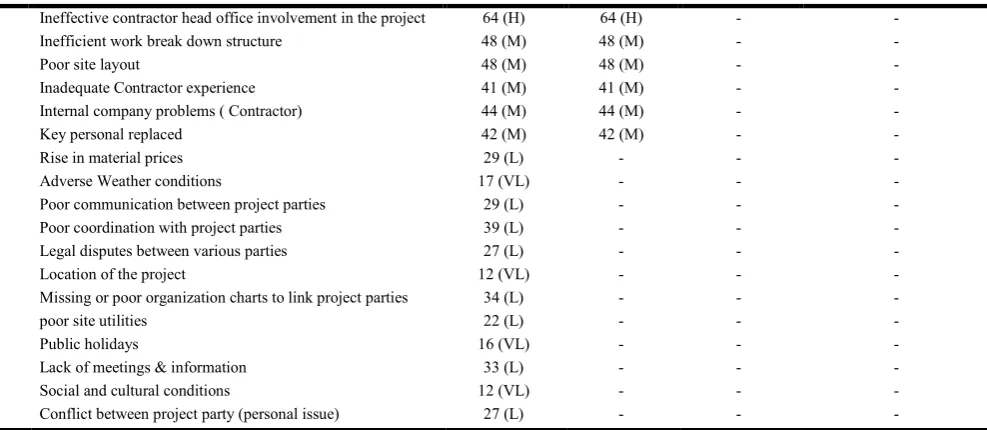
1 Delay in Change order approval by client 64 (H) 65 (H) 66 (H) 2%
2 Government Tendering system problem (award to lowest
bidder only…)
53 (M) 53 (M) - -
3 Change in project scope & specification 47 (M) 47 (M) - -
4 Changes in government regulation and laws 12 (L) - - -
5 Delay in Change order prepared by contractor 47 (M) 47 (M) - -
6 Complexity level of the project 21 (L) - - -
7 Scope is not well defined 20 (VL) - - -
8 Improper technical study during bidding stage 56 (M) 56 (M) - -
9 Unforeseen subsurface condition on site 29 (L) - - -
10 Ineffective delay penalty 49 (M) 65 (H) 73 (H) 11%
11 Contract duration is too short 26 (L) - - -
12 Not applying engineering method to estimate project
duration
45 (M) 45 (M) - -
13 Ineffective planning and scheduling by contractor 63 (H) 72 (H) 83 (VH) 13%
14 Low incentive to be ahead of schedule by contractor 48 (M) 48 (M) - -
15 Late in approving design documents by owner 30 (L) - - -
Number Delay Causes 1st Round
% of Opinion
2nd Round
% of Opinion
3rd Round
% of Opinion
Difference Between 2nd&
3rdRounds (%)
16 Incompetent design 33 (L) - - -
17 Conflict between design specification and building code 27 (L) - - -
18 Frequent design changes 57 (M) 57 (M) - -
19 Mistakes by designers due to unfamiliarity with local
conditions & environment
40 (L) - - -
20 Late of selection finishing materials 21 (L) - - -
21 Mistakes on specifications and project documents 43 (M) 43 (M) - -
22 Poor design 49 (M) 49 (M) - -
23 Variations in quantities 48 (M) 48 (M) - -
24 Conflicts between consultant and designer 28 (L) - - -
25 Conflict between contract documents 31 (L) - - -
26 Difficulties in obtaining work permits from owner 15 (VL) - - -
27 Delay in work approval by owner 35 (L) - - -
28 Delay in contractor claims by owner 20 (VL) - - -
29 Suspension of works by owner 36 (L) - - -
30 Slow decision making by owner 43 (M) 43 (M) - -
31 Delay in progress payments by owner 25 (L) - - -
32 Delay in approving submittals by owner 27 (L) - - -
33 Documents not issued on time 29 (L) - - -
34 Delay in solving major disputes and negotiations 28 (L) - - -
35 Nonpayment of contractor claims 16 (VL) - - -
36 Delay in work approval by consultant 40 (L) - - -
37 Delay in instructions from consultant 34 (L) - - -
38 Delay in approving changes by consultant 37 (L) - - -
39 Inflexibility(rigidity) of consultant to finalize works 43 (M) 43 (M) - -
40 Difficulties in obtaining work permits from consultant 27 (L) - - -
41 Delay in approving of shop drawings 44 (M) 44 (M) - -
Number Delay Causes 1st Round
% of Opinion
2nd Round
% of Opinion
3rd Round
% of Opinion
Difference Between 2nd&
3rd Rounds (%)
42 Difficulties in obtaining permits from authorities 35 (L) - - -
43 Delay in preparation of contractor submissions 64 (H) 60 (H) 62 (H) 3%
44 Interference by owner in construction operation 21 (L) - - -
45 Shortage of materials on site or market 29 (L) - - -
[image:3.595.53.566.166.803.2]46 Low skill of manpower 63 (H) 61 (H) 65 (H) 6%
47 Fraud and cheating in execution 33 (L) - - -
48 Rework due to errors of construction 38 (L) - - -
49 Improper construction method by contractor 36 (L) - - -
50 Inefficient quality control by contractor 55 (M) 55 (M) - -
51 Material quality problem 37 (L) - - -
52 Nationality of labor 23 (L) - - -
53 Shortage of shoring for excavation 22 (L) - - -
54 Damage of stored materials 17 (VL) - - -
55 Government Tendering system problem (award to lowest
bidder only…)
51 (M) 51 (M) - -
56 Owner’s poor communication 12 (VL) - - -
57 Poor qualification of Owner key personnel 39 (L) - - -
58 Monthly payments difficulties 32 (L) - - -
59 Complicating contract administration by owner 30 (L) - - -
60 Owner poor coordination with government authorities 20 (VL) - - -
61 Excessive bureaucracy in owner's administration 34 (L) - - -
62 Type of project bidding and award 13 (VL) - - -
63 Inadequate Owner experience. 17 (VL) - - -
64 Breach/modification of the contract by owner 28 (L) - - -
65 Work interference between various contractors 35 (L) - - -
66 Owner’s personality problem 16 (VL) - - -
Number Delay Causes 1st Round
% of Opinion
2nd Round
% of Opinion
3rd Round
% of Opinion
Difference Between 2nd&
3rd Rounds (%)
67 Lack of finance by owner 49 (M) 49 (M) - -
68 Holding other work 27 (L) - - -
69 Increase in contractor’s overheads 30 (L) - - -
70 Uncooperative owner with consultant & contractor 18 (VL) - - -
71 Poor qualification of Consultant 50 (M) 50 (M) - -
72 Delay in inspection and testing works 33 (L) - - -
73 Inadequate Consultant experience 38 (L) - - -
74 Internal company problems (Consultant) 26 (L) - - -
75 Slow response from consultant to contractor inquiries 41 (M) 41 (M) - -
76 Absence of consultant’s site staff 27 (L) - - -
77 Shortage of Manpower 71 (H) 73 (H) 77 (H) 5%
78 Shortage of qualified engineers. 65 (H) 71 (H) 73 (H) 3%
79 Delay in mobilization 37 (L) - - -
80 Cash flow& financial problem 75 (H) 74 (H) 76 (H) 3%
81 Delay in materials delivery 69 (H) 69 (H) - -
82 Poor qualification of Contractor 50 (M) 50 (M) - -
83 Shortage of equipment 35 (L) - - -
84 Failure of equipment 22 (L) - - -
85 Increased number of projects by the same contractor 70 (H) 75 (H) 83 (VH) 10%
86 Missing of contractor administrative personnel 31 (L) - - -
87 Poor implementation of safety rules and regulations 48 (M) 48 (M) - -
88 Accidents during construction 24 (L) - - -
89 Shortage of technical professionals persons of contractor 52 (M) 52 (M) - -
90 Ineffective control of progress by contractor 56 (M) 62 (H) 70 (H) 11%
91 Financing difficulties by contractor 75 (H) 74 (H) 76 (H) 3%
92 Problems between contractor and subcontractors (payments,
quality, time…)
65 (H) 66 (H) 70 (H) 6%
Number Delay Causes 1st Round
% of Opinion
2nd Round
% of Opinion
3rd Round
% of Opinion
Difference Between 2nd&
3rd Rounds (%)
93 Delay in shop drawings preparation 63 (H) 63 (H) - -
94 Late of procurement/ supplying materials 58 (M) 58 (M) - -
95 Low productivity level of labors 49 (M) 49 (M) - -
96 Low productivity level of equipment 29 (L) - - -
97 Technical problems in project site 47 (M) 47 (M) - -
98 Missing information on shop drawings 34 (L) - - -
99 Mistake in soil investigation 24 (L) - - -
100 Breach of the contract by contractor 35 (L) - - -
101 Ineffective contractor head office involvement in the project 64 (H) 64 (H) - -
102 Inefficient work break down structure 48 (M) 48 (M) - -
103 Poor site layout 48 (M) 48 (M) - -
104 Inadequate Contractor experience 41 (M) 41 (M) - -
105 Internal company problems ( Contractor) 44 (M) 44 (M) - -
106 Key personal replaced 42 (M) 42 (M) - -
107 Rise in material prices 29 (L) - - -
108 Adverse Weather conditions 17 (VL) - - -
109 Poor communication between project parties 29 (L) - - -
110 Poor coordination with project parties 39 (L) - - -
111 Legal disputes between various parties 27 (L) - - -
112 Location of the project 12 (VL) - - -
113 Missing or poor organization charts to link project parties 34 (L) - - -
114 poor site utilities 22 (L) - - -
115 Public holidays 16 (VL) - - -
116 Lack of meetings & information 33 (L) - - -
117 Social and cultural conditions 12 (VL) - - -
[image:5.595.61.555.53.268.2]118 Conflict between project party (personal issue) 27 (L) - - -
Table 6. List of the most critical Causes of Delay identified using Delphi technique
No. Delay Causes Final Results % of Opinion
1 Delay in change order approval by client 66
2 Insufficient delay penalty 73
3 Ineffective planning and scheduling by contractor 83
4 Low skill of manpower 65
5 Delay in preparation of contractor submissions 62
6 Shortage of Manpower 77
7 Shortage of qualified engineers. 73
8 Increased number of projects by the same contractor 83
9 Ineffective control of progress by contractor 70
10 Financing difficulties by contractor 76
11 Problems between contractor and subcontractors (payments, quality, time…) 70
[image:5.595.89.502.299.563.2] [image:5.595.100.500.588.772.2]12 Cash flow& financial problem 76
Figure 1. Membership function for all linguistic variables
Figure 2. Sample of input and output scenarios in rules identification survey Y: Degree of Membership function
Figure 3. Graphical user interface tools to construct the fuzzy assessment model in the fuzzy logic toolbox
[image:6.595.58.544.417.745.2]Research Methodology
The literature review revealed 118 causes of delay applicable to Saudi construction industry. Delphi technique is used to identify the most critical causes of delays in public university projects with the help of domain experts.23 domain experts were contacted and 10 out of them agreed to participate in the study (3 of them were From KAU and 7 from TU). This number of experts is sufficient according to Hallowell and Gambatese (2010), Table 3 presents the experts details.
The identified main causes of delays in public universities were used to develop fuzzy system using MATLAB to estimate the percentage of delay in this type of projects.
Identifying Causes of Delay using Delphi Technique
[image:7.595.121.474.54.317.2]Delphi surveys were prepared and distributed to the experts in several rounds. In the first round, survey containing a list of 118 proposed causes of delay. It is sent to the experts asking for their opinions about the most critical causes of delays.
Figure 5. Model Validation form
Table 7. Sample of Fuzzy Rules (IF THEN RULE)
Rule number If Input1 &2 &3 &4 &5 &6 &7 &8 &9 &10 &11 &12 Then, Output
1 VL VL VL VL VL VL VL VL VL VL VL VL VL
43 L H L L L L L VL L L L L L
119 H H H M M M M M M H M H M
148 M L L L L L M L L L L L L
195 VH H VH VH H VH VH VH VH VH H VH VH
Table 8. Model Validation Results
No. Project code Actual Amount of Delay (%) = Revised finish
date - Original finish date (1)
Estimated Fuzzy System Amount of Delay (%) =Calculated by fuzzy in MATLAB (2)
Difference (%) =│col. (1)- col. (2)│
1 1-TU 65 50 15
2 2-TU 68.1 71.1 3
3 3-TU 74.4 72.4 2
4 4-TU 49.7 55.2 5.5
5 5-TU 51.8 52.2 0.4
6 6-TU 39 52.2 13.2
7 7-TU 100 81.4 18.6
8 1-KAU 68.2 56 12.2
9 2-KAU 62.3 56 6.3
10 3-KAU 54.9 56 1.1
11 4-KAU 44.8 56 11.2
12 5-KAU 83.3 64.5 18.8
13 6-KAU 21.6 30 8.4
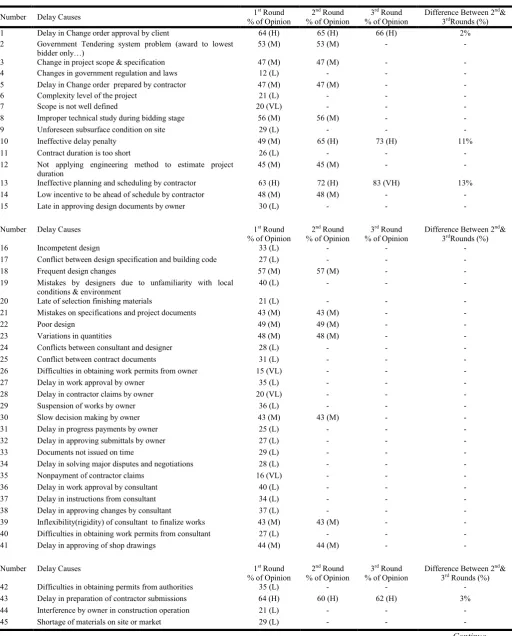
[image:7.595.44.554.475.628.2]Filling out the survey is done by using classifications and ranges mentioned in Table 4.The results indicated no causes assigned as Very High, 13 causes assigned as High, 31 causes assigned as Medium and the rest of the causes assigned as Low and Very low. In the second round, the survey is sent to experts containing 44 identified most critical causes of delay from first round after removing Low and Very low causes. This survey asked again about identifying most critical causes of delay. The results showed 15 causes as High and 29 causes as Medium. After applying third round of survey with the same procedure of the second round but only containing the15 identified causes “rated as High” in second survey.
The results showed 2 causes as Very high, 10 causes as High and 3 causes as Medium. The twelve identified causes as Very High and High are considered to be the most critical causes of delay. Table 5 summaries all of Delphi rounds and Table6 lists the most critical causes of delay identified using Delphi technique.
Fuzzy Logic System to Estimate Amount of Expected Delay
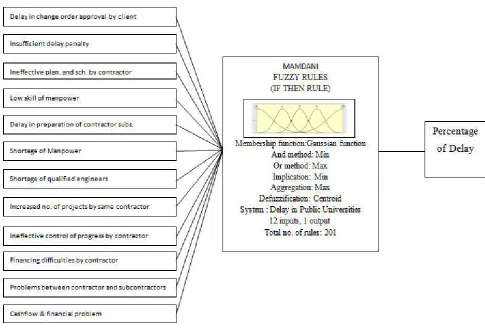
After reaching expert's consensuses about the most critical causes of delays, shown in Table 6. A fuzzy system is developed based on Mamdani stylein fuzzy inference system (FIS) using MATLAB. The proposed system estimates the expected amount of delay as percentage of project original duration. The following steps are used to construct the proposed fuzzy system:
1- Input and output parameters were defined.
2- Determination of membership functions shapes for each variable.
3- Establishing the behavior of the system by defining aggregation, defuzzification and list of rules.
4- Getting plots of output value by rule viewer.
Finally, a quantifiable fuzzy system is used to estimate the expected amount of delay to help all of the project parties to overcome expected delays that may happen during construction. Figure 3 shows graphical user interface (GUI) to construct a fuzzy logic system.
Application of the model
Main Input of fuzzy system
The twelve critical causes of delay shown in Table 6 are used as the main inputs in the developedfuzzy logic system.
LinguisticVariables and Fuzzy Membership Functions
This research will use linguistic variable for inputs and output as follow: Very high (VH), High (H), Medium (M), Low (L) and Very low (VL).The range of inputs and output will be from 0 to 100. Membership functions of the inputs and output will be in a Gaussian function forms as shown in Figure 1.
EstablishingFuzzy Rules, Aggregation and Defuzzification
In this research, Mamdani Style is used due to its widespread acceptance and suitability to human brains as mentioned by Kaur and Kaur (2012).If-Then Rules are used to connect inputs
with output in form of linguistic variables. Aggregation is an operation that combine fuzzy sets into single fuzzy set. Aggregation is set to Max method which is common in useaccording to Gunduz, Nielsen, and Ozdemir (2013). Defuzzification is used to reach fuzzy output from fuzzy sets. The most common method for Defuzzification is center of
gravityaccording to Naaz, Alam and Biswas (2012)which is
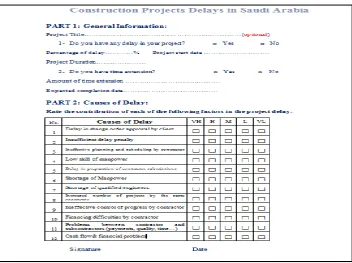
used in this research. If then rules were constructed by sending the survey, shown in Figure 2, to the experts asking them for giving a possible scenarios based on their experience. Each column of the Table in Figure 2 must be filledvertically by a linguistic variable VL, L, M, H, VH according to ranging scale mentioned previously in Table 4.
The total number of generated rules by experts were 201. Table 7 shows sample of fuzzy rules, these rules will be entered into FIS in the following form:
if INPUT 1 is H & INPUT 2 is VH & ..…&INPUT 12 is H
Then OUTPUT is VH ………(Eq.1)
Constructing Fuzzy System to Estimate Amount of Expected Delay
The Proposed fuzzy system is constructed by using GUI, shown in Figure 3, of fuzzy logic toolbox in MATLAB. First, inputs and output are defined. Second, membership function numbers, ranges and forms are entered for each variables of inputs and output. Third, the list of rules as well as the aggregation and defuzzification methods establishing the behavior of the system were defined and entered. Based on that, the system will start to work and can give a percentage result of delay. Figure 4 shows the proposed fuzzy system to estimate percentage of delay.
Fuzzy System Validation
Shortage of qualified engineers, Increased number of projects by the same contractor, Ineffective control of progress by contractor, Financing difficulties by contractor and Cashflow & financial problem.
Conclusion and Recommendation
This research work focused on studying delays in the construction of public universities projects. KAU & TU are used in the study because they constitute 15.3% of the total budget allocated in 2015 to public universities which equals to 54.17 billion SR as mentioned by Ministry of Education (2015). This research proposed a fuzzy system to estimate the expected percentage of delay in the construction of public universities projects. This will help owner and contractors to pay more attention regarding causes of delay to avoid project losses based on most critical causes of delay. After finishing literature review and using Delphi Technique, 12 critical causes of delay were identified out of 118 causes found. The most critical causes of delay are used as fuzzy inputs and the required output is calculated as percentage of delay. Domain experts are used to develop the fuzzy rules by assigning relations between critical causes using IF THEN RULE. Mamdani style have been used in developed fuzzy model. Aggregation was Max and Defuzzification method used were
Center of Gravity which are common in use. Fuzzy system is
constructed by using MATLAB software. Model validation was done using data collected from fourteen actual delayed projects in KAU and TU to check the proposed system accuracy, the comparison was satisfactory. The maximum difference between actual delay Vs. fuzzy system delay was 18.8 % while minimum difference was 0.4 % with overall standard deviation= 6.45 %.
REFERENCES
Assaf, S.A., Al-Khalil, M. and Al-Hazmi, M., 1995. Causes of delay in large building construction projects. Journal of
Management in Engineering, 11(2), pp.45-50.
Ejaz, N., Ali, I. and Tahir, M.F. 2013. Assessment of delays and cost overruns during construction projects in Pakistan. Gunduz, M., Nielsen, Y. and Ozdemir, M., 2013. Fuzzy
assessment model to estimate the probability of delay in
Turkish construction projects. Journal of Management in
Engineering, 31(4), p.04014055.
Hallowell, M.R. and Gambatese, J.A., 2009. Qualitative research: Application of the Delphi method to CEM research. Journal of Construction Engineering and
Management, 136(1), pp.99-107.
Kaur, A. and Kaur, A., 2012. Comparison of fuzzy logic and neuro fuzzy algorithms for air conditioning system.
International Journal of Soft Computing and Engineering,
2(1), pp.2231-2307.
Li, J., Moselhi, O. and Alkass, S., 2006. Forecasting project status by using fuzzy logic. Journal of Construction
Engineering and Management, 132(11), pp.1193-1202.
Mahamid, I., Bruland, A. and Dmaidi, N., 2011. Causes of delay in road construction projects. Journal of Management
in Engineering, 28(3), pp.300-310.
Mamdani, E.H. and Assilian, S., 1975. An experiment in linguistic synthesis with a fuzzy logic controller.
International Journal of Man-Machine Studies, 7(1),
pp.1-13.
Ministry of Economics and Planning, 9th development plan, http://services.mep.gov.sa/themes/Dashboard/index.jsp;jses sionid=0F3E58FF6A9F8B1D2999E6A9A433BCBD.gam ma?event=SwitchLanguage&Code=EN#1457247121639 Ministry of Education, PublicUniversities budget, 2015,
https://www.mohe.gov.sa/ar/Pages/Budget.aspx
Naaz, S., Alam, A. and Biswas, R., 2011. Effect of different defuzzification methods in a fuzzy based load balancing application. IJCSI-International Journal of Computer
Science Issues, 8(5).
Oliveros, A.V.O. and Fayek, A.R., 2005. Fuzzy logic approach for activity delay analysis and schedule updating. Journal
of Construction Engineering and Management, 131(1),
pp.42-51.
Saudi Society of Civil Engineering. Annual Conference no. 8, SSCE 2012 http://civileng-socity.kau.edu.sa/Default.aspx? Site_ID=751&lng=AR Access date, 13October 2013 Venkatesh, M.P., Renuka, S.M. and Umarani, C., 2012,
September. Causes of delay in Indian construction industry.
In Applied Mechanics and Materials, (Vol. 174, pp.
2768-2773).