ISSN Online: 2333-9721 ISSN Print: 2333-9705
DOI: 10.4236/oalib.1105164 Jan. 24, 2019 1 Open Access Library Journal
Design and Performance Evaluation of a
Variable-Feed Hydrous-Bioethanol
Fuel Injector for Retrofitted Engine
Alexis T. Belonio, Manuel Jose C. Regalado, Marvelin L. Rafael, Katherine C. Villota,
Phoebe R. Castillo
Philippine Rice Research Institute (PhilRice), Science City of Munoz, Philippines
Abstract
A variable-feed hydrous-bioethanol fuel injector (VFHBFI) for retrofitted en-gine was designed and evaluated to provide a technology that would allow spark-ignition engines commonly used by farmers be fuelled with hydrous bioethanol from nipa. With this technology, farmers can make use of their farm resources to fuel their engines making them less dependent on imported fossil fuel. The VFHBFI consists of the following components: 1) Fuel tank; 2) DC pump; 3) Fuel line; 4) PWM switch; 5) Battery; and 6) Fuel injector. The tank is made of a stainless-steel cylinder with 2-liter capacity of hydr-ous bioethanol (95%). The DC pump that feeds alcohol fuel is a diaph-ragm-type operating on a 12-volt line. It is ran by a 16-AH gel-type battery and its pumpingrate is regulated by a 12-volt, 0.8-Amp PWM switch. The position of the switch and of the battery is dictated by the kind of machine to be powered. The fuel line that delivers the alcohol to the engine is made of an alcohol-resistant plastic hose. The VFHBFI was evaluated using a 6.5-hp spark-ignition Kenbo engine retrofitted to utilize hydrous bioethanol as fuel. The fuel feed rate was calibrated with the PWM switch setting. A micro-tiller and a power-tiller-operated hauler were used in the evaluation. The forward speed of the power-tiller-operated hauler was also evaluated at varying load. Results showed that the VFHBFI performs satisfactorily as per design. The fuel feeding rate of the injector behaves linearly with the PWM switch setting. It was observed that smooth engine speed is achieved at medium to high PWM switch setting. Using the VFHBFI, a retrofitted-engine-driven mi-cro-tiller successfully tilled a 1500 m2 farm making it ready for planting in 2 to 3 passes. The average amount of fuel consumed in tilling was 2.0 liters per hour, which is double than when using pure gasoline as fuel. Also using the VFHBFI, a retrofitted-engine-driven power-tiller hauler consumed an aver-How to cite this paper: Belonio, A.T.,
Regalado, M.J.C., Rafael, M.L., Villota, K.C. and Castillo, P.R. (2019) Design and Performance Evaluation of a Variable-Feed Hydrous-Bioethanol Fuel Injector for Retrofitted Engine. Open Access Library Journal, 6: e5164.
https://doi.org/10.4236/oalib.1105164
Received: January 2, 2019 Accepted: January 21, 2019 Published: January 24, 2019
Copyright © 2019 by author(s) and Open Access Library Inc.
This work is licensed under the Creative Commons Attribution International License (CC BY 4.0).
DOI: 10.4236/oalib.1105164 2 Open Access Library Journal age of 1.6 liters of alcohol per km on a rough road. The forward speed of the hauler was observed declining with the increase in load. The socio-economic advantage of the technology is also discussed.
Subject Areas
Agricultural Engineering
Keywords
Hydrous Bioethanol, Fuel Injector, Retrofitted Engine
1. Introduction
In 2013, PhilRice launched the Free Fossil Energy program to substantially or entirely remove fossil fuel from rice and rice-based farming by developing alter-native energy sources and inputs to come up with sustainable and cost-effective rice and rice-based farming systems (PhilRice, 2014) [1]. One of the projects under this program is the development of renewable, alternative, diversified, and decentralized energy resource systems for and from rice-based agriculture that will provide sustainable energy and fuel for rice farming activities as well as for electricity generation. The unearthing of hydrous bioethanol from fermented Nipa sap and its consequent use as fuel for spark-ignition internal combustion engines, one of the studies undertaken at Rice Engineering and Mechanization Division (REMD) of PhilRice, is envisioned to empower the farmers in the event the cost of fuel becomes high and farmers cannot use their machines to do farming. This scenario is more likely to occur when the supply of fossil fuel will reach its maximum and then subsequently will start to decline, which is popu-larly known as “The Peak Oil Theory” (Alekllet, 2012) [2]. When such time happens, PhilRice would like rice farmers to be able to continue in their farming activities using the available farm resources, like nipa, as source of fuel for their farm machines.
DOI: 10.4236/oalib.1105164 3 Open Access Library Journal section of the country, the use of nipa sap for alternative fuel production is still promising.
Using a simple and locally designed and built internally-heated distiller, Phi-lRice has proven to successfully distil fermented nipa sap initially at 8% alcohol raising it to 95% using rice husk as heat source in producing liquid fuel to run agricultural machines Regalado, et al. (2017) [4]. Retrofitting an engine in such a way that hydrous bioethanol can be injected directly into its intake manifold by-passing the carburetor paves the way to properly utilize alcohol as fuel for spark-ignition internal combustion engines. An early development has shown that a simple manually-operated fuel injector, which is entirely dependent on the opening of the feeder and on the suction created by the engine piston, has prov-en that hydrous bioethanol can be used to run an prov-engine at the required speed and power. However, the set up of the fuel injector only allows the use of the de-vice that can be easily reached and manually adjusted such as that of stationary engines like pumps, micro-mills, as well as pump boats commonly used by far-mers. For mobile machines where the engine is in proximate distance from the handle of the machine, a variable-feed hydrous-bioethanol fuel injector needs to be designed. In this way, farmers can feed the fuel to the engine without getting near it to stop or to control its speed. By having the unit integrated to the engine, moreover, farmers can change the speed of the machine while in operation without getting closer to the engine to regulate the switch that controls the feed rate of the injector.
Objectives of the Study
The general objective of the study is to design and evaluate the performance of a variable-feed hydrous-bioethanol fuel injector (VFHBFI) for retrofitted engine.
The specific objectives are:
1) To design a fuel injector that can supply hydrous bioethanol into a retrofit-ted engineat variable feed rates;
2) To calibrate the fuel injector feed rate in terms of the switch current input; 3) To evaluate the performance of the fuel injector in operating a micro-tiller and a power-tiller-operated hauler;
4) To determine the travel speed of the power-tiller-operated hauler using VFHBFI at varying load; and
5) To present the socio-economic advantage of the use of hydrous bioethanol as fuel.
2. Review of Literature
DOI: 10.4236/oalib.1105164 4 Open Access Library Journal condition, which means that the alcohol does not change its level even if it is continuously boiling. The other one requires chemical process to bring the al-cohol level up to almost 100 percent.
Hydrous ethanol, according to Denovan (2009) [7], is the most concentrated grade of ethanol that can be produced by simple distillation without further de-hydration steps necessary to produce anhydrous ethanol. It is sometimes known as azeotropic ethanol which typically ranges from 93% to 96% alcohol and the remaining 4% to 7% is water. It was found out that blending hydrous ethanol with gasoline lowers the operating temperature of the engine, which is due to the cooling effect caused by the fuel mixture containing water, but increases the heat of vaporization resulting in a more efficient combustion, cooler running engines, lower exhaust temperature, and increased longevity of engine life. The water contained in hydrous ethanol blends also reduces NOx ratios, as also found by Northrop (2014) and Tartakovsky, et al. (2013) [8][9], and decreases engine de-tonation. Both water and ethanol were found to increase the octane level of the fuel mixture.
According to Bradley and Runnion (1984) [10], moreover, pure ethanol can be a replacement for gasoline in modified spark-ignition engines or it can be blended with gasoline up to 20 percent concentration to fuel unmodified gaso-line engines. According to them, blending can prolong the supply of gasogaso-line and can enhance the octane rating of the fuel.
This is further supported by the study of Rutz and Janssen (2007) [11] which suggested that to use fuels blended with 20% alcohol or higher, the engine must be retrofitted since ethanol causes corrosion of rubber and other mild steel ma-terials found in the fuel tank and in the carburetor. Although there is a slight reduction in the power output of the engine owing to the lower energy content of alcohol as compared with gasoline, hydrous bioethanol can still be used as fuel for small engines or machines that farmers already have.
In order to obtain better engine performance and reduced emission on the use of hydrous ethanol as fuel, Nilaphai et al. (2016) [12] suggested that the engine needs to be calibrated to suit the fuel to run with conventional spark-ignition engines.
In the late 70’s, Brazil has proven that hydrous bioethanol can be used as fuel directly on a spark-ignition engine. Only that ethanol-fuel vehicles need modifi-cation in order to meet the required fuel management and engine calibration so hydrous bioethanol can work well with the engine. The modification includes the use of materials in the engine carburetor, fuel tank, and linesmust be those which can resist alcohol corrosion, not aluminum, brass, zinc, etc. that are commonly used in conventional engines.
DOI: 10.4236/oalib.1105164 5 Open Access Library Journal ratio, and possible cold start problem. Retrofitting the engine by increasing the fuel delivery and by providing an analytic muffler with an integrated O2 sensor and thermocouple has made the engine to run effectively on the fuel mixture he used. He found that in a long term test of 2 months, running the engine for 2 hours has no significant increase in the fuel consumption with the normal gaso-line-burning lawn mower. Results of mowing tests showed that no discernible damage was observed over the length of the testing performed.
Costa and Sodre (2010) [14] compares the performance of a 1-liter, 8-valves, four-stroke cycle engine fueled with purely hydrous bioethanol (6.8% water content) and mixture of gasoline and hydrous bioethanol (78% gasoline and 22% alcohol) fuel mixture. They found that the torque and break mean effective pressure (BMEP) were higher when gasoline-alcohol mixture fuel is used in low speed engine. On the other hand, higher torque and higher BMEP were achieved when hydrous bioethanol is used in high speed engine. They found that hydrous bioethanol can cause high power at high engine speed; whereas for low engine speed, both fuel produces the same power. They further added that hydrous bio-ethanol produces higher thermal efficiency and higher specific fuel consumption than gasoline-ethanol blend throughout the same engine speed. Moreover, hydrous bioethanol resulted in a reduced CO and HC emission but increased CO2 and NOx level.
Li, et al. (2013) [15] designed an on-board reformer and dual-fuel
(hydr-ous-ethanol and gasoline) supply system to examine experimentally the reform-ing performance of hydrous-ethanol for an on-line operatreform-ing engine. Based on the series of optimization and comparison experiments they conducted, results showed that HE75 (75% hydrous-ethanol) conversion first increases and later decreases with the temperature and reaches its peak at a temperature of ap-proximately 675˚K. They found out that the effects of flow rate and of tempera-ture on the product distribution are minimal. Compared with the prototype gas-oline-fueled engine, the average decreases on the equivalent specific fuel con-sumption, NOx emission, CO emission and total hydrocarbon emission for the optimized engine fueled with hydrogen-rich reformates were 6%, 70%, 50%, and 80%, respectively. Their preliminary experiment suggests that the utilization of hydrous, rather than anhydrous, ethanol in a spark-ignition engine by the on-board steam reforming of ethanol may represent a sustainable alternative energy source.
DOI: 10.4236/oalib.1105164 6 Open Access Library Journal compared with gasoline. Hydrous bioethanol as a fuel replacement for gasoline fuel is potential for use by farmers, especially when it is produced locally and sold half the price of the gasoline fuel.
3. Methodology
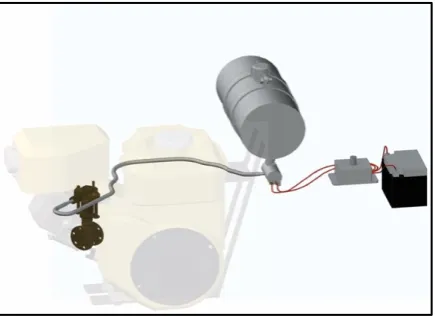
The design of a variable-feed hydrous-bioethanol fuel injector (VFHBFI) was carried out aimed at providing farmers a technology that can enable them to immediately change the rate of feeding of hydrous bioethanol fuel into the en-gine not needing for them to get closer to the enen-gine to turn the knob of the in-jector in order to reduce or to increase the feeding rate of fuel into the engine. The option of providing the injector with a pump to facilitate control of the rate of feeding of fuel was considered in this design. Since the rate of feeding of fuel into the injector is regulated by means of a pump, the rate of pumping is then controlled by regulating the amperage requirement of the pump with the use of a PWM switch. A fuel injector commonly used in diesel engine was used to inject hydrous bioethanol in a regulated manner as controlled by the pumping rate. After the set-up (Figure 1) was built, the different components of the fuel feed system were installed into the retrofitted engine previously adopted in the study (Belonio, et al., 2016) [4].
The rate of feeding the hydrous bioethanol was tested by varying the input current of the PWM switch. During the tests, the volume of hydrous bioethanol fed at a given setting was measured using a 100 liter-capacity graduated cylinder for a given time duration. The rate of feeding was plotted in a graph against the current input to show the relationship between the two variables.
[image:6.595.266.484.537.695.2]Two applications of the VFHBFI were tested during the conduct of the study, such as that in 1) Micro-Tiller and 2) Power-Tiller-Operated Hauler, to deter-mine whether the set-up will work well as an alternative over the previous fuel feeding mechanism. In micro-tiller, the fuel feeding mechanism was installed on the machine enabling the operator to change the rate of feeding of fuel imme-diately not needing for him to get closer to the engine to adjust the fuel feeding
DOI: 10.4236/oalib.1105164 7 Open Access Library Journal device. The same set up was also adopted for the power-tiller-operated hauler not requiring the farmer to put the tiller into a halt and change the rate of feed-ing of fuel.
Performance testing and evaluation of the VFBHFI was carried out at PhilRice Experimental Farm in operating the micro-tiller in tilling the field in three passes. After each pass, the field was allowed to stay for 5 days to allow the weeds to decompose before the next pass. In testing the VFBHFI in running a pow-er-tiller-operated hauler, the hauler was loaded with bags of fertilizer to a certain weight and the amount of hydrous bioethanol fuel and the distance traveled by the machine were measured during the tests. Several runs were made to deter-mine the fuel consumption rate per unit distance travelled by the machine.
4. Results and Discussions
4.1. Design of Fuel Feeding Device
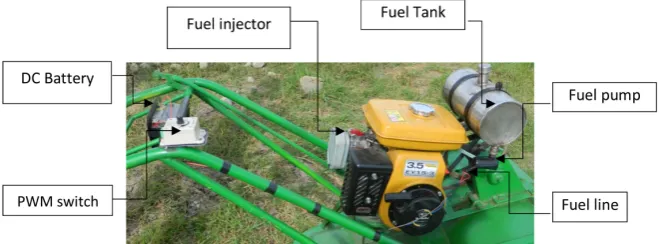
The complete set-up of the VFHBFI is shown in Figure 2. As shown, the device consists of the following components: 1) Fuel Tank; 2) DC Pump; 3) Fuel Line; 4) PWM Switch; 5) Battery; and 6) Fuel Injector. The fuel tank is made of a stainless-steel cylinder having a capacity of 2 liters at full load.
[image:7.595.209.539.570.692.2]The top of the tank has a treaded nipple and a cap where hydrous bioethanol is fed during operation. At the bottom end of the tank is an outlet nipple where fuel exits. Attached to it is a DC pump operating on a 12-volt, 4-amp line. The pump is a diaphragm-type pump commonly used in feeding gasoline fuel. It is powered by a 12-volt, 16-amp-hour battery and is controlled by a 12-volt, 0.8-amp PWM switch. The rate of pumping and of feeding of fuel into the in-jector is controlled by the PWM switch. Turning the PWM switch knob to the right increases the pumping rate which consequently increases the feeding of fuel into the fuel injector. The fuel is fed into the fuel injector through a plastic hose. The fuel injector permits the feeding of hydrous bioethanol fuel into the intake manifold of the engine. The rate of feeding of fuel into the intake mani-fold by the fuel injector is affected by the rate of pumping of fuel. The location of the pump and of the injector is quite far from each other but both are situated near the engine. On the other hand, the battery and the PWM switch are adjacent
DOI: 10.4236/oalib.1105164 8 Open Access Library Journal to each other and they are attached to the machine handle so the farmer can eas-ily control the rate of feeding of fuel during operation. With this set up, there is no need for the farmer to move closer to the engine to stop it or decelerate its speed.
[image:8.595.266.481.521.690.2]4.2. Fuel Feeding Rate and Current Input
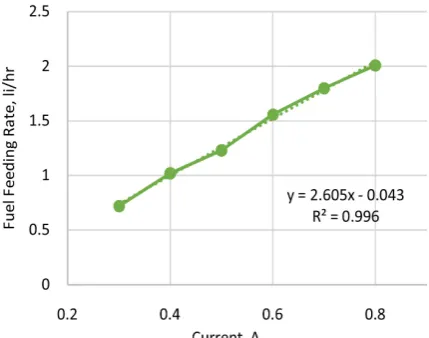
Figure 3 shows the relationship between the fuel feeding rate and the current
input of the PWM switch. It shows that there is a linear relationship between the two variables—i.e. as the current input increases, the fuel feeding rate also in-creases. During the tests, moreover, a smooth engine speed was observed only at 0.6 to 0.7 ampere current input. This can be attributed to the supply of fuel in which at lower current input less amount of fuel is supplied providing not enough power to propel the engine to the required speed. At higher current in-put, however, there is over supply of fuel causing the engine to lose power due to lower air-to-fuel ratio. The required air-to-fuel ratio is attained at mid range of current input thereby resulting in a smooth engine speed. The equation of the line using the regression equation gave a relationship between the fuel feeding rate (Y) and the current input (X) of Y = 2.6057x − 0.0431 with R2 equal to 0.99615.
4.3. Engine Performance in Operating Rice Machines
The performance of the retrofitted engine with the VFHBFI was tested using micro-tiller and power-tiller-operated hauler, shown in Figure 4. Testing of en-gine performance in operating both machines was conducted at PhilRice Expe-rimental area during the dry cropping season of 2016-2017. In micro-tilling op-eration, a 1500 m2 farm was tilled in 3 passes to determine whether the retrofit-ted engine with the VFHBFI can operate the micro-tiller in tilling the field. Re-sults show that an average of 2.0 liters of hydrous bioethanol is consumed in til-ling the fieldper hour. When gasoline fuel is used, on the other hand, the average
DOI: 10.4236/oalib.1105164 9 Open Access Library Journal
Figure 4. The two machines evaluated using the VFHBFI: 1) Micro-Tiller, and 2) Pow-er-Tiller-Operated Hauler.
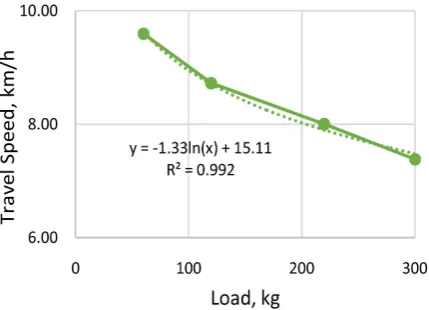
consumption is only 1 liter per hour. This indicates that the consumption for hydrous bioethanol is double than that for gasoline in operating the machine in performing the same task. The higher consumption for hydrous bioethanol (95% alcohol) was expected due to its lower heating value, which is 25.60 MJ/kg, compared with that of gasoline, which is 43.45 MJ/kg. In providing power to drive the power-tiller-operated hauler, it was found out that the hauler can be operated using the VFHBFI. It was observed, moreover, that there was a de-crease in the travel speed of the machine with the inde-crease in load. Figure 5
shows the relationship between the travel speed and the weight of load of the hauler. As shown, the travel speed as a function of the load can be predicted by the regression equation, y = −1.338ln(x) + 15.111 with R2 = 0.99207. On the av-erage, the retrofitted engine consumes 3.9 liters of hydrous bioethanol for travel-ling a total distance of 6.4 kilometers on a rough road, giving an average com-puted alcohol consumption of 1.6 liter per km distance.
4.4. Socio-Economic Advantage
Since the use of hydrous bioethanol as fuel is not yet popular to date, the farmers can make use of the technology by producing the fuel by himself from the avail-able resources in his farm. He can use the fuel he produced for his farm ma-chines or sell it to benefit his neighboring farmers. He can also sell his excess al-cohol for industrial as well as for medical uses. As reported by Belonio, et al. (2016) [4], one person can harvest nipa from 150 trees in one day.
At a nipa yield of 0.75 liter per tree (Table 1), approximately 112.5 liters of nipa sap is available per day. At 10% hydrous bioethanol that can be extracted after the sap is fermented, 11.25 liters is available for use as fuel. The farmer can use portion of the hydrous bioethanol that he can produce for his farm machines and sell the remaining to neighboring farmers. At a distilling cost of PHP37.7 per liter and with the current price of gasoline of P45.00 per liter, the farmer can save around P7.30 per liter from using the hydrous bioethanol over the use of gasoline.
DOI: 10.4236/oalib.1105164 10 Open Access Library Journal
Figure 5. Effect of load on the forward speed of the ma-chine.
Table 1. Nipa production and cost.
Yield per tree of nipa 0.75 liter
Number of trees a person can harvest per day 150 trees Amount of nipa sap that can be harvested per person-day 112.5 liters
Percentage production of hydrous bioethanol 10% Expected hydrous bioethanol that can be produced 11.25 liters
Cost of distilling fermented nipa sap P37.70 per liter
per unit cost of distilling would be further dropped providing him more advan-tage in terms of cost to produce the fuel. By doing this, farmers can minimize getting drunk all the times instead make his day fruitful in doing his farming and household tasks.
5. Conclusions and Recommendations
The use of hydrous bioethanol as fuel is again successfully demonstrated for po-wering rice machines. The VFHBFI works well for the two rice machines tested in controlling the rate of feeding of fuel allowing the farmer to regulate the speed of the machine in real-time operation. Farmers need not get close to the engine to stop the operation but just turn the switch either to stop or to slow down the operation. Smooth engine speed can be maintained by setting the current input of the PWM switch within the range of 0.6 to 0.7 ampere. The use of hydrous bioethanol as fuel for the engine is more advantageous if farmers will produce the fuel by themselves using the available resources in their farm, like nipa. Fur-ther improvements need to be done on the VFHBFI to make it operate beyond the present range of the PWM switch current input.
Conflicts of Interest
[image:10.595.213.539.287.394.2]DOI: 10.4236/oalib.1105164 11 Open Access Library Journal
References
[1] PhilRice (2014) Farming without Fossil Energy. National Rice R&D Highlights. Phi-lippine Rice Research Institute, Science City of Munoz, 52.
[2] Alekllet, K. (2012) Peeking at Peak Oil. Springer Science, New York, 325 p. [3] Rasco Jr., E.T. (2011) The Nypa Palm. Nature’s Gift from the Age of the Dinosaurs.
National Academy of Science and Technology, Manila, 156.
[4] Regalado, M.J.C., Belonio, A.T., Rafael, M.L., Villota, K.C., Castillo, P.R. and Gage-lonia, E.C. (2017) Design, Testing, and Evaluation of Hydrous Bioethanol Distiller for the Production of Fuel-Grade Alcohol from Nipa Sap (Nypa fruticans). 2017
Annual International Meeting of the American Society of Agricultural and Biologi-cal Engineers, Spokane, Washington, USA, 16-19 July 2017, 9 p.
[5] Freudenberge, R. (2009) A Guide to Small-Scale Ethanol Alcohol Fuel. Making and Using Ethanol as Renewable Energy Fuel. New Society Publishers, 257.
[6] Madson, P.W. (2003) Ethanol Distillation: The Fundamentals. The Alcohol Text-book 4th Edition, Nottingham University Press, Nottingham, 446 p.
[7] Dennovan, B.J. (2009) Anhydrous Ethanol vs Hydrous Ethanol in Gasoline Blend-ing. Filed to Pump. 3 p.
[8] Northrop, W. (2014) High Efficiency Enabled by Hydrous Ethanol Use in Dual-Fuel Engines. Agricultural Utilization Research Institute, University of Minneso-ta/Minnesota Corn, 12 p.
[9] Tartakovsky, L., Baibikov, V. and Veinblat, M. (2013) Comparative Performance Analysis of SI Engine Fed by Ethanol and Methanol Reforming Products. SAE In-ternational, Troy, 13 p.
[10] Bradley, C. and Runnion, K. (1984) Understanding Ethanol Fuel: Production and Use. VITA, Arlington.
[11] Rutz, D. and Janssen, R. (2007) Biofuel Technology Handbook. WIP Renewable Energies, Munchen, 149 p.
[12] Nilaphai, O., Chuepeng, S., Thongchai, S., Suebwong, A. and Tongroon, M. (2016) Preliminary Study of Hydrous Ethanol as Fuel for a Spark Ignition Engine on Per-formance and Combustion. The Journal of Industrial Technology, 12, 27-36. [13] Curran, S. (2006) Retrofit of a Briggs & Stratton Small Engine to Run E85.
Pro-ceedings of the National Conference on Undergraduate Research, Asheville, 6-8 April 2006, 8 p.
[14] Costa, R.C. and Sodre, J.R. (2010) Hydrous Ethanol vs. Gasoline-Ethanol Blend: Engine Performance and Emissions. Fuel, 89, 287-293.
https://doi.org/10.1016/j.fuel.2009.06.017
[15] Li, G., Zhang, Z., Fubing, Y., Pan, Z., Zhang, X., Dong, J. and Gao, X. (2013) A Novel Strategy for Hydrous-Ethanol Utilization: Demonstration of a Spark Ignition Engine Fueled with Hydrogen-Rich Fuel from an on Board Ethanol/Steam Refor-mer. International Journal of Hydrogen Energy, 38, 5936-5948.
https://doi.org/10.1016/j.ijhydene.2013.03.008
[16] Belonio, A.T., Regalado, M.J.C., Tado, N.M.C. and Sicat, E.V. (2014) Development of a Hydrous Ethanol Fuel Feeding Device for Spark-Ignition Engine. Journal of Technology Innovation in Renewable Energy, 3, 159-165.