doi:10.4236/eng.2011.310129 Published Online October 2011 (http://www.SciRP.org/journal/eng)
Industrial X-Ray Image Enhancement Algorithm Based on
AH and MSR
Wei Jie1, Dada Wang1, Yanwei Wang2, Jin Li2, Lei Wang2, Hong Liang2
1
Yunnan Power Grid Corp., Kunming, China, 2
Automation College, Harbin Engineering University, Harbin, China,
E-mail: xianxinyue@163.com
Received August 3, 2011; revised August 22, 2011; accepted September 1, 2011
Abstract
An X-ray image enhancement algorithm based on AH (adaptive histogram) and MSR (Multi-scale Retinex) algorithm is proposed in this paper for the industrial X-ray image, which contrast is low, and the detail fea-tures is poor. Firstly, the contrast limited adaptive histogram equalization and neighborhood algorithm is used for the image. Then the mapping is built between the image and the detail scales by the enhance func- tion ratio rules, which is adjusted by the local contracting information. Finally, according the enhance func- tion radios, the reconstructed image is rebuild. Compared with other image enhancement algorithms, expe- rimental results show that our algorithm can improve the global image effectively, moreover it overcomes the visible artifacts of X-ray image. Therefore, the x-ray image becomes clearer, and a better perceptual im- age is acquired for the image feature recognizing and matching.
Keywords:X-Ray, MSR, Adaptive, Image Enhancement
1. Introduction
The valid method to enhance X-ray image is histogram enhancement. The histogram of industry X-ray in a small filed, most of pixels in the low frequency areas, and there are hardly few pixels in high frequency areas, Even the industry X-ray image is an image seems like the black image. Therefore, it is need a method to image enhance- ment. Recently, many people researcher on this field. Shu Yang and Cairong Wang proposed an image en- hancement algorithm based on multi-scale morphological reconstruction [1]. Stephane G. Mallat researches the theory for multi-resolution signal decomposition [2]. Pizer S. M. proposed adaptive histogram equalization and its variations [3]. Tang Jinshan adopted a direct im- age contrast enhancement algorithm in the wavelet do- main for screening mammograms [4]. Wang Xiu-bi [5] refers to image enhancement based on lifting wavelet transform [6]. Jinshan Tang and Qingling Sun used con- trast measure in the wavelet domain for screening mammograms image enhancement algorithm. In this paper, we will investigate image-enhancement techno- logy based on adaptive histogram and wavelet.
2. Limited Contrast AHE
2.1. Histogram Enhancement Theory
Histogram enhancement, the advantages of high speed and better effect, wildly applied in X-Ray processing. Histogram is the function of gray levels, which denotes the gray level of every pixel. Therefore, the contrast ra- dio will be improved by gray nonlinear transform to ad- just the accumulation function, and the gray in small range will be transform in the whole filed.
Image histogram is an important tool to analysis image gray distribution, which is a summary graph showing a count of the data points failing in the data. Therefore, histogram is defined as follows.
k kn p r
n
(1)
which n is the total pixels of X-ray image, is the gray level of corresponding pixels.
k
n rk
W. JIE ET AL. 1041
togram of original image. The processed image with equal gray scale in the same gray level, at the same time, the maximum entropy is acquire, it means that the image information is abundant.
Hypothesis that the gray transfer function is s f r
, which slope is the limited non-minus continuum decline function, it can transform input image A x y
, to out- put image B x y
,
, the HA
r
is the histogram ofinput image, and HB
r is the histogram of outputimage. According the definition of the histogram, the original image histogram and processed histogram areas are equal:
B A
H s dsH r dr (2)
The relationship between HA
r and HB
r is thefollowing:
1
1
A A
B
H f s H r
H s
ds dr f f s
(3)
where
0
m A
R
f r H
A
r
2.2. AHE Algorithm
Compared with the whole histogram equalization, the
2.3. Limited Contrast AHE Algorithm
AHE algorithm improve the image contrast, at the same
tep of AHE algorithm is input image is constant. After transformed,
every pixel of the image is tensile to extend the image gray level areas, and the vision effect is improved.
adaptive histogram enhancement (AHE) has the advan- tage of good local contrast. But the AHE algorithm will commute the local histogram and accumulation distrib- uting function of every pixels, it is extremely computa- tional intensive. Besides, the AHE algorithm is sensitive for noises, which is liable to bad enhancement for local area.
time magnified the noise. Even the enhancement will lead to image distortion in some detail area, which lead to noise amplification and distortion, that affects the im- age diagnose.
The first s
,A x y block. And the local histogram in every block. limit contrast function to AHE in every block to Thus
ge
d to preliminary adjustment before the image bl
it is need to bilinear in- te
ear interpolation processing,
nerate transform function respectively. Then the adap- tive bilinear interpolation used to joint output image
,B x y . ee It is n
[image:2.595.312.536.525.608.2]ock, Definite the limit function to limit the gray level probability density, and adjust the exceed histogram, Figure 1 shows the processing.
To decrease the block effect,
[image:2.595.360.487.650.703.2]rpolation.The block gray value is the gray transform function of adjacent pixels.
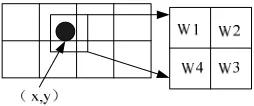
Figure 2 depicts the bilin
x y, is the center of the sub image, compute the ar- le in adjacent areas, the value is the following:4
eas sca
, 1, i i x y
i
g x y W T r
(4)
x y,Ti r is the gray transform function, r x y, is the gray value of pixel
x y, . This image en ement algorithm based on h ram,hanc istog independent with the pixel position.
3. X-Ray Image Enhancement Algorithm
Multiple Scale Retinex algorithm used to industrial X-
Based on Adaptive Histogram and MSR
ray enhancement, if I x y
, is the environment bright- ness function, which reflects light intensity, R x y
, is the reflected function, which means the variet ray absorption the ratio of every part of elements,y of
X-
,I x y determines the dramatic range of X-ray image. Th , MSR algorithm usually used in X-ray enhancement to ensure the best DR (dramatic range) and the contrast is enlightening.
erefore
3.1. MSR Principle
It is well known that the X-ray is the gray scale image,
(5)
which the parameter is the number of the environ- the MSR is following.
k
1
, i(log , log i , * ,
i
R x y w I x y F x y I x y
k
ment functions, Fi represents environment function,
(a) (b)
Figure 1. Limited function chart. (a) Original gray chart, (b) adjusted gray chart.
and Wi is the weight function. The different standard io
deviat n of normal is selected by the Fi function
to control the scale r ge of the environme function, the parameter i
an nt
F with the large, middle and small scales. And the weight is basis for dramatic range and color sense [7].
3.2. X-Ray Image Enhancement Algorithm
The main idea of adaptive histogram and MSR is adjust
put image is blocked into sub images, then we ad
Based on Adaptive Histogram and MSR
the original image histogram, then bilinear difference is used to rebuild, and the gray scale vale and position in- formation is recorded. After coordinate transformation, the image is divided three sub images in three scale, the MSR enhancement will modify the amplify ratio, at the same time, the image will be a better dramatic range and effects.
The in
just the gray value, the original limited function is 0.001, and the image is divided into three scales. Most of image information are in low contrast area, the ratio is acquired by the Equation (6), and the transform ratio will be acquired. According to the CLAHE algorithm,
B
equalization every sub images, computed every the global MSE, the result is used to adjust limit function.
0.11447 5
3.97156 4014544 1 0.26891 5 2.5 0.98711 0.96330 2.5
q (6)
The Gauss transform ratio is acquired by the Eq
i
(7)
The final transform ratio B is the following.
i b uation (7).
2 3 2 3 2 3 31.5782 2.444 1.428 0.422 0
2.44413 2.85619 1.2661 1
1.4281 1.2661 2
0.422205 3 i
q q q i
q q q i
b
q q i
q
1B b1 b2 b3 b0 (8)
which the weight ratio is acquired by the Equation (9), the Equations (8) and (9) is built the relationship between the input and output images.
3
0 1
i i
w n Bin n b w n i b
(9)We will get three Gauss ratios in three scales, the im- age convolution in every scale, the Gauss filter is recur- sive, the input and output images will be acquired by the forward and the backward filter, at the same time, the relationship of the input data in n
and out put out n
is illustration in the Equation (10).
3
0 1
i
out n Bw n biout n i b
(10)Equation (8) is the weight mean of every scale, the w
4. Experiments and Conclusions
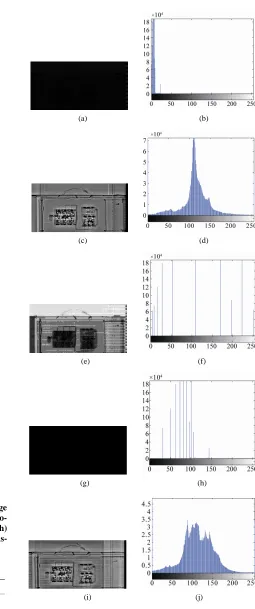
Figure 3 is the picture of CJ10-40 AC contractor, which
can see th
the Figure 3(g), we see that the gray field is en
picts the relationships between the time and th
ture of JQX-10F3Z AC contractor, w
of MSE and times of dif- fe
5. Conclusions
Industrial X-ray widely applied in nondestructive test- eight is 1/3, the output image will be acquire through the Equations (9) and (10).
size is 2816*300 pixels, CJ10-40 AC contractor has an important role in power system, so it is meaningful to enhance X-ray image in non-contract detection.
Figure 3(a) is the original input image, we
at the contrast is very low that it is hardly to see any- thing in the Figure 3(a). Figure 3(c) is the MSR results, the processing time is 15.9787 s. The enhancement is poor, the processing image also with low contrast, and hardly to recognize in background. Figure 3(e) is the HE adjust enhancement results, the image contrast is en- hanced slightly. Figure 3(g) is the ALE algorithm re- sults.
From
larged in different field. But the back ground of the Figure 3(g) is complied mixed with noises. Figure 3(j) is the algorithm results. The elapse time 4.68264 s. the image contrast is enhanced. Figure 3(i) is our method, we see that the gray field is enlarged. From the results, we can conclusion that our algorithm can improved the global contrast, at the same time, it is obviously that im- age enhanced between the detected element and back- ground.
Table 1 de
e MSE of test CJ10-40 X ray image, from the Table 1, we will see that our method is better in MSE and time than other methods.
Figure 4 is the pic
hich size is2816*1000 pixels, JQX-10F3Z contractor also has an important role in power system, Figure 4 is the processing of the test 2nd. The 2nd test is the element with complex inner structure.
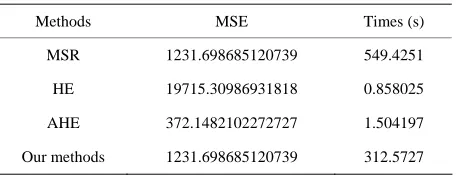
Table 2 describes the value
rent methods. Compared with the different methods in the list, our method has a better result in MSE and the processing time is acceptable.
W. JIE ET AL. 1043
(a) (b)
(c) (d)
(e) (f)
(g) (h)
[image:4.595.280.535.69.678.2]
(i) (j)
Figure 3. The Input image
Table 1. The time and MSE of test 1st image.
M s)
processing of test 1st image.(a)
of X-ray, (b) histogram, (c) MSR image, (d) MSR histo- gram, (e) HE image, (f) HE histogram, (g) AHE image, (h) AHE histogram, (i) our method, (j) corresponding his- togram.
ethods MSE Times (
MSR
(a) (b)
(c) (d)
(e) (f)
(g) (h)
2545.764727815063 15.9787
HE 18636.35103338068 1.009322
AHE 442.8181107954545 1.316437
[image:4.595.66.278.88.562.2](i) (j)
Figure 4. The Input image
processing of test 2nd image. (a)
of X-ray, (b) histogram, (c) MSR image, (d) MSR histo- gram, (e) HE image, (f) HE histogram, (g) AHE image, (h) AHE histogram, (i) our method, (j) our method histogram.
[image:4.595.60.284.647.720.2]Table 2. The time and MSE of test 2nd image.
Methods MSE Times (s)
MSR 1231.698685120739 549.4251
HE 19715.30986931818 0.858025
AHE 372.1482102272727 1.504197
Our methods 1231.698685120739 312.5727
mited adapti
e Yunnan power institute of
ang and L. G. Deng, “A New Approach of li
in
ve histogram equalization algorithm is used the first step. We set the initial limit coefficient of limit function then building a map between the image and the detail scales by the wavelet ratio, which is adjusted by the local contracting information. According the enhance function radios, the reconstruct image is rebuild.
Compared with other image enhancement algorithms, experimental results show that our algorithm can im- prove the global image contrast effectively, moreover, restrain the background and enhance the contrast between the background and the detection element. Processed image, with more details information and better vision, benefits to further identify and recognize.
6. Acknowledgements
The paper is supported by th
the Yunnan power test institute (group) Ltd.
7. References
[1] S. Yang, C. W
Image Enhancement Based on Multi-Scale Morphological Reconstruction,” 9th International Conference on Hybrid Intelligent Systems, Shenyang, 12-14 August 2009, pp. 113-116. doi:10.1109/HIS.2009.30
[2] S. G. Mallat, “A Theory for Multiresolution Signal De- composition: The Wavelet Representation,” IEEE Trans- actions on Pattern Analysis and Machine Intelligence, Vol. 2, No. 7, 1989, pp. 674-693.
doi:10.1109/34.192463
[3] S. M. Pizer and E. P. Ambtrrn, “Adaptive Histogram Equalization and Its Variations,” Computer Vision Gra- phics & Image Processing, Vol. 39, No. 3, 1987, pp. 355-368. doi:10.1016/S0734-189X(87)80186-X
[4] J. S. Tang, X. M. Liu and Q, L. Sun, “A Direct Image
ng
n and K. Agyepong, “An Image En-Contrast Enhancement Algorithm in the Wavelet Domain for Screening Mammograms,” IEEE Journal of Selected Topics in Signal Processing, Vol. 3, No. 1, 2009, p. 1. [5] X.-B. Wang, “Image Enhancement Based on Lifti
Wavelet Transform,” 4th International Conference on Computer Science & Education, Xiamen, 25-28 July 2009, pp. 739-741.
[6] J. S. Tang, Q. L. Su
hancement Algorithm Based on a Contrast Measure in the Wavelet Domain for Screening Mammograms,” IEEE International Conference on Image Processing, San An-tonio, 16-19 September 2007, pp. 74-80.
doi:10.1109/ICIP.2007.4379757
[7] J. M. Morel, A. B. Petro and C. A. Sbert, “PDE
010.2049239
Formalization of Retinex Theory,” IEEE Transac-tions on Image Processing, Vol. 19, No. 11, 2010, pp. 2825-2837.