29 AUGUST 2011
MASTER'S THESIS
NETWORK MANAGEMENT
IN A DISTRIBUTED SYSTEM
Maurits David de Jong
HUMAN MEDIA INTERACTION
FACULTY OF ELECTRICAL ENGINEERING, MATHEMATICS AND COMPUTER SCIENCE
EXAMINATION COMMITTEE dr.Job Zwiers
ir.Pierre G. Jansen
ing.Niels A.G.W. Kortstee
Network Management in a Distributed System
v1.3.9Maurits D. de Jong
EEMCS, Human Media Interaction
University of Twente
A thesis submitted for the degree of
Master of Science Human Media Interaction
We approve the master’s thesis ofMaurits D. de Jong.
Date of Signature
dr.Job Zwiers
Associate Professor of Human Media Interaction (HMI) esis Supervisor
Chair of Committee
ir.Pierre G. Jansenretired
Associate Professor of Computer Architecture for Embedded Systems (CAES) esis Co-Supervisor
ing.Niels A.G.W. Kortstee esis Co-Supervisor
Acknowledgements
During my work on this thesis I have experienced a lot of support from many directions, for which I’m very grateful. e coaching and critique I have received from my supervisors, both at theUniversity of Twenteand at
PrismTech Netherlands, have helped me achieve more than I would have achieved without them. e team in general atPrismTech Netherlandswas always helpful and also supported me with both technical and non-techni-cal issues.
Besides the support from my professional environment, I would like to ac-knowledge two persons especially. First and most of all: my loving wife, Eline, who has supported me in every way possible. She has been an amaz-ing help, listener and motivator. Her patience with me and the graduation process has been incredible. Secondly my father, Marcel, who has helped me forward with his brilliant technical insights; the resulting sparring we could do on technical subjects and ideas, motivational support and pulling me out of the mud when stuck in textual formulations, have greatly helped me with completing this thesis.
Abstract
When managing large scale Data Distribution Service ()systems, the information requests of system-managing experts vary widely. A monitor-ing system is indispensable and must be either very extensive — which is unfeasible — or it must be simply extendible. e goal of such a system is to facilitate the experts’ need for information by providing a straightfor-ward and exible solution, without introducing high hurdles to be cleared in order to use it. Basic monitoring and diagnostic features must thus be available, providing a friendly basis for evolution of the system and guaran-teeing immediate usability of the solution.
A new concept is introduced, dubbedDelegated Monitoring, describing a framework that suits theenvironment naturally. It solves many of the issues encountered in traditional network management solutions by using the facilities of itself. e primarily in-band solution can even sup-port (fully) autonomous monitoring and/or (fully) autonomous manage-ment solutions. e framework doesn’t require an on-line central entity to de ne what is monitored and where it is monitored.
By distributing the management routines as well as the commands control-ling them through, the delegated monitoring concept provides a (fully) distributed cooperative framework that enables the required high exibil-ity.
e monitoring framework requires a strict de nition of the domain se-mantics with regard to low level monitoring primitives, allowing for a uni-form interpretation of these primitives. Understanding them well is partic-ularly needed in diverse highly integratedsystems and helps to make such systems diagnosable.
Preface
As a newcomer in the world of, I soon ran into the limitations of the currently available diagnostic tools. It appeared that the need for improve-ment was widely felt. Not surprisingly, time to research and develop a more useful tool or generic solution was really scarce. It was from the initial dis-cussions on the topic that the subject for this thesis emerged, where the set-ting of a graduation project could provide for the time to properly research the current solutions and the possibility to come up with a new design or concept that would allow for an integral improvement of the diagnosability of thesystem.
Working on it proved to be not only an insight increasing activity, but also a potentially essential contribution to the development of better diagnos-tic tools forsystems. In particular a fully distributed implementation of thestandard, such as OpenSplice ™, can bene t greatly from a monitoring and management approach that is also capable of being applied in a fully distributed manner.
I enjoyed exploring and working creatively in this highly specialised do-main, where oen seemingly incompatible requirements meet (and have to be met). Microseconds matter, yet still discussions take place at a level of abstraction that is not expected when worrying about microseconds. I have started to appreciate the underlying concepts and the proven applica-bility of the paradigm and therefore fully hope that my contribution may one day nd it’s way into the domain.
X
M J Enschede, e Netherlands August
Typographical Conventions
e type styles shown below are used in this document to distinguish pro-gramming statements or standards de ned entities from ordinary English. ese conventions are not used in tables or section headings where no dis-tinction is necessary.
Adobe Minion Pro — Standard body text.
Adobe M inion P ro Italic— Formulae and/or calculations.
Thesis Mix Mono— programming statements or standards de ned
enti-ties.
Pluralisation Normal plural forms of entities (either programming or standards de ned) are used for readability. e suffix will be formatted as standard body text. For example the plural of Publisherwill become
Publishers, the possessive form Publisher’s and the plural possessive
formPublishers’. Just so, the plural of Classwill be written asClasses.
e name of an entity will however never be modi ed for proper pluralisa-tion. In cases where that would otherwise be necessary, the suffix -’s will be used. e plural of Policywill thus be written asPolicy’s instead of
Policies.
Contents
Contents v
List of Figures ix
List of Tables xi
Acronyms xii
Glossary xvii
Introduction
. Network Management . . .
. Delegated Network Management . . .
. Visualisation . . .
. Data Distribution Service . . .
. OpenSplice ™ . . .
. Optimisation and Maintenance . . .
. Organisation . . .
. Research Questions . . .
. Structure of this esis . . .
Data Distribution Service
. Publish/Subscribe . . .
.. Filtering . . .
.. Advantages/disadvantages . . .
. O’s D-Speci cation . . .
Contents
.. D Model . . .
... Overview . . .
... Conceptual Model . . .
... Instances . . .
. S . . .
.. Indices . . .
.. Re nements and Extensions . . .
. OpenSplice ™ . . .
.. Architecture . . .
.. Services . . .
.. Design . . .
... Shared Memory . . .
... Hot-Swap Support . . .
... Time Decoupling . . .
... Singleton Communication . . .
... Information Priority . . .
... Information Urgency . . .
... Network Partitioning . . .
.. OpenSplice ™ Management . . .
. S as a System Design Approach . . .
. Conclusion . . .
Network Management
. Introduction . . .
. Challenges . . .
.. Relevance . . .
. Network Management in D . . .
.. Tasks . . .
.. Network Management Architectures . . .
... Platform-Centred Architectures . . .
... Decentralised Architectures . . .
... Cooperative Architectures . . .
.. Distributed Monitoring . . .
Contents
... Compression . . .
... Delegation . . .
... Metrics . . .
. Conclusion . . .
Visualisation
. Introduction to Visualisation . . .
.. Data Visualisation . . .
.. Scienti c Visualisation . . .
.. Information Visualisation . . .
. Insight . . .
.. Insight Characteristics . . .
.. Gaining Insight . . .
. Visualising Data ow . . .
.. Topology . . .
.. Data ow Analysis . . .
... Basic Data ow Example . . .
.. Data ow Highlighting and Selection . . .
. Conclusion . . .
Design
. Introduction . . .
. Global Design . . .
.. Architecture . . .
.. Platform Abstraction . . .
... Abstraction Set . . .
.. Delegation . . .
... Delegation Agent . . .
... Delegation Runtime . . .
.. Distributed Monitoring: Two Examples . . .
... C-loadDelegationRuntime . . .
... ProcessListDelegationRuntime . . .
. Conclusion . . .
Contents
Conclusions
. Findings to Research Questions . . .
.. Findings to Research QuestionII . . .
.. Findings to Research questionIII . . .
... Findings to Sub-Research QuestionIII.a . . .
... Findings to Sub-Research QuestionIII.b . . .
... Findings to Sub-Research QuestionIII.c . . .
.. Findings to Research QuestionIV . . .
.. Findings to Research QuestionV . . .
.. Findings to Research QuestionI . . .
. Recommendations for Further Research . . .
.. Logical Network Visualisation . . .
.. Visualisation Evaluation . . .
.. Security . . .
References
A I Speci cations A-
A. Platform Abstraction . . . A-
A. Delegation Module Pseudo- . . . A-
B D Speci cation B-
B. QoS-policies . . . B-
List of Figures
. Dconceptual model . . .
. Entity model . . .
. OpenSplice ™ shared memory architecture . . .
. Example data ow visualisations . . .
(a) Data ow without edge-bundling . . .
(b) Data ow with edge-bundling . . .
. Data ow graphs . . .
(a) With fourDomainParticipants . . .
(b) With two nodes . . .
. Dynamic monitoring by delegation . . .
(a) Overview . . .
(b) DelegationAgentdetail . . .
. ree faces of a perforated cube . . .
(a) Logical face . . .
(b) Process face . . .
(c) Connections face . . .
. Multiple faces of D cube . . .
(a) ree faces combined . . .
(b) Red issue . . .
(c) Blue issue . . .
(d) Multiple similar cubes forming a complex whole . . .
. Multi-faceted body . . .
List of Figures
. Force-directed edge bundlesexample . . .
List of Tables
. Basic data ow example . . .
. Example set of metrics to be abstracted . . .
B. DefaultQoS-policiesfor-entities . . . B-
Acronyms
MB unit symbol for themebibyteas de ned by theInternational Electrotechnical Com-mission(). e binary pre xmebimeans220, therefore mebibyte is
byte. –
RO is the acronym forrequested–offered— indicates a compatibility requirement for requested and offeredquality of service()in thespeci cation.,B-,see
&QS-
is the acronym forapplication programming interface— an interface implemented by a soware program which enables it to interact with other soware.,,,
,A-
is the acronym forapplication virtual machine— an application inside a host op-erating system()supporting a single process.,see also
is the acronym for Common Intermediate Language — the lowest-level human-readable programming language de ned by theCommon Language Infrastructure
(). ,see also
is the acronym forCommon Language Infrastructure — an open speci cation de-scribing the executable code and runtime environment that form the core of the
Microso .NET Frameworkand the free and open source implementationsMono
andPortable.NET.xii,see also
is the acronym forcombat management system.
is the acronym and short name for theObject Management Group(’s)
Com-mon Object Request Broker Architecturestandard, which enables soware
Acronyms
nents written in multiple computer languages and running on multiple comput-ers to work together.xiii,A-
is the acronym forcentral processing unit— the portion of a computer system that carries out the instructions of a computer program. ,,,,,,,–,
–,
is the acronym fordatabase management system— a set of programs that con-trols the creation, maintenance, and use of a database. ,
is the acronym fordata centric publish subscribe— a publish/subscribe paradigm that is de ned around the requirement for availability of a speci c piece of data, i.e., the interface between publishers and subscribers is the data itself. It can also refer to the lower level interface speci ed in the-speci cation. ix,xiii,–,
,,
is the acronym for the’sData Distribution Service for Real-time Systems stan-dard, which de nes a publish/subscribe middleware for distributed real-time sys-tems, created by thein response to the need to augmentwith adata centric publish subscribe()speci cation. ii,iii,xi–xiii,–,–,–,,
,,,,–,,,,,,,,,,–,,–,–,,B-
is the acronym for theData Local Reconstruction Layer — an (optional) higher level interface de ned in the-speci cation for simple integration in the appli-cation layer.,,,
is the acronym forforce-directed edge bundles— a self-organising edge-bundling method capable of bundling edges in any graph since it doesn’t require hierarchi-cal input (Holten & Van Wijk,;Holten,). x,,see&
is the acronym and short name of theFree Soware Foundation. xiv
is the acronym forgeometry-based edge bundling — an edge-bundling method that relies on the generation of a control mesh to guide the bundling (Cuiet al.,
).,see&
is the acronym forglobal data space— the concept of a storage or memory that is accessible to multiple interested applications.,,
Acronyms
is the acronym for ahierarchical edge bundles— an edge bundling technique de-veloped byHolten().,see&
is the acronym forInterface Description Language— a speci cation language used to describe a soware component’s interface. ,,A-
is the acronym and short name theInternational Electrotechnical Commission— a non-pro t, non-governmental international standards organization that prepares and publishes international standards for all electrical, electronic and related tech-nologies. xii
is the acronym and short name for theInternet Engineering Task Force— a task force with the mission to make the internet work better by producing high qual-ity, relevant technical documents that in uence the way people design, use, and manage the internet.
is the acronym for the Transmission Control Protocol — a protocol providing the communication of data across packet-switched networks which is part of the in-ternet layerof theInternet Protocol Suite. xv,see alsoTCP/IP
is the acronym for just-in-time compilation — a method to improve the runtime performance of computer programs by compiling (parts of) a program during runtime.
is the acronym forJava™ Virtual Machine— a set of computer soware programs and data structures which use a virtual machine model for the execution of other computer programs and scripts. e model used by aaccepts a form of in-termediate language commonly referred to asJava™bytecode.xiv,xvii,see
is the acronym and short name for theGNU Lesser General Public License— a free soware license published by theFree Soware Foundation().
is the acronym for model driven engineering — a soware development metho-dology which focuses on creating models, or abstractions, more close to some particular domain concepts rather than computing (or algorithmic) concepts. It is meant to increase productivity by maximising compatibility between systems,
Acronyms
simplifying the process of design, and promoting communication between indi-viduals and teams working on the system.
is the acronym for management information base— a virtual database used for managing the entities in a communications network.
is the acronym and short name for theNetwork Management Research Group— a forum for researchers to explore new technologies for the management of the internet.
is the acronym and name for theObject Management Group — a soware con-sortium aimed at setting standards for distributed object-oriented systems, mod-elling (programs, systems and business processes) and model-based standards.
xii,xiii,,,,,
is the acronym forobject-oriented programming— a programming paradigm us-ingobjects— data structures consisting of data elds and methods together with their interactions — to design applications and computer programs. ,
is the acronym forobject-oriented. ,,,
is the acronym foroperating system— soware, consisting of programs and data, that runs on computers, manages computer hardware resources, and provides common services for execution of various application soware.xii,,
is the acronym for peer-to-peer — a computing or networking architecture that partitions tasks of workloads between equally privileged, equipotent participants.
,,
is the acronym forquality of service— a resource reservation control mechanism that provides the ability to provide different priority to different applications, users, or data ows, or to guarantee a certain level of performance to a data ow.
xii,xviii,,,,,,see alsoQS-
is the acronym forSimple Network Management Protocol— an internet-standard protocol for managing devices onInternet Protocol()networks.,
Acronyms
is the acronym for Subscribe Paradigm for the Logical Interconnection of Con-current Engines— a system architecture developed with the goal to simplify the creation and maintainability of complex, distributed, real-time systems.,,
is the acronym forsingle point of failure— a part of a system that, if it fails, will stop the entire system from working. ,,,,
is the acronym for theTransmission Control Protocol— a protocol guaranteeing reliable, ordered delivery that is part of thetransport layerof theInternet Protocol Suite.seeTCP/IP
is the acronym for theUser Datagram Protocol— a protocol providing best-effort delivery which is part of the transport layerof theInternet Protocol Suite. see
UDP/IP
Glossary
C is the name of theC programming language— an imperative (procedural) language and is one of the most widely used general-purpose computer programming lan-guages.
C++ (pronounced: see plus plus) is the name of the C++ programming language — a multi-paradigm general-purpose computer programming language, which is among one of the most popular languages. ,
C (pronounced: see sharp) is the name of the C programming language— a multi-paradigm programming language developed by Microso.
Ethernet is a family of frame-based computer networking technologies for local area networks, standardised asIEEE ..
Java EE stands forJava™ Platform, Enterprise Edition, a standard platform for develop-ing multitier enterprise applications withJava™.
Java™ is a programming language originally developed by Sun Microsystems . Java ap-plications are typically compiled to bytecode which can run on anyJava™ Virtual Machine()regardless of computer architecture.xiv,xvii,,,,
Lingua Franca is abridge languageorworking language— “a language systematically used to communicate between persons not sharing a mother tongue, in partic-ular when it is a third language, distinct from both persons mother tongues” (Wikipedia,a).
Since January , fully acquired byOracle Corporation
Glossary
QoS-policy is a policy de ning — a general concept that is used to specify the behaviour of a service, oen used for aspects like resource reservation control in communication systems.xi,,,–,–,,,–,B-,see also
SOAP is a protocol speci cation for exchanging structured information using Extensi-ble Markup Language (XML). Previously it was known as the acronym forSimple Object Access Protocol, but the acronym was dropped with version . of the spec-i catspec-ion.,
TCP/IP is a set of communication protocols.,see&
UDP/IP is a set of communication protocols.,see&
Chapter
Introduction
e domain of large-scale networked computer systems is largely dominated by client/ server architectures like for example the World Wide Web orJava EE. Distributed par-allel systems are becoming larger and more advanced and in many distributed appli-cation domains the publish/subscribe messaging paradigm has become popular. e paradigm — in contrast to traditional point-to-point models, e.g., client/server — de-couples end-points in time, synchronisation and space. is decoupling makes publish/ subscribe systems potentially highly scalable (Eugsteret al.,, p. ) and it also fa-cilitates dynamic network topologies. Full advantage can be taken of the decoupling by implementing a fully distributed event dispatcher infrastructure, thereby eliminating a
single point of failure()which exists in centralised event dispatcher infrastructures. is can make a publish/subscribe middleware very robust. While many deployed pub-lish/subscribe systems still use a centralised infrastructure, some commercial and aca-demic efforts have led to highly-available publish/subscribe middlewares that use a truly decentralised architecture (Cugolaet al.,, p. ).
e decentralised nature, increasing scale and overall complexity of such distributed systems makes analysis and comprehension of runtime behaviour increasingly complex. In many types of work people nd working with distributed and/or parallel systems (e.g., parallel debuggers or distributed algorithms) difficult (Kraemer & Stasko, , p. ). is is not lastly due to the amount of raw data that oen needs to be analysed (Reedet al.,). Speci cally in a publish/subscribe infrastructure, which on a logical level is inherently connection-less, (system-) aspects like interactions (or lack thereof), data ows and availability, performance and mappings of logical concepts onto physical
Chapter — Introduction
entities are hard to analyse.
.
Network Management
Network management is concerned with system deployment, surveillance of important performance metrics and optimisation of system performance. It requires means to monitor important (performance) metrics and to control the behaviour of both the hardware and the soware resources of the system. A network management framework should apart from that optimally support autonomous optimisation too.
e task of managing large scale systems is oen concerned with vast amounts of data coming from highly complex infrastructure compositions. Since the supporting protocols, the infrastructure itself and sometimes even the topology are not completely understood, it is essential to support network management experts in gaining insight in the system.
Network management tasks that are well supported in traditional network systems are more difficult in more dynamic networks like inpeer-to-peer()networks, ad-hoc networks or the logical network formed by the matched subscriptions of the publish/ subscribe architecture, for example due to the fact that many tasks are very difficult to be performed by a centralised manager. In these dynamic systems the monitored network itself needs to implement part of the network management functionality in a distrib-uted manner, enabling the network to perform distribdistrib-uted ltering and aggregation of monitoring data. is data can then be presented and visualised for human operators in a meaningful and accessible format. For example topological views allowing interactive exploration of non-volume related parameters like unusual traffic and patterns can be provided.
It is thus essential that a network management architecture for a publish/subscribe system supports these monitoring and management primitives. Such a solution can be built by making distributed entities cooperate at some level in order to achieve func-tionality outside entity boundaries. By utilising a cooperative architecture, the need for a centralised management entity is avoided.
Chapter — Introduction
. Delegated Network Management
A new approach to enhance, or better enable, experts capability to monitor and diagnose publish/subscribe systems is proposed. Provisions to dynamically delegate monitoring tasks to all components of the system are designed. is distributed monitoring frame-work allows the management induced netframe-work-load to be effectively reduced while per-taining the good scalability characteristics of the underlying publish/subscribe system. Because the tasks are delegated, processing of monitoring data is done distributedly, also supporting the scalability of the network management framework.
Monitoring behaviour at distributed nodes or groups of nodes and even diagnostic tasks can be tuned to varying and/or evolving needs and desires of the network manag-ing expert because of the dynamic delegation. is tunability is of vital importance as it provides a principal exibility, that will almost certainly prove to be of essential value when expertise in this new way of network managing begins to grow. Although this new approach may prove to be a necessity without which further upscaling of highly reliable and dynamic network systems may be impossible — or at least extremely troublesome — the same approach may prove to be worthwhile also in systems of lesser extent. In fact, there is virtually no reason to live without the attractive characteristics of delegated monitoring even in the smallest of systems.
e proposed network management architecture implements a scalable, fully dis-tributed and extensible monitoring solution, allowing for virtually unlimitedly complex distributed monitoring logic to be deployed, including distributed automatic optimisa-tion algorithms.
.
Visualisation
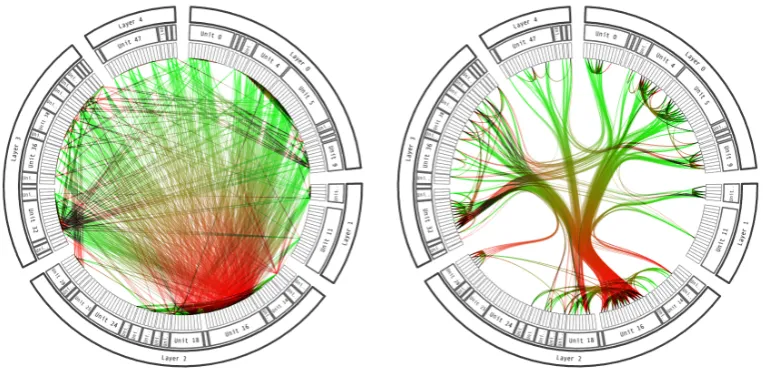
When the monitoring and management primitives are combined with existing or newly developed network management and visualisation tools, a very powerful solution can be created. Analysis can be done on the conceptual publish/subscribe network, where for example the data ows can be used to form an overlay network, even when the true underlying concept is fundamentally connection-less. Visualisation of monitoring data can be used to exploit the remarkable capabilities of the human visual system in iden-tifying trends, patterns and peculiarities in datasets, allowing system exports to gain
Chapter — Introduction
insight in the monitored system.
Allowing a user to interactively select matched subscriptions or lower level network channels will allow the user to gain speci c insights regarding the mapping, connection attributes or connectivity in general.
.
Data Distribution Service
eObject Management Group()— a soware consortium aimed at setting stan-dards for distributedobject-oriented()systems, modelling (programs, systems and business processes) and model-based standards — has de ned a publish/subscribe stan-dard calledData Distribution Service for Real-time Systems , of which the rst version was published on June , . It has been created in response to the need for a stan-dardised data-centric programming model for distributed real-time systems. Many of the concepts of the speci cation originated from a project aimed at simplifying the intricate task of designing large-scale systems with stringent requirements regard-ing robustness, availability, temporal behaviour, performance and maintainability, as described byBoasson().
estandard de nes a data-centric publish/subscribe networking middleware that simpli es complex network programming. It de nes the concept of a logicalglobal data space()containing information expressed by data-units calledTopics that are published /consumed by distributed Publishers /Subscribers. e standard speci es a large range ofquality of service()policies that drive the logical behaviour of data-distribution and availability.
e level of abstraction provided to applications using a middleware, oen makes it difficult to identify faults when they occur. e speci c focus of the standard on performance, the typical stringent requirements on deployed systems and the com-plex interplay of the availableQoS-policiesde ned in it, can make runtime analysis of such systems a daunting task. e rich feature set and global concept underlying the
speci cation enable and stimulate the efficient development of large scale distrib-uted systems as described byBoasson(, chap. ). However, the same extensive set
Data Distribution Service()
e current version of the speci cation is. described indocumentformal/--, which can be obtained fromhttp://www.omg.org/spec/DDS/1.2/PDF/.
Chapter — Introduction
of features and concept are on the other hand a complicating factor in understanding and addressing faulty runtime behaviour.
.
OpenSplice ™
An implementation of thespeci cation — implemented using a truly scalable and decentralised architecture — is OpenSplice ™. e core development of OpenSplice ™ is done atPrismTech Netherlands . OpenSplice ™ is a very high-performance, real-time, data-centric publish/subscribe middleware platform for distributed mission-critical systems. It extends on the standard by allowing for a dynamic and program-matic mapping of logicalentities and their relatedQoS-policies(w.r.t. information urgency and importance, information reliability and persistence) onto the physical (run-time) infrastructure existing of interconnected (sub)systems, hierarchical networks, en-terprise and embedded computing nodes, shared-memory within nodes, multi-thread-ed application processes and pluggable services. PrismTech has an open source edi-tion of their implementaedi-tionOpenSplice ™ Community Edition available since April .
Many large systems with extreme requirements regarding availability, robustness and performance utilise OpenSplice ™ because of its distinctive features with regard to data-centred control, deployment, services, modelling and other facilities it offers to the applications, developers and system designers.
.
Optimisation and Maintenance
e deployment of systems adumbrated above has in practice revealed that optimisa-tion and curing and/or preventing system malfuncoptimisa-tion are daunting tasks that require system experts with overall knowledge of the system. e vast amount of — mostly tex-tual and inherently sequential — data that can aid in resolving issues can be difficult to assimilate. e relation of the metrics to the issue at hand is oen not well de ned ei-ther, complicating the task even more. Typical issues that have to be dealt with involve inappropriate resource allocation, hardware failures and performance de ciencies.
Hengelo (Ov.), e Netherlands
OpenSplice ™ Community Editioncan be downloaded fromhttp://opensplice.org
Chapter — Introduction
Conceptually, tuning of the system can be seen as a multidimensional optimisation problem with complex optimisation criteria. Mankind searches for an optimal state in many areas — for as long as we exist. Optimisation science exists from ancient times and may well be one of the oldest sciences in the world (Neumaier,, p. ) and surely in uences our daily lives. Many optimisation algorithms have been developed over the years (e.g.,Horstet al.,;Weise,). e web page created byNeumaier() is also a good compilation of relevant matter on the subject.
Currently no automatic optimisation is done by OpenSplice ™, so it is interest-ing to determine to what extent optimisation algorithms (either on-line or off-line) can be applied to optimisation of deployed/running OpenSplice ™ systems. It is how-ever anticipated that — even with the currently best possible automatic optimisation — human intervention will be necessary. Not least because large systems sometimes already require tuning in order to ful l preconditions that must be satis ed in order to get OpenSplice ™ started. During this deployment/start-up phase, the system can-not perform on-line optimisations and con guration xes and optimisations thus have to be carried out by system experts.
.
Organisation
e project was performed at PrismTech Netherlands and was supervised by dr. Job Zwiers(associate professor) andir.Pierre G. Jansen(associate professor) on behalf of the
University of Twenteanding.Robert C.G. Poth(chief architect) anding.Niels A.G.W. Kortstee(technical-/team lead) on behalf ofPrismTech Netherlands. Robert Poth and Niels Kortstee both have years of experience in developing mission-critical real-time systems atT Netherlands .
e goal of the graduation project is to analyse the issues encountered with manage-ment of OpenSplice ™ systems and design a solution that aids in- or resolves the encountered issues. Because the solution to this issue touches a lot of different domains of key research, an overview of the domains and their relevance will be given in the respective chapters in order to aid in answering the main questions of the thesis.
BeforeHolland Signaalapparaten B.V.(orSignaalfor short), one of the founding parties of the
-speci cation
Chapter — Introduction
.
Research Questions
is section will introduce the main research questions that will be looked into in this thesis. In the following chapters the context of the questions will be highlighted and answers to the questions will be given. e main research question that is considered in this thesis is:
Research question I
How can human experts be optimally supported with their management tasks in -based systems?
e main question to be answered within this thesis deals with the problem of how expert users of middleware can be assisted in their system-management tasks by making behaviour of the system diagnosable. In this thesis the main focus will be on assisting the users in their tasks. It is however also possible that — at least a subset of — the problems encountered can be autonomously solved by the system by applying auto-matic optimisation algorithms. is also leads to the de nition ofresearch question II:
Research question II
Which network management and visualisation of management data is needed in -based systems?
Visualisation is not a goal in itself, so the relevance of visualisation for network manage-ment related tasks will have to be determined. By nding the types of tasks and areas of network management where the users typically need to be assisted will allow the def-inition of suitable assisting methods. So probably, subsets of tasks will be best assisted by either (semi-)automatic optimisation, visualisation or even rendered obsolete by an autonomous capability of the system. In anticipation that there will be use-cases for which visualisation is useful despite other options like autonomous optimisation, the following questions are de ned.
Research question III
What functionality is needed for management tasks insystems?
Answering this question will give insight in the problems that need to be tackled in order to provide the right data in the right format to the users. Literature research on similar problems like network management in traditional network systems and data-visualisation will also provide valuable information on typical problems/solutions in
Chapter — Introduction
this area. e insight gained by the answer onresearch question IIwill act as input to de ning which functionality will have to be available in order to satisfy the visualisation and information needs for network management in-based systems. is is expected to range from practical functionality like data gathering to abstract functionality like data presentation.
Sub research question III.a
In what areas is the OpenSplice ™ system currently lacking?
e current state of OpenSplice ™ with regard to the functionality as found in the answer toresearch question IIIwill drive which parts of the implementation require fur-ther research. Shortcomings of OpenSplice ™ can be eifur-ther in availability or design of speci c functionality.
Sub research question III.b
How can data be collected in a scalable manner, suiting the environments in which is typically deployed?
e typical nature of the systems in whichis deployed will render an even appar-ently trivial task like data-gathering very difficult. is issue will need to be solved in a way that suits the deployment environment, not yielding too many compromises on the network management capabilities.
Sub research question III.c
Which data and/or metrics are needed for management ofsystems?
If it is possible to identify a type or set of data and metrics that will be needed for network management, de ning them will help in nding existing applicable visualisations or creating new or adapted ones, tailored to thenetwork management needs.
Research question IV
Is visualisation in a network management solution fora luxury or a necessity?
Given the availability of a considerable amount of network management related data, one may question whether it makes a difference to represent these data graphically. is question may be especially valid in the speci c professional area of network man-aging experts. Some of these highly skilled persons have indeed developed a surprising and laudable ability in analysing raw or simply tabulated data. Nonetheless, if the raw
Chapter — Introduction
data are properly transformed to graphics, the analysis may even be performed faster. Although thorough in-depth analysis of raw data related to a graphically localised is-sue may still be necessary, network management experts may still bene t greatly from graphical representations of the data.
Research question V
How can a network management implementation in OpenSplice ™ be designed?
A management solution for OpenSplice ™ will touch a lot of layers of both the prod-uct as well as abstractions of the prodprod-uct. In order to facilitate efficient management, a design will have to be created that satis es all criteria found in this thesis.
.
Structure of this esis
In this chapter the context of the work performed for this thesis has been described. In
chapter (Data Distribution Service) the global concepts underlying the speci
-cation and the speci c implementation thereof in the form of OpenSplice ™ will be described. Inchapter (Network Management) the focus will be on traditional network management systems and how they relate to. Furthermore the areas relevant for a network management solution inwill be discussed. Inchapter (Visualisation) the necessity of visualisation for network management and the general goal and concepts of visualisation are discussed. Inchapter (Design) a design will be proposed that suits theenvironment and ful ls the requirements for a network management solution in. Finally in chapter (Conclusions) the ndings to the research questions and recommendations for further research are given.
Chapter
Data Distribution Service
Inchapter (Introduction) a short introduction to publish/subscribe, and
Open-Splice ™ has been given. In this chapter, those topics will be discussed more elab-orately and information will be provided about the publish/subscribe paradigm in
sec-tion .below, thestandard insection .(O’s D-Speci cation) and of
Open-Splice ™ speci cally insection .(OpenSplice ™). Insection .(S) the heritage of bothand OpenSplice ™ will be introduced.
Goal of this chapter is to provide background information on the context in which the thesis is performed. is chapter will also answerresearch question IIby explain-ing the difficulties encountered in deployexplain-ing and managexplain-ing systems based on the
speci cation.
.
Publish/Subscribe
Publish/subscribe is a messaging paradigm related to themessage queueparadigm. In the publish/subscribe concept, senders of messages (publishers) are not connected to the receivers (subscribers) of the messages. Messages are distinguished by classes to which they are published. ere is no knowledge in the publisher as to what — if any — sub-scribers there are. Analogous, subsub-scribers receive messages from classes they expressed interest in, without knowing what — if any — publishers there may be. e concept of decoupled senders and receivers is bene cial for the scalability and topology dynamics
Also abbreviatedpub/subor
Chapter — Data Distribution Service
of systems implementing it.
Already in a patent was led in e Netherlands for adata centric publish sub-scribe (), shortly followed by an international application in . Also in at theSymposium on Operating Systems Principlesconference a publish/subscribe sub-system of theISIS ToolkitcalledNews (Birman & Joseph,, p. ) was published
(Wikipedia,b).
..
Filtering
Subscribers have interest in only a part of all published messages in typical systems and thus need means to lter the messages. Two forms for this ltering are oen applied: topic-basedandcontent-based. e rst is characterised by the fact that the publisher is responsible for de ning the classes and the classi cation of the messages, whereas in the latter case this is done by the subscriber.
Topic-based — Messages are published as topicsto which subscribers can subscribe. All subscribers subscribed to a topic will receive the same messages. e publisher de nes the classes/topics to which the messages belong.
Content-based — A subscription is taken on speci c attributes or content of the mes-sages, which will only be delivered if they match the constraints set by the sub-scriber. In this ltering approach, the responsibility for classifying messages lies with the subscriber.
ese ltering approaches are not mutually exclusive and can thus be combined to form ahybridsystem supporting both.
..
Advantages/disadvantages
As already noted earlier, the most notable advantages of the publish/subscribe paradigm are itsloosely-couplednessandscalability. Because the publishers and subscribers are de-coupled, they can be location agnostic and continue to operate if one of both ceases to exist. In a traditional client/server system, a client needs to know how to reach the
Dec. , , NL
Dec. , , U.S. Pat. Appl. , continued in U.S. Pat. Appl. on Oct. , . Patent issued on Apr. , , U.S. Pat. (Boasson,)
Chapter — Data Distribution Service
serverandthe server needs to be available at the time of the request of the client. is server is thus ain such a set-up. In a publish/subscribe system, the process imple-menting the functionality of the server (potentially consisting of both a publisher and a subscriber) can easily be relocated (for example to a more powerful machine) without affecting the whole system.
Because no end-to-end connections exist on the conceptual level, implementations can bene t by being able to scale easily. Especially when a lot of one-to-many relations exist. Although not all systems implementing the publish/subscribe paradigm actually do scale well, this is not an inherent limitation of the paradigm itself.
e most notable disadvantages of publish/subscribe systems oen are attributed to one of the main advantages: its loosely-coupledness. e lack of end-to-end notion is considered to be a shortcoming by some, explained by the issue that arises when a publisher is interested in knowing whether anyone is actually doing something with the published information (or whether delivery succeeded) . Such information is oen not available to the publish/subscribe system.
Another case for which the lack of end-to-end notion is restrictive is sender/receiver veri cation or authorisation of content-access. While obviously highly implementation dependant, this traditionally requires the notion of the receiver on the sending side and vice versa.
.
O’s D-Speci cation
As introduced insection .(Data Distribution Service), thehas de ned the
standard which de nes a architecture with a speci c focus on performance. In data-centric communication, speci c parameters can be speci ed for the data being distributed in the form ofQoS-policies, allowing applications to be developed according to requirements regarding those policies. is leads to a system where the only interface between applications is the data itself together with the speci edQoS-policies.
Being primarily based on two major proprietary implementations — fromReal-Time Innovations, Inc.andfrom— the standard has been
cre-One could argue that in a proper application of the publish/subscribe paradigm, the interest of the publisher should be expressed as a subscription to that information, which in turn should be published by the subscriber in cases where necessary
Chapter — Data Distribution Service
ated in a joint effort of these parties with the. Apart from both mentioned vendors, Objective Interface Systems, Inc.,e Mitre Corporationand theUniversity of Torontoalso submitted and/or supported parts of the speci cation (OMG,, pp. –). Two lev-els of interfaces are de ned in the speci cation: a lowerlevel, which is targeted at efficiency and an (optional) higherData Local Reconstruction Layer()level, which is targeted at easier integration at the application level (OMG,, p. ).
e speci cation de nes compliance pro les in which optional functionality is de-ned. For example the-layer is optional and is de ned in a separate pro le. e following pro les are distinguished (OMG,, pp. –):
Minimum pro le — In this pro le just the compulsory features of the-layer are contained.
Content-subscription pro le — In this pro le functionality is added that allows for
content-based ltering. e default ltering mechanism in the minimum pro le
istopic-based.
Persistence pro le — is pro le adds a durability aspect to the middleware, which allows data to be stored on permanent or transient storage so that it can survive the life-cycle of a publisher/writer or even middleware outings.
Ownership pro le — In this pro le functionality to de ne anownerof data is added allowing the middleware to handle multiple publishers for the same data. is pro le also adds the possibility to specify a history for instances.
Object model pro le — is pro le includes the-layer and adds some data-pre-sentation functionality.
especi cation de nes severalQoS-policiesby which application developers can in uence how the service behaves, without the need to specify how this should be achieved. In the minimum pro le,QoS-policiesare available that affect predictability, overhead and resource utilisation. ese policies follow directly from the main purpose for real-time applications of predictable data distribution with minimal overhead.
Chapter — Data Distribution Service
.. D Model
is section is an excerpt of the basic concepts introduced in version . of the speci cation, which should be consulted when a more detailed explanation is required.
... Overview
Ininformation ows in the form of Topics from the sending side by means of a
PublisherandDataWriterto aSubscriberandDataReaderon the receiving side.
All in uenced by theQoS-policiesof the respective entities. ATopicassociates a name with a data-type andQoS-policy.
• ePublisherobject is responsible for data distribution and may publish data
of different types. Data for a speci c type is written through a typed accessor of
thePublishercalled theDataWriter. When an application has used a
Data-Writerto communicate data-object values to the Publisher, it becomes the
Publishers responsibility to perform the distribution. e association of a
Pub-lisherand aDataWriterde nes apublication, which expresses the intent of an
application to publish data described by theDataWriterin the context provided by thePublisher.
• e Subscriberobject is responsible for receiving and providing data of
dif-ferent types to the receiving application. e received data can be accessed by the application by means of a DataReader, which de nes a typed interface to
aSubscriber. e association of aSubscriberand aDataReaderde nes a
subscription, which expresses the intent of the application to subscribe to the data described by theDataReaderin the context provided by theSubscriber.
Publications and subscriptions are matched based onTopics. Publications must be un-ambiguously identi able for subscriptions to be able to refer to them, so the name of
aTopicneeds to be unique . eQoS-policyrelated to theTopic, together with the
QoS-policies of thePublisher and DataWritercontrol the behaviour on the
pub-lishing side, while theTopic-,Subscriber- andDataReader-QoS-policycontrol the behaviour on the subscribing side.
e key of aTopicis also part of this association; keys are introduced insection ...(Instances) Within a domain (seefootnote on pagefor the de nition of a domain)
Chapter — Data Distribution Service
... Conceptual Model
Topic
QosPolicy
Publisher S ubscriber
DataReader Entity
DataWriter
DomainParticipant
DomainEntity
<<summary>>
A DomainParticipant is the entry-point for the service and isolates a set on applications that share a physical network.
*
1
*
* *
1
* 1
* <<implicit>>
[image:36.595.112.503.147.480.2]* 1
Figure .:Dconceptual model Source:OMG(, p. , simpli ed)
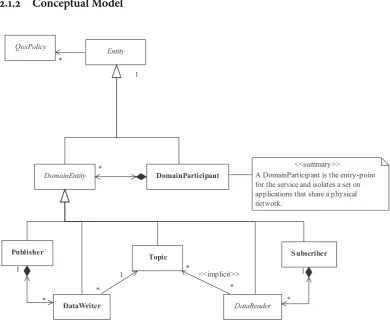
InFigure .above, the conceptual model of the communication entities is
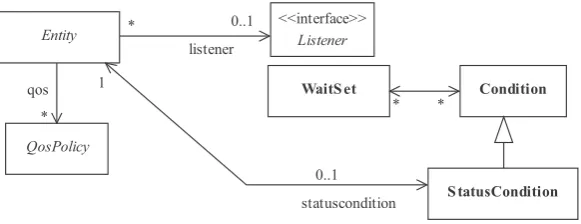
shown. Figure .shows that all specialisations of Entityfollow the uni ed patterns of:
• Supportingby means ofQosPolicy’s —QoS-policiesprovide a generic mech-anism for the application to control the behaviour of the middleware. Every En-titysupports its own specialised kind ofQoS-policy.
• Accepting aListener— aListenerprovides a generic mechanism for the mid-dleware to asynchronously notify the application of events (noti cation-based communication).
• Accepting aStatusCondition— aStatusCondition(in conjunction with a
Chapter — Data Distribution Service
WaitSet) provides support for a wait-based communication style between the
middleware and the application.
QosPolicy
<<interface>>
Listener Entity
WaitS et
S tatusCondition Condition *
1
0..1
0..1 listener
statuscondition * *
qos
[image:37.595.164.455.201.313.2]*
Figure .:Entity model Source:OMG(, p. , simpli ed)
e local membership of an application to adomain is represented by a
Domain-Participant, to which allentities are attached.
... Instances
By de nition, aTopiccorresponds to a single data type, but severalTopics may refer to the same data type. Information represented by data types are sent atomically . ese atomic data value sets are calledsamples.
ATopicidenti es data of a single type, ranging from a single instance to a collection
of instances. When a Topicidenti es multiple instances, then the different instances must be distinguishable. is is achieved by means of specifying one or more of the data elds askey. e de nition of the key,i.e., the list of data elds whose values form the key, must be speci ed to the middleware. Different samples with the same key-value represent successive values for the same instance, samples with different key-values rep-resent different instances. When a key de nition is omitted, the data set associated with
aTopiccan only contain one instance.
Adomainis a distributed concept that links all applications that are able to communicate with each other
On thelevel, the optionallayer provides the means to break data-objects into separate elements, each sent atomically
Chapter — Data Distribution Service
.
S
One of the already existing implementations on which the speci cation is based
is . e development of this architecture already began in the s, leading to a
patent application in . It was driven by the difficulties encountered designing highly
sophisticated control systems. e concept ofmodularity— where different pieces of functionality are separated into modules having some level of independence from other modules — was still lacking as a solution to this problem with regard to certain aspects. Particularly the non-functional requirements of such systems, like fault-tolerance, hy-brid deployment environments with a multitude of different processing platforms and adaptability restrained the design freedom of the modular approach to the extent that it was hardly feasible to satisfy the requirements.
eparadigm introduced an — also modular — approach that solved many
of the issues inherent in the originally practised approach. In thearchitecture, a system is (recursively, if wanted) composed of:
Applications — Independent, autonomous processes that are totally isolated from each other. ey only interact with the rest of the system throughAgents, with a well-de ned interface.
Agents — Every application interacts with exactly one agent, which serves the applica-tion with storage and processing facilities needed for communicaapplica-tion. All agents are identical and communicate through a message passing mechanism.
Network — e messages between agents are handled by the network that connects them.
All relevant data (outside of the application scope) is labelled in such a way that there is a one-to-one relation between a label and the interpretation of the data by an appli-cation that uses it. is label and the structure of the data being labelled are needed by application designers working on a particular subsystem. Communication decisions — like where to get speci c data from or where to send it — are deferred until execution time. During execution, the agents determine, based on the labels of the data being pro-duced or consumed, the communication needs. As a result, no application relies on the
Subscribe Paradigm for the Logical Interconnection of Concurrent Engines()
Chapter — Data Distribution Service
presenceorknowledgeof another application. e only requirement is that the needed data is producedsomewherein the system.
.. Indices
A subscription to a particular label, adatasort, declares the interest in both the current as well as any future data-instance for that label. As a re nement to that principle, which allows for only one instance per label, theparadigm allows speci cation of an index by means of key- elds. If an instance differs from already stored instances it will be stored separately, otherwise it will overwrite the previous value. is key-de nition is a strictly local notion, and can thus differ between the producer and consumer, or multiple consumers of the same data.
De ning an index on the producing side may seem a bit strange at rst, but it aids in exibility in the order in which consuming applications become active. Typically, a consuming application will need all the currently valid instances for all its sorts. If the producer would not have an index de ned, the consuming application would only get the (single) available data instance. To solve this, the producer may specify an index, so that a complete set of relevant instances is available instead. If an application subscribes to the sort, the producer’s agent will rst send out all stored instances and then send new instances as described earlier.
.. Re nements and Extensions
In order to tackle more speci c issues typically encountered in control systems — the area in whichwas developed — more extensions and re nements where made to the paradigm. For example support for redundancy and ltering. A more detailed expla-nation of the extensions and re nements is available byBoasson(, chap. III.B–C).
.
OpenSplice ™
e open source product of PrismTech’s implementing the - speci cation is OpenSplice ™ and it has its roots in theproduct developed at accord-ing to the paradigm described insection .(S). e open source product is
Chapter — Data Distribution Service
plemented by commercial subscriptions, which extend the capabilities of the product even more.
Community Edition — eOpenSplice ™ Community Editionis available as open source and is therefore freely downloadable. is edition is licensed under the
GNU Lesser General Public License ()and provides a great way of getting started with a full- edgedimplementation with support forall pro lesexcept
theobject model pro le.
Compact Edition — e OpenSplice ™ Compact Edition is available only by sub-scription. In addition to the features provided by the Community Edition, the Compact Edition includes model driven engineering() PowerToolsto boost development productivity and theOpenSplice ™ Tunertool to help inspect and optimise system performance.
Professional Edition — eOpenSplice ™ Professional Editionadds support for the optional object model pro le, enhancing the Compact Edition with an Object Cache Object/Relational Mapping layer (i.e.,). It furthermore adds aSOAP -Connector, which allows for easy integration withSOAP-based environments.
Enterprise Edition — eOpenSplice ™ Enterprise Editionadds a connector to data-base management system(dbms’s)and is the most complete and advanced edition available.
Apart from the basic descriptions above, the platform support generally gets better with more advanced editions.
.. Architecture
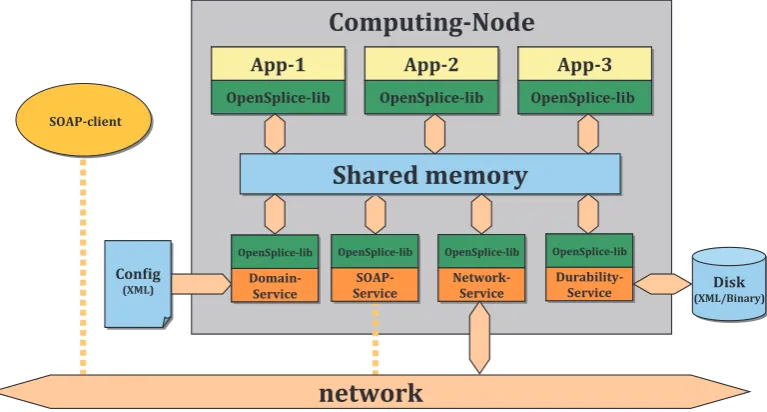
OpenSplice ™ utilises a shared-memory architecture where samples are physically present only once on any node. Internal administration still provides each Subscrib-er with its own private view on this data. is architecture enables aSubscriber’s data cache to be seen as an individual database, which can have content lters, queries, etc., by using the functionality provided in the content-subscription pro le. is shared-memory architecture results in low footprint, excellent scalability and optimal
Chapter — Data Distribution Service
performance when compared to implementations where eachDataReader/ DataWri-ter is a communication end-point with its own storage (i.e., historical data both at
theDataReaderandDataWriter) and where data itself has to be moved around in
memory, even within one node. e same shared-memory is also used to interconnect all applications that reside within one computing node as well as for a con gurable and extensible set of services, which provide pluggable functionality.
[image:41.595.117.501.263.469.2]Computing-Node
App-1 App-1 OpenSplice-lib OpenSplice-lib App-1 App-1 OpenSplice-lib OpenSplice-lib App-2 App-2 OpenSplice-lib OpenSplice-lib App-2 App-2 OpenSplice-lib OpenSplice-lib App-3 App-3 OpenSplice-lib OpenSplice-lib App-3 App-3 OpenSplice-lib OpenSplice-libShared memory
Shared memory
Disk (XML/Binary) Disk (XML/Binary) Con9ig (XML) Con9ig (XML) OpenSplice-lib OpenSplice-lib Domain-Service Domain-Service OpenSplice-lib OpenSplice-lib Domain-Service Domain-Service OpenSplice-lib OpenSplice-lib Durability-Service Durability-Service OpenSplice-lib OpenSplice-lib Durability-Service Durability-Service OpenSplice-lib OpenSplice-lib SOAP-Service SOAP-Service OpenSplice-lib OpenSplice-lib SOAP-Service SOAP-Service SOAP-client OpenSplice-lib OpenSplice-lib Network-Service Network-Service OpenSplice-lib OpenSplice-lib Network-Service Network-Servicenetwork
Figure .:OpenSplice ™ shared memory architecture
InFigure .above a graphical representation of the shared memory architecture
used in OpenSplice ™ is given. It shows four services — available in theOpenSplice
™ Professional Edition— and depicts the way services and applications interact in
a standardised way with the shared memory. All applications and services access the shared-memory through a library which on the most basic level provides an data-base view on the shared-memory. ere are severalapplication programming interface
()layers included in the library, each with a speci c focus (e.g.,-,-
and language-bindings for languages such asJava™,C,C++,C, etc.).
Chapter — Data Distribution Service
.. Services
e OpenSplice ™ middleware comes with a set of pluggable services, which are highly con gurable. e services can therefore be tailored to suit really speci c and demanding use-cases. A description of the most common services is given below.
Domain-service — is service’s responsibility lies with creating the shared memory and initialising the shared nodal administration for a speci c-domain on a node. It also con gures the administration according to a con guration- le. e domain service also starts all pluggable services con gured in the con
guration-le, monitors the health and controls the life-cycle of the services. Furthermore it provides functionality to cleanly tear down a domain. Without this service, no application nor service can join a domain on that node.
SOAP-service — is service provides a remote interface to the monitor and control facilities of OpenSplice ™ by means of theSOAP-protocol. is enables for example the remote-domain monitor and control functionality of the Open-Splice ™ Tuner .
Network-service — When communication endpoints are located on different nodes, the data produced locally must be communicated to the remote nodes joining the domain and vice versa. is service provides this bridge over a network interface. Multiple instances of this service can exist next to each other; each serving one or more physical network interfaces. e service is responsible for sending data to and receiving data from the network. It can be con gured to distinguish multiple communication channels with differentQoS-policies. ese policies will then be used to schedule individual messages to speci c channels.
Durability-service — OpenSplice ™ provides support for the optionalpersistence
pro le, which speci es the concept of so called durable data. Durable data
pro-duced by applications must stay available for late joining DataReaders. is means that DataReaders joining the system at a later stage will be able to re-ceive (durable) data that has been produced before they joined. e durability of data can be eithertransientorpersistentand is determined by theQoS-policy
Which then acts as aSOAP-client as depicted inFigure .on the preceding page
Chapter — Data Distribution Service
of the Topic. If a speci cTopic is marked to be transient, the corresponding data instances remain available in the system during the complete life-cycle of the system. If a speci cTopicis marked to be persistent, the corresponding data instances even survive the shut-down of a system because they are written to a permanent storage (e.g., a hard disk). e durability-service is responsible for the realisation of these durable properties of the data in the system.
-service — is service provides a bridge between the real-time and the enterprise domain. e service is capable of bridging data from to any and vice-versa. is provides many useful capabilities, such as for example the logging ofdata in a,QoS-policy-enabled replication of a
— even between different -implementations — and easy migration from existing-based applications to-based applications.
..
Design
ere are some fundamental principles underlying the architecture of OpenSplice ™, supporting its capabiliti