Defining a knowledge exchange model:
Exploring knowledge transfer activities of internationally oriented
high-tech SMEs
Master‟s Thesis
Arakel Yousif University of Twente
November, 2010
Supervisors University of Twente Dr. S.J. de Boer
Dr. Ir. H.J. Steenhuis
Preface
This Master‟s thesis is a result of the graduation project for the Master‟s degree in Business Administration at the University of Twente, conducted at Micronit Microfluidics in Enschede, the Netherlands. Within the Business Administration program and International Management track specialization, I studied knowledge transfer activities of internationally oriented high-tech SMEs. It gave me the opportunity to learn from high-tech entrepreneurs about their view on high-tech entrepreneurship, knowledge transfer and cross-border activities.
It was a great time to work with wonderful and experienced professionals in science and business. I learned a lot from all who were involved within my graduation assignment and had a tremendous time during my thesis. I would like to express my appreciation to the graduation committee, supervisors from Micronit and all those who supported and participated within this study.
First, I would like to thank my supervisors from the University of Twente. Special thanks to Dr. de Boer for his guidance, conceptual ideas and critical feedback. I learned a lot from our discussion about the conceptual process and thank you for giving me the opportunity to attend the High Technology Small Firms conference at the University of Twente this year. It was a great pleasure working with you. I would also like to thank my second supervisor who is situated in Washington, United States. Dr. Steenhuis, it was a great pleasure working with you. Your in-depth feedback and insight on this research topic were valuable to me and helped me further during the graduation assignment.
My gratitude also goes to my supervisors from Micronit. Ronny, it was a great pleasure working with you. I learned a lot from our discussion about international entrepreneurship - your enthusiasm and vision about Micronit inspired me during the graduation. Thank you for giving me space to work and to learn from other assignments within the organization. Special thanks to Harmen, who helped me no matter time or day of the week. Our discussion and your support have been valuable to me. I also would like to thank all experts and managers from high-tech SMEs those who took their time to participate within the research.
Table of contents
Preface 2
1. Introduction 6
1.1 Research background 6
1.2 Research objectives 7
1.3 Research question 7
1.4 Research strategy 7
2. Literature review 8
2.1 Internationally oriented high-tech SMEs 8
2.1.1 International entrepreneurship 8
2.1.2 High-tech SMEs 9
2.2 Domain of knowledge transfer 10
2.2.1 Defining knowledge 10
2.2.2 Defining knowledge transfer 11
2.2.3 Inter-firm and intra-form knowledge transfer process 12
2.2.4 Performance evaluation of knowledge flows 14
2.3 Factors influencing knowledge transfer 15
2.3.1 Actors 16
2.3.2 Context 18
2.3.3 Content 19
2.3.4 Media 20
2.3.5 Research model 21
3. Methodology 23
3.1 Sample 23
3.2 Semi-structured interviews 23
3.3 Data analysis 24
4. Findings 25
4.1 Exploring the general opinion 25
4.2 Identifying current and future knowledge level 26
4.3 Influencing dimensions and underlying factors 27
4.3.1 Actors dimension 28
4.3.2 Context dimension 30
4.3.4 Media dimension 33
4.4 Improving factors within knowledge transfer activities 34
4.5 Conclusion 35
5. The case of Micronit 38
5.1 Applying the model 38
5.2 Identification of bottlenecks 40
5.3 Conclusion 40
6. Conclusions & recommendations 42
6.1 Conclusions 42
6.2 Reflections 43
6.3 Recommendations 45
References 46
Appendices 51
A1 Interview protocols 51
A1.1 Expert interviews 51
A1.2 Interviews among internationally oriented high-tech SMEs 51
A1.2.1 General checks 52
Table of figures
Figure 1: Research structure 7
Figure 2: Factors influencing cross-border activities of high-tech SMEs 9 Figure 3: Inter-firm and intra-firm knowledge transfer process 15
Figure 4: Knowledge transfer framework (Albino et al., 1999) 16
Figure 5: Actors 18
Figure 6: Context 19
Figure 7: Content 20
Figure 8: Media 21
Figure 9: Research model 22
Figure 10: Bohn‟s (1994) knowledge growth scale 26
Figure 11: Overview of dimension 28
Figure 12: Review of factors within the actors dimension 28
Figure 13: Review of factors within the context dimension 30
Figure 14: Review of factors within the content dimension 32
Figure 15: Review of factors within the media dimension 33
1. Introduction
1.1 Research background
High-technology (high-tech) small- and medium-sized enterprises (SMEs) of the past decades have developed themselves into global leaders nowadays. Some case examples include high-growth companies such as: Intel, Google, Microsoft and Apple. These companies have grown exponentially in a couple of decades and have set „the standard‟ in their markets internationally. One of the factors influencing international business activities of high-tech SMEs includes inter-firm and intra-firm knowledge transfer. These companies have been able to organize their knowledge transfer activities successfully and developed themselves into market pioneers. So one may assume: being aware of knowledge transfer processes, influencing factors and organizing it successfully, can lead to improvements in international activities of high-tech SMEs.
Indeed, in a rapidly changing business environment, knowledge becomes one of the most important determinants of business success (OECD, 1996). It is explained that in order to succeed internationally, a firm must possess some advantageous knowledge-based assets (Martin & Salomon, 2003). Knowledge actually represents the main resource upon which competitive advantage is founded, and its transfer is widely emphasized as a strategic issue for the firm competition (Ramasamy, Goh & Yeung, 2006). Knowledge transfer is viewed as a critical factor for a firm necessary to rapidly respond to change, innovate and achieve competitive success (Albino, Garavelli & Schiuma, 1999; Cohen & Levinthal, 1990). This raises the issue that companies have to manage their knowledge by creating and transferring knowledge internally and by preventing knowledge transfer to their competitors (Argote & Ingram, 2000).
The larger body of literature discusses the importance of knowledge transfer for multinational enterprises (MNEs) and emphasizes intra-firm knowledge flow processes (Martin & Salomon, 2003; Tsai, 2001; Bresman, Birkinshaw & Nobel, 1999). However, some scholars have stressed the role of inter-firm knowledge transfer for MNEs in strategic alliances (Simonin, 2004; Simonin, 1999; Mowery & Oxley, 1996), and in international joint ventures (Lyles & Salk, 1996). To a lesser extent attention is given to inter-firm knowledge transfer activities of internationally oriented high-tech SMEs.
Also in international business literature, MNEs played a dominant role, while SMEs have only recently attracted broader interest (Ruzzier & Hisrisch, 2006). Due to continuing globalization and as a result of increasing international competition, international expansion is no longer the domain of large firms. SMEs have been observed to internationalize, sometimes at an early age of development (Pangarkar, 2008), and SMEs are considered as the engine of the global economic growth, because of their innovative capacity (Acs, Morck, Shaver & Yeung, 1997).
1. Introduction
2. Literature review
3.
Methodology 4. Findings
5. The case of Micronit
6. Conclusions & discussion intellectual property protection. That is why, there is the need to identify factors and to understand underlying processes that influence knowledge transfer activities of internationally oriented SMEs. In this thesis it will be explored how internationally oriented high-tech SMEs organize their knowledge transfer activities within and across their organization‟s boundaries, and which factors influence this process. The next sections describe the research objectives, research question and the research strategy for this study.
1.2 Research objectives
The objective of this study is twofold. First, to identify the factors and processes that facilitate knowledge transfer activities of internationally oriented high-tech SMEs, resulting into a tentative model. The intention is to provide and to design an appropriate model for knowledge transfer activities of internationally oriented high-tech SMEs.
Second, since Micronit Microfluidics (Micronit) is the sponsor of this research project, the objective is to identify factors and processes underlying knowledge transfer activities concerning the firm itself. Micronit will be advised on how it could organize the knowledge transfer activities internationally, in order to improve the overall organizational performance. This has to result in economic benefits.
1.3 Research question
The theme of the current study is primarily focussed on high-tech based firms. High-tech SMEs are chosen, because of several interesting details:
1. These type of companies are relatively more internationally oriented; 2. High-tech SMEs have limited resources, and;
3. High-tech SMEs manage more knowledge-intensive operations than usual.
Considering the lack of literature and the need for Micronit to manage the inter- and intra-firm knowledge transfer process, the resulting research question is:
What international knowledge transfer process is appropriate for internationally oriented high-tech SMEs and how can Micronit implement such a process?
1.4 Research strategy
The research strategy follows a deductive approach (Saunders, Lewis & Thornhill, 2009). Therefore, the remainder of this thesis is organized as follows (Figure 1). Chapter 2 consists of an elaborated literature review, resulting in a research model. Chapter 3 explains the methodology. Then, chapter 4 presents the findings, followed by the case of Micronit in chapter 5. Conclusions and discussion will be provided in chapter 6.
2. Literature review
2.1 Internationally oriented high-tech SMEs
This section (2.1) describes literature on international business and factors influencing cross-border activities of high-tech SMEs. First, literature on international entrepreneurship will be discussed, followed by characteristics of internationally oriented high-tech SMEs. Then, the domain of knowledge transfer is elaborated (2.2). Furthermore, section 2.3 discusses dimensions and underlying factors that influence knowledge transfer activities, resulting in the research model adopted in this study (2.3.5).
2.1.1 International entrepreneurship
Conducting research into an international business environment, needs one to define the concept clearly. International entrepreneurship is defined as the discovery, enactment, evaluation and exploitation of opportunities – across national borders – to create future goods and services (Oviatt & McDougall, 2005). It is also related to the innovative, proactive and risk-seeking behaviour that crosses national borders, and intended to create value in organizations (McDougall & Oviatt, 2000).
Internationalization is a process in which the enterprise gradually increases its international involvement (Moen & Servais, 2002). This process evolves in the interplay between the development of knowledge about foreign markets and operations on the one hand and increasing commitment of resources to foreign markets on the other hand. It is also explained that elements such as size, age and prior experience affect the extent of internationalization (Andersson, Gabrielsson & Wictor, 2004).
Literature in the area of MNEs‟ cross-country knowledge transfer activities and best practices is dominated by two scenarios: adaptation and standardization (Yakhlef, 2007; Theodosiou & Leonidou, 2003). There are as many advocates of adaptation as of standardization strategies. Both strategies are regarded as strategic devices for competing in overseas markets (Jensen & Szulanski, 2004). Internationally oriented high-tech SMEs can also deal with the issue to adopt an adaptation strategy or a standardization strategy for its international activities.
Whether the firm will use an adaptation or a standardization approach depends on several factors that affect the cross-border activities of SMEs (Etemad, 2004):
1. Push factors, refer to the pressure on the firm from the inside (Jansson & Sandberg, 2008); 2. Pull factors, relate to the drivers in the environment and external to the firm (Andersson, 2004);
3. Mediating factors, which represent the basic characteristics of the firm and the circumstances under which the entrepreneur operates (Andersson, 2002; 2000), and;
Figure 2, Factors influencing cross-border activities of high-tech SMEs (Perks & Hughes, 2008; Etemad, 2004; Burgel & Murray, 2000; Acs et al., 1997; Moen & Servais; Rothwell, 1991)
Push factors
•Low resource commitment
•Focus on Commercialization
Pull factors •Differences in language
•Culture, and
•Legal system
Firm's own characteristics •Small size
•High-tech orientation
•Imperfect information about the foreign market
•Knowledge-intensive
Mediating factors •Efficient internal
communication
•Interactive management style
•Rapid response to threats and opportunities
•Short-term orientation
•Customer relation
•Tacit knowledge & vision
•Product-service complexity
2.1.2 High-tech SMEs
SMEs differ in many aspects from MNEs in their cross-border activities. SMEs can enjoy a number of behavioural advantages (e.g. rapid response to external threats and opportunities, efficient internal communication) and a number of material disadvantages (e.g. low resource commitment) over their larger counterparts (Rothwell, 1991). Factors influencing cross-border activities of high-tech SMEs, according to Etemad (2004), are defined as follows.
Push factors for internationally oriented high-tech SMEs are characterized by low resource commitment and
the focus on commercialization (Burgel & Murray, 2000; Moen & Servais, 1992). Internationally oriented high-tech SMEs are directed toward commercialization rather than foreign production (Burgel & Murray, 2000). High-tech SMEs therefore should use a business area with homogeneous customers and minimal adaptation in the marketing mix (Moen & Servais, 1992). The argument is that these firms cannot take a multi-domestic approach as a large firm can, simply because they do not have sufficient scale in their operations worldwide (Moen & Servais, 1992). However, some scholars assume that resource constraints do not affect the SME‟s choice to internationalize (Perks & Hughes, 2008). That may be true, but still high-tech SMEs are short-term oriented which can affect current international business activities.
Pull factors for internationally oriented high-tech SMEs include natural differences, such as a different
language, culture and a legal system (Acs et al., 1997). These differences can make international business very risky for high-tech SMEs. Therefore, high-tech SMEs may have limited operations abroad. In contrast, some scholars assume that the cultural context and industry environment does not affect the SME‟s choice to internationalize (Perks & Hughes, 2008).
Geographical and cultural distance may not be an issue for the choice to internationalize, but critical for current international business activities of high-tech SMEs.
Firm’s own characteristics of internationally
oriented high-tech SMEs include a relatively small size, internationally oriented, high-tech oriented, imperfect information about the foreign market and knowledge-intensive activities (Burgel & Murray, 2000; Acs et al., 1997). These factors also affect the cross-border activities of high-tech SMEs.
Mediating factors for internationally oriented
[image:9.595.285.529.499.743.2]communication, an interactive management style, rapid response to external threats and opportunities and a short-term orientation (Rothwell, 1991). Because of these factors, high-tech SMEs can be relatively flexible and enjoy major advantages compared to larger enterprises. SMEs are also able to make decisions quickly and efficiently, whereas the strategy formulation of high-tech SMEs is based on commercialization. It is also said that the customer relation, tacit knowledge, vision and product-service complexity affect the decision to internationalize (Perks & Hughes, 2008).
In sum, several factors affect cross-border activities of high-tech SMEs. The four influencing dimensions of Etemad (2004) are illustrated in figure 2. As a result, these factors can also influence knowledge transfer activities of internationally oriented high-tech SMEs.
2.2 Domain of knowledge transfer
This section defines knowledge (2.2.1), knowledge transfer (2.2.2), inter-firm and intra-firm knowledge transfer processes (2.2.3), and its relation with organizational performance (2.2.4).
2.2.1 Defining knowledge
Before delving into concepts of knowledge transfer, first it will be explained how knowledge is different from information and data (Roberts, 2002).
Data could be considered as the input for information. Data are series of observations, measurements or facts in the form of numbers, words, sounds and/or images. It has no meaning and provides raw material from which information could be produced (Roberts, 2002).
Information is data that have been arranged into a meaningful pattern. Boisot & Canals (2004) describe information as the extraction of data. Information can possibly result from conducting a survey, or the analysis of reports, charts and graphs that give meaning to data (Roberts, 2002).
Knowledge is actually the application and productive use of information. Knowledge is more than information,
since it involves the awareness or understanding through experience, familiarity or learning (Roberts, 2002). Takeuchi & Nonaka (1995) define knowledge as the meaning, beliefs and commitment, and of a particular stance, perspective or intention.
Knowledge can be broadly classified into explicit knowledge or tacit knowledge (Ramasamy et al., 2006). Explicit knowledge is information that can be easily documented and shared through electronic or other media,
Whether knowledge is explicit or tacit, it should be accessible to the target audience. The diffusible feature of information establishes the availability of data and information for those who want to use it. This feature depends on the level of codification and abstraction (Boisot, 1998). Knowledge may be widely diffusible but remain unused (Boisot, 1998). A reason for not using the information might be that it is not recognized, or too much time and effort is needed to use it, and information can be subject to restrictions (Boisot, 1998). Another reason could be that information is not reliable or suitable.
In sum, knowledge is different from information or data. Knowledge can be classified into tacit and explicit knowledge. The diffusion of knowledge depends on the level of codification and the level of abstraction. The question is how the transfer of knowledge looks like and which concepts are related to this process.
2.2.2 Defining knowledge transfer
By defining knowledge transfer, ideas of several authors are presented below.
It is known that knowledge transfer seems to be appropriate when specific exchange conditions are set (Yang & Kim, 2007). Different conditions are needed in different situations. Yang & Kim (2007) explain that knowledge transfer can be used when the knowledge source and recipient are defined clearly. During knowledge transfer, a clear direction of knowledge flow from source to recipient is visible (Yang & Kim, 2007).
Knowledge transfer can also be considered within a broad definition of technology transfer (Roberts, 2000). Technology transfer is the diffusion of the complex bundle of knowledge, which surrounds a level and type of technology. It includes transfer of information and knowledge at micro- and macro-level between individuals, organizations, and economies (Roberts, 2000). So, this could also be true when high-tech SMEs send their knowledge about complex technologies and services to their customers internationally. In that case, high-tech SMEs are defined as a knowledge source, whereas their customers are defined as knowledge receiver. However, these roles of sending and receiving knowledge could also change during a partnership, joint venture project or interaction between both actors, since both actors can exchange knowledge about their technologies and products to each other.
Szulanski (1996) explains knowledge transfer as the dyadic exchange of organizational knowledge between a source and a recipient. During knowledge transfer, the recipient of knowledge needs to be motivated to gain knowledge, and the donor must have something worthwhile to offer (Easterby-Smith, Lyles & Tsang, 2008). The more features the actors share the more successful knowledge transfer is likely to be (Yakhlef, 2007; Kostova, 1999; Inkpen & Dinur, 1998; Lyles & Salk, 1996).
Argote & Ingram (2000) explain knowledge transfer as the process through which one unit is affected by the experience of another, which occurs through changes in knowledge of performance of the recipient unit.
1989). Knowledge transfer can take place by means of different ways, such as interaction of personnel, patent disclosures, publications, assets and services exchanges.
As knowledge transfer is defined, now it is explained how the overall process of knowledge transfer is characterized.
2.2.3 Inter-firm and intra-firm knowledge transfer process
Two models dominated the domain of using, sharing and transferring knowledge: the Communication-based and the Knowledge-creation model (Yakhlef, 2007; Inkpen & Dinur, 1998).
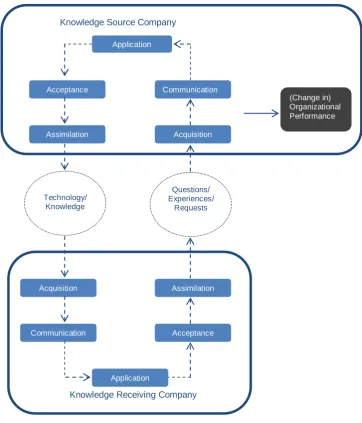
First, the knowledge transfer process can be considered as a communication process with information processing activities (Albino et al., 1999). Communication is defined as the process of giving and receiving information (Ramasamy et al., 2006). In this case, knowledge owned by an actor (according to its specific characteristics) can be transferred to another actor by information flows through different media. The effectiveness and efficiency will partly depend on media choice (Albino et al., 1999).
The transfer of knowledge, from a communication perspective, is regarded as a message encoded in a medium by a sender to a recipient in a given context (Yakhlef, 2007). Based on previous literature (Shannon, 1998), it could be assumed that an inter-firm knowledge transfer activity includes three stages: an encoding stage, a transmission stage and a receiving and interpretation stage. First, knowledge is codified by the source company. This stage is important and difficult. On the one hand a high level of codification increases the transfer of knowledge with the potential customer. On the other hand, knowledge with a high level of codification can also be easily captured by competitors (Albino et al., 1999). After encoding information, it is transmitted towards the receiving actor, either verbally or written. In this stage it is essential to choose the most appropriate channel through which information is transmitted. In the third stage, information is interpreted and received by the receiving actor. In this stage information is decoded, acquired and shared throughout the company. This third stage is related to the receptive and absorptive capacity of the company. Eventually the receiving company sends feedback to the source company. In the overall process of transmitting a message, certain information that is not intended by the source is unavoidably added to the message. This noise can be internal (i.e. coming from own knowledge, attitudes, or beliefs), or external (i.e. coming from other sources). Such internal or external noise can either strengthen the intended effect of a message (if the information confirms the message) or weaken the intended effect (if the intended information contradicts the message).
In addition, Gupta & Govindarajan (2000) consider knowledge flows as any two-person communication, including:
4. A channel;
5. Transmission through the channel; 6. A decoding scheme;
7. A receiver, and;
8. The assignment of meaning to the decoded message.
Since inter-firm knowledge transfer in this study primarily represents information processing activities between two firms, rather than creating knowledge together, it is considered as a communication-based process. The reason is that, in this study, it is assumed that high-tech SMEs send and receive knowledge from their relations internationally, primarily to stimulate international sales. However, it does not mean that high-tech SMEs do not learn from their customers internationally. In fact, when high-tech SMEs need to build a new product which requires new production processes, it can even improve its own knowledge on product and production level. So, knowledge creation can occur, but primarily facilitated by a communication-based process.
Second, knowledge transfer is also related to organizational learning (Albino et al., 1999; Gilbert & Cordey-Hayes, 1996). Organizational learning occurs through individual learning and knowledge sharing. The process of organizational learning is stimulated by a shared vision (Walsh & Ungson, 1991; Senge, 1994; Kim, 1993). Therefore, knowledge through interaction transfers more readily within than between firms (Argote & Ingram, 2000). Knowledge transfer in this case occurs through socialization, education and learning, which may be either purposefully or as an outcome of other activities (Roberts, 2000). As a learning process knowledge transfer occurs in five stages:
1. Acquisition; 2. Communication; 3. Application; 4. Acceptance, and;
5. Assimilation, (Albino et al., 1999; Gilbert & Cordey-Hayes, 1996).
Knowledge transfer, from an organizational learning perspective, is also considered as the creation of knowledge through four modes of explicit and implicit forms of knowledge (Takeuchi & Nonaka, 1995). These modes include:
1. Socialization (from tacit to tacit knowledge); 2. Combination (from explicit to explicit); 3. Externalization (from tacit to explicit), and; 4. Internalization (from explicit to tacit).
Externalization and internalization are considered as appropriate modes for inter-organizational activities,
whereas socialization and combination are considered as appropriate within the organizational boundaries (Takeuchi & Nonaka, 1995).
The intra-firm knowledge transfer activity of internationally oriented high-tech SMEs is considered as a knowledge-creation activity. The reason is that the intra-firm activity is associated with organizational development and overall performance of a firm (Van Wijk, Jansen & Lyles, 2008). Nevertheless, communication of knowledge also occurs during intra-firm knowledge transfer (Walsh & Ungson, 1991). As discussed before, knowledge creation can also be an inter-firm activity, since customers can come up with new product needs that have to be developed together, and whereby knowledge can be exchanged or created.
In this study, characteristics of both, the communication-based and the knowledge-creation model are integrated within the research model (Figure 3). The reason for using both approaches is that intra- and inter-firm knowledge transfer are highly related to each other (Holmqvist, 2003).
In sum, both inter-firm and intra-firm knowledge transfer processes are explained. Next, the relation between knowledge transfer and organizational performance are explained.
2.2.4 Performance evaluation of knowledge flows
It is known that knowledge transfer from both internal sources and external sources has important implications for a firm‟s organizational performance and innovativeness (Van Wijk et al., 2008). Organizing knowledge transfer activities successfully can result into qualitative and quantitative organizational benefits (Chen & Chen, 2006). Qualitative indicators include: improving employees‟ skills, improving quality strategies, improving core business processes, developing customer relationships and developing supplier relationships. Quantitative indicators include: decreasing operation costs, decreasing product cycle time, increasing productivity, increasing market share, increasing shareholder equity and increasing patent income.
Figure 3, Inter-firm and intra-firm knowledge transfer process
Knowledge Source Company
Knowledge Receiving Company
and short-term goals. As the overall knowledge transfer process is characterized, it is interesting to identify factors that could possibly affect the process.
2.3 Factors influencing the knowledge transfer
This section explains a framework of factors, which can possibly influence the knowledge transfer process. Multiple factors can influence knowledge transfer activities. Boisot (1998) suggests that several elements affect the knowledge transfer:
1. The availability of means of communication; 2. The sharing of codes between sender and receiver; 3. The prior sharing of contexts between sender and receiver; 4. The speed with which messages diffuse;
5. Cultural dispositions, and;
(Change in) Organizational Performance
Acquisition Application
Communication
Assimilation Acceptance
Questions/ Experiences/
Requests
Acquisition
Communication
Application
Acceptance Assimilation Technology/
2.3 Knowledge Transfer
2.3.1 Actors, involved in the
knowledge transfer process
2.3.2 Context, in which the
interaction takes place
2.3.3 Content, transferred between the
actors
2.3.4 Media, by which the transfer is carried out 6. Legal considerations.
Other factors influencing the knowledge transfer process, distinguished by Boschma (2005), are: 1. The distance (geographical);
2. The absorptive capacity and disseminative capacity (cognitive), and; 3. Trust (social, institutional and organizational).
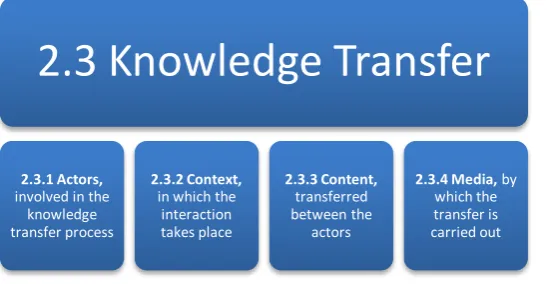
A more advanced framework for analyzing the knowledge transfer process is suggested by Albino et al. (1999). These scholars identified four dimensions of a framework, which influence knowledge transfer (Figure 4). Albino et al. (1999) assume that all knowledge owned by individuals or organizations defines their skills and core competencies, and enable them to carry out some tasks. In fact, every skills is always referred to a specific task defined as a goal. Thus, when knowledge transfer is analysed, it is always possible to find a knowledge-related task (Albino et al., 1999). Therefore, particular attention has to be given to the transferred knowledge-related task.
This knowledge transfer framework will be discussed deliberately, because it considers the most essential dimensions and underlying aspects very specifically. It could be assumed that the framework can be used for both inter-firm and intra-firm knowledge transfer analysis. The next sub sections clarify different dimensions that can influence knowledge transfer.
2.3.1 Actors
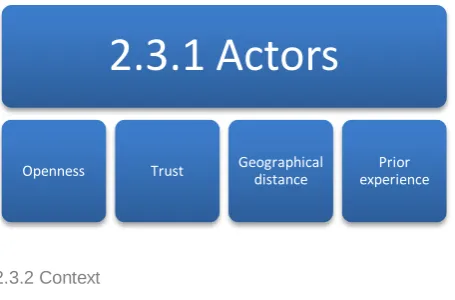
The first dimension refers to the role of actors during knowledge transfer (Figure 5). Actors are considered as either the individuals or the organizations. Analysing the knowledge transfer, some key factors can influence the effectiveness of knowledge exchange (Albino et al., 1999) Factors influencing the actors dimension and, therefore, the effectiveness of knowledge transfer are: openness, trust, geographic distance, and prior experience (Easterby-Smith et al., 2008; Ramasamy et al., 2006; Albino et al., 1999; Boschma, 2005; Nieminen, 2005).
[image:16.595.75.349.331.473.2]Openness can be understood in terms of the partners‟ willingness to share knowledge in a collaborative interaction, which could also be referred to as the overall perceived openness of dialogue. A higher level of
openness allows a more effective knowledge transfer (Albino et al., 1999). A related factor to openness is trust, which has a direct and positive effect on openness.
Trust can be characterized as the parties‟ ability to believe that the counterparts‟ behaviour will remain consistent in the future (Nieminen, 2005). It is said that tacit knowledge, for instance, is more easily enforced by trust than a contractual agreement (Roberts, 2000). When mutual trust is high, on the supply-side, business partners will share and exchange their knowledge with knowledge-seeking firms (Buckley, Clegg & Tan, 2006; Ramasamy et al., 2006; Levin & Cross, 2004). On the demand side, if the knowledge-seeking firm does not trust its partner, the seeking firm would probably have no intention to learn from them, as the firm assumes the partner firm would not transfer any knowledge. The knowledge-seeking firm can even be suspicious about the accuracy and reliability of the information received from the partner (Ramasamy et al., 2006). Strong long-term relationship is a strong enabler of effective coordination of inter-firm activities, which in turn leads to a higher degree of knowledge transfer for the source firm.
Knowledge transfer is possible when there is mutual trust, transparency and intents (Nieminen, 2005; Goh, 2002). The role of mutual trust is significant as the transferred knowledge is highly related to the organization‟s competitive advantage, and it can therefore raise the question of opportunism (Nieminen, 2005; Hamel, 1991).
According to Nieminen (2005), trust can be built on three sets of issues:
1. Process-based trust (i.e. level of trust between the firms regarding their mutual history and reputation for trust);
2. Characteristics-based trust (i.e. level of cognitive and cultural similarities, social relations and shared understanding) ,and;
3. Institutional trust (i.e. implicit certificates and contractual agreements).
Trust has a direct influence on knowledge transfer, but commitment does not directly influence knowledge transfer. That is, even when the relationship between two firms is weak, a certain minimum level of knowledge transfer still occurs (Ramasamy et al., 2006).
It is said that geographical distance between two actors can influence the knowledge transfer (Boschma, 2005). Knowledge transfer can occur when there is a large geographical distance, but more easily when there is no or less geographical distance.
Prior experience of both actors also influences the capability of both conveying knowledge through
2.3.1 Actors
Openness Trust Geographical distance
Prior experience
performance increases clearly (Albino et al., 1999; Cohen & Levinthal, 1990). This can be true for both the receiving and the source company.
The structure of an inter-organizational relationship also refers to the context in which knowledge transfer takes place, and the transfer mechanisms, which are established within that context (Easterby-Smith et al., 2008). The next section elaborates the role of the context, wherein interaction takes place.
2.3.2 Context
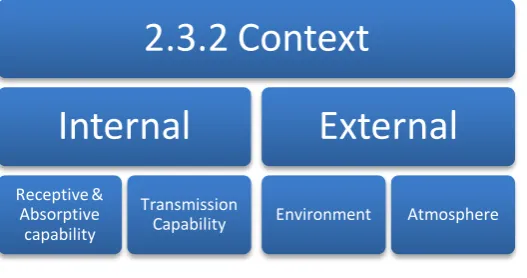
The second dimension in the knowledge transfer framework of Albino et al. (1999) refers to the context (Figure 6). Much attention has been given to the role of the context of the knowledge transfer process (Jensen & Szulanski, 2004; Lyles & Salk, 1996; Mowery, Oxely & Silverman, 1996; Almeida & Grant, 1998; Kostova, 1999, Simonin, 1999). Referring to organizations, it is possible to distinguish two kinds of contexts that influence knowledge transfer: the internal and the external context.
The internal context actually corresponds to the organizational culture and basically represents the set of behaviours, technical skills, resources and technology assets, attitudes and values belonging to and shared by the members of an organization. Albino et al. (1999) characterize it on the one hand by the receptive and absorbing capability of the learning organization. More specifically, Cohen & Levinthal (1990) explain that the firm‟s ability to recognize value of new external information, to assimilate it, and apply it to commercial ends is critical to its innovative capabilities. On the other hand, the internal context is characterized by the transmission capability of the organization (Albino et al., 1999). The transmission capability refers to the ability of making tacit knowledge explicit, which is referred to as externalization by Takeuchi & Nonaka (1995).
[image:18.595.74.302.201.351.2]The external context can be defined as a set of variables representing the conditions in which inter-firm relationships take place (Albino et al., 1999). It influences the nature of the knowledge exchanged and is characterized by two dimensions: environment and atmosphere. The environment represents market characteristics in which organizations operate, such as market structure, its international scale, and the connected technologies. The atmosphere represents the combination of specific inter-organizational variables, such as cooperation, closeness, expectations and socio-cultural aspects.
2.3.2 Context
Internal
Receptive & Absorptive
capability
Transmission Capability
External
Environment Atmosphere
The external context seems to have influence on several aspects of the internal context. For instance, if companies operate and cooperate in the same atmosphere, they tend to present similar culture (Albino et al., 1999). Therefore, knowledge can be transferred more readily. The next section explains the role of the content.
2.3.3 Content
The third dimension refers to the content (Figure 7). The content of the knowledge transfer on the one hand is the ability to perform a specific task distinguished by Albino et al. (1999) and content refers to the knowledge itself on the other hand.
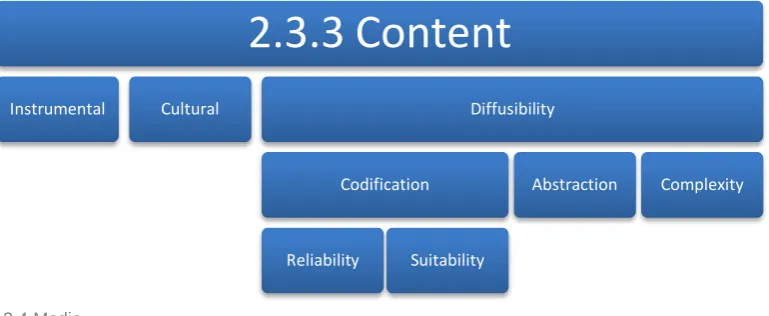
Albino et al. (1999) assume that the knowledge transfer process is associated with a knowledge-related transfer task. The knowledge transfer is successful when the ability associated with the transferred knowledge is assimilated by the receiving actor. A distinction can be made between two types of content associated with the transferred knowledge: Instrumental content and Cultural content (Albino et al., 1999).
The instrumental content is related to all knowledge necessary to do or to coordinate a job. The task associated to this knowledge concerns the individuals‟ ability, product and technology knowledge, technical operations, intra- and inter-organizational procedures and rules (Albino et al., 1999).
The cultural content is associated with the knowledge capability of creating a specific organization‟s cognitive background. It includes organizational values and beliefs, individuals‟ cultural background and the „language‟ used in the organization to communicate. During inter-firm knowledge transfer, it enables the creation of a common inter-organizational culture. Its task is to improve the understanding capability of the actors involved, for instance providing a common language, which increases the efficiency of communication (Albino et al., 1999).
The knowledge content on the other hand also refers to the characteristics of knowledge itself. The content depends on the diffusion of knowledge and the nature of it (Boisot, 1998). The question is to what extent knowledge is codified, abstract – and therefore accessible to the target audience. Knowledge faces numerous barriers to its transfer from originator to user, and so it is relatively immobile.
[image:19.595.71.335.157.296.2]The obstacles between knowledge sender and receiver are caused by knowledge attributes. This is referred to as knowledge ambiguity, which is caused by tacitness and complexity (Liao & Hu, 2007). Tacit knowledge cannot be described fully and articulable knowledge can be codified, which is also more easily to diffuse (Garud &
2.3.3 Content
Instrumental Cultural Diffusibility
Codification
Reliability Suitability
Abstraction Complexity
Nayyar, 1994). Transferring tacit knowledge would be more expensive across firm boundaries than within a firm (Martin & Salomon, 2003; Kogut & Zander, 1992). Furthermore, it is possible to describe simple knowledge with little information. In contrast, a larger amount of information is required to describe complex knowledge (Garud & Nayyar, 1994).
In addition, Steenhuis & De Bruijn (2004) identified that codified information is never completely accurate and explain that this depends upon the absolute and relative quality of information. The former is also called reliability, which on its turn depends on the stability of information. The latter is called suitability and depends on ambiguity and the applicability of information (Steenhuis & De Bruijn, 2004). The next section discusses the role of the media.
2.3.4 Media
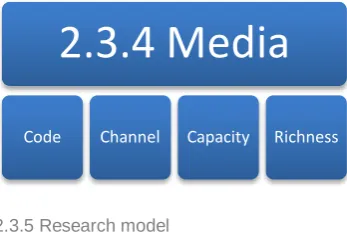
The fourth dimension (Figure 8) refers to media. This dimension is considered as every means useful for transferring data and information (Albino et al., 1999). From a structural point of view, media are characterized by two elements: code and channel. The code is a particular representation of the information to be exchanged also discussed in the previous section. The channel is the means by which the code can be transferred. Important characteristics of the channel are the capability of immediate feedback, number and typology of items that can be used and the speed of processing (Albino et al., 1999).
Two characteristics of media can be distinguished: capacity and richness. These characteristics can affect the efficiency and effectiveness of knowledge transfer. Media capacity can be defined as the ability of the media to process information, without noise or information lack and with transferred information redundancy (Albino et al., 1999). Media richness is the capability of making the change of mental representations of actors. Media with
[image:20.595.77.462.289.447.2]high capacity are all those useful for processing information at a high quantitative and qualitative level. These media rely on the rules, forms, procedures and data bases, and use basically impersonal media sources, such as written and numeric documents, e-mail, telephone and fax (Albino et al., 1999; Appleyard, 1996). Media characterized by a high level of richness are personal and involve face-to-face contact between actors.
2.3.4 Media
Code Channel Capacity Richness
2.3.5 Research model
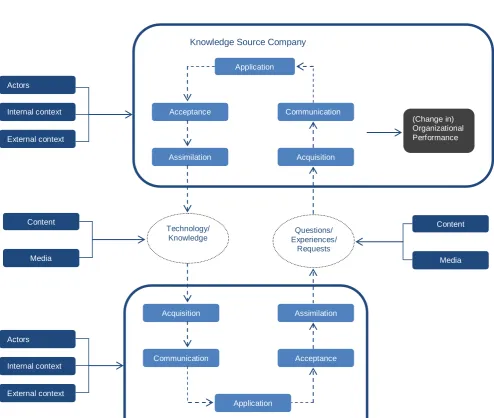
Considering literature review, the research model in this study is defined as follows. Knowledge transfer is characterized as an inter-firm communication and an intra-firm learning process (Figure 9). The knowledge source firm is regarded as a high-tech SME and the knowledge receiving firm is considered as a customer, whereby the role of sending and receiving knowledge may change during a project with a customer. Within these international relationships often knowledge exchange occurs, since high-tech SMEs work with young and complex technologies. High-tech SMEs need to know what their customers‟ needs are, whether their products and services fit with customers‟ needs, and how a new designed product needs to be produced.
High-tech companies exchange knowledge and information about their complicated technologies and related services with customers by different communication channels. Customers receive information and send it throughout their company. Customers respond to the high-tech SME as a result of interaction, and by explaining their current needs (Van Wijk et al., 2008). High-tech SMEs receive knowledge and information and send it throughout their organization internally, which results into organizational learning and improvement of the overall organization performance of high-tech SMEs. In this study only high-tech SMEs will be investigated. It will be analysed how these companies have organized their knowledge transfer activities and which factors they think are important for knowledge transfer.
In the case of Micronit, knowledge transfer occurs as follows. First, the customer‟s needs are identified by sales engineers, which is a communication activity. Then, Micronit explains what Microfluidics is and what the technical capabilities are. During this introductory conversation, it is also identified whether the lab-on-a-chip product to be produced is:
(1) a standard prototype;
(2) has to be developed together with the customer for the next few years to come, or;
(3) whether many chips have to be manufactured according to specific customer‟s requirements.
So, knowledge is received from customers about the chip to be produced, and the characteristics of the chip and knowledge is sent towards customers about Micronit‟s technical capabilities and about Microfluidics.
[image:21.595.74.248.82.198.2]This loop of interaction can take place a few times, before a project is defined. As a result of this exchange, the customer will set up a draft and send it towards Micronit, or the customer will ask some questions in order to
Figure 9 Research model
Knowledge Source Company
Knowledge Receiving Company
“Influencing factors” “Knowledge transfer process”
set up a draft. Micronit will produce and deliver the chip if it received a draft and when it is able to manufacture it. In that case, there is already a lab-on-a-chip that is developed by the customer, whereby fine-tuning takes place.
If the chip is not designed and developed by the customer yet, Micronit will, based on a request, design and develop the chip together with the customer. In that case, knowledge transfer occurs more intensively, because knowledge can be either created or existing knowledge can be exchanged in order to design and develop a new chip. Both wise, knowledge is exchanged about what exactly needs to be produced, and what the requirements and experiences are, since the lab-on-a-chip needs to fit with the application of the customer. The goal of knowledge transfer in this case is to manufacture and develop products for customers.
So, in both cases knowledge is transferred, whereas in the second scenario, new knowledge can be created together with the customer, and in the third scenario existing knowledge can be exchanged. In all cases, Micronit can learn from its customers. Even when the customer sends existing knowledge about a chip, Micronit may learn from that and apply the same knowledge for another customer in the same target segment.
Actors
Internal context
Content
Media (Change in) Organizational Performance External context
Acquisition Application
Communication
Assimilation Acceptance
Content
Media
Acquisition
Communication
Application
Acceptance Assimilation
Actors
Internal context
External context
Questions/ Experiences/
Requests Technology/
3. Methodology
This chapter explains the methodology of this study, by describing the sample (3.1), semi-structured interviews (3.2) and data analysis (3.3).
3.1 Sample
The focus population of this study consists of internationally oriented high-tech SMEs situated in the Netherlands. Out of this population, a small sample of 19 high-tech SMEs is approached. The self-selection sampling technique is used, since there are no statistical inferences desired, it needs to be representative and no quota variables were available (Saunders et al., 2009).
SMEs are selected based on the headcount (between 10 and 249 employees) and turnover (between EUR 2.000.000,- and EUR 50.000.000,-), which is defined by the European Commission (Verheugen, 2003). Since there is no broadly accepted definition for high-tech SMEs, the definition of OECD is partly adopted (Hytti, Heinonen & Oberholzner, 2002). According to them, a high-tech SME is a firm that has implemented technologically new or significantly technologically improved products or processes (OECD, 1997).
For the pre-test of the tentative model, four experts were asked for relevant cases. Although this sample may not be sufficient in size to result in findings that can be generalized to the population at large statistically, it is believed that this sample is sufficient in terms of providing findings that can be convincing or at least strongly indicative towards the theoretical assumptions adopted in this study.
3.2 Semi-structured interviews
This study is predominantly of an exploratory nature as it aims to explore which factors and processes are essential for knowledge transfer activities of internationally oriented high-tech SMEs. In line with the deductive approach and using the tentative research model, which is presented earlier, semi-structured interviews are conducted. Semi-structured interviews are likely to be used to reveal and understand the „what‟ and „how‟, and exploring the „why‟ question (Saunders et al., 2009).
This research design is chosen, because it can provide deeper understanding of the factors that influence the process of knowledge transfer for internationally oriented high-tech SMEs. It provides the opportunity to „probe‟ answers, where interviewees are needed to explain, or build on, their responses (Saunders et al., 2009). This means that several themes and the tentative model are presented and discussed, which is similar for most of the respondents. However, if needed and relevant, additional in-depth questions are raised and respondents are given space partly to answer to questions in the way they prefer (Saunders et al., 2009).
be divided into eight stages: (1) Complete ignorance, (2) Awareness, (3) Measurement, (4) Control, (5) Process capability, (6) Process characterization, (7) Know why, and (8) Complete knowledge. The knowledge level of an actor with regard to the role of a key variable in a process determines to what extent one could control the process and its output (Bohn, 1994). A process can be influenced by multiple variables. That is, with a higher knowledge level, control of the variable and of the process can be increased (Bohn, 1994). Other scholars, such as Ricciardi, Barroso & Ermine (2005), and Alstete (2007) have worked with the framework of Bohn (1994) before.
First, open questions are asked about the respondent‟s view and experience with regard to the knowledge transfer process and surrounding factors. Next, the tentative model is checked by asking the respondent to review and provide comments on the model. Respondents are asked to describe their daily activities with regard to knowledge transfer with their customers internationally and with their colleagues internally. The semi-structured interviews consisted of several questions addressing:
1. Interviewees‟ general ideas about knowledge transfer activities of internationally oriented high-tech SMEs, how they deal with issues during knowledge transfer activities;
2. The current and future knowledge level on Bohn‟s (1994) knowledge growth scale;
3. The appropriateness and representativeness of the model and the essence of the underlying factors on a five-point Likert scale. This scale is used in order to indicate the level of importance per factor, and; 4. To what extent underlying factors need to be improved.
In sum, the tentative research model is reviewed by four experts specialized in the high-tech SME market (Appendix A1). Next, using feedback of the experts, semi-structured interviews among 19 individuals are conducted from different internationally oriented high-tech SMEs. Finally, eight employees of Micronit involved in knowledge transfer activities are interviewed, in order to gather data for the case of Micronit. For Micronit, the intra-firm knowledge transfer process and related bottlenecks are more elaborated compared to other cases.
3.3 Data analysis
4. Findings
This chapter presents the results derived from the semi-structured interviews held among experts, managers of high-tech SMEs and employees at Micronit. First, the general view of the expert group (n=4), the managers of the high-tech SME group (n=19) and employees from Micronit (n=8) with regard to knowledge transfer is discussed (4.1). Second, current knowledge transfer activities and the knowledge level on Bohn‟s (1994) knowledge growth scale are elaborated (4.2). Subsequently, dimensions and underlying factors are reviewed (4.3), whereas for Micronit also internal bottlenecks are identified in chapter five. It is also discussed what factors are indicated to be improved by respondents (4.4). Finally, an overall conclusion is provided for internationally oriented high-tech SMEs (4.5) and for Micronit individually (5.3). The elaboration provides a valuable insight into what process is appropriate for internationally oriented high-tech SMEs and how Micronit could implement such a process.
4.1 Exploring the general opinion
Before the research model adopted in this study was introduced to respondents, they were asked to provide their general view with regard to knowledge transfer activities.
The expert group explained the essence and strategic importance of knowledge transfer activities for the organizational performance of internationally oriented high-tech SMEs. In order to provide valuable solutions to customers and to sustain the competitive advantage, experts stated that high-tech SMEs need to interact and exchange knowledge within their environment, and understand their customer‟s product and market intensively. The underlying idea is that high-tech SMEs need to create acceptance among their customers when providing customers with valuable solutions, whereby knowledge exchange is critical.
Figure 10, Bohn‟s (1994) knowledge growth scale
It could be concluded that all three groups underline the importance of knowledge transfer activities for the organizational performance of internationally oriented high-tech SMEs. However, the expert group emphasizes the interaction with the environment, whereas the other two groups underline the intensive interaction with customers during knowledge transfer activities.
4.2 Identifying current and future knowledge level
As all three groups confirmed the importance and intensiveness of knowledge transfer activities with customers internationally, they were asked to indicate the current and future knowledge level on Bohn‟s (1994) knowledge growth scale, see figure10. These results demonstrate how internationally oriented high-tech SMEs have organized their knowledge transfer activities currently and to what extent they would like to improve the knowledge transfer process.
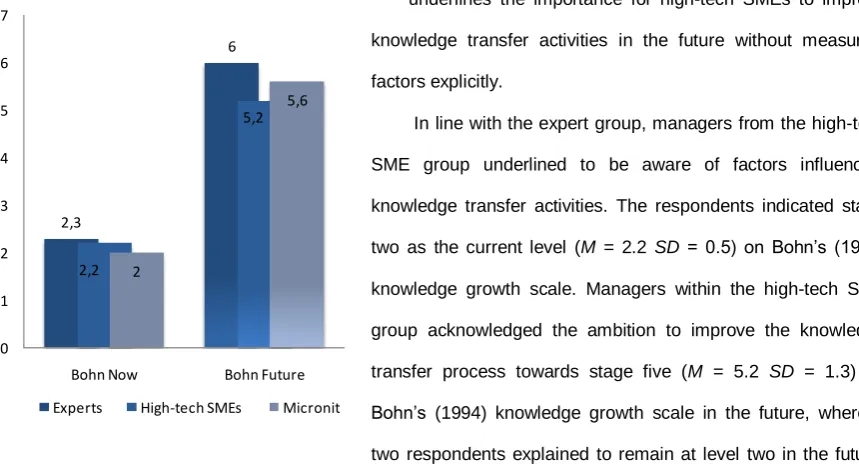
The expert group indicated stage two as the current knowledge level of internationally oriented high-tech SMEs (M = 2.3 SD = 0.5) and the need to grow towards stage six (M = 6.0 SD = 1.4) in the future on Bohn‟s (1994) knowledge growth scale. The expert group clarified the awareness of internationally oriented high-tech SMEs of factors influencing knowledge transfer activities, without measuring factors explicitly as described by Bohn (1994). The expert group questioned the relevance for internationally oriented high-tech SMEs to explicitly measure factors influencing knowledge transfer activities. Respondents stated that internationally oriented high-tech SMEs have a lack of resources and feel the need to focus on core activities rather than optimizing
management processes. The expert group, however, underlines the importance for high-tech SMEs to improve knowledge transfer activities in the future without measuring factors explicitly.
In line with the expert group, managers from the high-tech SME group underlined to be aware of factors influencing knowledge transfer activities. The respondents indicated stage two as the current level (M = 2.2 SD = 0.5) on Bohn‟s (1994) knowledge growth scale. Managers within the high-tech SME group acknowledged the ambition to improve the knowledge transfer process towards stage five (M = 5.2 SD = 1.3) on Bohn‟s (1994) knowledge growth scale in the future, whereas two respondents explained to remain at level two in the future. The underlying reason of these two respondents is that they seem to be satisfied with the current process of knowledge transfer. Furthermore, some respondents suggested that the firm‟s maturity level could be related to the knowledge stage of high-tech SMEs on Bohn‟s (1994) knowledge growth scale. These respondents
2,3
6
2,2
5,2
2
5,6
0 1 2 3 4 5 6 7
Bohn Now Bohn Future
explained; the more mature a firm is, the higher the level one would reside on Bohn‟s (1994) knowledge growth scale. Also some respondents discussed whether it would be relevant to measure factors influencing knowledge transfer activities explicitly.
Employees at Micronit indicated stage two as the current level (M = 2.0 SD = 0.0) on Bohn‟s (1994) knowledge growth scale, since the organization seems to be aware of factors influencing knowledge transfer activities. Employees explained the ambition to improve the current knowledge transfer process towards stage six (M = 5.6 SD = 0.7) in the future. Respondents justified this ambition with the overall organizational ambition to increase both the turnover and number of employees. Similar to respondents in previously mentioned groups, employees at Micronit questioned the relevance to measure factors influencing international knowledge transfer activities explicitly, since it would not fit with the organizational activities.
In conclusion, respondents indicated stage two as the current level on Bohn‟s (1994) knowledge growth scale. That is, respondents have acknowledged being aware of factors influencing knowledge transfer activities, without explicitly measuring influential factors. Bohn (1994) clarifies that variables in the first three stages are usually considered exogenous, in that it is impossible to control them. The underlying idea is that factors and knowledge about the factors influencing knowledge transfer activities are intangible, which make it difficult to manage and measure systematically (Bohn, 1994). However, influencing factors could be measured implicitly, characterized as passive, natural experiments to determine the relationship between a factor and the output (Bohn, 1994). Furthermore, respondents indicated their wish to improve their knowledge transfer activities towards a higher level on Bohn‟s (1994) knowledge growth scale. This confirms the relevance and importance for knowledge transfer activities to them. Although all respondents indicated the need to improve the process, a minor difference appears in this ambition. Employees at Micronit and the experts indicated stage six as a target, whereas the high-tech SME group indicated stage five as their ambition. The underlying reason is that some respondents within the high-tech SME group fear the consequences of a bureaucratic procedure for their organizational operations.
4.3 Influencing dimensions and underlying factors
Figure 12, review of factors within the actors dimension Figure 11, overview of dimensions
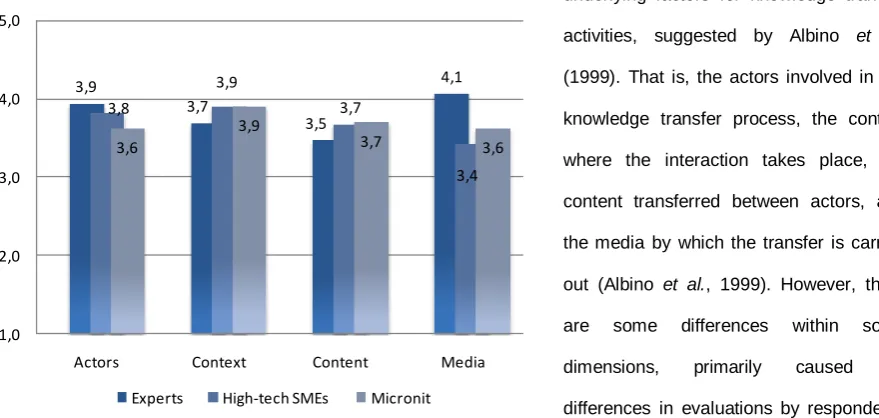
It is worth noting that the majority of the factors, and as a result, the dimensions illustrated in figure 11 are evaluated as above average important (≥ 3.7) for knowledge transfer activities of internationally oriented high-tech SMEs. This partly indicates the relevance of the framework, consisting of four overarching dimensions and underlying factors for knowledge transfer activities, suggested by Albino et al. (1999). That is, the actors involved in the knowledge transfer process, the context where the interaction takes place, the content transferred between actors, and the media by which the transfer is carried out (Albino et al., 1999). However, there are some differences within some dimensions, primarily caused by differences in evaluations by respondents for the underlying factors. Since this study mainly concentrates on the influencing factors, rather than the overarching dimensions itself, the next subsections will elaborate these underlying factors.
In sum, all respondents indicated the research model in this study as representative and appropriate for their knowledge transfer activities. Furthermore, all dimensions are evaluated as above average important with a minor difference among the groups with regard to the media dimension. The expert group provides a relatively high evaluation for the media dimension compared to the other groups. The following subsections will discuss the importance of the underlying factors.
4.3.1 Actors dimension
Respondents were asked about the relevance of the factors within the actors dimension on a five-point scale, and their ideas with respect to these factors. Except for geographic distance, and prior experience by the expert group and high-tech SME group, other factors within the actors dimension are evaluated as above average important (≥ 3.8) for knowledge transfer activities illustrated in figure 12.
Within the actors dimension, all groups believe that openness has a positive influence and an important role within knowledge transfer activities. The underlying reason is that respondents believe that a higher level of openness would improve transfer of Actors dimension Experts (n=4) High-tech SMEs (n=19) Micronit (n=8)
M SD M SD M SD
Actors: 3.9 0.9 3.8 1.0 3.6 1.1
Openness 4.3 0.5 4.4 0.6 4.1 1.1
Trust 4.8 0.5 4.7 0.5 4.0 0.9
Geographic 3.3 0.5 2.6 0.8 2.6 0.7
Experience 3.5 1.3 3.5 0.6 3.8 0.9
3,9 3,7 3,5 4,1 3,8 3,9 3,7 3,4 3,6 3,9 3,7 3,6 1,0 2,0 3,0 4,0 5,0
Actors Context Content Media
knowledge. Without openness, it is less easy to transfer knowledge since misinterpretations and different expectations could occur. Actors within an internationally oriented high-tech environment face new knowledge and technologies, whereby a high level of transparency and the willingness to collaborate improves knowledge transfer. Respondents indicate that an overall perceived level of openness improves the collaboration within an international product development project, which results into a more readily transfer of knowledge. This is also discussed in literature (Albino et al., 1999). All groups, therefore, confirm that a higher level of openness improves the effectiveness of knowledge transfer. In fact, the high-tech SME group indicates that without openness, mutual trust will be low and knowledge transfer could take a long time. Although employees at Micronit evaluated openness as relatively important, some respondents within the group clarified that Micronit does not have to be open about patented or strategically important knowledge in order to do business internationally. However, respondents consider openness and trust as the starting point for an international business relationship, wherein knowledge transfer takes place.
Similar to the relevance of openness, respondents consider trust as essential for knowledge transfer. The expert group and high-tech SME group indicate that trust is even more important compared to openness. Trust increases the level of knowledge transfer and also the level of openness. The expert group explains that trust could be increased in long-term product development projects by being open about technological possibilities and limitations. According to the three groups more trust could improve knowledge transfer activities; whereas employees at Micronit explain that knowledge transfer could also occur if there is minimal trust between two actors. In that case, non-disclosure agreements are formulated. Trust and openness are explained to affect each other. More trust results into a higher level of openness, and a higher level of openness could increase the level of trust. Furthermore, respondents only indicated the role of two types of trust are important for knowledge transfer activities: characteristics-based trust and institutional trust.
Geographic distance is perceived as least important factor by all three groups, though evaluated relatively high by the expert group. The respondents from all groups explain that the larger the geographic distance, the less easy knowledge transfer occurs. However, information technology possibilities nowadays enable firms to cooperate over a large distance easily, whereby the geographical distance becomes a less important factor for knowledge transfer. The high-tech SME group confirms this idea, but indicates that the closer a customer is based near their organization, the better knowledge transfer would occur. The expert group assumes that a larger geographic distance could even affect openness and trust negatively. The cultural distance, which is related to the geographical distance, is assumed to be more important for knowledge transfer activities of internationally oriented high-tech organizations. Cultural differences could raise differences in interpretations, which could harm knowledge transfer.
Figure 13, review of factors within the context dimension
regarded as a moderator, rather than a required factor. Furthermore, one respondent discussed that prior experience of actors could also be different and biased, and in that case prior experience could affect knowledge transfer negatively.
In sum, all groups provide a comparable evaluation for the importance of the factors within the actors dimension. Openness and trust are evaluated as essential, whereas geographic distance is evaluated as least important factor because of the availability of different means. Furthermore, some respondents indicated the relation between trust and openness, whereby a high level of openness could affect the level of trust positively, and a high level of trust could affect the level of openness positively. Literature has described the direct and positive influence of trust on openness (Albino et al., 1999). Less is known about the role of openness on trust within cross-border knowledge transfer activities.
4.3.2 Context dimension
Respondents were asked about the relevance of the factors within the context dimension on a five-point scale, and their ideas with respect to these factors. Except for receptive and absorptive capability by the expert group, and environment by all groups, other factors within the context dimension are evaluated as above average important (≥ 3.8) for knowledge transfer activities, which is illustrated in figure 13.
With regard to the receptive and absorptive capability, the experts provide a slightly lower evaluation compared to other groups. The expert group, however, indicates the relevance of the receptive and absorptive capability for knowledge transfer activities. The same group suggests that one needs to listen, identify and absorb knowledge from customers with regard to their needs and products, so that internationally oriented high-tech SMEs can provide valuable solutions and transfer knowledge effectively. The high-tech SME group confirms this point of view. All groups explained the essence and positive influence of the receptive and absorptive capability on knowledge transfer. In addition, employees at Micronit perceive it as a requirement for transfer of knowledge.
All groups underlined the importance of transmission capability for knowledge transfer activities. The ability to make tacit knowledge explicit by codification is essential to transform customer needs into technological solutions. Moreover, the expert group suggests that the transmission capability is related to the receptive and absorptive capability of internationally oriented high-tech SMEs. The high-tech SME group explains that in order to transform customer‟s needs into technological solutions, high-tech SMEs need to receive, identify and absorb knowledge first.
Context dimension
Experts (n=4)
High-tech SMEs (n=19)
Micronit (n=8)
M SD M SD M SD
Context: 3.7 0.5 3.9 0.9 3.9 0.8
Receptive 3.5 0.6 4.3 0.8 4.5 0.5
Transmission 4.0 0.0 4.2 1.0 4.4 0.5
Environment 3.5 0.6 3.3 0.9 3.0 0.5