Detecting botnets using file system
indicators
Master’s thesis
University of Twente
Author:
PeterWagenaar
Committee members: Prof. Dr. Pieter H. Hartel Dr. DamianoBolzoni Frank BernaardsLLM (NHTCU)
Abstract
Contents
1 Introduction 4
1.1 Problem . . . 4
1.2 Contribution . . . 5
1.3 Research questions . . . 5
2 Related work 6 2.1 Botnet overview . . . 6
2.1.1 Botnet design . . . 6
2.1.2 Malicious botnet activities . . . 7
2.1.3 Comparing botnets to regular cloud services . . . 9
2.2 Botnet characteristics . . . 9
2.2.1 Attack vectors . . . 10
2.2.2 Overall botnet infrastructure and communication channels . . . 10
2.2.3 Using DNS . . . 13
2.2.4 Miscellaneous botnet enhancing techniques . . . 15
2.2.5 Future botnet developments . . . 17
2.3 Botnet detection . . . 18
2.3.1 Malicious traffic-based detection . . . 18
2.3.2 Command & Control traffic-based detection . . . 20
2.3.3 Comparison . . . 21
2.3.4 Conclusion . . . 22
3 Method 23 3.1 Dataset . . . 23
3.2 Indicators . . . 24
3.2.1 Database table name . . . 26
3.2.2 File size . . . 26
3.2.3 SQL queries . . . 26
3.2.4 File type . . . 27
3.2.5 Spam lists . . . 27
3.2.6 Web script file name . . . 27
3.2.7 Web script entropy . . . 27
3.2.8 Other indicators . . . 28
3.3 Detection methodology . . . 29
3.3.1 Disk images . . . 29
3.3.3 Proof of concept implementation . . . 30
4 Results 32 4.1 Results per indicator . . . 32
4.2 Combining indicators . . . 32
4.3 Indicator performance analysis . . . 34
5 Conclusion 35 5.1 Future work . . . 35
A Proof of concept implementation 37 A.1 Modules . . . 37
A.2 Performance . . . 38
A.2.1 Different programming language . . . 38
A.2.2 Parallel processing . . . 38
A.2.3 Smart file selection . . . 38
Glossary 39
Peer-reviewed literature 40
Acknowledgements
This work would not have been possible without the guidance, help and feedback of several individuals. I would like to take this opportunity to express my sincere gratitude towards them.
First of all, I would like to thank Prof. Dr. P.H. Hartel for providing me with the opportunity to perform this research, for giving me the freedom to find my own way, for helping me enthusiastically throughout the project and for keeping me on the right track with his critical feedback.
I wish to thank F. Bernaards, LLM and E. Monsma, MSc. for welcoming me to the world of crime fighting and for being the spiders in the web of all the external contacts that helped realize this research.
A thank you to Dr. D. Bolzoni for making time in his busy schedule to be part of my graduation committee and for technically reviewing my work.
I am also grateful to the members of the National High Tech Crime unit of the Netherlands’ Police Agency for lending me their technical expertise and creativity in the process of devel-oping the botnet detection method described in this thesis. Besides, they have really made me feel at home, for which I am sincerely grateful.
I wish to thank P. Takkenberg in particular for giving me the time to finish my thesis even though other matters were more pressing.
Chapter 1
Introduction
Botnets, large groups of networked zom-bie computers under centralised control, are recognised as one of the major threats on the internet. As a proper understanding of this phenomenon is vital to be able to fight it, a lot of research is dedicated to this topic. Academia as well as anti virus companies, operating system developers and law enforce-ment agencies all spend considerable time and effort in botnet research, botnet disruption and botnet takedown operations.
A large part of the academic botnet research is geared towards developing ways of detect-ing botnets. Almost all detection methods discussed in the literature focus on network traffic, be it analysis of individual packets or by looking at more general netflow data. This focus makes sense from the perspective of re-searchers (academic as well as law enforce-ment agencies). Network data can be mon-itored and analyzed with relative ease: legal systems usually have provisions for intercept-ing network traffic and there are enough tools available for the analysis of intercepted data. The control traffic is also what separates bot-net bots from, for instance, regular viruses and trojan horses, making it an obvious can-didate for botnet detection.
1.1
Problem
What happens, however, when network data is unavailable? Scenario’s for such a case are the following:
• If a number of different servers share the same internet connection it may be impossible to determine which of the servers is the actual C&C and which are less interesting.
• When a number of servers is confiscated for an offense other than hosting botnet infrastructure, there may not be enough legal reason to capture network traffic for every server, or not enough capac-ity to do so, rendering network based botnet detection impossible. Such a scenario may occur when dealing with bulletproof hosting providers (see next chapter), who rent out a number of servers, each of which can be used for a different (illicit) purpose.
• Automatically detecting which servers host a botnet C&C may also be used in a triage procedure, to reduce the num-ber of servers that one has to investigate by hand.
• A final use case is botnet detection on live systems, where a hosting com-pany could periodically scan whether rented systems are being used as botnet C&C’s, possibly alongside traditional network based botnet detection.
In these scenario’s it may help to have other C&C detection methods available, methods that rely less on network traffic and more on the servers themselves. Our problem state-ment is as follows:
How can we determine whether a given sys-tem contains a botnet C&C, without the use of network data?
soft-ware. This can be explained in part by the difficulty of gaining access to C&C software: apart from a few commercial crimeware kits (such as ZeuS[52] and SpyEye[53]) generally only law enforcement agencies have access to C&C software through confiscated C&C ma-chines.
1.2
Contribution
For our research, we will look at botnets from the botmaster’s perspective. Our contribu-tion is twofold. We will analyse a number of botnet enhancing techniques in light of three aspects: resilience, stealth and churn. Re-silience defines how well a botnet is equipped versus takedown. Stealth defines how well a botnet can operate without being detected. Churn defines how fast bots join the botnet, i.e how fast machines are infected and how fast infected machines are disinfected again. These aspects help us look at botnets from a botmaster’s perspective, so that we can see the motivation behind using certain botnet enhancing techniques.
For our second contribution, we propose a new botnet detection method.
We will focus on the way a C&C is stored on a file system. Information on the file system is well structured, can be accessed and pro-cessed quickly and contains the heart of the C&C infrastructure: the place where the ac-tual C&C program code resides. We will try to find a set of indicators that, when searched for within a file system, can indicate whether a C&C infrastructure is present on the ma-chine or not.
We will develop a proof of concept botnet de-tection implementation which, using these in-dicators, can search for botnet C&C infras-tructures in disk images. We will apply our method to a test dataset consisting of 94 disk images of confiscated servers of a bulletproof
hosting provider and discuss the results for each indicator.
1.3
Research questions
The research questions to which we try to find an answer are the following:
• Which file system indicators can we use to correctly identify the presence of a botnet C&C?
• Which indicator has the lowest false pos-itive rate and which has the lowest false negative rate and why?
• How feasible is using these indicators when searching through large datasets?
In our search for file system indicators, we fo-cus on the “quick wins”: simple yet fast and effective methods of finding out whether a sys-tem hosts a C&C infrastructure or not. The reasoning is that simple indicators can be lo-cated and processed fast so that many systems can be checked as fast as possible. Our re-search is highly exploratory: we think of some indicators, build a proof of concept implemen-tation that will search for these indicators and see how each indicator performs. Some indi-cators may give a high false positive or false negative ratio, some will work unexpectedly well. Since this is one of the first researches of its kind, we just want to see what’s out there and provide a basis for further research.
Chapter 2
Related work
This chapter provides an overview of the cur-rent state of the literature regarding botnet characteristics and botnet detection methods. The contents are as follows. We will start with describing what botnets are, how they work and what they are used for in section 2.1. Then, in section 2.2, we will dive deeper into the characteristics of different botnet designs. We will look at the different communication channels used and at some of the techniques to enhance botnets. After that, in section 2.3 we will discuss several detection methodologies, subdividing them into those based on mali-cious traffic and those based on C&C traffic.
2.1
Botnet overview
Offenders have always been resourceful in their ways of making money. As people in-corporate internet in more and more aspects of their life, offenders started seeing opportu-nities for making money in the digital world through scams, extortion schemes, property destruction, theft, etc. One branch of this so-called “cybercrime” involves the use of ma-licious pieces of software, called “malware”, with the goal of making a target’s computer perform actions that the target hasn’t con-sented to or knows about. If the malware al-lows the offender to control the infected com-puters remotely, such a group of comcom-puters
is generally called a “botnet”. A single com-puter within this group is known as a “bot” or “zombie” and the person(s) controlling the computers are known as “botherders” or “bot-masters”.
Besides offenders there are other parties that use botnets, such as (cyber)terrorists[54] and government agencies[55]. Although we will mention the activities they employ below, the setups they use are largely outside the scope of this paper and will not be discussed further. Before we look at botnet activities, however, we will first discuss botnet design, to give the reader a better understanding of what botnets are and how they operate.
2.1.1 Botnet design
Although there are many different possible de-signs for botnets, all dede-signs have some factors in common. First of all, all botnets consist of a group of devices infected with malware to perform the actual work. These devices can be infected through a variety of attacks including drive-by downloads, automated ex-ploitation (like with computer worms), mal-ware on USB flash drives or malicious attach-ments in e-mails. The goal of the infection is to get a piece of malware running on the target’s device, preferably without the target knowing about it; this way the target is less likely to take steps to remove the malware.
Once a target’s device is infected, the botmas-ter needs to set up some sort of control mech-anism to tell the infected device what to do. The way this control mechanism is designed forms one of the characterizing features used by researchers to taxonomize botnets[1][2][3].
commands which she provides get distributed from this central point to all the bots.
On the other side there is a decentralized ar-chitecture. In this architecture there are no centralized machines; every machine in the infrastructure is of equal importance. Com-mands are given to one or a few bots, chosen at random, which in turn make sure that the commands reach all the other bots in the bot-net.
These two architectures form two extremes. In reality botnets employ aspects of each ar-chitecture in a hybrid design. We will discuss this more deeply in section 2.2.
Reported sizes of botnets vary greatly. Re-search into enumerating botnets is still ongoing[4][5] and each new trick botmasters invent to hide their botnets makes estimat-ing the actual size harder. There have been reports of botnets with over 30 million total infections (Bredolab, see [56]). Most of the malicious activities (see below) hinge on the number of bots available, so maximizing the number of infections is paramount for the bot-master.
2.1.2 Malicious botnet activities
Botmasters use their botnets for all kinds of different purposes, most of which are con-sidered malicious and/or harmful. The rea-sons botmasters use botnets for these activi-ties are many. As we will see in the next sec-tion, botnets provide a measure of anonymity which, because of the malicious nature of the activities, is a necessity. Furthermore, the geographically distributed nature of botnets means that it is difficult for researchers to track them. Different time zones, languages, laws and jurisdictions all form barriers, aiding the botmaster in staying ahead of the law[6].
Some activities that have been seen in the field include:
Spam[7]
Sending spam means surreptitiously sending unsolicited e-mails in the hope that the re-cipient follows the link inside the e-mail. The page the link points to can, for instance, be a phishing page (designed to steal login creden-tials) or a pharmacy scam (designed to sell counterfeit drugs). Having more bots in the botnet means that more mails can be sent, thus raising the chances of a recipient follow-ing the link.
DDoS[8]
DDoS attacks are attacks on a website or other internet facing service, performed by generating so much traffic to it that it can’t handle all the requests and will be unavailable for regular users. This can then be used ei-ther in an extortion scam (“pay me 100.000$ or your site will remain offline”) or purely as a way of harassing others. Having more bots in the botnet means that more traffic can be generated, which in turn means that larger, more popular websites can be taken offline. This can be useful in an extortion scheme, where more money can be extorted for larger websites.
Information stealing[57]
Some offenders gather login credentials, e-mail addresses, company secrets, credit card numbers or other information using their bot-net. The information can be gathered by various methods, such as keyloggers or file system crawlers. It can be sold on the black market or used by the botmaster herself for other purposes. Obviously, having more bots means more gathered information.
Pay-per-install[9]
pay-per-install scheme, the other botmaster doesn’t have to devise a way of spreading the malware on its own. Having more bots in the pay-per-install botnet means that more “installs” can be sold.
Click Fraud[10]
A botmaster can also use his botnet to gener-ate clicks on his own website’s advertisements, with the goal of getting paid for each click. If there are More bots in the botnet, this means more clicks and thus more money.
Mining or stealing Bitcoins[58][59]
Mining or stealing bitcoins is a relatively new botnet activity. Bitcoins[60] are a digital cur-rency based on cryptographic principles that started emerging around 2009 and has grown to quite a big user base[61]. The idea be-hind Bitcoins is that they can be “mined” (basically generated) on a computer and that they can be used in anonymous but verifi-able transactions to purchase goods. Bitcoin mining requires significant computational re-sources; the more resources one has avail-able the quicker one can generate Bitcoins. The massive computational power a botnet provides can thus be used to mine Bitcoins: having more bots means more computational power and thus more Bitcoins. Of course, one can also try to steal other people’s Bitcoins as they are stored in a file (called a “wallet”) on the computer.
Cyberwarfare[11]
Malware can be used by political groups or nations to attack another political group or nation, with the intention of causing damage or disruption to the target’s systems, or to steal information. This activity was first seen with the Stuxnet virus which was allegedly designed by the United States of America to-gether with Israel to impair Iran’s uranium enrichment capabilities. Another example is
the Flame virus, which sends screenshots, keyboard activity, network traffic and docu-ments from the infected computer to its C&C. Flame infections were initially only found at government organizations and prominent state officials in Middle Eastern countries, leading the belief that it was indeed an act of cyberwarfare.
Both these examples were targeted attacks, instead of the erratic, non discriminant in-fection behaviour we see with “regular” bot-nets. Nonetheless, we classify cyberwarfare as a botnet activity because of other prop-erties: both viruses were designed to spread to other systems and both were controlled from a central location. As the attacks were targeted and never meant to leak out to the public, this is one of the few botnet activities in which larger numbers aren’t directly bene-ficial to the botmaster.
Botnet improvement
Using the bots in the botnet to enhance the botnet itself by raising botnet resilience, stealth or churn (see section 2.2). The ex-act methods will be explained later, but this usually means using the bots as a “shield” of sorts, to make sure that researchers are un-able to find the real identity of the botmaster.
Hacktivism[62]
politi-cal opinion different from the attackers’ opin-ion. An example of such an opt-in DDoS bot-net is the attacks by hacker group Anonymous on the website of the Scientology church, in which people could install the LOIC1 tool to join in on the DDoS attack[63].
2.1.3 Comparing botnets to regular cloud services
Parallels can be drawn between botnets and regular cloud services, such as Amazon’s EC2. Both provide massive computational power, network bandwidth and storage. Some bot-nets provide lease services, where one can hire part of the botnet to perform tasks such as the ones mentioned above, but also for use as a regular hosting service or computation platform[64][65]. Botnets and cloud services also provide a level of resilience: a service that runs on top of either of the two infras-tructures can remain online even if some of the nodes that make up the infrastructure get taken down.
The three botnet aspects that we will discuss in the next section, however, reveal some dif-ferences as well. First of all, because of the il-legitimate nature of botnets they tend to have a stealthy setup, trying to hide as much of the infrastructure as possible from the outside world. Secondly, the composition of nodes in a botnet changes more rapidly than in a regu-lar cloud service. Reguregu-lar cloud services usu-ally only swap out nodes if they suffer hard-ware failure and add nodes when the com-putational requirements surpass the computa-tional power available. The involuntary par-ticipation of the infected machines in a botnet means that the number of node joins and node leaves is much higher than in a regular cloud service. A final difference is the number of ille-gitimate services ran from a botnet; a regular cloud service has strict rules on what activ-ities are allowed and which are not whereas
a botnet (even a rented one) can be used for any and all activities.
In some ways, cloud service providers could learn from the evolution of botnets. Meth-ods for decentralized control, dealing with node failure and dealing with the heterogene-ity of the operating systems of different nodes are all problems shared between cloud service providers and botmasters.
After this brief overview of the botnet world we will now discuss the characteristics of bot-nets over the years.
2.2
Botnet characteristics
Today’s botnets have come a long way from the IRC based bots that were used at the be-ginning of the 21stcentury. In this chapter we will provide an overview of historic and cur-rent botnet characteristics. We will discuss these characteristics in light of three main botnet aspects: resilience, stealth and churn.
Resilience indicates how well a botnet can withstand takedown. Setting up a botnet takes time and money, so keeping the botnet online as long as possible raises the botmas-ter’s return on investment.
Stealth means how well a botnet can stay hid-den from researchers and targets. The longer a botnet stays hidden, the longer it can oper-ate without problems. Stealth also indicoper-ates how well the botmaster can stay hidden in case of an investigation.
Churn has everything to do with the spread-ing capability of the malware used to create the botnet. It indicates how fast new ma-chines are infected and how fast malware is removed again. As long as the churn is “pos-itive”, more bots are joining than there are bots leaving, meaning that the botnet grows in size.
These aspects impact the size and availability of a botnet: a botmaster wants to have a bot-net with many bots that can operate undis-turbed for as long as possible. A high posi-tive churn impacts the botnet’s size because churn defines how fast bots join the botnet. A high resilience and good stealth helps to let the botnet operate undisturbed.
We have chosen these three aspects as they show what kind of properties botmasters want in their botnets. Compared to the survey work by Bailey et al. [12] and Li et al. [13], our aspects provide a view on the characteris-tics of botnets that is centralised around the botmaster’s wishes, instead of focusing purely on the botnet characteristics from an out-sider’s perspective.
The following sections will discuss some of the techniques employed by botmasters to en-hance their botnets and we will show how each technique impacts resilience, stealth and churn. As each of the techniques described below requires effort to implement, choosing whether or not to add a given technique to a botnet will always be a matter of weighing the implementation costs versus the benefits that the technique will bring.
2.2.1 Attack vectors
An important factor in the success of a bot-net is its ability to infect new machines. As we have seen in section 2 there are many pos-sible attack vectors, each with its own advan-tages and disadvanadvan-tages. Which attack vec-tor(s) the botmaster employs greatly impacts resilience, stealth and churn. For instance, if she chooses to use a virus that exploits a known vulnerability in some piece of software, it is likely that the success rate won’t be very high, as targets have already patched the vul-nerability. If she develops a virus that ex-ploits an unknown vulnerability, however, the chance of infection will become higher, but developing such a virus takes a lot more time.
Besides viruses that directly attack software she could also try to use phishing e-mails to get a target to start the malware or use mal-ware that spreads using USB sticks only. The attack vector’s infection rate determines how fast bots join the botnet and thus has a great impact on botnet churn.
A second factor that impacts botnet churn is the speed with which an infection can be re-moved from a system. If the malware tar-gets a piece of software that is developed by a company that hardly ever fixes vulnerabil-ities in their software, targets are going to have a hard time protecting their system from infections. Furthermore, the employed mal-ware could use rootkit and other process hid-ing techniques, hidhid-ing the malware from the operating system, making removal a difficult task. Increasing the difficulty with which the malware can be removed increases the botnet churn rate and raises botnet resilience.
The aggressiveness of the chosen attack vec-tor also determines how stealthy the botnet is going to be: if 100.000 computers are infected within a few hours, somebody is bound to no-tice whereas a slow infection using USB sticks only may go undetected for quite some time.
2.2.2 Overall botnet infrastructure and communication channels
Facebook or Twitter. In this section we will look at some of these communication channels and their impact on the three main botnet as-pects.
All the different communication channels mentioned below can be used to add stealth and resilience to the botnet. A botnet inves-tigation usually starts with a researcher in-vestigating an infected machine and trying to trace control communications from this ma-chine back to the botmaster. Adding one or more proxy layers between the botmaster and her bots means that finding the botmaster becomes more difficult, thus adding stealth. Furthermore, controlling the bots using mul-tiple C&C machines in parallel means that when a single C&C machine is taken down, the botnet can still survive, thus raising re-silience.
IRC based botnets
One of the first programs with botnet char-acteristics known to the academic world was Eggdrop[66], an IRC bot used to man-age and protect IRC channels from takeover attempts[13]. Although Eggdrop does not have malicious capabilities per se, it was one of the first to make multiple programs work together towards a certain goal under central-ized remote management. Furthermore, we see that IRC is the communications channel of choice for botmasters at the start of the botnet era. Various bots using IRC as the primary communication channel have been developed since Eggdrop, including Slapper, Agobot and Sdbot, the latter two of which are still actively seen in the wild[67].
Just like regular IRC users, bots of IRC based botnets connect to a centralized IRC server. The botmaster controls the bots by connect-ing to the same IRC network and then either gives the bots commands one by one, or lets
all the bots join a single chatroom in which the botmaster posts commands for all bots to see. The botmaster can use a public IRC server or run her own. Both possibilities are encountered in the field; a public server re-quires less setup but running one’s own server provides slightly more anonymity. A third party server usually logs all incoming connec-tions, including the botmaster’s IP, meaning that a takedown operation could uncover the true identity of the botmaster[68].
Most botmasters use IRC as a control channel because of its simplicity. Using IRC does not greatly increase resilience, stealth or churn, but is easy to setup, easy to maintain and provides the most basic form of centralised control. This is probably also the reason why IRC-based botnets are still seen in the wild, even though there are plenty of detec-tion methods available for IRC-based botnets (see section 2.3).
Web (HTTP) based botnets
In recent years, more and more botnets have appeared that use communication channels other than IRC[69]. The reason for this is probably that it is not very hard to detect IRC based botnets in network traffic, as proven by the general interest and the amount of successful detection methods provided by the academic world[70][68][71]. To remain be-yond the reach of the law, botmasters need to constantly tweak, upgrade and reinvent their botnet architectures and corresponding bot-net communication channels. Two of these new channels are web-based protocols (e.g. HTTP) and peer-to-peer (P2P) protocols.
Many of today’s large2botnets use HTTP as a communication channel: Bredolab (2009)[72], Rustock (2006)[14], Conficker (2008)[73], TDL4 (2010)[64] and ZeuS (2007?)[15] are prominent examples. Using HTTP has a few
2
advantages over IRC as a communications channel[16]:
• Firewalls usually allow free access to the web by default, whereas they may block IRC traffic. This way, more infected computers can reach the C&C, effec-tively enlarging the botnet.
• There is a large amount of “regular” web traffic, making hiding in the crowd easy. This adds stealth to the botnet.
• Extra anonymity can be gained by us-ing a hacked webserver instead of one’s own machines; there are enough inse-cure webservers out there. This, again, raises stealth.
• Encryption of the traffic between a bot and the C&C can be implemented easily using HTTPS. This raises stealth, but also raises resilience as researchers will have a harder time figuring out how a botnet works.
In contrast with IRC based bots, web based bots usually work in a pull fashion; commands are put online on publicly facing web servers which the bots occasionally poll to see if there are new commands.
Peer-to-peer botnets
Recently (starting at about 2003) we started seeing a third type of communication chan-nel become popular besides HTTP: peer-to-peer based communication channels. Start-ing with the Slapper worm[17] and later the Nugache and Storm[18] botnets, application of P2P technology promises to substantially change the botnet world.
Both IRC and Web based botnets have a purely centralized control architecture. That is, the botmaster has all the bots communi-cate with one or more centralized servers to receive their commands. These centralized
servers form a weak point in the botnet infras-tructure; if a law enforcement agency or other botmaster somehow takes these servers down the botnet is crippled or even completely shut down since the bots can no longer be con-trolled.
P2P techniques can be used to mitigate this problem[19]. In a P2P botnet, bots have the ability to contact each other directly, pass-ing on commands and data from one bot to another. To give a command to her botnet, a botmaster contacts a few nodes and gives them the command. These bots will, in turn, make sure that the command is passed on to every node that they know. The receiving nodes will, in turn, propagate the command to all the nodes they know, etc. In this way the command ripples through the entire bot-net, provided that every node in the botnet can be reached from the first few (i.e. the net-work that the bots form amongst themselves is a connected graph). This simple, flat ar-chitecture is employed by the Slapper botnet [17].
Another P2P architecture (such as used by Nugache) “promote” bots to become so-called servant bots, putting them hierarchi-cally above a group of regular bots. From that moment on, the servant bot is responsible for relaying commands to these regular bots. If the servant bot goes offline for whatever rea-son, another servant bot is chosen to take its place. Commands can propagate between the servants in a P2P fashion (one servant noti-fies another) or again in a hierarchical fashion where a “super-servant” notifies all other ser-vants. In this hierarchical architecture, a bot does not need to know about all the other bots in the botnet; it suffices if a bot knows those bots that come “below” it and those that are “above” it.
guaran-tees on which bot knows which other bots, commands can take a long time to traverse the entire network [20]. The hierarchical de-sign helps mitigate this issue by making sure the command travels between the servant bots first, which amongst each other know all the bots in the network.
Note that the absence of a centralized com-mand infrastructure is not a necessity for a botnet to be classified as a P2P botnet; Storm is a good example of a “hybrid P2P botnet”, which mixes a P2P structure with centralized command and data store components[74].
With regard to resilience and stealth, using P2P provides some additional advantages over using HTTP. First of all, since the botnet it-self provides the C&C machines it is easy to replace C&C machines that are taken down. In an HTTP scheme replacement C&C ma-chines have to be bought or hacked, meaning a lot of work for the botmaster. Secondly, pe-riodically changing which machines perform C&C functions is easy. This provides extra stealth and resilience to the botnet, as suspi-cious C&C activities can only be monitored for a short while on the same machine, after which the channel switches again.
2.2.3 Using DNS
There are several other techniques botmasters use to enhance their botnets. In this section we will look at a few of them. The first three of these revolve around the use of DNS and they form three steps of increasing resilience. One could argue that these techniques also increase stealth, as they add a layer of indi-rection between the bots and the C&C, but since regular DNS has to be publicly accessi-ble it is also accessiaccessi-ble to researchers, meaning that no additional stealth is provided.
The first and simplest technique involving DNS is to let bots find the C&C by letting them resolve a domain instead of
hardcod-ing an IP address. If (part of) the C&C is taken down by authorities, the botmaster can change the DNS record to point to a newly set up C&C infrastructure with a different IP address, effectively keeping the botnet alive with minimal losses. Using low TTL values for the DNS record ensures that bots always have the latest IP address to connect to.
Sinkholing and domain-flux
One of the techniques researchers use to anal-yse and disrupt botnets is called sinkholing. In general network terms, sinkholing means routing all traffic with a certain destination away from its original destination and towards a new destination. The objective for the re-searcher is to make sure that instead of the real C&C, the bots in a botnet either can’t talk to a server at all (blackholing) or talk to a server under the researcher’s control. The for-mer technique only disrupts the botnet where the latter gives the researcher full control, so he could use it to collect data or even remove the bot software from the infected machines, effectively taking down the whole botnet.
There are three ways of sinkholing[21]:
1. Redirect all traffic matching a certain destination domain name to the re-searchers machine (DNS based)
2. Redirect all traffic matching a certain destination IP to the researchers ma-chine (IP based)
3. Rebind the IP of the destination ma-chine to the researchers mama-chine (IP based)
The first measure has to be implemented at the registrar which handles the registration of the DNS records in question. The other two measures can only be implemented at the ISP which hosts the C&C infrastructure.
botmasters set up their C&C infrastructures at so called “bulletproof hosting providers”; providers which do not respond to complaints from outside parties. As the 2nd and 3rd sink-hole methods require ISP co¨operation, using a bulletproof hosting provider makes it diffi-cult for researchers to harm the botnet using IP based sinkholing.
A simple answer to the DNS based sinkhole method is to design the botnet in such a way that no DNS is required at all, as we see with the Nugache botnet[18]. Besides this, the bot-master can also make her bots try not just a single domain but a large set of domain names when trying to find their C&C. In this way, researchers will have to sinkhole a large number of domains, increasing the difficulty of the operation. A further enhancement to this scheme is to let the bots create the list of do-main names anew periodically, based on some seed (such as the current date). This tech-nique is called “domain-flux”[75]. Since the botmaster knows the algorithm and the seed that the bots will use to generate the domain names she can calculate a list of domains in advance, register one of them beforehand and let it resolve to the C&C server of her choice. If researchers want to sinkhole a botnet using domain-flux techniques, they would need to know which domains are going to be used for a given period (i.e. by reversing the bot binary), then register all those domain names before the botmaster does. If the effort succeeds the researchers have control of the botnet for as long as the bots use the same domain name, since the next period all the bots will gener-ate a new list of domains. To keep control of the botnet the researchers would either have to keep registering all domain names for ev-ery period to come, or they would have to change how the bot generates domain names, a procedure raising legal and ethical questions because the researcher would have to use the botnet to change the bot software.
Fast-Flux
Many of the uses of botnets require an in-ternet facing webserver to distribute mali-cious content: hosting phishing sites, provid-ing bots with updates, providprovid-ing spam send-ing bots with new e-mail addresses and tem-plates and sites where password stealing bots can dump their gathered information (see also section 2 on the uses of botnets). This proves to be a problem for the botmaster. If a static location (such as a rented webserver or a hacked webserver of a third party) is used to host the malicious site on, researchers can find the IP address of this static loca-tion with relative ease; they can simply re-solve the domain name found in the phish-ing e-mail or look at the network traffic of an infected machine to see where it connects to. To prevent researchers from finding the IP address in such an easy manner and to make taking down these hosting sites harder, bot-masters can use another dynamic DNS tech-nique known as “Flux”[22]. In a Fast-Flux scheme the botmaster makes sure that a malicious domain does not directly resolve to the IP address of the machine hosting the malicious content, but instead she lets it re-solve to a subset of all the IP addresses of bots in her botnet. Since the bot population in a botnet changes rapidly (bots go offline, bots come online, new machines are infected, machines are disinfected by anti virus soft-ware, etc.), the set of IP addresses that the domain resolves to needs to change rapidly as well. The botmaster could even decide to switch out certain IP addresses based on bot health; bots with high bandwidth and low la-tency may be preferable over other bots. Us-ing a Fast-Flux scheme, the botmaster can use the bots themselves to host the content, mak-ing it harder for researchers to take down the hosting facilities.
par-ticipating in the Fast-Flux, the content can be hosted on a single server, called the Fast-Flux “Mothership” in the literature. Each bot can then act as a reverse proxy, transparently forwarding requests for content to the Moth-ership and forwarding every reply from the Mothership back to the target. This tech-nique is called a “reverse proxy” because the bots function as a proxy for a group of servers, whereas a normal “forward proxy” functions as a proxy for a group of clients.
Another improvement is to not just use Fast-Flux for content, but also for DNS itself; be-sides hosting content every bot can become a DNS server, accepting and forwarding DNS queries, providing another layer of redirec-tion. In the literature this scheme is known as “double-flux” whereas the simpeler scheme is known as “single-flux”[76].
The advantages of a Fast-Flux scheme are as follows:
• Simplicity
Maintaining content on one server is easier than maintaining it on all the bots.
• Protection
The extra layers of redirection make it harder for researchers to find the server that actually hosts the content in a re-verse proxy scheme.
• Extended lifespan
If researchers do not fully reverse engi-neer the bot software it is hard to de-tect whether the bot uses Fast-Flux and where the content actually comes from. Researchers may spend time investigat-ing machines that are actually dispos-able assets instead of focussing on the actual content hosting server.
Overview
Table 2.1 shows an overview of the three DNS based techniques described above. The “Speed” column in this table denotes the relative speed with which DNS records are changed. Regular use of DNS (e.g. no flux) in botnets means records are only changed in case of a takeover attempt, therefore the rel-ative speed is “slow”. All other techniques are “fast”. The “Flux scope” column denotes which DNS parts of the botnet are fluxed, e.g. DNS entries in that scope are changed regu-larly.
2.2.4 Miscellaneous botnet enhanc-ing techniques
We will now discuss some other botnet en-hancing techniques.
Encoding, obfuscation and encryption
A lot of the research into botnets these days revolves around reverse engineer-ing bot software binaries and network protocols[25][26][14][16]. Botmasters use a variety of techniques to hamper researchers in these areas.
Name Speed Flux scope Example botnet
Regular DNS use Slow None Cutwail[23] & Grum[77] Domain flux Fast Finding the C&C Torpig[24] & Kraken[78] Single Fast-Flux Fast Malicious content Warezov/Stration[76] Double Fast-Flux Fast DNS server and
mali-cious content
[image:18.595.81.512.108.191.2]Storm[79]
Table 2.1: Botnet enhancing techniques using DNS. The Speed column denotes the relative speed with which DNS records are changed. The Flux scope column denotes which parts of the botnet using DNS are fluxed.
signatures. Encoding and obfuscation meth-ods raise the resilience of the botnet, as well as the stealth if they are used to evade detection by antivirus software.
Besides encoding and obfuscation, encryption techniques are also used to hide a bot’s inten-tions. Encryption of bot communication[25] as well as encryption of the bot binary itself[14] has been seen in the wild. Both these forms of encryption raise resilience and stealth, as they mask information from re-searchers, making it hard to detect and un-derstand the botnet.
TOR/VPN
Regardless of which control mechanism is used, in the end the botmaster will need to connect to her botnet command infrastruc-ture to provide commands to her bots. Rather simple but effective measures can be taken in this phase to make sure that it is hard to track the origin and content of the connection, namely by using Tor[27] or a Virtual Private Network (VPN).
Tor is an anonymity providing proxy based on layered (or onion-like) encryption. It assures anonymity even in a situation where multi-ple nodes in the network have been compro-mised, meaning that it is extremely difficult for researchers to trace a connection back to its source. Although at the time of writing, no fully Tor based botnet designs have been found in the literature, there have been some
proposals on what such a design should look like[80].
Besides using Tor a botmaster can easily set up a VPN service on the server running the command infrastructure (if there is such a server). Although a VPN server does not hide the connection’s origin it will encrypt all traffic between the botmaster and the C&C, meaning that it is hard to perform network analysis on captured network traffic. Such a VPN has been used in the field, for instance in the Bredolab and Mariposa botnets[28].
Although TOR and VPN do not explicitly hide a botnet from outside spectators, they do provide extra anonymity for the botmas-ter, so both TOR and VPN usage raise botnet stealth.
Interfering programs
in-stalled on the infected host and if it is, shut it down and remove it from the system.
Besides defences against other bots, bot-masters have also built defences against an-tivirus software, as seen in recent Agobot instances[30]. This last feature makes bot-nets more resilient against removal from the infected system and also helps the bot stay hidden from the user, provided that the an-tivirus software is inactivated in such a way that it still seems active to the target.
2.2.5 Future botnet developments
As researchers progress their efforts in un-derstanding, disrupting and taking down bot-nets, botmasters will need to resort on their ingenuity to come up with new defense mech-anisms, new control channels and new ways of spreading their malware. In this section we’ll take a brief look at what we can still expect in the future.
Different control channels
Other communication channels have been considered besides P2P, IRC and HTTP. The academic world has evaluated numerous pos-sibilities, hoping that their research can pre-emptively identify novel botnet communi-cation channels so that defensive measures can be designed before botmasters decide to use those channels. Examples of such new communication channels are Bluetooth[31], e-mail[32], social media (such as Twitter)[33] and even SMS[34]. Moving to these new chan-nels means that the tried and true botnet detection and takedown procedures may no longer work. This could lead to delays in the judicial process or even to researchers failing to detect a botnet altogether.
Mobile botnets
Just like in the general virus world[35], bot-masters seem to become interested in mo-bile phones as well. Starting with the SymbOS/Yxes[36] worm, serious advances have been made in building mobile malware capable of being controlled from the internet. One of the first fully-fledged mobile botnets was built around an iPhone ssh vulnerabil-ity, exploited by iKee.B[37]. This bot can pull new commands from a webserver using the phone’s internet connection and is able to spread to other phones by exploiting the same vulnerability on phones connected to the lo-cal network. Because more and more people use their phones for mobile banking, mobile malware may the new platform of choice for botmasters[38]. So far there have been no re-ports of C&C infrastructures moving to mo-bile platforms as well.
Botnet builders
While building and running one’s own bot-net is a profitable business[81], it brings with some risks that not all botmasters are will-ing to take; gettwill-ing caught is always a real possibility. Therefore, some choose to take botnet business exploitation to the next level, designing and building “bot kits” which cus-tomers can buy, after which cuscus-tomers can create their own botnet with just a few mouse clicks. Examples of this are the ZeuS and Spy-Eye kits.
This commercial availability and easy setup make botnets accessible for a much broader group of offenders, leading to a proliferation of small botnets. We already see this happen-ing with the ZeuS and SpyEye kits3.
2.3
Botnet detection
The goal of much of the research into bot-nets is to provide support to law enforcement agencies and other parties in their efforts to disrupt or take down botnets. Besides re-search into the botnets themselves another big branch of research is geared towards develop-ing methods and tools for detectdevelop-ing botnets. In this section we will take a brief look at the basics of botnet detection.
In our overview we will make a distinction be-tween two areas of research: detection based on malicious traffic and detection based on C&C traffic. We will discuss both areas and give some examples of research.
2.3.1 Malicious traffic-based detec-tion
The first area is focused on detecting botnets by monitoring network traffic and trying to find the malicious traffic that bots generate, i.e. DDoS, spam or malware infection traffic. Within this area a further distinction can be made between signature-based and anomaly-based techniques.
Signature-based techniques focus on deriving signatures of traffic or behaviour from known botnets. These signatures can then be used to search for similar traffic in a live net-work setting. Two examples of signature-based detection techniques are Snort[39] (an open source Intrusion Detection System) and Rishi[40] (a signature-based botnet detector for IRC-based botnets). A disadvantage of
any signature-based detection method, be it for botnets or otherwise, is the reliance on knowing the signatures in advance; if no sig-natures are known for a botnet, a signature-based detection method will not be able to detect this botnet. This deficiency can be mit-igated partially by generating the signatures automatically, such as proposed by Perdisci
et al. in their work on clustering and signa-ture generation for HTTP-based malware[41], although they still require a labeled malware training set.
This disadvantage also brings us to the sec-ond technique: anomaly-based detection. In-stead of relying on patterns that need to be known in advance, anomaly-based detection focuses on network traffic anomalies, such as high traffic volumes, suspicious packet sizes or anomalies in network flow data. Early work in this area was performed by Binkleyet al. [42] in 2006, who developed a detection methodol-ogy for IRC-based botnets based on the obser-vation that“IRC hosts are grouped into chan-nels by a channel name [..] and that an evil channel is an IRC channel with a majority of hosts performing TCP SYN scanning”[42]. They analysed a year’s worth of network traf-fic to create 2 sets of groups of hosts. One set consists of groups of hosts that are in the same IRC channel based on IRC commands in the captured TCP packets. The second set con-sists of all hosts that have a high “work load”, defined as the ratio of TCP control packets versus the total number of TCP packets. This metric is meant to find hosts that are perform-ing port scan activities as their work load is higher than the work load of normal hosts. If a high percentage of hosts in an IRC chan-nel also has a high work load, it means they are probably all performing port scans and chances of those hosts being part of a botnet are high.
A bit later, in 2007, Gu et al. [43] de-signed and implemented BotHunter, a
net detection system based on following the dialog between a host trying to infect an-other host. They modelled the infection pro-cess as a loosely ordered series of informa-tion exchanges, such as port scanning, in-bound exploitation, new malware download-ing and C&C communications. They combine this model with information from an IDS in which they model each of these information exchanges using packet contents, netflow data and payload signatures for known botnet. By correlating the information from the IDS with the infection model they are able to detect bot infections in the monitored network.
The same team also designed BotMiner in 2008[44], which incorporates both malicious traffic and Command & Control traffic. They look at two types of traffic, designated by them as C-plane (“Who is talking to whom”) and A-plane (“Who is doing what”) traffic. The C-plane traffic is captured by a regu-lar netflow capture tool. This “C-flow” data shows which hosts were talking to each other during a day. The flows are clustered by projecting them into a space and then us-ing Ξ-means clusterus-ing. The A-plane traffic is captured by a modified version of BotH-unter. Each record in the A-plane is grouped by recorded activity and then each group is clustered further using specific activity fea-tures. For instance, for the activity “send-ing spam” one could cluster us“send-ing the desti-nation of the SMTP connection or the content of the spam message. After both the C-plane an A-plane data is clustered, a cross-plane correlation is performed to determine which hosts performed similar activities in the A-planeand appear in the same C cluster. This finally shows which hosts are probably part of the same botnet.
Work by Ehrlich et al. [45] is a methodol-ogy geared towards spam. Using a classifier based on a Bayesian classification of a labeled training set, they divide spam and non-spam SMTP traffic. They then determine whether the spam senders also communicate with a
C&C by looking at the entropy of the lo-cal and remote ports used for each connec-tion and comparing that entropy to models of known botnet spam senders and known non-botnet spam senders. They then try to find this C&C by combining several flow-based metrics with DNS metadata to find a sin-gle source of control for all the found spam sources, making this another method combin-ing malicious traffic and C&C traffic.
Each of the detection methods has its own shortcomings. Lying a focus on IRC botnets only, such as Binkley et al. have done, may no longer be sufficient, as botnets are moving away from their IRC base. The BotHunter detection process relies, in part, on the detec-tion of inbound exploitadetec-tion attempts, by us-ing Snort rules for specific exploits. In the val-idation they provide for their method, almost every successful detection was based on de-tecting a known botnet malware. It is unclear whether their methods work as well as they claim for unknown pieces of malware. Fur-thermore, their detection method is based on a bot communication model, something that may change for future botnets. BotMiner in-corporates BotHunter as part of its detection method, making it vulnerable to the same weaknesses. None of these detection meth-ods are capable of detecting the C&C if they find a botnet, they require additional analysis of the malware. The spam-based method pro-posed by Ehrlich et al. uses traffic statistics from SMTP servers to determine whether a bot sends spam or not. Botmasters can evade detection by using legitimate mail accounts, using stolen webmail login credentials.
2.3.2 Command & Control traffic-based detection
As the goal of botnet detection is usually to find the C&C and shut it down, focusing on malicious traffic might not be the best ap-proach; instead one could also try to find the C&C directly, by finding and analyzing the communication between the C&C and the bots.
An interesting field of anomaly-based bot-net detection research in this area is the re-search based on “IP flows”, as we have al-ready seen above. This relatively new field acknowledges the problem of using full packet inspection to analyse network traffic due to the sheer amount of processing required and instead focuses on aggregate information in the form of IP flows. These flows are gathered for every connection made through a central point (such as a router) from one host to an-other and encompass general network statis-tics about that connection, such as times-tamps, the number of transferred bytes and the number of sent packets. Based on this in-formation one can perform an anomaly-based traffic analysis to find indicators of botnet traffic[46].
In 2007, Karasaridis et al. [47] provided a detection method for IRC-based botnets based on IP flows. They propose a multistage approach starting with trigger information of suspicious activities from distributed con-sumer IDS systems to find suspicious hosts. All flows from and to these hosts are gathered and filtered using three different approaches. Firstly, all traffic to known IRC ports is gath-ered. Secondly, if a host has many incoming connections it may be a control hub, so traf-fic to such a hub is gathered as well. Lastly, they used an (undocumented) flow model for IRC traffic to classify flows that are probably IRC traffic. This filtered data, which they call “Candidate Controller Conversations”, is then filtered again in two steps. First, if many
flows point towards the same destination ad-dress and destination port, that destination is marked as a possible C&C and all flow sources are marked as suspected bots. All destina-tions are rated on the number of suspected bots and destinations which fall below a cer-tain threshold are discarded for further eval-uation. All flows to the remaining destina-tion hosts are compared to the IRC traffic model again, to determine which destination address/port combinations are most interest-ing. For each item in this final list of ad-dress/port combinations a heuristics score is determined, based on how periodic the flows are for the item. All these calculated metrics are combined in a confidence score, which fi-nally rates how likely it is that a given host is a C&C.
Later, in 2008, Gu et al. [48] designed Bot-Sniffer. BotSniffer uses IP flow information along with payload information to determine which nodes in a network respond to the same query within the same time frame and with a high similarity in payload content. Using this
“spatial-temporal correlation and similarity”
they can find which computers are part of a botnet.
A different approach was taken by Livadaset al. [49], who use machine learning techniques to first distinguish IRC from non-IRC fic and then to distinguish botnet IRC traf-fic from non-botnet IRC traftraf-fic. They evalu-ate different machine learning methodologies (such as J48, naive Bayes and Bayesian net-work classifiers) and conclude that, although difficult and quite sensitive to the quality of the training data, using machine learning for botnet detection should be feasible.
Later work by Strayeret al. [68] and Ehrlich
bot-net and determine the botbot-net C&C. They start with some basic filtering of the flow data based on white/blacklists and some sim-ple flow attributes to remove non-TCP traf-fic, port scans, high-bitrate flows, flows with very large packets and flows with a short du-ration. Then a classifier tries to determine which flows have chat-like characteristics, us-ing machine learnus-ing classification algorithms. This step was unsuccessful in their training set as the false positive and false negative rate was too high for all tried algorithms, but can probably be improved with a better training set. The third step is a flow correlation step, which is implemented in a fashion similar to the C-flow clustering mentioned earlier in the BotMiner summary. Each flow is projected in a d-dimensional space, using different at-tributes of the flow for each dimension, and the normalized Euclidean distance between two flows determines whether flows are close to each other; if the distances are close to 0 chances are good that the flows are somehow related. The final step in the determination process is to analyze the clusters of flows with a low distance to each other and look for the host that has the most incoming connections; this host is most likely the C&C, the other hosts are most likely bots.
Ramachandran et al. [50] use data on DNS blacklist lookups, which botmasters that want to send spam perform to see if their bots are placed in a DNS blacklist, as a measure to see which systems are infected. They build a DNS blacklist query graph from data gathered from the blacklist query logs from ISPs. An edge from A to B in such a graph denotes that host A queried the blacklist to see if host B is on it. They then examine the graph to look for two properties: Spatial relationships and Temporal relationships. A legitimate SMTP server will send queries to the blacklist to find out if connecting hosts are legitimate, but the server itself will be the subject of queries by other hosts as well, i.e. it is the object and subject of queries. A botmaster only queries
about its own hosts, but is never the subject of queries, so this should be visible in the graph by nodes with a high out-degree and a low in-degree. For the second property, a comparison between the arrival of e-mail and the arrival of blacklist queries is performed. Queries from legitimate SMTP servers will correlate with the arrival of e-mail whereas queries from bot-masters will not. This property wasn’t tested by the authors and remains the topic of future work.
A final mention here should also go to Bot-Miner (see above), as their approach uses IP flow information to find hosts with similar traffic characteristics (i.e. bots).
As already discussed by Sperotto et al. [46], a lot of the C&C traffic based botnet detec-tion methods are based on analysis of netflow data. Active evasion by botmasters could im-pair these detection methods. As they are all based on detecting anomalies in the traffic, botmasters could try to shape their bot traf-fic even more like regular HTTP traftraf-fic, effec-tively hiding their botnet. Another reason for concern is that none of these detection meth-ods can detect P2P botnets. The dynamic-ity of the botnet world means that detection methods will have to evolve as well, if we are to stay ahead of the threat.
2.3.3 Comparison
Class Ref Name or researcher
Unknown bot detection
Protocol & structure independent
Encrypted bot detection
Low false positive
[39] Snort × × X ×
[40] Rishi × × × ×
[41] Perdisci × × × X
Malicious traffic based
[42] Binkley X × X ?
[43] BotHunter × × × X
[45] Ehrlich X X X X
Hybrid
[44] BotMiner X X X X
[47] Karasaridis X × X X
[48] BotSniffer X × X X
[49] Livadas X × X ×
[68] Strayer X × X ?
C&C traffic based
[image:24.595.82.532.109.291.2][50] Ramachandran X X X ?
Table 2.2: Comparison of botnet detection techniques
mark. The “Encrypted bot detection” met-ric indicates whether a detection technique can detect bots even though the traffic that is analysed is encrypted.
It is worth noting that the low false positive rates are mainly encountered in later work (e.g. after 2008), which is to be expected in a starting field of research. Another observa-tion is that there aren’t many detecobserva-tion tech-niques that are protocol & structure indepen-dent. Given the variety of today’s botnets and the ingenuity of the botmasters, it would be prudent to focus on developing more gener-ally applicable detection methods in the fu-ture. A last observation is that the newest and most successful research uses information both from the malicious traffic as well as the C&C traffic.
2.3.4 Conclusion
In the past pages we have discussed bot-nets and botnet detection methods. We have looked at the general design, at botnet uses, at botnet characteristics and at the ways re-searchers try to detect botnets.
We see that botnets grow in sophistica-tion over time, as do the detecsophistica-tion
meth-ods provided by the literature. Recent news items[84][85][86] show the interest in botnets by law enforcement agencies and large soft-ware companies alike.
Chapter 3
Method
We set ourselves the goal of determining whether a given computer system contains a botnet C&C or not. As discussed in the intro-duction we want to focus on the file system, so we assume that we only have access to the computer’s hard disk. In the forensics world it is customary to process hard disk informa-tion in the form of disk images, created by tools such as “dd”, “FTK” or “EnCase”, so we assume that the disk information from the computer(s) we want to research comes in the form of a disk image. This disk image can be created from a physical or a virtual machine.
There are multiple ways of looking at hard disk information. One way is to process the information available through the file system. This means that the file system needs to be intact, uncorrupted and unencrypted. Us-ing this method one can look at the informa-tion present on the disk as if it were a regu-lar local disk, including directories, files and metadata. Another way of looking at hard disk information is by ignoring the file sys-tem altogether and processing the raw data stream available from a hard disk. An advan-tage of this method is that all information on the disk will be processed, even information that is hidden outside the regular file system boundaries. The first method may miss in-formation if the file system is corrupt, if file systems are removed from a disk or if a
sus-pect hides files outside the file system on pur-pose. A disadvantage of the second method is that every single byte of the disk needs to be processed, even if most of the disk contains garbage data, making this method slow com-pared to the first method. It also has another problem: if we can’t use information from the file system we do not know where files start and end on the disk, meaning that finding the contents of a single file may be cumbersome.
For our botnet detection, we don’t need to have the guarantee that all possible evidence is found and processed. Furthermore, we try to identify simple indicators which can be lo-cated relatively fast, so we will use the first of the methods described above. In this context the word fast means that we don’t want to have to parse every byte of every file on the file system, looking for indicator matches.
3.1
Dataset
Before we dive into the indicators themselves, we need to discuss the dataset we use to de-rive the indicators from, as well as the dataset that we use to test our detection method. The dataset that we use consists of a total of 207 disk images that were created from 129 confiscated computers in the “Tolling” case, run by the National High Tech Crime Unit of the Dutch National Crime Squad. The to-tal size of the dataset is 23TB of compressed EnCase images, about 57TB of uncompressed data. The images have been created using the EnCaseR Forensic software.
The C&C infrastructure itself consisted of 6 different computers, each with its own func-tion. Besides the Bredolab computers a lot of other computers were confiscated in the same case, all of which belonged to the same bulletproof hosting provider. A bulletproof hosting provider is an individual or organi-sation that provides webhosting or dedicated servers with a high level of leniency towards the content that is distributed with the pro-vided webhosting or server. Bulletproof host-ing is used extensively in the spammhost-ing and copyright infringing content distribution in-dustries. In this particular case a bulletproof hosting provider called John Datri rented servers from LeaseWeb, one of the largest hosting providers in Europe. He then sub-leased these servers to third parties, with the guarantee that these third parties would re-main anonymous with regards to LeaseWeb. The Bredolab botmaster rented his servers from this bulletproof hosting provider. There was sufficient evidence to suggest that the other computers that John Datri rented out were also involved in illegitimate businesses, be it botnet related or otherwise, so the Dis-trict Attorney decided that these other com-puters should be confiscated as well.
For our research, we discard all images that have no valid file system. We can see whether a disk has a valid file system by looking at the Master Boot Record (MBR), to find out whether the disk is partitioned and if so, which file system type is used for each par-tition. To determine this information pro-grammatically we use the open source foren-sics toolkit “The Sleuth Kit”[87]. 45 images were removed from the set in this step.
We also discard all images containing the Windows operating system, which removes another 60 images. The reason for this is that a lot of well-known botnet C&C’s are known to run on Linux, including ZeuS, Spy-Eye, Flame[88] and Bredolab. Because of this, the indicators we have gathered come only from C&C’s that are installed on Linux. The
directory structures for Unix operating sys-tems and the Windows operating system dif-fer substantially, leading to a difdif-ference in in-dicators. Furthermore, the tools used most of-ten for hosting websites and databases are dif-ferent between Windows and Unix operating systems, meaning that searching for certain indicators may become difficult or even im-possible. Adding support for searching Win-dows file systems as well remains future work.
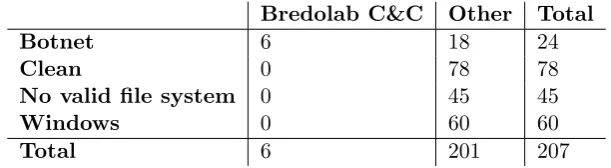
After this filtering, 102 images remain, be-longing to 90 different computers. Six of these images belong to the Bredolab C&C infras-tructure. In order to validate our method we labelled each of the images in this final 102 as “botnet” or “clean”, by manually looking through the file system on each image to de-termine whether it contains C&C related ma-terial. The distribution of these labels can be seen in table 3.1. All the Bredolab images are classified as “botnet”. Within the rest of the images we have found that 18 images contain botnet control software, making a total of 24 botnet images.
3.2
Indicators
To determine whether a given system contains a botnet C&C or not, we want to search its file system for indicators that reveal the pres-ence of a C&C. However, before we can start searching, we need to know which indicators to look for.
Bredolab C&C Other Total
Botnet 6 18 24
Clean 0 78 78
No valid file system 0 45 45
Windows 0 60 60
[image:27.595.148.454.108.192.2]Total 6 201 207
Table 3.1: The number of Bredolab and other disk images
One approach would be to build a database of the files making up the C&C’s belonging to as many known botnets as possible, then look for those files on the file system, i.e. a signature-based approach. If a number of files in this database are found on the file system, we can be pretty sure that there is a C&C present. This method is similar to the way most antivirus programs try to detect viruses. Unfortunately, this would mean that we can only detect C&C’s for known botnets, as our indicators would be too botnet specific.
Another approach would be to collect a num-ber of C&C’s for known botnets and try to distill generic C&C indicators from this collec-tion, incorporating information from the lit-erature and opinions of field experts. There is no guarantee that the indicators that re-sult from this process will be present in the C&C’s of future botnets, but it would be a step in the right direction. We have chosen to use this approach for our research. In the next few sections we will discuss how we came to our indicators.
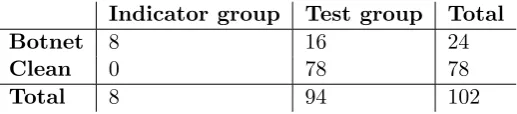
We have used two sources for gathering known C&C’s. The first source is the leaked versions of ZeuS and SpyEye, as discussed in section 1. For the second source we used part of our dataset. To this end, we divided the dataset into a “indicator group” and a “test group”. In the indicator group, we included the full Bredolab infrastructure (6 images) and two other images labeled as botnet. All the other images are part of the test group. The full dis-tribution of images can be seen in table 3.2.
Besides these two sources we have also spoken
with experts in the field of botnet research and botnet takedowns. These are:
1. The digital investigators who were involved with the Bredolab case at NHTCU, who know the Bredolab dataset well and helped devise the indi-cators “File Type” and “Database table name”.
2. The Director of the Digital Crimes Unit at Microsoft; Kayne Naughton at Shad-owserver; a legal consultant at Fox-IT and a number of technical representa-tives of the NCSC (former GOVCERT), all of whom helped to validate the de-tection method.
Besides these expert opinions a number of academic publications have helped our under-standing of the inner workings of certain com-mon botnets, such as ZeuS[15], SpyEye[29] and Cutwail[23]. These papers show how more and more bots use the http protocol to communicate with their C&C, which in turn tells us something about the way the C&C is set up.
Indicator group Test group Total
Botnet 8 16 24
Clean 0 78 78
[image:28.595.173.432.108.165.2]Total 8 94 102
Table 3.2: The number of disk images in the indicator and test groups
no longer detect the C&C using that specific indicator.
3.2.1 Database table name
The Bredolab C&C, as well as the ZeuS and SpyEye C&C all use suspicious names for the tables in the database that they use to store information about each bot. Examples are “bm2bots stats” or “4bnevbotstatus”. We try to find out where the database is located on disk by parsing the configuration files for the database software. We then extract the database table names and see if they contain the word “bot”.
Robustness: fragile, because a botmaster can change the names of the tables used by the C&C software.
3.2.2 File size
Law enforcement see full disk encryption and encrypted vaults more and more often in their cases[89][90][91]. It makes sense for a botmas-ter to put the vital parts of the C&C in an en-crypted vault as it will make forensics of the machine virtually impossible without getting hold of the encryption key or accessing the machine while the vault is already opened. If the botmaster ever gets caught by law enforce-ment, hiding the C&C software and data in an encrypted vault may deny law enforcement access to crucial evidence to make a case.
However, simply looking for large files on the file system gives us many false positives. If the server is used for sharing movies or host-ing virtual machines, for instance, large files
will be present, but the machine doesn’t nec-essarily contain an encrypted vault. Calculat-ing the entropy of each large file also doesn’t solve this problem as movies or other large files may have the same entropy characteris-tics as an encrypted vault and on top of that, calculating the entropy of a file takes a lot of time.
We try to lower the number of false positives by marking an image as suspicious if and only if the number of files over 1GB is larger than 0 and less than 5. Of course, even if the large file is an encrypted vault, this does not necessarily mean that the machine is botnet related. The next chapter will show whether this indicator yields many false positives or false negatives.
Robustness: medium, if a botmaster wants to use encrypted vaults these will usually be de-tectable. A botmaster can, however, use full disk encryption instead of encrypted vaults, in which case there is no access to the file system and thus no files to look for.
3.2.3 SQL queries
This indicator is an extension of the database table name indicator mentioned above. For all web hosting related scripts we find on a file system, we try to see if hard coded SQL queries contain the word “bot” using a regular expression and if so, mark the system contain-ing the scripts as suspicious.
3.2.4 File type
Bredolab was a so-called pay-per-install bot-net. The botmaster used Bredolab as a plat-form to distribute other pieces of malware