University of Warwick institutional repository: http://go.warwick.ac.uk/wrap
A Thesis Submitted for the Degree of PhD at the University of Warwick
http://go.warwick.ac.uk/wrap/36379
This thesis is made available online and is protected by original copyright. Please scroll down to view the document itself.
Knowledge Integration Processes and Dynamics:
An Empirical Study of Two
Cross-functional Programme Teams
Jimmy Chun-Ming Huang
Submitted in fulfilment of the requirements for the degree of Doctor of
Philosophy at Warwick Business School, University of Warwick
WAkVVICK
Warwick Business School
University of Warwick
ABSTRACT
This thesis critically reviews and evaluates theories of organisational knowledge and
knowledge-related activities. Specifically, it assesses and synthesises relevant theories
and thoughts to develop a conceptual model of the knowledge integration process.
Empirical evidence, collected from two organisations- Boots The Chemists and NatWest
Global Financial Markets is also exploited as a means of building a grounded theory of
knowledge integration
This theory explains the processes of knowledge integration within the context of
cross-functional project teams. It also considers the general factors that influence these
processes, as well as the dynamic interrelationships between the proposed processes.
The theory provides a framework not only for future research to systematically examine
and test knowledge integration processes within different organisations, but also allows
management to continuously anticipate knowledge integration activities within their own
organisations.
Based on a social construction perspective, this thesis demonstrates that knowledge
integration is more than merely the representation of intellectual activities underlying the
planning, redesign and implementation stages of a cross-functional programme. It also
argues that cross-functional knowledge integration is a continuous process in which
programme participants establish emotional alignment through social interaction.
This research contributes to studies of organisational knowledge and knowledge-related
activities by providing an explorative account that synthesises existing literature with
empirical evidence. Secondly, this research contributes to the theoretical development of
knowledge integration by focusing on its processes rather than just its outcomes and
implications which have been the main concern of other researchers. Finally, the
development of a cross-functional knowledge integration theory contributes to the
consolidation of the intellectual and emotional dimensions of knowledge-related
Contents
Chapter One: Introduction
1.1. Research Objectives and Significance 1
1.2. Synopsis of Current Literature and Research Gaps 2
1.3. Research Methodology and Design 6
1.4. Research Findings 7
1.5. Theoretical, Methodological and Managerial Contributions and Implications 9
1.6. Structure of the Thesis 11
Chapter Two: Current Debates and Perspectives
2.1. Introduction 14
2.1.1 Definitions 15
2.1.2 Objectives and scope of the literature review 16
2.1.3 The key research questions and the structure of the literature review 17
2.2. Knowledge in Organisations 19
2.2.1 What is knowledge? 19
2.2.2 The importance of knowledge 19
2.2.2.1 The societal focus 19
2.2.2.2 The economic focus 20
2.2.2.3 The strategic focus 21
2.2.3 Emerging issues 23
2.2.4 Typologies of knowledge 24
2.2.5 An integrative view of knowledge typologies 27
2.2.6 Knowledge-related concepts 30
2.2.6.1 Paradigm 32
2.2.6.2 Organisational memory 34
2.2.6.3 The interrelationship between paradigm, organisational knowledge
and organisational memory 36
2.2.6.4 Emerging issues 41
2.2.7.1 Organisation as a loosely coupled system 43
2.2.7.2 From resource dependence theory to the essence of resource
allocation 45
2.2.7.3 Cross-functional project teams 46
2.2.7.4 Emergent issues 48
2.3 Knowledge-related Activities 49
2.3.1 Introduction 49
2.3.2 Knowledge creation 49
2.3.2.1 The early analysis of knowledge creation: Product
and process innovation 50
2.3.2.2 The main contributions of innovation studies 52
2.3.2.3 Knowledge creation theories 52
2.3.2.4 Enablers for organisational knowledge creation 56
2.3.3 Knowledge sharing 57
2.3.3.1 Viewpoints and contribution of innovation research 57
2.3.3.2 The theoretical assumptions of innovation research 58
2.3.3.3 Knowledge sharing from the virtual team viewpoint 59
2.3.3.4 The emergence of a different viewpoint 60
2.3.3.5 Viewpoint of the present study 61
2.3.4 Collective learning 63
2.3.4.1 Individual learning 64
2.3.4.2 Collective learning 65
2.3.4.2.1 Collective learning processes: Radical
and incremental approaches 67
2.3.4.2.2 An alternative perspective: The concept of situated
learning 71
2.3.4.2.3 The standpoint of the present study 73
2.3.5 Knowledge integration 74
2.3.5.1 Definitions of cross-functional collaboration and knowledge
integration 75
2.3.5.2 Knowledge integration: Perspectives from various
research disciplines 76
2.3.5.2.1 The organisational behavioural approach 76
2.3.5.2.2 The innovation approach 78
2.3.5.2.4 Interrelationships between knowledge integration, sharing,
creation and collective learning 84
2.3.5.3 The processes of knowledge integration 85
2.3.5.3.1 Knowledge integration as a socialisation process 85
2.3.5.3.2 Knowledge integration as a resource securing process 87
2.3.5.3.3 Knowledge integration as a perspective taking process 88
2.3.5.3.4 Knowledge integration as an organisational memory
constructing process 90
2.4 The Social Construction Perspective 92
2.4.1 Introduction of the social construction perspective 92
2.4.2 Extended thoughts: The social construction of technology and
actor-network theory 92
2.4.3 Using the social construction perspective to study organisational
knowledge and knowledge-integration processes 95
2.4.3.1 The social construction perspective on organisational knowledge 96
2.4.3.2 The social construction perspective on knowledge
integration processes 98
2.5 Theoretical Gaps and Researchable Questions 99
2.5.1 Introduction 99
2.5.2 The unit and context of analysis 100
2.5.3 The identification of researchable questions 101
2.5.3.1 The accessibility of organisational knowledge 101
2.5.3.2 Situated learning and communities of practice 102
2.5.3.3 The prioritisation of knowledge integration 102
2.5.3.4 Perspective taking and knowledge integration 103
2.5.3.5 Organisational memory and knowledge integration 103
2.5.3.6 Knowledge integration processes 104
Chapter Three: Research Methodology
3.1 Introduction 105
3.2 Research Design 106
3.2.1 Philosophical stance 107
3.2.2 Qualitative versus qualitative research 109
3.2.4 Research design: Case study 113
3.2.4.1 Introduction 113
3.2.4.2 Advantages and disadvantages of case study 114
3.2.4.3 The issue of generalisability 115
3.2.4.4 Issues of validity and reliability 116
3.2.4.5 The issue of triangulation 117
3.3 Case Study: The Fieldwork Research Design 118
3.3.1 The preparation phase 118
3.3.1.1 Shaping the case study protocol 118
3.3.1.2 The pilot case study 119
3.3.1.2.1 Selecting and gaining access to the pilot case site 120
3.3.1.2.2 The lessons learnt from the pilot study 122
3.3.2 The data collection phase 124
3.3.2.1 Introduction 124
3.3.2.2 Gaining access 125
3.3.2.3 On-site observation 127
3.3.2.4 Interviewing 128
3.3.2.4.1 Types of interview 129
3.3.2.4.2 The formulation and piloting of interview questions 130
3.3.2.4.3 The selection of interviewees and interviews 131
3.3.2.5 Documentation 133
3.4 The Data Analysis and Interpretation Phase 134
3.4.1 The coding processes 134
3.4.2 Literature comparison and the issue of validation 137
3.5 Thesis Writing 138
3.6 Conclusion 139
Chapter Four: A Case Study Of Boots The Chemists- The
Business Process Redesign Programme
4.1 Introduction 142
4.1.1 Organisational background 142
4.1.2 The BPR Programme: Background 143
4.1.3 The interrelationships between the projects 145
4.1.4 BPR team and programme participants 147
149 149 149 150 151 151 152 152 153 157 158 158 159 163 163 166 175 175 176 177 177 178 179 179 180 181 181 182 4.1.4.2 The BPR programme participants
4.2 The BPR Programme and its Processes
4.2.1 Introduction
4.2.2 Pre-BPR preparation
4.2.3 The processes of the BPR Programme
4.2.3.1 Introduction
4.2.3.2 Shaping the future
4.2.3.2.1 Introduction
4.2.3.2.2 Challenges and problems occurring during the
'shaping the future' stage
4.2.3.2.3 Promotion, persuasion and negotiation
4.2.3.3 The redesign stage of the BPR Programme
4.2.3.3.1 Introduction
4.2.3.3.2 Challenges and problems occurring during the
redesign stage
4.2.3.4 The implementation of the BPR Programme
4.2.3.4.1 Introduction
4.2.3.4.2 Challenges and problems occurring during the
implementation stage
4.3 Emerging Themes from the BTC Case
4.3.1 Introduction
4.3.2 Removing departmental boundaries
4.3.3 Sustaining the project priority
4.3.4 Overcoming individual's mental barriers
4.3.5 Modifying organisational routines
Chapter Five: A Case Study Of Natwest Global Financial
Markets (GFM)- The GFM Millennium Programme
5.1 Organisational Background
5.1.1 NatWest GFM's business process
5.1.2 Organisational structure
5.2 The NatWest GFM Millennium Programme (GMP)
5.2.1 Programme background
5.2.3 The GMP team 185
5.2.3.1 The team leader 186
5.2.3.2 The team members 187
5.3 The GMP and its Processes 189
5.3.1 Pre-GMP preparation: The initiative stage 189
5.3.2 Major challenges faced by the GMP team 190
5.3.3 The implementation planning stage 191
5.3.3.1 Introduction 191
5.3.3.2 Major activities of the implementation planning stage 192
5.3.3.2.1 The expansion of system inventory 192
5.3.3.2.2 The introduction of documentation 193
5.3.3.3 Challenges arising during the implementation planning stage 194
5.3.3.3.1 The diversity and complexity of IT systems 194
5.3.3.3.2 Differences in knowledge backgrounds 196
5.3.4 The implementation stage 197
5.3.4.1 Introduction 197
5.3.4.2 Activities during the implementation stage 198
5.3.4.2.1 The recruitment of team members 198
5.3.4.2.2 The introduction of a global standard procedure 200
5.3.5 Millennium compliance testing 201
5.3.5.1 Challenges faced during the implementation and testing stages 202
5.3.5.1.1 Overcoming team members' learning curve 202
5.3.5.1.2 Gaining agreement on the approach to conduct IT
system testing 204
5.3.5.2 Overcoming communication barriers 206
5.3.5.3 Gaining programme priority 210
5.4 Emerging Themes from the NatWest GFM Case 213
5.4.1 Introduction 213
5.4.2 Bridging the knowledge gap 213
5.4.3 Overcoming communication barriers 214
5.4.4 Sustaining programme priority 214
Chapter Six: Analysis -- The Processes of Cross-functional
Knowledge Integration
6.1 Introduction 217
6.2 The Process of Boundary Penetrating 219
6.2.1 Multi-faceted and multi-directional nature of the boundary
penetrating process 219
6.2.2 Barriers created by the physical dispersion of organisational units 222
6.2.3 Observed mechanisms for boundary penetrating 226
6.2.4 Subcultural boundaries and their penetration 228
6.2.5 The boundary of knowledge and its penetration 232
6.2.6 Issues influencing the boundary penetrating process 236
6.2.6.1 The task-related aspect 237
6.2.6.1.1 The use of incentives 237
6.2.6.1.2 Selection of team members to ensure knowledge
redundancy 239
6.2.6.1.3 External forces 240
6.2.6.2 The socio-emotional aspect 241
6.2.6.2.1 Social networks 241
6.2.6.2.2 Trust 242
6.2.7 Summary of the boundary penetrating process 244
6.3 The Process of Priority Maintaining 245
6.3.1 The importance of priority maintaining 245
6.3.2 The process of priority maintaining 247
6.3.3 Priority maintaining and the cost of knowledge-related activities 249
6.3.4 Actions taken to maintain programme priority 251
6.3.4.1 Achieving intellectual buy-in 252
6.3.4.2 Achieving emotional buy-in 253
6.3.5 Issues influencing the priority maintaining process 255
6.3.5.1 The intellectual aspect 255
6.3.5.1.1 The progress of the programme 255
6.3.5.1.2 Information sharing 257
6.3.5.2 The emotional aspect 259
6.3.5.2.2 The reconfiguration of social networks 261
6.3.6 Summary of the priority maintaining process 263
6.4 The Process of Paradigm Expanding 264
6.4.1 The nature of paradigms 265
6.4.2 Paradigm expanding within cross-functional programme teams 267
6.4.3 Paradigm expanding and collective sense-making 270
6.4.4 Paradigm expanding and the process of developing a collective mind 272
6.4.5 Paradigm expanding and the distribution of power in the programme team 274
6.4.6 Managing paradigmatic differences 275
6.4.7 Issues influencing the paradigm expanding process 277
6.4.7.1 Perspective taking 278
6.4.7.2 Mutual learning 280
6.4.8 Summary of the paradigm expanding process 282
6.5 The Process of Organisational Memory Refining 283
6.5.1 The nature of organisational memory refining 284
6.5.1.1 Cross-functionality 284
6.5.1.2 Continuity 286
6.5.2 Tactics in organising the process of organisational memory refining 288
6.5.2.1 The use of external expertise and contractors 288
6.5.2.2 Documentation 291
6.5.2.3 Tactics for managing the process of organisational memory
refining 294
6.5.3 Issues influencing the organisational memory refining process 295
6.5.3.1 Group diversity 296
6.5.3.2 Knowledge transformation and embedding knowledge
into practice 298
6.5.4 Summary of the organisational memory refining process 300
6.6 The Dynamic Interrelationships between the Four Processes 302
6.7 Summary from the Perspective of Organisational Knowledge and the
Concept of Knowing 304
6.7.1 The perspective of organisational knowledge 304
Chapter Seven: Conclusion
7.1 Introduction 309
7.2 Limitations and Future Research 311
7.3 Contributions and Implications 315
7.3.1 Theoretical contributions and implications 315
7.3.1.1 A synergetic account of cross-functional knowledge integration 315
7.3.1.2 Knowledge integration in the context of cross-functional teams 323
7.3.1.3 Social construction perspective of knowledge integration 324
7.3.2 Managerial contributions and implications 326
7.3.2.1 The management of cross-functional knowledge
integration activities 327
7.3.2.2 The development of virtual teamwork 327
7.3.2.3 Project management 328
7.3.3 Methodological contributions and implications 329
List of Tables
Tables Titles Pages
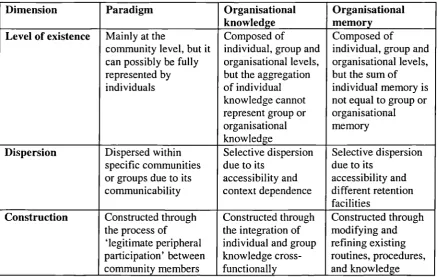
Table 2.1 A comparison of paradigm, organisational knowledge and
organisational memory 37
Table 3.1 The main distinctions between quantitative and qualitative
research methods 109
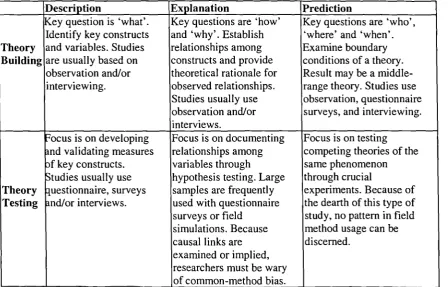
Table 3.2 Theory building vs. theory testing 112
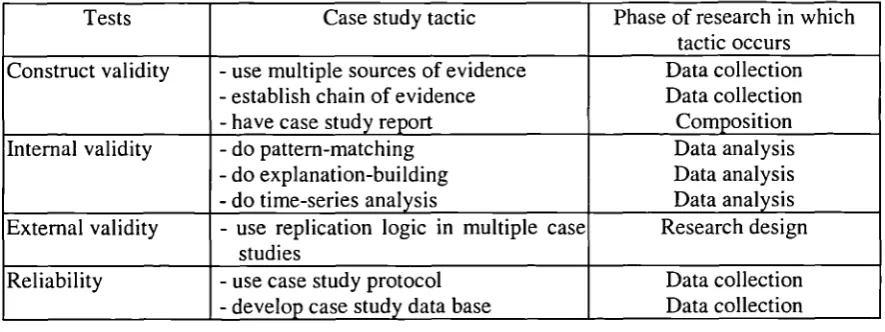
Table 3.3 Case study tactics for four design tests 116
Table 5.1 The key milestones of the GMP 185
List of Figures
Figures Titles Page
Figure 2.1 The landscape of knowledge in the organisational context 28
Figure 4.1 The structure of the Head Office 2000 Programme 144
Figure 5.1 NatWest Group Millennium Programme 183
Figure 5.2 An example of how networked IT systems were tested by
the GMP team 205
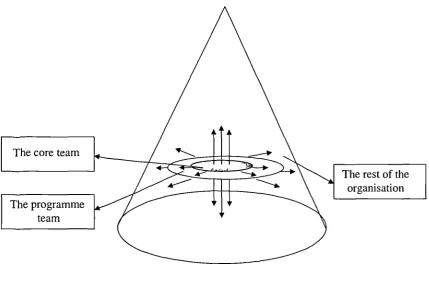
Figure 6.1 The multi-directional nature of the boundary penetrating
process 222
Figure 6.2 Processes of knowledge integration and issues influencing
Abbreviations
BP Amoco British Petroleum Amoco
BPR Business Process Redesign
BT British Telecommunications
BTC Boots The Chemists
DTI Department of Trade and Industry
FTSE Financial Times Stock Exchange
GFM Global Financial Markets
GMP GFM Millennium Programme
IBM International Business Machine
ICT Information Communication Technology
IMR0 Investment Management Regulatory Organisation
IT Information Technology
MIRA Motor Industry Research Association
NatWest National Westminster Bank
NGC National Grid Company
Declaration
This thesis is presented in accordance with the regulations for the degree of doctor of
philosophy (Ph.D.). The work described is entirely original and my own, unless
otherwise indicated. None of the material contained hereafter has been submitted for a
degree at any other university. The interpretations in this thesis are the sole
responsibility of the author, and do not in any way represent the views of the case
companies or Warwick Business School.
The following papers based on the findings in this thesis have already been published
Book Chapter
Huang, J. and Antonacopoulou, E. (1999), 'How an oil giant learns: A case study of
British Petroleum', in W. Baets, edited 'A collection of essays on complexity and
management', London: Word Scientific.
Conference Papers
Huang, J. C., Newell, S. and Pan, S. L. (2000), 'Knowledge integration: Learning from
millennium bug experience: A case study of Natwest Global Financial Markets',
European Conference on Information Systems (ECIS 2000), Presented in July 2000,
Vienna, Austria.
Huang, J. C., Laurent, S. and Pan, S-L. (2000), 'Knowledge sharing as the process of
boundary penetrating', 16 th EGOS Colloquium, Presented in July 2000, Helsinki,
Acknowledgements
The three and half years at Warwick Business School studying for my Ph.D. were not merely an intellectual challenge, but also represented a lengthy procedure of mental development. The process of completing this thesis was by no means smooth, in particular before and during the fieldwork, it is thanks to the people addressed below that the journey has finally been concluded.
Without the support of my family, the completion of this study would not have been possible. It was the sense of pride my parents gave me that encouraged and inspired me begin the process and it was our determination to 'produce' a Dr. Huang for the family that invigorated me to stand up again when I fell down. My sisters are also two heroines behind my study who have continuously provided support and encouragement.
I would like to express my sincere gratitude to Professor Sue Newell of Nottingham Business School, Dr. Elena Antonacopoulou of Manchester Business School and Mr. Glenn Morgan of Warwick Business School who have all provided superb supervision at various stages of my studies. In particular, Sue and Elena have devoted enormous efforts in laying the foundations for the project, shaping the research design and also developing my own mental strength. Elena's remarkable commitment has transformed a dreamer into a creator. Sue's incredible patience and energy helped me through the entire Ph.D. process — you said 'keep going', with your help, I did. I also wish to thank the two examiners, Professor Paul Quintas and Professor Bob Galliers, for their supportive and constructive remarks upon my thesis.
Many colleagues at Warwick Business School also provided tremendous help and support during my study by sharing my happiness and tears. Dr. Shan L. Pan, now of the National University of Singapore was not only my co-author on many publications, but also a person I spent many, many hours discussing research with. Ming-Heui Hsieh, who married Shan only a few weeks ago, showed remarkable patience and tolerance in allowing those discussions to take place. Dr. Graham Sadler and Dr. Laura Read are two friends that I know I can knock on their door at anytime whenever I need their help. Intensive debates with Mr. Arjen van den Berg in this relatively distinctive research area also helped to stimulate and extend my thoughts.
I would also like to offer my thanks to the University of Aberdeen for providing me with a lectureship in the Department of Management Studies. It has enhanced my research interests and my confidence. In particular, the special allowance provided by Professor Graeme Simpson and Professor Richard Harrison allowing me initially to fully concentrate on the completion my thesis was of immense help.
Mr. Mark Swarbrick of the DTI who enthusiastically facilitated and ensured the progress of my research. In particular, Mr. Brad Poulson of BTC and Mr. David Piggin of Bizbuyer.com (previously of NatWest GFM) have provided enormous help in arranging meetings with potential project sponsors. Ms. Gillian McCabe also provided valuable support during the fieldwork in NatWest GEM.
Chapter One: Introduction
1.1 Research Objectives and Significance
The growing interest in the issue of organisational knowledge has been reflected in the
increased academic attention, as well as the number of organisations that have begun to
pay particular attention to the way they manage their knowledge. Despite the fact that
the value of knowledge to organisations has long been recognised by management
scholars (e.g. Bell 1973; Drucker 1968), it is only recently that knowledge within the
organisational context has been studied in its own right. The diversity in research foci
and efforts has extended the understanding of knowledge from simply what people
know, to what people do (Blackler 1995; Blackler, Crump and McDonald 2000;
Gherardi 2000; Grant 1996). This is evident in numerous management studies that
emphasise how knowledge can be created (Nonaka and Takeuchi 1995), shared (Hansen
1999; Pan and Scarbrough 1999), acquired (Huber 1991), transferred (Lam 1997;
Wathne, Roos and von Krogh 1996) and managed (Hedlund 1994; Quintas, Lefrere and
Jones 1997). The present study categorises the above type of research into studies of
knowledge-related activities.
In synthesising all efforts of researching knowledge-related activities and organisations'
competitiveness, Grant (1996) concludes that 'the primary role of the firm, and the
essence of organisational capability, is the integration of knowledge' (p: 375). The
concept of knowledge integration is also addressed and examined by other studies, for
development (Pisano 1994) and product development (Pinto and Pinto 1990). Despite
the abundant research efforts, however both within the intra- and inter-organisational
contexts, it is manifest that previous studies placed emphasis primarily upon the
outcome, importance and implications of knowledge integration. There are relatively
few previous studies that seek to unveil and theorise the underlying processes of
knowledge integration (Hauptman and Hirji 1999), in particular within the context of
cross-functional project teams. Inspired by the need for further theoretical development,
this thesis aims to fill this gap by building a grounded theory that is able to depict the
processes of knowledge integration, as well as the dynamic interrelationships between
those processes. The context of cross-functional project teams reflects the primary
emphasis of the study that is to focus on knowledge integration processes and dynamics
at the team and group levels, rather than at the organisational or inter-organisational
levels. Also, this explains why some important concepts, such as the importance of
knowledge to a firm's growth (Penrose 1959) and cross-organisational technology
diffusion (Attewell 1996; Newell, Swan, Newell and Robertson 1999), are not
incorporated into the study.
1.2 Synopsis of Current Literature and Research Gaps
In terms of the nature of organisational knowledge, past findings suggest that knowledge
is not merely something that is abstract, centralised and detached from its context (Star
1989). Instead, organisational knowledge is context dependent (Nonaka and Konno
1998), dispersed (Tsoukas 1994), practice-based (Cohen and Bacdayan 1994),
of the nature of organisational knowledge, studies developing knowledge typologies
propose numerous categorisations in conceptualising the distinctiveness of
organisational knowledge. Some examples of knowledge typologies include the tacit and
explicit dimensions advocated by Polanyi (1958), Sanchez and Heene's (1997)
know-what, know-how and know-why, as well as public and private knowledge by Matusik
and Hill (1998). Stemming from the development of such knowledge typologies, further
research stresses activities in which knowledge is embedded, as reflected in the concept
of knowing (Blackler 1995; Blackler Crump and McDonald 2000; Gherardi 2000).
Synthesising various knowledge typologies with the concept of knowing,
knowledge-related activities are summarised in this thesis into six categories, namely knowing-what,
knowing-who, knowing-how, knowing-why, knowing-where and knowing-when. For
instance, the study of social capital in relation to knowledge creation (Nahapiet and
Ghoshal 1998) is an example that anticipates how knowing-who and knowing-where
facilitate the process of knowing-how. Additionally, the study of collective learning
from the aspect of organisational routines (Cyert and March 1963) demonstrates an
equal emphasis on the issues of knowing-what and knowing-why. In comparison to
other types of knowing, the concept of knowing-when is less developed and articulated.
The need for theoretical development in explaining how organisations prioritise their
knowledge-related activities is clearly evident.
The current literature in the area of knowledge-related activities also provides a vital
foundation to explore and anticipate the dynamics of cross-functional knowledge
externalising knowledge that is often tacit and embedded (Nonaka and Takeuchi 1995).
Also, the creation of new organisational knowledge lies in the process of combining
existing knowledge, regardless of whether it is tacit or explicit (Nahapiet and Ghoshal
1998; Nonaka and Takeuchi 1995). The study of knowledge sharing suggests not only
the importance of understanding the interplay between technical and social issues (Pan
and Scarbrough 1999), but also the need for overcoming boundaries created by cultural
differences (Lam 1997). Collective learning research has enlarged our understanding of
how knowledge can be acquired (Huber 1991), utilised (Arrow 1962), and discarded
(Hedberg 1982) as a means of enhancing organisational renewal (Jones and Hendry
1994). Clearly, from the above examples, the study and conceptualisation of knowledge
integration can not be isolated from other knowledge-related activities.
Additionally, even though concepts such as paradigm (Kuhn 1970) and organisational
memory (Walsh and Ungson 1991) are often quoted in the research of
knowledge-related activities and organisational knowledge, there are relatively few accounts that
explain their significance and influence in relation to knowledge-related activities. In
particular, previous accounts of knowledge integration have largely failed to take into
account paradigm and organisational memory as part of their inquiries. An important
contribution of this thesis then is the way it incorporates the concepts of paradigm and
organisational memory as a means of exploring the processes of cross-functional
knowledge integration.
Although the advantages of using cross-functional project teams are strongly promoted
empirical evidence available to depict the dynamics of knowledge integration within
such a specific context, especially in relation to the use of virtual teams in an
organisation. Such virtual teams often employ information communication technology
(ICT) to overcome geographic constraints (e.g. Ciborra and Suetens 1996; Jarvenpaa,
Knoll and Leidner 1998) or cut down travelling cost (e.g. Wilson 1994). Our
understanding about such practice is still limited primarily to such advantages.
Difficulties and problems encountered by virtual teams in terms of encouraging
knowledge sharing (Ciborra and Patriotta 1996) and developing emotional attachment
(Lembke and Wilson 1998) and trust (Jarvenpaa, et al. 1998) require much more
investigation. Stemming from such theoretical underdevelopment, this study
incorporates cross-functional virtual teams as the main context for exploring knowledge
integration processes.
Based on the notion of Berger and Luckmann (1967) that reality is constructed through
the social interaction of actors, it is clear that such a reality can only be understood and
analysed through its evolution. Further thoughts and ideas added to the social
construction perspective, such as SCOT (Grint and Woolgar 1997; Pinch and Bijker
1987) and actor-network theory (Latour 1987), all share the view that the essence of
studying any social process lies in the understanding of the dynamics of social
interaction. Such perspectives provide an adequate philosophical lens with which to
anticipate and theorise the processes of cross-functional knowledge integration.
Synthesising the above theories, thoughts and perspectives, three research questions are
• What are the processes of knowledge integration within the context of
cross-functional project teams?
• What are the issues that influence these cross-functional knowledge integration
processes?
• What are the dynamic interrelationships between those knowledge integration
processes?
1.3 Research Methodology and Design
Empirical evidence is necessary for the above research questions to be answered, and to
achieve the research objective of building a grounded theory (Glaser and Strauss 1967;
Strauss and Corbin 1990) that is able to depict the phenomenon of cross-functional
knowledge integration. Based on the seminal work of Glaser and Strauss (1967), Yin
(1984) and Miles and Huberman (1984), Eisenhardt's (1989) generative account of
using case studies for theory building provides a useful guideline for shaping the
research design. The case study research design adopted in this thesis is based on the
rationale of flexibility in using multiple data collection methods, as well as the ability to
articulate insightful stories embedded within the chosen social context (Van Maanen
1979). The development of a case study protocol helped not only to clarify necessary
procedures, but also to enhance the reliability of the study (Stake 1995; Yin 1984). A
pilot case study conducted in BP Amoco enabled the researcher to acquire first hand
research experience, improve the research design and provide an excellent example of
Based on the concept of theoretical sampling (Glaser and Strauss 1967), two research
sites were selected based on the criteria of project scope, duration and the geographic
dispersion of participants. Such selection also helped to accommodate both theoretical
similarities and differences (Orlikowski 1993). Despite the fact that gaining access to
research sites appeared to be more difficult and problematic than anticipated, valuable
lessons were gained and are illustrated in Chapters Three and Seven. The two case
studies finally conducted were in Boots The Chemists (Business Process Redesign
Programme) and National Westminster Bank Global Financial Markets (GFM
Millennium Programme). The data collected through interviews, on-site observation and
documentation were analysed systematically based on the concepts of open, axial and
selective coding (Strauss and Corbin 1990), as well as the technique of matrix display
proposed by Miles and Huberman (1994).
1.4 Research Findings
Four distinctive but interrelated knowledge integration processes were identified from
the data. The term 'boundary penetrating' is used to refer to the process by which team
members break through various task-related and socio-emotional (Benne and Sheats
1948) boundaries to acquire the information and knowledge needed for a programme.
The complexity and multi-dimensional and —faceted nature of boundaries are illustrated
and conceptualised. This shows clearly why boundary penetrating is so problematic but
also critical for understanding processes of cross-functional knowledge integration. The
second process of cross-functional knowledge integration is termed 'priority
reinforced and priority is continuously sustained through competition with other
programmes and initiatives. The third process is called 'paradigm expanding' and refers
to the process by which consensus is developed from different theoretical and
methodological rules, instruments and standards practised by the programme
participants. The final process is termed 'organisational memory refining'. The concept
of organisational memory refining is used here to refer to the process through which
organisational memory is continuously re-examined, challenged, modified, and
redefined through the social interaction of programme participants during various stages
of the cross-functional programme.
Evidence abstracted from the analysis suggests that from a task-related perspective the
use of incentives, the selection of programme participants to ensure knowledge
redundancy (Nonaka 1990) and the presence of external forces are the three main issues
that influence the process of boundary penetrating. On the other hand, from the
socio-emotional perspective, the availability of social networks (Burt 1992; Nahapiet and
Ghoshal 1998) and the development of trust (Newell and Swan 2000) between
participants were found to be paramount for penetrating the various different types of
boundaries identified from the two cases. From an intellectual dimension, the evidence
indicates that programme progress and information sharing are crucial to the process of
priority maintaining. In contrast, from the emotional aspect, sharing programme
ownership and the reconfiguration of social networks are critically essential for the
process of priority maintaining. Perspective taking (Boland and Tenkasi 1995; Sessa
1996) and mutual learning (March 1991) are identified as two main issues that influence
1998), transforming information into knowledge, and applying knowledge into
day-to-day organisational practices and routines are found to be vital for refining organisational
memory.
Despite the fact that the above four processes are analytically separated, they are in fact
interconnected and mutually reinforced. In terms of the dynamic interrelationships, it is
found that to penetrate three different types of boundary, either task-related or
socio-emotional, requires aligning the programme participants and the stakeholders
intellectually and emotionally. This points to a link between boundary penetrating and
priority maintaining through the achievement of intellectual and emotional buy-in.
Group diversity as a source of paradigmatic differences also creates boundaries that need
to be penetrated. This demonstrates the interdependence between the processes of
boundary penetrating and paradigm expanding. The management of group diversity was
found to be crucial for the process of organisational memory refining, suggesting a link
between the processes of boundary penetrating and paradigm expanding. The
interrelationships between the process of priority maintaining and the other three are
reflected in the importance of maintaining programme priority as a means of ensuring
the continuity of cross-functional knowledge integration activities.
1.5 Theoretical, Methodological and Managerial Contributions and
Implications
Derived from the synergistic nature of this study, one of the major theoretical
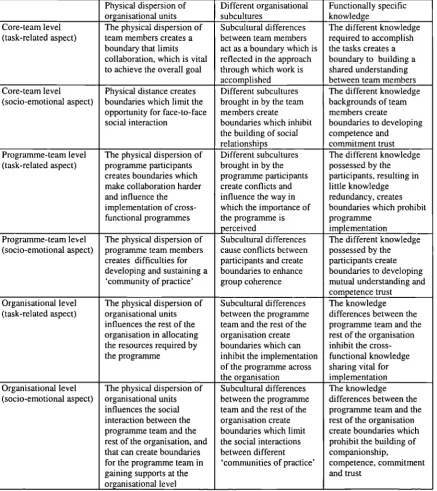
integration. Systematic efforts in identifying various types of boundary and the
elaboration of boundary penetrating point out the incompleteness of perceiving
knowledge sharing as a merely psychological issue influenced by individuals'
willingness. The concept of priority maintaining raises the importance of resources in
energising knowledge-related activities that are commonly neglected in the current
literature. The discussion of priority maintaining further portrays resource allocation as
not simply a decision based on an objective measurement of pros and cons. Resource
allocation is an ongoing socialising process between organisational members and is
largely influenced by the landscape of social networks.
Another theoretical contribution lies in the exploration of the knowledge integration
concept within the context of cross-functional teams, in particular where participants are
geographically dispersed. Findings generated in this thesis not only extend the concept
of 'community of practice' (Brown and Duguid 1991; Wenger and Snyder 2000) by
adding the virtual dimension, but also enlarge the concept of situated learning (Lave and
Wenger 1991) by inputting different phenomena to the process of 'peripheral legitimate
participation'.
The third theoretical contribution is to incorporate a social construction perspective into
the study of knowledge integration. Stemming from the social construction perspective
(Berger and Luckmann 1967), four interrelated processes elaborated in this study
suggest that cross-functional knowledge integration cannot be anticipated merely from
between the intellectual and emotional elements underlying the phenomenon of
cross-functional knowledge integration.
In addition to the theoretical implications, the four knowledge integration processes
elaborated above have methodological implications, as they can be applied as a
guideline for data collection. Firstly, the concept of boundary penetrating suggests the
need for using different penetration tactics for gaining access. However, various types of
boundary highlighted in Section 6.2 indicate that it is equally vital to penetrate
boundaries created by cultural and knowledge differences between the researcher and
the researched. The process of priority maintaining points out the essence of achieving
intellectual buy-in by promoting the value of the research project to the research site, as
well as an emotional buy-in by developing trust with the researched. From the aspect of
paradigm expanding, it is crucial to understand and take the researched perspective as a
means of understanding the way in which their social reality is constructed. Finally, the
discussion of organisational memory refining raises the needs for the researcher to
provide the researched with valuable recommendations for improving their existing
practices and routines. This also facilitates other processes, in particular boundary
penetrating and priority maintaining.
In terms of managerial contributions and implications, this study outlines some essential
guidelines for the management of cross-functional project teams, and the development
of virtual teams, as well as for project management. To enable collaboration across
functions, it is vital for management to ensure that various boundaries are overcome.
are all found to be useful. Additionally, it is vital for management to recognise that
cross-functional knowledge integration cannot be treated as merely an intellectual
activity. Equally important, the significance of social and emotional elements needs to
be taken into account, in particular for the development of virtual teamwork. This further
raises the issue that the management of cross-functional projects and project teams lies
in the anticipation, understanding and appreciation of the interplay between intellectual
and emotional aspects of the project.
1.6 Structure of the Thesis
The remainder of this thesis is structured as follows. Chapter Two highlights current
debates and perspectives related to the areas of organisational knowledge and
knowledge-related activities. Additionally, issues that are essential to the inquiry of
cross-functional knowledge management are examined. Three research questions
derived from the examination of the current literature are investigated. Chapter Three
outlines the methodological concerns related to this study. Issues including the
philosophical stance, research orientation, design, objectives, data collection methods,
techniques for data analysis are also explored as a means of answering the proposed
research questions. Chapter Four outlines the data collected from the first case site, the
BPR Programme in BTC. Stories relating to the planning, redesign and implementation
of the BPR programme are provided. Chapter Five details stories of how the millennium
programme was planned, designed and implemented within NatWest GFM. Insights
relating to various stages of the programme are presented. Chapter Six elaborates the
sites, as well as the comparison of the current literature outlined in Chapter Two.
Finally, Chapter Seven concludes the thesis, elaborating the research limitations and
future research directions, as well as addressing theoretical, managerial and
Chapter Two: Current Debates and Perspectives
2.1 Introduction
An increasing volume of literature has identified different types of knowledge within
organisations and their interrelationships, as illustrated by the typologies of Blacker
(1995) and Spender (1996). There has also been a sustained effort to investigate how
knowledge is created (Nonaka and Takeuchi 1995), shared (Hansen 1999), managed
(Quintas, et al. 1997), and learnt (Cyert and March 1963; Argyris and Schiin 1978) in
the organisation. Knowledge integration has come to be seen as a key foundation of
competitive advantage (Grant 1996) and as a means by which organisations synthesise
and co-ordinate their activities (Lawrence and Lorsch 1967). However, compared with
concepts such as knowledge creation, knowledge sharing and organisational learning,
the concept of knowledge integration remains underdeveloped (Hauptman and Hirji
1999). A lack of empirical evidence and coherent theoretical approaches to the
conceptualisation of the knowledge integration phenomenon have provided the
inspiration for this thesis to explore further these areas of concern.
Additionally, even though cross-functional project teams are increasingly formed for
various purposes, such as new product development (Moenaert and Sounder 1990) and
improving co-ordination (Ford and Randolph 1992), the theoretical underdevelopment
of knowledge integration processes within this specific context is evident (Denison et al.
dynamics of knowledge integration processes within the context of cross-functional
project teams, as well as to identify the main issues that influence those processes.
2.1.1 Definitions
To begin with, it is important to define some key terms that will feature in the
subsequent analysis. First, derived from the seminal work of Berger and Luckmann
(1967) and Nonaka and Takeuchi (1995), knowledge is defined by the present study as a
'socially constructed true belief', and organisational knowledge as a 'collective socially
constructed belief shared by some or all of the organisational members'. Secondly,
building upon the work of Lawrence and Lorsch (1967) and the above definition of
organisational knowledge, this study defines knowledge integration as 'an ongoing
collective process of constructing, articulating and redefining shared belief through the
social interaction of organisational members'. For the sake of convenience, we define
research that investigates knowledge issues (such as the characteristics and typologies of
knowledge) in the organisational context as 'organisational knowledge' studies. As
Blackler (1995) observes, as well as trying to understand what people know, it is equally
vital to investigate what they do. Accordingly, research that focuses on how
organisational members create, share, learn and integrate knowledge in the
organisational context may be seen to encompass studies of 'knowledge-related
activities'. Furthermore, learning may be defined as an 'integrated cognitive and
socio-emotional process' (Kolb and Fry 1975, p. 34). This study adopts the term collective
learning (Dodgson 1993) to refer to learning taking place at the team, group,
2.1.2 Objectives and Scope of the Literature Review
This literature review has three interrelated objectives. First, it seeks to review the
chosen literature critically and sympathetically in order to expose current debates and
perspectives in the chosen areas of investigation. This leads directly to the second
objective, which is to identify major theoretical gaps that need to be filled. Following on
from this, the third objective is to formulate researchable questions and an appropriate
data collection strategy that addresses the need for further theoretical development.
The two main bodies of literature reviewed in this study are those concerning
organisational knowledge and knowledge-related activities. In addition, various theories
and ideas rooted in the study of organisational behaviour, group dynamics, strategy and
innovation are also examined. In the field of organisational knowledge, considerable
attention has already been given to the typologies and characteristics of knowledge. In
addition, concepts such as paradigm (Kuhn 1970) and organisational memory (Walsh
and Ungson 1991) have been regularly discussed, often in association with such ideas as
organisational knowledge base' (Boisot and Grifiths 1999) and knowledge architecture2
(Rebentisch and Ferretti 1995).
The rationale behind focusing on these two specific areas is fourfold. First, a typology
provides an ecological view on the different kinds of knowledge existing within the
organisation. Secondly, an analysis of the characteristics of organisational knowledge
'According to Boisot and Griffiths (1999), knowledge base refers to the domain within which the intellectual capital possessed by an organisation is allocated.
2
helps to explain the complexity of organisational knowledge and suggests that a holistic
view of the dynamics of knowledge in an organisational context is needed (Star 1989).
Thirdly, it is important to clarify the conceptual ambiguity between organisational
knowledge, organisational memory and paradigm — terms that are often used
interchangeably, for example in studies by Stein and Zwass (1995) and Wang (1999). As
far as knowledge-related activities are concerned, for the sake of convenience this
review distinguishes between knowledge creation, knowledge sharing, collective
learning and knowledge integration. This decision is based on two major considerations:
(1) in view of the need to take a broad view of the concept of 'knowing' (Blackler
1995), as indicated earlier, it is clear that merely reviewing the literature on
organisational knowledge is not sufficient for the purpose of understanding the process
of knowledge integration; (2) the concept of knowledge integration processes cannot be
studied in isolation from other knowledge-related activities.
2.1.3 The Key Research Questions and the Structure of the Literature Review
Three key research questions, articulated through a review of the main body of the
literature, may be summarised as follows:
• What are the key processes that underlie knowledge integration within the
cross-functional project team?
• What are the interrelationships between these key knowledge integration processes?
The main body of this literature review is divided into four parts: organisational
knowledge, knowledge-related activities, the social construction perspective, and
theoretical gaps and research questions. The rationale behind this structure is that the
understanding of organisational knowledge serves as the first step in investigating
knowledge-related activities in the organisational context. This in turn helps to
consolidate and compare different research findings on knowledge-related activities with
empirical evidence generated by this study. The social construction perspective forms
the basis of the theoretical approach adopted in this study to investigate the dynamics of
knowledge integration processes. Based on a review of the existing literature, and using
the chosen perspective, major theoretical gaps are then identified and key research
questions formulated.
After formulating a definition of knowledge, a discussion of knowledge typologies
follows. Knowledge-related concepts such as paradigm and organisational memory are
then analysed, and the main characteristics of organisational knowledge, memory and
paradigm are identified. The value of knowledge, as seen by different schools of
thought, is then discussed. The second body of literature is concerned with central
debates and perspectives on knowledge-related activities. A discussion of knowledge
creation is followed by a review of knowledge sharing, a consideration of collective
learning, and an exploration of the development of a cross-functional knowledge
integration theory. Finally, after discussing the social construction perspective, key
2.2 Knowledge in Organisations
2.2.1 What is Knowledge?
Debates about the nature of knowledge can be traced back to the ancient Chinese and
Greeks. These have been characterised by enduring battles between different schools of
thought and a resulting failure to achieve agreement. This thesis does not seek to prolong
these ongoing arguments. For the sake of convenience, it combines Berger and
Luckmann's (1967) social construction perspective and Nonaka and Takeuchi's (1995)
theory, and defines knowledge as a socially constructed true belief. According to the
social construction perspective, knowledge is constructed by the interaction of social
actors and represents the way in which reality is interpreted within a specific social
setting. This perspective provides a lens to examine and consolidate other relevant
concepts that represent knowledge within various social contexts, for example the
concepts of paradigm and organisational memory.
2.2.2 The Importance of Knowledge
The importance of knowledge is widely recognised in many research disciplines. This
study concentrates on three categories of literature which together provide different
insights into the significance of knowledge: the societal, economic and strategic.
2.2.2.1 The Societal Focus
Rapid change in our society means that the only certainty is uncertainty (Nonaka and
Takeuchi 1995). For many scholars, it is the emergence of the knowledge society that
critical importance of knowledge to the post-industrial society is emphasised by Bell
(1973). A similar viewpoint is expressed by Drucker (1999), who notes that: 'the most
valuable asset of a 2.1 st century institution (whether business or non-business) will be its
knowledge workers and their productivity' (p. 79).
Research in IT and IS also underlines the social impact of knowledge. In particular,
studies of the 'information age' (e.g. Brown 1999 and Lynch and Lynch 1996) point to
the crucial role of information and communication technology (ICT) in catalysing
societal change. The low cost and increased efficiency of acquiring information is
widely seen as a vital issue in facilitating knowledge creation (Nambisan, Agarwal and
Tanniru 1999). One of the most critical issues revealed by the societal focus is the need
for organisations to effectively acquire knowledge from the external environment as a
basis for knowledge integration.
2.2.2.2 The Economic Focus
The essence of knowledge in relation to production and cost was first recognised by
economists, in particular those who advocated the concept of a learning curve. The basic
assumption of this concept is that organisations gradually learn through their production
processes. As the volume of production increases, organisations benefit from a reduction
in time and cost per unit produced because of the experience and knowledge they have
gained (Argote, Beckman and Epple 1990; Arrow 1962; Epple, Argote and Devadas
1996; Yelle 1979). The learning curve concept is similar to Cyert and March's (1963)
It is clear, then, that organisations can successively improve their performance and
efficiency based on the knowledge they accumulate over time. The major contribution
made by the economic perspective lies in the recognition of the application of past
experience to future use. However, the learning curve concept presumes that the market
is in equilibrium, and therefore does not take account of environmental change. The
modification of the process by which organisations articulate, integrate and utilise their
knowledge in order to respond to environmental change is largely ignored in learning
curve research. For example, as Jelinek and Goldhar (1984) observe, the increasing
demand for customised products means that firms must modify and utilise their
knowledge in ways which are quite different from those associated with the process of
mass production.
2.2.2.3 The Strategic Focus
The importance of knowledge, in particular knowledge that is embedded within the
organisational context, is extensively explored and exploited by the strategy researchers.
The strategic value of knowledge is given particular emphasis in the resource-based
view (Prahalad and Hamel 1990; Wernerfelt 1984) and knowledge-based view of the
firm (Foss 1996; Grant 1996; Spender 1996). Each of these approaches will now be
discussed in turn.
2.2.2.3.1 The Resource-based View of the Firm
The resource-based view of the firm, as advocated in the work of Wernerfelt (1984),
underlines the importance of 'resources endowment' in relation to the firm's strategic
identifying categories of resources (including tangible resources such as finance capital
and human resources) and then developing such resources in relation to the firm's
performance (e.g. Nkomo 1987; Penrose 1959; Wissema, Brand and Van Der Pol 1981).
By contrast, the resource-based view emphasises the central importance of the firm's
'capabilities' in utilising and integrating its resources as a means of obtaining
competitive advantage (Grant 1996; Prahalad and Hamel 1990; Teece, Pisano and Shuen
1997). It is argued that the capabilities embedded within organisational routines are
developed over time and are intrinsically intangible, difficult to imitate and hard to
transfer (Conner and Prahalad 1996; Kogut and Zander 1992; Wernerfelt 1984).
2.2.2.3.2 The Knowledge-based View of the Firm
By synthesising such concepts as the resource-based view and organisational learning
and innovation, the knowledge-based view of the firm specifically emphasises the
strategic and managerial importance of knowledge embedded within firm-specific
capabilities (Grant 1996; Grant and Baden-Fuller 1996). Firms with their unique
knowledge bases can be considered as an inventory of expertise, and such firms are
termed by Mueller and Dyerson (1999) as 'fractal organisations'. The emerging theory
aims to elaborate the existence and competitive advantage of the firm based on the
firm's role in co-ordinating various knowledge-related activities such as knowledge
creation (Nonaka and Takeuchi 1995), utilisation (Spender 1996) and integration
(Demsetz 1991; Lawrence and Lorsch 1967). As indicated by Spender (1996),
knowledge, as a dynamic concept embedded within actor networks, should not be
considered merely as a resource, but as a process. This is reflected in the notion of
organisational knowledge should not be limited to articulating what people know.
Instead, it must also seek to understand the processes by which knowledge is acquired,
created and applied through organisational members organising, co-ordinating and
performing their activities. The essence of these processes mirrors the fundamental role
of the firm, which is to bring together all its specialised knowledge (Grant 1996). This
pinpoints the importance of knowledge integration in relation to organisational
competitive advantage.
2.2.3 Emerging Issues
The relationship between the utilisation of knowledge and competitive advantage (or, in
Nahapiet and Ghoshal's (1998) term, organisational advantage) has been scrutinised
across a spectrum of studies. In particular, studies of product innovation and knowledge
creation suggest that existing organisational knowledge provides a foundation for
stimulating the creation of new knowledge (Matusik and Hill 1998; Nahapiet and
Ghoshal 1998; Nonaka and Takeuchi 1995; Quintas, et al. 1997; Souder 1987). Several
issues revealed by strategic researchers point to the need for further investigation,
especially in relation to knowledge integration within the organisational context. Two
particularly important questions are: What preconditions are necessary to foster and
sustain organisational knowledge? What is the role of knowledge integration in relation
to the creation of organisational knowledge?
From the above discussion of the resource-based and knowledge-based views of the
firm, it is clear that strategic researchers generally see the value of knowledge as
However, these scholars overlook the fact that organisational knowledge can become
obsolete, in which case it must be discarded. The obsolescence of organisational
knowledge is discussed by Hedberg (1982), Nystrom and Starbuck (1984) and McGill
and Slocum (1993), who argue that any organisation wishing to learn must also develop
the capacity to 'unlearn'. This leads to another important question: How do
organisations or organisational units unlearn through the processes of knowledge
integration?
2.2.4 Typologies of Knowledge
Typology studies have enhanced our understanding of the various forms of knowledge
resident in the organisation. The different typologies proposed by scholars reveal how
they see knowledge in the organisation as a whole, as well as how they divide
knowledge, according to its theoretical and operational nature, into various clusters.
Typologists have played a pioneering role in developing the concept of organisational
knowledge, even though some of their concepts have no empirical basis and remain at
the conceptual level. The following section considers the basic concepts of these
typologies, as well as their interrelationships within the organisational context.
The tacit and explicit dimensions of knowledge were first articulated by Michael Polanyi
(1958), who showed that it is not easy for people possessing tacit knowledge (e.g.
knowledge of how to skate) to articulate and transfer that knowledge by verbal
description. By contrast, explicit knowledge can easily be codified and transferred
through written or verbal explanation. For Polanyi, all knowledge contains elements of
knowledge at one end and explicit knowledge at the other. Polanyi focuses primarily on
the individual's capability to acquire and transfer tacit and explicit knowledge. His
exploration of the communicability and transferability of knowledge is especially
significant for an understanding of knowledge sharing in organisations.
The distinction between tacit and explicit knowledge can also be found in other
typologies. For instance, Sanchez and Heene (1997) distinguish between three types of
knowledge: know-what, know-how and know-why. Know-what, referring to the
descriptive components of knowledge in a codified form, is similar to the concepts of
dictionary knowledge (Sackmann 1991) and declarative knowledge (Cohen and
- Bacdayan 1994; Cohen and Sproul] 1996). All three concepts can be seen to correspond
to Polanyi's (1958) category of explicit knowledge. The primary focus of all these
concepts is the 'what' facts, propositions and events that are stored.
By contrast, know-why, as suggested by Sanchez and Heene (1997) is similar to the
concept of axiomatic knowledge as defined by Sackmann (1991): 'ultimate explanations
exist referring to "why certain events happen" (p. 37). In terms of Polanyi's (1958)
typology, know-why and axiomatic knowledge are similar to tacit knowledge. The
emphasis here is on 'why' knowledge is constructed.
The third type of knowledge, know-how (Sanchez and Heene 1997), is similar to the
concept of directory knowledge as defined by Sackmann (1991): 'causal-analytical
attributions representing commonly held theories of actions' (p.36). Similarly,
Bacdayan 1994) are evident. Know-how, procedural knowledge and axiomatic
knowledge refer to the form of experience-based knowledge that is acquired through the
process of doing (Kolb and Fry 1975). In comparison with the previous two types of
knowledge (know-what and know-why), know-how, procedural knowledge and
directory knowledge can be either tacit or explicit. For instance, technological
know-how can be codified in a written form and protected by its patent right. On the other
hand, know-how can be embedded within the craftsman's skill, and this can be tacit in
nature. The primary focus here is on 'how' knowledge is constructed.
Spender (1996) expands the distinction between the tacit and explicit dimensions of
knowledge to the organisational level, and adds the social dimension into his typology.
He argues that there are four types of knowledge: conscious, automatic, objectified and
collective. The first two types are individual forms of knowledge, but conscious
knowledge is explicit and automatic knowledge is tacit. In contrast, the third and fourth
types of knowledge are social knowledge, in which objectified knowledge indicates the
explicit aspect and collective knowledge refers to the tacit aspect. Despite their
terminological differences, there are theoretical overlaps between Spender's (1996)
typology and Matusik and Hill's (1997) concept. Instead of using the individual/social
distinction, Matusik and Hill divide organisational knowledge into the private and public
domains, based on the concept of 'permeable organisational boundaries'. Both
typologies concentrate on the accessibility of knowledge and the issue of knowledge
ownership, in addition to the transferability and communicability of knowledge. As far
as individual, private knowledge is concerned, it is clear that it can be either tacit or
learning and imitating it. Public, social knowledge can also be either tacit or explicit.
However, because of its pattern of ownership, it involves fewer boundaries that restrain
other people from gaining access to the knowledge in question.
The concept of embrained, embedded, encoded, encultured and embodied knowledge
(Blackler 1995; Collins 1993) provides an alternative approach to understanding
knowledge in organisations. Building upon the work of Collins (1993), Blackler (1995)
further analyses these five types of knowledge within the organisational context
according to their role, the location in which the knowledge resides, and the way in
which knowledge is constructed. For Blackler, instead of just trying to understand what
people know, it is more important to investigate what they do. This is reflected in his
concept of 'knowing' in relation to the value of knowledge. Similar arguments can be
found in Sanchez and Heene's (1997) study, which reveals that the value of knowledge
lies in its applications rather than in the knowledge per se. This means that the strategic
value of knowledge can be leveraged only through its use.
2.2.5 An Integrative View of Knowledge Typologies
The present review adopts the concept of 'knowing' advocated by Blackler (1995), and
seeks to integrate the various knowledge typologies into a five-fold categorisation of
knowledge: how, what, why, who and
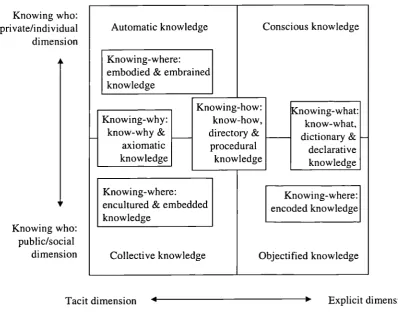
knowing-where (see Figure 2.1). More specifically, Figure 2.1 represents an integration of the
work of Polanyi (1958), Matusik and Hill (1998) and Spender (1996). It contains two
broad dimensions: the tacit/explicit and private (individual)/public (social). The first
Automatic knowledge Conscious knowledge
Knowing-where: embodied & embrained knowledge Knowing-why: know-why & axiomatic knowledge Knowing-how: know-how, directory & procedural knowledge Knowing-what: know-what, dictionary & —
declarative knowledge
Knowing-where: encultured & embedded knowledge Collective knowledge Knowing-where: encoded knowledge Objectified knowledge Knowing who: private/individual dimension A
•
Knowing who: public/social dimension•
Explicit dimensionTacit dimension
communicability. The second dimension reflects the 'ownership' and accessibility of
knowledge. Therefore, this review terms this dimension as 'knowing-who'. In other
words, knowing who possesses the required knowledge as part of organisational
practice. For the convenience of discussion, the study uses the overall space within the
two dimensions as a 'map' that presents different types of knowledge in the
[image:46.595.89.488.302.621.2]organisational context.
Figure 2.1 the landscape of knowledge in the organisational context.
According to Spender (1996), the automatic, collective, conscious and objectified forms
of knowledge occupy four distinctive parts of the knowledge map, based on their nature
and ownership. The five types of knowledge identified by Collins (1993) and Blackler
embedded knowledge refers to knowledge that resides in operational procedures or
organisational routines. According to this variation in the location of knowledge, this
study places the five types of knowledge, namely embodied, embedded, encoded,
encultured and embrained, into the category of 'knowing-where'. In other words,
knowing where knowledge is located serves as a critical mechanism for carrying out
activities that demand knowledge that is dispersed across various organisational units.
Embodied and embrained knowledge, as the representation of individual's experience
and skill, are tacit in nature. By contrast, encultured and embedded knowledge, which
are tacit in nature, are socially constructed by organisational members (Blackler 1995).
Encoded knowledge, which exists in written form (e.g. in documents), is explicit in
nature and can be accessed by a large number of organisational members. Know-why
and axiomatic knowledge are placed in the category of 'knowing-why' because of their
focus on the rationale of why knowledge is constructed. This study uses the term
knowing-why to reflect the ongoing processes of rationalisation underlying
organisational activities, instead of regarding know-why or axiomatic knowledge as
something static. A similar argument can be applied to the following two concepts.
Know-how, directory and procedural knowledge are categorised into 'knowing-how'.
Finally, as representation of facts and propositions, know-what, dictionary and
declarative knowledge are allocated to the category of 'knowing-what'.
Locating the five types of knowing on the organisational knowledge map helps not only
to generate a synthesised view of the various knowledge typologies, as a means of
understanding their interrelationships, but also helps to identify major theoretical gaps in