http://wrap.warwick.ac.uk/
Original citation:
Mullins, A., Bowen, A., Wilson, Roland, 1949- and Rajpoot, Nasir M. (Nasir Mahmood)
(2007) Bayesian surface estimation from multiple cameras using a prior based on the
visual hull and its application to image based rendering. In: British Machine Vision
Conference (BMVC 2007), Coventry, UK, 10-13 Sep 2007
Permanent WRAP url:
http://wrap.warwick.ac.uk/61640
Copyright and reuse:
The Warwick Research Archive Portal (WRAP) makes this work by researchers of the
University of Warwick available open access under the following conditions. Copyright ©
and all moral rights to the version of the paper presented here belong to the individual
author(s) and/or other copyright owners. To the extent reasonable and practicable the
material made available in WRAP has been checked for eligibility before being made
available.
Copies of full items can be used for personal research or study, educational, or
not-for-profit purposes without prior permission or charge. Provided that the authors, title and
full bibliographic details are credited, a hyperlink and/or URL is given for the original
metadata page and the content is not changed in any way.
A note on versions:
The version presented in WRAP is the published version or, version of record, and may
be cited as it appears here.For more information, please contact the WRAP Team at:
Bayesian Surface Estimation from Multiple
Cameras Using a Prior Based on the Visual Hull
and its Application to Image Based Rendering
Adam Bowen, Andrew Mullins, Roland Wilson and Nasir Rajpoot
Department of Computer Science
University of Warwick, UK
{fade,andy,rgw,nasir}@dcs.warwick.ac.uk
Abstract
The problem of visible surface estimation for image-based rendering is tack-led using a new approach, which combines visual hull and surface estimation techniques. It is shown that the new method combines the best features of both approaches, being more robust than direct surface element estimation and more flexible than the visual hull. The new method uses an estimate of the visual hull as a prior on the ill-posed problem of surface element esti-mation. To improve the computational preformance of the algorithm, a mul-tiresolution approach to surface patch estimation is used. The patches thus estimated can then be tracked over time, to provide an accurate model of the surface geometry, which is then used for estimation of the scene from arbitrary viewpoints. After a brief description of the algorithm, results are presented to show the improvement in performance which can be obtained using either technique alone. The paper concludes with a discussion of ex-tensions to the work currently under investigation.
1
Introduction
and make simplifying assumptions about the convexity of the object [10], require a large amount of memory, and suffer from quantization effects [9], but they lead to robust estimates; they are also reasonably fast computationally. A method which combines the features of the two seems like an obvious way to overcome the limitations of either.
Previous work in this area has used both determinstic [19] and simple stochastic meth-ods [6] for hull refinement. In this paper, we present such a method, which uses a stochas-tic Bayesian framework for the computation of planar surface elements but employs a prior on those elements, derived from the visual hull. Such surface elements are a com-mon respresentation of surface geometry [15], [18], [17], and provide a more general representation than similar surface descriptions such as wireframe meshes. The input to the algorithms are a set of video sequences together with camera calibration information for those sequences. The calibration information is obtained separately using the methods described in [22].
After a brief discussion of the surface representation and a description of the estima-tion algorithms, we present some results to show the performance of the new method, which significantly outperforms our earlier methods, giving more accurate surface esti-mates in a reduced computation time. The paper is concluded with a discussion of the power and limitations of the new approach and suggestions for further work.
2
Surface Estimation Method
First, a multiresolution segmentation algorithm is applied to the images captured from the scene to separate figure and background. From the silhouettes derived from the seg-mentation, a view-dependent visual hull is constructed following a similar method to that described in [11]. From the visual hull the depth and surface orientation along any ray in the scene may be derived using total least squares, a robust method of fitting planes to surface data [12]. These estimates are used as a prior in a multiscale particle filter, which provides the final surface estimates, in terms of a number of disjoint quadrilaterals, cor-responding to square blocks in each image of the scene. The patches can then be tracked over time using a second particle filter [14], and used to reconstruct arbitrary views of the scene using an adaptation of a conventional graphics renderer, giving real-time recon-structions [13], [17].
2.1
Surface Representation
A view dependent surface model is defined as follows: partition each input image into pixel blocks and assume each block is the projection of a quadrilateral region of a surface in world space. For notational convenience it is assumed that every block has a unique indexn. The class of quadrilaterals corresponding to image blocks will subsequently be refered to as ‘patches’.
The centroid of a patch which corresponds to a blockn, must lie along the line which passes through both the imaging camera, and the focal plane at the point which corre-sponds to the centre of the block (such lines will be refered to as ‘pixel rays’ for obvious reasons). A compact representation of the position of a patch is its distancednfrom the
The orientation of a patch must lie between face-on, and almost perpendicular to, the imaging camera. In an appropriately chosen Cartesian frame where the z-axis aligns with the pixel ray for the centre of blockn, the orientation of the patch may be represented using the first two components (in,jn) of its surface normal, with the third component
having unit length. This representation allows all allowable orientations, yet prevents the patch from becoming oriented perpendicular, or beyond perpendicular, to the imaging camera. The complete representation of a patch corresponding to blocknis then
xn= (dn,in,jn). (1)
For convenience in the later discussion,fn(xn)will denote the plane defined byxnin some
fixed Cartesian frame common to all patches.
2.2
Locally Adaptive Foreground-Background Segmentation
For a camera cin a data set, its image will be denoted Ic, and its Gaussian pyramid
decompositionIc[0]. . .Ic[M], where Ic[0]=Ic. For a pixel(u,v)in an image levelIc[m], its
labellings(u,v)as either foreground or background is performed using a likelihood model derived from a segmentation of the previous image pyramid level Ic[m+1]. One global
approach using the above idea would be to evaluate the likelihood of a labellings(u,v) =l as
ps(I [m+1]
c |s(u,v) =l) =
1 K
K
∑
k=0
N(Ic[m](u,v);µ [k] l ,σ
[k]
l ), (2)
with theKGaussian mixture components being derived from the colours of the pixels in classl at the previous image level. However, unless the number of components is very large, image details will not feature prominently in the mixture and may be misclassified. Adopting a more local approach, our algorithm proceeds as follows: firstly each pixel is labelled using the classification of its ‘parent’ pixel from the previous image level, in quad-tree fashion. Then the image is partitioned into blocks and the segmentation refined with a two pass approach:
Pass one:For each block: if every pixel within the block and that of its neighbours is of the same class, mark the block as classified.
Pass two: The remaining unclassified blocks form a ‘corridor of uncertainty’ [21]. For each unclassified block,
i Search within an increasing radius until one or more blocks are found from each class which were classified in the first pass.
ii Form a Gaussian mixture colour likelihood model for both classes by clustering the pixel values within these classified blocks.
iii Classify each pixel within the current block as either foreground or background based on the local likelihood model.
2.3
Surface Prior Construction
Initially, a view dependent hull is constructed. For every pixelu,vin a particular image levelIc[m], it is possible to estimate a point which lies on the surface of the visual hull as
follows:
i Generate a foreground-background segmentation for every camera.
ii Intersect the pixel ray for each pixelu,vlabelled as foreground in imageIc[m] with
the back-projected foreground regions in all other camerasc06=cto produce zero or more lines in world space.
iii The closest line end point puv to camerac is the point on the visual hull which
projects into pixelu,v.
The algorithm to construct a surface prior ˆxnfor blocknthen proceeds as follows:
i CalculateM= 1
|Pn|(u,
∑
v)∈P n(puv−p¯)(puv−p¯)T, where ¯p=
1
|Pn|(u,
∑
v)∈P npuv, and where
Pnis the set of pixels in blockn.
ii Compute the eigenvectors and eigenvalues ofM.
iii The eigenvector corresponding to the smallest eigenvalue is the normal to the best-fit plane through the data, and together with ¯pdefines a planeyn.
The prior can then be chosen for blocknand has mean ˆxn=fn−1(yn), and covariance ˆσn
which is chosen empirically.
2.4
Multiresolution Particle Filter
A particle filter is used which works across scale to produce surface estimates. For each patch at a given image level, the algorithm draws a set of samplesX={x[1]. . .x[S]}from
an importance sampling function,
X∼q(xn|xh(n),I[m]. . .I[M]), (3)
whereh(n)is the parent block of blockn.
The samples drawn from the importance sampling distribution are weighted according to
w[ns]∝w[hs(]n)
p(I[m]|x[ns])p(xn[s]|xh[s(]n))
q(xn|xh(n),I[m]. . .I[M])
, (4)
where the process model for the parameters of blocknis simply
p(xn|xh(n)) =N(xn; fn−1(fh(n)(xh(n))),σp) (5)
i.e. the parameters corresponding to the same plane as that defined by its parent, but with some process noise with covarianceσpadded.
The measurement likelihood p(I[m]|xn)is defined as follows: for any pixel(u,v)in
This point may be projected into any other camera’s images and the colour of the original pixel compared to that in the projected location. Intuitively, the more similar the colours, the more likely thatxnare the correct parameters for the block. This mapping between a
pixel(u,v)belonging to a blocknin camerac, and the pixel(u0,v0)to which it projects in camerac0given that the block has parametersxnis defined as(u0,v0) =gc→c
0
(u,v,xn).
Following this intuition we define a likelihood for a patch, given a set of multiscale image data from the cameras. The likelihood ofxn, given one camera’s image levelI
[m] c0 is
p(Ic[m0]|xn) =
1
|Pn|(u,
∑
v)∈P nN(Ic[m0](gc→c 0
(u,v,xn));I [m]
c (u,v),σ), (6)
That is, the colour of the re-projected pixel is assumed to be normally distributed, with covarianceσ about the colour of the pixel from the original block. Given all the images
I[m]={I1[m]. . .IC[m]}from all cameras in the data set at levelm, the likelihood of a patch is
p(I[m]|xn) =
1
|Nc|c0
∑
∈N cp(Ic[m0]|xn), (7)
whereNcare the spatial neighbours of camerac.
3
Results
Our locally adaptive segmentation provides a clear advantage over the Markov random field approach in dealing with background regions of images onto which a shadow has been cast. Figure 4 highlights the class boundary for the two methods for an image taken from one of our data sets. Although the Markov random field has corrected the white regions on the t-shirt which are classified as background under using a naive approach, it has also misclassified several areas of shadow close to the body as foreground. The locally adaptive model as prevented this misclassification.
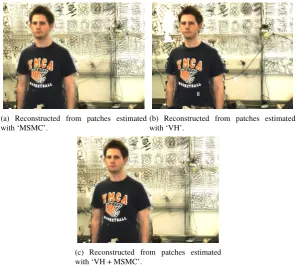
The results in table 3 indicate the mean squared error in colour across all patches when they are reprojected into neighbouring cameras, using different patch estimation algorithms for two data sets. The first contains a static person, whilst the second contains a person in motion which presents a significant challenge for the likelihood model due to motion blur. ‘MSMC’ is the multi-scale Monte-carlo algorithm which simply estimates patches using a particle filter across scale, but a weak prior. The ‘VH’ algorithm produces surface estimates derived from the visual hull alone. The ‘VH + MC’ algorithm estimates the patches using Monte-carlo simulation at the finest resolution using the visual hull to provide a prior. Finally, the ‘VH + MSMC’ algorithm is the full multiscale Monte-carlo algorithm using the visual hull as a prior, as described in section 2.4. This algorithm clearly outperforms all other approaches.
Data set MSMC VH VH + MC VH + MSMC 1 1571.9 2563.4 2318.5 1374.3 2 n/a 9179.8 9268.7 5585.8
Table 1: MSE of estimated patch projections.
4
Conclusions and Further Work
We have shown the power of a combining hull and surface estimation within a Bayesian framework. It significantly increases the accuracy and speed of object geometry esti-mation. In addition, we have proposed a novel multiscale method for producing the foreground-background segmentations which are used to generate the visual hull. As a part of future work we would like to investigate the possibility of using hull information for the estimation of frame-to-frame motion.
References
[1] Adrian Broadhurst, Tom Drummond, and Roberto Cipolla. A probabilistic frame-work for space carving. pages 388–393.
[2] E. Chen and L. Williams. View interpolation for image synthesis, 1993.
[3] S. Chen. Quicktime vr — an image-based approach to virtual environment naviga-tion, 1995.
[4] S. Gortler, R. Grzeszczuk, R. Szeliski, and M. Cohen. The lumigraph, 1996.
[5] A. Hilton and J. Starck. Multiple view reconstruction of people.
[6] J. Isidoro and S. Sclaroff. Stochastic refinement of the visual hull to satisfy photo-metric and silhouette consistency constraints.
[7] Kiriakos N. Kutulakos and Steven M. Seitz. A theory of shape by space carving. Technical Report TR692, 1998.
[8] Marc Levoy and Pat Hanrahan. Light field rendering. Computer Graphics, 30(An-nual Conference Series):31–42, 1996.
[9] M. Li, M. Magnor, and H. Seidel. Improved hardware-accelerated visual hull ren-dering, 2003.
[10] Ming Li, Hartmut Schirmacher, Marcus Magnor, and Hans-Peter Seidel. Combin-ing stereo and visual hull information for on-line reconstruction and renderCombin-ing of dynamic scenes.
[11] Wojciech Matusik. Image-based visual hulls. InMaster of Science Thesis, 2001.
(a) Fixed foreground-background model. (b) Adaptive foreground-background model.
Figure 1: An input image with the border between foreground and background image overlayed for two different algorithms.
(a) Reconstructed from patches estimated with ‘MSMC’.
(b) Reconstructed from patches estimated with ‘VH’.
(c) Reconstructed from patches estimated with ‘VH + MSMC’.
[image:8.595.151.449.376.641.2][13] Andrew Mullins, Adam Bowen, Roland Wilson, and Nasir Rajpoot. Estimating pla-nar patches for light field reconstruction. InThe Proceedings of the British Machine Vision Conference, 2005.
[14] Andrew Mullins, Adam Bowen, Roland Wilson, and Nasir Rajpoot. Surace estima-tion and tracking using sequential mcmc methods for video based rendering. InTo be published in: The Proceedings of the International Conference on Image Pro-cessing ICIP07, 2007.
[15] Don Murray and James J. Little. Patchlets: Representing stereo vision data with surface elements. InProceedings of the Seventh IEEE Workshops on Application of Computer Vision., volume 1, pages 192–199, 2005.
[16] P J Narayanan and Takeo Kanade. Virtual worlds using computer vision. In Proceed-ings of the 1998 IEEE and ATR Workshop on Computer Vision for Virtual Reality Based Human Communications, pages 2 – 13, January 1998.
[17] Hanspeter Pfister, Matthias Zwicker, Jeroen van Baar, and Markus Gross. Surfels: Surface elements as rendering primitives. In Kurt Akeley, editor,Siggraph 2000, Computer Graphics Proceedings, pages 335–342. ACM Press / ACM SIGGRAPH / Addison Wesley Longman, 2000.
[18] Tobias Pietzsch and Axel Gromann. A method of estimating oriented surface ele-ments from stereo images. InProceedings of the British Machine Vision Conference, volume 1, 2005.
[19] P. Ramanathan, E. Steinbach, P. Eisert, and B. Girod. Geometry refinement for light field compression.
[20] S. Seitz and C. Dyer. Photorealistic scene reconstruction by voxel coloring, 1997.
[21] Michael Spann and Roland Wilson. A quad-tree approach to image segmentation which combines statistical and spatial information. InPattern Recognition 18, vol-ume (3-4), pages 257–269, 1985.
[22] Tom´aˇs Svoboda, Daniel Martinec, and Tom´aˇs Pajdla. A convenient multi-camera self-calibration for virtual environments. PRESENCE: Teleoperators and Virtual Environments, 14(4):407–422, August 2005.
[23] Yang Wang, Kia-Fock Loe, Tele Tan, and Jian-Kang Wu. A dynamic hidden markov random field model for foreground and shadow segmentation. InProceedings of the Seventh IEEE Workshops on Application of Computer Vision, volume 1, pages 474– 480, 2005.