Design of a real-time network channel in LUNA
R. (Robin) Wijnholt
MSc
Report
C
e
Dr.ir. J.F. Broenink
K.J. Russcher, MSc
Dr.ir. P.T. de Boer
October 2017
047RAM2017
Robotics and Mechatronics
EE-Math-CS
University of Twente
Summary
LUNA is a real-time framework that uses CSP to pass messages from process to process. When communication between two LUNA applications on different hosts is required, no communic-ation method is available that is able to deliver real-time guarantees whilst keeping the CSP methodology in mind.
In this thesis a new network component in LUNA (referred to asNetwork Channel) has been de-signed and realized that is capable of connecting two real-time LUNA applications. OpenDDS has been used as the communication protocol, which is an open source implementation of Data Distribution System (DDS). Rendezvous communication has been implemented, because this way of message passing is also used in CSP (execution engine of LUNA).
OpenDDS provides QoS settings and can perform real-time communication. An interface for reading and writing to OpenDDS has been realized and has been implemented by theNetwork Channelto implement functionality. The OpenDDS interface is constructed to support bund-ling of data with the same endpoint. Bundbund-ling of data results in better performance as writing to OpenDDS is an expensive operation on the RaMstix (1.34ms per write). A more resource rich platform is faster, and also scheduling the threads with a not real time scheduler on a RAMstix results in faster writes to OpenDDS. Probably mode switches occur on the RaMstix with the Xenomai scheduler and causes higher writer times.
TheNetwork Channelimplements publish-subscribe, and rendezvous communication. The
DDSReactoris responsible for sending and receiving messages. A disadvantage is that the loop time of one iteration introduces an extra latency. For the publish-subscribe communication a maximum transmission frequency of 250Hz for 10 channels is obtained where a theoretical maximum sending speed of 400Hz was expected. This is not achieved, as not all data is avail-able in one data bundle, resulting in more than one iteration before all readers are unblocked.
For rendezvous communication a trade-off has been made to only notify the reader’s state to minimize the round-trip time of one data exchange. It has been observed that the data se-quences do not necessarily contain the data for all readers, and therefore a waiting functionality has been implemented. Waiting for the data of all writers results in the unblocking of the read-ers at the subscriber side in one iteration, instead of two or maximum three iterations. How-ever at sending rates higher than 200Hz the waiting functionality fails, resulting in incomplete packets and therefore more than one iteration before unblocking. The maximum rendezvous communication with functioning wait functionality has been obtained at 230Hz.
TERRA generates executable code with the LUNA framework from CSP models. A hardware port is added to the TERRA application such that theNetwork Channelcan be initialized by the user using the GUI provided by TERRA.
A demo has been realized that controls the youBot base from a RaMstix using an EtherCAT interface and controller in LUNA. An Ubuntu machine is used to execute a LUNA application to send values from a joystick to the RaMstix using theNetwork Channel. It has been observed that periodicity is caused by the SOEM EtherCAT master on the RaMstix, and not necessarily due to Xenomai.
Contents
List of acronyms viii
1 Introduction 1
1.1 Context . . . 1
1.2 Goals of the project . . . 1
1.3 Outline of the report . . . 2
2 Background 3 2.1 LUNA and TERRA . . . 3
2.1.1 CSP . . . 3
2.1.2 LUNA . . . 4
2.1.3 TERRA . . . 6
2.2 OpenDDS . . . 7
2.3 RaMstix . . . 9
2.4 YouBot . . . 10
3 Requirements 13 3.1 Network channel . . . 13
3.2 EtherCAT interface . . . 14
3.3 youBot controller . . . 14
4 Network Channel in LUNA 16 4.1 Introduction . . . 16
4.2 OpenDDS . . . 16
4.2.1 Design . . . 16
4.2.2 Realization . . . 18
4.2.3 Tests . . . 21
4.3 TERRA . . . 23
4.3.1 Design . . . 23
4.3.2 Realization . . . 24
4.3.3 Tests . . . 26
4.4 LUNA implementation . . . 27
4.4.1 Design . . . 27
4.4.2 Realization . . . 33
4.4.3 Tests . . . 35
4.5 Conclusion . . . 38
5.2 Realization . . . 40
5.3 Test . . . 41
5.3.1 Setup . . . 41
5.3.2 Results . . . 42
5.3.3 Discussion . . . 43
6 EtherCAT interface and Network Channel combined 44 6.1 Introduction . . . 44
6.2 Design . . . 44
6.2.1 YouBot . . . 44
6.2.2 Input device . . . 45
6.2.3 Controller . . . 45
6.2.4 Test design . . . 45
6.3 Realization . . . 47
6.3.1 Controller . . . 47
6.3.2 Controller and joystick test . . . 48
6.3.3 Integration test . . . 48
6.4 Tests . . . 51
6.4.1 Controller and joystick test . . . 51
6.4.2 Integration test . . . 51
6.5 Conclusion . . . 53
7 Conclusion & Recommendations 54 7.1 Conclusion . . . 54
7.2 Recommendations . . . 54
A LUNA implementation realization 56 A.1 Component integration in LUNA . . . 56
A.2 LUNA implementation . . . 56
B LUNA implementation tests 63 B.1 Introduction . . . 63
B.2 Test setup . . . 63
B.3 Tests . . . 65
B.3.1 Transport . . . 65
B.3.2 Bundled data validation . . . 65
B.3.3 Latency analysis . . . 67
B.3.4 Stress tests . . . 72
C Code of the integration test 80
D Demo 82
E Building demo from source 84
E.0.1 Compiling for Ubuntu . . . 84
E.0.2 Compiling for RaMstix . . . 85
F Getting TERRA with DDS ports 86
G Propagation delay on Ethernet 87
H Dependency of reactor loop frequency and sending frequency 89
I Waiting for publish and subscribe communication 90
J Latency analysis on rendezvous communication 91
List of acronyms
ADC Analog to Digital Converter
API Application Programming Interface
CAN Controller Area Network
CSP Communicating Sequential Processes
DAC Digital to Analog Converter
DCPS Data-Centric Publish-Subscribe
DDS Data Distribution System
DOF Degrees of Freedom
ENI EtherCAT Network Information
ESI EtherCAT Slave Information
FIFO First In First Out
FPGA Field Programmable Gate Array
GPMC General Purpose Memory Controller
GUI Graphical User Interface
HRT Hard Real Time
I/O Input/Output
IPC Intrinsic Passive Control
LUNA LUNA Universal Networking Architecture
OS Operating System
MDD Model Driven Design
PWM Pulse Width Modulation
RaM Robotics and Mechatronics
RPI Raspberry Pi
ROS Robotic Operating System
RTPS Real-Time Publish-Subscribe
SBC Single Board Computer
SOEM Simple Open EtherCAT Master
TCP Transmission Control Protocol
UDP User Datagram Protocol
USB Universal Serial Bus
1 Introduction
1.1 Context
A Single Board Computer (SBC) is used more and more for embedded applications due to their flexibility and ability to perform complex computations. The processing power of these SBCs continues to grow, which makes them popular for robotic setups that need (complex) control. At the Robotics and Mechatronics (RaM) group a SBC is developed called the RaMstix (RaM, 2017a), which is an expansion board for the Gumstix Overo module (Gumstix, 2017). The RaM-stix can run Hard Real Time (HRT) control loops using LUNA Universal Networking Architec-ture (LUNA) in a Xenomai environment (Bezemer, 2011).
LUNA is a hard real-time, multi-threaded, multi-platform, Communicating Sequential Pro-cesses (CSP) capable, and a component-based framework. However a real-time communic-ation channel following the heuristics of CSP is not present.
A channel with Robotic Operating System (ROS) for LUNA is already designed by van der Werff (2016), but this solution mainly focuses on connecting a LUNA application with HRT loop con-trollers to a more resource rich platform that is not necessarily HRT. The disadvantage of using ROS as a communication channel is that it provides no real-time guarantees and therefore the complete system using ROS channel is definitely not real-time.
The work of van de Ridder (2017) on the production cell is an example of a project where real-time communication between those SBCs is important for correct functioning of the total setup. This setup consists of multiple stations each performing their own task, for example a feeder belt, extraction belt, rotation robot and an extraction robot. Every station contains its own LUNA application that has to pass the status of the station to other stations in this setup. Without a reliable communication channel, correct functioning of the setup is not guaranteed.
The work of van de Ridder (2017) is just one of many more projects that could benefit from a proper network component in LUNA. LUNA is a great framework for controlling setups and together with a good functioning communication channel it is easily scaled to bigger projects.
1.2 Goals of the project
This project consists of three parts: theNetwork Channel, the EtherCAT interface and the con-troller for the youBot. Figure 1.1 shows the relation of these parts.
Figure 1.1:The relation between theNetwork Channel, the EtherCAT interface and the controller resid-ing on two platforms.NCsignifies theNetwork ChannelandECsignifies EtherCAT.
The goals of this project are formulated as follows:
the industry for real-time applications. The youBot uses EtherCAT to talk to the motor drivers of the youBot joints.
3. Showcase the Network Channel: The correct functioning of theNetwork Channel, con-troller, and EtherCAT interface for the youBot must be shown with a demo.
1.3 Outline of the report
2 Background
The hardware and software used in this project are described in this chapter. Section 2.1 con-tains information about LUNA and TERRA with a subsection that describes CSP. The funda-mentals of OpenDDS are in Section 2.2 and information about the RaMstix is provided in Sec-tion 2.3. This chapter concludes with SecSec-tion 2.4 with informaSec-tion about the youBot.
2.1 LUNA and TERRA
CSP describes how processes interact with each other. LUNA implements CSP as its execution engine. First the basics of CSP are discussed in Section 2.1.1. The fundamentals of LUNA is discussed in Section 2.1.2 and lastly TERRA is treated in Section 2.1.3, which implements a Graphical User Interface (GUI) for drawing CSP processes and can create execution code for the LUNA framework.
2.1.1 CSP
CSP is introduced by Hoare (1978) and is a method to describe a concurrent synchronous com-munication application. Channels connect CSP processes and can exchange messages by using events. Communication events with variables in CSP are denoted as:
• c?v: read variablevfrom channelc.
• c!v: write variablevonto channelc.
• c.v: Variablevon channelc, no direction provided.
Events are instantaneous and do not have to be accompanied by a variable. Processes are ac-companied by a set of events (called an alphabet) where a process may engage in. The order of operation is not determined by the channels, but by process operators. The basis process operators for CSP are:
• PAR: All processes activated at the same time, execution order is fair (no fixed order of execution). Continues to a next process when all processes in a parallel construct are finished.
• SEQ: The processes are activated and executed one by one.
• ALT: Certain processes are activated depending on the variable on the provided channel.
A graphical example of a CSP model is shown in Figure 2.1. TheSequenceController, LoopCon-trollerandFilterare processes connected with each other by channels that are indicated with the arrows. The direction of the arrow indicate the direction of the variable. The arrows how-ever do not state the order of execution as that is indicated by the connections with a ’||’ sign that indicates a parallel construct. The question and exclamation mark indicates a reader and writer respectively and the asterisk in the top left corner states that everything that is boxed in that rectangle is repeated indefinitely.
Messages between processes are exchanged only when both processes are active. This results in a synchrony between communicating processes. This way of messaging is referred to in CSP as rendezvous communication.
Figure 2.1:A CSP example drawn with TERRA. The processes are connected using parallel constructs that indicate the order of execution, and the arrows indicate the channels and the direction of the vari-able on that channel.
2.1.2 LUNA
LUNA is a framework that implements CSP as the execution engine. LUNA (Wilterdink, 2011) is the answer to shortcomings of other implementations and is designed with the following requirements in mind:
• Hard real-time
• Multi platform
• Thread support
• Scalability
• CSP execution engine
• Component based
Figure 2.2 shows the architecture of LUNA. CSP is used as the execution engine, but LUNA is made such that other execution engines can be implemented as well. The core components are on layer 1 indicating that layer 2 and 3 are independent of the used Operating System (OS).
Figure 2.2: Overview of the LUNA architecture (Bezemer, 2011). The light grey blocks are yet to be integrated.
LUNA is designed with threads to support concurrent processes. These threads are used as long as the OS on which LUNA is running can provide them. This way of working is possible ,because the execution engine is separated from the core components.
are light on resources, but must run in a OS thread and are thus running on the same core as the OS thread.
LUNA is responsible to map the processes and constructs onto threads. An example of a LUNA application that is mapped onto threads is shown in Figure 2.3. This figure shows that processes are mapped onto user threads and are put in a user thread container (UTC) before mapping them on a OS thread. The CSP constructs are decentralized implemented, which results in a generic scheduling mechanism without any knowledge of the other CSP constructs.
Figure 2.3:The implementation of thread grouping performed in LUNA (Bezemer, 2011). User threads are placed in a user thread container before it is placed on an OS thread.
All processes are able to run parallel in their own thread groups. The efficiency of the applic-ation is dependent on how the thread groups are created as only the thread groups are able to run their threads in parallel.
Previous implementations by Kempenaar (2014), Bezemer and Broenink (2015), and van der Werff (2016) were able to connect LUNA to another application using ROS channels. The goal of the network channel presented in this thesis is to connect two HRT LUNA programs whilst trying to maintaining the CSP methodology as much as possible. This has as a result that the Network Channel should also support rendezvous communication as well. An example of ren-dezvous messaging for a writer and a reader is shown in Figure 2.4.
Figure 2.4:Rendezvous messaging shown using two processes A and B (Smyth and Davis II, 1999).
In Figure 2.4 the blocking of process A (sender) is shown, but the same holds for process B (receiver) if that process happens to be activated earlier in time than process A. On the same host this behavior is easily obtained by shared memory or by sharing relevant classes between processes, but for processes residing on different hosts this asks for a different approach, which is discussed in detail in Chapter 4.
TERRA is a Model Driven Design (MDD) tool that enables the user to draw CSP processes and to generate execution code using the LUNA framework. TERRA is a modular collection of tools for designing (control) software for cyber-physical systems, currently providing (RaM, 2017b):
• Model editors: Editor for CSP and an architecture model editor.
• Model Validation
• Code validation: machine CSP and LUNA (C++).
• Simulation and animation: log model to visualize system states with an animation.
• External tool support: 20-sim and SCXMLgui
For this project TERRA is used to implement a hardware port that is able to add the Network Channel in TERRA. Hardware ports were first added by Bezemer (2014) to get rid of the sand-boxed LUNA applications. The Mesa Anything I/O FPGA board was used in that project as a proof of concept. The design of the hardware port is shown in Figure 2.5. On the left side an architecture meta-model is shown that is used to construct the functionality of the hardware port. The graphical editor part and the code generation are on the right side and deliver the graphical part and code generation.
Figure 2.5:The design used for adding hardware ports to TERRA (Bezemer, 2014).
Regular CSP channels provide means to communicate data from a writer to a reader over a channel, hardware channels replace the channel with a hardware implementation as is shown in Figure 2.6.
Figure 2.6 shows the interfacing of a hardware component to the rest of LUNA by using a IChan-nelInand anIChannelOut interface. This way the actual channel implementation is hidden from readers and writers, resulting in no difference between hardware ports and writers and readers from LUNA perspective. The result is a TERRA code generation that is able to generate the standard readers and writers, even when hardware communication is required.
2.2 OpenDDS
In the search for a suitable communication protocol the following requirements must be met:
• Scalable
• Discovery of endpoints
• Rich set of Quality of Service (QoS) settings
• Real-time capabilities
A lot of communication protocols are available and most of the protocols do not provide all the requirements. ZeroMQ (ZMQ, 2014) provides real-time capabilities, but has no auto discovery for endpoints. Boost.Asio (Kohlhoff, 2017) has the ability to find endpoints using broadcast-ing, but is not able to provide QoS settings for the user. ZeroMQ and Boost.Asio are protocols that wrap the sockets provided by the OS and therefore do not provide a lot of QoS settings. Also these protocols do not have their own serialization and deserialization and need therefore another library to provide that.
ZeroMQ and Boost.Asio are not suitable for this project but do deliver fast writing speeds as is shown in Busch (2010). This test compares OpenDDS to ZeroMQ and Boost.Asio. All three have a great performance, but OpenDDS does provide the QoS settings that this project needs. OpenDDS also provides endpoint discovery and real-time capabilities as it is based on the OMG Data Distribution Service (DDS) for Real-Time Systems standard. Serialization and deserializ-ation is performed using the IDL data structure OMGIDL (2017).
OpenDDS is completely open source, is used in ROVE (ROVE, 2017) and the new version of ROS uses ROS2 as its communication protocol. Therefore using OpenDDS for this project will result in a new ROS LUNA interface as all DDS vendors should be inter-operable.
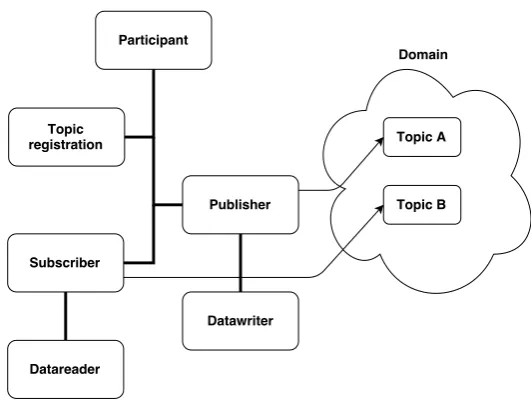
OpenDDS is a publish-subscribe service, which is data oriented. The basic entities that needs to be available for every DDS communication are:
• Topic: Contains information about a single data type and the distribution and availability of samples.
• Publisher: Apply control and restrictions to flow of data from DataWriters.
• Subscriber: Apply control and restrictions to flow of data from DataReaders.
• Datawriter: Creates Samples of a single application data type.
• Datareader: Receives Samples of a single application data type.
To show the relation between the previously mentioned entities Figure 2.7 is provided. For each subscriber or publisher a participant must be available as well as a topic. The participant resides in a DDS domain. Each publisher is accompanied by a datawriter and each subscriber is accompanied by a datalistener.
Figure 2.7:Overview of the relation between the entities of DDS, based on Corsaro (2013).
The flow of sending a sample from publisher to subscriber via an OpenDDS topic is as follows:
1. The publisher initiates the flow of data when a data value has been written to the datawriter.
2. The datawriters publication publishes the Samples to the associated subscription(s).
3. Each associated subscriber gives the received sample to its datareader(s) that are associ-ated with the sending datawriter.
4. The flow ends when the application retrieves the data from the datareader.
[image:18.595.152.418.79.282.2]A conceptual view of the established connection between a DDS publisher and DDS subscriber communicating via a topic is shown in Figure 2.8. The datawriter and datareader are the in-stances that provide the means to write to, and to read from OpenDDS topics respectively.
2.3 RaMstix
The RaMstix (RaM, 2017a) is a platform used to run embedded control software at the RAM group. A functional overview of the RaMstix is shown in Figure 2.9. The RaMstix is an expansion board for the Gumstix Overo module (Gumstix, 2017). The Gumstix Overo module has a single core running at 800M hzand provides WiFi and Bluetooth. Xenomai runs in dual kernel mode alongside the normal kernel on the Gumstix to support HRT applications. The Overo module is connected with a General Purpose Memory Controller (GPMC) to an Field Programmable Gate Array (FPGA). This combination offers the following Input/Output (I/O):
• Universal Serial Bus (USB)/serial debug interface
• 100 Mbit Ethernet
• USB master
• USB slave
• Four dedicated Encoder inputs
• Four dedicated Pulse Width Modulation (PWM)/Stepper outputs
• 16 digital output pins
• 16 digital input pins
• Controller Area Network (CAN) bus interface
• Two 16-bit Analog to Digital Converter (ADC)
• Two 16-bit Digital to Analog Converter (DAC)
Figure 2.9: A functional overview of the different components available on the RaMstix. The arrow indicate data flow.
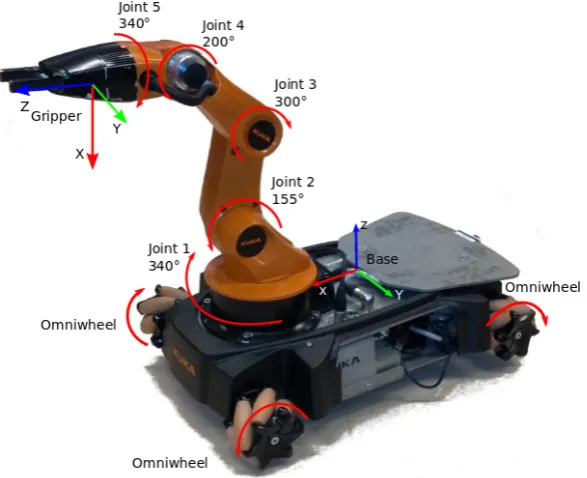
The youBot is used as a demonstrator to show the functionality of theNetwork Channel. The youBot is a robotic arm on an omni-directional platform designed by KUKA. The arm has five Degrees of Freedom (DOF) and a two-finger gripper. The platform consist of four omni-directional wheels such that it can move in each direction on its x y plane without rotating around thez axis. A picture of the youBot together with the positive joint directions and its range of motion are shown in Figure 2.10.
Figure 2.10:The KUKA youBot. Positive direction of the joints are shown with arrows together with the range of motion in degrees for each joint (Frijnts, 2014).
[image:20.595.139.433.200.439.2]Each joint of the youBot is controlled by a motor driver that is connected to EtherCAT. The motor driver is capable of performing PID control on torque, velocity and position, but also low level control as setting PWM speeds to the joints and reading encoder values is provided. The motor driver on joint 5 has a RS232 connection that is able to control the gripper. An overview of the interconnection of the motor drivers is shown in Figure 2.11
Figure 2.11: All joints have their own motor driver that communicates over EtherCAT with the master (youBot embedded computer). The gripper is controlled via rs232 via motor driver 5 (Frijnts, 2014).
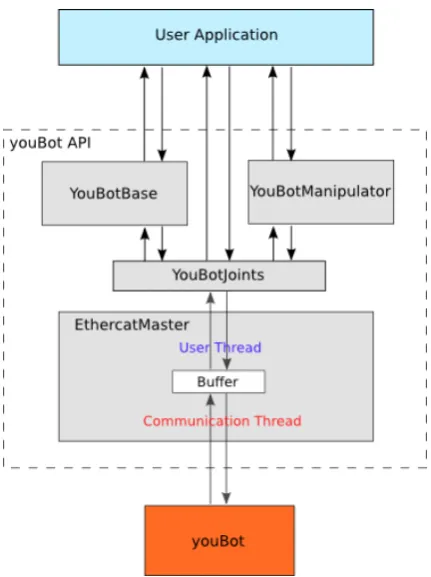
Figure 2.12:Architecture of the youBot API (KUKA, 2015). The API provides joint level control for the youBot.
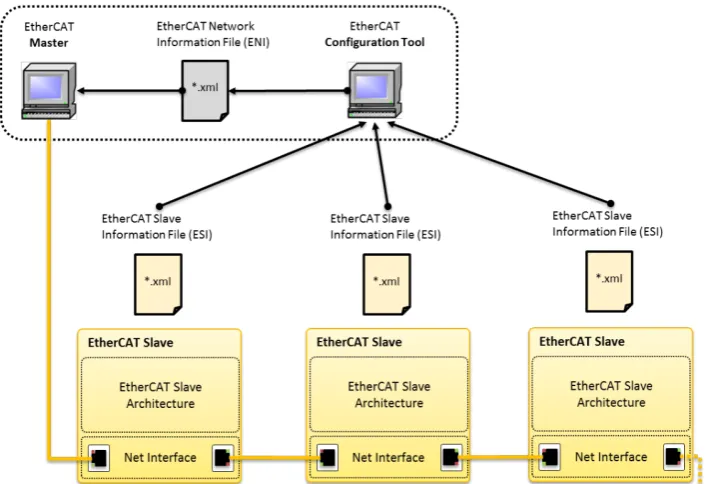
The youBot uses EtherCAT to control the motor drivers. EtherCAT is an Ethernet based fieldbus system that can achieve real-time communications. The power of EtherCAT lies in the way it handles the data. Each EtherCAT slave extracts relevant data and places his own data into the telegram "on-the-fly". The telegram reaches all slaves before it is returned to the master. EtherCAT almost supports all topologies, including line, tree, star and daisy-chain.
3 Requirements
The requirements of this project are listed in MoSCoW format per part of this project. The requirements are separated into three parts, namely:Network Channel, EtherCAT and the con-troller that drives the youBot. The relation between those parts is shown in Figure 3.1.
Figure 3.1:This schematic shows the relation between an input device, LUNA with input andNetwork Channelcomponent, and the connection with EtherCAT to the youBot.
The requirements of theNetwork Channelare given in Section 3.1. The requirements of the EtherCAT interface is given in Section 3.2 and lastly the requirements on the youBot controller are specified in Section 3.3.
3.1 Network channel
TheNetwork Channel is the main component in this project. The main goal of theNetwork Channelis to connect two LUNA applications for the exchange of data. The requirements be-longing to theNetwork Channelare listed below in descending priority.
1. The Network Channel must be able to perform reliable communication between LUNA applications: TheNetwork Channelmust be able to communicate with certain guaran-tees of the channel performance.
2. The Network Channel must function on WiFi: The implementation must work with WiFi as this enables devices to be mobile.
3. The Network Channel must provide a rich set of QoS settings: There must be a lot of settings that could change the behavior of the channel, such that the desired channel characteristics can be obtained.
4. The Network Channel must support rendezvous communication: LUNA exploits CSP as the execution engine. To follow the CSP method theNetwork Channelshould provide rendezvous communication as well.
5. The Network Channel must be implemented as a component in LUNA: TheNetwork Channelcould be implemented by a code block, but it is more convenient to make the
Network Channelpart of LUNA by implementing it as a component. This way it is pos-sible to build theNetwork Channelas an option in LUNA.
6. The Network Channel should support buffered channels: Physically separated systems can have different loop frequencies. To be able to communicate between those systems buffered channels should be implemented as well.
a convenient way it should be available in the TERRA GUI. The high level settings can be handled by the configuration window in TERRA and the user would not have to bother about typing code.
9. The Network Channel could be inter-operable with ROS2: The newest version of ROSec: uses DDS as the communication middleware. The new version or ROS promises to be real-time capable. ROS1 is used for many applications at RaM and it may therefore be beneficial to make thisNetwork Channelcompatible with this newer version of ROS, as it will most probably used for future projects.
10. A new communication protocol for the Network Channel will not be designed: A pro-tocol that is designed from scratch will most certainly have issues with maintainability, usability, and portability. An existing protocol will probably have no issues with these as support and updates are mostly provided. Also a community is can be present that is able to help when bugs arise.
3.2 EtherCAT interface
EtherCAT is used to control the youBot motor drivers and therefore some requirements are drafted for the EtherCAT interface in this project.
1. There must be a coupling between LUNA and an EtherCAT interface to control the mo-tors of the youBot: The EtherCAT API for the youBot works as is, but it should also be (partly) implemented in LUNA to enable interfacing with the youBot from LUNA.
2. The EtherCAT interface should have real-time performance: A goal is to obtain an EtherCAT connection together with LUNA that can perform real-time communication with the youBot. EtherCAT is known for its fast and deterministic cycles and therefore real-time communication should be feasible.
3. A LUNA component for EtherCAT could be made accessible from TERRA: If the LUNA component for EtherCAT is designed and it is generic enough it could be implemented in TERRA as well to make it accessible from the GUI to make it easy to use in other ap-plications.
4. The EtherCAT master from IgH could be used for EtherCAT connection instead of the youBot API: SOEM is known to have high periodic latency peaks (Spil (2016)). If this is caused by the SOEM implementation another open source implementation can be used like IgH which may solve this problem.
5. A new EtherCAT master will not be designed.: No effort is put into designing a new EtherCAT master for communication with the youBot.
3.3 youBot controller
An implementation of a controller is necessary to calculate with inputs the desired outputs Depending on the type of controller the actual implementation may vary.
1. A youBot controller must be implemented in LUNA: A controller must be implemented to show a demo of LUNA with the EtherCAT interface controlling the youBot. The kind of controller is less important as the focus of this project is to design a network component in LUNA and not on designing a new kind of controller.
4 Network Channel in LUNA
4.1 Introduction
The design choices, realization, and tests for every part that constructs theNetwork Channel
is provided in this chapter. This chapter contains three sections, and each section contains a design, realization, and tests:
• OpenDDS: An interface is designed in Section 4.2 that enables LUNA to write and read from OpenDDS. This interface implements a way to provide rendezvous, and publish-subscribe communication by using OpenDDS as communication protocol and is utilized by the LUNA implementation to actually add functionality to theNetwork Channel.
• TERRA: To graphically draw CSP processes TERRA is used. TERRA is able to generate ex-ecutable code using the LUNA framework. An extra hardware port (DDS port) is added to TERRA in Section 4.3, such that the user can initialize theNetwork Channelfrom TERRA.
• LUNA implementation: The OpenDDS interface is integrated in the actual Network Channelin Section 4.4. The functionality of theNetwork Channelis implemented and a component in LUNA is constructed in this section. This section integrates the OpenDDS interface.
An overview of the relations between TERRA, LUNA, and OpenDDS is given in Figure 4.1. TERRA uses the LUNA framework to generate executable code. The generated code is able to instantiate theNetwork Channelthat used the OpenDDS interface to provide the commu-nication between LUNA applications.
Figure 4.1:Overview of how OpenDDS relates to LUNA and how LUNA relates to TERRA. The solid lines indicate data flow, and the dashed line represents a dependency.
4.2 OpenDDS
4.2.1 Design
The implementation of OpenDDS provides an interface for writing and reading to OpenDDS topics from theNetwork Channelcomponent in LUNA.
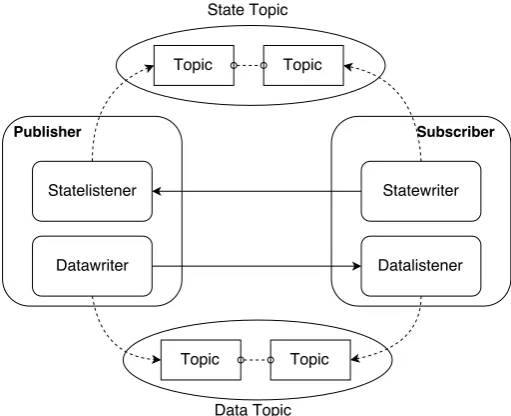
The OpenDDS implementation should support publish-subscribe and rendezvous communic-ation. For publish-subscribe communication only one datawriter is instantiated at the pub-lisher and one datalistener at the subscriber. If the topics match, then the data will be ex-changed from publisher to subscriber, which is shown in Figure 4.2.
Figure 4.2:An overview of communication via OpenDDS with the publish-subscribe pattern. The data flow is from publisher to subscriber. The topics must match before communication is started.
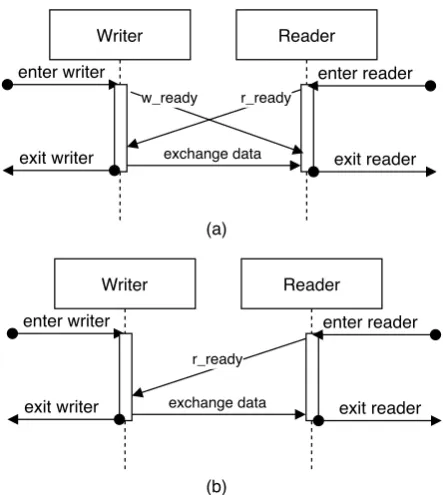
trade-off is made that only the reader can present its state to the writer, which will result in one less state exchange for every data exchange, which is shown in Figure 4.3.
Figure 4.3: The messages that are send over the network when traditional rendezvous messaging is used(a) versus the trade-off that only notifies a ready reader(b).
In the trade-off two flows of data are present, one for state exchange and one for data exchange. The reading side cannot publish data to the writer, and therefore it is necessary to instantiate another writer at the reading side, and an extra listener at the writing side a statewriter and statelistener respectively and is shown in Figure 4.4. It is chosen to instantiate another listener and writer for rendezvous communication, because it separates the publish-subscribe com-munication from the rendezvous comcom-munication.
The blocking of writers and readers is not implemented by OpenDDS, but by theNetwork Channelimplementation in Section 4.4.
Figure 4.4:An overview of the initialized datawriter, statewriter, datalistener, and statelistener for ren-dezvous communication. The direction of data is from publisher to subscriber, and the direction of the state is from subscriber to publisher. The state topics and data topics should match before rendezvous communication is can be performed.
multiple data instances in one OpenDDS data structure, which results in less write actions to OpenDDS and therefore probably also in a better overall performance.
4.2.2 Realization
4.2.2.1 IDL file
[image:28.595.156.412.80.288.2]The IDL format is used to specify the data structures. This IDL file is shown in Figure 4.5 and shows the data struct (Packet) with the unbounded sequences and the struct for the state ex-change from reader to writer.
Figure 4.5:The IDL file that is used to register topics with. If a publisher and subscriber use the same data format (and QoS) than the topics will match. Also the data format for the state exchange for ren-dezvous communication is provided in this file, and can notify the publisher the subscriber is ready to receive using a value.
un-block in one iteration. Figure 4.6a shows how the subtopics are bundled on one DDS topic. If rendezvous communication is enabled only onereader readymessage needs to be send, noti-fying that all the readers in a parallel construct are ready.
The separate data structure should be used if the data has different endpoints. Also when the readers in one LUNA application are not in a parallel construct it is better to use the separate data structure. For the separate data structure each subtopic results in a separate DDS topic and is shown in Figure 4.6b. Every DDS topic has to present a separatereader readymessage to the corresponding subscriber if rendezvous is enabled.
(a)A schematic representation of bundling different subtopics into one DDS topic. The single arrow from publisher to subscriber indicates information flow over one DDS topic. One state topic is used to state the readiness of the subscriber.
(b)A schematic overview of the separate data structure when different DDS topics are used for every subtopic. For every DDS topic a DDS publisher and subscriber pair is instantiated, which is illustrated with multiple arrows from publisher to subscriber. Also multiple state topics are used, because every subscriber has to notify its readiness.
Figure 4.6:A schematic that shows the differences between bundled and separate data structures.
4.2.2.2 Software architecture
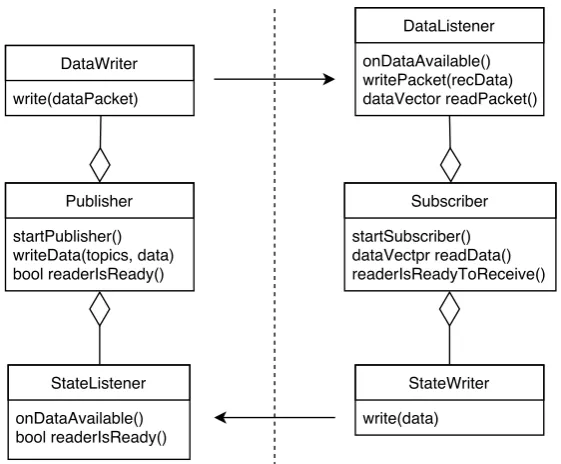
The software structure of OpenDDS consists of aPublisher and aSubscriber class. The Pub-lisherclass is able to write data via a datawriter to a DDS topic and theSubscriberis able to receive data via a listener from a DDS topic. A DDS listener is implemented, because awaitset
and a polling listener introduces extra latencies. The listener however is more resource heavy.
When rendezvous communication is enabled thePublisherclass provides a statelistener and theSubscriberclass a statewriter to be able to send and receive state updates. The realized software architecture is shown in Figure 4.7.
ThewriteDatafunction in thePublisherclass calls thewritemember function in the datawriter to write the data to DDS. ThewriteDatafunction needs two vectors as arguments, one with subtopic names and one with data corresponding to the subtopics. These vectors are placed in arrays that are provided by the IDL file. The algorithm that places these values and topics in the C++ arrays provided by the IDL file is shown in Algorithm 1.
Figure 4.7:Software architecture ofPublisher(left) andSubscriber(right). The listeners and writers are provided by OpenDDS and functions are added for extra functionality. The solid arrows indicate data flow and the dashed line the separation by OpenDDS.
Algorithm 1Pseudo code of the functionwriteDatain the OpenDDS implementation at the Publisher class of the OpenDDS interface.
Input:Two vectors, one dataVector and on topicVector
1: initialize arrays with the length of the dataVector
2: forevery sample in the dataVectordo
3: place sample in allocated data array
4: forevery topic in the topicVectordo
5: place topic in allocated topic array
6: place topic and data array in a dataPacket provided by the datastructure from IDL
7: Call write in datawriter with the dataPacket as argument
8: ifrendezvous communication is enabledthen
9: Set thereaderIsReadyboolean to false in the statelistener
The datalistener at the Subscriber class fills a dataVector with the function writePacket
whenever data is received and places therecDataon thedataVector. When data was already present in thedataVectorthe received data is appended. The data consists of a subtopic and the corresponding value.
ThereadDatain theSubscriberclass calls thereadPacketmember function of the datalistener and returns the data it has received up until this call. This returned data consists of a vector with strings and the corresponding values. The string represents the topic and the double is the data.
ThereaderIsReadyToReceivemember function of theSubscriberclass sends a message on the state topic via thewritefunction of the statewriter to indicate the reader is ready to receive data.
ThestartSubscriber andstartPublisherfunctions instantiate the components that are neces-sary for OpenDDS to start exchanging messages. To instantiate aPublisher orSubscriberthe constructor needs the following arguments:
• Configuration file: The path to a configuration file that indicates what kind of transport is used.
• QoS: The QoS Reliability can be either "RELIABLE" or "BESTEFFORT", which is the qual-ity of service for datawriter, datalistener and topic. RELIABLE transport is not supported for User Datagram Protocol (UDP) transport.
• Rendezvous: A boolean that indicates if an extra writer at theSubscriber class and a listener atPublisherclass for rendezvous communication should be instantiated.
4.2.3 Tests
To test the basic functionality of this implementation a test is performed with five DDS chan-nels. With more than one channel the behavior of multiple listeners can be tested.
The publisher and subscriber are hosted on different RaMstixes and the "Master" runs the Data-Centric Publish-Subscribe (DCPS) service provided by OpenDDS for endpoint detection. The setup for this test is shown in Figure 4.8.
Figure 4.8:The setup used for the test of the OpenDDS implementation. The master, and two RaMstixes connect via a switch to the same network.
Tests are performed to show that the OpenDDS interface is functioning. Publish and subscribe, and rendezvous communication with separate and bundled data structure are tested.
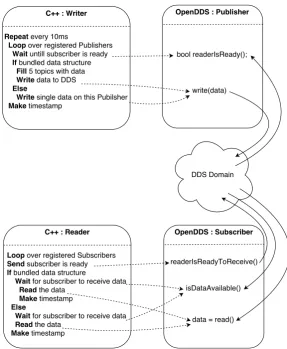
A functional overview of this test is given in Figure 4.9. An application written in C++ calls functions of the OpenDDS interface to test the interface. The C++ writer tries to send its data every 10ms, and the C++ reader actively listens for data and continues if data is received for all the topics.
For these tests Transmission Control Protocol (TCP) transport is used with DCPS for end-point detection. The Real-Time Publish-Subscribe (RTPS) transport is not used as it does not work with multiple participants on one host (When separate structure is used), and it fails to join multicast addresses from time to time. Time stamping is performed after each write to OpenDDS and after receiving data from OpenDDS. The difference between two timestamps at the C++ writer and two timestamps at the C++ reader are used to show the execution time of each iteration.
The publish-subscribe communication results for the bundled and separate data structure are shown in Figure 4.10. It is observed that the execution time of publishing messages using the separate data structure results in more jitter around the sending frequency of 100Hz (10ms), and is caused by writing five times more often to OpenDDS than when using a bundled data structure.
Figure 4.9: An overview of how the OpenDDS interface is used by a C++ program and presented as pseudo code in this figure. The dashed arrows indicate usage of the member function in another class and the solid arrows indicates the flow of data. "Wait until subscriber is ready" at the C++ Writer and "Send subscriber ready" are omitted for the publish-subscribe communication.
polling the other listeners in the meantime. This waiting for data expresses itself in bands sep-arated by 4ms, which is equal to 250Hz and is the polling frequency for checking if data is avail-able. The extra band 4ms above the 10ms line for the bundled data structure is due to the non availability of the data in the first iteration of the C++ reader and therefore the data is received the next iteration 4ms later.
For rendezvous communication similar behavior is obtained, but the C++ reader and the C++ writer are not decoupled anymore due to the state exchange, so the behavior is also translated to the publishing side and is shown in Figure 4.11.
The bundled data structure is able to maintain a 100Hz sending rate, but for the separate data structure this is not feasible due to long waiting times at the C++ reader for data for every listener. Note again the 4ms separation due to actively listening for the readiness of the reader and the availability of data.
These tests shows that the OpenDDS interface is functioning for rendezvous and publish-subscribe communication. The performance however is not directly translatable to the per-formance in theNetwork Channelimplementation in LUNA that uses this interface.
These tests are blocking when no data is available. The implementation in theNetwork Channel
1100 1120 1140 1160 1180 1200 Samples 2 4 6 8 10 12 14 16 18 20 time (ms)
Publisher TCP 100Hz PUBSUB
Seperate Bundled
(a)The time between timestamps at the publisher side for the publish-subscribe pattern.
1100 1120 1140 1160 1180 1200 Samples 0 10 20 30 40 50 60 70 80 time (ms)
Subscriber TCP 100Hz PUBSUB
Seperate Bundled
(b)The time between timestamps at the subscriber side for the publish-subscribe pattern.
Figure 4.10:A comparison between a separate and bundled data structure for publish-subscribe com-munication
1100 1120 1140 1160 1180 1200 Samples 5 10 15 20 25 30 35 time (ms)
Publisher TCP 100Hz RENDEZ
Seperate Bundled
(a)The time between timestamps at the publisher side for rendezvous communication.
1100 1120 1140 1160 1180 1200 Samples 5 10 15 20 25 30 35 time (ms)
Subscriber TCP 100Hz RENDEZ
Seperate Bundled
(b)The time between timestamps at the subscriber side for rendezvous communication.
Figure 4.11:A comparison between a separate and bundled data structure for rendezvous communica-tion
Therefore the implementation in LUNA will not have such a sequential behavior, and therefore a better performance is expected when this OpenDDS interface is implemented for theNetwork Channel.
4.3 TERRA
4.3.1 Design
Bezemer (2014) wanted to get rid of sandboxed modelling software, and therefore hardware ports got implemented, such that the modelling software was able to communicate with the physical world. As a proof-of-principle the Mesa Anything I/O FPGA board was used to show the implementation of the proposed hardware ports in LUNA. The design that is used to add a hardware port to LUNA and TERRA proposed by Bezemer (2014) is shown in Figure 4.12.
The architecture of the TERRA plugin is rather complex and therefore it is chosen to append theNetwork Channelto this proof of principle implementation.
Figure 4.12:The design used for adding Hardware Ports to LUNA and TERRA(Bezemer, 2014).
The TERRA project contains a lot of plugins for its hardware ports, but the plugins relevant for appending a DDS port to the existing Mesa Anything I/O FPGA board hardware port imple-mentation are:
• nl.utwente.ce.terra.arch.hw.anyio.model
• nl.utwente.ce.terra.arch.hw.anyio.editor
• nl.utwente.ce.terra.arch.hw.anyio.codegen
Inhw.anyio.modela new configuration is added in where the parameters are provided that the
Network Channelneeds for instantiating aNetwork Channel. These parameters are shown in the "Properties" pane in TERRA once a DDS port is placed on the drawing pane of TERRA.
Inhw.anyio.editora validator is added that checks if the type that is connected to the channel is supported by theNetwork Channel. All types are set to be valid, such that it is possible to test different data types without changing the TERRA hardware port. The user has to take care of connecting the correct type of channel to the port. Also theplugin.xmlfile is changed such that the DDS port shows up in the TERRA application.
Inhw.anyio.codegenthe actual code generation is performed. The constructor of theNetwork Channelmust be placed in a C++ file such that the constructor of theNetwork Channelcan instantiate the writer or reader. Also the header file must be added to the top of the generated code.
4.3.2 Realization
Inhw.anyio.modelan extra model is added tohwanyio.ecoreby copying and renaming another model. The extra model is shown in Figure 4.13 and is calledAnyioDDSConfiguration.
Next a validator is added inhw.anyio.editorthat checks if the type connected to the channel is supported. The validator for the DDS port is shown in Figure 4.14.
Theplugin.xmlfile is appended with a hardware port configuration for the DDS hardware port, which is shown in Figure 4.15.
Figure 4.13:An extra model is added to thehwanyio.ecorefile, and is renamed to AnyioDDSConfigura-tion
Figure 4.14:The validator for the DDS port is added inhw.anyio.editorto make sure the correct type is connected to the DDS port. All types are currently supported for the TERRA DDS port.
Figure 4.15:Theplugin.xmlis appended with a hardware port configuration for theNetwork Channel.
Figure 4.16:Theconstruction.eglfile that gives a template for placing the constructor of theNetwork Channelin the generated code.
Then a Java class is copied from thesrc directory in thehw.anyio.codegenplugin and altered to implement a code generation for theNetwork Channel. This part adds the constructor and header file for theNetwork Channelactual to a C++ file and is shown in Figure 4.17.
Lastly theplugin.xmlin thehw.anyio.codegenfolder is altered such that the code generation is actually able to generate theNetwork Channelconstructor and header. Theplugin.xmlfile is shown in Figure 4.18
Figure 4.17:TheAnyioDDSCodeGeneratorthat actually places the constructor and header in a C++ file. ThegetConstructionCodecalls the file that is shown in Figure 4.16.
Figure 4.18:The addition of the DDS code generation to theplugin.xmlto enable code generation for theNetwork Channel.
4.3.3 Tests
A TERRA application with one DDS port at architecture level is constructed to show the correct functioning of the added DDS port.
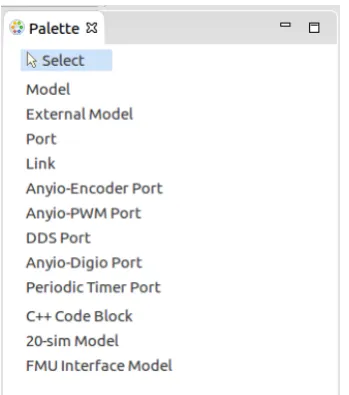
[image:36.595.199.374.416.614.2]When initializing a new architecture model thePaletteshows up at the right side in TERRA. The DDS Port is located between the other hardware ports and is shown in Figure 4.19.
Figure 4.19:The DDS port as it shows up in thePaletteof TERRA.
After placing a DDS port on the drawing frame in TERRA a properties pane shows up at the right bottom corner that enables the user to set some parameters as is shown in Figure 4.20. The settings entered in this properties pane are passed to the constructor that initializes the
Network Channel. The buffersize,commonTopic(DDS topic), path to configuration file, own-Topic(subtopic),acQoS, and rendezvous are configurable parameters.
After code generation the constructor of the class that initializes the Network Channel
Figure 4.20:The properties pane in TERRA that shows the settings that are passed to the constructor that initializes theNetwork Channel.
(a)The arguments that were set in the TERRA properties pane show up as arguments in the constructor of theNetwork Channel(DDSChannel).
(b)The code generation succesfully placed the header file (DDSChannel.h) of the network channel among the other dependencies.
Figure 4.21:Screenshots of the generated C++ code that call the constructor that initializes theNetwork Channeland places the necessary header files on top.
The user of TERRA is now able to use DDS ports as hardware port in TERRA. The next section describes the implementation of theNetwork Channelin LUNA such that placing a DDS port in TERRA actually delivers functionality to this hardware port.
4.4 LUNA implementation
4.4.1 Design
LUNA is component based, so by adding another component specifically for the DDSNetwork Channelit must be possible to use thisNetwork Channelwith LUNA. The file structure used by LUNA is shown in Figure 4.22.
LUNA
components
component name Makefile files
All header and CPP files
that holds the files for the Network Channel. The component folder name is chosen to be dds-channelsto follow the convention of other components.
Themakefile is responsible for linking all the project files, such that LUNA knows where to find the necessary files. Themakefile is also used by the build menu ofLUNAto show the component as an option to build.
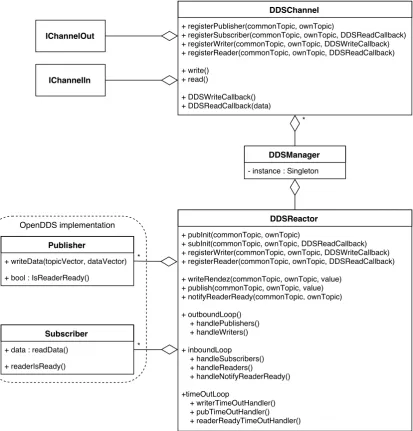
A new software architecture based on ROS channels by van der Werff (2016) is designed for this
[image:38.595.84.498.245.677.2]Network Channeland is shown in Figure 4.23. The difference with the software architecture of the ROS channels is that this implementation has an extra class (DDSManager) that is instanti-ated as aSingleton, which means that only one object of that class can exist. This extra class is used as a pass through class for all the objects ofDDSChannelto theDDSReactor.
4.4.1.1 DDSChannel
On the top of Figure 4.23 theDDSChannelclass is shown. TheDDSChannelis where the com-ponent interfaces with the rest of the LUNA application via theIChannelInandIChannelOut
interfaces, which are provided by the CSP component in LUNA.
Every DDS port at TERRA level results in an object of the DDSChannel class. Invoking a new publisher or subscriber, blocking of readers and writers, and the type of communication (publish-subscribe or rendezvous) are managed by this class. TheDDSChannelprovides the in-terface to the rest of the LUNA application and therefore blocking of writers and readers must be implemented at this class.
Writers unblock if data is written to the OpenDDS publisher (only for rendezvous), and readers unblock once data is received by the OpenDDS subscriber. Thewrite function provided by
IChannelIninterface invokes a write to OpenDDS. If the writer is configured for rendezvous communication the writer will block until the data is written to a OpenDDS publisher.
At the reader areadfunction is provided by theIChannelOutinterface that blocks until data is available. Blocking is implemented for publish-subscribe communication as well as for rendez-vous communication. The reader with publish-subscribe communication does not necessarily have to block, but it is chosen to block such that loop frequency of the reader is dependent on the send frequency of the writer. With this dependency it is easier analyse the characteristics of theNetwork Channel, and a timer at the subscriber is not necessary.
Once a reader or writer is blocked there must be a way to unblock the reader or writer. Active polling for data can be implemented in theDDSChannel, but this results in an extra latency introduced by the polling frequency and also the CPU usage will increase as every reader is polling for data. Therefore callback functions are implemented that are given as an argument to theDDSReactorat registering of a blocking writer or reader. A function can be passed as argument by using thestd::functionprovided byC++11. The callback function for the writer only has to unblock the writer where the callback function of the reader also has to place the received value in the buffer at DDSChannel.
Also a buffer is implemented in the DDSChannel that can store data presented by the
DDSReactor. Whenever the buffer is full, old data will be overwritten.
4.4.1.2 DDSManager
The DDSManager class is implemented as a singleton and instantiates an object of the DDSReactor. A class implemented as aSingletoncan only instantiate one object of the class and therefore allDDSChannelsobjects have access to the sameDDSManager which makes it practical to use as a pass through class.
4.4.1.3 DDSReactor
TheDDSReactorin Figure 4.23 takes care of actually publishing and subscribing to OpenDDS. One single thread could handle all the publishing and subscribing, but problems were ob-served, and therefore multiple threads are implemented which gave less deviation and there-fore the multiple thread implementation is used from now on.
The threads that are implemented are: one for writing to OpenDDS, one for reading from OpenDDS and the third one for handling the time-out functionality.
The time-out thread makes sure a message is send to a certain topic if the last publish to that topic was longer ago than a pre-defined time. With a good functioningNetwork Channelno time-outs occur, but if a packet is lost with rendezvous communication a deadlock can occur. This deadlock can be resolved by re-sending to the topic that caused the time-out.
For the communication over theNetwork Channel two types of communication should be available:
• Publish and Subscribe: This is the most basic communication pattern and also imple-mented by most other communication protocols. The publisher publishes data without knowing the subscriber was ready. The subscriber simply receives the data without noti-fying its readiness.
• Rendezvous: CSP is used in LUNA and therefore rendezvous communication is used in the LUNA application. Therefore theNetwork Channelshould support rendezvous com-munication as well to maintain the synchrony between two systems following CSP the-ory. The publisher for rendezvous communication waits until the subscriber is ready to receive before sending the data.
For the publish-subscribe communication the writer atDDSChannelis not blocking and the reader atDDSChannelblocks until the registered callback function with data is called from theDDSReactor. A timing sequence that shows how messages are exchanged for the publish-subscribe communication is shown in Figure 4.24.
Figure 4.24:A timing sequence that shows how publish-subscribe communication is performed. The writer does not block and the reader unblocks as soon as the callback function is called from the DDSReactor.
For rendezvous communication the writer onDDSChannelis blocking until the data is send on the DDS publisher at theDDSReactor. The reader onDDSChannelis blocked until the call-back function with the received data is called from theDDSReactor. The reader atDDSChannel
states its readiness to the DDS subscriber at theDDSReactor. Once the readiness of the reader is received at the DDS publisher theDDSReactoris allowed to send the data to the DDS sub-scriber. The behavior of the writer and reader is shown using a timing sequence in Figure 4.25.
4.4.1.5 Publishing data
Multiple instances of theDDSChannelcall the same member function in theDDSReactorto ini-tiate a publish onto a DDS topic. TheDDSChannelobjects are running concurrent and there-fore a queue must be implemented that guarantees thread safety.
To make it a thread safe operation one could use the mutex wrapperlock_guardsupported by
C++11. If a thread enters this function than other threads wait with entering this function until the lock is ended. The same functionality but different implementation is also provided by thelockfreeimplementation by the Boost library (Blechmann, 2011), and by the First In First Out (FIFO) queues of MoodyCamel (Moodycamel, 2014).
MoodyCamel compared its implementation with thelock_guardandlockfreefrom the Boost library. Also Qihoo360 (2017) tested these three implementations. Both tests conclude that MoodyCamel has the fastest writing and reading speeds when a queue is accessed by multiple threads. Therefore the FIFO queue implementation of MoodyCamel is used for the implement-ation of the queues.
Both communication types uses queues for sending messages. Every message that has to be published contains three arguments:
• commonTopic: The DDS topic that the data should be published to. This topic must be registered by a OpenDDS publisher.
• ownTopic: This is the subtopic on acommonTopic. MultipleownTopicscan reside in one
commonTopicas this is supported by the data structure provided by OpenDDS.
• Data value: The value that the writer wants to send to the reader.
MultipleownTopicscan reside in onecommonTopic. The functionality of bundling of ownTop-icsinto a bundle is shown in Figure 4.26.
Figure 4.26:The functionality of publishing a message using queues. Messages are placed on the queue from multiple instances of theDDSChannel. The first items placed in a queue will be dequeued first as well (FIFO). Note that the messages are bundled by thecommonTopicsbefore writing to the correspond-ing OpenDDS publisher. TheDDSManageris left out as as it only passes the messages.
TheoutboundLoopin theDDSReactoris responsible for dequeueing the messages from the queue.
Every iteration of theoutboundLoopall the messages on the queue will be dequeued by the
handlePublishers function for publish-subscribe communication and by the handleWriters
lisher. However, a problem arises if not all the messages were presented yet to the queue and therefore the amount of messages for a certain DDS topic is not equal to the amount of re-gistered writers. For rendezvous messaging this will results in a deadlock as not all readers are unblocked in one iteration, which means that the reading side does not state its readiness again and the writing side send no data as it waits for the readiness of the reader. Therefore for ren-dezvous messaging a wait function must be implemented that waits for all registered writers to have presented their data to the queue. The wait function is illustrated for four writers and readers writing to the samecommonTopicand is shown in Figure 4.27.
Figure 4.27:An illustration of the wait functionality for onecommonTopicand four registered writers. In the first iteration not all four writers have presented their data to the queue and in the second iteration the bundle is complete as all messages from all the writers are available.
4.4.1.6 Subscribing to data
Where the outboundLoop is responsible for sending messages the inboundLoop at the
DDSReactor is responsible for receiving the messages and placing the data on the callback function that corresponds to the receivedownTopic. The data is processed once it is available and therefore no queue is needed for receiving data.
However, one queue is implemented that handles thereader is readymessages for rendezvous communication. The reader atDDSChannelinvokes the call to notify the corresponding writer by callingnotifyReaderReadyfunction in theDDSReactor, which enqueues thecommonTopic
and is matched to a registered OpenDDS publisher topic at dequeueing. Once matched, a read-erIsReadymessage on that topic is published. After this message the reader will block until data is received via the callback function.
For publish-subscribe communication the reader at theDDSChannelwill block without noti-fying its readiness.
4.4.1.7 Time out
ThetimeOutHandlerLooptakes care of sending a message to a certain topic if the last publish to that topic was longer ago than a pre-defined value. This time-out occurs when a deadlock is ob-tained by for example missing packages. If a deadlock occurs it is resolved by the timeOutHand-lerLoop. If rendezvous communication is used the synchrony is lost for a moment, but it is more important to have data than to be in a deadlock forever. ThetimeOutHandlerLoopcalls in every iteration three functions, namely:
• writerTimeOutHandler(): This function checks if the last publish to a topic for rendez-vous communication was not longer ago than a pre-configured time-out time.
• readerReadyTimeOutHandler(): This function checks if the lastreader readynotification to a topic was not longer ago than a pre-configured time-out time.
4.4.2 Realization
The essence of the realization is discussed in this section. More details on the implementation are given with pseudo code and flow charts in Appendix A.
4.4.2.1 Component integration in LUNA
Following the generic file structure of a component a new folder is added with the name dds-channelsto follow the naming convention of other components. Inside this folder amakefileis present that specifies which files are needed for thedds-channelcomponent. OpenDDS is used and therefore LUNA needs the location of the OpenDDS binaries and headers. Thesetenv.sh
script that is provided by OpenDDS sets the environment variables. Inrules.mk(located in top directory of LUNA), it is checked if the environment variables are set.
The result is that theNetwork Channelcan be build with LUNA, because it is presented as a build option in the LUNA build configuration.
4.4.2.2 LUNA implementation
The software architecture for theNetwork Channelas is shown in Figure 4.23 consists of three classes, and depending on the setup also aPublisherorSubscriberobject is instantiated.
The most important functionality of the Network Channel is implemented in the looping threads. Three threads are used in theDDSReactor:
• inboundLoop: This loop handles all incoming messages and is started when the first sub-scriber is instantiated.
• outboundLoop: This loop handles all outgoing messages and is started when the first publisher is instantiated.
• timeOutHandlerLoop: This loop is started as soon as the first publisher or subscriber is instantiated. This loop sends a message to a DDS topic if the last write to that topic was longer ago than a pre-defined time.
Those three threads implement the core functionality of theNetwork Channeland call the im-plemented functions that enables theNetwork Channelto perform publish-subscribe and ren-dezvous communication.
TheoutboundLoopdequeues the messages from a Moodycamel (2014) queue. The messages on a queue contain acommonTopic,ownTopic, and a data value. TheoutboundLoop imple-ments the following functions:
• handlePublishers(): This function implements the dequeueing of the publish-subscribe queue, which is filled by the implementedpublishfunction in theDDSReactor. All mes-sages are written to the corresponding DDS topic (ownTopic) by this function.
• handleWriters(): This function implements the dequeueing of the rendezvous queue, which is filled by the implementedwriteRendezfunction in theDDSReactor. All messages are written to the corresponding DDS topic (ownTopic) if the corresponding is ready to read. Also the waiting functionality is implemented in thewriteRendezfunction.
dequeueing.
Algorithm 2Pseudo code of the functionhandleWritersthat dequeues the messages on the queue with waiting enabled. The writer is written to OpenDDS if thedataVectorsize is equal to the amount of registered writers.
1: forevery entry of publisher in publisherVectordo
2: ifaccompanying subscriber is readythen
3: whilequeue with messages is not emptydo
4: Dequeue a message
5: ifmessage commonTopic is equal to the publisher topicthen
6: append ownTopic to topicVector
7: append value to dataVector
8: forevery entry in the callbackVectordo
9: ifcallback topic is equal to the ownTopic of the messagethen
10: Add callback to callback vector.
11: else
12: add message to reenqueueVector.
13: ifdataVector size is equal to number of registered writersthen
14: write data to write function of publisher
15: Handle all callback functions in callbackVector.
16: clear topicVector, dataVector and callbackVector.
17: ifre-enqueue vector is not emptythen
18: re-enqueue this vector in the message queue.
As also mentioned in the design section, callback functions are presented to theDDSReactor
to unblock a writer or reader. TheinboundLoopreceives the messages and implements the following functions:
• handleSubscribers(): This function receives the message for the publish-subscribe com-munication. With the callback of the reader that is provided at the registration the reader can be unblocked.
• handleReaders():This function receives the message for the rendezvous communication. With the callback of the reader that is provided at the registration the reader can be un-blocked.
• handleReaderReadyNotification(): This function dequeues the queue withreader is ready
messages. This queue is filled by thenotifyReaderReadyfunction implemented in the
DDSReactor. All messages are written to the corresponding DDS topic by this function.
ThetimeOutHandlerLoopmakes sure the last publish was not longer ago than a pre-defined time (currently hard coded on 10s), and calls the following functions:
• pubTimeOutHandler(): This function re-publishes a value if the previous publish to a publish-subscribe topic was longer ago than a pre-defined time.
• writerTimeOutHandler(): This function re-publishes a value if the previous publish to a rendezvous topic was longer ago than a pre-defined time.
The three threads and the functions in those threads implement most of the functionality of theNetwork Channel. The implementation of the connection between theDDSChanneland theDDSReactoris not discussed in this section, and also the implementation of the functions is not detailed in this section.
Stating the implementation of theNetwork Channel in words would merely result in a repe-tition of the design section, and showing the actual implementation would result in a long realization section due to all flow charts and pseudo code listings. Therefore it is chosen to present the realization in Appendix A. This appendix contains a detailed implementation by using pseudo code and flow charts to show the realization of the member functions and the relation ofDDSChannel,DDSManagerandDDSReactor.
4.4.3 Tests
A summary of the performed tests is discussed in this section. A more extensive analysis of the results from the tests is discussed in Appendix B.
Four tests are conducted to investigate the performance of thisNetwork Channel implementa-tion:
• Transport
• Bundled data validation
• Latency analysis
• Stress test
All tests use the setup that is shown in Figure 4.28, with exception of the load test in the Stress test. The setup consists of a DCPS server that provides the endpoint discovery for the OpenDDS instantiations and two RaMstixes of which one is the publisher and one is the subscriber.
[image:45.595.219.389.482.595.2]The testing setup consists of 10 parallel writers for the publisher and 10 parallel readers for the subscriber at TERRA level.
Figure 4.28: The setup used for all the tests. The "Master" hosts the DCPS server, which is used for endpoint discovery. One of the RaMstixes executes the publisher code and the other the subscriber code.
4.4.3.1 Transports
The first test contains of a transport test that investigates the differences between UDP and TCP transport. UDP delivers no guarantees in terms of reliability, where TCP offers reliable transport of data (Kurose and Ross, 2012).